


 Скачать презентацию Grant Writing for Success Ronald Margolis Ph D
78ddbec43219d53e191cae2abb027197.ppt
- Количество слайдов: 109
 Grant Writing for Success Ronald Margolis, Ph. D. National Institute of Diabetes, Digestive and Kidney Diseases Amanda Boyce, Ph. D. National Institute of Arthritis and Musculoskeletal and Skin Diseases Alan Willard, Ph. D. National Institute of Neurological Diseases and Stroke 2011 NIH Regional Seminars, Phoenix
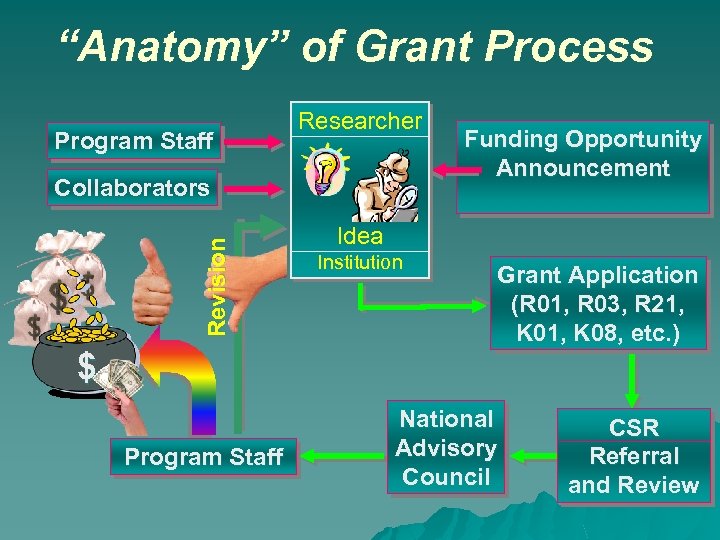 “Anatomy” of Grant Process Program Staff Researcher Revision Collaborators Funding Opportunity Announcement Idea Institution Grant Application (R 01, R 03, R 21, K 08, etc. ) $ Program Staff National Advisory Council CSR Referral and Review
 Grant Writing for Success Writing the Application: Start early Seek advice from colleagues Start with a good idea Talk to your NIH Program Official(s) Use the NIH webpage (www. nih. gov) Remember review criteria Follow instructions carefully
 What Determines Which Grants Are Funded? Scientific merit Program considerations Availability of funds
 Components of a Successful Grant Application Strong Idea Strong Science Strong Application
 Principles of Success Understand the peer review process Understand the agency mission – Every IC is different! Secure collaborators (mentors) to complement your expertise and experience – Don’t compete … collaborate! Learn and practice the skills of writing applications for grant funds
 Understanding the Mission of each NIH IC is based and defined in law – Authorizations (create/continue an agency – periodic) – Appropriations ($ for the agency – annual) ICs establish specific research emphases – Legislative mission – Current state of science Use the Web to find out!
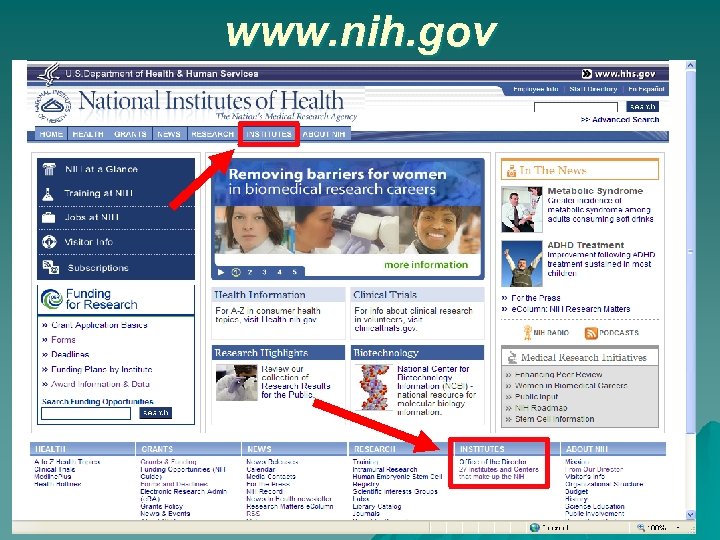 www. nih. gov
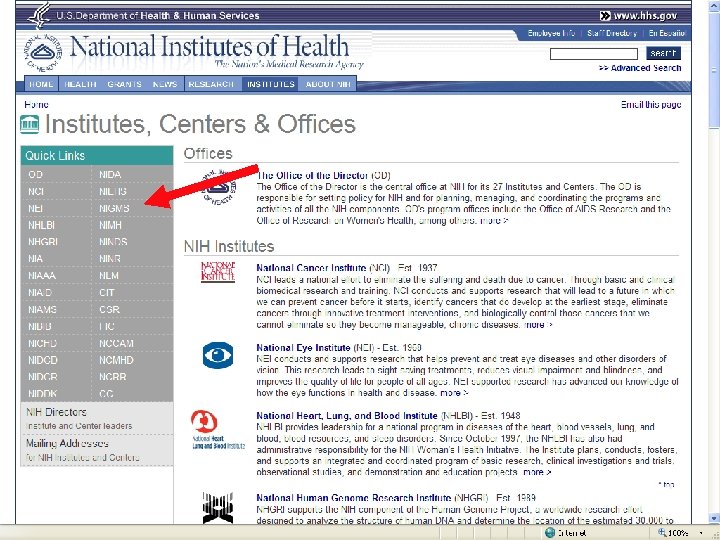
 Identifying NIH Initiatives Most NIH Institutes establish specific research Initiatives and Priorities Funding Opportunity Announcements (FOAs) – Must respond to a FOA via Grants. gov
 NIH Guide for Grants and Contracts Official publication listing NIH funding opportunities and policy notices – Request for Applications (RFA) – Program Announcements (PA, PAR, PAS) – Request for Proposals (RFP) – Notices (NOT) Published weekly
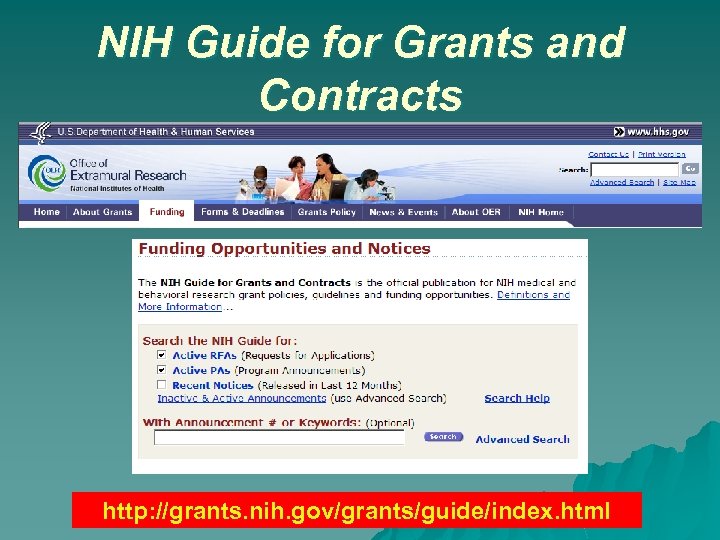 NIH Guide for Grants and Contracts http: //grants. nih. gov/grants/guide/index. html
 Identify NIH Funded Grants See what Research Projects the NIH or any Institute has funded Find Potential Collaborators for your Project
 Research Portfolio Online Reporting Tool (Re. PORT) http: //report. nih. gov/index. aspx A searchable database of federally supported biomedical research Access reports, data, analyses, expenditures, results of NIH supported research activities Identify, analyze IC research portfolios, funding patterns, funded investigators: • • • Identify areas with many or few funded projects Identify NIH-funded investigators and their research Identify potential mentors/collaborators
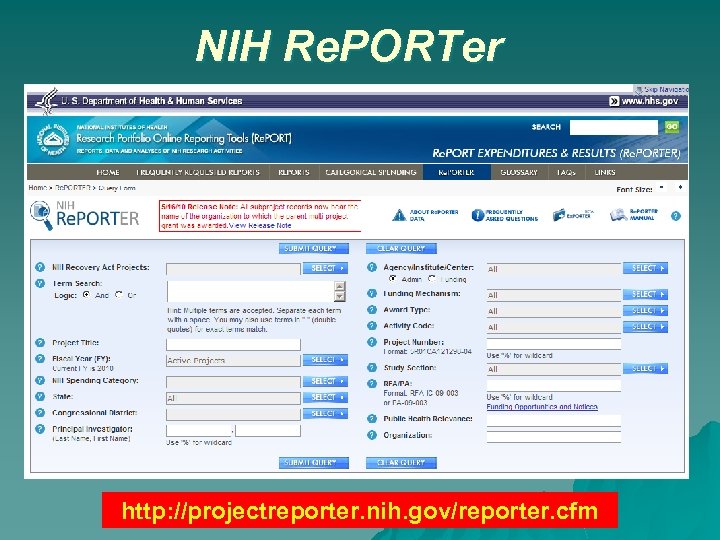 NIH Re. PORTer http: //projectreporter. nih. gov/reporter. cfm
 Application Development Strategy Act (Plan) Think Write
 So WHY Plan? You’re more likely to get … A compelling scientific question Appropriate NIH Institute Appropriate review committee Adequate time to complete – A major stress reducer! …a better grant application
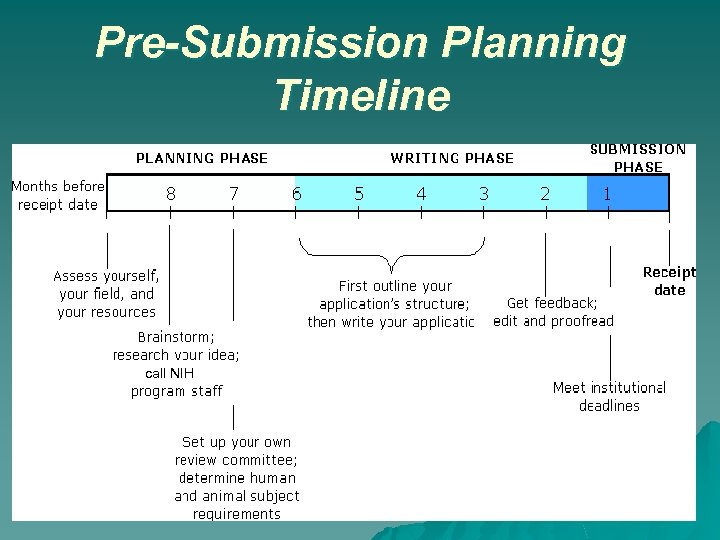 Pre-Submission Planning Timeline call NIH
 Remember … Before you start Talk to Program Staff at appropriate IC Read instructions for application form – SF 424 R & R Know your audience – Which Integrated Review Group (IRG) is most likely to get your application? Propose research about which you are passionate and totally committed to doing
 Good Idea Does it address an important problem? Will scientific knowledge be advanced? Does it build upon or expand current knowledge? Is it feasible … – to implement? – to investigate?
 Good Grantsmanship Grant writing is a learned skill – Writing grant applications, standard operating protocols and manuals of procedures that get approved are learned skills – Writing manuscripts that get published in peer reviewed journals is a learned skill Grantsmanship is a full time job – Learn about the grant application process
 Good Grantsmanship Searching NIH web sites is a good start … but follow up with personal contact Contact NIH program staff early Ask what information would help them advise you about IC interest & “goodness of fit” Are there related FOAs?
 Good Grantsmanship Collaborate with other investigators – Fill gaps in your expertise and training – Add critical skills to your team “Team Science” can be powerful
 Multiple Principal Investigators Single PI model does not always work well for multi-disciplinary, collaborative research Recognizes contributions of full team In place for most submissions to Grants. gov Implications for “New Investigator” status A complex issue – Talk to NIH program staff if you are considering multiple PIs ! grants 1. nih. gov/grants/multi_pi
 Good Grantsmanship Show your draft application to a colleague who does not already know what you intend to do Show your draft application to a colleague who is not your best friend
 Good Grantsmanship Your draft reviewers need to understand – What you intend to do – Why you believe it is important to do – Exactly how you are going to do it If they don’t get it, you must revise your application Leave enough time to make revisions
 Good Presentation 3 Simple Steps: Read the application instructions carefully Don’t forget …. . . read the application instructions carefully
 Good Grantsmanship Good ideas, clearly presented Align your application with the new review guidelines to maximize impact: – Significance – Investigator – Innovation – Approach – Environment
 Developing a Strong Research Plan Specific Aims Grab the reader immediately State long-term objectives AND expected impact Explicitly state hypotheses and research question
 Developing a Strong Research Plan Preliminary Studies/Progress Report How previous work -- by you, your team, and others -- leads to this study Demonstrate your experience, competence and likelihood of continued success Must flow logically from literature review and major themes of the problem area
 Developing a Strong Research Plan Approach Does your plan flow logically from the literature review and prior studies? How will each hypothesis be evaluated? Do your measures capture the variables needed to test hypotheses? Why did you choose those measures? Methods and analyses must match
 Developing a Strong Research Plan Approach For clinical studies be explicit and thorough in discussing – intervention or system to be studied – target population – inclusion and exclusion criteria – independent and dependent variables – all measures and instruments – power analyses
 Developing a Strong Research Plan Some Common Miscues: Failure to … Document why the problem is important Distinguish empirical findings from speculation Critically analyze key themes in literature Consider alternative perspectives Read, understand, and cite the crucial studies
 Align with Review Criteria 1) Overall Impact (Address on Specific Aims page) 2) The 5 core review criteria: – Significance – Investigator – Innovation – Approach – Environment http: //grants. nih. gov/grants/guide/n otice-files/NOT-OD-09 -025. html
 Good Presentation OVERALL IMPACT The likelihood for the project to exert a sustained, powerful influence on the research field(s) involved: – in consideration of the following five core review criteria, and – additional review criteria (as applicable for the project proposed)
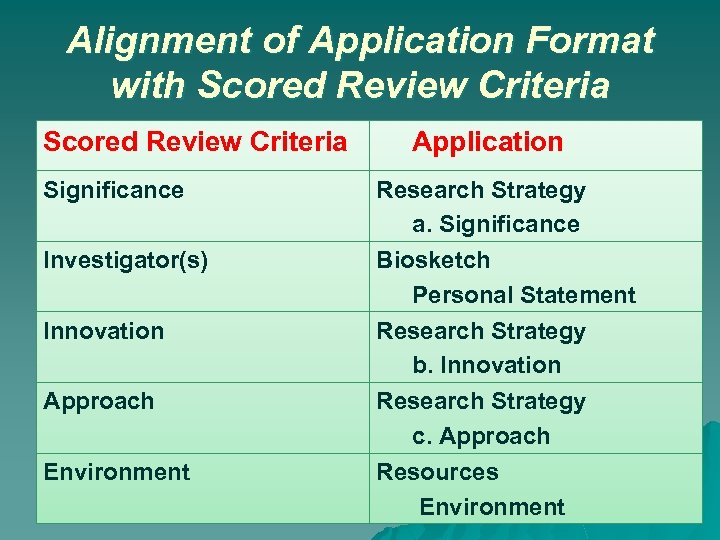 Alignment of Application Format with Scored Review Criteria Significance Investigator(s) Innovation Approach Environment Application Research Strategy a. Significance Biosketch Personal Statement Research Strategy b. Innovation Research Strategy c. Approach Resources Environment
 Good Presentation SIGNIFICANCE Does this study address an important problem? If the aims are achieved, how will scientific knowledge be advanced? What will be the effect on concepts or methods that drive this field?
 Good Presentation INVESTIGATOR Are the investigators appropriately trained and well suited to carry out this work? Is the work proposed appropriate to the experience level of the principal investigator and other researchers? Does the investigative team bring complementary and integrated expertise to the project (if applicable)?
 Good Presentation INNOVATION Does the project employ novel concepts, approaches or methods? Are the aims original and innovative? Does the project challenge existing paradigms or develop new methodologies or technologies?
 Good Presentation APPROACH Are the conceptual framework, design, methods, and analyses adequately developed, well-integrated, and appropriate to the aims of the project? Does the applicant acknowledge potential problem areas and consider alternatives?
 Good Presentation ENVIRONMENT Does the scientific environment in which the work will be done contribute to the probability of success? Do the proposed experiments take advantage of unique features of the scientific environment or employ useful collaborative arrangements? Is there evidence of institutional support?
 Good Presentation Be realistic … not overly ambitious Discuss potential problem areas Discuss possible solutions – Explain rationale for your decisions Be explicit Reviewers cannot read your mind … Don’t assume they know what you intend
 Other Review Considerations Human subjects Animal care and use Select agents Model organism sharing plan Data sharing plan
 Good Review Get to the right review group Title, abstract, specific aims all point to the main goals of your project Attach a cover letter for the Center for Scientific Review Division of Receipt and Referral – suggest IC and review group assignment* – outline areas of key expertise needed for appropriate review – do not name specific reviewers * Consult with Program Official
 Good Review Understand the dynamics of peer review: Reviewers will review many applications Make your application easy to read and easy to understand The impact and significance should be clear throughout the application Convince them to be your advocate – Get them on your side!
 Common Reasons Cited for a Weak Application Lack of or weak impact Significance not obvious or weak — — — Too ambitious, lacking focus Unclear or flawed hypothesis Feasibility unsupported Poor writing Applicant track record weak or lacking appropriate expertise Approach flawed
 Hallmarks of an Outstanding Grant Application Strong significance to an important problem in public health: IMPACT is high — High degree of novelty and innovation Strong track record by a well qualified applicant Clear rationale Relevant and supportive preliminary data Clear and focused approach that provides unambiguous results Careful attention to details — Fonts, clarity of data, error bars, spelling, etc
 How to assure that your grant gets funded? Good ideas, well presented always win Think clearly Write clearly Be complete but not verbose Never lose sight of the significance Point to the impact Pay attention to details
 Where Do I Get More Information? NIH homepage: http: //www. nih. gov/ NIDDK (or any Institute): http: //www. niddk. nih. gov/ CSR website: http: //www. csr. nih. gov/

 Additional supporting material
 Top 10 Common Reviewer Concerns …. . or How Not To Get DINGED!
 # 1 Concern There is not a CLEAR HYPOTHESIS, or WELL DEFINED GOALS Provide a focused hypothesis, objectives Describe the importance and relevance of your problem Be clear on how your project will move the field forward
 Grant 1 Hypothesis: The proposed research seeks to examine the relationship between neurotransmitter A and neurotransmitter B signaling in Brain Region of Interest and in vivo electrophysiological measures of Brain ROI output during the transition from chronic morphine exposure to morphine withdrawal… additionally seeks to determine whether putative Brain ROI projection neurons exhibit altered basal and behaviorally-correlated firing profiles during these states… finally seeks to determine whether the observed behavioral, neurochemical, and neurophysiological indices associated with morphine dependence and withdrawal are dependent on Neurotransmitter A projections to the Brain ROI.
 Grant 1 SA #1: Examine alterations in Brain ROI neurotransmitter A and neurotransmitter B efflux in response to acute morphine challenge and withdrawal in morphine-dependent rats SA #2: Examine alterations in Brain ROI single-unit neuronal activity in response to acute morphine challenge… SA #3: Determine the sensitivity of withdrawal- associated neurotransmitter A efflux, single unit neuronal activity, and withdrawal-associated behaviors to lesions of the neurotransmitter A afferent inputs
 Grant 1 Reviewer Comments: 1. This application appears to lack a hypothesis driven from a specific mechanism. 2. Enthusiasm … dampened by the lack of a specific mechanism 3. …. . the proposal begins to look more like a collection of experiments where the applicants are simply listing experiments according to their expertise in specific techniques 4. …. overambitious nature of the project
 # 2 Concern The specific aims do NOT TEST the Hypothesis, or the specific aims DEPEND on results from previous aims The best proposals are those with independent specific aims that address your hypothesis using different approaches
 Grant 2 Hypothesis: The increase in brain receptor subunits after chronic morphine is an adaptation to reduced tonic neurotransmitter release in the brain region of interest and elevates the threshold for opioid analgesia. Objective: Study is to design opioid-based pain relief paradigms with extended analgesic efficacy and reduced risk of abuse. Purpose: To determine whether these brain receptors are good targets for “antitolerance” drugs
 Grant 2 SA #1: Determine the anatomical location(s) of chronic morphine-induced changes in brain receptor subunit levels SA #2: Examine the role of brain receptor subunits in opioid-induced behaviors other than analgesia R 01 Requested $225, 000 direct costs / 5 years
 Grant 2 Reviewer Comments: 1. Unfortunately, several of the experiments proposed do not directly test the hypothesis and may or may not aid in our further understanding of opioid tolerance. 2. . . it is not clear whether such changes would correlate with anti-nociceptive function 3. . . there is a lack of preliminary data determining whether such studies can be accomplished and whether any significant changes can be measured 4. . . the literature reports 15 to 20 different mechanisms demonstrating the inhibition of opioid anti-nociceptive tolerance, yet none of these are addressed 5. . . studies proposed in aim 2 lack rationale
 # 3 Concern The proposal is NOT MECHANISTIC, or NOT SCIENTIFICALLY RELEVANT Do not propose correlative studies, propose strong associations Do not propose general observations, propose specific manipulations
 Grant 3 Hypothesis: Sustained electrical activity enhances neuronal process X activity, targeting select proteins essential for synaptic vesicle neurotransmitter release and downregulating presynaptic output in neurotransmitter A neurons Objective: To define the cellular pathways initiated during periods of increased electrical activity to induce subsequent decreases in synaptic output Propose: Signal Transduction pathway 1 acts ultimately to phosphorylate and protect the key presynaptic targets of the process X structure
 Grant 3 SA #1: Investigate the interplay between process X function and Signal Transduction 1 signaling in persistent neuronal plasticity SA #2: Validate roles for the presynaptic proteins ABC 1 and ABC 2 in persistent neuronal plasticity R 01 Requested $225, 000 direct costs / 5 years
 Reviewer Comments: Grant 3 1. . . the investigator presents an unrealistically simplistic picture of Signal Transduction 1 signaling in neurons 2. The general experimental design relies on correlative studies of signaling systems that are highly complex, and which act at multiple levels. 3. The anticipated outcomes are discussed only superficially and assume only that the experiments will turn out to support the investigator’s hypothesis…many outcomes can be imagined 4. The paradigms still place the neurons in unnatural (nonphysiological) environments for extraordinarily long periods of time. . this model system (cultured cells) reduces the significance of the project because the relevance to more realistic neuronal networks remains unclear 5. . . experiments have been added which are outside the technical expertise of the investigator and for which preliminary data are not in hand
 Grant 4 Hypothesis: Combined Treatment A/B group will have a greater reduction in substance use and better outcomes three months after study entry, and lower HIV risk from drug or sexual behaviors Purpose: Examine the utility of a Combined Treatment A/B protocol in the [hospital] emergency department with persons at risk for drug addiction and its associated health consequences SA #1: Determine the impact of a Combined Treatment A/B protocol on substance use, HIV risk reduction, health care utilization, and health status among persons at moderate or high risk for substance abuse seeking treatment in a [hospital] emergency department
 Grant 4 Reviewer Comments: 1. The initial model of care is not different from the current practice…. thus, it is not clear that this Combined Treatment A/B protocol will have an impact of identifying new patients who need counseling. 2. . . the significance of this Combined Treatment A/B application is compromised by the failure to integrate the intervention into existing practice. 3. The recruitment process is not based on a uniform screening protocol (lack of specifics on subject recruitment, interview process, support personnel, follow-up strategy).
 # 4 Concern This application is not APPROPRIATE for the GRANT MECHANISM A R 21 is NOT a R 01 A Career Development Award (K) is NOT a Research Project Grant (R)
 Grant 5 Hypothesis: Amphetamine-induced Behavior A targets Transcription Factor X to dendritic structures such as the spines of pyramidal cells or the dendrites of interneurons of the Brain ROI SA #1: Amphetamine-induced Behavior A alters Transcription Factor X immunoreactivity in pyramidal neurons and/or interneurons SA #2: Amphetamine-induced Behavior A targets Transcription Factor X to dendrites and spines that receive excitatory synapses
 Grant 5 Reviewer Comments: 1. This proposal ……is somewhat novel, although mainly in the sense that no one previously has examined this issue before in the Brain ROI. However, in essence this question reflects more of an incremental advance in our knowledge as opposed to the novel ideas targeted by the R 21 mechanism.
 # 5 Concern The proposal is OVERLY AMBITIOUS Set realistic goals for the budget and project period you propose
 # 6 Concern PRELIMINDARY DATA is lacking Include preliminary data for all aims Use preliminary data to show knowledge of methods and data analyses But DO propose more than just confirming preliminary results
 # 7 Concern I’m not sure that the Investigator can do the PROPOSED EXPERIMENTS Don’t propose what you can’t do Include Collaborators and Consultants on your project Describe the value of datasets and experimental models
 # 8 Concern The background section is MISSING KEY publications and experimental findings Thoroughly describe the literature, especially controversies, but Support your views and ideas Be sure you have found key references
 Grant 6 Objective: Study is designed to revise and evaluate Intervention Model A for homeless adolescents Purpose: Intervention Model A has been thoroughly developed and standardized for adults, but not as well for adolescents, and certainly not within existing services. This will be a stage I, early treatment development project, with the aim of refining Intervention Model A for homeless adolescents
![Grant 6 SA #1: Refine the existing Intervention Model A [for adults] program to](https://present5.com/presentation/78ddbec43219d53e191cae2abb027197/image-75.jpg "Grant 6 SA #1: Refine the existing Intervention Model A [for adults] program to") Grant 6 SA #1: Refine the existing Intervention Model A [for adults] program to develop an integrated Intervention A and Intervention B treatment program for homeless adolescents presenting symptoms of substance use disorders and self-injury/suicidality SA #2: Examine the feasibility of delivering the new Integrated Intervention program within the context of the [currently used] youth Intervention program recently developed …. for homeless adolescents SA #3: Conduct a pilot study, comparing the new Integrated Invention program to Treatment-as-Usual in a randomized two group repeated measures design, assessing clients enrolled in [the currently used] homeless adolescent Intervention program who are experiencing substance abuse disorder symptoms and suicidality/self-injurious behaviors
Grant 6 SA #1: Refine the existing Intervention Model A [for adults] program to develop an integrated Intervention A and Intervention B treatment program for homeless adolescents presenting symptoms of substance use disorders and self-injury/suicidality SA #2: Examine the feasibility of delivering the new Integrated Intervention program within the context of the [currently used] youth Intervention program recently developed …. for homeless adolescents SA #3: Conduct a pilot study, comparing the new Integrated Invention program to Treatment-as-Usual in a randomized two group repeated measures design, assessing clients enrolled in [the currently used] homeless adolescent Intervention program who are experiencing substance abuse disorder symptoms and suicidality/self-injurious behaviors
 Grant 6 Reviewer Comments: 1. 2. 3. 4. 5. . . the application does not provide a balanced, critical review of Intervention Model A with substanceabusing adults, and why this approach would, in turn, be promising with homeless youth. . there is an almost complete absence of focus on substance abuse or the integration of Intervention Model A [previously] adapted for this problem Other more serious design problems include different assessment schedules, attendance burden, and discharge rules between the two conditions. . inclusion criteria …are extremely broad…would seem to introduce enormous heterogeneity to the sample selected What is not well-specified in the application is how the team will decide if the results of the trial warrant the move to a large efficacy trial.
 # 9 Concern Experimental details, alternative approaches, or interpretation of data are INADEQUATELY DESCRIBED Don’t assume the reviewers know the methods Provide other experimental directions you might use should you encounter problems Show the reviewers that you have thought about your research plan
 # 10 Concern The Proposal is NOT RELEVANT to the MISSION of the Institute Don’t try to make your application FIT the Mission of a particular Institute
 Funded Applications
 Good Grant 1 Hypothesis: Chronic drug exposure upregulates the expression of Factor X, which triggers and sustains the exocytotic trafficking and surface expression of functional Receptor A Purpose: To investigate the molecular mechanisms for Factor X-induced Receptor A trafficking
 Good Grant 1 SA #1: Determine the signaling pathways mediating Factor X-induced Receptor A trafficking SA #2: Determine Factor X involvement in druginduced Receptor A trafficking SA #3: Determine the synaptic sites of Receptor A trafficking and Receptor A-B interactions SA #4: Determine the behavioral significance of emergent Receptor A and behavioral Receptor A-B interactions
 Good Grant 1 Reviewer Comments: 1. Strengths are numerous and include novel and innovative hypotheses, sound experimental design using multidisciplinary approaches, a highly qualified investigator and research team, and a high likelihood of meaningful findings 2. Strengths include the significance of the central hypothesis, the well-designed experimental plan, supportive preliminary data …. 3. . . the rationale for the studies are clearly delineated, appropriate controls are in place, scope of the studies is appropriate, and there is … complete discussion of possible limitations of some approaches and how findings will be interpreted
 Good Grant 2 Objective: To use … conceptual and statistical models to address challenges in the development of practical strategies for measuring the quality of community treatment programs Purpose: To extend previous approaches to casemix adjustment for performance measurement, and the feasibility of valid outcomes-based performance measurement systems for community treatment.
 Good Grant 2 SA #1: Test whether Treatment Program A demonstrates efficacy under experimental conditions relative to community-based care programs, can be translated to a set of community-based care programs, and is effective relative to a set of community-based care programs SA #2: Identify program features associated with good client outcomes which might serve as indicators of the quality of community-based treatment programs SA #3: Identify candidate quality indicators appropriate for assessing the performance of community-based care programs in serving key client subgroups
 Good Grant 2 Reviewer Comments: 1. The evaluation of Treatment Program A. . in real world settings, and the examination of efficacy, translational, and effectiveness outcomes in a single study represents a highly significant endeavor. 2. . . the approach to aim 1 is elegant 3. The study has the potential to address a major gap in treatment services research, and to guide diffusion of research-based practices to real world settings 4. The solid design and measurement aspects of the study and the innovative analytical approach. . make this an exciting application with the potential for high impact on the field
 Three Simple Rules to remember when planning, writing and submitting your application
 #1 DO NOT write the application for yourself unless you are going to fund it yourself. You MUST convince the entire review committee and the funding agency.
 #2 Reviewers are never wrong. Reviewers are never right. They simply provide an assessment of material that you provided in your application. Don’t take it personally!
 #3 The comments in the summary statement only list some of the weaknesses… not all of the weaknesses. When you revise your application use the time as an opportunity to improve the entire application.

 More Web Resources
 Funding Opportunities - sites with important information: http: //grants. nih. gov/grants/index. cfm http: //grants. nih. gov/grants/welcome. htm#introduction http: //deainfo. nci. nih. gov/funding. htm http: //deainfo. nci. nih. gov/extra/extdocs/grantrevprocess. h tm http: //www. niaid. nih. gov/ncn/grants/default. htm http: //www. niaid. nih. gov/ncn/grants/charts/default. htm http: //www. niaid. nih. gov/ncn/glossary/default. htm
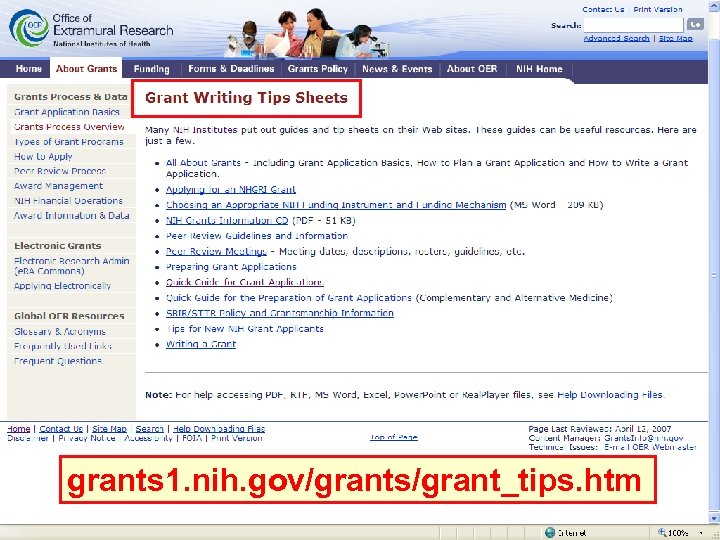 grants 1. nih. gov/grants/grant_tips. htm
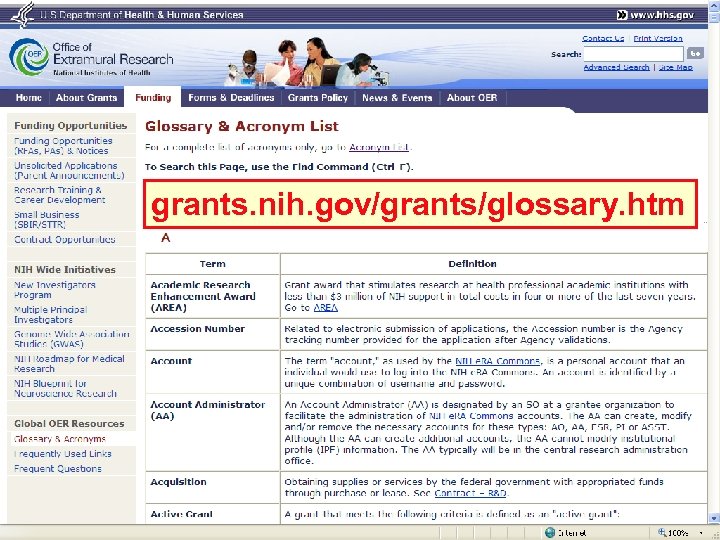 grants. nih. gov/grants/glossary. htm
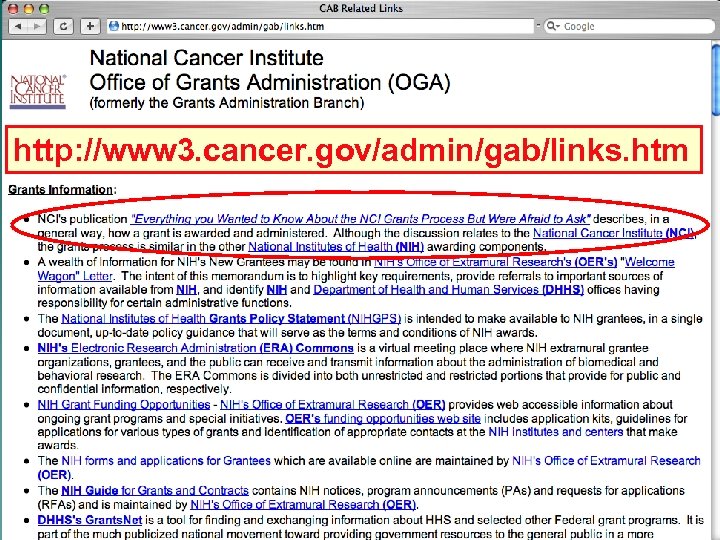 http: //www 3. cancer. gov/admin/gab/links. htm
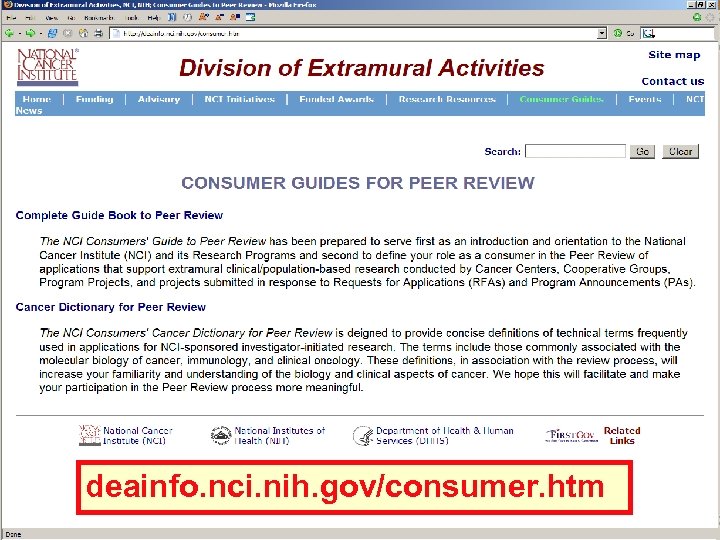 deainfo. nci. nih. gov/consumer. htm
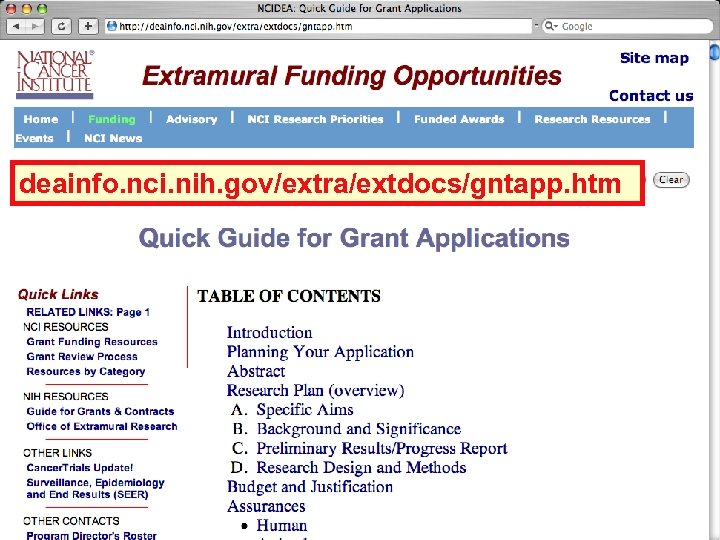 deainfo. nci. nih. gov/extra/extdocs/gntapp. htm
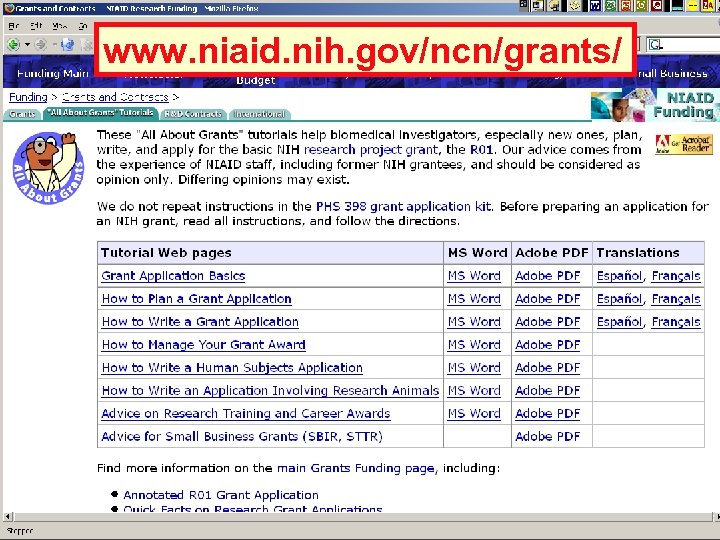 www. niaid. nih. gov/ncn/grants/
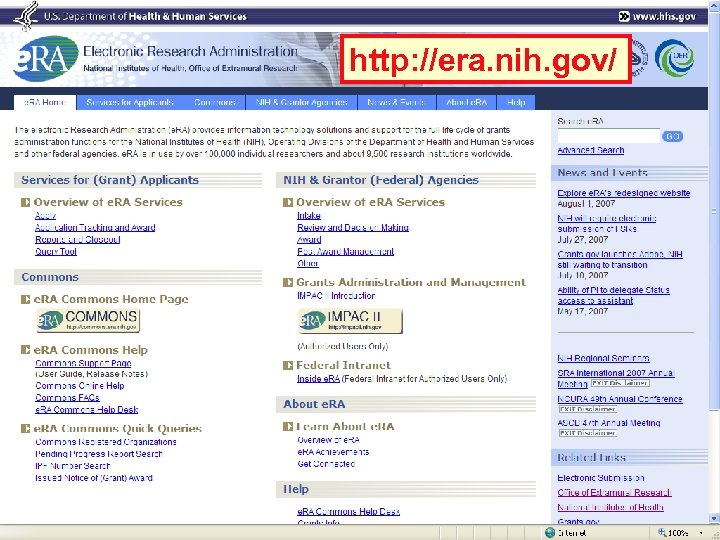 http: //era. nih. gov/
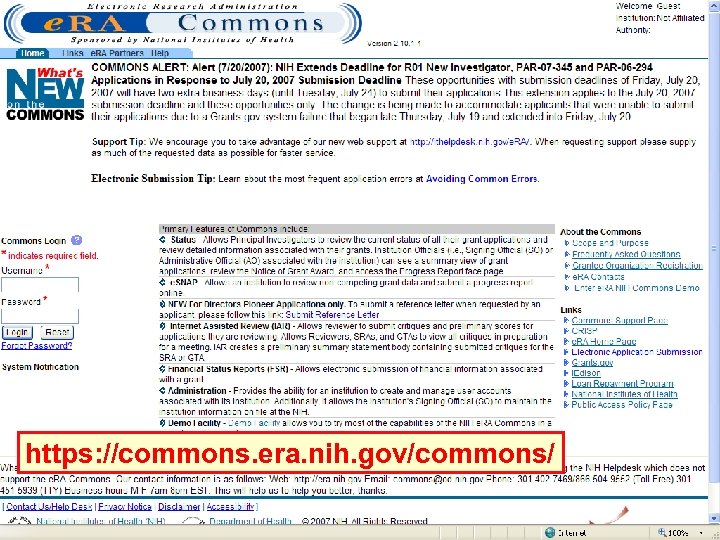 https: //commons. era. nih. gov/commons/
 http: //era. nih. gov/virtualschool/
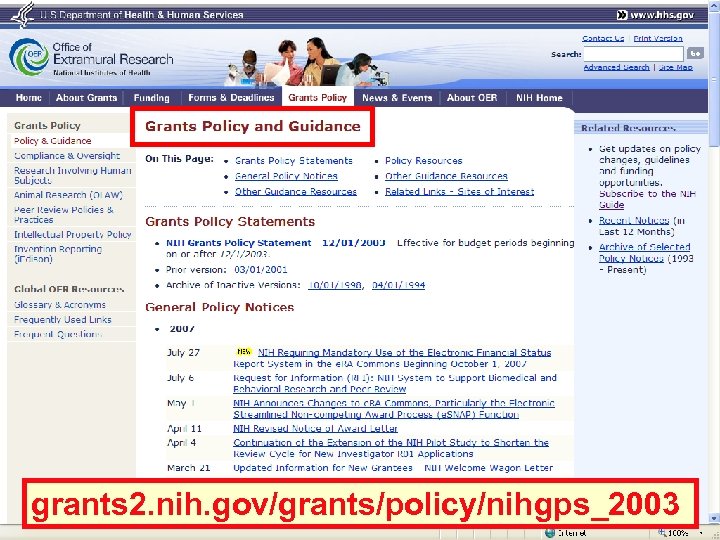 grants 2. nih. gov/grants/policy/nihgps_2003
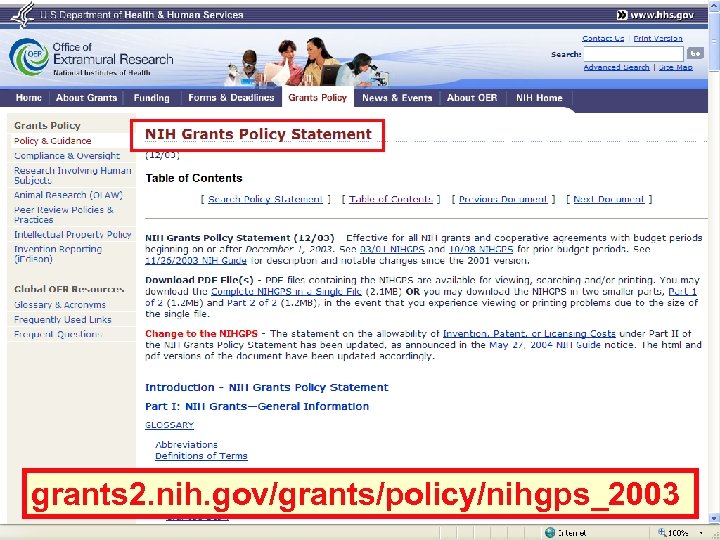 grants 2. nih. gov/grants/policy/nihgps_2003
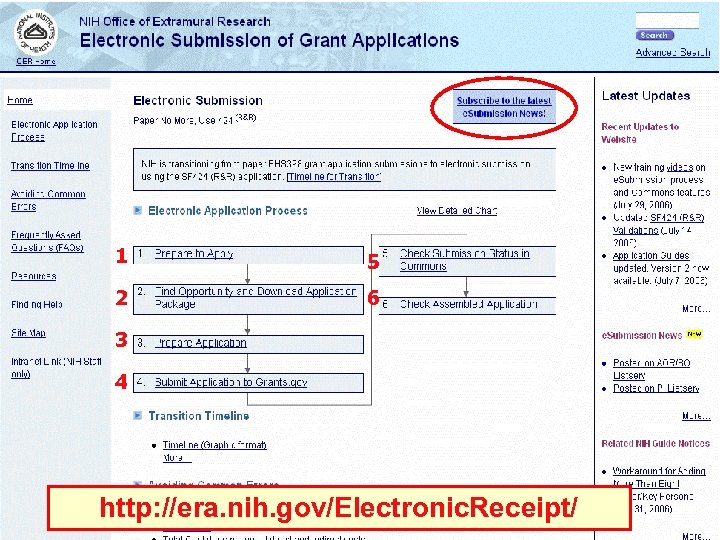 1 5 2 6 3 4 http: //era. nih. gov/Electronic. Receipt/
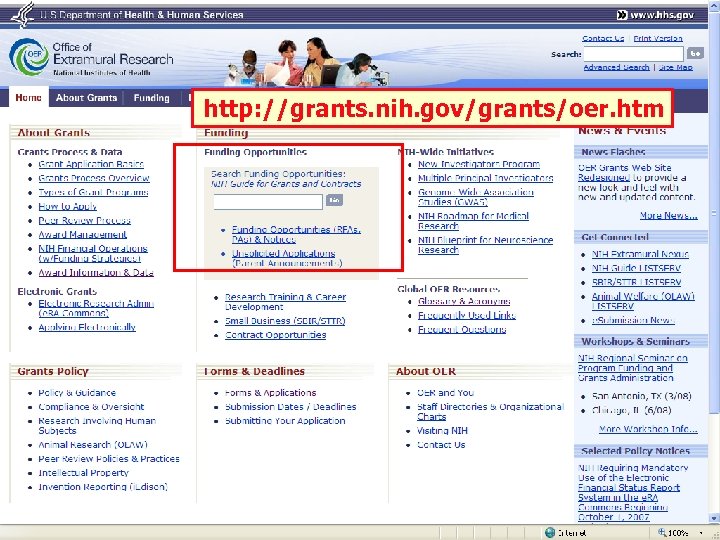 http: //grants. nih. gov/grants/oer. htm
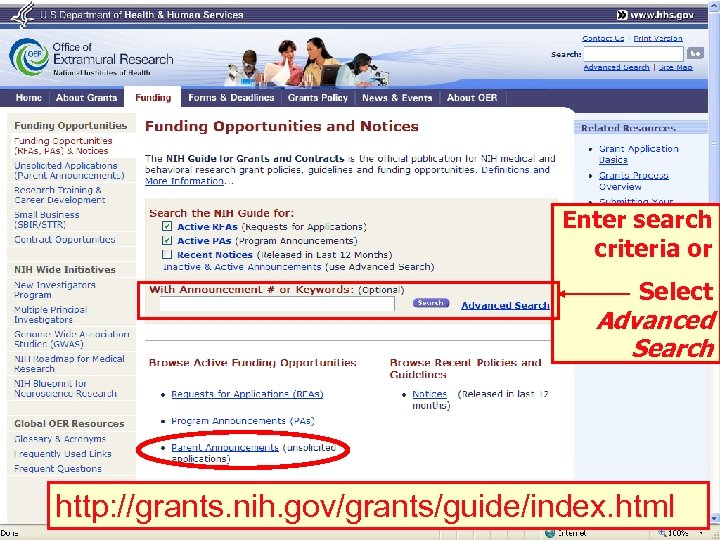 Enter search criteria or Select Advanced Search http: //grants. nih. gov/grants/guide/index. html
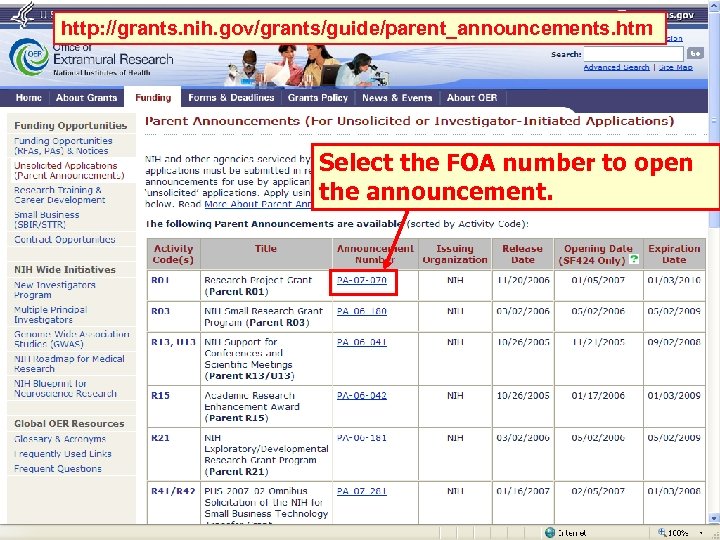 http: //grants. nih. gov/grants/guide/parent_announcements. htm Select the FOA number to open the announcement.
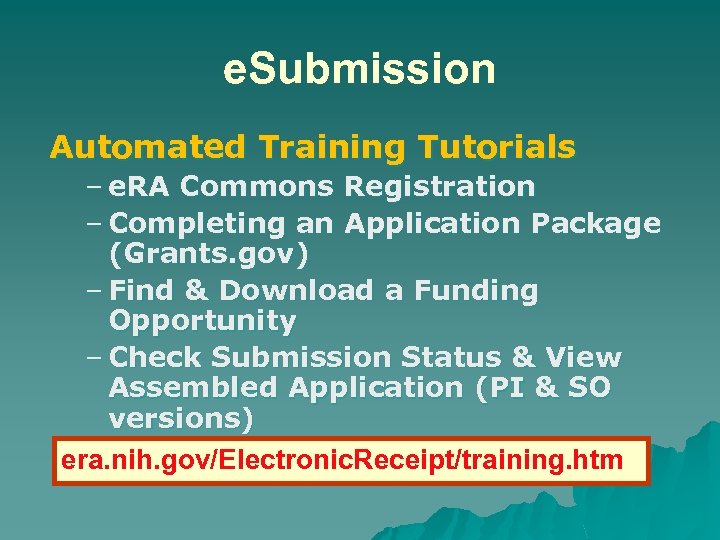 e. Submission Automated Training Tutorials – e. RA Commons Registration – Completing an Application Package (Grants. gov) – Find & Download a Funding Opportunity – Check Submission Status & View Assembled Application (PI & SO versions) era. nih. gov/Electronic. Receipt/training. htm
 e. Submission Frequently Asked Questions era. nih. gov/Electronic. Receipt/faq. htm Avoiding Common Errors era. nih. gov/Electronic. Receipt/avoiding_errors. htm Presentations, Quick Reference Materials, Brochures, Drop-in newsletter articles era. nih. gov/Electronic. Receipt/communication. htm Training Videos, Videocast Archives era. nih. gov/Electronic. Receipt/training. htm