Скачать презентацию GRAND CHALLENGE 2 Discover quantify and reduce environmental
2a1a533c8d98b84951e381b4bfc8b473.ppt
- Количество слайдов: 30
 GRAND CHALLENGE #2: Discover, quantify, and reduce environmental risks to health of individuals and populations
 “ I know no safe depository of the ultimate powers of society but the people themselves; if we think them not enlightened enough to exercise their control with a wholesome discretion, the remedy is not to take it away from them, but to inform their discretion. ” - Thomas Jefferson
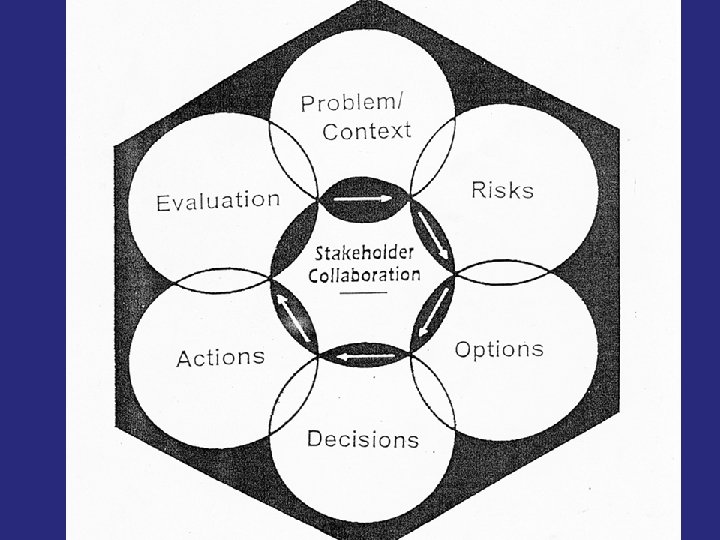
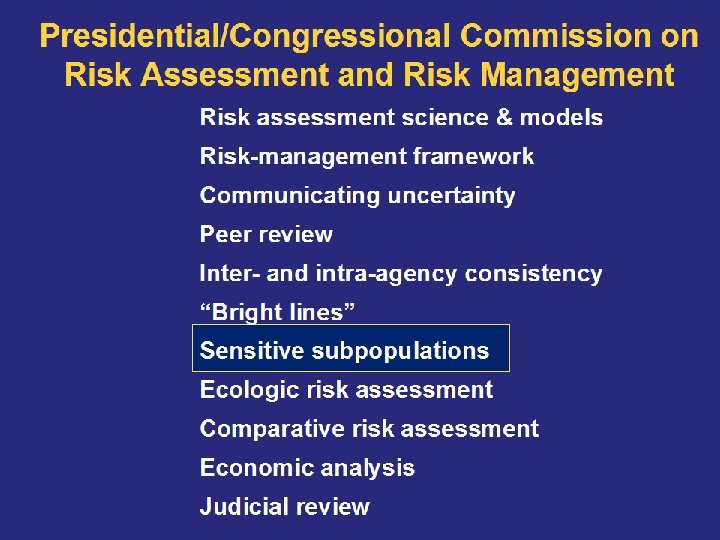 Presidential/Congressional Commission on Risk Assessment and Risk Management Risk assessment science & models Risk-management framework Communicating uncertainty Peer review Inter- and intra-agency consistency “Bright lines” Sensitive subpopulations Ecologic risk assessment Comparative risk assessment Economic analysis Judicial review
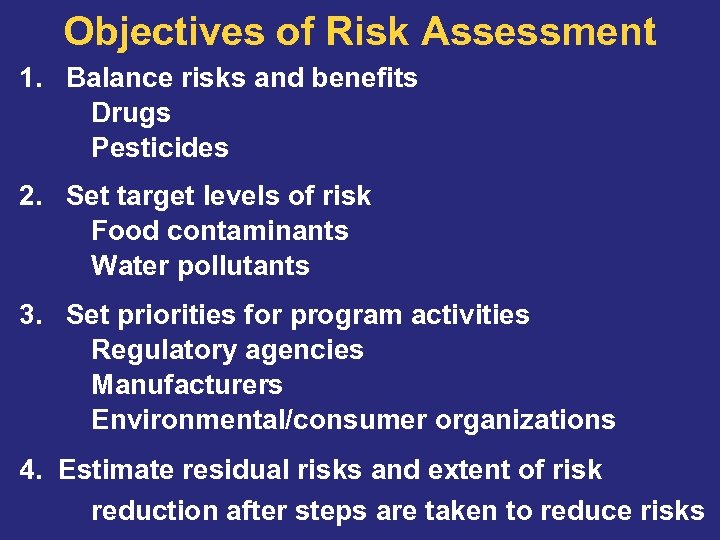 Objectives of Risk Assessment 1. Balance risks and benefits Drugs Pesticides 2. Set target levels of risk Food contaminants Water pollutants 3. Set priorities for program activities Regulatory agencies Manufacturers Environmental/consumer organizations 4. Estimate residual risks and extent of risk reduction after steps are taken to reduce risks
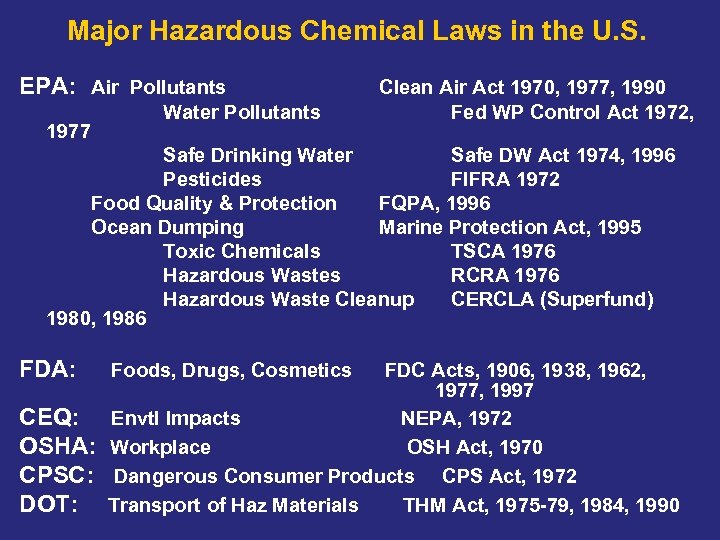 Major Hazardous Chemical Laws in the U. S. EPA: Air Pollutants 1977 Water Pollutants Clean Air Act 1970, 1977, 1990 Fed WP Control Act 1972, Safe Drinking Water Safe DW Act 1974, 1996 Pesticides FIFRA 1972 Food Quality & Protection FQPA, 1996 Ocean Dumping Marine Protection Act, 1995 Toxic Chemicals TSCA 1976 Hazardous Wastes RCRA 1976 Hazardous Waste Cleanup CERCLA (Superfund) 1980, 1986 FDA: CEQ: OSHA: CPSC: DOT: Foods, Drugs, Cosmetics FDC Acts, 1906, 1938, 1962, 1977, 1997 Envtl Impacts NEPA, 1972 Workplace OSH Act, 1970 Dangerous Consumer Products CPS Act, 1972 Transport of Haz Materials THM Act, 1975 -79, 1984, 1990
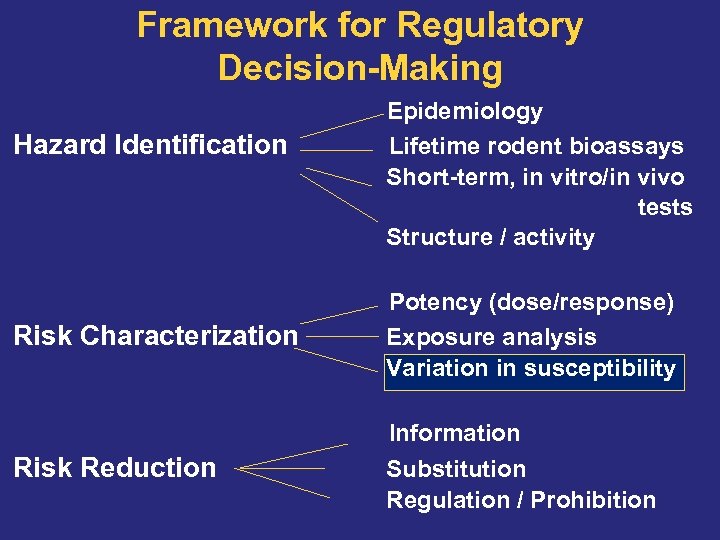 Framework for Regulatory Decision-Making Hazard Identification Epidemiology Lifetime rodent bioassays Short-term, in vitro/in vivo tests Structure / activity Risk Characterization Potency (dose/response) Exposure analysis Variation in susceptibility Risk Reduction Information Substitution Regulation / Prohibition
 Biological End-Points Cancers Mutations Birth defects Reproductive toxicity Immunological toxicity Neurobehavioral toxicity Organ-specific effects Endocrine modulation / disruption Ecosystem effects
 Context Multiple sources of same agent Multiple media/pathways of exposure Multiple risks/effects of same agent Multiple agents causing same effects Public health: status / trends Ecological health Social, cultural, environmental justice considerations
 Change the Context Move beyond one chemical, one environmental medium (air, water, soil, food), one health effect (cancer, birth defect…) at a time in risk assessment and risk management: requires comprehensive public health view
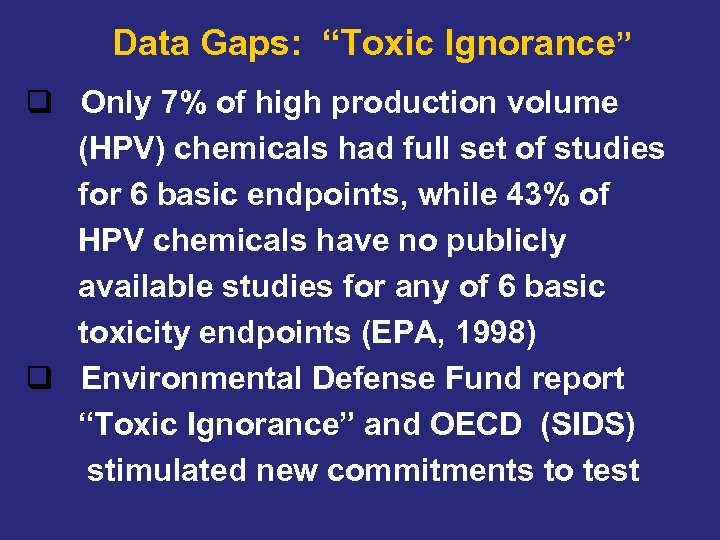 Data Gaps: “Toxic Ignorance” Only 7% of high production volume (HPV) chemicals had full set of studies for 6 basic endpoints, while 43% of HPV chemicals have no publicly available studies for any of 6 basic toxicity endpoints (EPA, 1998) Environmental Defense Fund report “Toxic Ignorance” and OECD (SIDS) stimulated new commitments to test
 Eco-Genetics • The interaction of environmental exposures and genetic variation • Range of susceptibility for specific exposures • Application of gene and protein expression methods to detect and clarify “molecular signatures” as biomarkers of exposure, early adverse effect, and susceptibility
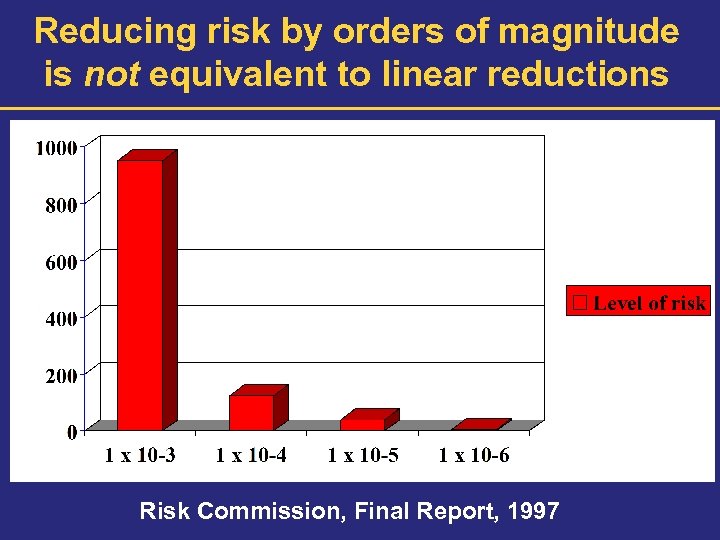 Reducing risk by orders of magnitude is not equivalent to linear reductions Risk Commission, Final Report, 1997
 GRAND CHALLENGE #3: Drive progress toward affordable, quality health care. Figure out what works and what doesn’t, what is safe and what is not, in personal health care and in community public health services.
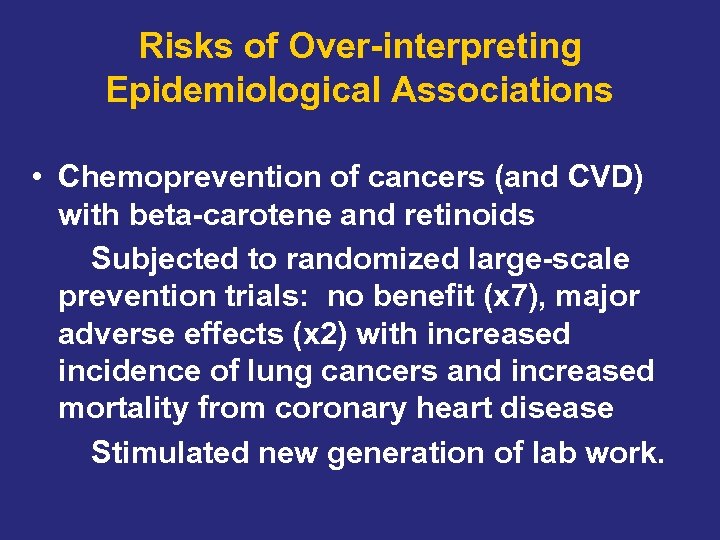 Risks of Over-interpreting Epidemiological Associations • Chemoprevention of cancers (and CVD) with beta-carotene and retinoids Subjected to randomized large-scale prevention trials: no benefit (x 7), major adverse effects (x 2) with increased incidence of lung cancers and increased mortality from coronary heart disease Stimulated new generation of lab work.
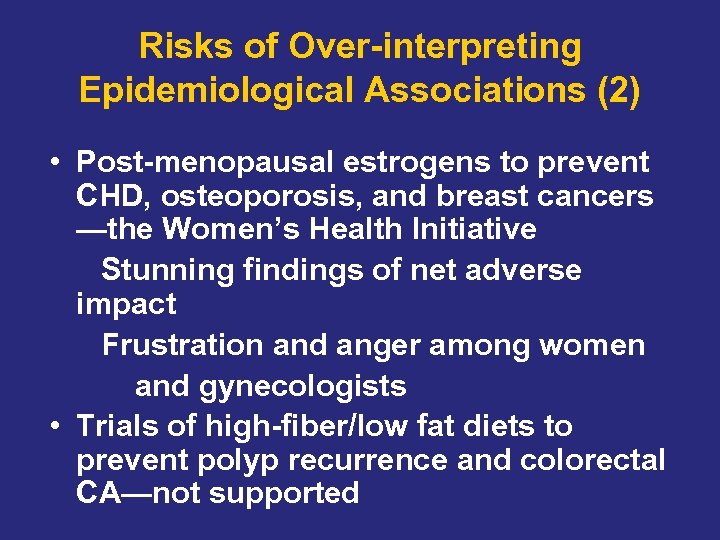 Risks of Over-interpreting Epidemiological Associations (2) • Post-menopausal estrogens to prevent CHD, osteoporosis, and breast cancers —the Women’s Health Initiative Stunning findings of net adverse impact Frustration and anger among women and gynecologists • Trials of high-fiber/low fat diets to prevent polyp recurrence and colorectal CA—not supported
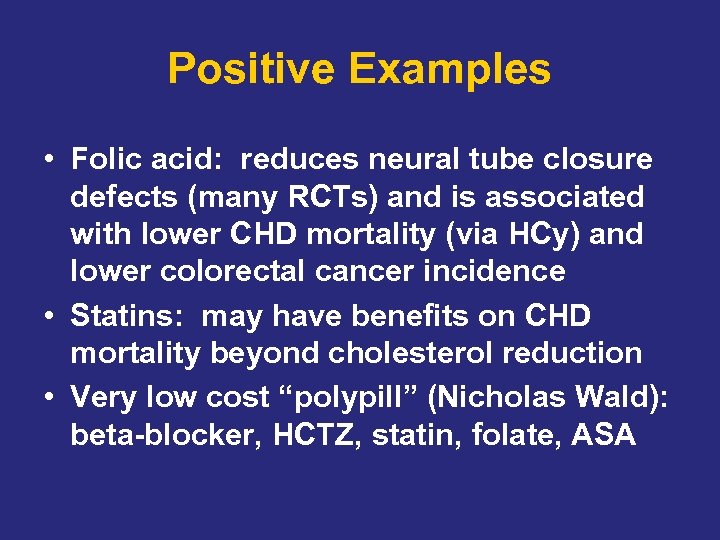 Positive Examples • Folic acid: reduces neural tube closure defects (many RCTs) and is associated with lower CHD mortality (via HCy) and lower colorectal cancer incidence • Statins: may have benefits on CHD mortality beyond cholesterol reduction • Very low cost “polypill” (Nicholas Wald): beta-blocker, HCTZ, statin, folate, ASA
 IOM SERIES ON HEALTH CARE QUALITY • To Err is Human---Patient Safety • The Health Care Quality Chasm— 6 attributes of quality care: safe, timely, patient-centered, effective, efficient, equitable • Leadership by Example: The Role of Government in Enhancing Health Care Quality—policy ramifications of patientcentered care and coverage
 Population-based efficacy “The average patient seeing the average doctor for a typical condition finally has a better than average chance of benefitting from the encounter. ” ---L. J. Henderson, 1913 Let’s be sure the odds are still good!
 Mobilize to overcome major global health problems High-quality, low-cost training, kudos to UP “Supercourse” Technological breakthroughs Remember our best example: the Salk vaccine from U Pitt
 Gates Fdn/NIH Fdn “Grand Challenges” Varmus, Klausner, Zerhouni, et al, Science 2003; 302: 398 -99 To Improve Childhood Vaccines: #1: Effective single-dose neonatal vaccines #2: Vaccines that do not require refrigeration #3: Needle-free delivery systems To Create New Vaccines: #4: Reliable model systems tests to evaluate live attenuated vaccines #5: More effective antigens #6: Learn which immune responses are protective
 To Deplete or Incapacitate Insects that Transmit Agents of Disease: #7: Genetic strategies #8: Chemical strategies To Improve Nutrition to Promote Health: #9: Optimal bioavailable nutrients in staple plant species To Improve Drug Rx of Infectious Diseases: #10: Drugs and delivery systems to minimize resistance
 To Cure Latent and Chronic Infections #11: Therapies to cure latent infections #12: Immunological methods to cure chronic infections To Measure Disease and Health Status Accurately & Economically #13: Technologies for quantitative assessment of health status #14: Point-of-care technologies for individuals with multiple conditions or pathogens
 MUCH MORE THAN TECHNOLOGY IS REQUIRED • Influence of income inequalities • Other causes of health disparities • Need to be alert to identify—and demonstrate scientifically--unanticipated benefits: the story of Vitamin A in child survival, on top of blindness prevention • Play a professional role in prevention of violence, from interpersonal to terrorism and war: UP leadership
 PRINCIPLES OF COMMUNITY-BASED RESEARCH University of Washington • Community partners should be involved from the earliest stages • Community partners should have real influence on project • Research processes and outcomes should benefit the community • Community members should be part of the analysis/interpretation • Productive partnerships should last beyond the project • Community members should be empowered to initiate projects
 Building Broader Partnerships • RWJF/WK Kellogg Fdn initiative “Turning Point, a new Century for Public Health”—state and local coalitions • Take advantage of the Internet Public Health INFO from CDC Supercourse from U Pittsburgh GSPH
 REMEMBER: Our Most Certain, Major Products are People Recognize Schools of Public Health as a national and international treasure!