 Скачать презентацию Grammatical Tone Assignment Answersː Present pronouns o you
474210f49396a591efd00390f0df2ff5.ppt
- Количество слайдов: 35



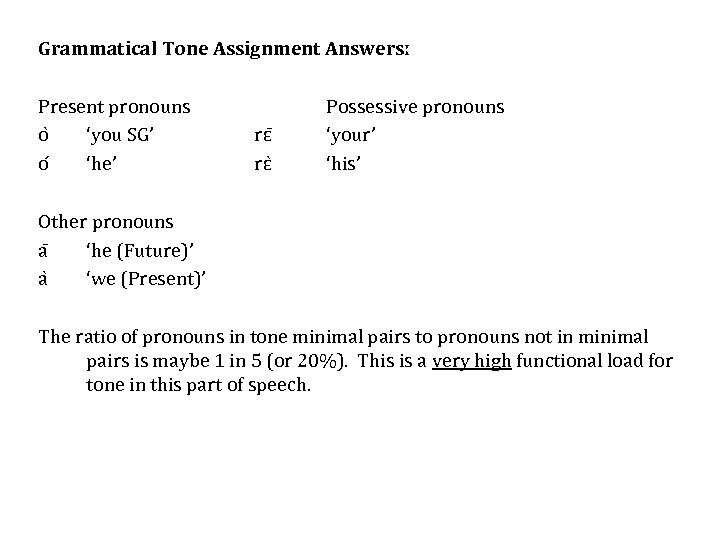
Grammatical Tone Assignment Answersː Present pronouns o ‘you SG’ o ‘he’ rɛ rɛ Possessive pronouns ‘your’ ‘his’ Other pronouns a ‘he (Future)’ a ‘we (Present)’ The ratio of pronouns in tone minimal pairs to pronouns not in minimal pairs is maybe 1 in 5 (or 20%). This is a very high functional load for tone in this part of speech.
Grammatical Tone Review Fill in the blanks For each factor, the fewer the number of items, the ______ the functional load on those items. The fewer the items in non-tone factors, the _______ the tone functional load.
Grammatical Tone Review Fill in the blanks For each factor, the fewer the number of items, the greater the functional load on those items. The fewer the items in non-tone factors, the greater the tone functional load.
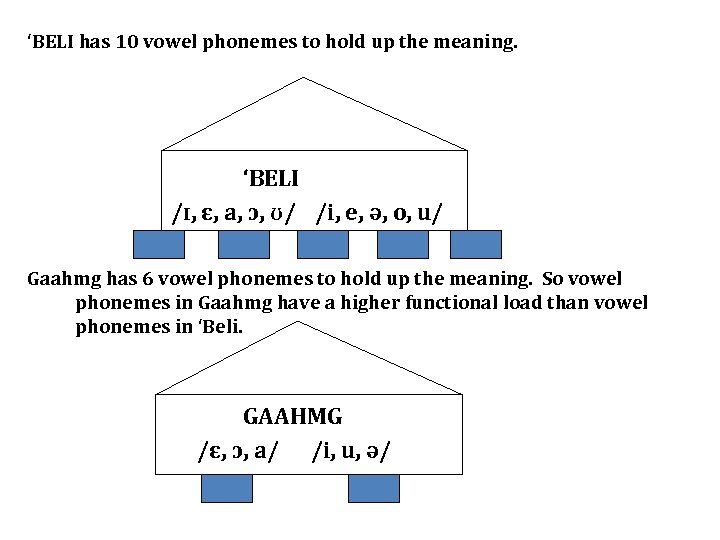
‘BELI has 10 vowel phonemes to hold up the meaning. ‘BELI /ɪ, ɛ, a, ɔ, ʊ/ /i, e, ə, o, u/ Gaahmg has 6 vowel phonemes to hold up the meaning. So vowel phonemes in Gaahmg have a higher functional load than vowel phonemes in ‘Beli. GAAHMG /ɛ, ɔ, a/ /i, u, ə/
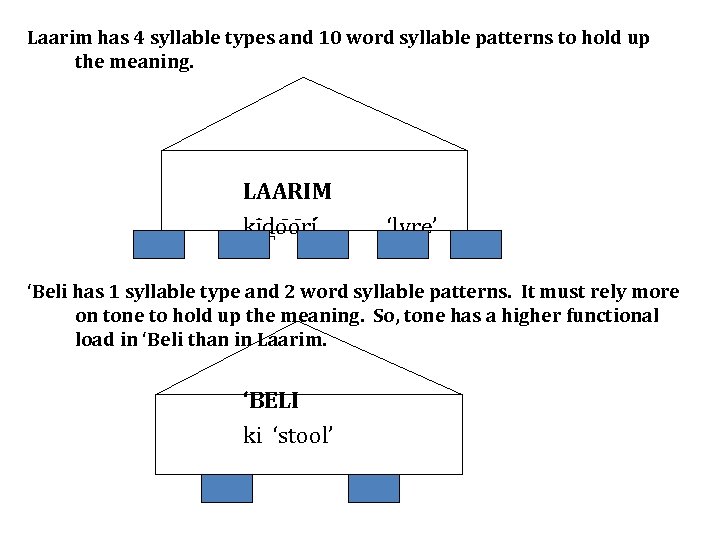
Laarim has 4 syllable types and 10 word syllable patterns to hold up the meaning. LAARIM ki d o o ri ‘lyre’ ‘Beli has 1 syllable type and 2 word syllable patterns. It must rely more on tone to hold up the meaning. So, tone has a higher functional load in ‘Beli than in Laarim. ‘BELI ki ‘stool’
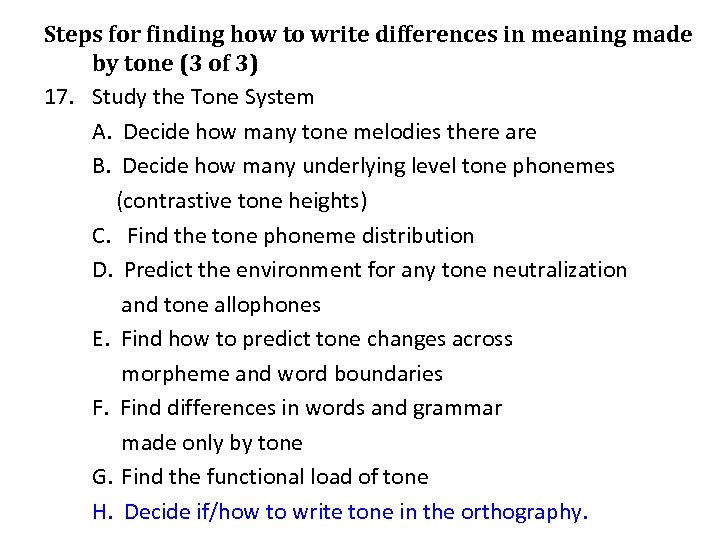
Steps for finding how to write differences in meaning made by tone (3 of 3) 17. Study the Tone System A. Decide how many tone melodies there are B. Decide how many underlying level tone phonemes (contrastive tone heights) C. Find the tone phoneme distribution D. Predict the environment for any tone neutralization and tone allophones E. Find how to predict tone changes across morpheme and word boundaries F. Find differences in words and grammar made only by tone G. Find the functional load of tone H. Decide if/how to write tone in the orthography.
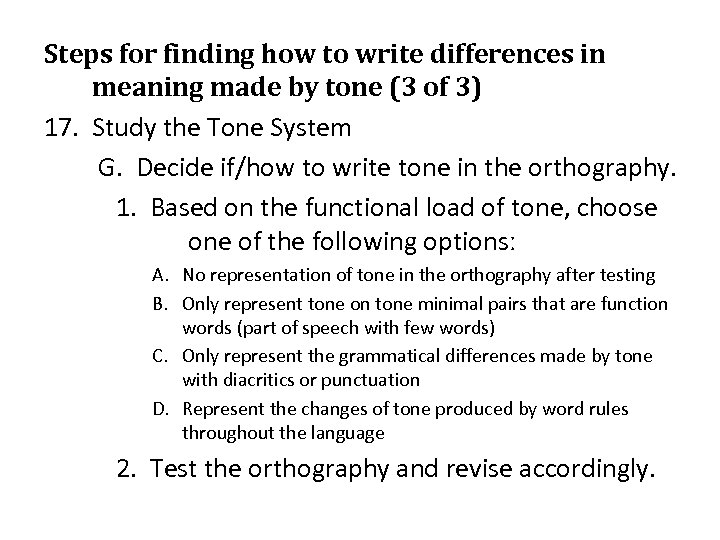
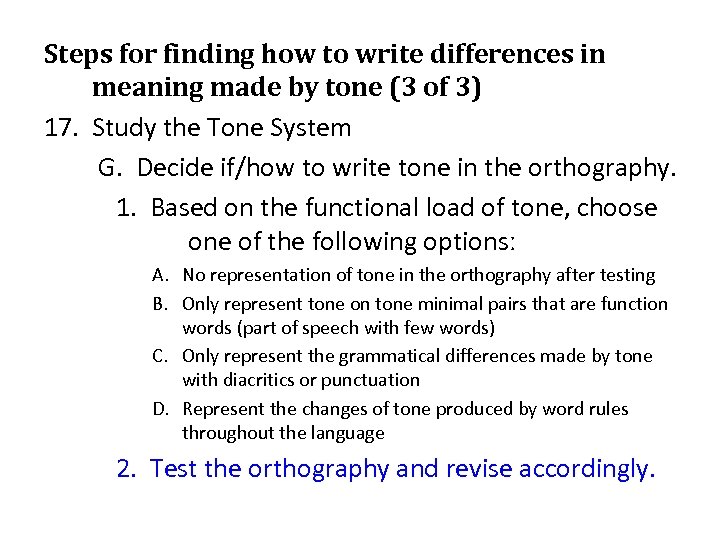
Steps for finding how to write differences in meaning made by tone (3 of 3) 17. Study the Tone System G. Decide if/how to write tone in the orthography. 1. Based on the functional load of tone, choose one of the following optionsː A. No representation of tone in the orthography after testing B. Only represent tone on tone minimal pairs that are function words (part of speech with few words) C. Only represent the grammatical differences made by tone with diacritics or punctuation D. Represent the changes of tone produced by word rules throughout the language 2. Test the orthography and revise accordingly.
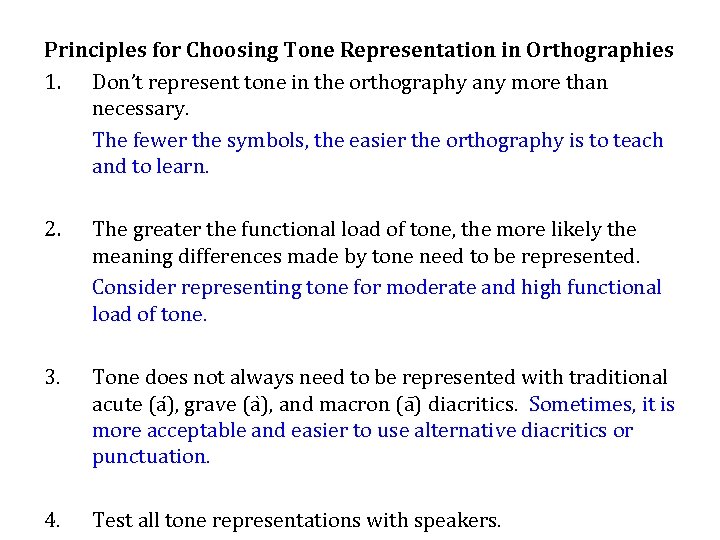
Principles for Choosing Tone Representation in Orthographies 1. Don’t represent tone in the orthography any more than necessary. The fewer the symbols, the easier the orthography is to teach and to learn. 2. The greater the functional load of tone, the more likely the meaning differences made by tone need to be represented. Consider representing tone for moderate and high functional load of tone. 3. Tone does not always need to be represented with traditional acute (a ), grave (a ), and macron (a ) diacritics. Sometimes, it is more acceptable and easier to use alternative diacritics or punctuation. 4. Test all tone representations with speakers.
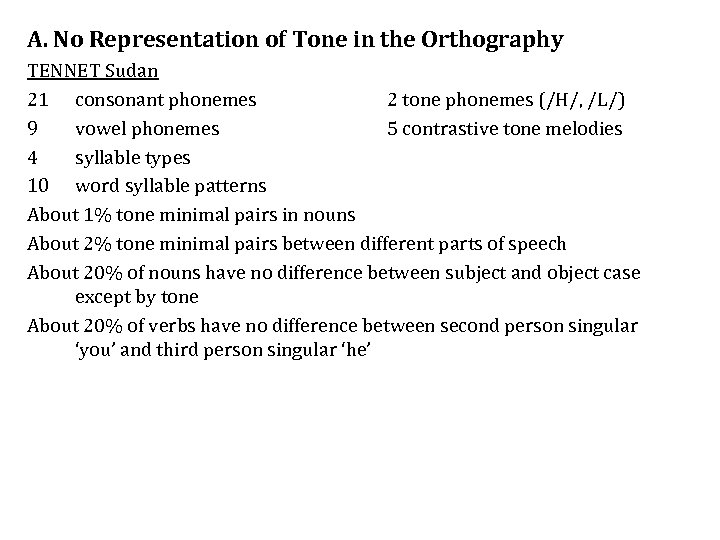
A. No Representation of Tone in the Orthography TENNET Sudan 21 consonant phonemes 2 tone phonemes (/H/, /L/) 9 vowel phonemes 5 contrastive tone melodies 4 syllable types 10 word syllable patterns About 1% tone minimal pairs in nouns About 2% tone minimal pairs between different parts of speech About 20% of nouns have no difference between subject and object case except by tone About 20% of verbs have no difference between second person singular ‘you’ and third person singular ‘he’
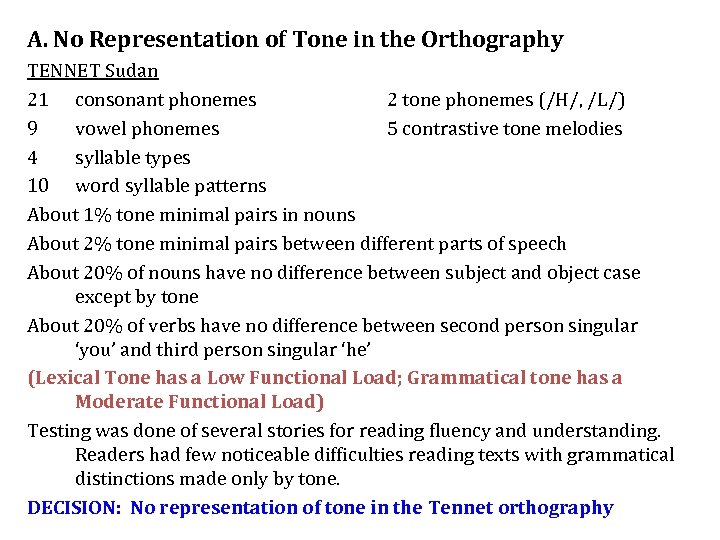
A. No Representation of Tone in the Orthography TENNET Sudan 21 consonant phonemes 2 tone phonemes (/H/, /L/) 9 vowel phonemes 5 contrastive tone melodies 4 syllable types 10 word syllable patterns About 1% tone minimal pairs in nouns About 2% tone minimal pairs between different parts of speech About 20% of nouns have no difference between subject and object case except by tone About 20% of verbs have no difference between second person singular ‘you’ and third person singular ‘he’ (Lexical Tone has a Low Functional Load; Grammatical tone has a Moderate Functional Load) Testing was done of several stories for reading fluency and understanding. Readers had few noticeable difficulties reading texts with grammatical distinctions made only by tone. DECISION: No representation of tone in the Tennet orthography
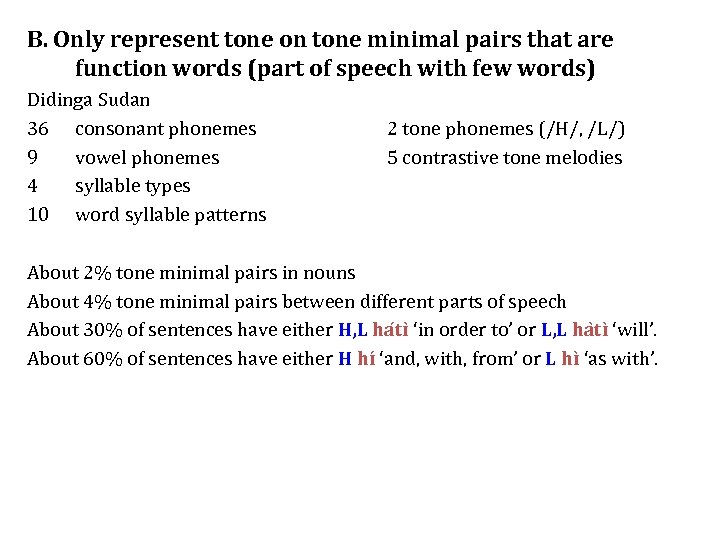
B. Only represent tone on tone minimal pairs that are function words (part of speech with few words) Didinga Sudan 36 consonant phonemes 9 vowel phonemes 4 syllable types 10 word syllable patterns 2 tone phonemes (/H/, /L/) 5 contrastive tone melodies About 2% tone minimal pairs in nouns About 4% tone minimal pairs between different parts of speech About 30% of sentences have either H, L ha tɪ ‘in order to’ or L, L ha tɪ ‘will’. About 60% of sentences have either H hɪ ‘and, with, from’ or L hɪ ‘as with’.
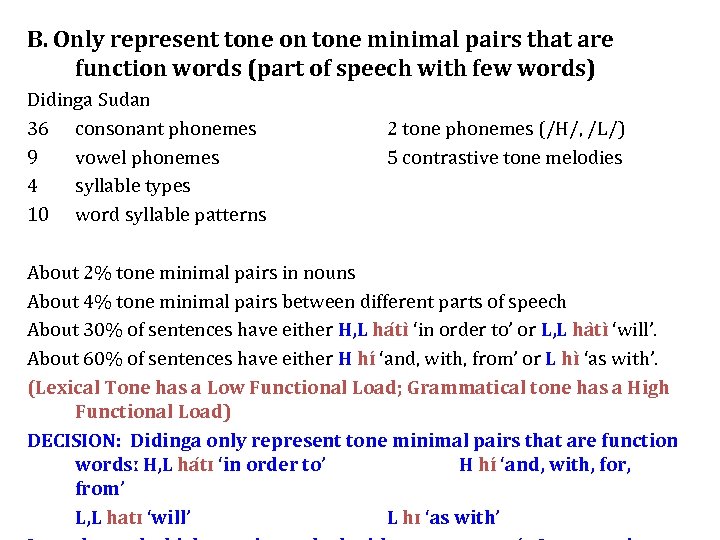
B. Only represent tone on tone minimal pairs that are function words (part of speech with few words) Didinga Sudan 36 consonant phonemes 9 vowel phonemes 4 syllable types 10 word syllable patterns 2 tone phonemes (/H/, /L/) 5 contrastive tone melodies About 2% tone minimal pairs in nouns About 4% tone minimal pairs between different parts of speech About 30% of sentences have either H, L ha tɪ ‘in order to’ or L, L ha tɪ ‘will’. About 60% of sentences have either H hɪ ‘and, with, from’ or L hɪ ‘as with’. (Lexical Tone has a Low Functional Load; Grammatical tone has a High Functional Load) DECISION: Didinga only represent tone minimal pairs that are function wordsː H, L ha tɪ ‘in order to’ H hɪ ‘and, with, for, from’ L, L hatɪ ‘will’ L hɪ ‘as with’
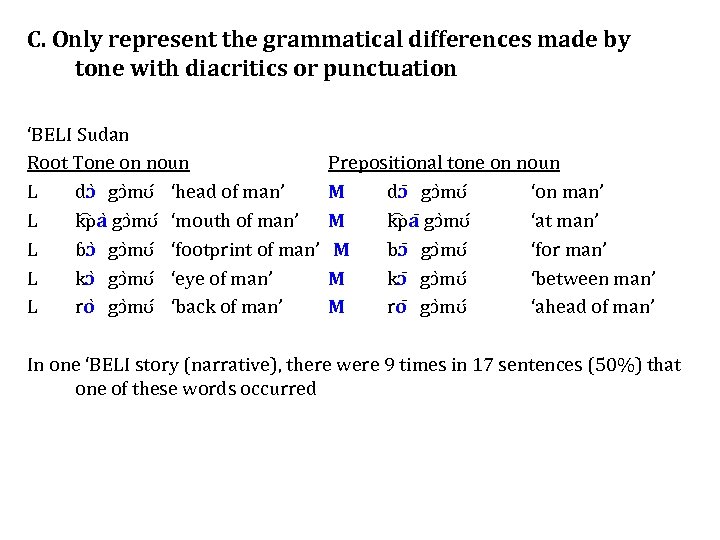
C. Only represent the grammatical differences made by tone with diacritics or punctuation ‘BELI Sudan Root Tone on noun L dɔ gɔ mʊ ‘head of man’ L k pa gɔ mʊ ‘mouth of man’ L ɓɔ gɔ mʊ ‘footprint of man’ L kɔ gɔ mʊ ‘eye of man’ L ro gɔ mʊ ‘back of man’ Prepositional tone on noun M dɔ gɔ mʊ ‘on man’ M k pa gɔ mʊ ‘at man’ M bɔ gɔ mʊ ‘for man’ M kɔ gɔ mʊ ‘between man’ M ro gɔ mʊ ‘ahead of man’ In one ‘BELI story (narrative), there were 9 times in 17 sentences (50%) that one of these words occurred
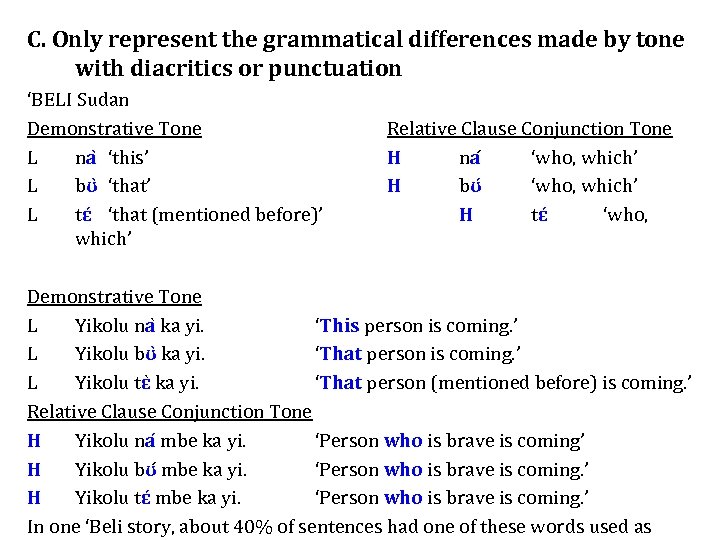
C. Only represent the grammatical differences made by tone with diacritics or punctuation ‘BELI Sudan Demonstrative Tone L na ‘this’ L bʊ ‘that’ L tɛ ‘that (mentioned before)’ which’ Relative Clause Conjunction Tone H na ‘who, which’ H bʊ ‘who, which’ H tɛ ‘who, Demonstrative Tone L Yikolu na ka yi. ‘This person is coming. ’ L Yikolu bʊ ka yi. ‘That person is coming. ’ L Yikolu tɛ ka yi. ‘That person (mentioned before) is coming. ’ Relative Clause Conjunction Tone H Yikolu na mbe ka yi. ‘Person who is brave is coming’ H Yikolu bʊ mbe ka yi. ‘Person who is brave is coming. ’ H Yikolu tɛ mbe ka yi. ‘Person who is brave is coming. ’ In one ‘Beli story, about 40% of sentences had one of these words used as
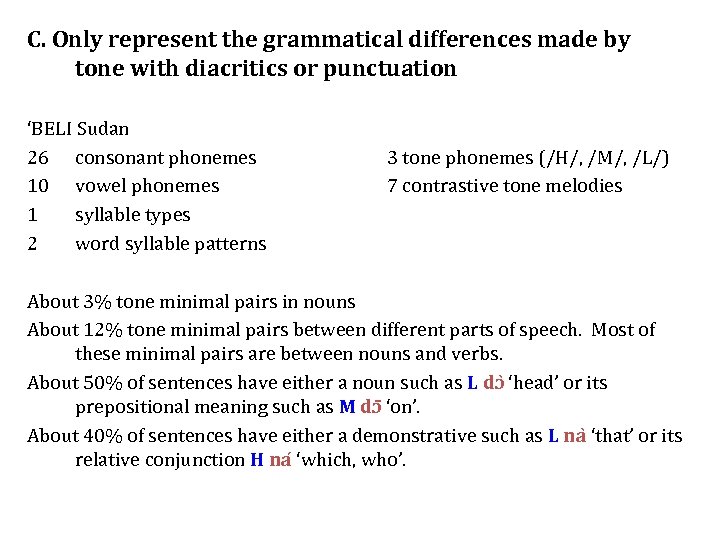
C. Only represent the grammatical differences made by tone with diacritics or punctuation ‘BELI Sudan 26 consonant phonemes 10 vowel phonemes 1 syllable types 2 word syllable patterns 3 tone phonemes (/H/, /M/, /L/) 7 contrastive tone melodies About 3% tone minimal pairs in nouns About 12% tone minimal pairs between different parts of speech. Most of these minimal pairs are between nouns and verbs. About 50% of sentences have either a noun such as L dɔ ‘head’ or its prepositional meaning such as M dɔ ‘on’. About 40% of sentences have either a demonstrative such as L na ‘that’ or its relative conjunction H na ‘which, who’.
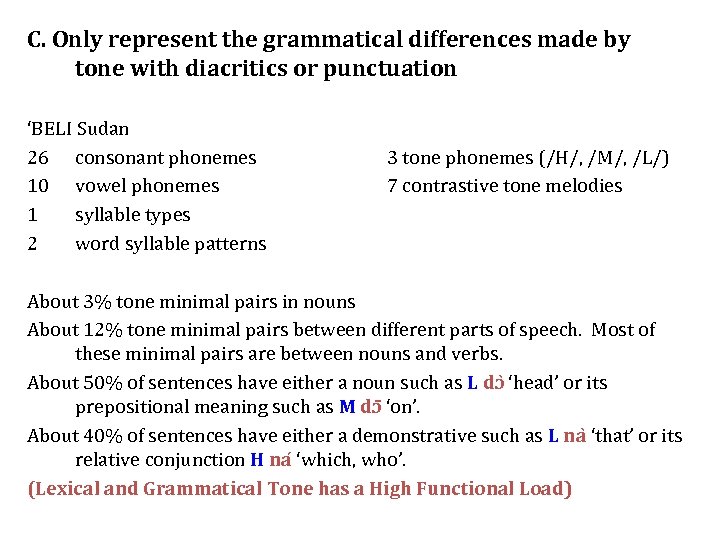
C. Only represent the grammatical differences made by tone with diacritics or punctuation ‘BELI Sudan 26 consonant phonemes 10 vowel phonemes 1 syllable types 2 word syllable patterns 3 tone phonemes (/H/, /M/, /L/) 7 contrastive tone melodies About 3% tone minimal pairs in nouns About 12% tone minimal pairs between different parts of speech. Most of these minimal pairs are between nouns and verbs. About 50% of sentences have either a noun such as L dɔ ‘head’ or its prepositional meaning such as M dɔ ‘on’. About 40% of sentences have either a demonstrative such as L na ‘that’ or its relative conjunction H na ‘which, who’. (Lexical and Grammatical Tone has a High Functional Load)
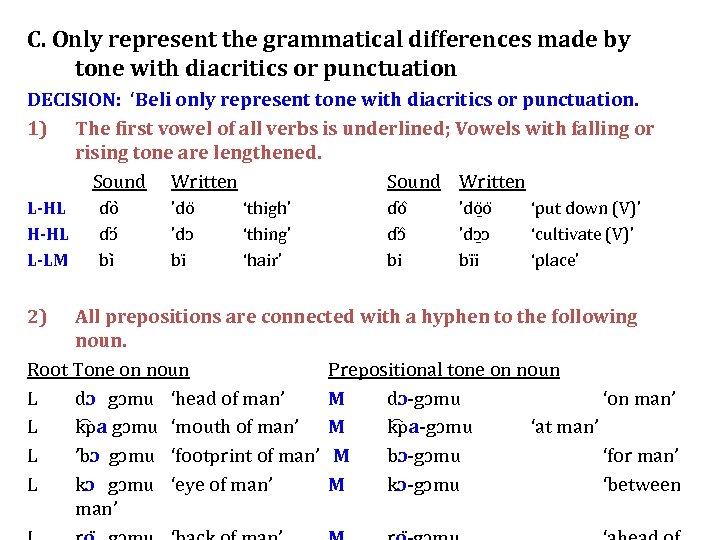
C. Only represent the grammatical differences made by tone with diacritics or punctuation DECISION: ‘Beli only represent tone with diacritics or punctuation. 1) The first vowel of all verbs is underlined; Vowels with falling or rising tone are lengthened. Sound Written L-HL H-HL L-LM 2) ɗo ɗɔ bi ’do ’dɔ bi ‘thigh’ ‘thing’ ‘hair’ ɗo ɗɔ bi ’do o ’dɔ ɔ bi i ‘put down (V)’ ‘cultivate (V)’ ‘place’ All prepositions are connected with a hyphen to the following noun. Root Tone on noun Prepositional tone on noun L dɔ gɔmu ‘head of man’ M dɔ-gɔmu ‘on man’ L k pa gɔmu ‘mouth of man’ M k pa-gɔmu ‘at man’ L ’bɔ gɔmu ‘footprint of man’ M bɔ-gɔmu ‘for man’ L kɔ gɔmu ‘eye of man’ M kɔ-gɔmu ‘between man’
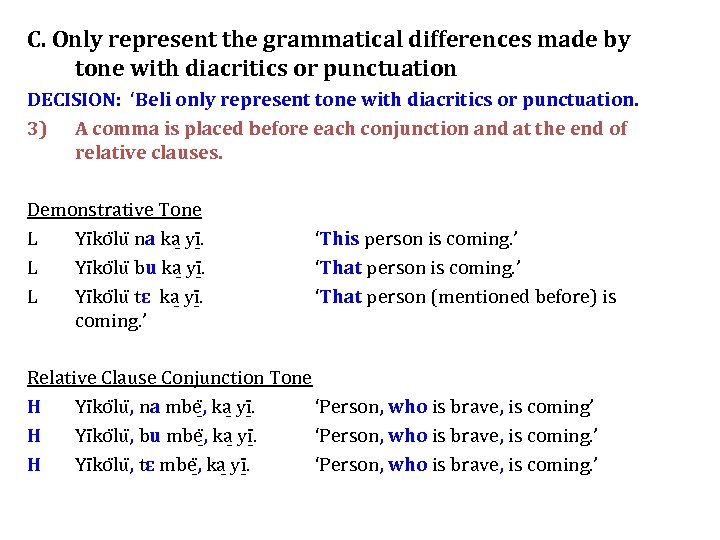
C. Only represent the grammatical differences made by tone with diacritics or punctuation DECISION: ‘Beli only represent tone with diacritics or punctuation. 3) A comma is placed before each conjunction and at the end of relative clauses. Demonstrative Tone L Yi ko lu na ka yi . L Yi ko lu bu ka yi . L Yi ko lu tɛ ka yi . coming. ’ ‘This person is coming. ’ ‘That person (mentioned before) is Relative Clause Conjunction Tone H Yi ko lu , na mbe , ka yi . ‘Person, who is brave, is coming’ H Yi ko lu , bu mbe , ka yi . ‘Person, who is brave, is coming. ’ H Yi ko lu , tɛ mbe , ka yi . ‘Person, who is brave, is coming. ’
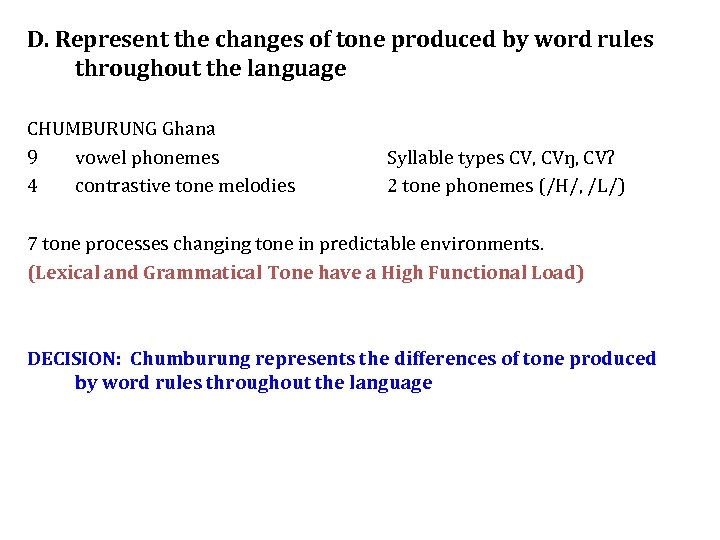
D. Represent the changes of tone produced by word rules throughout the language CHUMBURUNG Ghana 9 vowel phonemes 4 contrastive tone melodies Syllable types CV, CVŋ, CVʔ 2 tone phonemes (/H/, /L/) 7 tone processes changing tone in predictable environments. (Lexical and Grammatical Tone have a High Functional Load) DECISION: Chumburung represents the differences of tone produced by word rules throughout the language
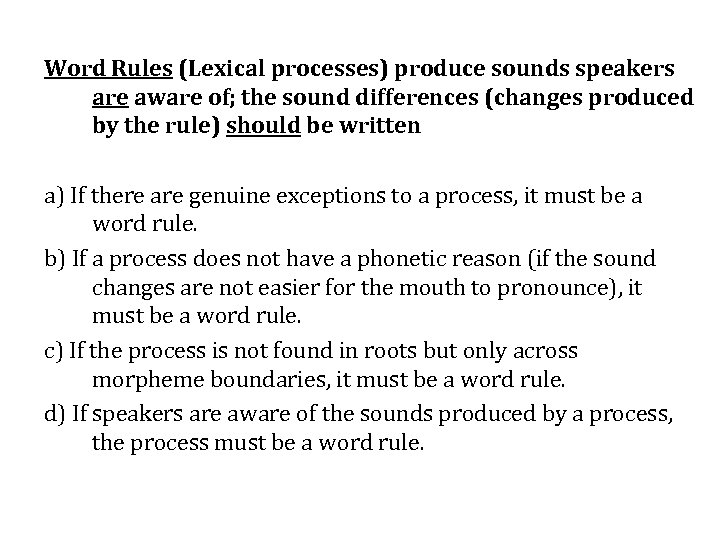
Word Rules (Lexical processes) produce sounds speakers are aware of; the sound differences (changes produced by the rule) should be written a) If there are genuine exceptions to a process, it must be a word rule. b) If a process does not have a phonetic reason (if the sound changes are not easier for the mouth to pronounce), it must be a word rule. c) If the process is not found in roots but only across morpheme boundaries, it must be a word rule. d) If speakers are aware of the sounds produced by a process, the process must be a word rule.
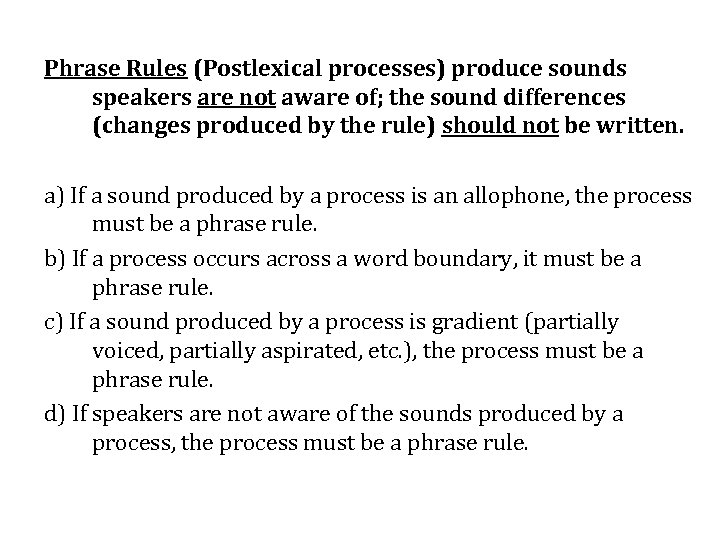
Phrase Rules (Postlexical processes) produce sounds speakers are not aware of; the sound differences (changes produced by the rule) should not be written. a) If a sound produced by a process is an allophone, the process must be a phrase rule. b) If a process occurs across a word boundary, it must be a phrase rule. c) If a sound produced by a process is gradient (partially voiced, partially aspirated, etc. ), the process must be a phrase rule. d) If speakers are not aware of the sounds produced by a process, the process must be a phrase rule.
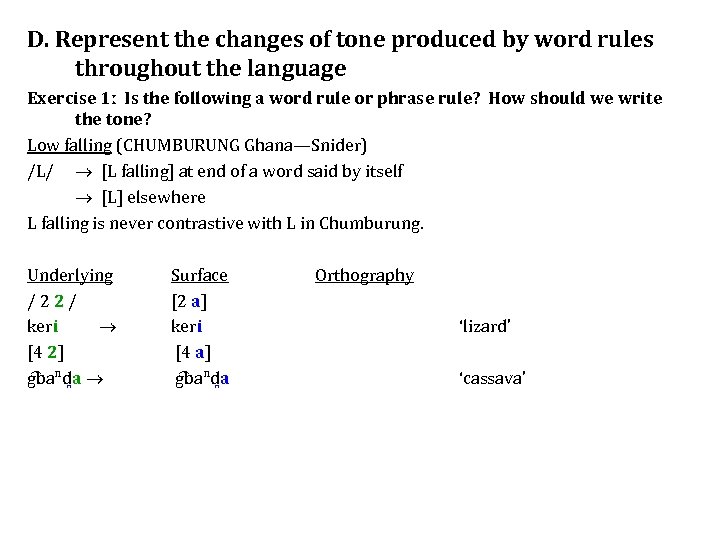
D. Represent the changes of tone produced by word rules throughout the language Exercise 1ː Is the following a word rule or phrase rule? How should we write the tone? Low falling (CHUMBURUNG Ghana—Snider) /L/ [L falling] at end of a word said by itself [L] elsewhere L falling is never contrastive with L in Chumburung. Underlying /22/ keri [4 2] g baⁿd a Surface [2 a] keri [4 a] g baⁿd a Orthography ‘lizard’ ‘cassava’
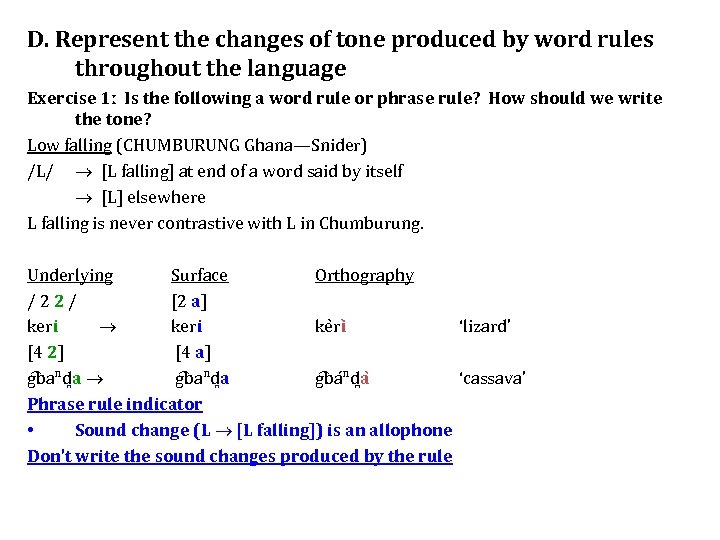
D. Represent the changes of tone produced by word rules throughout the language Exercise 1ː Is the following a word rule or phrase rule? How should we write the tone? Low falling (CHUMBURUNG Ghana—Snider) /L/ [L falling] at end of a word said by itself [L] elsewhere L falling is never contrastive with L in Chumburung. Underlying Surface Orthography /22/ [2 a] keri ke ri ‘lizard’ [4 2] [4 a] g baⁿd a g ba ⁿd a ‘cassava’ Phrase rule indicator • Sound change (L [L falling]) is an allophone Don’t write the sound changes produced by the rule
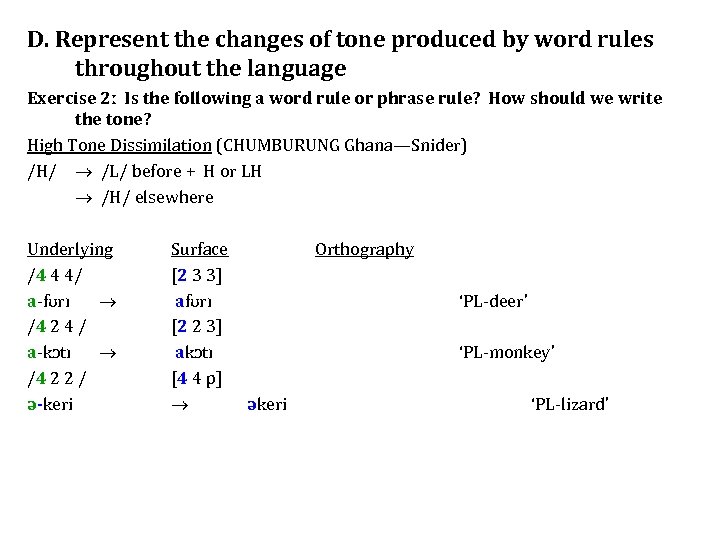
D. Represent the changes of tone produced by word rules throughout the language Exercise 2ː Is the following a word rule or phrase rule? How should we write the tone? High Tone Dissimilation (CHUMBURUNG Ghana—Snider) /H/ /L/ before + H or LH /H/ elsewhere Underlying /4 4 4/ a-fʊrɪ /4 2 4 / a-kɔtɪ /4 2 2 / ə-keri Surface [2 3 3] afʊrɪ [2 2 3] akɔtɪ [4 4 p] Orthography ‘PL-deer’ ‘PL-monkey’ əkeri ‘PL-lizard’
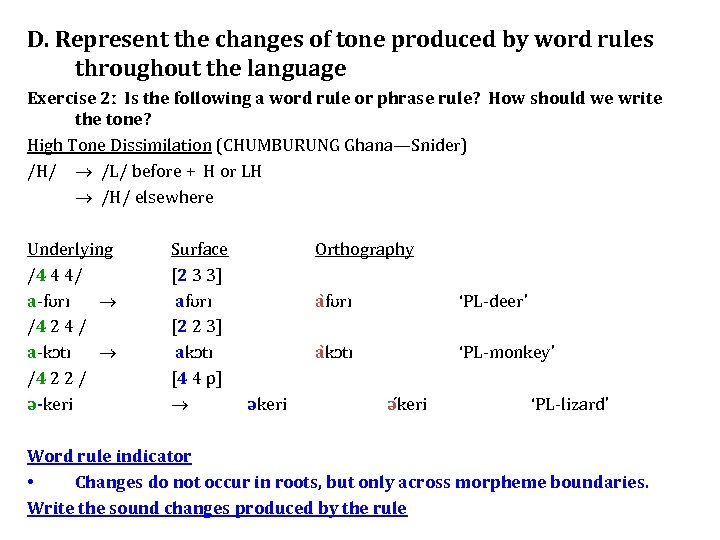
D. Represent the changes of tone produced by word rules throughout the language Exercise 2ː Is the following a word rule or phrase rule? How should we write the tone? High Tone Dissimilation (CHUMBURUNG Ghana—Snider) /H/ /L/ before + H or LH /H/ elsewhere Underlying /4 4 4/ a-fʊrɪ /4 2 4 / a-kɔtɪ /4 2 2 / ə-keri Surface [2 3 3] afʊrɪ [2 2 3] akɔtɪ [4 4 p] Orthography a fʊrɪ a kɔtɪ əkeri ‘PL-deer’ ‘PL-monkey’ ə keri ‘PL-lizard’ Word rule indicator • Changes do not occur in roots, but only across morpheme boundaries. Write the sound changes produced by the rule
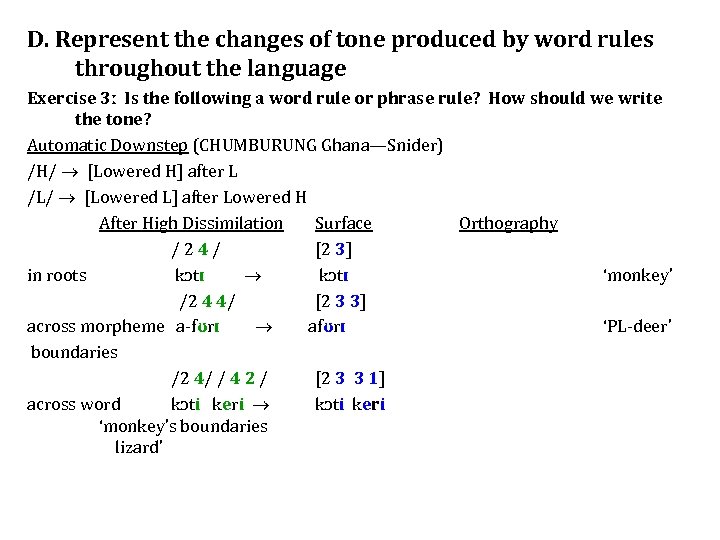
D. Represent the changes of tone produced by word rules throughout the language Exercise 3ː Is the following a word rule or phrase rule? How should we write the tone? Automatic Downstep (CHUMBURUNG Ghana—Snider) /H/ [Lowered H] after L /L/ [Lowered L] after Lowered H After High Dissimilation Surface Orthography /24/ [2 3] in roots kɔtɪ ‘monkey’ /2 4 4/ [2 3 3] across morpheme a-fʊrɪ afʊrɪ ‘PL-deer’ boundaries /2 4/ / 4 2 / [2 3 3 1] across word kɔti keri ‘monkey’s boundaries lizard’
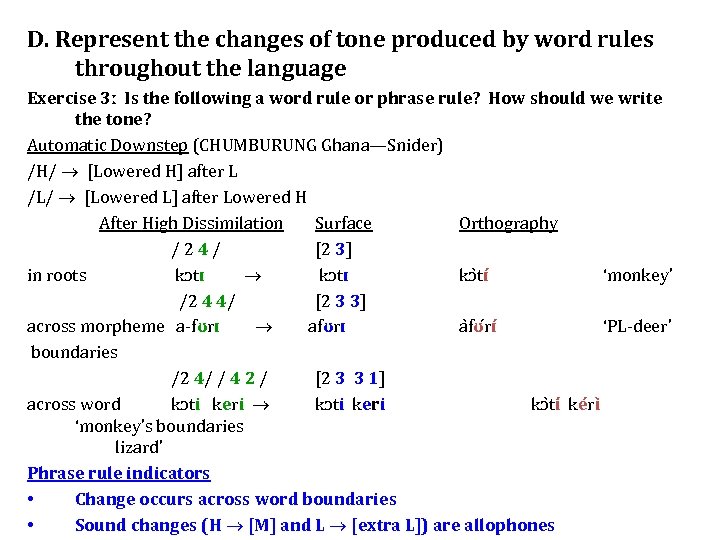
D. Represent the changes of tone produced by word rules throughout the language Exercise 3ː Is the following a word rule or phrase rule? How should we write the tone? Automatic Downstep (CHUMBURUNG Ghana—Snider) /H/ [Lowered H] after L /L/ [Lowered L] after Lowered H After High Dissimilation Surface Orthography /24/ [2 3] in roots kɔtɪ kɔ tɪ ‘monkey’ /2 4 4/ [2 3 3] across morpheme a-fʊrɪ afʊrɪ a fʊ rɪ ‘PL-deer’ boundaries /2 4/ / 4 2 / [2 3 3 1] across word kɔti keri kɔ ti ke ri ‘monkey’s boundaries lizard’ Phrase rule indicators • Change occurs across word boundaries • Sound changes (H [M] and L [extra L]) are allophones
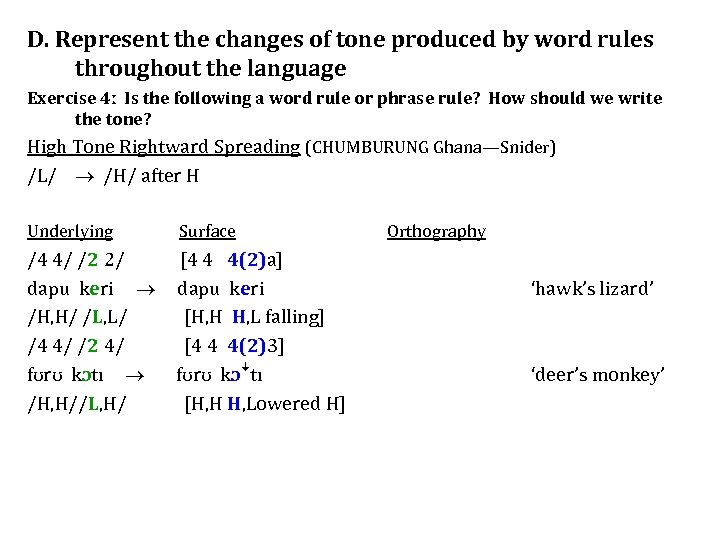
D. Represent the changes of tone produced by word rules throughout the language Exercise 4ː Is the following a word rule or phrase rule? How should we write the tone? High Tone Rightward Spreading (CHUMBURUNG Ghana—Snider) /L/ /H/ after H Underlying Surface /4 4/ /2 2/ dapu keri /H, H/ /L, L/ /4 4/ /2 4/ fʊrʊ kɔtɪ /H, H//L, H/ [4 4 4(2)a] dapu keri [H, H H, L falling] [4 4 4(2)3] fʊrʊ kɔꜜtɪ [H, H H, Lowered H] Orthography ‘hawk’s lizard’ ‘deer’s monkey’
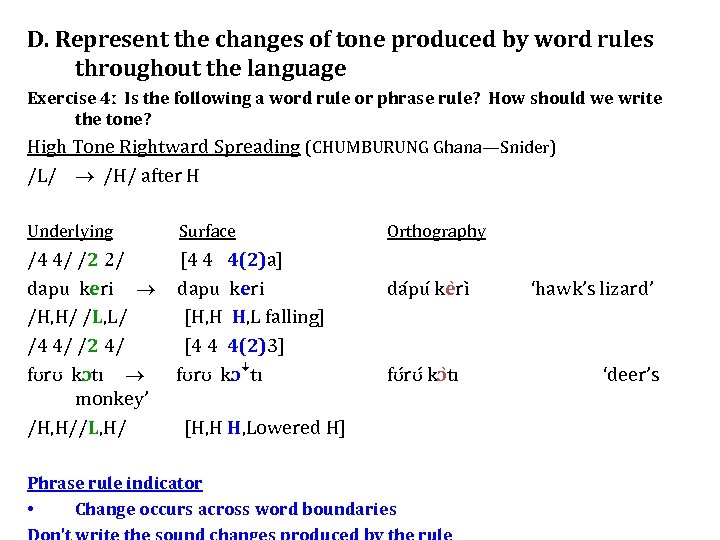
D. Represent the changes of tone produced by word rules throughout the language Exercise 4ː Is the following a word rule or phrase rule? How should we write the tone? High Tone Rightward Spreading (CHUMBURUNG Ghana—Snider) /L/ /H/ after H Underlying Surface /4 4/ /2 2/ dapu keri /H, H/ /L, L/ /4 4/ /2 4/ fʊrʊ kɔtɪ monkey’ /H, H//L, H/ [4 4 4(2)a] dapu keri [H, H H, L falling] [4 4 4(2)3] fʊrʊ kɔꜜtɪ Orthography da pu ke ri fʊ rʊ kɔ tɪ [H, H H, Lowered H] Phrase rule indicator • Change occurs across word boundaries ‘hawk’s lizard’ ‘deer’s
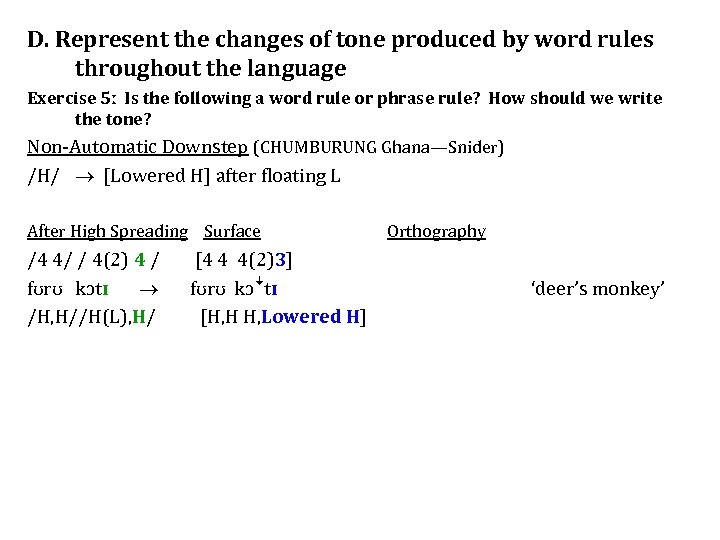
D. Represent the changes of tone produced by word rules throughout the language Exercise 5ː Is the following a word rule or phrase rule? How should we write the tone? Non-Automatic Downstep (CHUMBURUNG Ghana—Snider) /H/ [Lowered H] after floating L After High Spreading Surface /4 4/ / 4(2) 4 / fʊrʊ kɔtɪ /H, H//H(L), H/ [4 4 4(2)3] fʊrʊ kɔꜜtɪ [H, H H, Lowered H] Orthography ‘deer’s monkey’
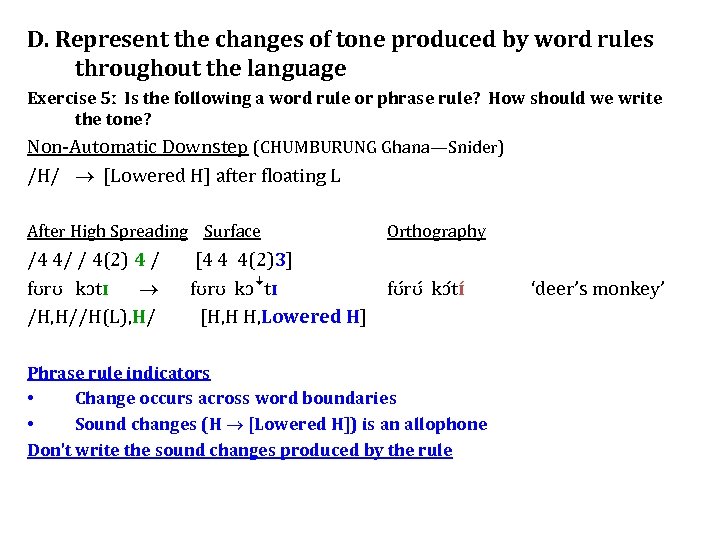
D. Represent the changes of tone produced by word rules throughout the language Exercise 5ː Is the following a word rule or phrase rule? How should we write the tone? Non-Automatic Downstep (CHUMBURUNG Ghana—Snider) /H/ [Lowered H] after floating L After High Spreading Surface /4 4/ / 4(2) 4 / fʊrʊ kɔtɪ /H, H//H(L), H/ Orthography [4 4 4(2)3] fʊrʊ kɔꜜtɪ fʊ rʊ kɔ tɪ [H, H H, Lowered H] Phrase rule indicators • Change occurs across word boundaries • Sound changes (H [Lowered H]) is an allophone Don’t write the sound changes produced by the rule ‘deer’s monkey’
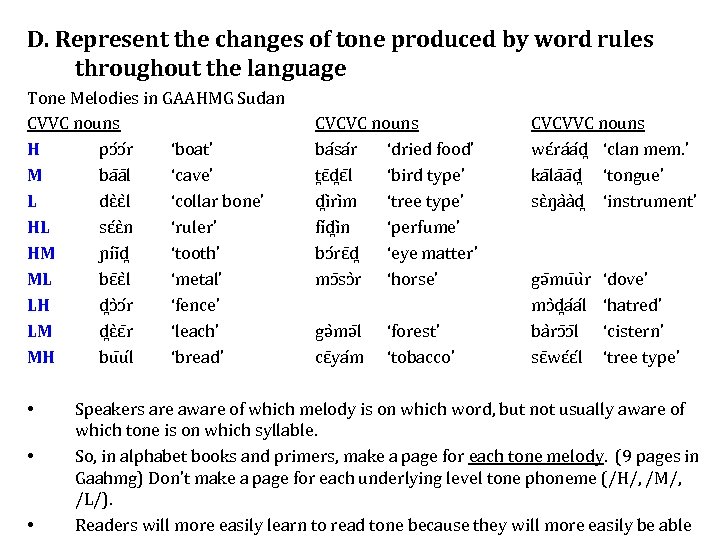
D. Represent the changes of tone produced by word rules throughout the language Tone Melodies in GAAHMG Sudan CVVC nouns H pɔ ɔ r ‘boat’ M ba a l ‘cave’ L dɛ ɛ l ‘collar bone’ HL sɛ ɛ n ‘ruler’ HM ɲi i d ‘tooth’ ML bɛ ɛ l ‘metal’ LH d ɔ ɔ r ‘fence’ LM d ɛ ɛ r ‘leach’ MH bu u l ‘bread’ • • • CVCVC nouns ba sa r ‘dried food’ t ɛ d ɛ l ‘bird type’ d i ri m ‘tree type’ fi d i n ‘perfume’ bɔ rɛ d ‘eye matter’ mɔ sɔ r ‘horse’ gə mə l cɛ ya m ‘forest’ ‘tobacco’ CVCVVC nouns wɛ ra a d ‘clan mem. ’ ka la a d ‘tongue’ sɛ ŋa a d ‘instrument’ gə mu u r mɔ d a a l ba rɔ ɔ l sɛ wɛ ɛ l ‘dove’ ‘hatred’ ‘cistern’ ‘tree type’ Speakers are aware of which melody is on which word, but not usually aware of which tone is on which syllable. So, in alphabet books and primers, make a page for each tone melody. (9 pages in Gaahmg) Don’t make a page for each underlying level tone phoneme (/H/, /M/, /L/). Readers will more easily learn to read tone because they will more easily be able
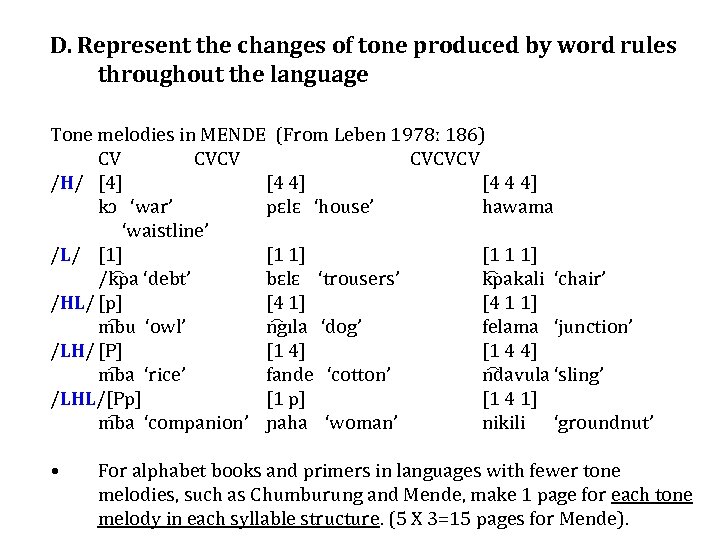
D. Represent the changes of tone produced by word rules throughout the language Tone melodies in MENDE (From Leben 1978ː 186) CV CVCVCV /H/ [4] [4 4 4] kɔ ‘war’ pɛlɛ ‘house’ hawama ‘waistline’ /L/ [1] [1 1 1] /k pa ‘debt’ bɛlɛ ‘trousers’ k pakali ‘chair’ /HL/ [p] [4 1 1] m bu ‘owl’ n gɪla ‘dog’ felama ‘junction’ /LH/ [P] [1 4 4] m ba ‘rice’ fande ‘cotton’ n davula ‘sling’ /LHL/[Pp] [1 4 1] m ba ‘companion’ ɲaha ‘woman’ nikili ‘groundnut’ • For alphabet books and primers in languages with fewer tone melodies, such as Chumburung and Mende, make 1 page for each tone melody in each syllable structure. (5 X 3=15 pages for Mende).
Steps for finding how to write differences in meaning made by tone (3 of 3) 17. Study the Tone System G. Decide if/how to write tone in the orthography. 1. Based on the functional load of tone, choose one of the following optionsː A. No representation of tone in the orthography after testing B. Only represent tone on tone minimal pairs that are function words (part of speech with few words) C. Only represent the grammatical differences made by tone with diacritics or punctuation D. Represent the changes of tone produced by word rules throughout the language 2. Test the orthography and revise accordingly.
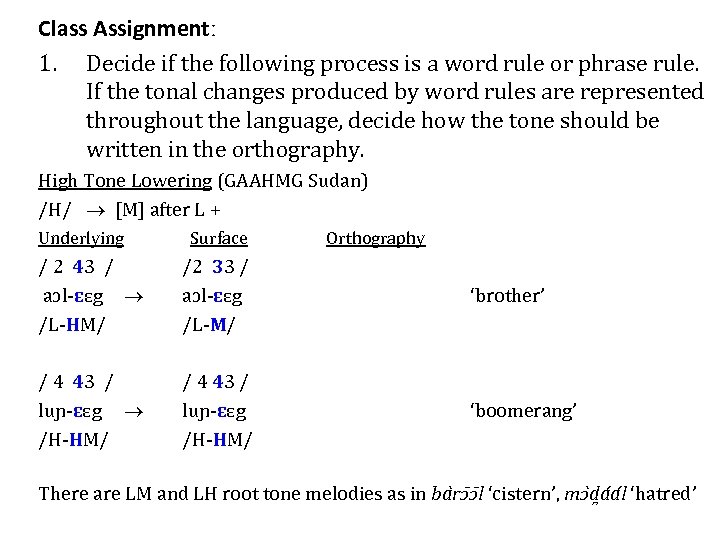
Class Assignmentː 1. Decide if the following process is a word rule or phrase rule. If the tonal changes produced by word rules are represented throughout the language, decide how the tone should be written in the orthography. High Tone Lowering (GAAHMG Sudan) /H/ [M] after L + Underlying Surface Orthography / 2 43 / aɔl-ɛɛg /L-HM/ /2 33 / aɔl-ɛɛg /L-M/ ‘brother’ / 4 43 / luɲ-ɛɛg /H-HM/ / 4 43 / luɲ-ɛɛg /H-HM/ ‘boomerang’ There are LM and LH root tone melodies as in ba rɔ ɔ l ‘cistern’, mɔ d a a l ‘hatred’
Скачать презентацию Grammatical Tone Assignment Answersː Present pronouns o you
474210f49396a591efd00390f0df2ff5.ppt