


 Скачать презентацию Grammatical category of voice As a grammatical
Passive Voice.ppt
- Количество слайдов: 12
 Grammatical category of voice • As a grammatical category voice is the form of • the verb which shows the relation between the action and its subject indicating whether the action is performed by the subject or passes on to it. There are two voices in English: the active and the passive. The active voice shows that the action is performed by its subject, that the subject is the doer of the action. The passive voice shows that the subject is acted upon, that it is the recipient of the action, e. g. : I wrote a letter. A letter was written by me.
 Passive Voice • The choice of the passive construction is often • • due to the fact that the agent is unknown or the speaker prefers not to speak of him. Sometimes the agent is dropped altogether when it is unknown, well knows or unimportant. Only the passive makes this economy possible. The passive voice is expressed by analytic combinations of the auxiliary verb be with the past participle of the notional verb. to be +Past Participle
 Get + Past Participle • The verb get can function in a manner very similar with be, e. g. : My dress got caught on a nail. – He got struck by a stone. • To get seems closer to the true passive auxiliary to be in patterns like the following: She got blamed for everything. She gets teased by the other children. He gets punished regularly. - • But with all the similarity of the two verbs used in such patterns get is unlike be in the primary paradigm. We can say, for instance, He gets punished regularly, but we shall hardly attest Gets he punished regularly?
 Become + past participle • The group to become + past participle expresses primarily state, e. g. : 1) The umbrella is not a possession lightly to be lost. Yet lost it becomes although it should not. 2) I have become very sunburnt. -
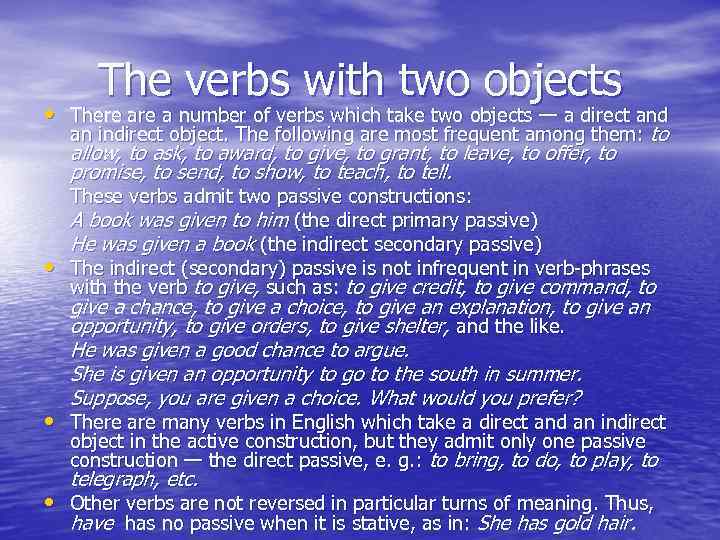 The verbs with two objects • There a number of verbs which take two objects — a direct and an indirect object. The following are most frequent among them: to allow, to ask, to award, to give, to grant, to leave, to offer, to promise, to send, to show, to teach, to tell. • These verbs admit two passive constructions: A book was given to him (the direct primary passive) He was given a book (the indirect secondary passive) The indirect (secondary) passive is not infrequent in verb-phrases with the verb to give, such as: to give credit, to give command, to give a chance, to give a choice, to give an explanation, to give an opportunity, to give orders, to give shelter, and the like. He was given a good chance to argue. She is given an opportunity to go to the south in summer. Suppose, you are given a choice. What would you prefer? • There are many verbs in English which take a direct and an indirect object in the active construction, but they admit only one passive construction — the direct passive, e. g. : to bring, to do, to play, to telegraph, etc. • Other verbs are not reversed in particular turns of meaning. Thus, have has no passive when it is stative, as in: She has gold hair.
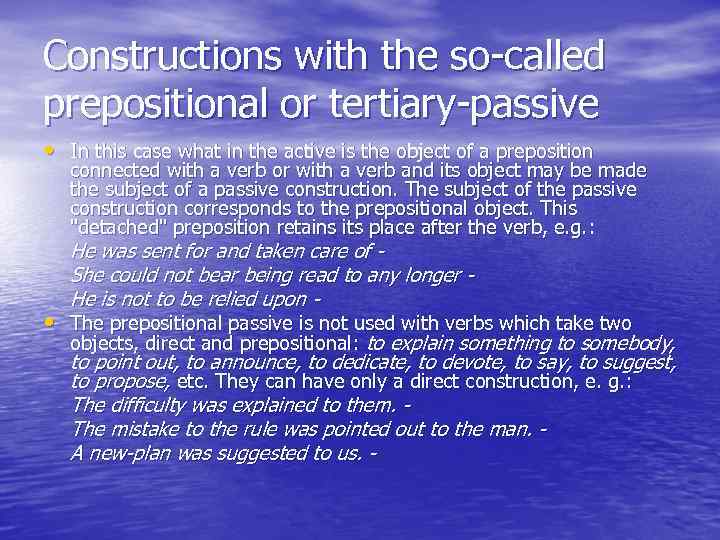 Constructions with the so-called prepositional or tertiary-passive • In this case what in the active is the object of a preposition connected with a verb or with a verb and its object may be made the subject of a passive construction. The subject of the passive construction corresponds to the prepositional object. This "detached" preposition retains its place after the verb, e. g. : He was sent for and taken care of She could not bear being read to any longer He is not to be relied upon - • The prepositional passive is not used with verbs which take two objects, direct and prepositional: to explain something to somebody, to point out, to announce, to dedicate, to devote, to say, to suggest, to propose, etc. They can have only a direct construction, e. g. : The difficulty was explained to them. The mistake to the rule was pointed out to the man. A new-plan was suggested to us. -
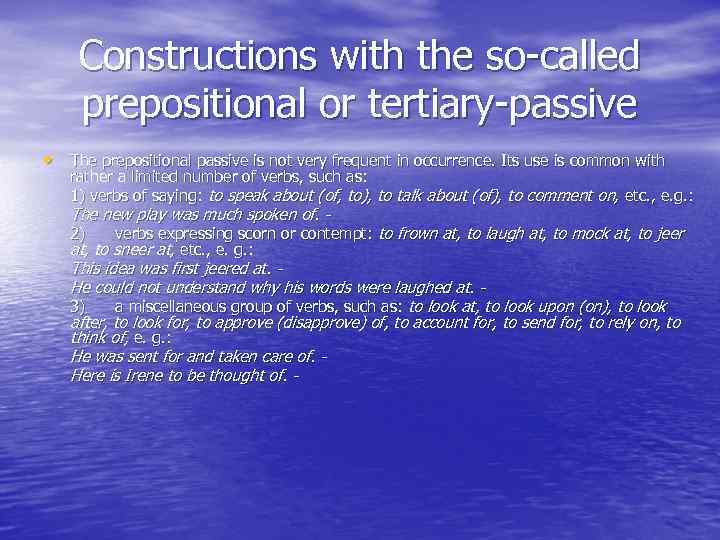 Constructions with the so-called prepositional or tertiary-passive • The prepositional passive is not very frequent in occurrence. Its use is common with rather a limited number of verbs, such as: 1) verbs of saying: to speak about (of, to), to talk about (of), to comment on, etc. , e. g. : The new play was much spoken of. - verbs expressing scorn or contempt: to frown at, to laugh at, to mock at, to jeer at, to sneer at, etc. , e. g. : 2) This idea was first jeered at. He could not understand why his words were laughed at. 3) a miscellaneous group of verbs, such as: to look at, to look upon (on), to look after, to look for, to approve (disapprove) of, to account for, to send for, to rely on, to think of, e. g. : He was sent for and taken care of. Here is Irene to be thought of. -
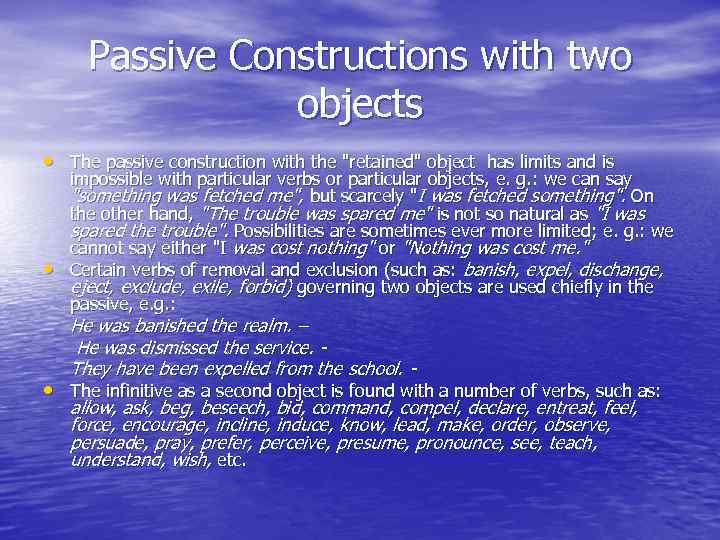 Passive Constructions with two objects • The passive construction with the "retained" object has limits and is • impossible with particular verbs or particular objects, e. g. : we can say "something was fetched me", but scarcely "I was fetched something". On the other hand, "The trouble was spared me" is not so natural as "I was spared the trouble". Possibilities are sometimes ever more limited; e. g. : we cannot say either "I was cost nothing" or "Nothing was cost me. " Certain verbs of removal and exclusion (such as: banish, expel, dischange, eject, exclude, exile, forbid) governing two objects are used chiefly in the passive, e. g. : He was banished the realm. – He was dismissed the service. They have been expelled from the school. - • The infinitive as a second object is found with a number of verbs, such as: allow, ask, beg, beseech, bid, command, compel, declare, entreat, feel, force, encourage, incline, induce, know, lead, make, order, observe, persuade, pray, prefer, perceive, presume, pronounce, see, teach, understand, wish, etc.
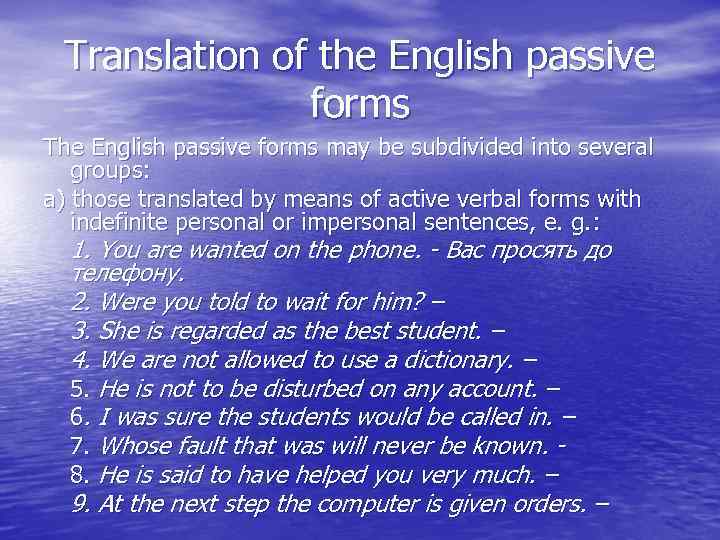 Translation of the English passive forms The English passive forms may be subdivided into several groups: a) those translated by means of active verbal forms with indefinite personal or impersonal sentences, e. g. : 1. You are wanted on the phone. - Вас просять до телефону. 2. Were you told to wait for him? – 3. She is regarded as the best student. – 4. We are not allowed to use a dictionary. – 5. Не is not to be disturbed on any account. – 6. I was sure the students would be called in. – 7. Whose fault that was will never be known. 8. He is said to have helped you very much. – 9. At the next step the computer is given orders. –
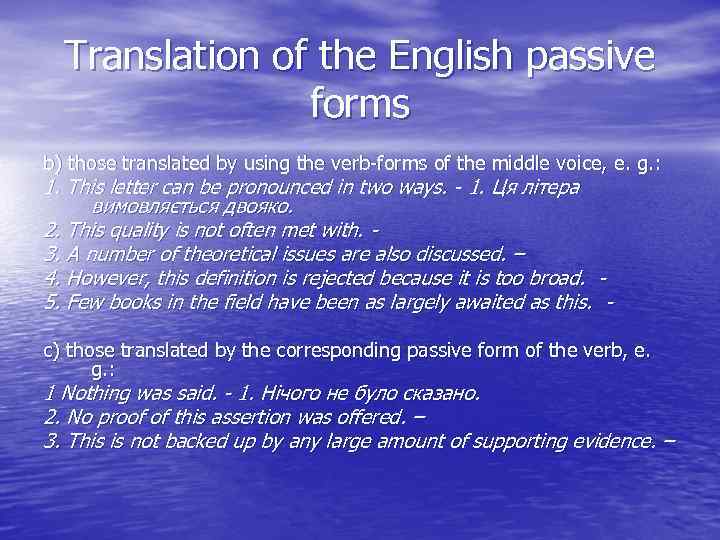 Translation of the English passive forms b) those translated by using the verb-forms of the middle voice, e. g. : 1. This letter can be pronounced in two ways. - 1. Ця літера вимовляється двояко. 2. This quality is not often met with. 3. A number of theoretical issues are also discussed. – 4. However, this definition is rejected because it is too broad. 5. Few books in the field have been as largely awaited as this. - c) those translated by the corresponding passive form of the verb, e. g. : 1 Nothing was said. - 1. Нічого не було сказано. 2. No proof of this assertion was offered. – 3. This is not backed up by any large amount of supporting evidence. –
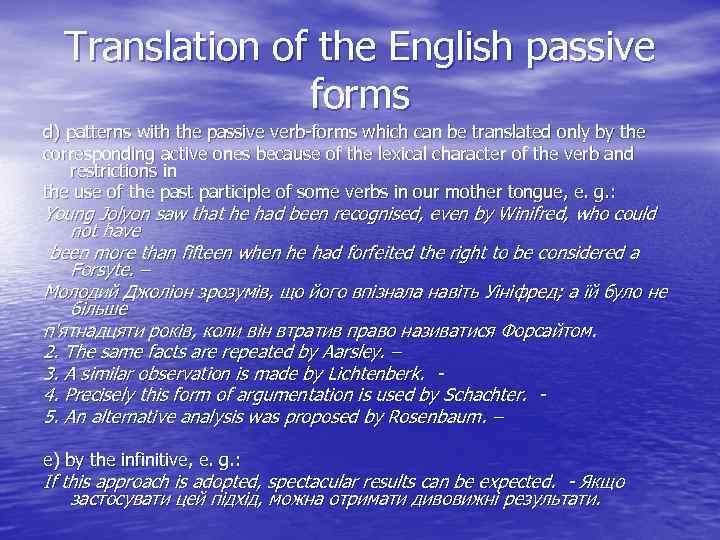 Translation of the English passive forms d) patterns with the passive verb-forms which can be translated only by the corresponding active ones because of the lexical character of the verb and restrictions in the use of the past participle of some verbs in our mother tongue, e. g. : Young Jolyon saw that he had been recognised, even by Winifred, who could not have been more than fifteen when he had forfeited the right to be considered a Forsyte. – Молодий Джоліон зрозумів, що його впізнала навіть Уініфред; а їй було не більше п'ятнадцяти років, коли він втратив право називатися Форсайтом. 2. The same facts are repeated by Aarsley. – 3. A similar observation is made by Lichtenberk. 4. Precisely this form of argumentation is used by Schachter. 5. An alternative analysis was proposed by Rosenbaum. – e) by the infinitive, e. g. : If this approach is adopted, spectacular results can be expected. - Якщо застосувати цей підхід, можна отримати дивовижні результати.
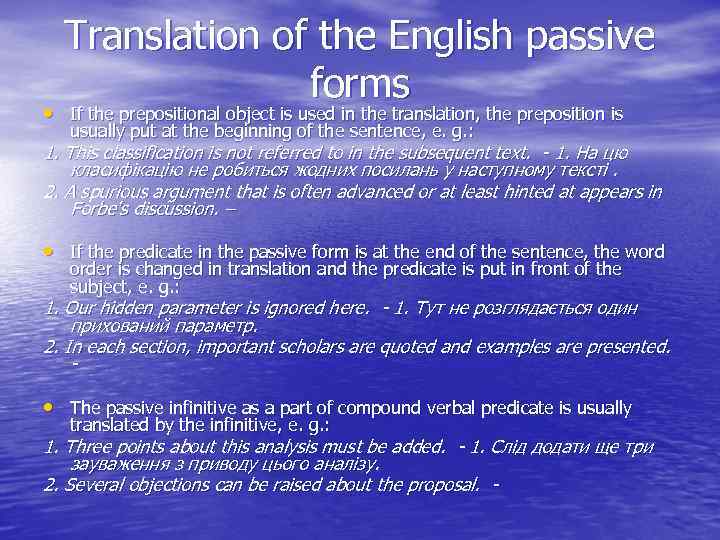 Translation of the English passive forms • If the prepositional object is used in the translation, the preposition is usually put at the beginning of the sentence, e. g. : 1. This classification is not referred to in the subsequent text. - 1. На цю класифікацію не робиться жодних посилань у наступному тексті. 2. A spurious argument that is often advanced or at least hinted at appears in Forbe's discussion. – • If the predicate in the passive form is at the end of the sentence, the word order is changed in translation and the predicate is put in front of the subject, e. g. : 1. Our hidden parameter is ignored here. - 1. Тут не розглядається один прихований параметр. 2. In each section, important scholars are quoted and examples are presented. - • The passive infinitive as a part of compound verbal predicate is usually translated by the infinitive, e. g. : 1. Three points about this analysis must be added. - 1. Слід додати ще три зауваження з приводу цього аналізу. 2. Several objections can be raised about the proposal. -