 Скачать презентацию Grammar Menu Commands Talking about the future Reflexive
bf0f284bf66db5ba20221709d4897df6.ppt
- Количество слайдов: 67



Grammar Menu Commands Talking about the future Reflexive verbs in the perfect tense En + present participle The imperfect tense Using the perfect and imperfect tenses together Time expressions The comparative and the superlative Qui and que The conditional tense © Boardworks Ltd 2003
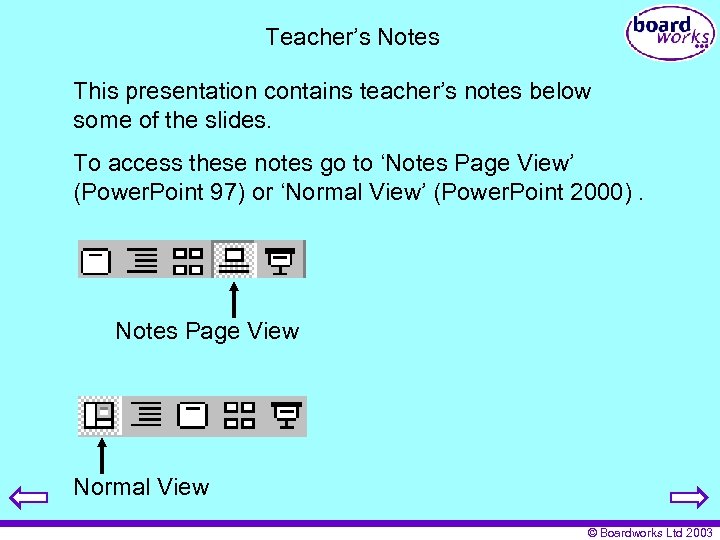
Teacher’s Notes This presentation contains teacher’s notes below some of the slides. To access these notes go to ‘Notes Page View’ (Power. Point 97) or ‘Normal View’ (Power. Point 2000). Notes Page View Normal View © Boardworks Ltd 2003
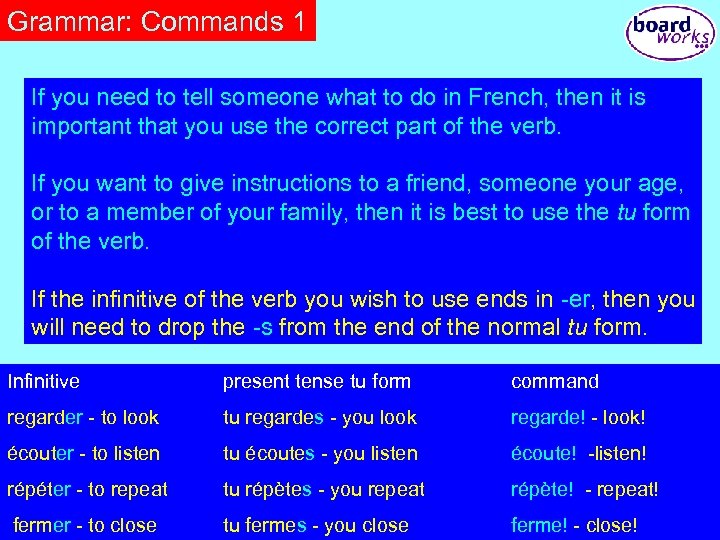
Grammar: Commands 1 If you need to tell someone what to do in French, then it is important that you use the correct part of the verb. If you want to give instructions to a friend, someone your age, or to a member of your family, then it is best to use the tu form of the verb. If the infinitive of the verb you wish to use ends in -er, then you will need to drop the -s from the end of the normal tu form. Infinitive present tense tu form command regarder - to look tu regardes - you look regarde! - look! écouter - to listen tu écoutes - you listen écoute! -listen! répéter - to repeat tu répètes - you repeat répète! - repeat! fermer - to close tu fermes - you close ferme! - close! Ltd 2003 © Boardworks
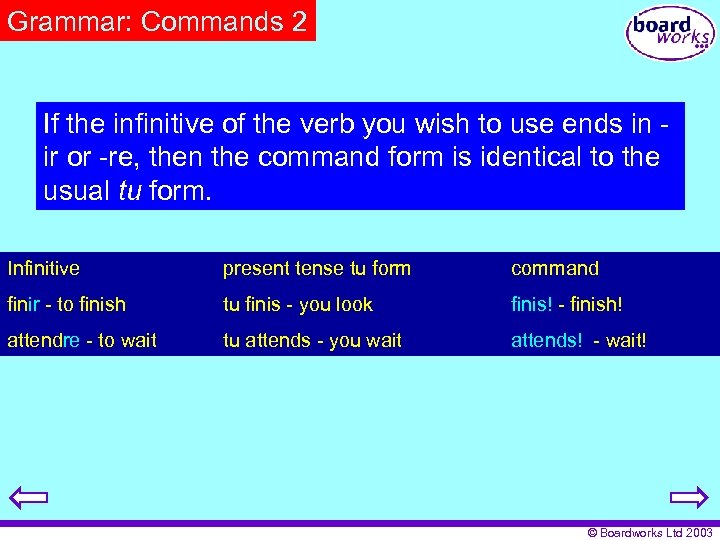
Grammar: Commands 2 If the infinitive of the verb you wish to use ends in ir or -re, then the command form is identical to the usual tu form. Infinitive present tense tu form command finir - to finish tu finis - you look finis! - finish! attendre - to wait tu attends - you wait attends! - wait! © Boardworks Ltd 2003
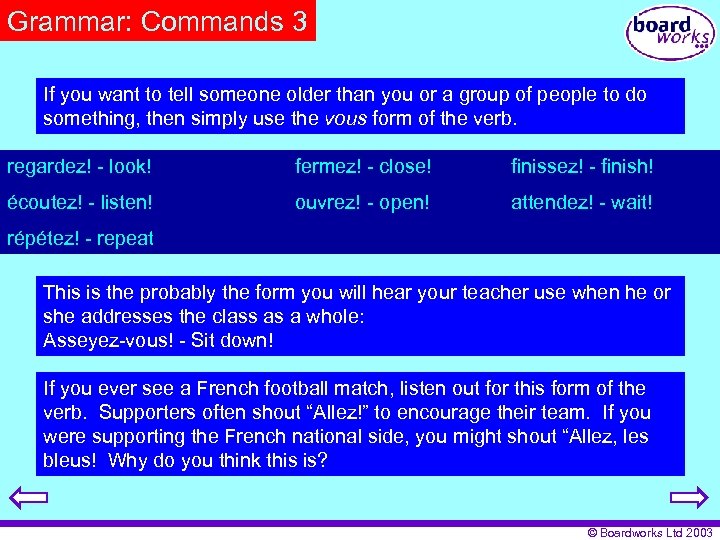
Grammar: Commands 3 If you want to tell someone older than you or a group of people to do something, then simply use the vous form of the verb. regardez! - look! fermez! - close! finissez! - finish! écoutez! - listen! ouvrez! - open! attendez! - wait! répétez! - repeat This is the probably the form you will hear your teacher use when he or she addresses the class as a whole: Asseyez-vous! - Sit down! If you ever see a French football match, listen out for this form of the verb. Supporters often shout “Allez!” to encourage their team. If you were supporting the French national side, you might shout “Allez, les bleus! Why do you think this is? © Boardworks Ltd 2003
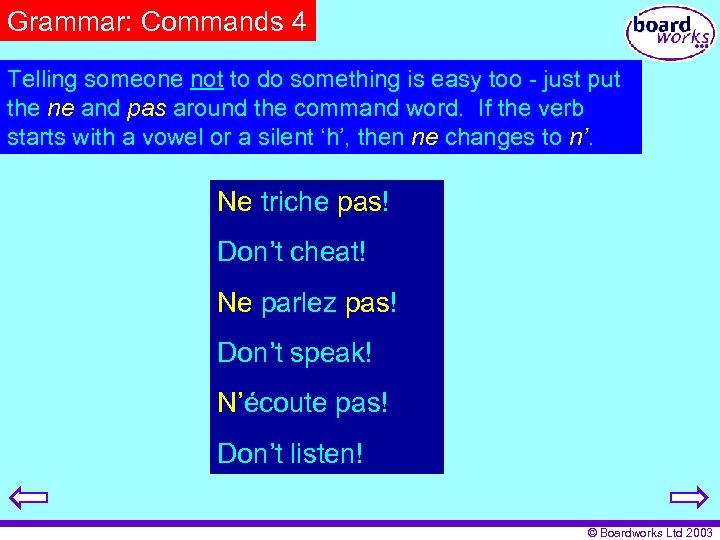
Grammar: Commands 4 Telling someone not to do something is easy too - just put the ne and pas around the command word. If the verb starts with a vowel or a silent ‘h’, then ne changes to n’. Ne triche pas! Don’t cheat! Ne parlez pas! Don’t speak! N’écoute pas! Don’t listen! © Boardworks Ltd 2003
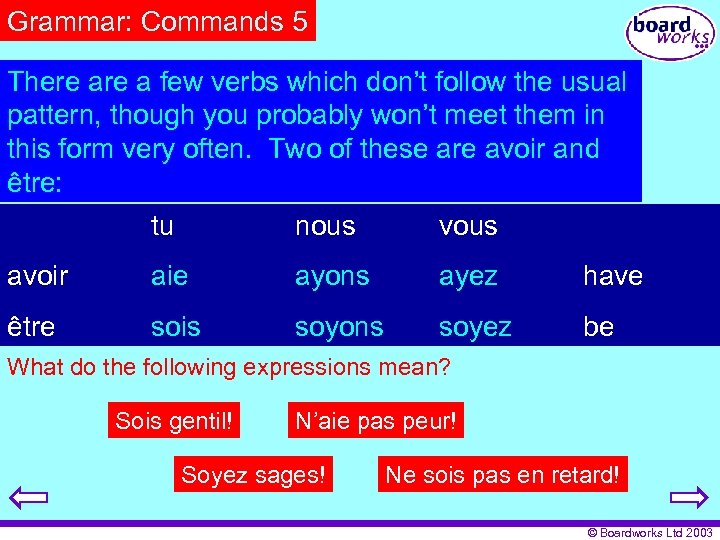
Grammar: Commands 5 There a few verbs which don’t follow the usual pattern, though you probably won’t meet them in this form very often. Two of these are avoir and être: tu nous vous avoir aie ayons ayez have être sois soyons soyez be What do the following expressions mean? Sois gentil! N’aie pas peur! Soyez sages! Ne sois pas en retard! © Boardworks Ltd 2003
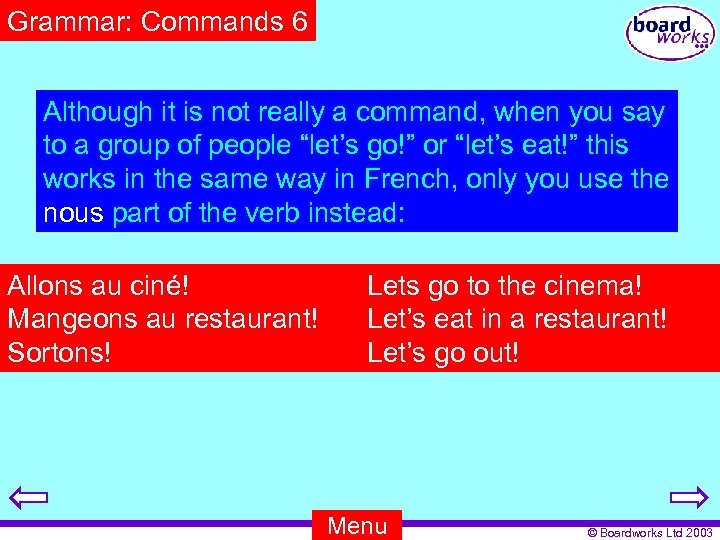
Grammar: Commands 6 Although it is not really a command, when you say to a group of people “let’s go!” or “let’s eat!” this works in the same way in French, only you use the nous part of the verb instead: Allons au ciné! Mangeons au restaurant! Sortons! Lets go to the cinema! Let’s eat in a restaurant! Let’s go out! Menu © Boardworks Ltd 2003
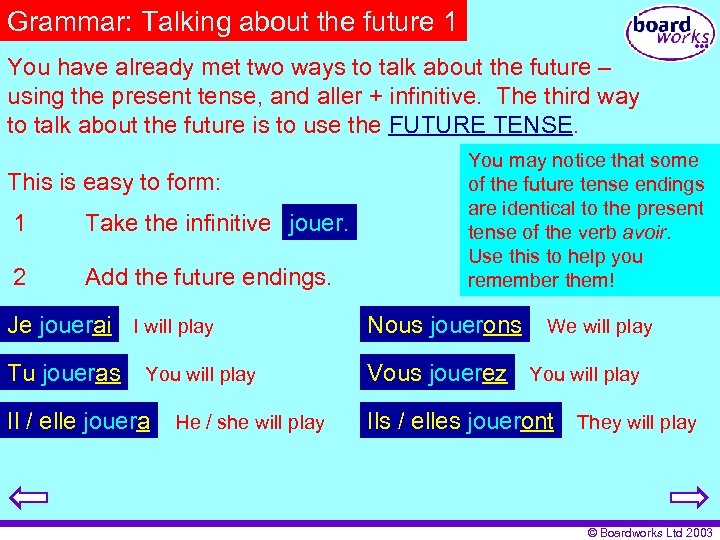
Grammar: Talking about the future 1 You have already met two ways to talk about the future – using the present tense, and aller + infinitive. The third way to talk about the future is to use the FUTURE TENSE. This is easy to form: 1 Take the infinitive jouer. 2 Add the future endings. You may notice that some of the future tense endings are identical to the present tense of the verb avoir. Use this to help you remember them! Je jouerai I will play Nous jouerons Tu joueras Vous jouerez You will play Il / elle jouera He / she will play We will play Ils / elles joueront They will play © Boardworks Ltd 2003
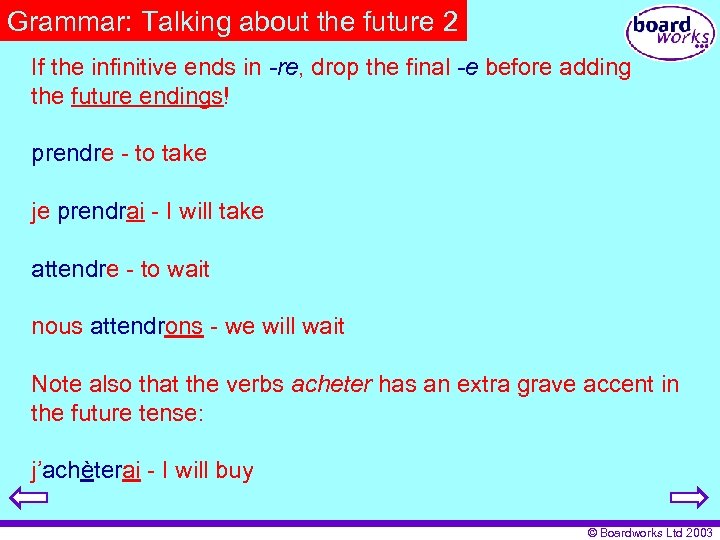
Grammar: Talking about the future 2 If the infinitive ends in -re, drop the final -e before adding the future endings! prendre - to take je prendrai - I will take attendre - to wait nous attendrons - we will wait Note also that the verbs acheter has an extra grave accent in the future tense: j’achèterai - I will buy © Boardworks Ltd 2003
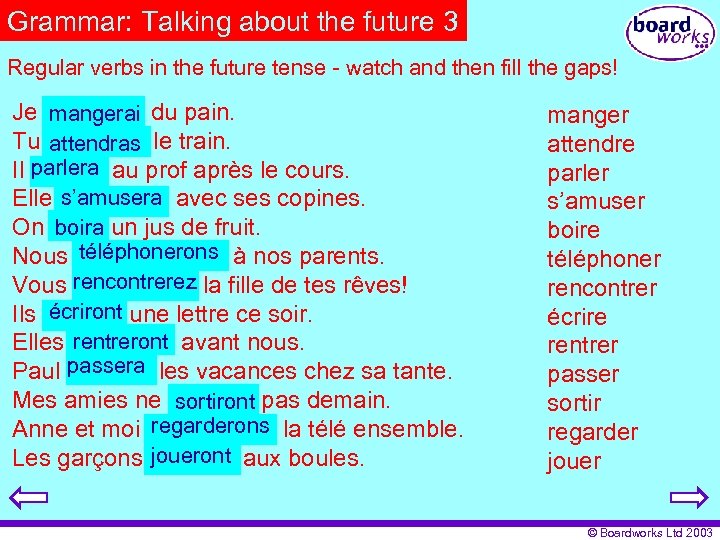
Grammar: Talking about the future 3 Regular verbs in the future tense - watch and then fill the gaps! Je mangerai du pain. mangerai Tu attendras le train. attendras parlera Il parlera au prof après le cours. s’amusera Elle s’amusera avec ses copines. boira On boira un jus de fruit. téléphonerons Nous téléphonerons à nos parents. Vous rencontrerez la fille de tes rêves! rencontrera écriront Ils écriront une lettre ce soir. rentreront Elles rentreront avant nous. passera Paul passera les vacances chez sa tante. Mes amies ne sortiront pas demain. sortiront regarderons Anne et moi regarderons la télé ensemble. joueront Les garçons joueront aux boules. manger attendre parler s’amuser boire téléphoner rencontrer écrire rentrer passer sortir regarder jouer © Boardworks Ltd 2003
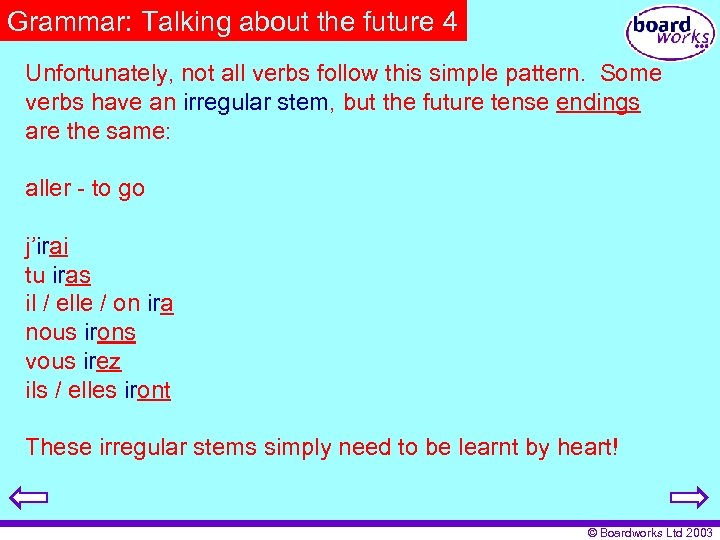
Grammar: Talking about the future 4 Unfortunately, not all verbs follow this simple pattern. Some verbs have an irregular stem, but the future tense endings are the same: aller - to go j’irai tu iras il / elle / on ira nous irons vous irez ils / elles iront These irregular stems simply need to be learnt by heart! © Boardworks Ltd 2003
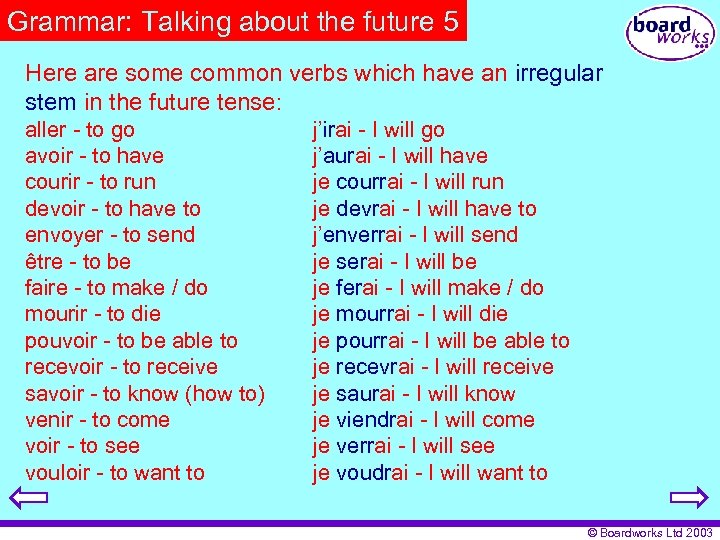
Grammar: Talking about the future 5 Here are some common verbs which have an irregular stem in the future tense: aller - to go avoir - to have courir - to run devoir - to have to envoyer - to send être - to be faire - to make / do mourir - to die pouvoir - to be able to recevoir - to receive savoir - to know (how to) venir - to come voir - to see vouloir - to want to j’irai - I will go j’aurai - I will have je courrai - I will run je devrai - I will have to j’enverrai - I will send je serai - I will be je ferai - I will make / do je mourrai - I will die je pourrai - I will be able to je recevrai - I will receive je saurai - I will know je viendrai - I will come je verrai - I will see je voudrai - I will want to © Boardworks Ltd 2003
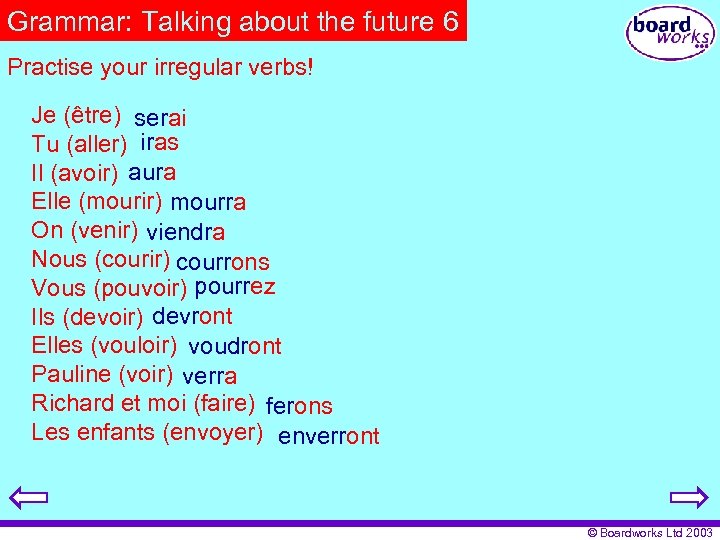
Grammar: Talking about the future 6 Practise your irregular verbs! Je (être) serai Tu (aller) iras Il (avoir) aura Elle (mourir) mourra On (venir) viendra Nous (courir) courrons Vous (pouvoir) pourrez Ils (devoir) devront Elles (vouloir) voudront Pauline (voir) verra Richard et moi (faire) ferons Les enfants (envoyer) enverront © Boardworks Ltd 2003
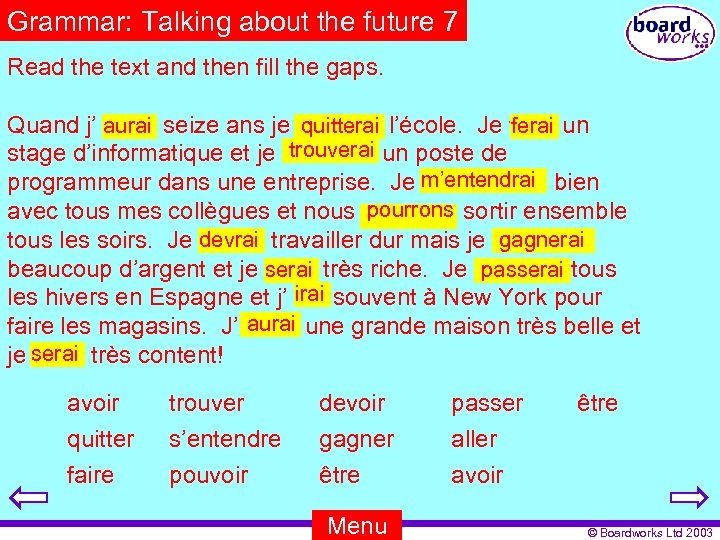
Grammar: Talking about the future 7 Read the text and then fill the gaps. Quand j’ aurai seize ans je quitterai l’école. Je ferai un aurai quitterai ferai trouverai stage d’informatique et je trouverai un poste de programmeur dans une entreprise. Je m’entendrai bien m’entendrai pourrons avec tous mes collègues et nous pourrons sortir ensemble gagnerai tous les soirs. Je devrai travailler dur mais je gagnerai devrai beaucoup d’argent et je serai très riche. Je passerai tous serai passerai irai les hivers en Espagne et j’ irai souvent à New York pour aurai faire les magasins. J’ aurai une grande maison très belle et je serai très content! serai avoir quitter faire trouver s’entendre pouvoir devoir gagner être Menu passer aller avoir être © Boardworks Ltd 2003
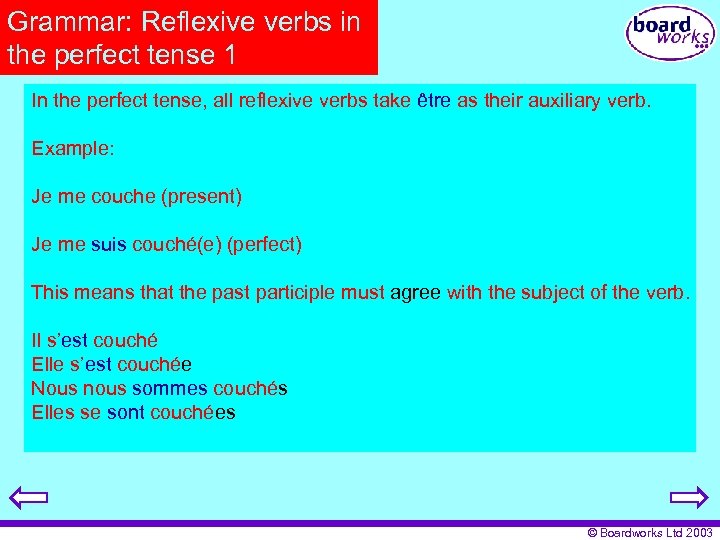
Grammar: Reflexive verbs in the perfect tense 1 In the perfect tense, all reflexive verbs take être as their auxiliary verb. Example: Je me couche (present) Je me suis couché(e) (perfect) This means that the past participle must agree with the subject of the verb. Il s’est couché Elle s’est couchée Nous nous sommes couchés Elles se sont couchées © Boardworks Ltd 2003
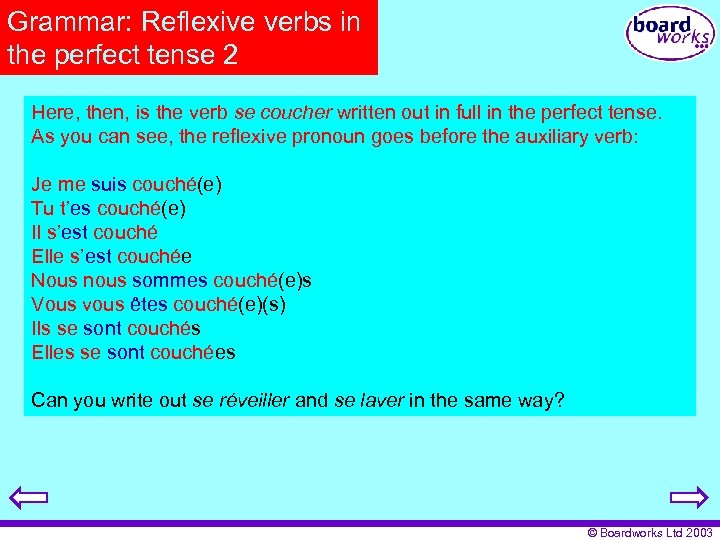
Grammar: Reflexive verbs in the perfect tense 2 Here, then, is the verb se coucher written out in full in the perfect tense. As you can see, the reflexive pronoun goes before the auxiliary verb: Je me suis couché(e) Tu t’es couché(e) Il s’est couché Elle s’est couchée Nous nous sommes couché(e)s Vous vous êtes couché(e)(s) Ils se sont couchés Elles se sont couchées Can you write out se réveiller and se laver in the same way? © Boardworks Ltd 2003
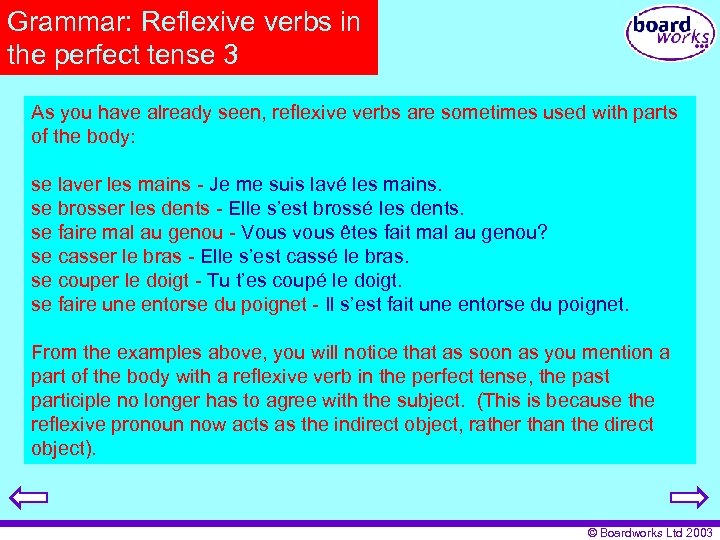
Grammar: Reflexive verbs in the perfect tense 3 As you have already seen, reflexive verbs are sometimes used with parts of the body: se laver les mains - Je me suis lavé les mains. se brosser les dents - Elle s’est brossé les dents. se faire mal au genou - Vous vous êtes fait mal au genou? se casser le bras - Elle s’est cassé le bras. se couper le doigt - Tu t’es coupé le doigt. se faire une entorse du poignet - Il s’est fait une entorse du poignet. From the examples above, you will notice that as soon as you mention a part of the body with a reflexive verb in the perfect tense, the past participle no longer has to agree with the subject. (This is because the reflexive pronoun now acts as the indirect object, rather than the direct object). © Boardworks Ltd 2003
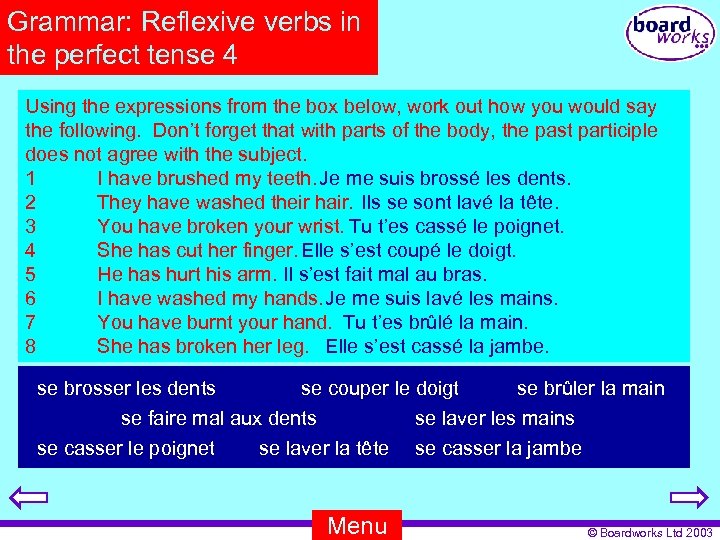
Grammar: Reflexive verbs in the perfect tense 4 Using the expressions from the box below, work out how you would say the following. Don’t forget that with parts of the body, the past participle does not agree with the subject. 1 I have brushed my teeth. Je me suis brossé les dents. 2 They have washed their hair. Ils se sont lavé la tête. 3 You have broken your wrist. Tu t’es cassé le poignet. 4 She has cut her finger. Elle s’est coupé le doigt. 5 He has hurt his arm. Il s’est fait mal au bras. 6 I have washed my hands. Je me suis lavé les mains. 7 You have burnt your hand. Tu t’es brûlé la main. 8 She has broken her leg. Elle s’est cassé la jambe. se brosser les dents se couper le doigt se brûler la main se faire mal aux dents se laver les mains se casser le poignet se laver la tête se casser la jambe Menu © Boardworks Ltd 2003
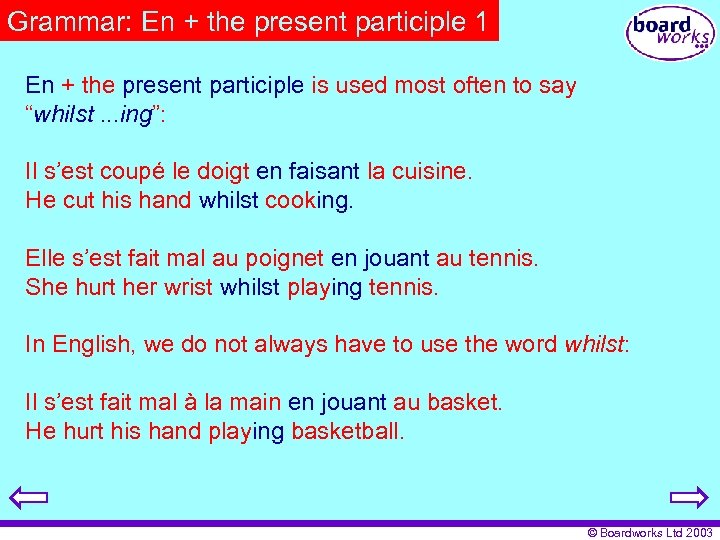
Grammar: En + the present participle 1 En + the present participle is used most often to say “whilst. . . ing”: Il s’est coupé le doigt en faisant la cuisine. He cut his hand whilst cooking. Elle s’est fait mal au poignet en jouant au tennis. She hurt her wrist whilst playing tennis. In English, we do not always have to use the word whilst: Il s’est fait mal à la main en jouant au basket. He hurt his hand playing basketball. © Boardworks Ltd 2003
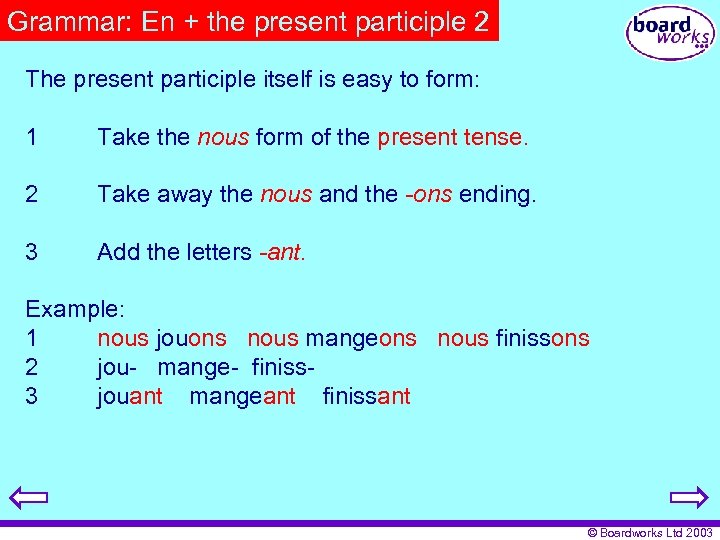
Grammar: En + the present participle 2 The present participle itself is easy to form: 1 Take the nous form of the present tense. 2 Take away the nous and the -ons ending. 3 Add the letters -ant. Example: 1 nous jouons nous mangeons nous finissons 2 jou- mange- finiss 3 jouant mangeant finissant © Boardworks Ltd 2003
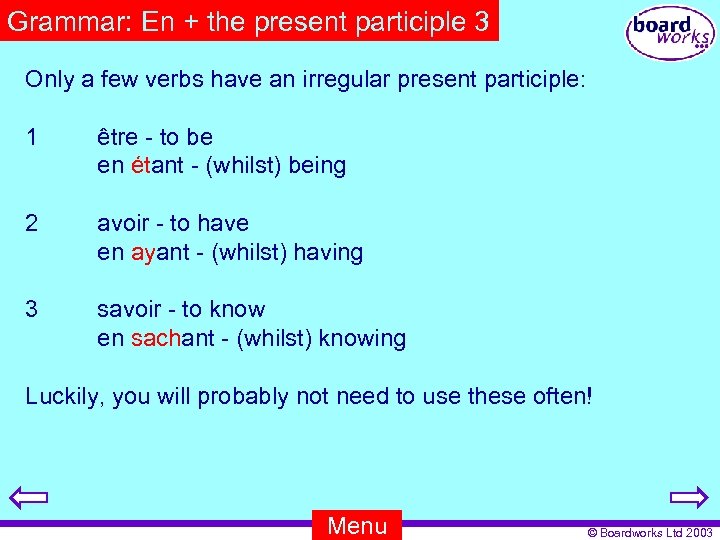
Grammar: En + the present participle 3 Only a few verbs have an irregular present participle: 1 être - to be en étant - (whilst) being 2 avoir - to have en ayant - (whilst) having 3 savoir - to know en sachant - (whilst) knowing Luckily, you will probably not need to use these often! Menu © Boardworks Ltd 2003
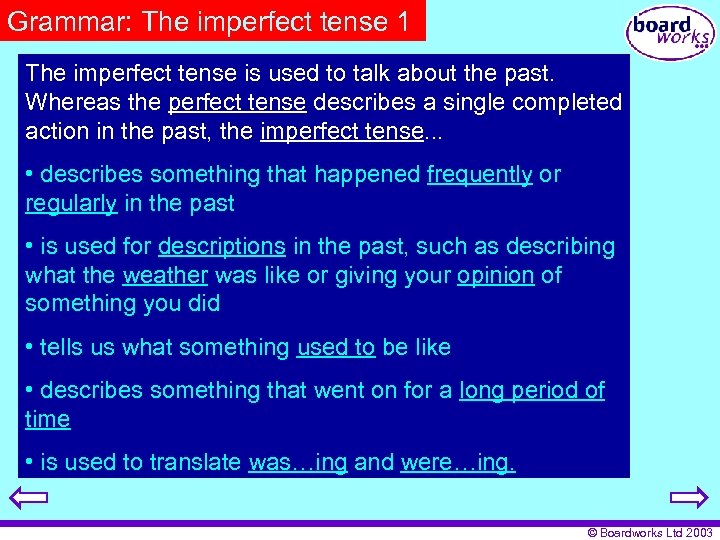
Grammar: The imperfect tense 1 The imperfect tense is used to talk about the past. Whereas the perfect tense describes a single completed action in the past, the imperfect tense. . . • describes something that happened frequently or regularly in the past • is used for descriptions in the past, such as describing what the weather was like or giving your opinion of something you did • tells us what something used to be like • describes something that went on for a long period of time • is used to translate was…ing and were…ing. © Boardworks Ltd 2003
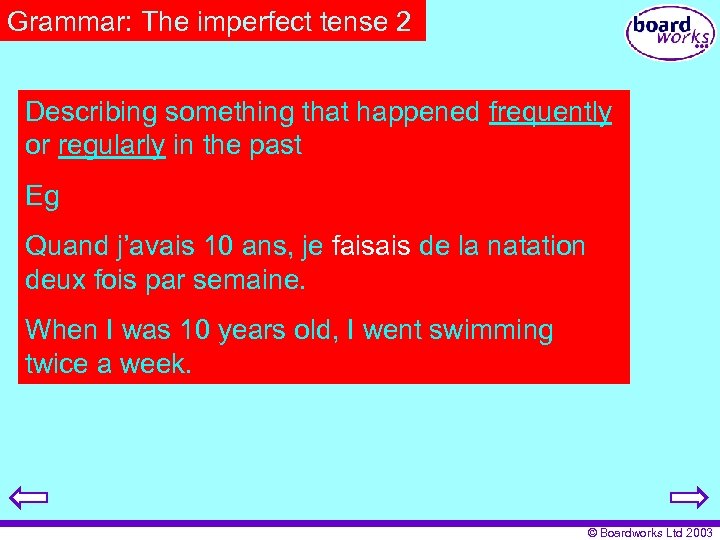
Grammar: The imperfect tense 2 Describing something that happened frequently or regularly in the past Eg Quand j’avais 10 ans, je faisais de la natation deux fois par semaine. When I was 10 years old, I went swimming twice a week. © Boardworks Ltd 2003
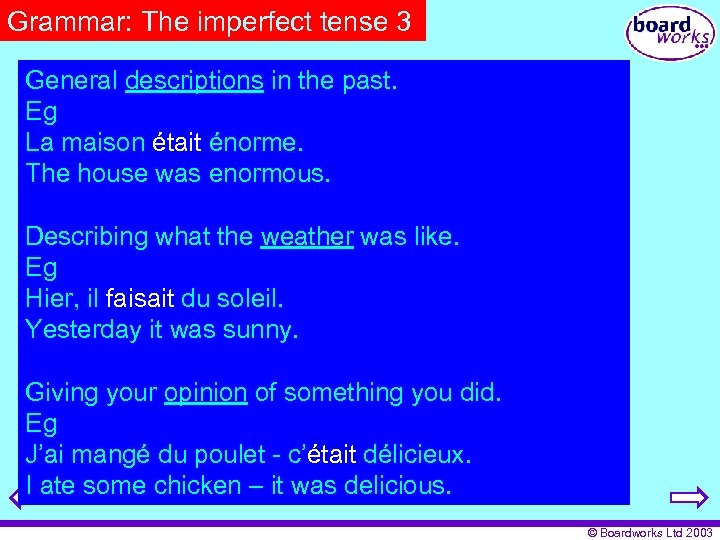
Grammar: The imperfect tense 3 General descriptions in the past. Eg La maison était énorme. The house was enormous. Describing what the weather was like. Eg Hier, il faisait du soleil. Yesterday it was sunny. Giving your opinion of something you did. Eg J’ai mangé du poulet - c’était délicieux. I ate some chicken – it was delicious. © Boardworks Ltd 2003
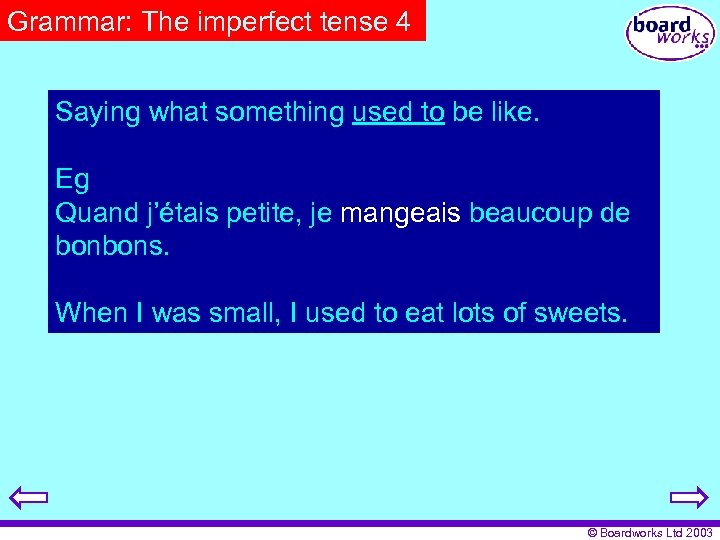
Grammar: The imperfect tense 4 Saying what something used to be like. Eg Quand j’étais petite, je mangeais beaucoup de bonbons. When I was small, I used to eat lots of sweets. © Boardworks Ltd 2003
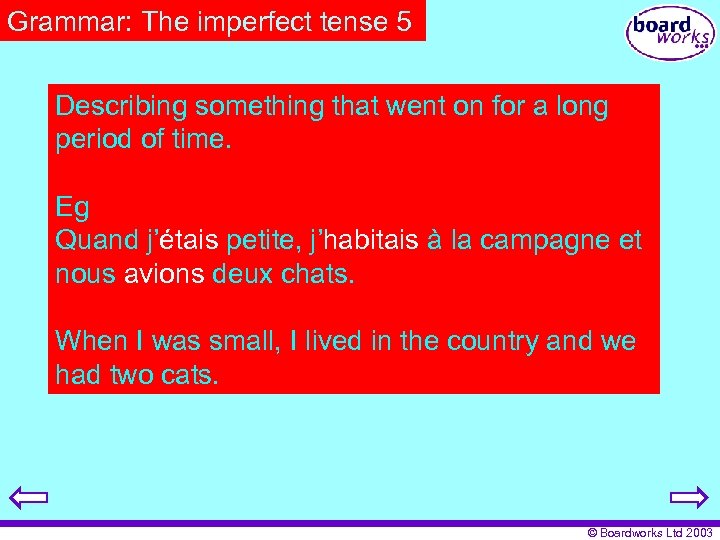
Grammar: The imperfect tense 5 Describing something that went on for a long period of time. Eg Quand j’étais petite, j’habitais à la campagne et nous avions deux chats. When I was small, I lived in the country and we had two cats. © Boardworks Ltd 2003
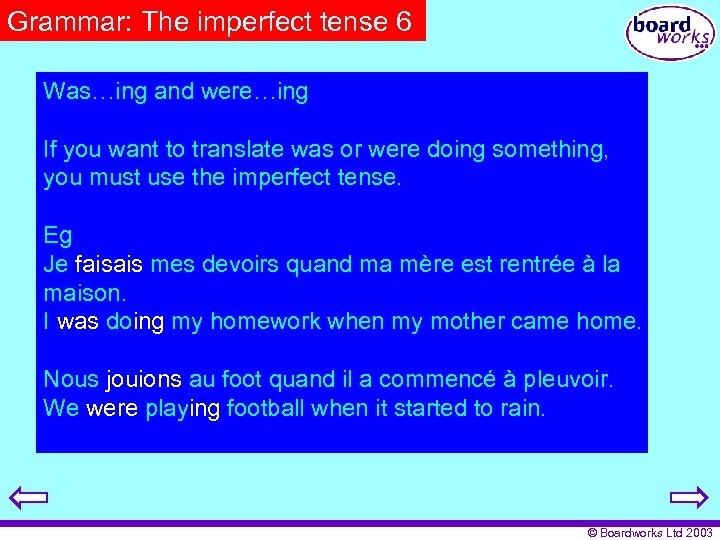
Grammar: The imperfect tense 6 Was…ing and were…ing If you want to translate was or were doing something, you must use the imperfect tense. Eg Je faisais mes devoirs quand ma mère est rentrée à la maison. I was doing my homework when my mother came home. Nous jouions au foot quand il a commencé à pleuvoir. We were playing football when it started to rain. © Boardworks Ltd 2003
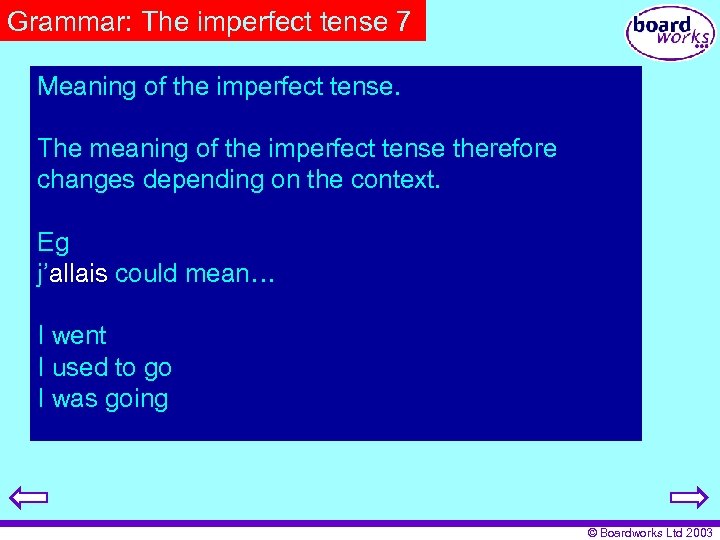
Grammar: The imperfect tense 7 Meaning of the imperfect tense. The meaning of the imperfect tense therefore changes depending on the context. Eg j’allais could mean… I went I used to go I was going © Boardworks Ltd 2003
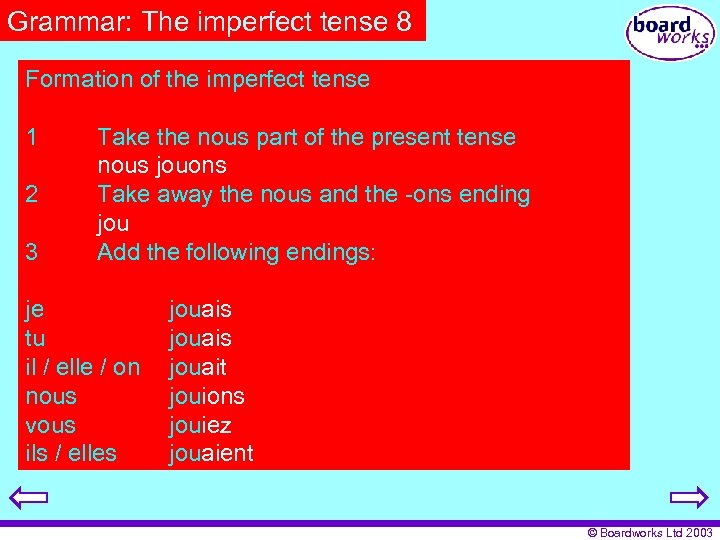
Grammar: The imperfect tense 8 Formation of the imperfect tense 1 2 3 Take the nous part of the present tense nous jouons Take away the nous and the -ons ending jou Add the following endings: je tu il / elle / on nous vous ils / elles jouais jouait jouions jouiez jouaient © Boardworks Ltd 2003
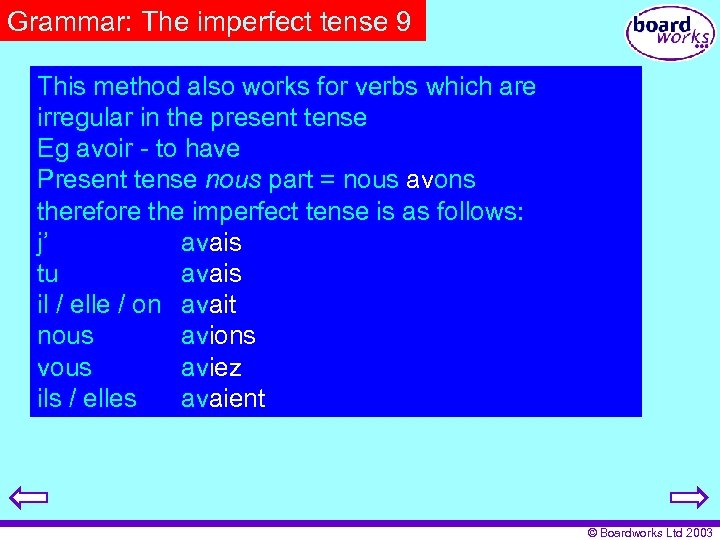
Grammar: The imperfect tense 9 This method also works for verbs which are irregular in the present tense Eg avoir - to have Present tense nous part = nous avons therefore the imperfect tense is as follows: j’ avais tu avais il / elle / on avait nous avions vous aviez ils / elles avaient © Boardworks Ltd 2003
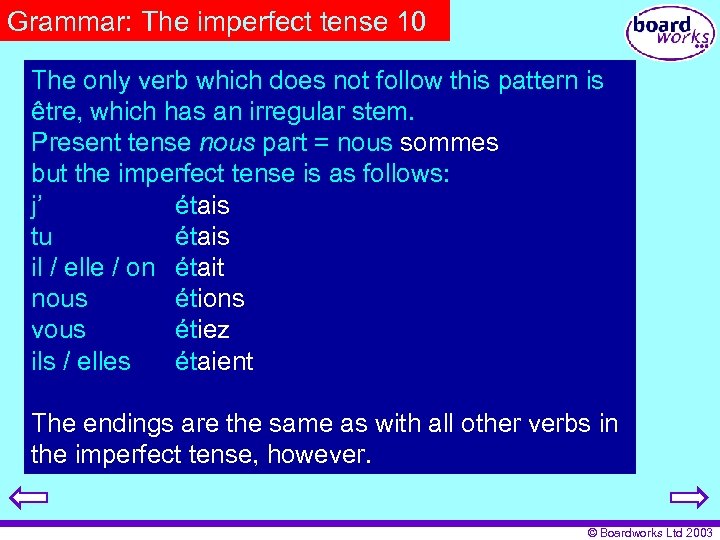
Grammar: The imperfect tense 10 The only verb which does not follow this pattern is être, which has an irregular stem. Present tense nous part = nous sommes but the imperfect tense is as follows: j’ étais tu étais il / elle / on était nous étions vous étiez ils / elles étaient The endings are the same as with all other verbs in the imperfect tense, however. © Boardworks Ltd 2003
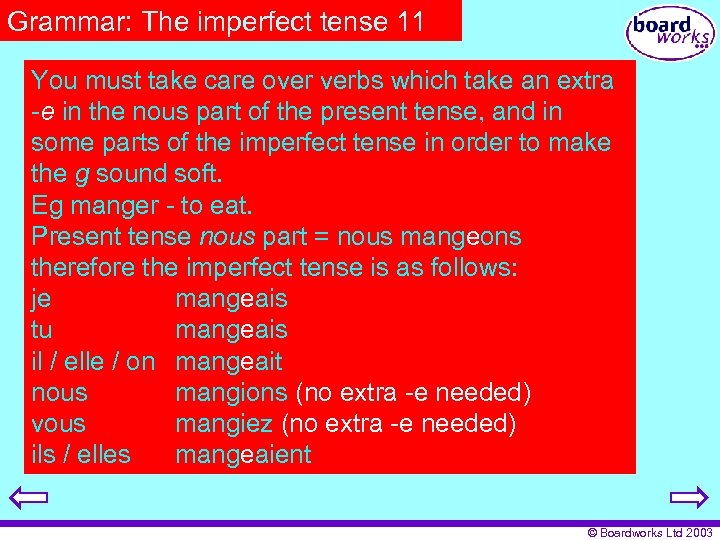
Grammar: The imperfect tense 11 You must take care over verbs which take an extra -e in the nous part of the present tense, and in some parts of the imperfect tense in order to make the g sound soft. Eg manger - to eat. Present tense nous part = nous mangeons therefore the imperfect tense is as follows: je mangeais tu mangeais il / elle / on mangeait nous mangions (no extra -e needed) vous mangiez (no extra -e needed) ils / elles mangeaient © Boardworks Ltd 2003
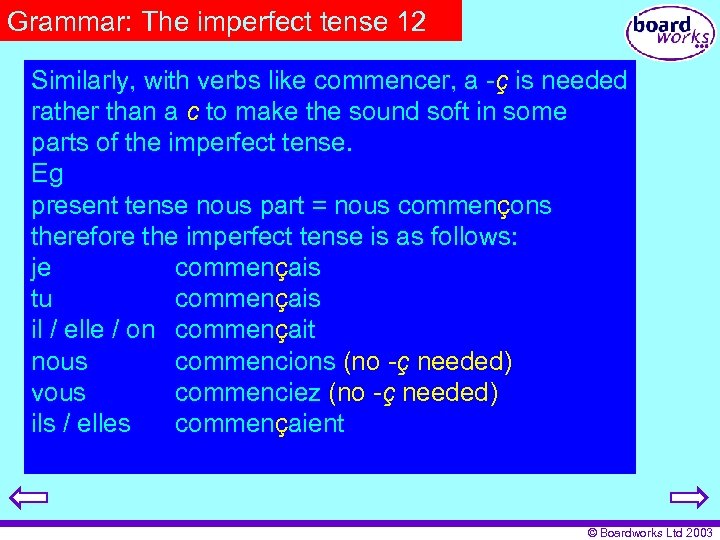
Grammar: The imperfect tense 12 Similarly, with verbs like commencer, a -ç is needed rather than a c to make the sound soft in some parts of the imperfect tense. Eg present tense nous part = nous commençons therefore the imperfect tense is as follows: je commençais tu commençais il / elle / on commençait nous commencions (no -ç needed) vous commenciez (no -ç needed) ils / elles commençaient © Boardworks Ltd 2003
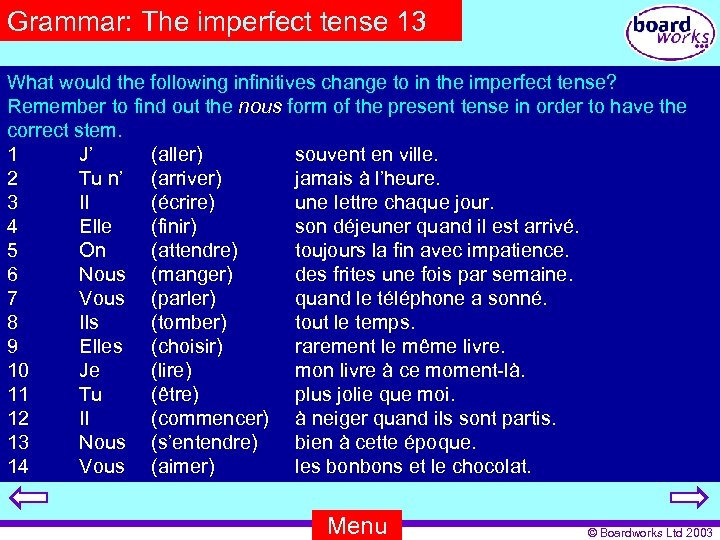
Grammar: The imperfect tense 13 What would the following infinitives change to in the imperfect tense? Remember to find out the nous form of the present tense in order to have the correct stem. 1 J’ (aller) souvent en ville. 2 Tu n’ (arriver) jamais à l’heure. 3 Il (écrire) une lettre chaque jour. 4 Elle (finir) son déjeuner quand il est arrivé. 5 On (attendre) toujours la fin avec impatience. 6 Nous (manger) des frites une fois par semaine. 7 Vous (parler) quand le téléphone a sonné. 8 Ils (tomber) tout le temps. 9 Elles (choisir) rarement le même livre. 10 Je (lire) mon livre à ce moment-là. 11 Tu (être) plus jolie que moi. 12 Il (commencer) à neiger quand ils sont partis. 13 Nous (s’entendre) bien à cette époque. 14 Vous (aimer) les bonbons et le chocolat. Menu © Boardworks Ltd 2003
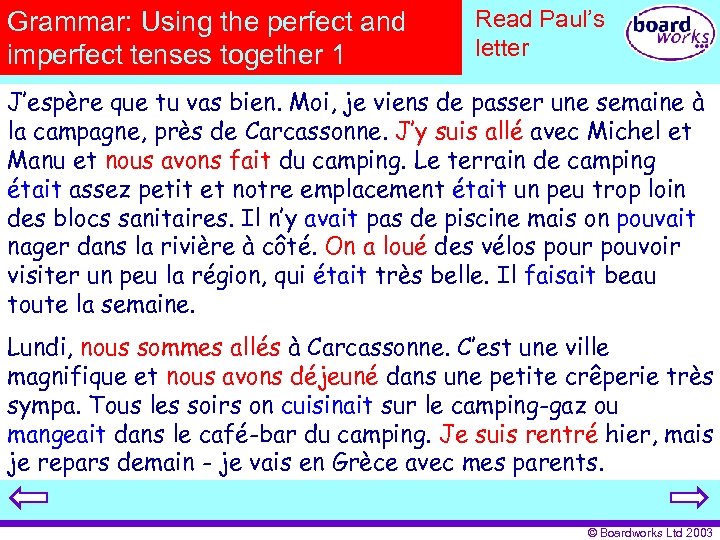
Grammar: Using the perfect and imperfect tenses together 1 Read Paul’s letter J’espère que tu vas bien. Moi, je viens de passer une semaine à la campagne, près de Carcassonne. J’y suis allé avec Michel et Manu et nous avons fait du camping. Le terrain de camping était assez petit et notre emplacement était un peu trop loin des blocs sanitaires. Il n’y avait pas de piscine mais on pouvait nager dans la rivière à côté. On a loué des vélos pour pouvoir visiter un peu la région, qui était très belle. Il faisait beau toute la semaine. Lundi, nous sommes allés à Carcassonne. C’est une ville magnifique et nous avons déjeuné dans une petite crêperie très sympa. Tous les soirs on cuisinait sur le camping-gaz ou mangeait dans le café-bar du camping. Je suis rentré hier, mais je repars demain - je vais en Grèce avec mes parents. © Boardworks Ltd 2003
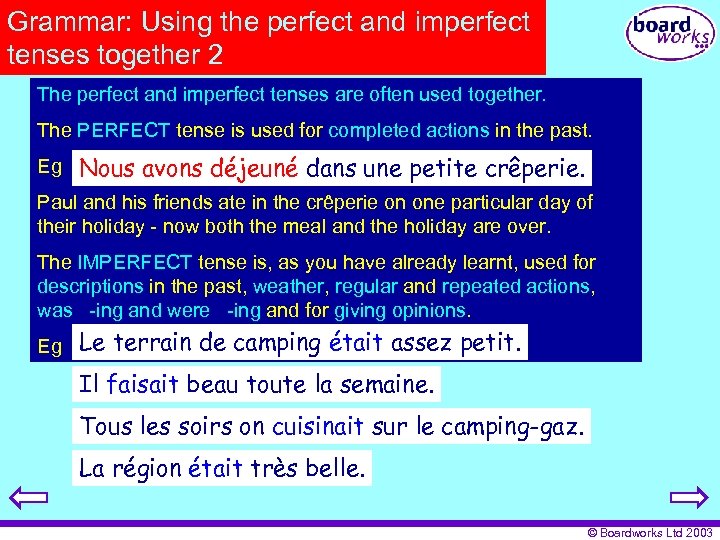
Grammar: Using the perfect and imperfect tenses together 2 The perfect and imperfect tenses are often used together. The PERFECT tense is used for completed actions in the past. Eg Nous avons déjeuné dans une petite crêperie. Paul and his friends ate in the crêperie on one particular day of their holiday - now both the meal and the holiday are over. The IMPERFECT tense is, as you have already learnt, used for descriptions in the past, weather, regular and repeated actions, was -ing and were -ing and for giving opinions. Eg Le terrain de camping était assez petit. Il faisait beau toute la semaine. Tous les soirs on cuisinait sur le camping-gaz. La région était très belle. © Boardworks Ltd 2003
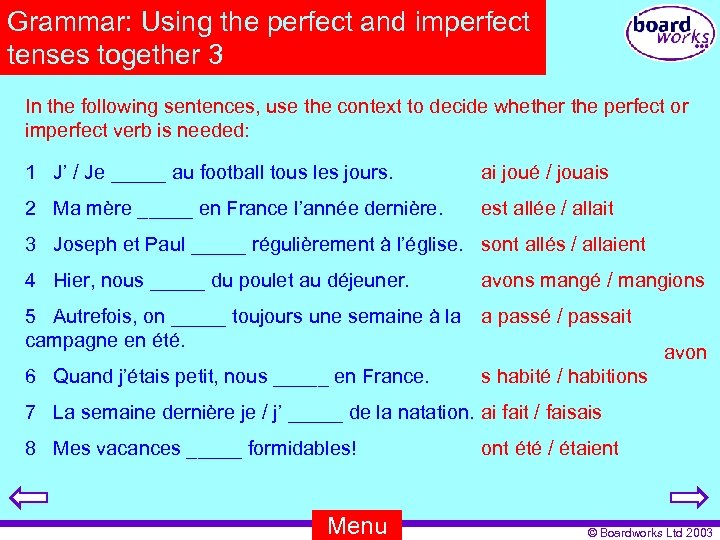
Grammar: Using the perfect and imperfect tenses together 3 In the following sentences, use the context to decide whether the perfect or imperfect verb is needed: 1 J’ / Je _____ au football tous les jours. ai joué / jouais 2 Ma mère _____ en France l’année dernière. est allée / allait 3 Joseph et Paul _____ régulièrement à l’église. sont allés / allaient 4 Hier, nous _____ du poulet au déjeuner. avons mangé / mangions 5 Autrefois, on _____ toujours une semaine à la campagne en été. a passé / passait 6 Quand j’étais petit, nous _____ en France. s habité / habitions avon 7 La semaine dernière je / j’ _____ de la natation. ai fait / faisais 8 Mes vacances _____ formidables! Menu ont été / étaient © Boardworks Ltd 2003
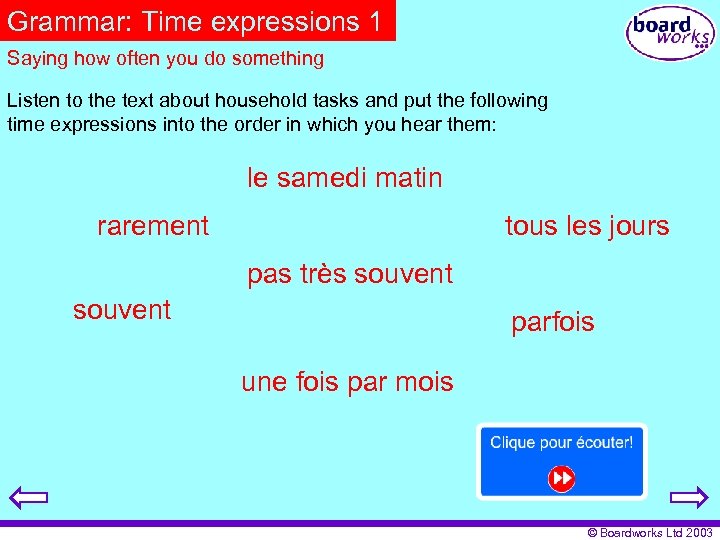
Grammar: Time expressions 1 Saying how often you do something Listen to the text about household tasks and put the following time expressions into the order in which you hear them: le samedi matin rarement tous les jours pas très souvent parfois une fois par mois © Boardworks Ltd 2003
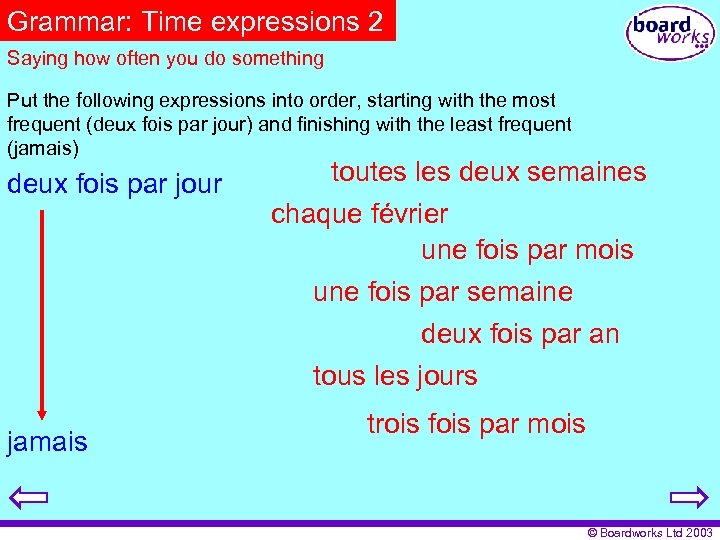
Grammar: Time expressions 2 Saying how often you do something Put the following expressions into order, starting with the most frequent (deux fois par jour) and finishing with the least frequent (jamais) deux fois par jour toutes les deux semaines chaque février une fois par mois une fois par semaine deux fois par an tous les jours jamais trois fois par mois © Boardworks Ltd 2003
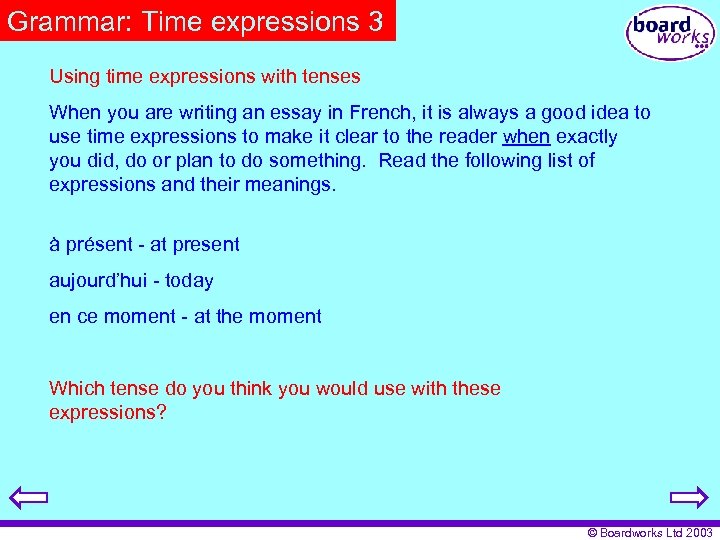
Grammar: Time expressions 3 Using time expressions with tenses When you are writing an essay in French, it is always a good idea to use time expressions to make it clear to the reader when exactly you did, do or plan to do something. Read the following list of expressions and their meanings. à présent - at present aujourd’hui - today en ce moment - at the moment Which tense do you think you would use with these expressions? © Boardworks Ltd 2003
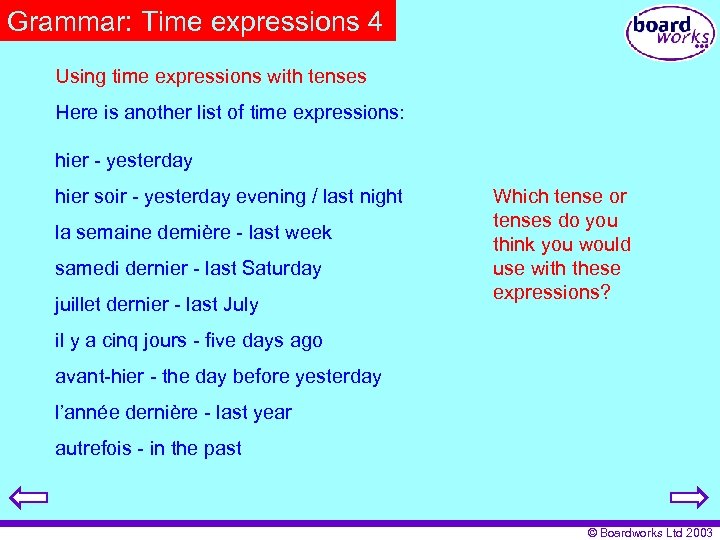
Grammar: Time expressions 4 Using time expressions with tenses Here is another list of time expressions: hier - yesterday hier soir - yesterday evening / last night la semaine dernière - last week samedi dernier - last Saturday juillet dernier - last July Which tense or tenses do you think you would use with these expressions? il y a cinq jours - five days ago avant-hier - the day before yesterday l’année dernière - last year autrefois - in the past © Boardworks Ltd 2003
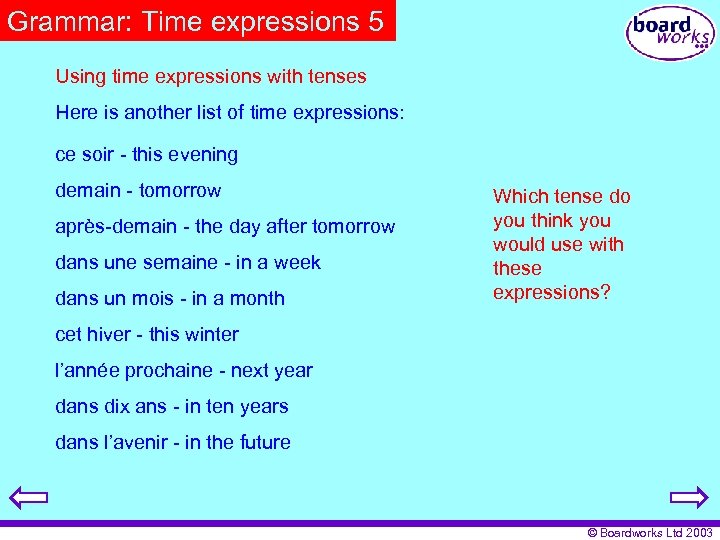
Grammar: Time expressions 5 Using time expressions with tenses Here is another list of time expressions: ce soir - this evening demain - tomorrow après-demain - the day after tomorrow dans une semaine - in a week dans un mois - in a month Which tense do you think you would use with these expressions? cet hiver - this winter l’année prochaine - next year dans dix ans - in ten years dans l’avenir - in the future © Boardworks Ltd 2003
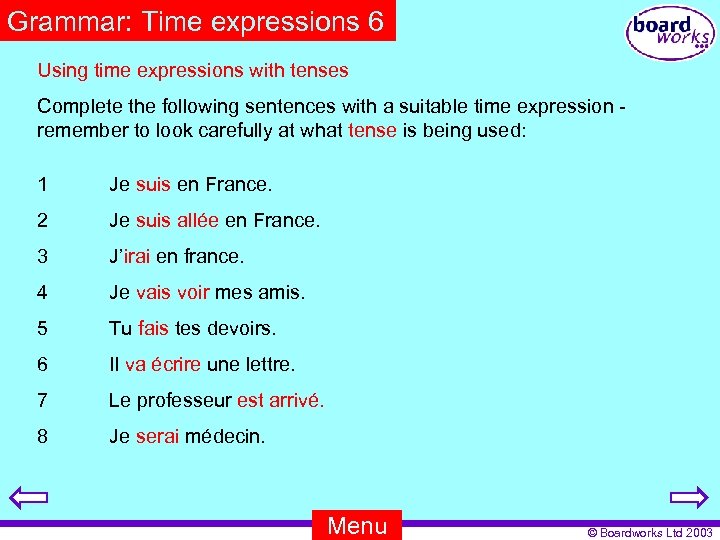
Grammar: Time expressions 6 Using time expressions with tenses Complete the following sentences with a suitable time expression remember to look carefully at what tense is being used: 1 Je suis en France. 2 Je suis allée en France. 3 J’irai en france. 4 Je vais voir mes amis. 5 Tu fais tes devoirs. 6 Il va écrire une lettre. 7 Le professeur est arrivé. 8 Je serai médecin. Menu © Boardworks Ltd 2003
Grammar: The comparative and the superlative 1 When you compare two or more things, you will probably need to use the words plus and moins. Plus means “more” and you can use it to say that something is more important, bigger, smaller, more interesting etc. Le train est plus cher que le bus. The train is more expensive than the bus. La moto est plus rapide que le bus. The motorbike is faster (literally “more fast”) than the bus. © Boardworks Ltd 2003
Grammar: The comparative and the superlative 2 Moins works in the same way, but means the opposite. It is used to say that something is less big, fast, expensive than something else. Le train est moins cher que le bus. The train is less expensive than the bus. La moto est moins rapide que le bus. The motorbike is slower (literally “less fast”) than the bus. With both plus and moins, it is important that you remember to make the adjective agree with what is being described: La voiture est plus polluante que le vélo. © Boardworks Ltd 2003
Grammar: The comparative and the superlative 3 There are some irregular forms to remember, however. If you want to say that something is better or worse than something else, you need to use the following expressions: Mon vélo est meilleur que sa moto. My bike is better than his motorbike. Ma voiture est pire que la voiture de ma mère. My car is worse than my mother’s car. © Boardworks Ltd 2003
Grammar: The comparative and the superlative 4 Both plus and moins can be used with adverbs as well as adjectives, to say that someone is doing something more quickly, less slowly etc than someone else: Il roule plus lentement que toi. He drives more slowly than you. Je suis arrivé moins vite que mon frère. I arrived less quickly than my brother. © Boardworks Ltd 2003
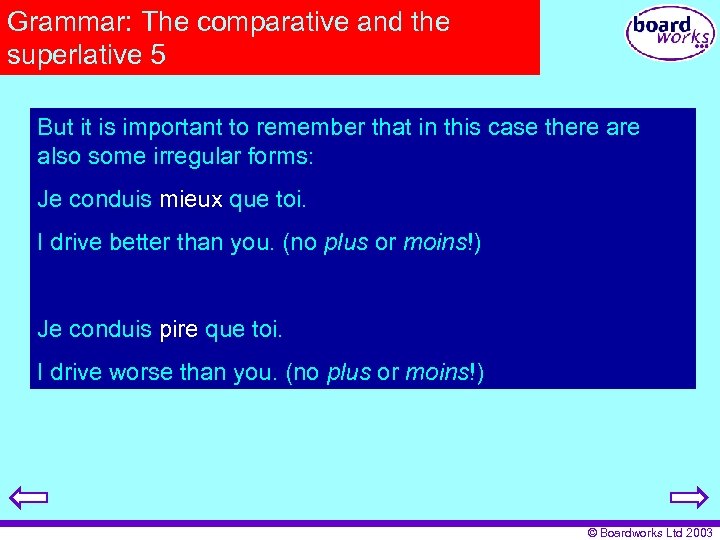
Grammar: The comparative and the superlative 5 But it is important to remember that in this case there also some irregular forms: Je conduis mieux que toi. I drive better than you. (no plus or moins!) Je conduis pire que toi. I drive worse than you. (no plus or moins!) © Boardworks Ltd 2003
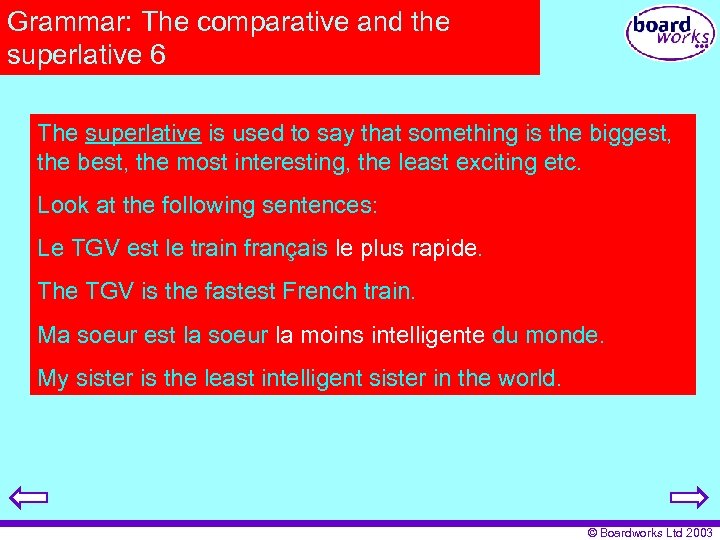
Grammar: The comparative and the superlative 6 The superlative is used to say that something is the biggest, the best, the most interesting, the least exciting etc. Look at the following sentences: Le TGV est le train français le plus rapide. The TGV is the fastest French train. Ma soeur est la soeur la moins intelligente du monde. My sister is the least intelligent sister in the world. © Boardworks Ltd 2003
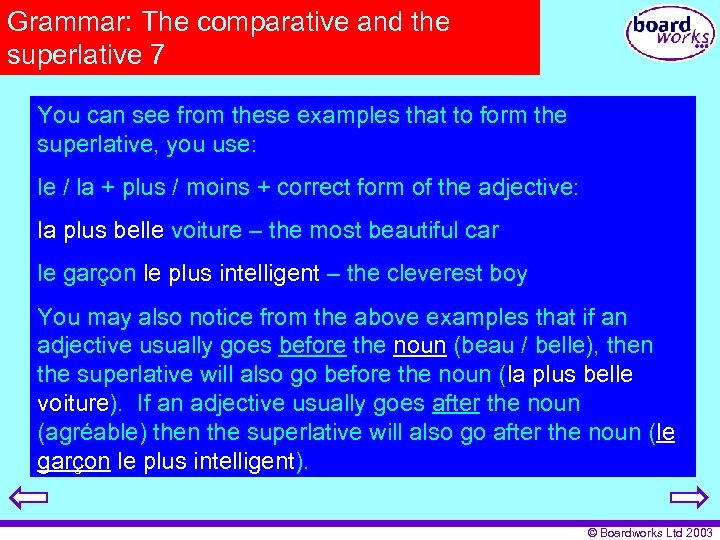
Grammar: The comparative and the superlative 7 You can see from these examples that to form the superlative, you use: le / la + plus / moins + correct form of the adjective: la plus belle voiture – the most beautiful car le garçon le plus intelligent – the cleverest boy You may also notice from the above examples that if an adjective usually goes before the noun (beau / belle), then the superlative will also go before the noun (la plus belle voiture). If an adjective usually goes after the noun (agréable) then the superlative will also go after the noun (le garçon le plus intelligent). © Boardworks Ltd 2003
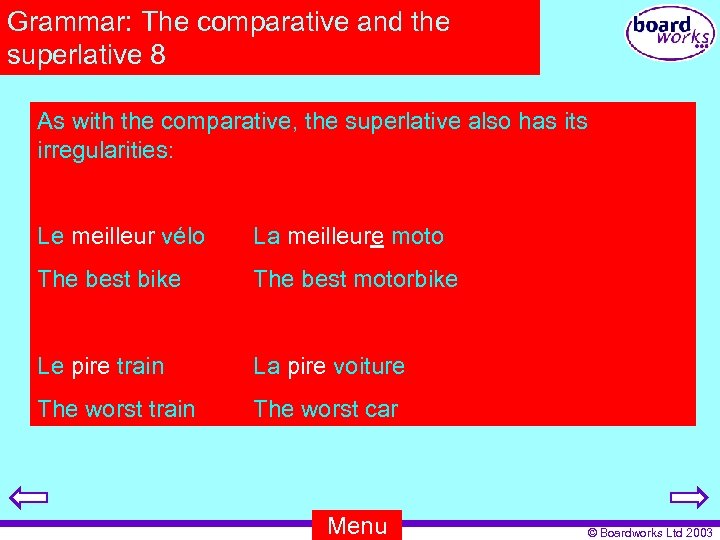
Grammar: The comparative and the superlative 8 As with the comparative, the superlative also has its irregularities: Le meilleur vélo La meilleure moto The best bike The best motorbike Le pire train La pire voiture The worst train The worst car Menu © Boardworks Ltd 2003
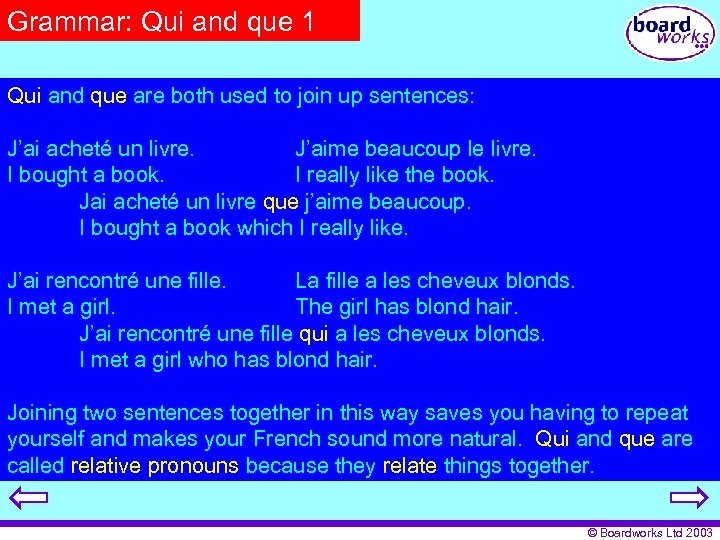
Grammar: Qui and que 1 Qui and que are both used to join up sentences: J’ai acheté un livre. J’aime beaucoup le livre. I bought a book. I really like the book. Jai acheté un livre que j’aime beaucoup. I bought a book which I really like. J’ai rencontré une fille. La fille a les cheveux blonds. I met a girl. The girl has blond hair. J’ai rencontré une fille qui a les cheveux blonds. I met a girl who has blond hair. Joining two sentences together in this way saves you having to repeat yourself and makes your French sound more natural. Qui and que are called relative pronouns because they relate things together. © Boardworks Ltd 2003
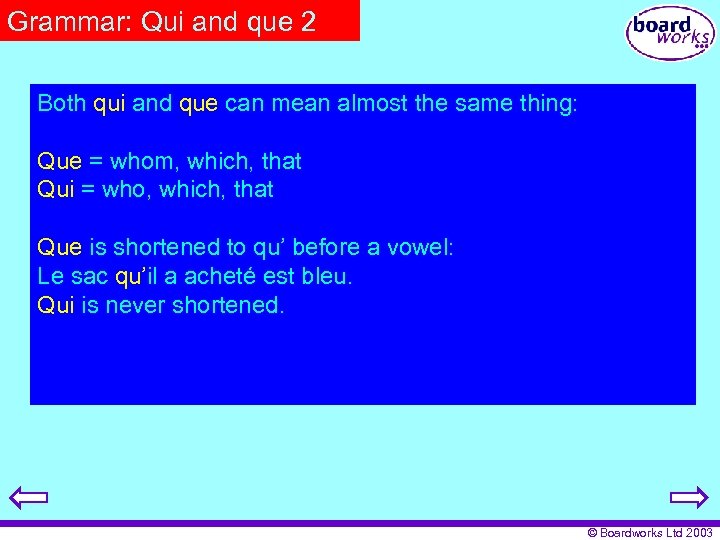
Grammar: Qui and que 2 Both qui and que can mean almost the same thing: Que = whom, which, that Qui = who, which, that Que is shortened to qu’ before a vowel: Le sac qu’il a acheté est bleu. Qui is never shortened. © Boardworks Ltd 2003
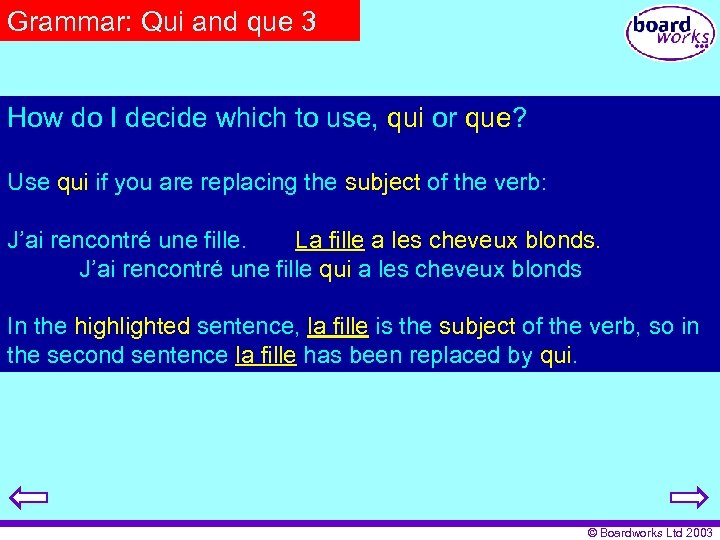
Grammar: Qui and que 3 How do I decide which to use, qui or que? Use qui if you are replacing the subject of the verb: J’ai rencontré une fille. La fille a les cheveux blonds. J’ai rencontré une fille qui a les cheveux blonds In the highlighted sentence, la fille is the subject of the verb, so in the second sentence la fille has been replaced by qui. © Boardworks Ltd 2003
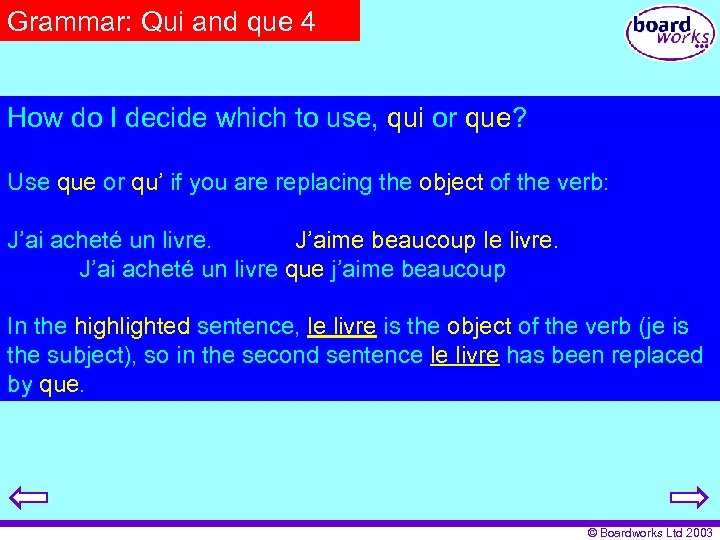
Grammar: Qui and que 4 How do I decide which to use, qui or que? Use que or qu’ if you are replacing the object of the verb: J’ai acheté un livre. J’aime beaucoup le livre. J’ai acheté un livre que j’aime beaucoup In the highlighted sentence, le livre is the object of the verb (je is the subject), so in the second sentence le livre has been replaced by que. © Boardworks Ltd 2003
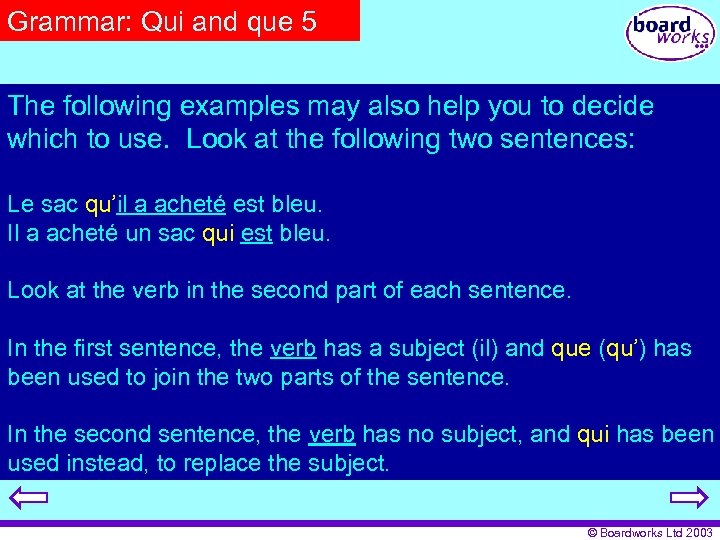
Grammar: Qui and que 5 The following examples may also help you to decide which to use. Look at the following two sentences: Le sac qu’il a acheté est bleu. Il a acheté un sac qui est bleu. Look at the verb in the second part of each sentence. In the first sentence, the verb has a subject (il) and que (qu’) has been used to join the two parts of the sentence. In the second sentence, the verb has no subject, and qui has been used instead, to replace the subject. © Boardworks Ltd 2003
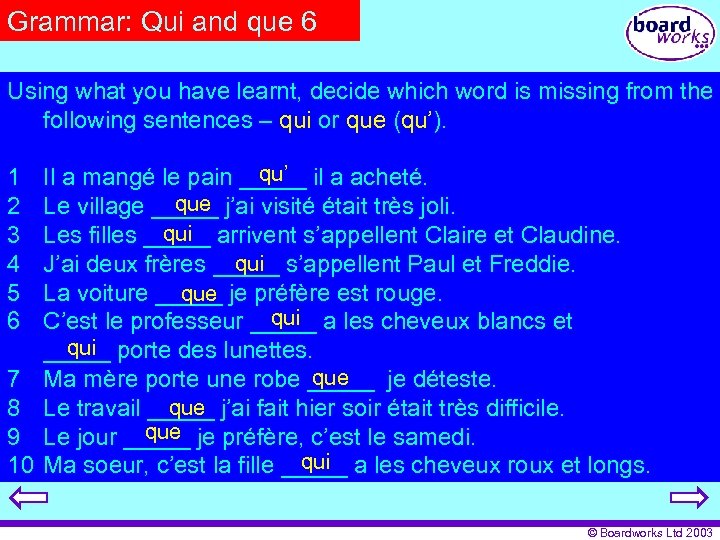
Grammar: Qui and que 6 Using what you have learnt, decide which word is missing from the following sentences – qui or que (qu’). 1 2 3 4 5 6 7 8 9 10 qu’ Il a mangé le pain _____ il a acheté. que Le village _____ j’ai visité était très joli. qui Les filles _____ arrivent s’appellent Claire et Claudine. qui J’ai deux frères _____ s’appellent Paul et Freddie. La voiture _____ je préfère est rouge. que qui C’est le professeur _____ a les cheveux blancs et qui _____ porte des lunettes. que Ma mère porte une robe _____ je déteste. que Le travail _____ j’ai fait hier soir était très difficile. que Le jour _____ je préfère, c’est le samedi. qui Ma soeur, c’est la fille _____ a les cheveux roux et longs. © Boardworks Ltd 2003
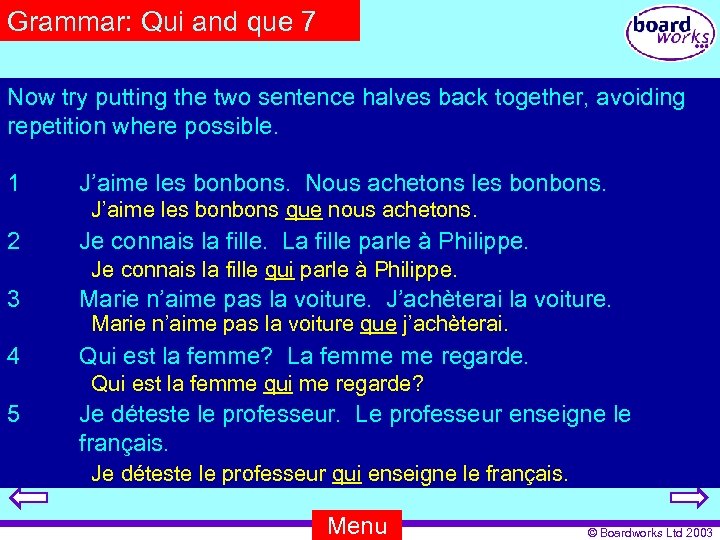
Grammar: Qui and que 7 Now try putting the two sentence halves back together, avoiding repetition where possible. 1 J’aime les bonbons. Nous achetons les bonbons. J’aime les bonbons que nous achetons. 2 Je connais la fille. La fille parle à Philippe. Je connais la fille qui parle à Philippe. 3 Marie n’aime pas la voiture. J’achèterai la voiture. 4 Qui est la femme? La femme me regarde. Marie n’aime pas la voiture que j’achèterai. Qui est la femme qui me regarde? 5 Je déteste le professeur. Le professeur enseigne le français. Je déteste le professeur qui enseigne le français. Menu © Boardworks Ltd 2003
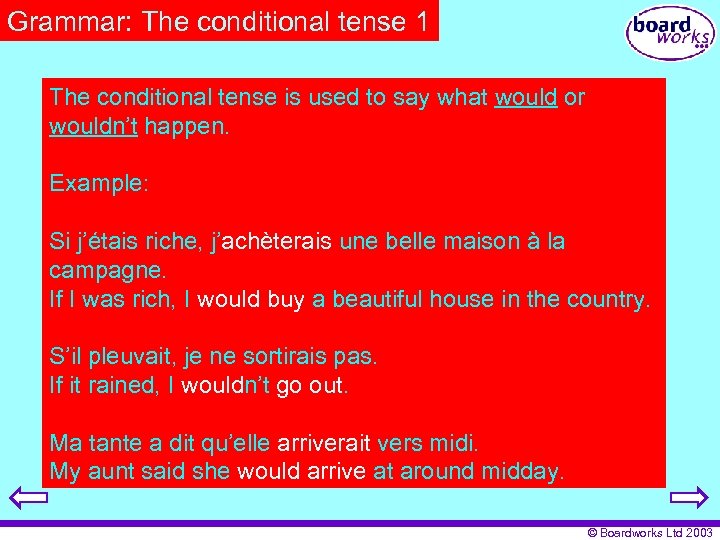
Grammar: The conditional tense 1 The conditional tense is used to say what would or wouldn’t happen. Example: Si j’étais riche, j’achèterais une belle maison à la campagne. If I was rich, I would buy a beautiful house in the country. S’il pleuvait, je ne sortirais pas. If it rained, I wouldn’t go out. Ma tante a dit qu’elle arriverait vers midi. My aunt said she would arrive at around midday. © Boardworks Ltd 2003
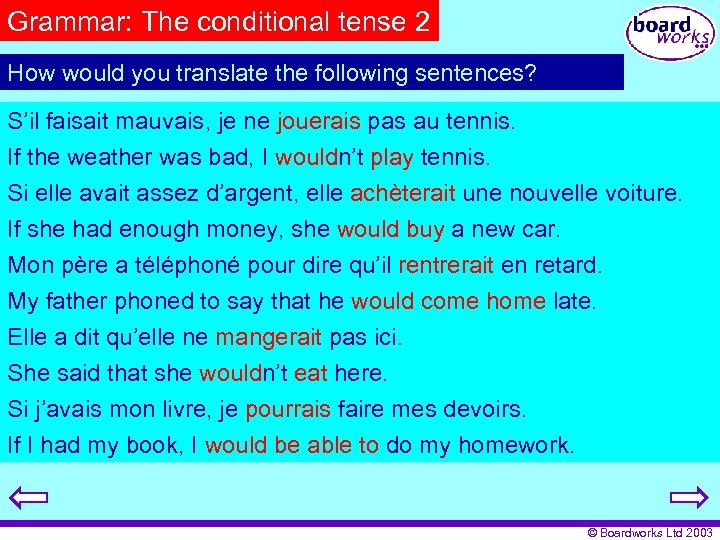
Grammar: The conditional tense 2 How would you translate the following sentences? S’il faisait mauvais, je ne jouerais pas au tennis. If the weather was bad, I wouldn’t play tennis. Si elle avait assez d’argent, elle achèterait une nouvelle voiture. If she had enough money, she would buy a new car. Mon père a téléphoné pour dire qu’il rentrerait en retard. My father phoned to say that he would come home late. Elle a dit qu’elle ne mangerait pas ici. She said that she wouldn’t eat here. Si j’avais mon livre, je pourrais faire mes devoirs. If I had my book, I would be able to do my homework. © Boardworks Ltd 2003
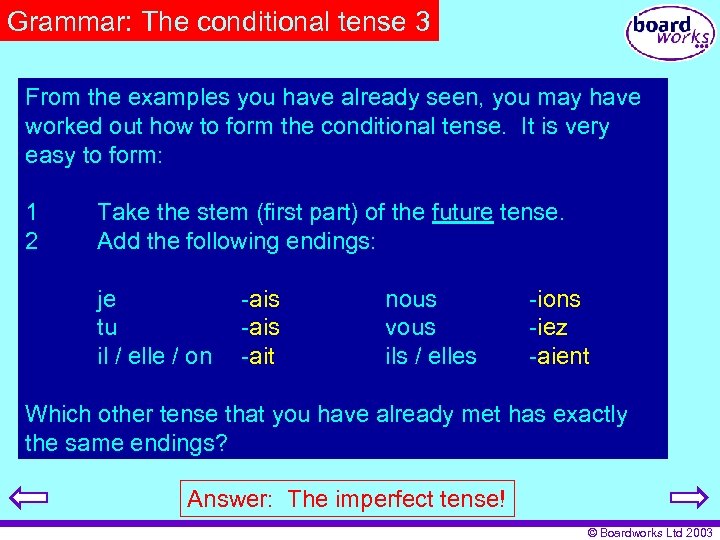
Grammar: The conditional tense 3 From the examples you have already seen, you may have worked out how to form the conditional tense. It is very easy to form: 1 2 Take the stem (first part) of the future tense. Add the following endings: je tu il / elle / on -ais -ait nous vous ils / elles -ions -iez -aient Which other tense that you have already met has exactly the same endings? Answer: The imperfect tense! © Boardworks Ltd 2003
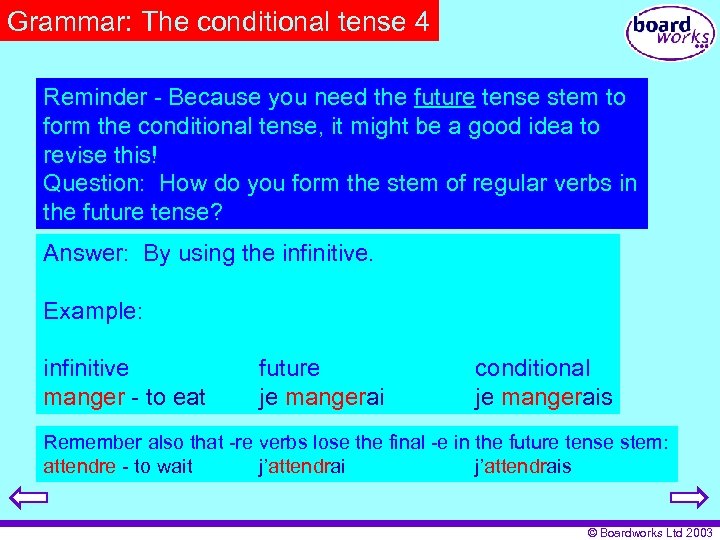
Grammar: The conditional tense 4 Reminder - Because you need the future tense stem to form the conditional tense, it might be a good idea to revise this! Question: How do you form the stem of regular verbs in the future tense? Answer: By using the infinitive. Example: infinitive manger - to eat future je mangerai conditional je mangerais Remember also that -re verbs lose the final -e in the future tense stem: attendre - to wait j’attendrais © Boardworks Ltd 2003
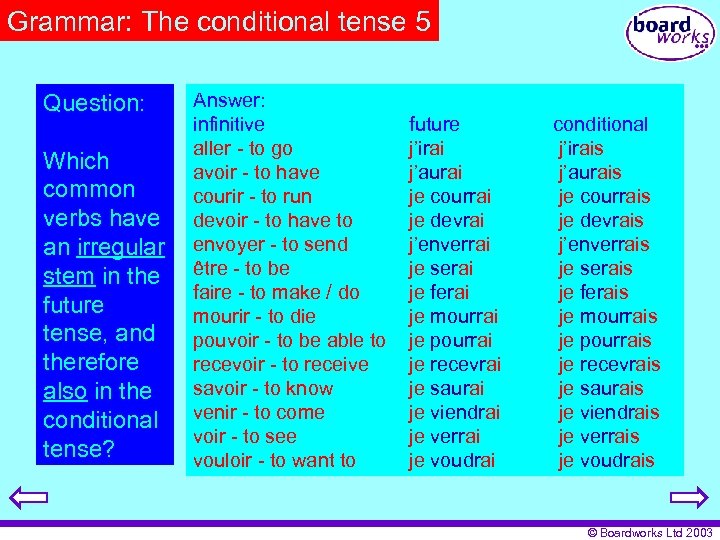
Grammar: The conditional tense 5 Question: Which common verbs have an irregular stem in the future tense, and therefore also in the conditional tense? Answer: infinitive aller - to go avoir - to have courir - to run devoir - to have to envoyer - to send être - to be faire - to make / do mourir - to die pouvoir - to be able to recevoir - to receive savoir - to know venir - to come voir - to see vouloir - to want to future j’irai j’aurai je courrai je devrai j’enverrai je serai je ferai je mourrai je pourrai je recevrai je saurai je viendrai je verrai je voudrai conditional j’irais j’aurais je courrais je devrais j’enverrais je serais je ferais je mourrais je pourrais je recevrais je saurais je viendrais je verrais je voudrais © Boardworks Ltd 2003
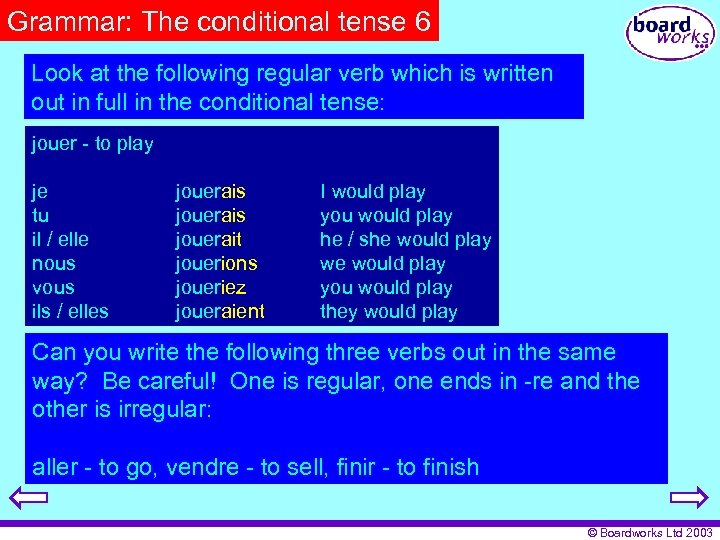
Grammar: The conditional tense 6 Look at the following regular verb which is written out in full in the conditional tense: jouer - to play je tu il / elle nous vous ils / elles jouerais jouerait jouerions joueriez joueraient I would play you would play he / she would play we would play you would play they would play Can you write the following three verbs out in the same way? Be careful! One is regular, one ends in -re and the other is irregular: aller - to go, vendre - to sell, finir - to finish © Boardworks Ltd 2003
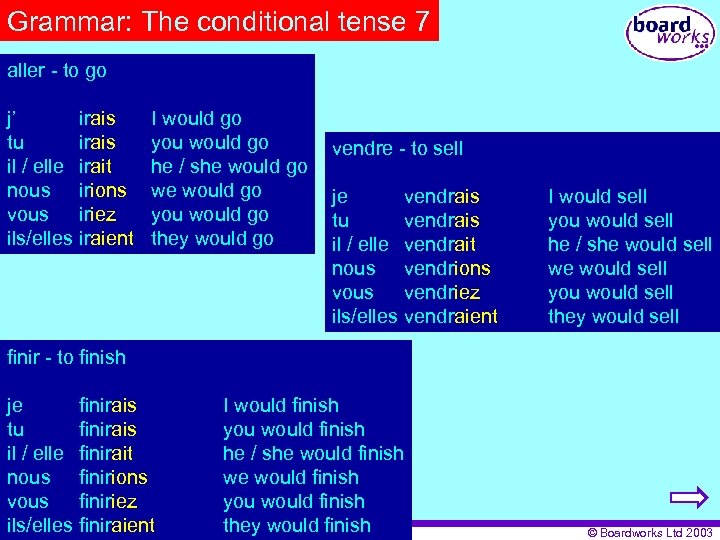
Grammar: The conditional tense 7 aller - to go j’ tu il / elle nous vous ils/elles irais irait irions iriez iraient I would go you would go he / she would go we would go you would go they would go vendre - to sell je tu il / elle nous vous ils/elles vendrais vendrait vendrions vendriez vendraient I would sell you would sell he / she would sell we would sell you would sell they would sell finir - to finish je tu il / elle nous vous ils/elles finirais finirait finirions finiriez finiraient I would finish you would finish he / she would finish we would finish you would finish they would finish © Boardworks Ltd 2003
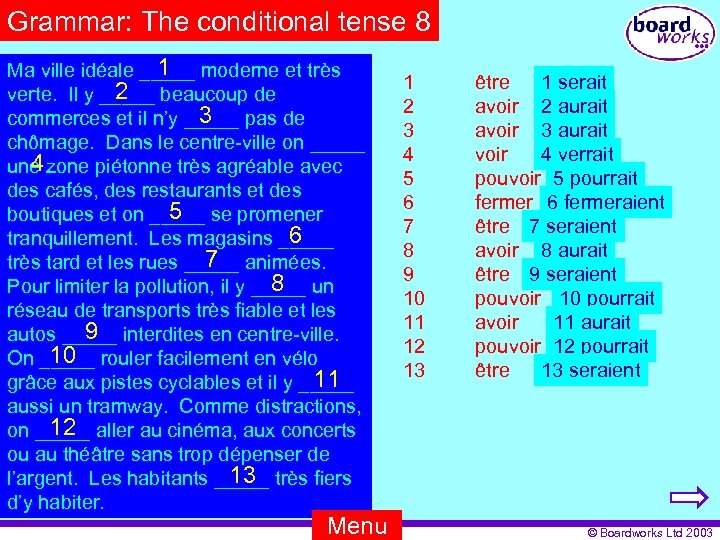
Grammar: The conditional tense 8 1 Ma ville idéale _____ moderne et très 2 verte. Il y _____ beaucoup de 3 commerces et il n’y _____ pas de chômage. Dans le centre-ville on _____ 4 une zone piétonne très agréable avec des cafés, des restaurants et des 5 boutiques et on _____ se promener 6 tranquillement. Les magasins _____ 7 très tard et les rues _____ animées. 8 Pour limiter la pollution, il y _____ un réseau de transports très fiable et les 9 autos _____ interdites en centre-ville. 10 On _____ rouler facilement en vélo 11 grâce aux pistes cyclables et il y _____ aussi un tramway. Comme distractions, 12 on _____ aller au cinéma, aux concerts ou au théâtre sans trop dépenser de 13 l’argent. Les habitants _____ très fiers d’y habiter. Menu 1 2 3 4 5 6 7 8 9 10 11 12 13 1 serait être avoir 2 aurait avoir 3 aurait 4 verrait voir pouvoir 5 pourrait fermer 6 fermeraient être 7 seraient avoir 8 aurait être 9 seraient pouvoir 10 pourrait avoir 11 aurait pouvoir 12 pourrait être 13 seraient © Boardworks Ltd 2003
Скачать презентацию Grammar Menu Commands Talking about the future Reflexive
bf0f284bf66db5ba20221709d4897df6.ppt