


 Скачать презентацию Grammar Mechanics The 10 deadly sins of Writing
a41fe8c24a50a562c4ada1e43e702e03.ppt
- Количество слайдов: 23
 Grammar Mechanics: The 10 deadly sins of Writing Brought to you by the Center for Teaching and Learning
 A Quick Note o Don’t worry! This workshop was designed to address the most common grammatical and compositional errors in college writing. That’s why we’re here; to make all of us, including myself, better writers.
 sin #1: The Sentence Fragment o A sentence fragment is a partial or incomplete thought that is used as a complete sentence. In most student writing, sentence fragments are the result of a less formal, more conversational tone.
 sin #1 Sentence Fragment o Ex: When I tripped on the curb. o Re: When I tripped on the curb, I split my pants right down the middle. n Tip: Look at your writing. Do you have any sentences that cannot stand alone?
 sin #2: The Run -On o The run-on occurs when two (or more) complete thoughts or phrases are written as a single sentence without separation. Run-ons are generally a result of simple carelessness.
 sin #2: The Run -On n Ex: Dave went to the store to buy some beer he forgot his wallet. n Re: Dave went to the store to buy some beer, but he forgot his wallet. o Tip: Run-ons are not confined to longer sentences; check the structure of short sentences, too.
 sin #3: The Comma Splice & Fused Sentences o This is a type of run-on sentence where two (or more) complete sentences are connected with only a comma. These types of fused sentences are usually the result the writer trying to tie a complex thought together.
 sin #3: The Comma Splice & Fused Sentences o Ex: Collin works out, he is the strongest guy in the class. o Re: Because Collin works out, he is the strongest guy in the class. n Tip: Review your work. If one sentence can easily be read as two complete sentences, it is probably a comma splice or fused sentence.
 sin #4: Lack of Agreement o A lack of agreement occurs when the subject does not agree with the verb (both not singular or both not plural).
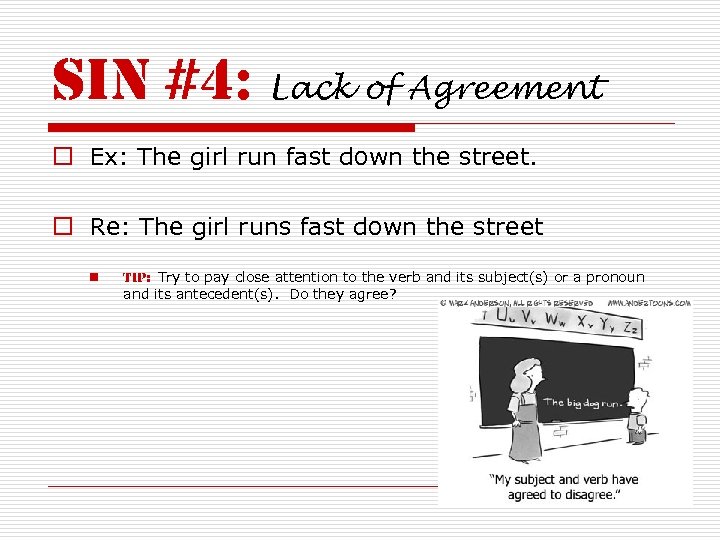 sin #4: Lack of Agreement o Ex: The girl run fast down the street. o Re: The girl runs fast down the street n Tip: Try to pay close attention to the verb and its subject(s) or a pronoun and its antecedent(s). Do they agree?
 sin #5: Inconsistent Tense o You can have inconsistent tense when the tense of two (or more) verbs in a sentence do not agree.
 sin #5: Inconsistent Tense o Ex: She forgot that she needs to do some homework for her math class. o Re: She forgot that she needed to do some homework for her math class. n Tip: When you have multiple verbs in one sentence, pay close attention to the tense.
 sin #6: Incorrect Homophone o A homophone is a word that is pronounced the same as another word but has a different meaning.
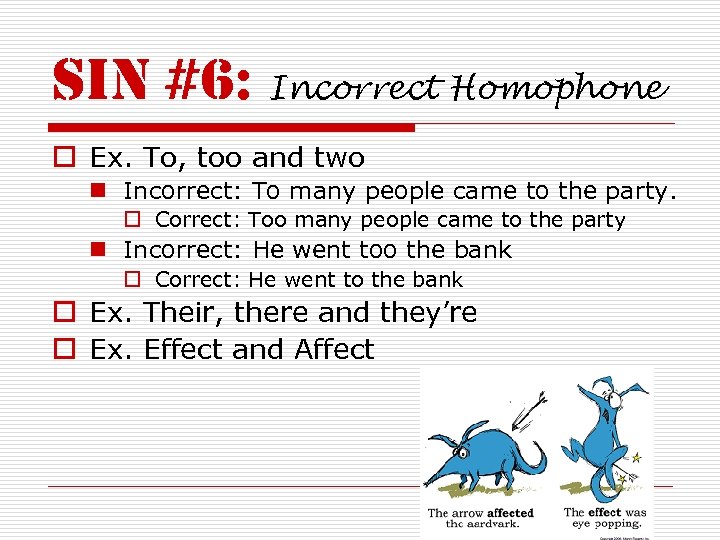 sin #6: Incorrect Homophone o Ex. To, too and two n Incorrect: To many people came to the party. o Correct: Too many people came to the party n Incorrect: He went too the bank o Correct: He went to the bank o Ex. Their, there and they’re o Ex. Effect and Affect
 sin #7: Dangling Modifiers o Simply put, dangling modifiers describe or reference words that never actually appear in a sentence.
 sin #7: Dangling Modifiers o Ex: Driving down the street, the weather seemed to be changing rather quickly. o Re: Driving down the street, I noticed the weather seemed to be changing rather quickly. n Tip: Try not to carelessly add descriptive phrases to a sentence. Pay attention to the phrases in a sentence and what they modify.
 sin #8: Passive Voice o With a passive voice, the subject of a sentence becomes the receiver of the action. Basically, nothing or no one is performing the action.
 sin #8: Passive Voice o Ex: The haunted house at the top of the hill was greatly feared by us. o Re: We feared the haunted house at the top of the hill. n Tip: Unless you absolutely need an passive verb, change it to the active voice.
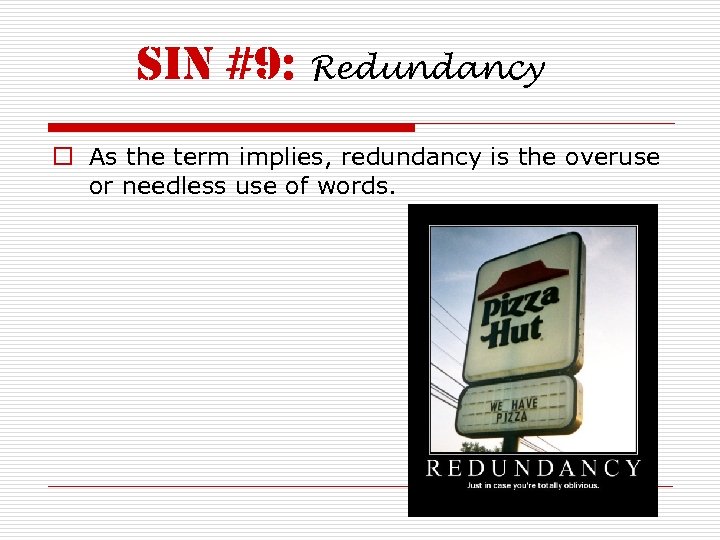 sin #9: Redundancy o As the term implies, redundancy is the overuse or needless use of words.
 sin #9: Redundancy o Ex: She was totally the tallest girl in the classroom. n Re: She was the tallest girl in the classroom. o Ex: To fix the car, you will need both a wrench and a screwdriver. n Re: To fix the car, you will need a wrench and a screwdriver. o Tip: Go through your work and look for descriptive words you often use when speaking – these tend to be redundant in college-level writing.
 sin #10: Inexactness/Imprecision o When writing, make sure you use words and phrases which correctly convey your meaning.
 sin #10: Inexactness/Imprecision o Ex: In an attempt to levitate the situation, the police officer backed off a few steps. o Re: In an attempt to alleviate the situation, the police officer backed off a few steps. n Tip: Don’t try and stretch your vocabulary. If needed, grab a dictionary to find the best word. Also, try and avoid extremely pretentious wording.
 Don’t forget… Check out our workshop schedule on the CTL website at www. uis. edu/ctl/ If you need further assistance, contact the CTL at ctl@uis. edu or 217 -206 -6503.