Скачать презентацию Grammar and usage Do you know what
8e1a1322213985d329c06d1cdeb3e733.ppt
- Количество слайдов: 35
 Grammar and usage
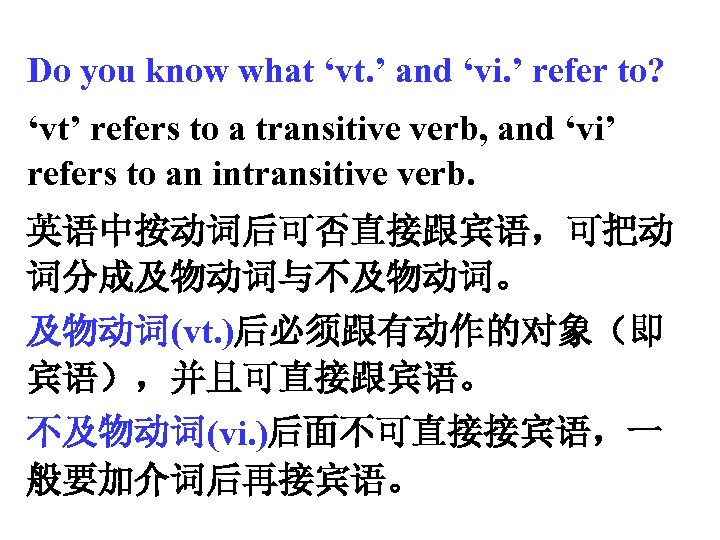 Do you know what ‘vt. ’ and ‘vi. ’ refer to? ‘vt’ refers to a transitive verb, and ‘vi’ refers to an intransitive verb. 英语中按动词后可否直接跟宾语,可把动 词分成及物动词与不及物动词。 及物动词(vt. )后必须跟有动作的对象(即 宾语),并且可直接跟宾语。 不及物动词(vi. )后面不可直接接宾语,一 般要加介词后再接宾语。
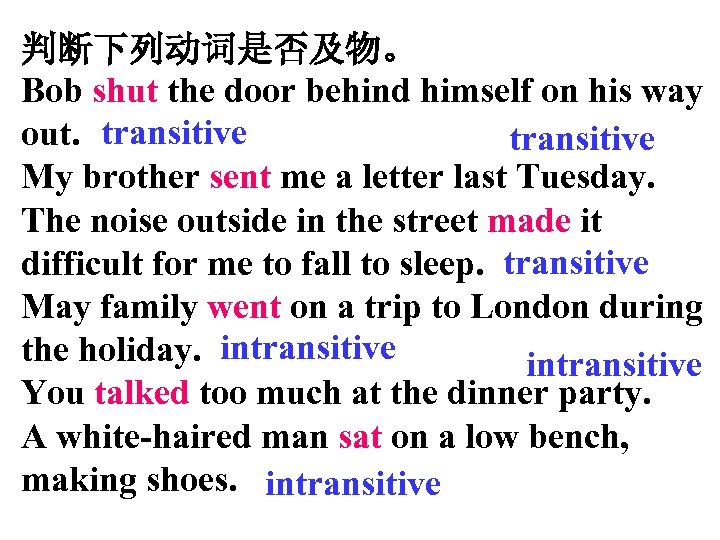 判断下列动词是否及物。 Bob shut the door behind himself on his way out. transitive My brother sent me a letter last Tuesday. The noise outside in the street made it difficult for me to fall to sleep. transitive May family went on a trip to London during the holiday. intransitive You talked too much at the dinner party. A white-haired man sat on a low bench, making shoes. intransitive
 How do you know whether a verb is a transitive or an intransitive? Read the points on Page 8, and you will find the answers.
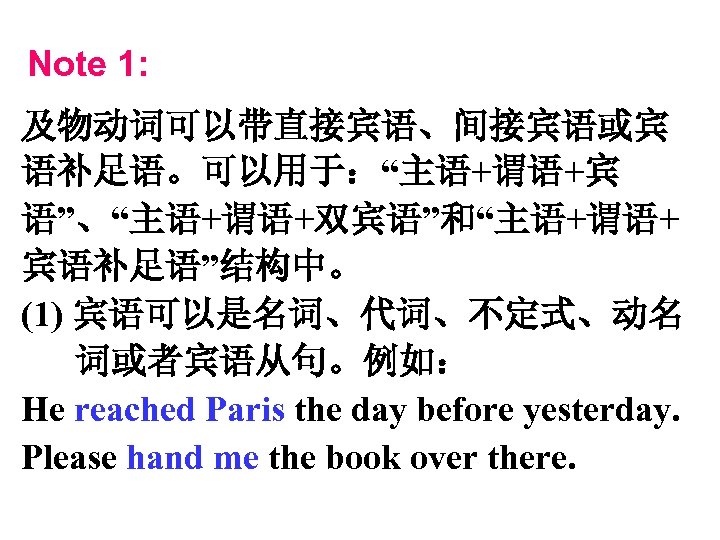 Note 1: 及物动词可以带直接宾语、间接宾语或宾 语补足语。可以用于:“主语+谓语+宾 语”、“主语+谓语+双宾语”和“主语+谓语+ 宾语补足语”结构中。 (1) 宾语可以是名词、代词、不定式、动名 词或者宾语从句。例如: He reached Paris the day before yesterday. Please hand me the book over there.
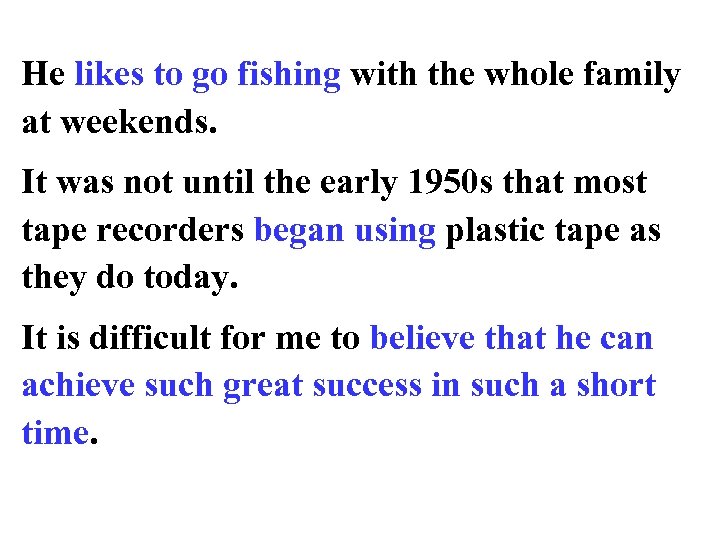 He likes to go fishing with the whole family at weekends. It was not until the early 1950 s that most tape recorders began using plastic tape as they do today. It is difficult for me to believe that he can achieve such great success in such a short time.
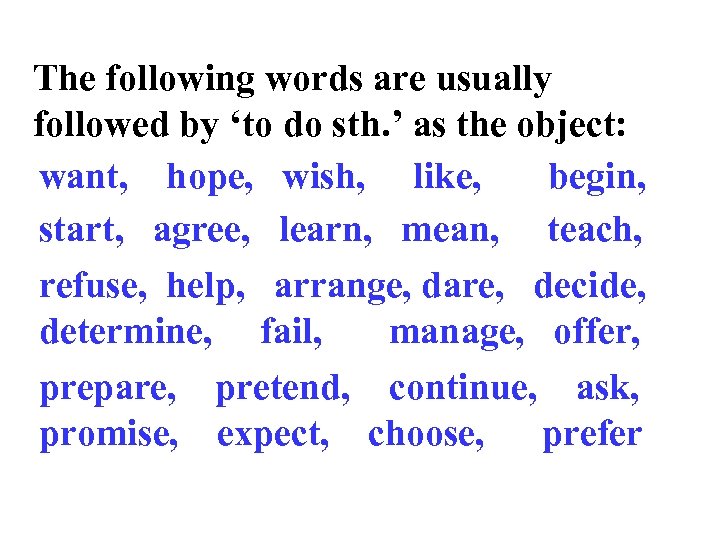 The following words are usually followed by ‘to do sth. ’ as the object: want, hope, wish, like, begin, start, agree, learn, mean, teach, refuse, help, arrange, dare, decide, determine, fail, manage, offer, prepare, pretend, continue, ask, promise, expect, choose, prefer
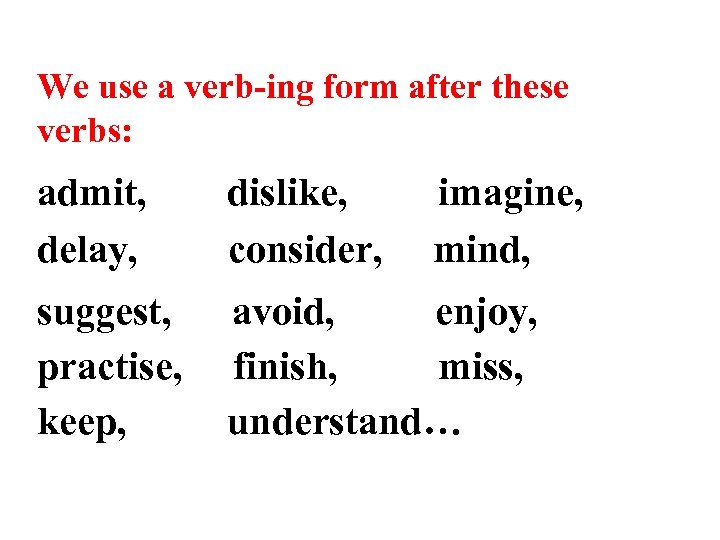 We use a verb-ing form after these verbs: admit, delay, dislike, consider, imagine, mind, suggest, practise, keep, avoid, enjoy, finish, miss, understand…
 Some verbs can be followed by a verb-ing form or ‘to do sth. ’, but with some differences in meanings or usage.
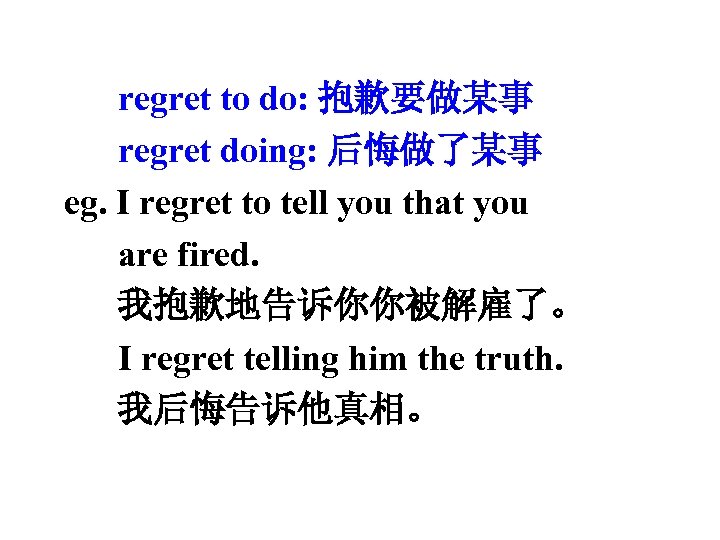 regret to do: 抱歉要做某事 regret doing: 后悔做了某事 eg. I regret to tell you that you are fired. 我抱歉地告诉你你被解雇了。 I regret telling him the truth. 我后悔告诉他真相。
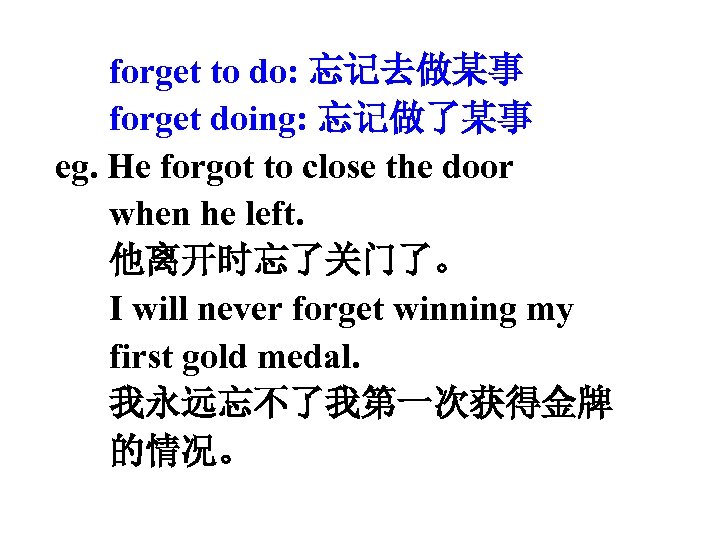 forget to do: 忘记去做某事 forget doing: 忘记做了某事 eg. He forgot to close the door when he left. 他离开时忘了关门了。 I will never forget winning my first gold medal. 我永远忘不了我第一次获得金牌 的情况。
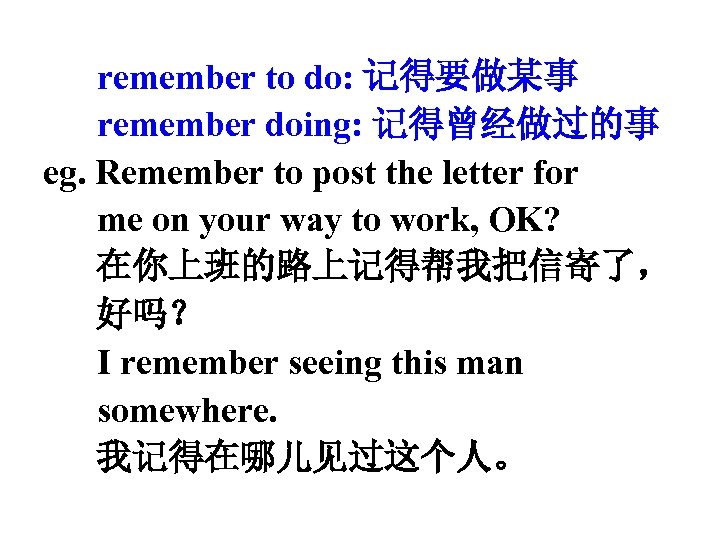 remember to do: 记得要做某事 remember doing: 记得曾经做过的事 eg. Remember to post the letter for me on your way to work, OK? 在你上班的路上记得帮我把信寄了, 好吗? I remember seeing this man somewhere. 我记得在哪儿见过这个人。
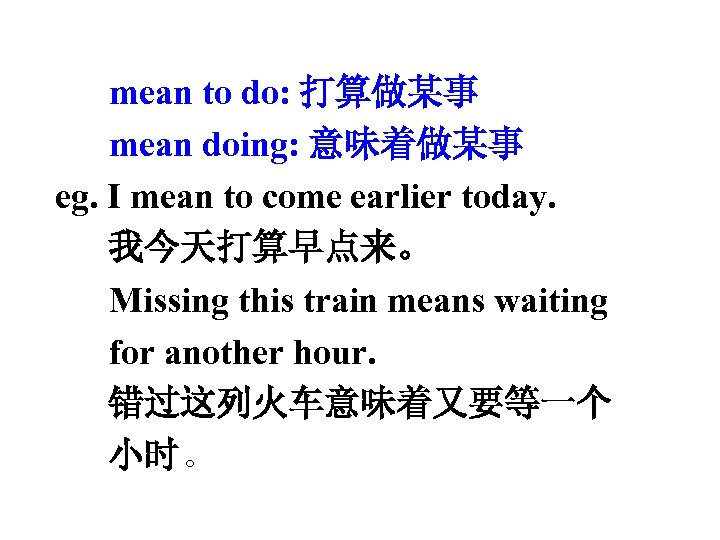 mean to do: 打算做某事 mean doing: 意味着做某事 eg. I mean to come earlier today. 我今天打算早点来。 Missing this train means waiting for another hour. 错过这列火车意味着又要等一个 小时。
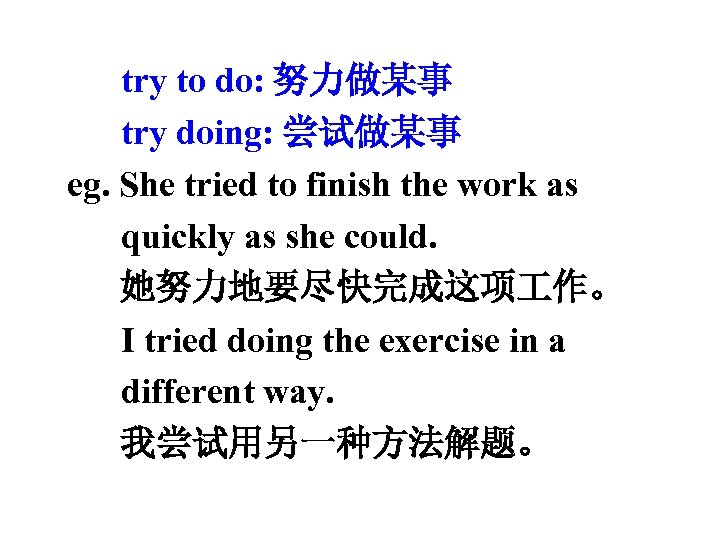 try to do: 努力做某事 try doing: 尝试做某事 eg. She tried to finish the work as quickly as she could. 她努力地要尽快完成这项 作。 I tried doing the exercise in a different way. 我尝试用另一种方法解题。
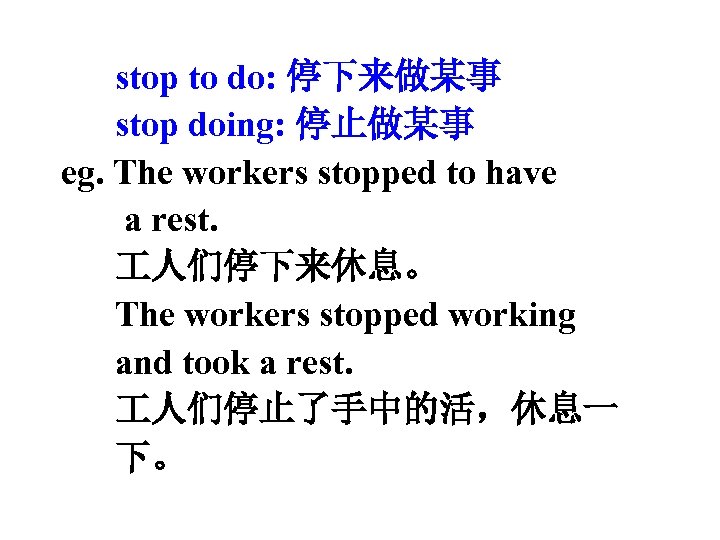 stop to do: 停下来做某事 stop doing: 停止做某事 eg. The workers stopped to have a rest. 人们停下来休息。 The workers stopped working and took a rest. 人们停止了手中的活,休息一 下。
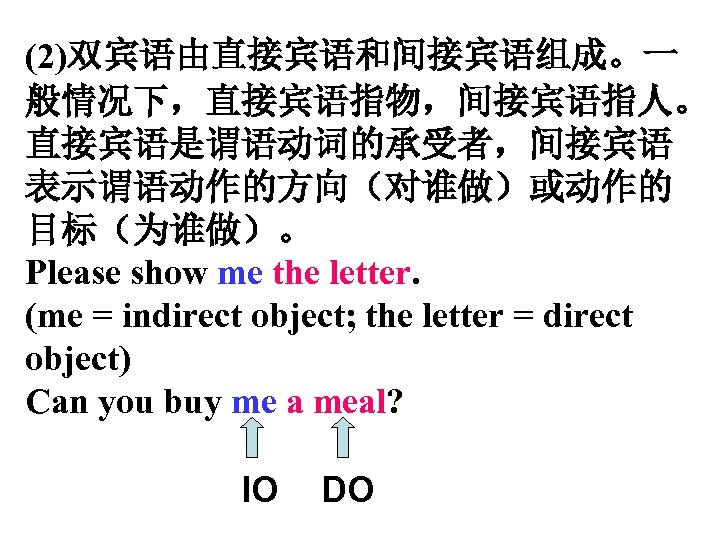 (2)双宾语由直接宾语和间接宾语组成。一 般情况下,直接宾语指物,间接宾语指人。 直接宾语是谓语动词的承受者,间接宾语 表示谓语动作的方向(对谁做)或动作的 目标(为谁做)。 Please show me the letter. (me = indirect object; the letter = direct object) Can you buy me a meal? IO DO
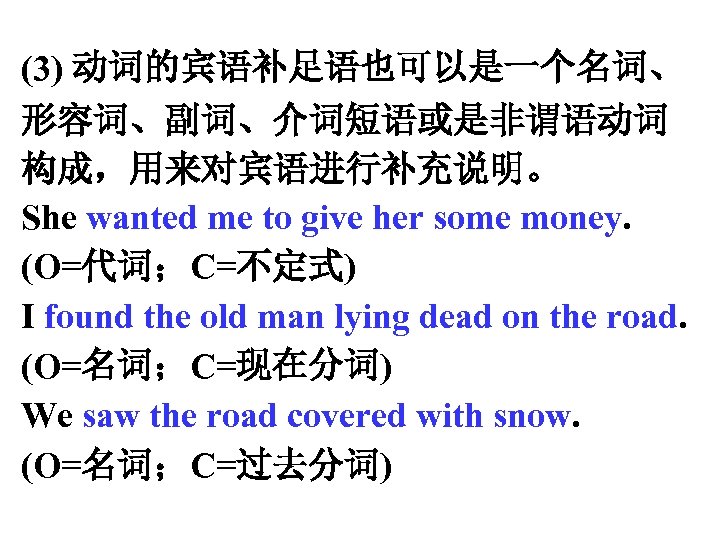 (3) 动词的宾语补足语也可以是一个名词、 形容词、副词、介词短语或是非谓语动词 构成,用来对宾语进行补充说明。 She wanted me to give her some money. (O=代词;C=不定式) I found the old man lying dead on the road. (O=名词;C=现在分词) We saw the road covered with snow. (O=名词;C=过去分词)
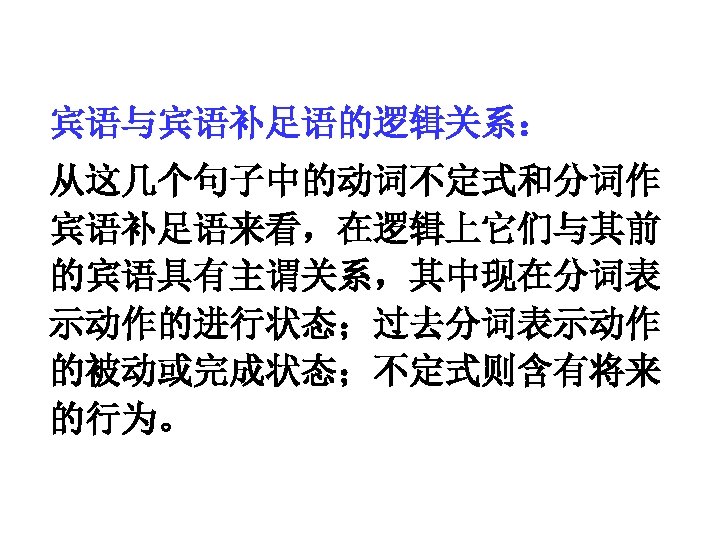 宾语与宾语补足语的逻辑关系: 从这几个句子中的动词不定式和分词作 宾语补足语来看,在逻辑上它们与其前 的宾语具有主谓关系,其中现在分词表 示动作的进行状态;过去分词表示动作 的被动或完成状态;不定式则含有将来 的行为。
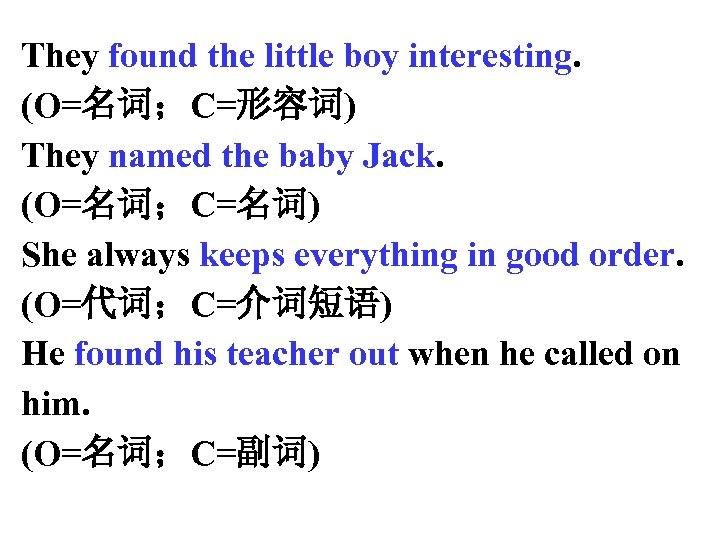 They found the little boy interesting. (O=名词;C=形容词) They named the baby Jack. (O=名词;C=名词) She always keeps everything in good order. (O=代词;C=介词短语) He found his teacher out when he called on him. (O=名词;C=副词)
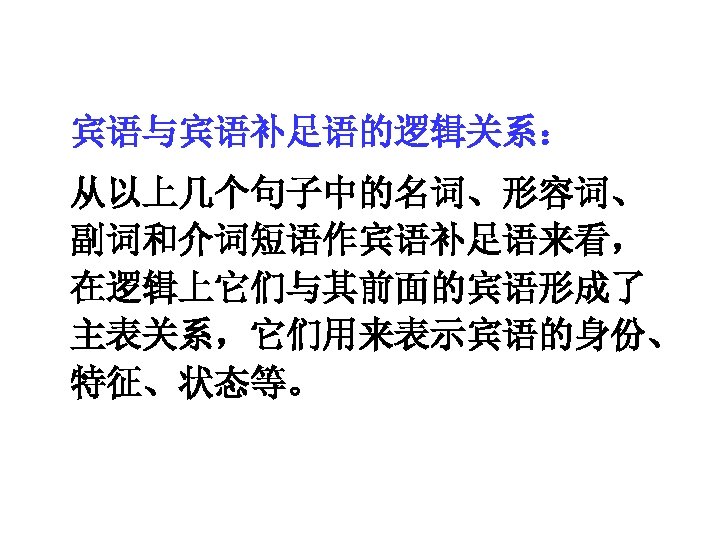 宾语与宾语补足语的逻辑关系: 从以上几个句子中的名词、形容词、 副词和介词短语作宾语补足语来看, 在逻辑上它们与其前面的宾语形成了 主表关系,它们用来表示宾语的身份、 特征、状态等。
 (4)大多数的及物动词都可以用于被动语 态中。如果主语是动作的承受者,或者 是说动作不是由主语而是由其他人完成 的,则用被动语态。例如: 孩子们热烈地欢迎外宾。 主动:The children gave the foreign guests a warm welcome. 被动:The foreign guests were given a warm welcome by the children.
 主动:They have warned us to be careful of rats. 被动:We have been warned to be careful of rats by them. 他们已提醒我们要注意老鼠。 主动:People have piled plastic bags full of rubbish in streets. 被动: Plastic bags full of rubbish have been piled in streets. 人们把装满垃圾的塑料袋子堆放在街上。
 Note 2: 不及物动词没有宾语,也不能用于被动语态。 但是不及物动词后面通常可接副词或者介词 短语。 Regular public broadcasting followed shortly afterwards. Technology is now changing faster than most people can keep pace with. MD stands for Mini. Disc. The ship set sail and headed for Shanghai.
 Note 3: 英语中很多动词既可以做及物动词,又可 以做不及物动词。我们需要视具体情况来 判断。例如: 1. He is drawing in the garden. He is drawing a picture in the garden. 2. Helen ran every weekend when she was at college. Tom’s father runs a big company in his hometown.
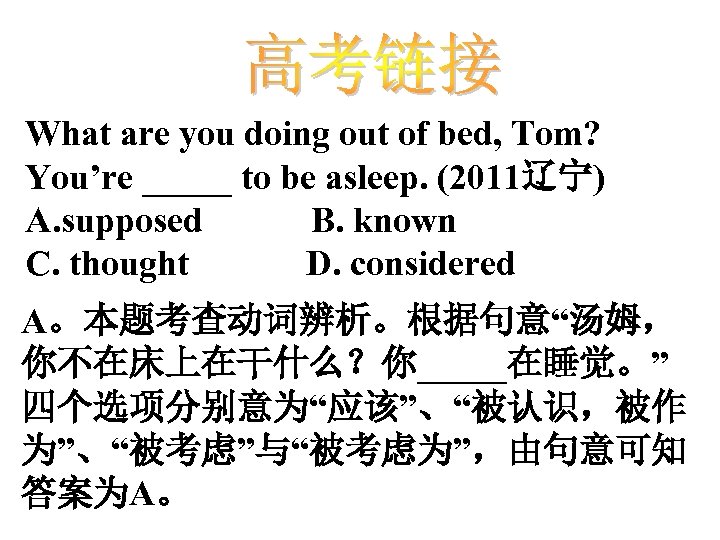 What are you doing out of bed, Tom? You’re _____ to be asleep. (2011辽宁) A. supposed B. known C. thought D. considered A。本题考查动词辨析。根据句意“汤姆, 你不在床上在干什么?你_____在睡觉。” 四个选项分别意为“应该”、“被认识,被作 为”、“被考虑”与“被考虑为”,由句意可知 答案为A。
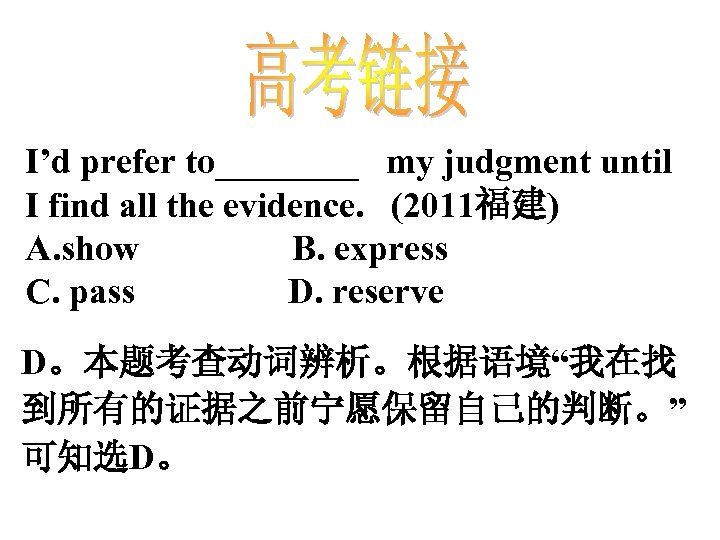 I’d prefer to____ my judgment until I find all the evidence. (2011福建) A. show B. express C. pass D. reserve D。本题考查动词辨析。根据语境“我在找 到所有的证据之前宁愿保留自己的判断。” 可知选D。
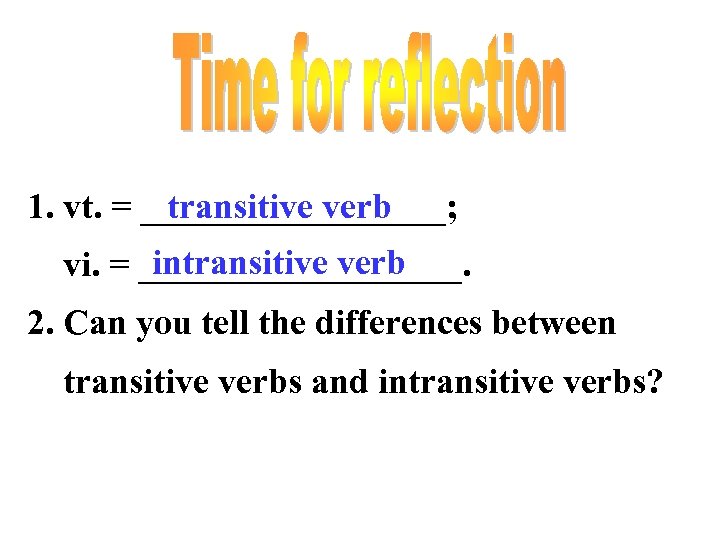 1. vt. = _________; transitive verb intransitive verb vi. = _________. 2. Can you tell the differences between transitive verbs and intransitive verbs?
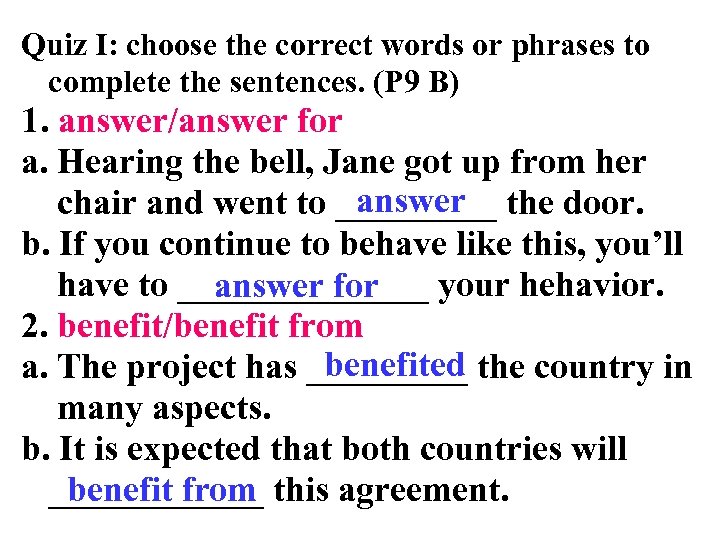 Quiz I: choose the correct words or phrases to complete the sentences. (P 9 B) 1. answer/answer for a. Hearing the bell, Jane got up from her answer chair and went to _____ the door. b. If you continue to behave like this, you’ll have to _______ your hehavior. answer for 2. benefit/benefit from benefited a. The project has _____ the country in many aspects. b. It is expected that both countries will benefit from ______ this agreement.
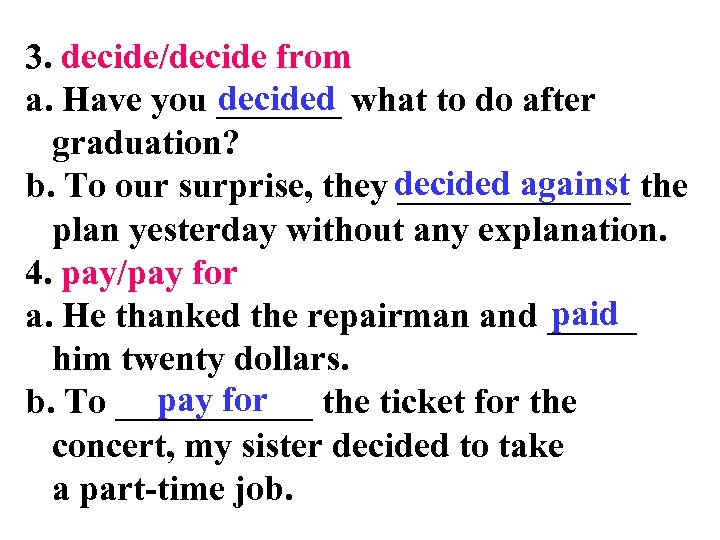 3. decide/decide from decided a. Have you _______ what to do after graduation? b. To our surprise, they decided against the _______ plan yesterday without any explanation. 4. pay/pay for paid a. He thanked the repairman and _____ him twenty dollars. pay for b. To ______ the ticket for the concert, my sister decided to take a part-time job.
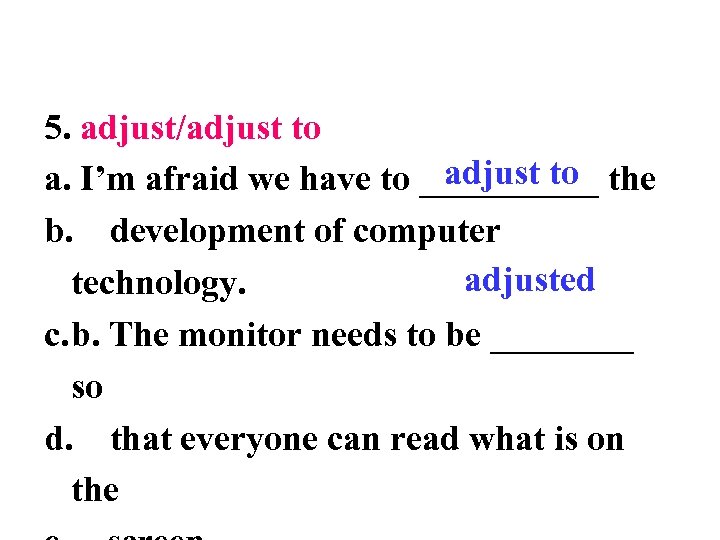 5. adjust/adjust to a. I’m afraid we have to _____ the b. development of computer adjusted technology. c. b. The monitor needs to be ____ so d. that everyone can read what is on the
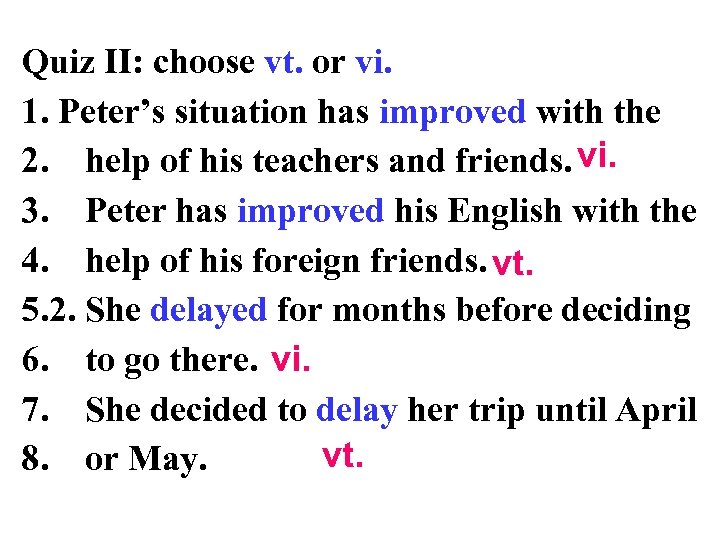 Quiz II: choose vt. or vi. 1. Peter’s situation has improved with the 2. help of his teachers and friends. vi. 3. Peter has improved his English with the 4. help of his foreign friends. vt. 5. 2. She delayed for months before deciding 6. to go there. vi. 7. She decided to delay her trip until April vt. 8. or May.
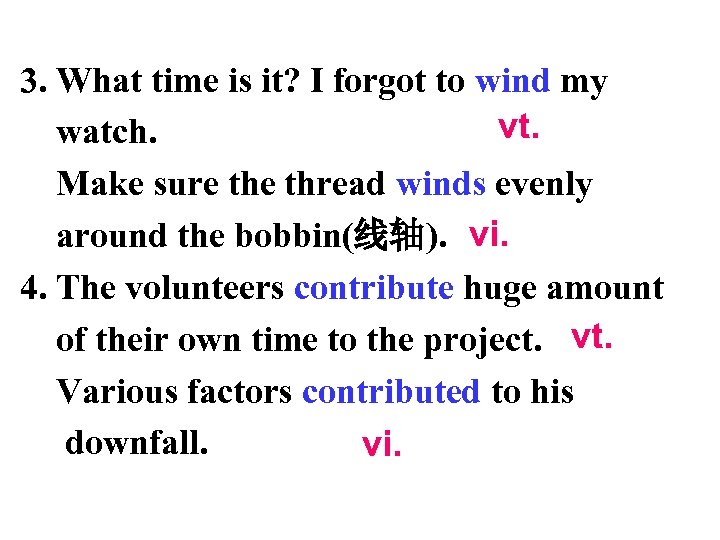 3. What time is it? I forgot to wind my vt. watch. Make sure thread winds evenly around the bobbin(线轴). vi. 4. The volunteers contribute huge amount of their own time to the project. vt. Various factors contributed to his downfall. vi.
 Finish the exercises on Page 10 and 11, in “世纪 金榜”