


 Скачать презентацию Grammar and Spelling Details details Preferred spellings
6a39bbab43479966d3839442cb37d1c8.ppt
- Количество слайдов: 103
 Grammar and Spelling Details, details
 Preferred spellings
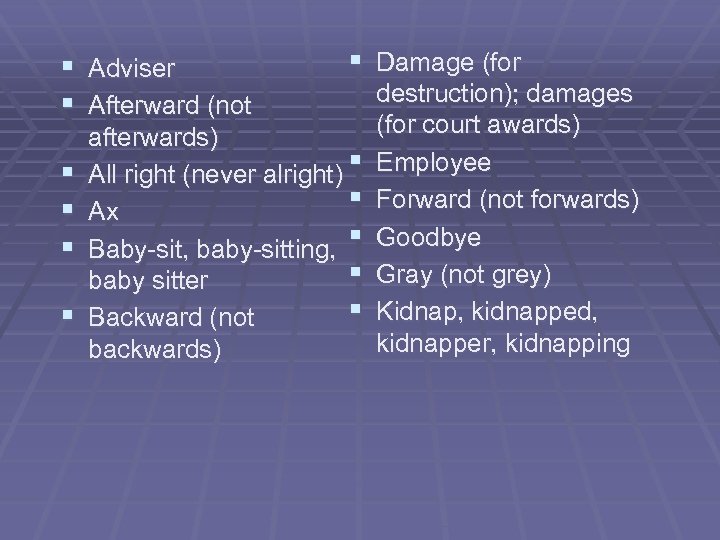 § Adviser § Afterward (not § § § Damage (for afterwards) All right (never alright) § § Ax Baby-sit, baby-sitting, § § baby sitter § Backward (not backwards) destruction); damages (for court awards) Employee Forward (not forwards) Goodbye Gray (not grey) Kidnap, kidnapped, kidnapper, kidnapping
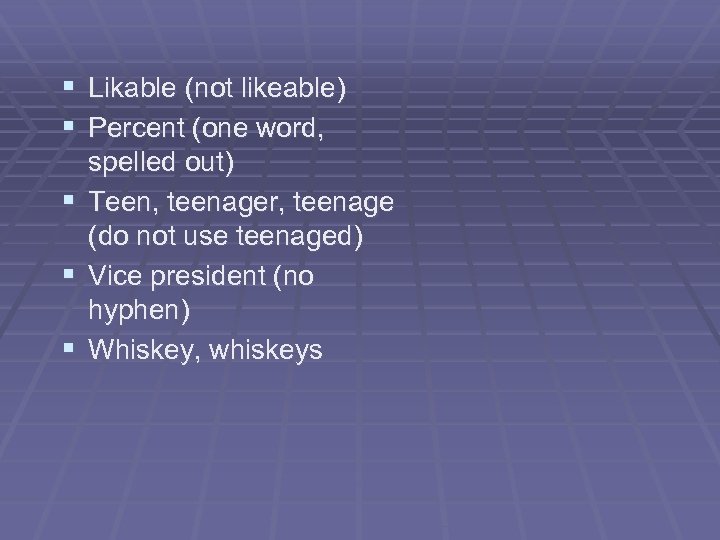 § Likable (not likeable) § Percent (one word, § § § spelled out) Teen, teenager, teenage (do not use teenaged) Vice president (no hyphen) Whiskey, whiskeys
 Preferred spellings for broadcast copy
 § Babysitter (one word) § Teen, teen-ager, teen-age
 Punctuation
 Comma/ages § Use commas to separate a person’s age from his or her name. § Artie Shaw, 94, died Wednesday.
 Comma/state names § Use commas to separate the name of a state from the name of a city. Use commas before and after the state name unless it ends the sentence. § The bus traveled from Cairo, Ill. , to Knoxville, Tenn.
 Comma/hometowns § Use commas to set off a person’s hometown when it is placed in apposition to the name. § Mary Richards, of Minneapolis, and Maude Findlay, of Tuckahoe, N. Y. , attended the ceremony.
 Comma/quotations § Use a comma after the attribution to introduce a one-sentence quotation. § She said, “The city has overspent its budget. ” § When the attribution follows the quotation, replace the period at the end of the quotation with a comma. § “The city has overspent its budget, ” she said.
 § Use commas before and after attribution that is in the middle of a quotation. § “Before the start of the war, ” the senator said, “the United States should have planned to fight insurgents. ” § Always place commas and periods inside quotation marks.
 § Use commas to set off attribution at the end or in the middle of an indirect quotation. § The war plans were inadequate, he said. § The time has come, the president said, to engage in direct negotiations. § Do not use a comma with indirect or partial quotations that start with the attribution. § Tucker said the plane was low on fuel.
 Comma/series § Use commas to separate elements in a series. Do not put a comma before the conjunction in a simple series. § The players’ jerseys are purple, yellow and white.
 Comma/appositives § An appositive is a word or expression placed beside another in order to explain or elaborate on the other word or expression. § Appositives should have commas before and after them, unless they come at the end of a sentence. § Bill Smith, the leadoff batter, struck out. § The letter came from Jane Mitchell, the state treasurer.
 Colon/lists § The most frequent use of the colon is at the end of a sentence to introduce a list, tabulation or text. § There were three considerations: expense, time and feasibility.
 Colon/quotations § Use a colon after the attribution to introduce a quotation of more than one sentence. § The prosecutor said: “The gunman showed no mercy. He shot both victims as they begged for their lives. ”
 Possessives § For common or proper nouns, singular or plural, that do not end in s, add an apostrophe and an s. (John’s house) § For singular common nouns that end in s, add an apostrophe and an s, unless the next word begins with an s. (boss’s house) (boss’ swing) § Singular common or proper nouns that end in ce, z or x, add an apostrophe and an s. (Rance’s house, Chaz’s car and Boudreaux’s restaurant.
 § For singular proper nouns that end in s, add only an apostrophe. (Tess’ comb) § For plural common or proper nouns ending in s, add only an apostrophe. (Jones’ car) § See Appendix C of “Reporting for the Media” for more rules and examples.
 Semicolon § Use semicolons to separate elements in a series where one or more of the elements has internal punctuation. § He leaves three daughters, Jane Smith of Wichita, Kan. , Mary Smith of Denver and Susan Kingsbury of Boston; a son, John Smith of Chicago; and a sister, Martha Warren of Omaha, Neb. § Note that a semicolon is used before the final element in the series.
 Punctuation for broadcast copy
 In general § Punctuation should help a newscaster understand read a story. § Most of the rules for punctuating print copy apply to broadcast copy
 Comma/ages and hometowns § Do not use commas to set off ages and hometowns from names. Instead, put ages and hometowns in separate sentences. § The governor has appointed James Burns to lead the Economic Development Department. He is a 48 -year-old banker from Pleasanton.
 Commas/quotations § Avoid direct quotations in stories. Use paraphrases or tape instead. § Where a direct quotation is central to a story, punctuate it as for print, but use a phrase that would make clear to listeners the words are those of the source, not of the reporter. § In the president’s words, “He can run, but he can’t hide. ”
 Capitalization
 § The Mathematics Department voted for the curriculum change, but the English Department opposed it. § The mathematics department voted for the curriculum change, but the English department opposed it.
 § The medal of honor was awarded to 1, 522 servicemen from the civil war, but only 464 received the award during world war two. § The Medal of Honor was awarded to 1, 522 servicemen from the Civil War, but only 464 received the award during World War II.
 § Many American holidays, like memorial day and labor day, are on Mondays. § Many American holidays, like Memorial Day and Labor Day, are on Mondays.
 § Although the Constitution allows references to god in such things as the pledge of allegiance, it does not allow public schools to require students to read the bible. § Although the Constitution allows references to God in such things as the Pledge of Allegiance, it does not allow public schools to require students to read the Bible.
 § He saw two cans of coke in the cup holders of the pontiac, but there was only a box of kleenex on the seat of the Truck. § He saw two cans of Coke in the cup holders of the Pontiac, but there was only a box of Kleenex on the seat of the truck.
 § Although it is not as tall as other Buildings, many people admire the Art Deco style of the Chrysler building. § Although it is not as tall as other buildings, many people admire the Art Deco style of the Chrysler Building.
 § If you want to rent the grand ballroom, speak to the reservations clerk in room 310. § If you want to rent the Grand Ballroom, speak to the reservations clerk in Room 310.
 § Thousands of tourists visit the capitol every year to see where congress holds its sessions. Many also visit the capitol in Richmond to see where the Virginia general assembly sits. § Thousands of tourists visit the Capitol every year to see where Congress holds its sessions. Many also visit the Capitol in Richmond to see where the Virginia General Assembly sits.
 § According to the congressional record, 335 members of the house voted for the resolution, but only 42 members of the senate supported it. § According to the Congressional Record, 335 members of the House voted for the resolution, but only 42 members of the Senate supported it.
 § The first amendment to the constitution guarantees Freedom of the Press, but courts have held libel suits against the media are Constitutional. § The First Amendment to the Constitution guarantees freedom of the press, but courts have held libel suits against the media are constitutional.
 § From southern California, they traveled Northeast until they reached the great plains and then headed South for the gulf coast. § From Southern California, they traveled northeast until they reached the Great Plains and then headed south for the Gulf Coast.
 § A Presidential order set an Administration policy of increasing traffic on the Mississippi and Missouri Rivers. § A presidential order set an administration policy of increasing traffic on the Mississippi and Missouri rivers.
 § Construction crews moved thousands of tons of Earth to construct the bunkers from which spectators could watch the spacecraft begin its journey from earth to Mars. § Construction crews moved thousands of tons of earth to construct the bunkers from which spectators could watch the spacecraft begin its journey from Earth to Mars.
 § The state patrol agreed to send investigators to help the Lewistown city police solve the double homicide. § The State Patrol agreed to send investigators to help the Lewistown City Police solve the double homicide.
 § The two cars collided at the intersection of United States highway 40 and state route seven, five miles South of I-44. § The two cars collided at the intersection of U. S. 40 and state Route 7, just five miles south of Interstate 44.
 § The joint amphibious assault exercise will involve troops from the British Army, the French Army and the United States army and marines, with the US navy providing transportation. § The joint amphibious assault exercise will involve troops from the British army, the French army and the U. S. Army and Marines, with the U. S. Navy providing transportation.
 § “We’re an equal opportunity bank. It makes no difference to us whether a customer is Black, White, arab or chinese, ” said Harriet Smith, the black vice president of the bank. § “We’re an equal opportunity bank. It makes no difference to us whether a customer is black, white, Arab or Chinese, ” said Harriet Smith, the vice president of the bank.
 § In the 1920’s, it was enough for most students to learn their ABC’s and to mind their ps and qs, but by the 50’s students needed more skills. § In the 1920 s, it was enough for most students to learn their ABCs and to mind their p’s and q’s, but by the ‘ 50 s students needed more skills.
 § The candidate is not a member of the Republican party or of the Democratic party. She says she belongs to the libertarian party, but her ideas are more Socialistic. § The candidate is not a member of the Republican Party or of the Democratic Party. She says she belongs to the Libertarian Party, but her ideas are more socialistic.
 § Sen. Susan Collins, r-Me. , and Rep. Mike Ross, d-Arkansas, have agreed to cosponsor the bill. § Sen. Susan Collins, R-Maine, and Rep. Mike Ross, D-Ark. , have agreed to cosponsor the bill.
 § The rockies and the appalachians are the two major Mountain Ranges in North America, but neither has peaks as high as those in the Himalayan mountains in asia. § The Rockies and the Appalachians are the two major mountain ranges in North America, but neither has peaks as high as those in the Himalayan Mountains in Asia.
 § “The people of some countries may call the United States the ‘great satan, ’ but it is the international terrorists who are truly Satanic, ” the ambassador said. § “The people of some countries may call the United States the ‘great Satan, ’ but it is the international terrorists who are truly satanic, ” the ambassador said.
 § The introduction of Astronaut Tom Leffler was made by mayor Anne Swenson and Herbert Williamson, the Governor. § The introduction of astronaut Tom Leffler was made by Mayor Anne Swenson and Herbert Williamson, the governor.
 Capitalization in Broadcast Copy
 § The U. S. Department of Defense and the U. S. Department of Agriculture are cooperating on a program to protect crops and livestock from terrorist attacks. § The U-S Defense and Agriculture departments are cooperating on a program to protect crops and livestock from terrorist attacks.
 Capitalization
 In general § Do not capitalize words unnecessarily. § Use capital letters only as required by the rules summarized here or in the AP Stylebook.
 Academic departments § Use lowercase except for proper nouns that are part of a department’s name. § the history department § the department of history § the English department § the department of English
 Awards/events/holidays/wars § Capitalize awards. § Medal of Honor § Capitalize historic events and periods. § the San Francisco Earthquake; the Great Depression § Capitalize holidays. § Thanksgiving Day § Capitalize wars § The Civil War; World War II
 Bible/God § Capitalize Bible, without quotation marks, to refer to the Old and New Testaments. § Quran is the preferred spelling for the Muslim holy book, and it, too, should be capitalized. § Capitalize God or Allah to refer to monotheistic deities; lowercase pronouns referring to the deity.
 Brand names § Capitalize brand names. § Pontiac § Coke § Kleenex § Lowercase generic terms. § sedan § cola § facial tissue
 Buildings/Rooms § Capitalize the proper names of buildings, including the word building if that is part of the name. § Empire State Building § Capitalize the names of specifically designated rooms and the word room when it’s used with a number. § the Blue Room § Room 345
 Capitol § Capitalize U. S. Capitol and the Capitol when referring to the building where Congress meets. § Capitalize Capitol when referring to the building where a specific state legislature meets. § the Indiana State Capitol
 Congress § Capitalize U. S. Congress and Congress when referring to the U. S. Senate and House of Representatives. § Lower case congressional, unless it is part of a proper noun, such as the Congressional Record. § Capitalize legislature and similar terms when referring to specific state legislative bodies. § the Kansas Legislature
 Constitution § Capitalize references to the U. S. Constitution, with or without the U. S. modifier. § Capitalize Bill of Rights and First Amendment (and all other amendments). § Lowercase the adjective constitutional.
 Directions/Regions § Lowercase north, southwest, etc. , when they indicate a compass direction. § Des Moines is north of Kansas City. § Capitalize such words when they indicate a region. § The storm hit Northeast states hardest. § Capitalize names of well known regions. § the Deep South; the East Side of Manhattan; Southern California.
 Do not capitalize § § § § administration first lady first family government presidential presidency priest seasons (fall, winter, etc. ) § years in school (sophomore, junior, etc. ) § Also, lowercase the common-noun elements of proper names in plural uses. § Elm and Main streets § the Missouri and Mississippi rivers
 Earth § Generally, lowercase earth. § She is a down-to-earth person. § Capitalize when it’s used as the proper name of the planet. § Mars is farther from the Sun than Earth.
 Government § Capitalize city, county, state and federal when part of a proper name. § Crawford County Commission § Capitalize city council, city hall, police department, legislature and assembly when part of a proper name. § Boston City Council; Chicago Police Department; Florida Legislature
 § Retain capitalization when the context makes clear the reference is to a specific body. § the City Council; the Police Department; the Legislature
 Highways § Use these forms for highways identified by number. § U. S. Highway 1; U. S. Route 1; U. S. 1; Illinois 34, Illinois Route 34; state Route 34; Interstate 495; Interstate Highway 495. § On second reference, use I-495. § When a letter is appended to a highway number, capitalize it. § Route 1 A
 Military § Capitalize the names of U. S. armed forces. § U. S. Army § the Navy § Marine regulations § Lower case the forces of other nations. § the French army
 Nationalities/Race § Capitalize proper names of nationalities, races and tribes. § French; Arab; Caucasian; Eskimo § Lowercase words such as black, white and mulatto. § Do not use colored; in the United States, the word is considered derogatory. § Do not identify people by race unless it is necessary to the story.
 Plurals § To form the plurals of a number, add s with no apostrophe. § 1920 s § To form plurals of a single letter, add ’s. To form plurals of multiple letters, add only s. § Mind your p’s and q’s. § She knows her ABCs.
 Political parties § Capitalize both the name of the party and the word party. § the Republican Party § Also capitalize Communist, Socialist, Libertarian when they refer to a specific party or party member.
 § Lowercase references to a political philosophy § The Libertarian candidate received 348 votes. § The foundation advocates libertarian policies. § Use a D or an R and the abbreviation for the state to identify members of Congress. § Sen. Mitch Mc. Connell, R-Ky. , … § Rep. Nancy Pelosi, D-Calif. , …
 § Use a D or an R and home town or district to identify members of state legislatures, city councils or other legislative bodies elected on a partisan basis. § State Sen. Joe Adams, R-Walnut, … § Councilwoman Alice Goode, D-3 rd District, …
 Proper nouns § Capitalize proper nouns, which uniquely identify persons, places or things. § Mary § Boston § the Columbia River § Lowercase common nouns when they stand alone. § the city § the river
 Satan § Capitalize Satan, but lowercase devil and satanic.
 Titles § Capitalize formal titles used immediately before a name. § Mayor Donna Rodgers § Lowercase titles used after the name or alone. § Donna Rogers, mayor of Walnut, ….
 § Lowercase words that are job descriptions rather than titles. § movie star Tom Hanks § Do not capitalize professor when used before a name. § He thanked professor Betty Falk for her advice.
 Capitalization for broadcast copy
 In general § Capitalization rules for broadcast copy are nearly identical to those for print copy. § See the AP Stylebook and the AP Broadcast News Handbook for more specifics.
 Government § Always refer to governmental bodies by the name that is most familiar to the audience. § Capitalize full proper names, and hyphenate U-S when that’s part of the name. § U-S Defense Department
 Grammar Basics: Common Errors
 Subject-verb agreement § Singular subjects take singular verbs. § A sharp knife cuts cleanly. § The basketball needs more air. § Plural subjects take plural verbs. § Most automobiles run on gasoline. § The magazines lie on the coffee table.
 Noun-pronoun agreement § Nouns have one of four genders: § masculine (man, father, uncle) § feminine (woman, mother, aunt) § neuter (tree, streetlight) § common (author, gymnast, lawyer, doctor) § Pronouns have one of three genders: § masculine (he, him, his) § feminine (she, hers) § neuter (it, its)
 § Pronouns must agree with their antecedents in number and gender. § Doris said she would bring the pie. § She keeps her shoes in their boxes. § Problems often arise when writers try to find a gender-neutral pronoun for a common noun. § Every firefighter wore their hat. § Try to recast the sentence as a plural: § All firefighters wore their hats.
 Collective nouns § Agreement problems also arise with collective nouns – team, jury, company – and proper names for collectives – Dodgers, General Motors. § Collective nouns may be singular or plural, but not both in the same sentence.
 Singular verb-plural pronoun § Sloppy writers sometimes use a singular verb and a plural pronoun – in the same sentence. § WRONG: The company demands too much from their employees. § RIGHT: The company demands too much from its employees. § RIGHT: The company’s managers demand too much from their employees.
 § The tendency in American English is to treat collective nouns as singular. § The board sets the salaries for the executives it hires. § An exception is made when the members of the collective are acting as individuals, not as a group. § The board disagree on whether the company should pay their travel expenses.
 Adjective-Adverb Confusion § Adjectives modify nouns. § Adverbs modify verbs, adjectives and other adverbs. § Sometimes writers use adjectives when they should use adverbs. § WRONG: She caught on quick to the scam. § RIGHT: She caught on quickly to the scam.
 “Good” and “well” § “Good” is an adjective; “well” is an adverb. § What is the difference in the meaning between these two sentences? § She does good. § She does well. § Which of these is correct? § The engine runs good. § The engine runs well.
 Relative pronouns § Use “that” and “which” to refer to inanimate objects, abstractions and animals that don’t have names. § Use “who” and “whom” for people and animals with names.
 “That” and “which” § Would these two sentences lead you to the same house? Why or why not? § Go to the third house, which has green drapes. § Go to the third house that has green drapes. § Use “which” to introduce nonessential phrases and clauses; use “that” to introduce essential phrases and clauses.
 “Who” and “whom” § Use “who” when it is the subject of the phrase or clause in which it stands. § Use “whom” when it is the object of a verb or preposition. § SUBJECT: I know who will win the Super Bowl. § OBJECT OF VERB: He is one whom I trust. § OBJECT OF PREPOSITION: To whom did you send the letter?
 Passive voice § Active voice sentences use the subjectverb-object pattern. § The batter hit the ball. § Passive voice turns the order around and makes the direct object the subject. § The ball was hit by the batter.
 Problems with passives § Passive sentences use more words than active ones, making them harder to understand. § Passive sentences also obscure responsibility. § Mistakes were made. § Laws were violated. § People were hurt.
 Compound modifiers § Hyphenate before a noun § …small-town resident …. § … man-eating shark …. § … full-time worker …. § Hyphen shows the two words work together, not independently, to modify the noun.
 § Absence of a hyphen can lead to ambiguity, some times humorous, as in this headline: § Squad helps dog bite victim § Whom is the squad helping, the dog or the victim? § …small town resident …. § Is the town small or the resident? § … man eating shark…. § Is the man eating the shark or the shark eating the man?
 Hyphenate predicate adjectives § Hyphenate compound modifiers used as predicate adjectives (adjectives that follow a linking verb such as “to be”). § Her outlook is small-town. § The shark is a man-eater.
 Don’t hyphenate in other contexts § She lives in a small town. § He is a victim of a dog bite. § She works full time.
 The language of news
 Be precise § Words are the journalists’ tools. Just as a surgeon must know how to use a scalpel or a carpenter must know how to use a plane, the journalist must know how to use words. § Some words, like “collide” and “epicenter, ” are widely misused. Others are misused because of confusion, like “cite” and “site. ”
 Use strong verbs § Verbs convey action. A strong, active verb can replace a weak verb and several adjectives. § WEAK: The car hit the roadside barrier hard and fell far into the ravine. § STRONGER: The car smashed the roadside barrier and plunged into the ravine.
 Slang, jargon and euphemisms § Slang words are linguistic fads that may or may not endure. § Jargon, or technical language, has meaning only to those in a particular job. § Euphemisms hide unpleasant realities. § All obscure understanding, but the journalists’ job is to increase understanding.
 Other issues § Avoid platitudes, which state the obvious. § The mayor was please by the warm reception. § Avoid the negative. § NEGATIVE: Students did not come to class often. § POSITIVE: Students often skipped class.
 § Avoid gush or enthusiastic exaggeration. § The fair will offer bigger and better attractions than ever before. § Avoid vague time references. In print copy, use day of the week or date instead of “yesterday” or “tomorrow. ” Eliminate redundancies like “ 10 a. m. in the morning” or “this Tuesday. ”