 Скачать презентацию Grameen social business loan service in Bangladesh Dr
74d42fd85c9259fae191f837f5d1fb76.ppt
- Количество слайдов: 45



Grameen social business loan service in Bangladesh Dr. Kazi Abdur Rouf York Center for Asian Research Faculty of Environment Studies, York University Noble International University, USA Paper presented at the Noble Institution for Environmental Peace (NIEP) Seminar Toronto. Date: January 14, 2016
Presentation contains three parts (1) Grameen Bank microenterprise loan (2) Grameen Nabin Uddugta (NU), new entrepreneur, social business loan (NUSBL) and (3) Their impact on the second generation of GB borrower in Bangladesh.
Background of Grameen Nabeen Uddugta (new entrepreneur) Social Business Funding Project in Banglsdesh 1. 2. 3. 4. 5. Grameen bank has been providing micro-credit to marginalized people in Bangladesh since 1976 Grameen Bank started micro enterprise loan (a little bigger size loan than micro credit) in 1999 Grameen Nabben Uddugta social business loan started in 2008 After resigning Muhammed Yunus from Grameen Bank in 2011, he has structured Yunus Center social business design lab in 2012 NU social business funding project is implementing by Grameen sister organizations designed by the Yunus Center social business design lab in Bangladesh since 2013
Grameen new entrepreneur social business loan (NUSBL) program • The Grameen new entrepreneur social business loan (NUSBL) program is designed by Muhammed Yunus • NUSBL program implementing agencies are Grameen sister organizations • Grameen Kallayan • Grameen Shakti Samajik Babsha • Grameen Telecom Trust • Grameen Trust
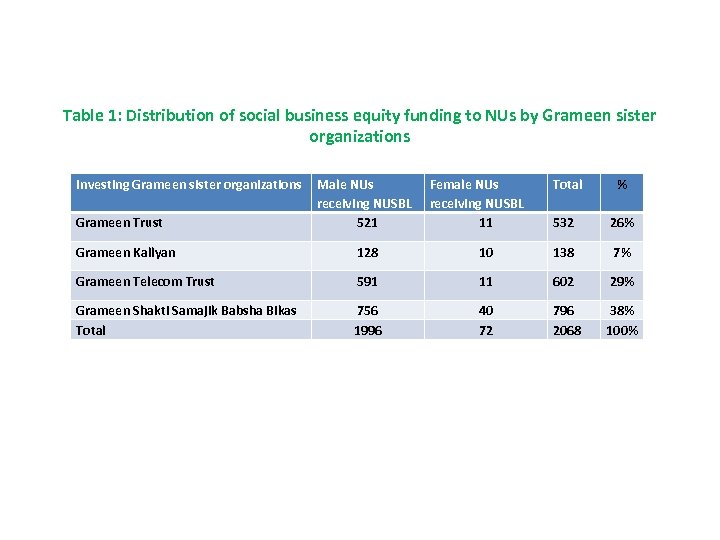
Table 1: Distribution of social business equity funding to NUs by Grameen sister organizations Investing Grameen sister organizations Grameen Trust Male NUs receiving NUSBL 521 Female NUs receiving NUSBL 11 Total % 532 26% Grameen Kallyan 128 10 138 7% Grameen Telecom Trust 591 11 602 29% Grameen Shakti Samajik Babsha Bikas Total 756 1996 40 72 796 2068 38% 100%
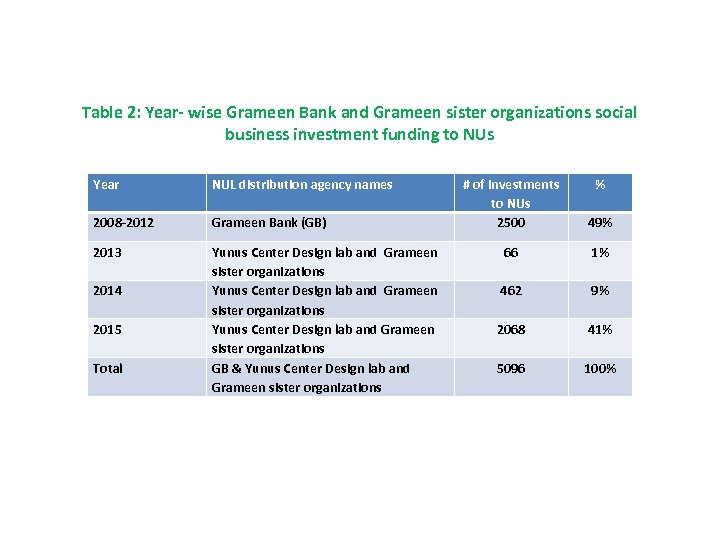
Table 2: Year- wise Grameen Bank and Grameen sister organizations social business investment funding to NUs Year NUL distribution agency names 2008 -2012 Grameen Bank (GB) 2013 Yunus Center Design lab and Grameen sister organizations GB & Yunus Center Design lab and Grameen sister organizations 2014 2015 Total # of investments to NUs 2500 % 49% 66 1% 462 9% 2068 41% 5096 100%
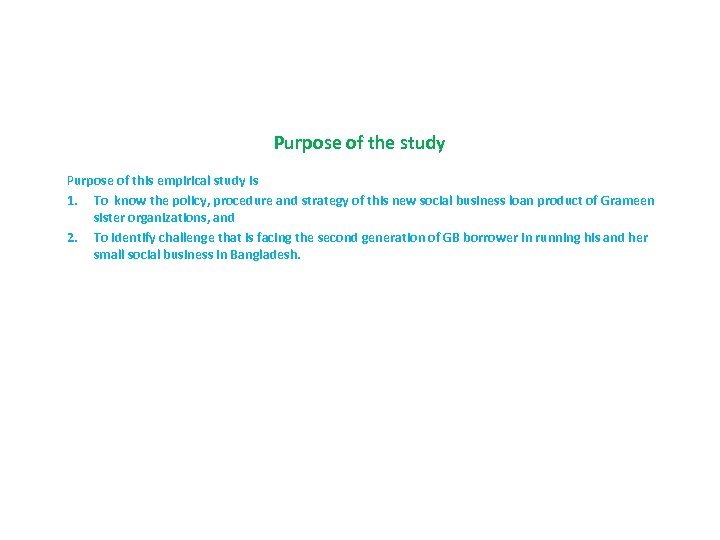
Purpose of the study Purpose of this empirical study is 1. To know the policy, procedure and strategy of this new social business loan product of Grameen sister organizations, and 2. To identify challenge that is facing the second generation of GB borrower in running his and her small social business in Bangladesh.
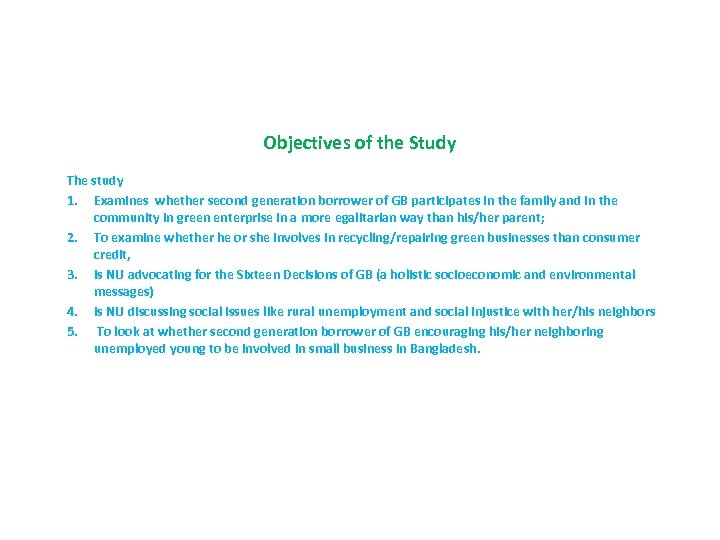
Objectives of the Study The study 1. Examines whether second generation borrower of GB participates in the family and in the community in green enterprise in a more egalitarian way than his/her parent; 2. To examine whether he or she involves in recycling/repairing green businesses than consumer credit, 3. Is NU advocating for the Sixteen Decisions of GB (a holistic socioeconomic and environmental messages) 4. Is NU discussing social issues like rural unemployment and social injustice with her/his neighbors 5. To look at whether second generation borrower of GB encouraging his/her neighboring unemployed young to be involved in small business in Bangladesh.
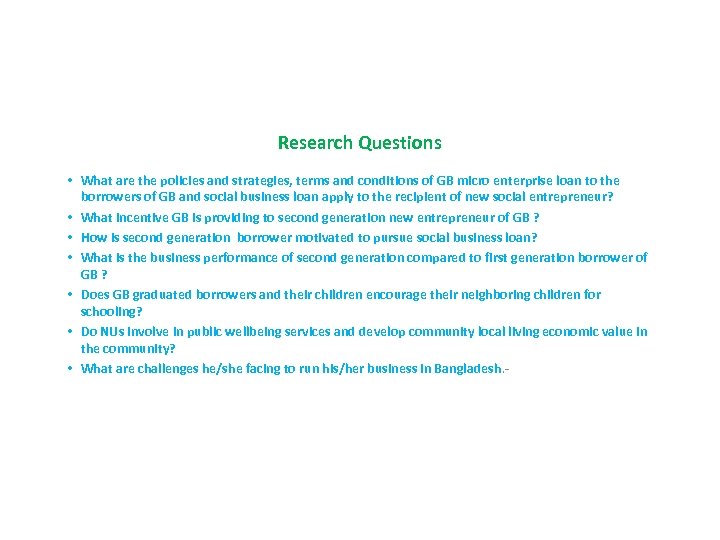
Research Questions • What are the policies and strategies, terms and conditions of GB micro enterprise loan to the borrowers of GB and social business loan apply to the recipient of new social entrepreneur? • What incentive GB is providing to second generation new entrepreneur of GB ? • How is second generation borrower motivated to pursue social business loan? • What is the business performance of second generation compared to first generation borrower of GB ? • Does GB graduated borrowers and their children encourage their neighboring children for schooling? • Do NUs involve in public wellbeing services and develop community local living economic value in the community? • What are challenges he/she facing to run his/her business in Bangladesh.
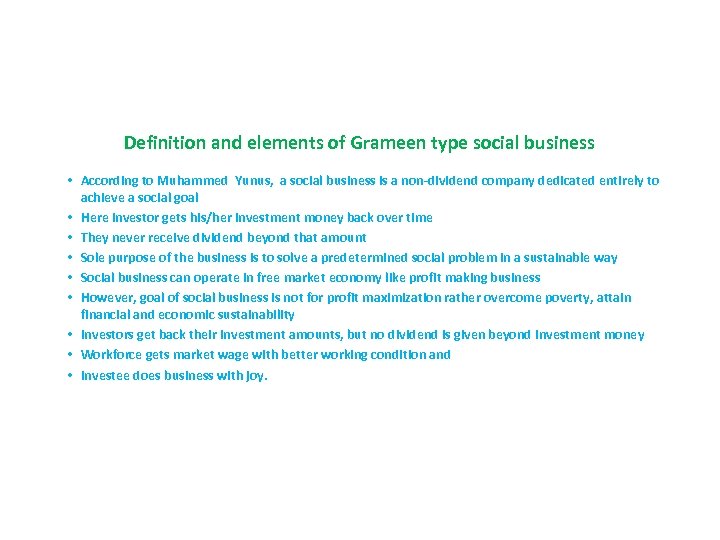
Definition and elements of Grameen type social business • According to Muhammed Yunus, a social business is a non-dividend company dedicated entirely to achieve a social goal • Here investor gets his/her investment money back over time • They never receive dividend beyond that amount • Sole purpose of the business is to solve a predetermined social problem in a sustainable way • Social business can operate in free market economy like profit making business • However, goal of social business is not for profit maximization rather overcome poverty, attain financial and economic sustainability • Investors get back their investment amounts, but no dividend is given beyond investment money • Workforce gets market wage with better working condition and • Investee does business with joy.
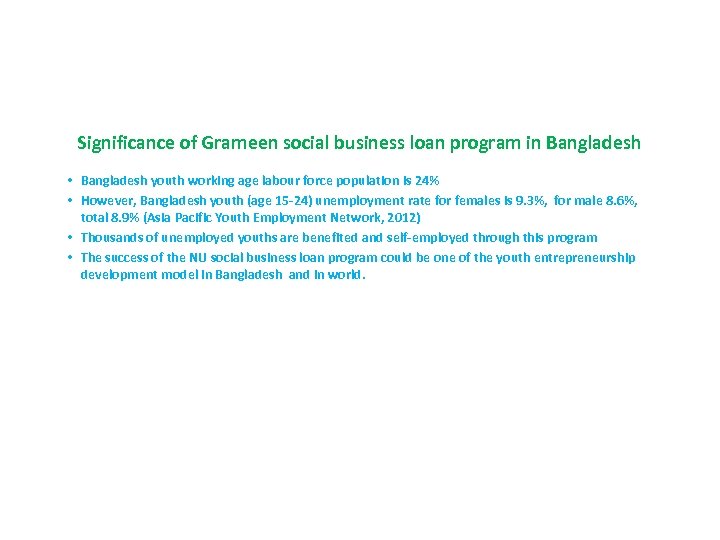
Significance of Grameen social business loan program in Bangladesh • Bangladesh youth working age labour force population is 24% • However, Bangladesh youth (age 15 -24) unemployment rate for females is 9. 3%, for male 8. 6%, total 8. 9% (Asia Pacific Youth Employment Network, 2012) • Thousands of unemployed youths are benefited and self-employed through this program • The success of the NU social business loan program could be one of the youth entrepreneurship development model in Bangladesh and in world.
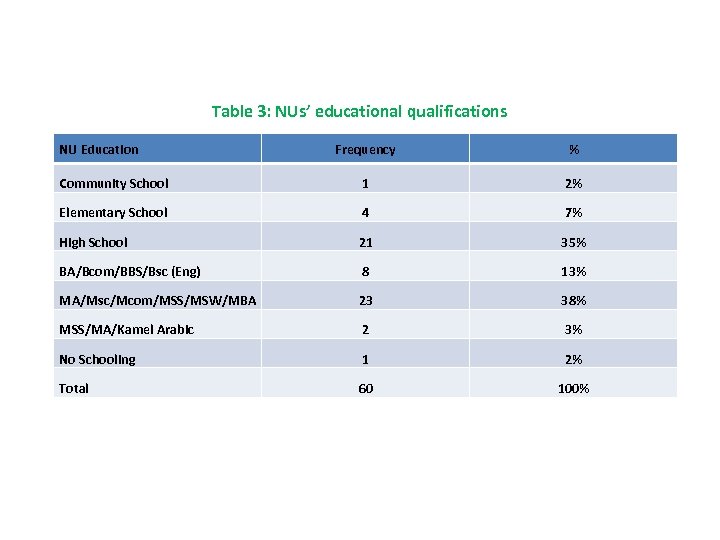
Table 3: NUs’ educational qualifications NU Education Frequency % Community School 1 2% Elementary School 4 7% High School 21 35% BA/Bcom/BBS/Bsc (Eng) 8 13% MA/Msc/Mcom/MSS/MSW/MBA 23 38% MSS/MA/Kamel Arabic 2 3% No Schooling 1 2% Total 60 100%
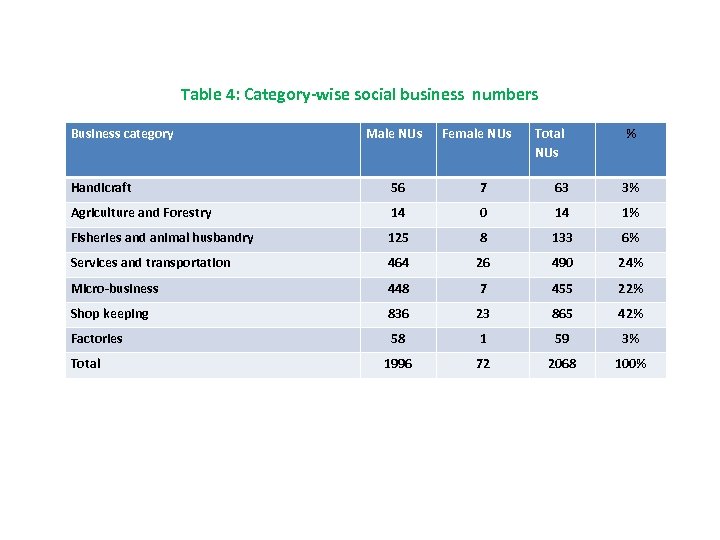
Table 4: Category-wise social business numbers Business category Male NUs Female NUs Total NUs % Handicraft 56 7 63 3% Agriculture and Forestry 14 0 14 1% Fisheries and animal husbandry 125 8 133 6% Services and transportation 464 26 490 24% Micro-business 448 7 455 22% Shop keeping 836 23 865 42% Factories 58 1 59 3% 1996 72 2068 100% Total
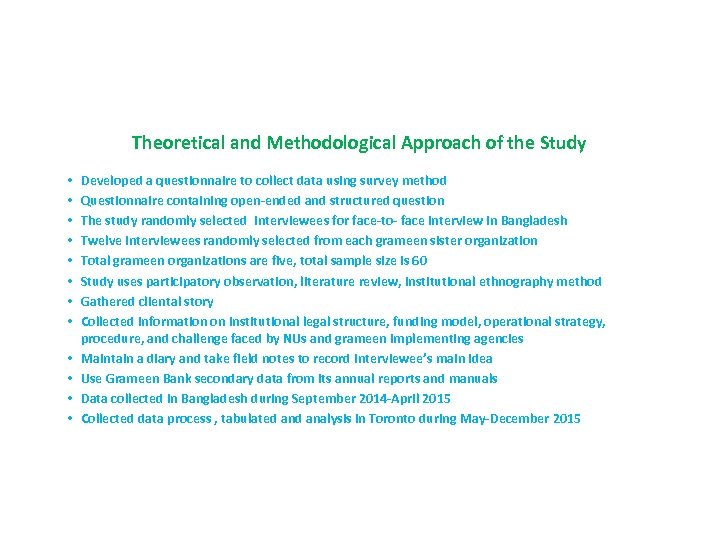
Theoretical and Methodological Approach of the Study • • • Developed a questionnaire to collect data using survey method Questionnaire containing open-ended and structured question The study randomly selected interviewees for face-to- face interview in Bangladesh Twelve interviewees randomly selected from each grameen sister organization Total grameen organizations are five, total sample size is 60 Study uses participatory observation, literature review, institutional ethnography method Gathered cliental story Collected information on institutional legal structure, funding model, operational strategy, procedure, and challenge faced by NUs and grameen implementing agencies Maintain a diary and take field notes to record interviewee’s main idea Use Grameen Bank secondary data from its annual reports and manuals Data collected in Bangladesh during September 2014 -April 2015 Collected data process , tabulated analysis in Toronto during May-December 2015
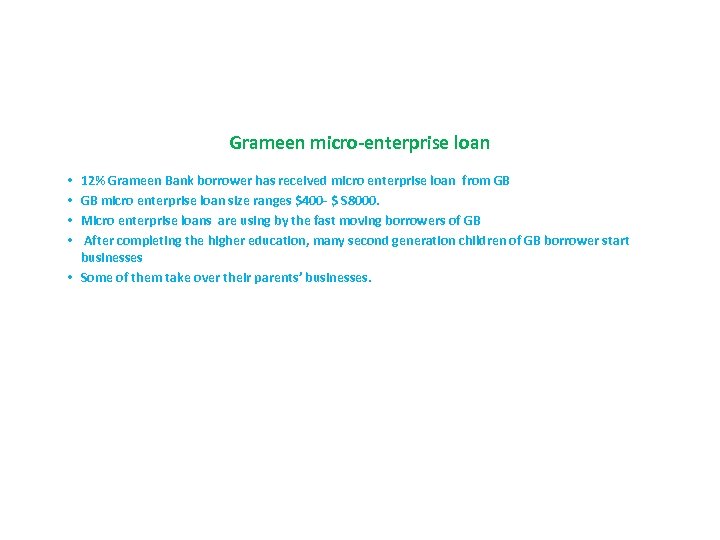
Grameen micro-enterprise loan 12% Grameen Bank borrower has received micro enterprise loan from GB GB micro enterprise loan size ranges $400 - $ S 8000. Micro enterprise loans are using by the fast moving borrowers of GB After completing the higher education, many second generation children of GB borrower start businesses • Some of them take over their parents’ businesses. • •
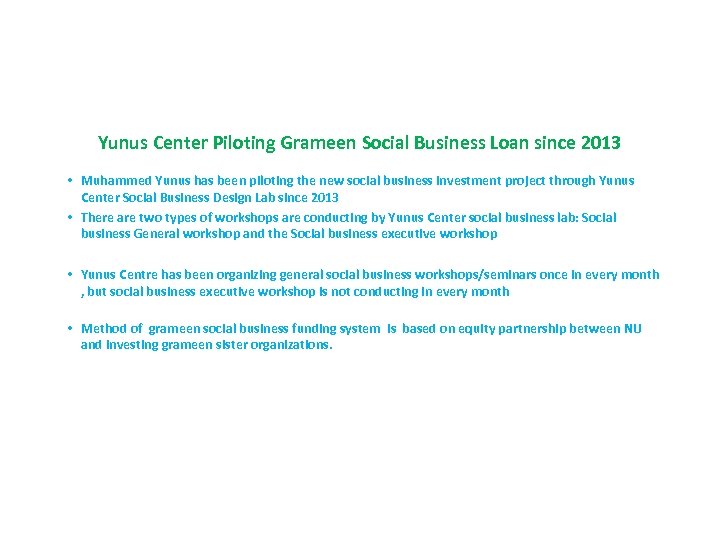
Yunus Center Piloting Grameen Social Business Loan since 2013 • Muhammed Yunus has been piloting the new social business investment project through Yunus Center Social Business Design Lab since 2013 • There are two types of workshops are conducting by Yunus Center social business lab: Social business General workshop and the Social business executive workshop • Yunus Centre has been organizing general social business workshops/seminars once in every month , but social business executive workshop is not conducting in every month • Method of grameen social business funding system is based on equity partnership between NU and investing grameen sister organizations.
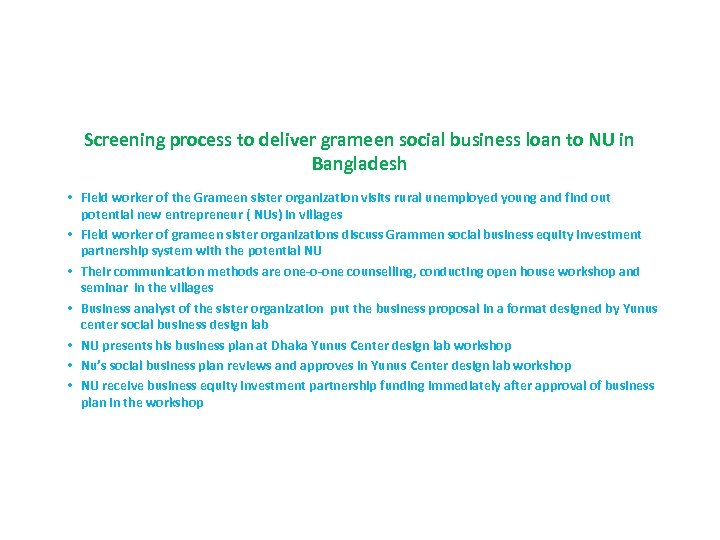
Screening process to deliver grameen social business loan to NU in Bangladesh • Field worker of the Grameen sister organization visits rural unemployed young and find out potential new entrepreneur ( NUs) in villages • Field worker of grameen sister organizations discuss Grammen social business equity investment partnership system with the potential NU • Their communication methods are one-o-one counselling, conducting open house workshop and seminar in the villages • Business analyst of the sister organization put the business proposal in a format designed by Yunus center social business design lab • NU presents his business plan at Dhaka Yunus Center design lab workshop • Nu’s social business plan reviews and approves in Yunus Center design lab workshop • NU receive business equity investment partnership funding immediately after approval of business plan in the workshop
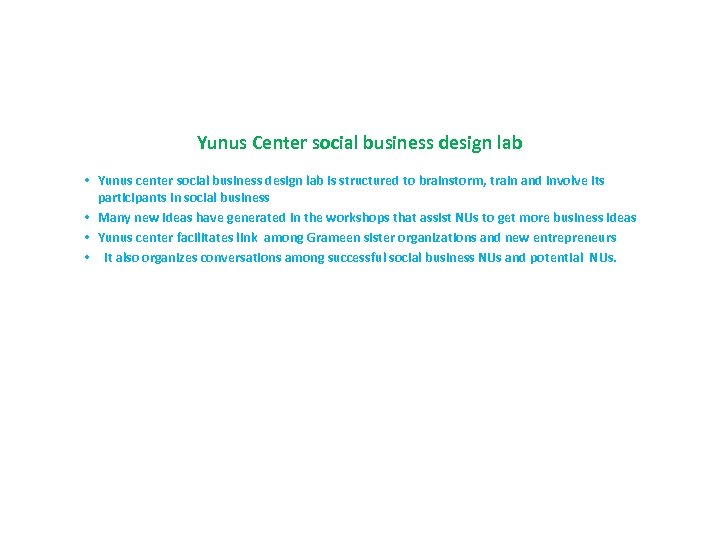
Yunus Center social business design lab • Yunus center social business design lab is structured to brainstorm, train and involve its participants in social business • Many new ideas have generated in the workshops that assist NUs to get more business ideas • Yunus center facilitates link among Grameen sister organizations and new entrepreneurs • It also organizes conversations among successful social business NUs and potential NUs.
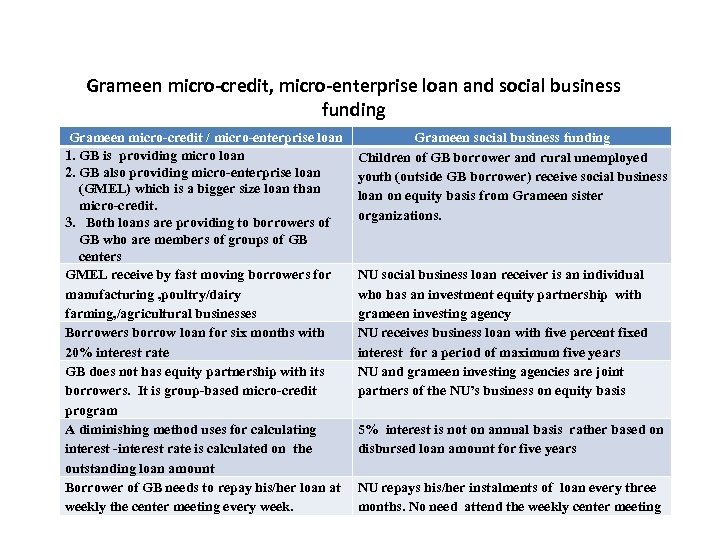
Grameen micro-credit, micro-enterprise loan and social business funding Grameen micro-credit / micro-enterprise loan 1. GB is providing micro loan 2. GB also providing micro-enterprise loan (GMEL) which is a bigger size loan than micro-credit. 3. Both loans are providing to borrowers of GB who are members of groups of GB centers GMEL receive by fast moving borrowers for manufacturing , poultry/dairy farming, /agricultural businesses Borrowers borrow loan for six months with 20% interest rate GB does not has equity partnership with its borrowers. It is group-based micro-credit program A diminishing method uses for calculating interest -interest rate is calculated on the outstanding loan amount Borrower of GB needs to repay his/her loan at weekly the center meeting every week. Grameen social business funding Children of GB borrower and rural unemployed youth (outside GB borrower) receive social business loan on equity basis from Grameen sister organizations. NU social business loan receiver is an individual who has an investment equity partnership with grameen investing agency NU receives business loan with five percent fixed interest for a period of maximum five years NU and grameen investing agencies are joint partners of the NU’s business on equity basis 5% interest is not on annual basis rather based on disbursed loan amount for five years NU repays his/her instalments of loan every three months. No need attend the weekly center meeting
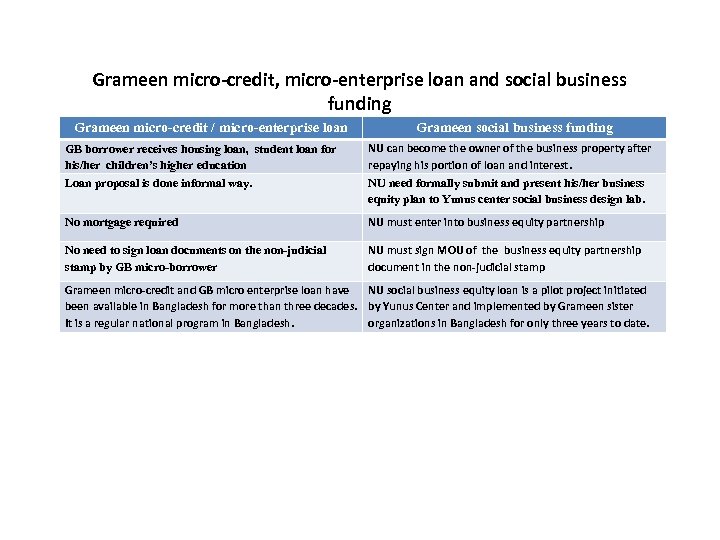
Grameen micro-credit, micro-enterprise loan and social business funding Grameen micro-credit / micro-enterprise loan Grameen social business funding GB borrower receives housing loan, student loan for his/her children’s higher education Loan proposal is done informal way. NU can become the owner of the business property after repaying his portion of loan and interest. NU need formally submit and present his/her business equity plan to Yunus center social business design lab. No mortgage required NU must enter into business equity partnership No need to sign loan documents on the non-judicial stamp by GB micro-borrower NU must sign MOU of the business equity partnership document in the non-judicial stamp Grameen micro-credit and GB micro enterprise loan have NU social business equity loan is a pilot project initiated been available in Bangladesh for more than three decades. by Yunus Center and implemented by Grameen sister It is a regular national program in Bangladesh. organizations in Bangladesh for only three years to date.
Benefits of Grameen NU social business loan (NUSBL) GSBL service is an anti-colonial localization process that empowers marginalised people It is a sustainable business development model in Bangladesh NU is involved in businesses like community information center, sports/music/theatre club Web page designing, multimedia studio Fisheries , poultry and livestock farming, poultry feed manufacturing and selling Equipment leasing, garments manufacturing and marketing, Manufacturing leather products and ceramic products NUSBL program keeps youth in rural area that protects him/her from to urban migration Grameen sister organizations mentor youth entrepreneurs to develop their entrepreneurs skills and • This NUSBL program facilitates self-employment among rural youths in Banglsdesh • • •
Findings- 1 • • • Grameen Bank average micro-enterprise loan size is ranges from $450 -$8000 5, 431, 907 micro enterprise loan borrowers of GB have received $ 2, 443 million loan Micro enterprise loan amounted 6. 06 % of grameen bank total loan disbursement Grameen social business loan receives by second generation of GB borrower NUs’ GSBL average loan size is $470 More than 90% of NUs receive social business loan for the first time NU sends his/her business daily income statement to Dhaka grammen monitoring cell by SMS Grameen field staff identifies potential business entrepreneurs and assist them receive GSBL implementing agencies are assisting to develop NUs capability and capacity building to run their business
Findings continue- 2 • Grameen sister organizations support local business initiatives and assist to build NU’s business confidence • They assist NU gets new business idea, develop business plan, aware market information and business safety net • These organizations also link NU with similar other business initiator • Business analyst share how to minimize and recoup with business and to recoup with financial risk • NU receives post–loan delivery services like post-business counselling, post-funding mentoring business and business management training etc.
Business items of NUs • • • Set-up kindergarten school, coaching center, child care center in the neighbourhoods Set-up community information center and community club Open IT center, electronics repairing centers and electronics selling centers in the villages Veterinary clinics, naturopathy business Law farms and social forestry
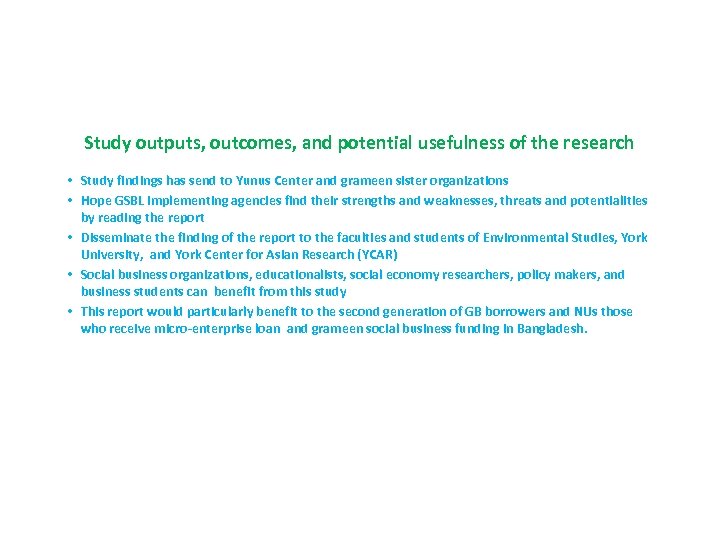
Study outputs, outcomes, and potential usefulness of the research • Study findings has send to Yunus Center and grameen sister organizations • Hope GSBL implementing agencies find their strengths and weaknesses, threats and potentialities by reading the report • Disseminate the finding of the report to the faculties and students of Environmental Studies, York University, and York Center for Asian Research (YCAR) • Social business organizations, educationalists, social economy researchers, policy makers, and business students can benefit from this study • This report would particularly benefit to the second generation of GB borrowers and NUs those who receive micro-enterprise loan and grameen social business funding in Bangladesh.
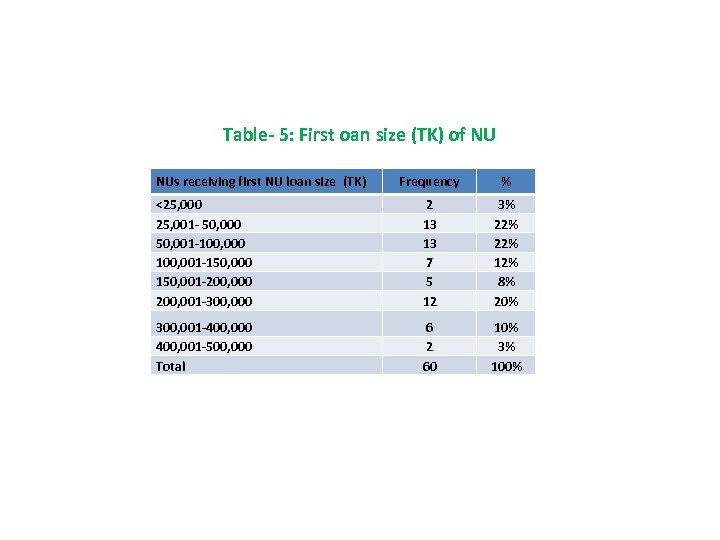
Table- 5: First oan size (TK) of NU NUs receiving first NU loan size (TK) Frequency % <25, 000 25, 001 - 50, 000 50, 001 -100, 000 100, 001 -150, 000 150, 001 -200, 000 200, 001 -300, 000 2 13 13 7 5 12 3% 22% 12% 8% 20% 300, 001 -400, 000 400, 001 -500, 000 Total 6 2 60 10% 3% 100%
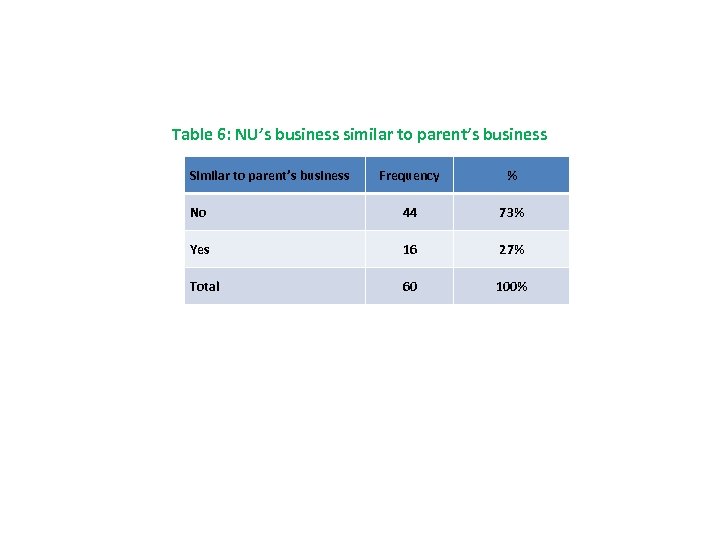
Table 6: NU’s business similar to parent’s business Similar to parent’s business Frequency % No 44 73% Yes 16 27% Total 60 100%
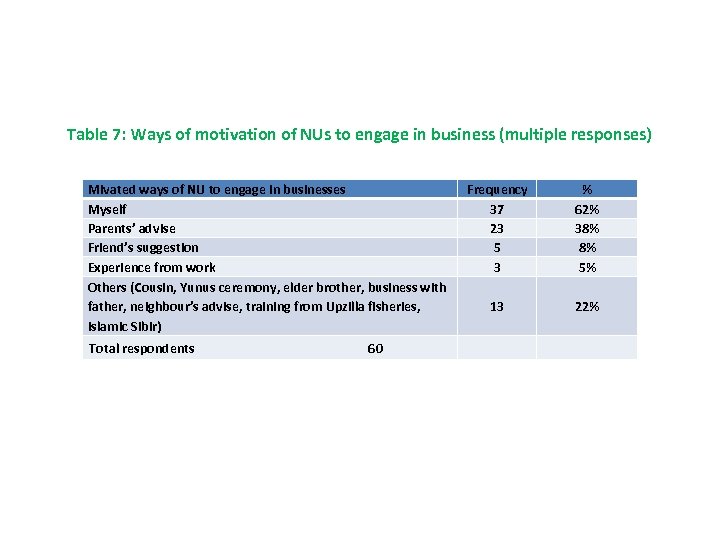
Table 7: Ways of motivation of NUs to engage in business (multiple responses) Mivated ways of NU to engage in businesses Myself Parents’ advise Friend’s suggestion Experience from work Others (Cousin, Yunus ceremony, elder brother, business with father, neighbour’s advise, training from Upzilla fisheries, Islamic Sibir) Total respondents 60 Frequency 37 23 5 3 % 62% 38% 8% 5% 13 22%
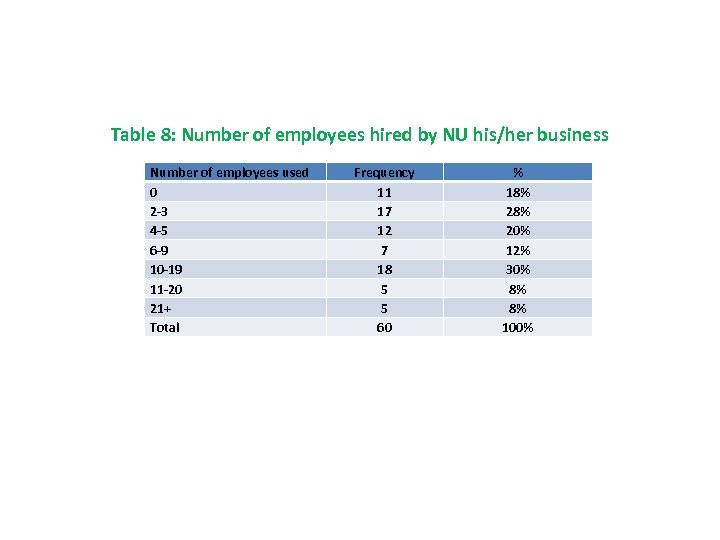
Table 8: Number of employees hired by NU his/her business Number of employees used 0 2 -3 4 -5 6 -9 10 -19 11 -20 21+ Total Frequency 11 17 12 7 18 5 5 60 % 18% 20% 12% 30% 8% 8% 100%
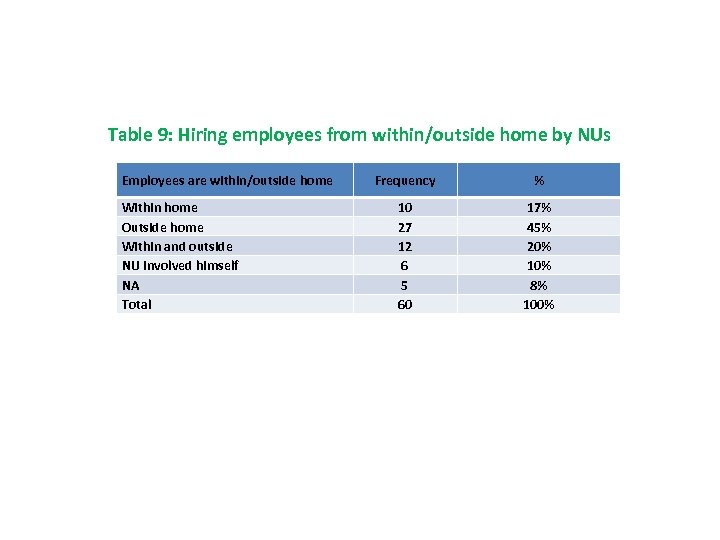
Table 9: Hiring employees from within/outside home by NUs Employees are within/outside home Within home Outside home Within and outside NU involved himself NA Total Frequency % 10 27 12 6 5 60 17% 45% 20% 10% 8% 100%
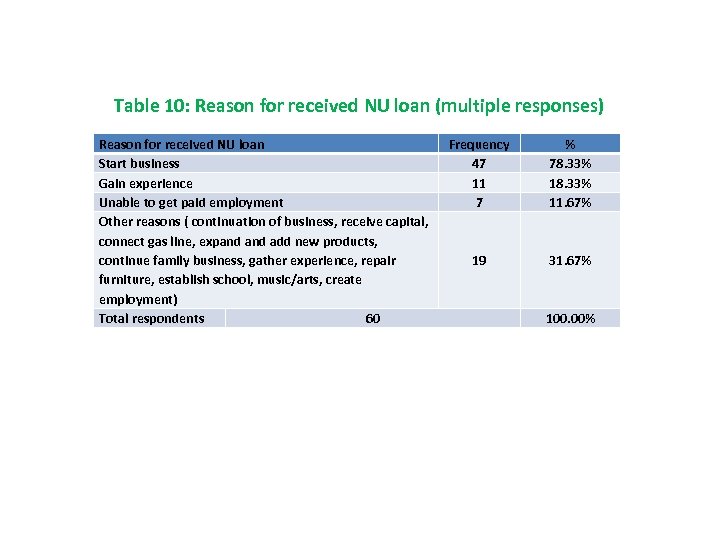
Table 10: Reason for received NU loan (multiple responses) Reason for received NU loan Start business Gain experience Unable to get paid employment Other reasons ( continuation of business, receive capital, connect gas line, expand add new products, continue family business, gather experience, repair furniture, establish school, music/arts, create employment) Total respondents 60 Frequency 47 11 7 % 78. 33% 11. 67% 19 31. 67% 100. 00%
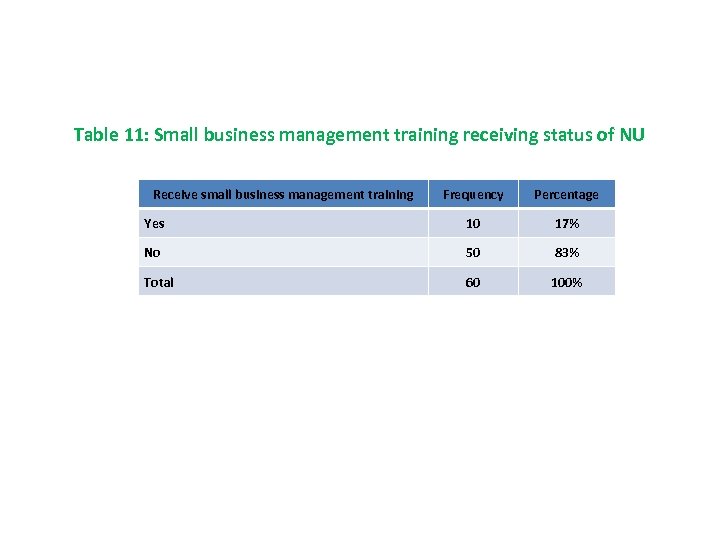
Table 11: Small business management training receiving status of NU Receive small business management training Frequency Percentage Yes 10 17% No 50 83% Total 60 100%
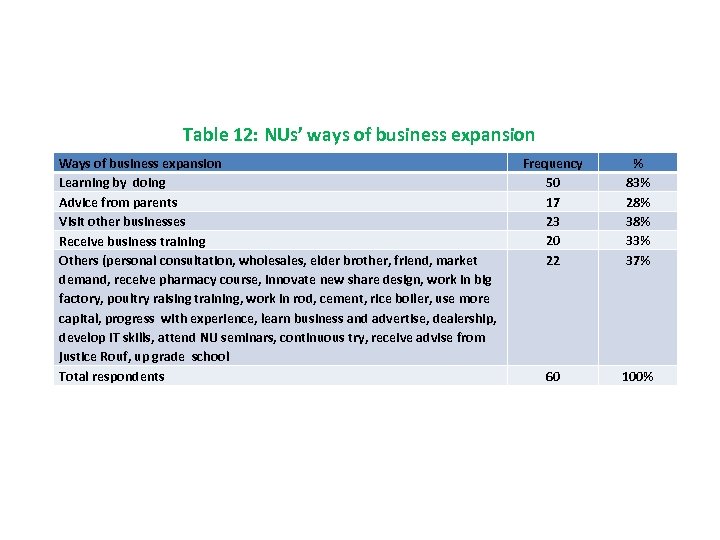
Table 12: NUs’ ways of business expansion Ways of business expansion Learning by doing Advice from parents Visit other businesses Receive business training Others (personal consultation, wholesales, elder brother, friend, market demand, receive pharmacy course, innovate new share design, work in big factory, poultry raising training, work in rod, cement, rice boiler, use more capital, progress with experience, learn business and advertise, dealership, develop IT skills, attend NU seminars, continuous try, receive advise from justice Rouf, up grade school Total respondents Frequency 50 17 23 20 22 % 83% 28% 33% 37% 60 100%
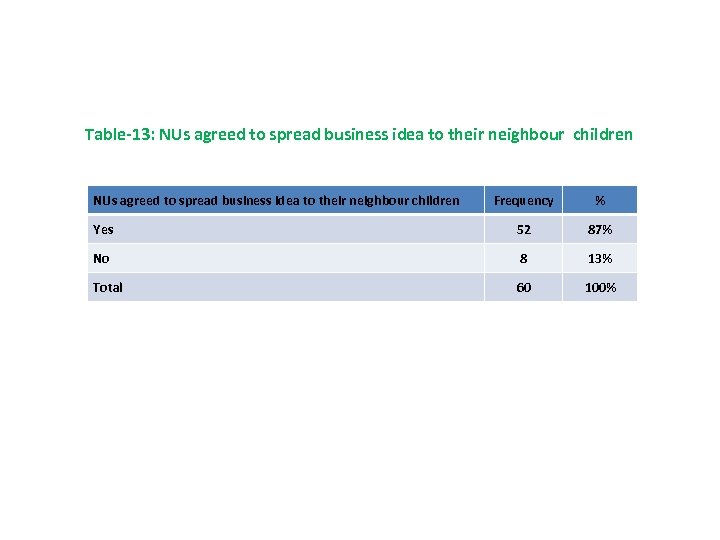
Table-13: NUs agreed to spread business idea to their neighbour children Frequency % Yes 52 87% No 8 13% Total 60 100%
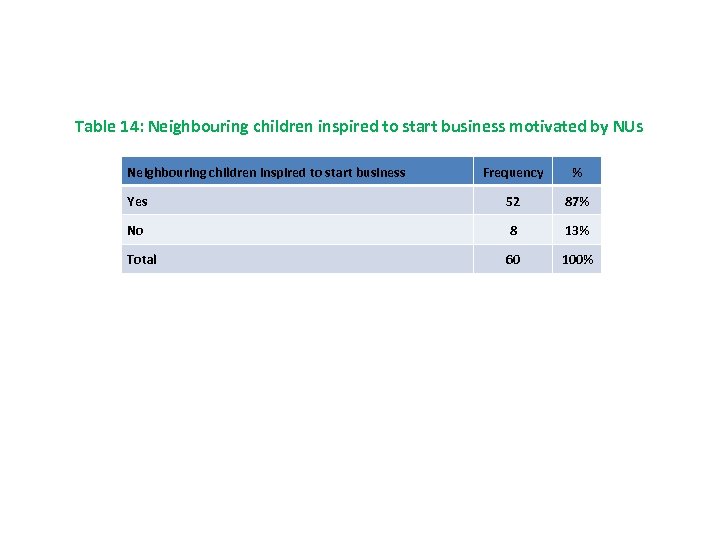
Table 14: Neighbouring children inspired to start business motivated by NUs Neighbouring children inspired to start business Frequency % Yes 52 87% No 8 13% Total 60 100%
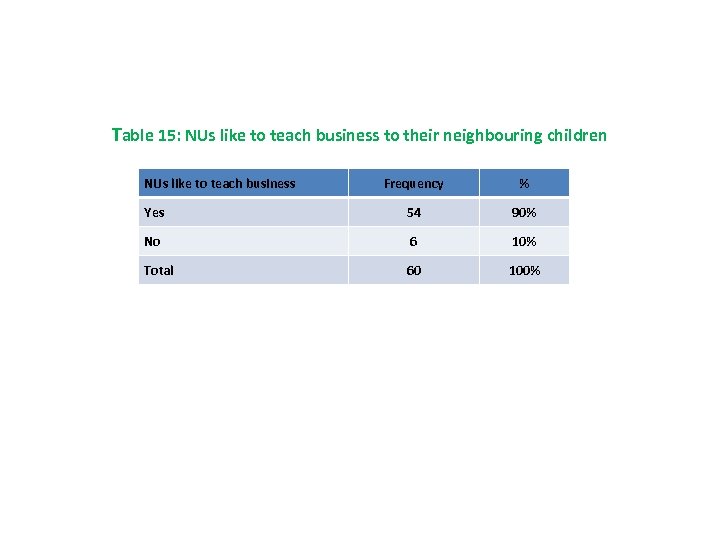
Table 15: NUs like to teach business to their neighbouring children NUs like to teach business Frequency % Yes 54 90% No 6 10% Total 60 100%
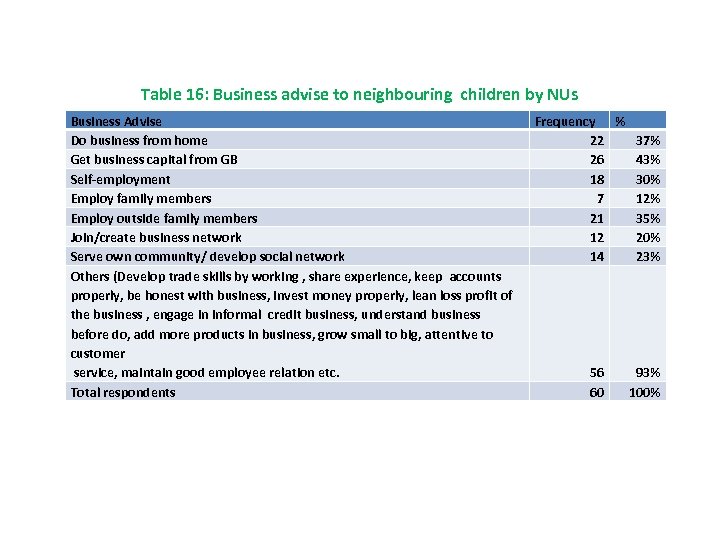
Table 16: Business advise to neighbouring children by NUs Business Advise Do business from home Get business capital from GB Self-employment Employ family members Employ outside family members Join/create business network Serve own community/ develop social network Others (Develop trade skills by working , share experience, keep accounts properly, be honest with business, invest money properly, lean loss profit of the business , engage in informal credit business, understand business before do, add more products in business, grow small to big, attentive to customer service, maintain good employee relation etc. Total respondents Frequency % 22 37% 26 43% 18 30% 7 12% 21 35% 12 20% 14 23% 56 60 93% 100%
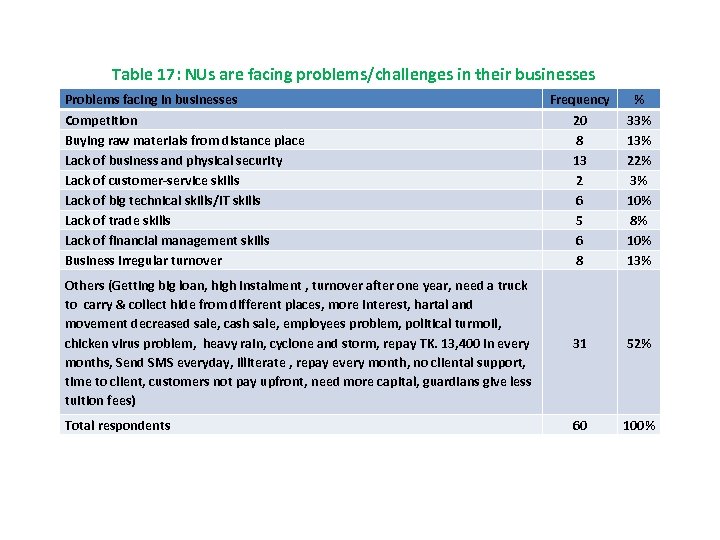
Table 17: NUs are facing problems/challenges in their businesses Problems facing in businesses Competition Buying raw materials from distance place Lack of business and physical security Lack of customer-service skills Lack of big technical skills/IT skills Lack of trade skills Lack of financial management skills Business irregular turnover Frequency 20 8 13 2 6 5 6 8 % 33% 13% 22% 3% 10% 8% 10% 13% Others (Getting big loan, high instalment , turnover after one year, need a truck to carry & collect hide from different places, more interest, hartal and movement decreased sale, cash sale, employees problem, political turmoil, chicken virus problem, heavy rain, cyclone and storm, repay TK. 13, 400 in every months, Send SMS everyday, illiterate , repay every month, no cliental support, time to client, customers not pay upfront, need more capital, guardians give less tuition fees) 31 52% Total respondents 60 100%
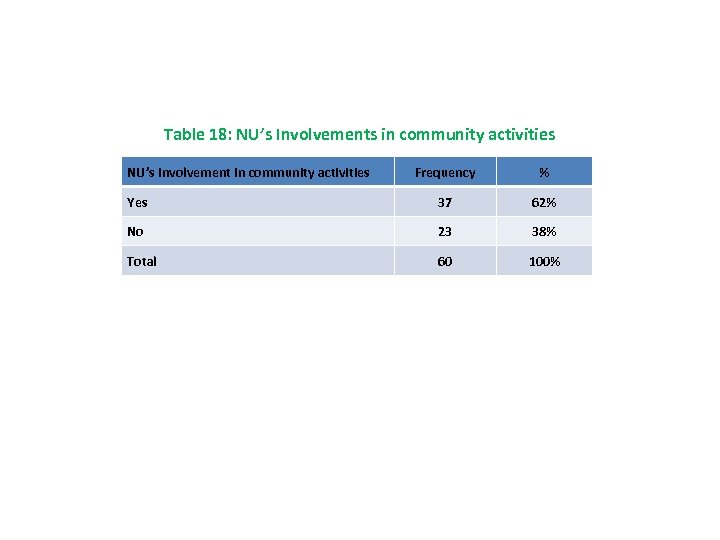
Table 18: NU’s Involvements in community activities NU’s Involvement in community activities Frequency % Yes 37 62% No 23 38% Total 60 100%
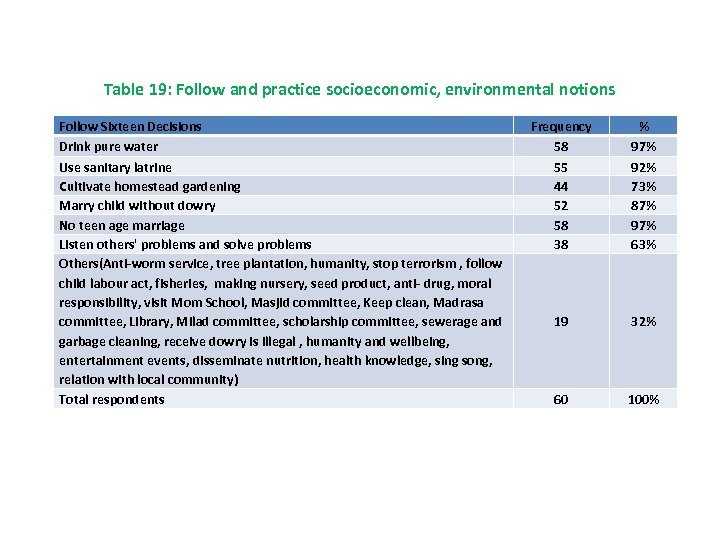
Table 19: Follow and practice socioeconomic, environmental notions Follow Sixteen Decisions Drink pure water Use sanitary latrine Cultivate homestead gardening Marry child without dowry No teen age marriage Listen others' problems and solve problems Others(Anti-worm service, tree plantation, humanity, stop terrorism , follow child labour act, fisheries, making nursery, seed product, anti- drug, moral responsibility, visit Mom School, Masjid committee, Keep clean, Madrasa committee, Library, Milad committee, scholarship committee, sewerage and garbage cleaning, receive dowry is illegal , humanity and wellbeing, entertainment events, disseminate nutrition, health knowledge, sing song, relation with local community) Total respondents Frequency 58 55 44 52 58 38 % 97% 92% 73% 87% 97% 63% 19 32% 60 100%
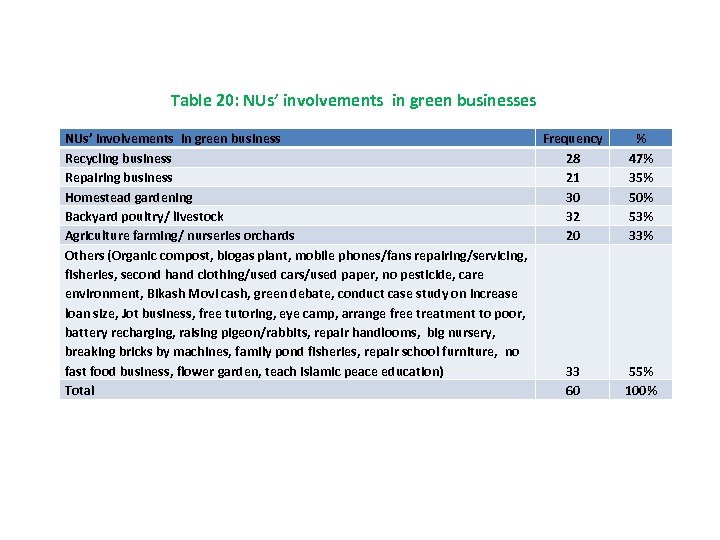
Table 20: NUs’ involvements in green businesses NUs’ involvements in green business Recycling business Repairing business Homestead gardening Backyard poultry/ livestock Agriculture farming/ nurseries orchards Others (Organic compost, biogas plant, mobile phones/fans repairing/servicing, fisheries, second hand clothing/used cars/used paper, no pesticide, care environment, Bikash Movi cash, green debate, conduct case study on increase loan size, Jot business, free tutoring, eye camp, arrange free treatment to poor, battery recharging, raising pigeon/rabbits, repair handlooms, big nursery, breaking bricks by machines, family pond fisheries, repair school furniture, no fast food business, flower garden, teach Islamic peace education) Total Frequency 28 21 30 32 20 % 47% 35% 50% 53% 33 60 55% 100%
Implication of the study • This research generates a new knowledge of social and green financing • This study could help social business implementing agencies to improve their social business loan programs • By reading this report, social business funding Grameen sister organizations and other social enterprise agencies could benefit.
Conclusion • This policy empirical research report creates a new knowledge in the field of social enterprise management in the field of entrepreneurship development • There is a huge market for social business equity financing in Bangladesh • Therefore, it is better implement this program by an organization that is fully assigned to implement the program • GB and grameen sister organizations have been instrumental in providing income-generating opportunities to poor people particularly for empowering woman through the extension of collateral-free banking in Bangladesh since 1976 • This policy empirical research provides information on Grameen Bank (GB) second generation borrower and their social entrepreneurship developmental status in Bangladesh
Conclusion- continue 2 • Grameen social business loan program is experimenting and implementing by grameen four sister organizations • Expand the NU social business equity investment funding program to both inside and outside Grameen borrowers’ families • Surprising Grameen bank has reduced its NU social business funding services after 2012 • As GB has huge network across Bangladesh and there is a huge demand for social business equity loan among fast moving borrowers of GB, GB could continue social business funding services to its first moving borrowers

Thank You Comments/Questions
Скачать презентацию Grameen social business loan service in Bangladesh Dr
74d42fd85c9259fae191f837f5d1fb76.ppt