 Скачать презентацию Grameen Bank New Entrepreneurship Development in Bangladesh Dr
4b0a7642537ac1623dee960ac8597d5f.ppt
- Количество слайдов: 62



Grameen Bank New Entrepreneurship Development in Bangladesh Dr. Kazi Abdur Rouf Faculty, Noble International University USA York Center for Asian Research (YCAR) Faculty of Environmental Studies, York University Paper presented at the Research Symposium, Outreach Program of NIU Toronto January 20, 2016
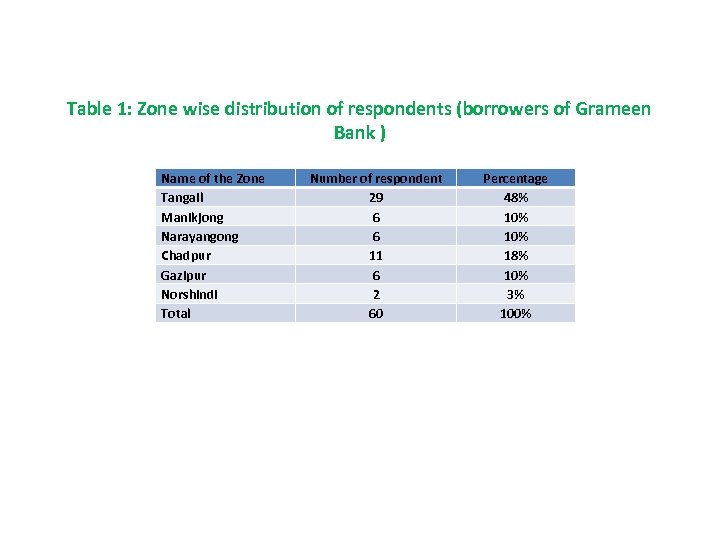
Table 1: Zone wise distribution of respondents (borrowers of Grameen Bank ) Name of the Zone Tangail Manikjong Narayangong Chadpur Gazipur Norshindi Total Number of respondent 29 6 6 11 6 2 60 Percentage 48% 10% 18% 10% 3% 100%
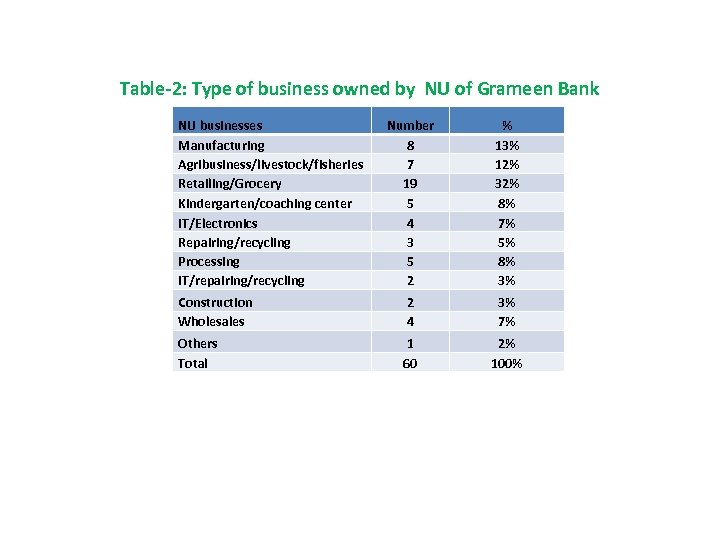
Table-2: Type of business owned by NU of Grameen Bank NU businesses Manufacturing Agribusiness/livestock/fisheries Retailing/Grocery Kindergarten/coaching center IT/Electronics Repairing/recycling Processing IT/repairing/recycling Number 8 7 19 5 4 3 5 2 % 13% 12% 32% 8% 7% 5% 8% 3% Construction Wholesales 2 4 3% 7% Others Total 1 60 2% 100%
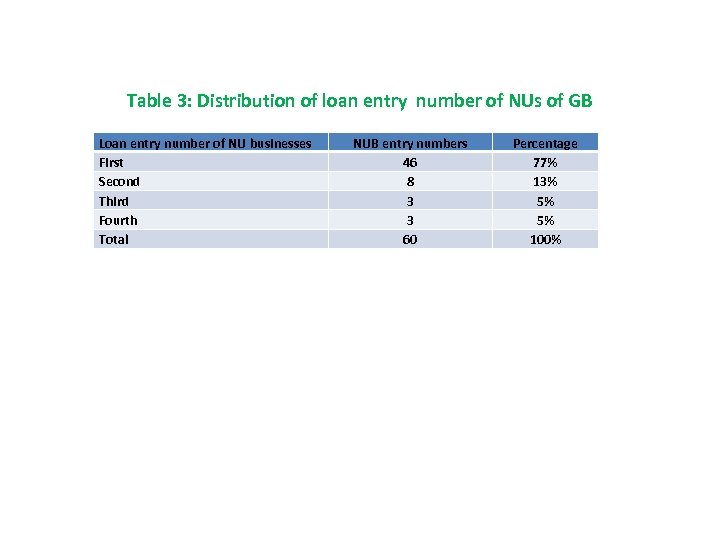
Table 3: Distribution of loan entry number of NUs of GB Loan entry number of NU businesses First Second Third Fourth Total NUB entry numbers 46 8 3 3 60 Percentage 77% 13% 5% 5% 100%
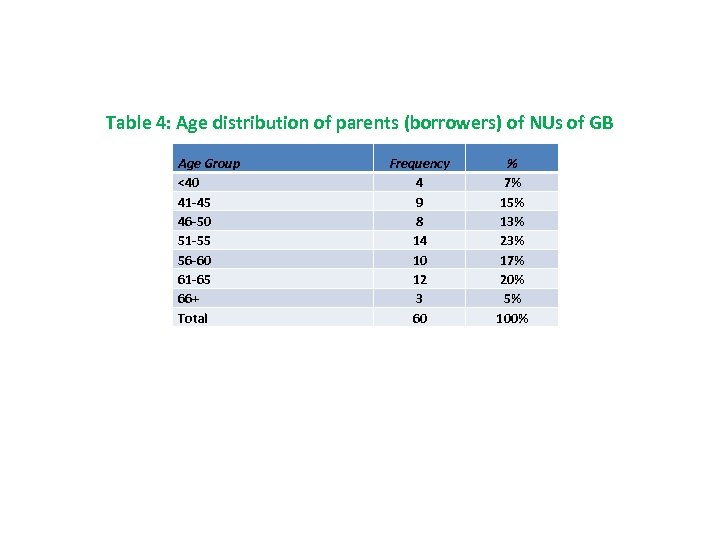
Table 4: Age distribution of parents (borrowers) of NUs of GB Age Group <40 41 -45 46 -50 51 -55 56 -60 61 -65 66+ Total Frequency 4 9 8 14 10 12 3 60 % 7% 15% 13% 23% 17% 20% 5% 100%
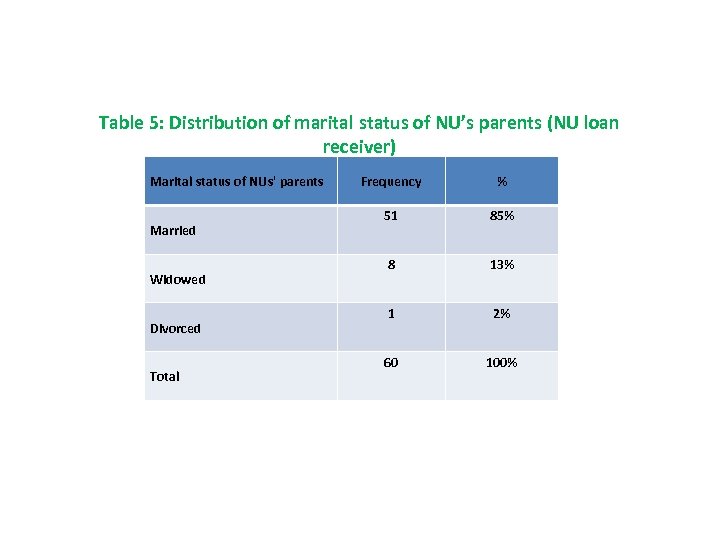
Table 5: Distribution of marital status of NU’s parents (NU loan receiver) Marital status of NUs' parents Married Widowed Divorced Total Frequency % 51 85% 8 13% 1 2% 60 100%
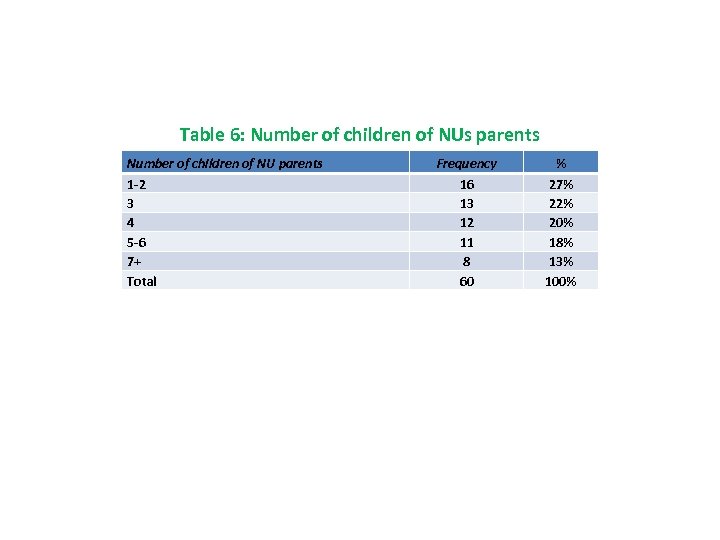
Table 6: Number of children of NUs parents Number of children of NU parents 1 -2 3 4 5 -6 7+ Total Frequency % 16 13 12 11 8 60 27% 22% 20% 18% 13% 100%
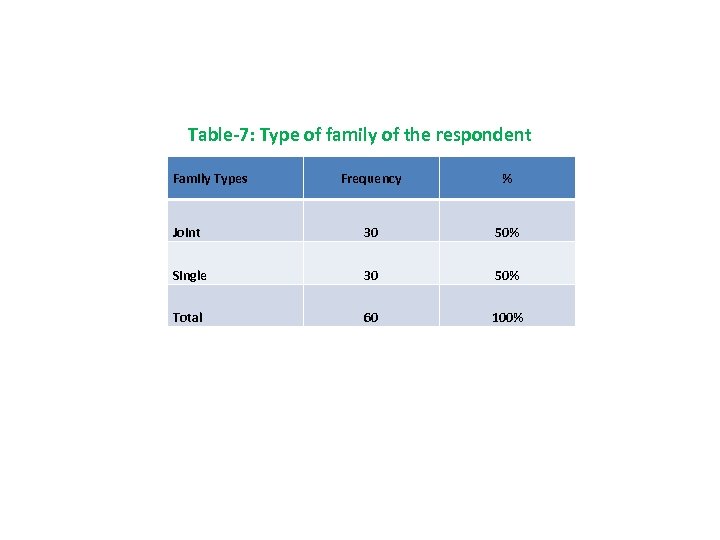
Table-7: Type of family of the respondent Family Types Frequency % Joint 30 50% Single 30 50% Total 60 100%
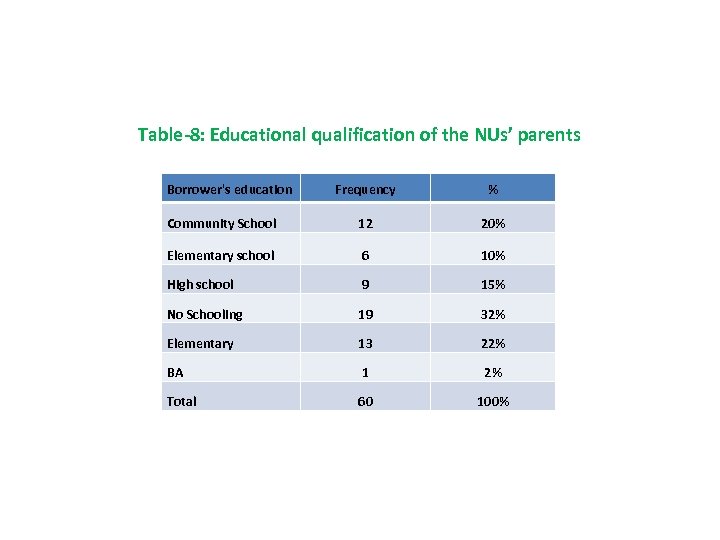
Table-8: Educational qualification of the NUs’ parents Borrower's education Frequency % Community School 12 20% Elementary school 6 10% High school 9 15% No Schooling 19 32% Elementary 13 22% BA 1 2% Total 60 100%
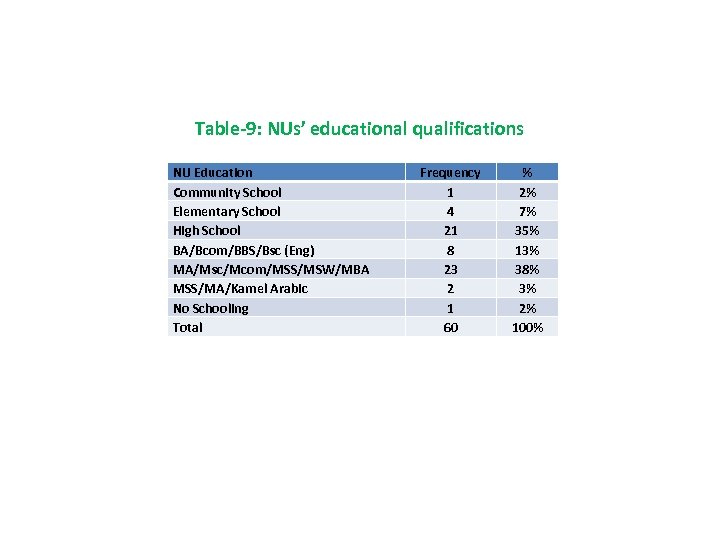
Table-9: NUs’ educational qualifications NU Education Community School Elementary School High School BA/Bcom/BBS/Bsc (Eng) MA/Msc/Mcom/MSS/MSW/MBA MSS/MA/Kamel Arabic No Schooling Total Frequency 1 4 21 8 23 2 1 60 % 2% 7% 35% 13% 38% 3% 2% 100%
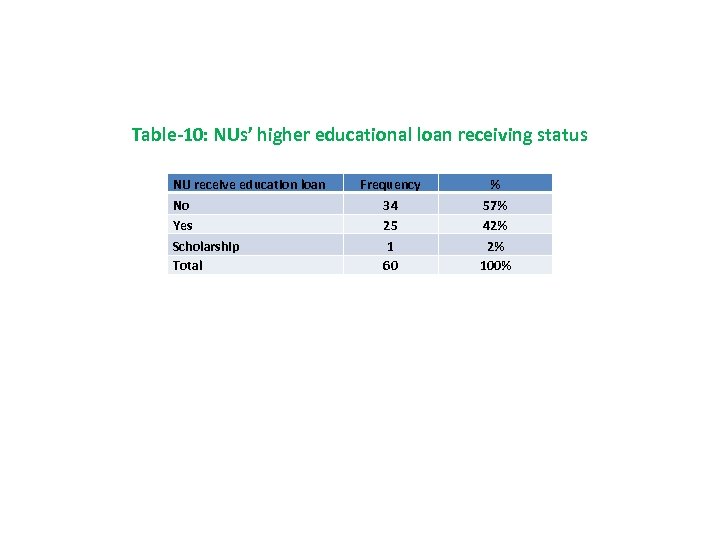
Table-10: NUs’ higher educational loan receiving status NU receive education loan Frequency % No Yes 34 25 57% 42% Scholarship Total 1 60 2% 100%
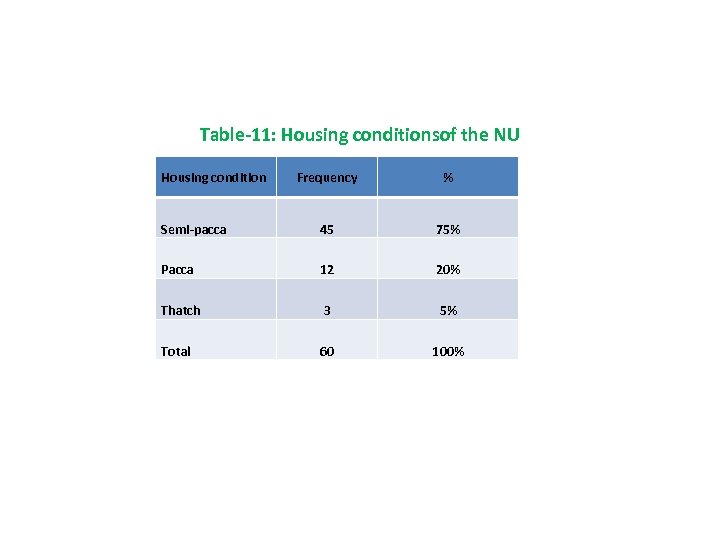
Table-11: Housing conditionsof the NU Housing condition Frequency % Semi-pacca 45 75% Pacca 12 20% Thatch 3 5% Total 60 100%
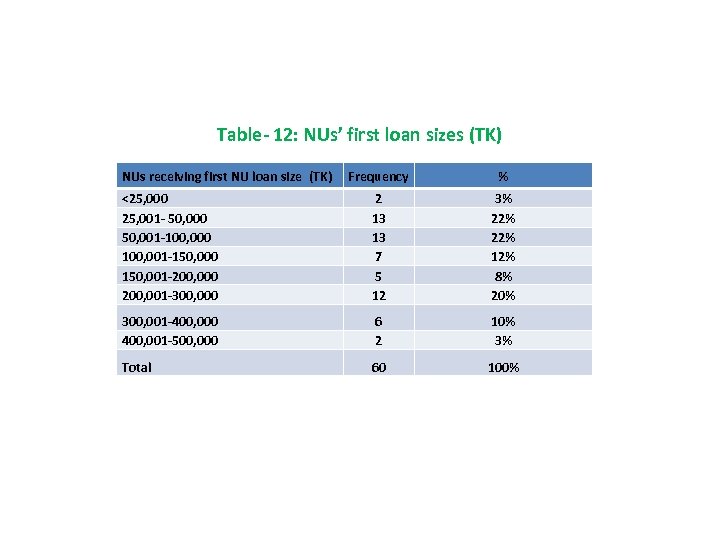
Table- 12: NUs’ first loan sizes (TK) NUs receiving first NU loan size (TK) Frequency % <25, 000 25, 001 - 50, 000 50, 001 -100, 000 100, 001 -150, 000 150, 001 -200, 000 200, 001 -300, 000 2 13 13 7 5 12 3% 22% 12% 8% 20% 300, 001 -400, 000 400, 001 -500, 000 6 2 10% 3% Total 60 100%
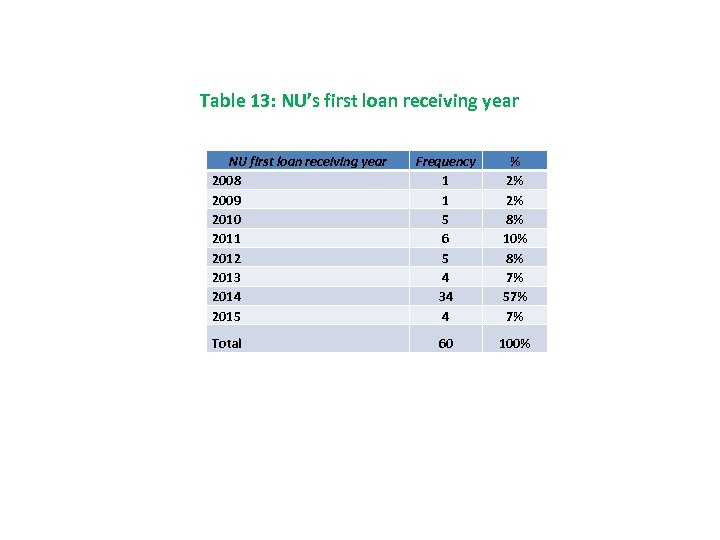
Table 13: NU’s first loan receiving year NU first loan receiving year 2008 2009 2010 2011 2012 2013 2014 2015 Total Frequency 1 1 5 6 5 4 34 4 % 2% 2% 8% 10% 8% 7% 57% 7% 60 100%
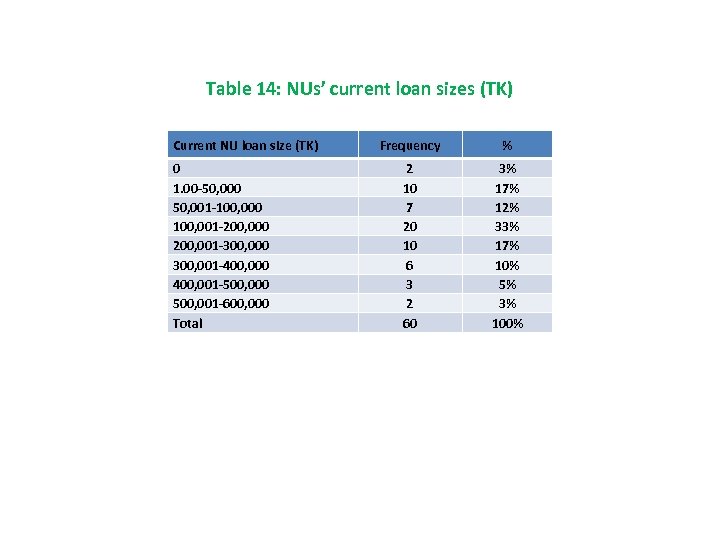
Table 14: NUs’ current loan sizes (TK) Current NU loan size (TK) 0 1. 00 -50, 000 50, 001 -100, 000 100, 001 -200, 000 200, 001 -300, 000 300, 001 -400, 000 400, 001 -500, 000 500, 001 -600, 000 Total Frequency % 2 10 7 20 10 6 3 2 60 3% 17% 12% 33% 17% 10% 5% 3% 100%
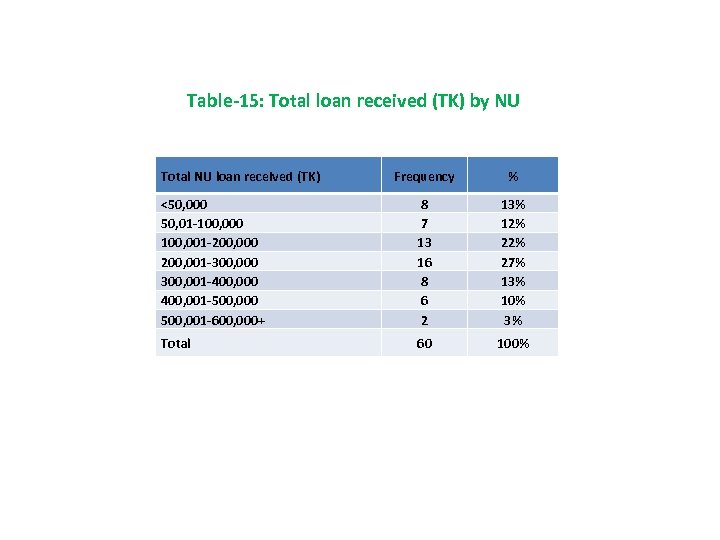
Table-15: Total loan received (TK) by NU Total NU loan received (TK) Frequency % <50, 000 50, 01 -100, 000 100, 001 -200, 000 200, 001 -300, 000 300, 001 -400, 000 400, 001 -500, 000 500, 001 -600, 000+ 8 7 13 16 8 6 2 13% 12% 27% 13% 10% 3% Total 60 100%
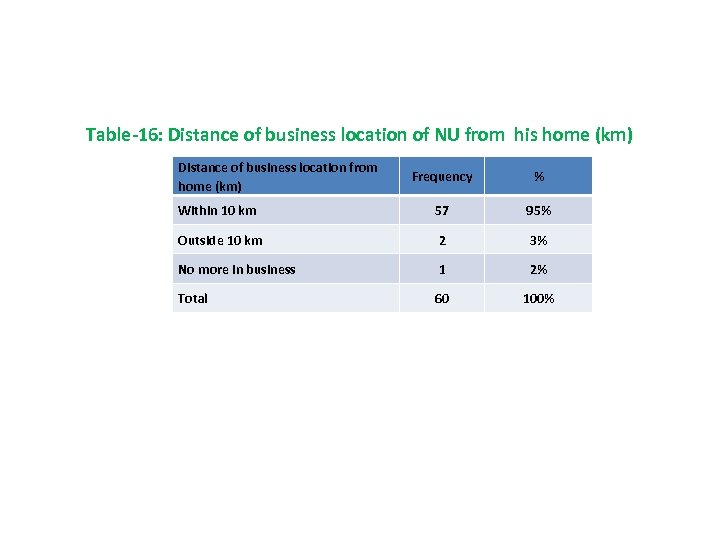
Table-16: Distance of business location of NU from his home (km) Distance of business location from home (km) Frequency % Within 10 km 57 95% Outside 10 km 2 3% No more in business 1 2% Total 60 100%
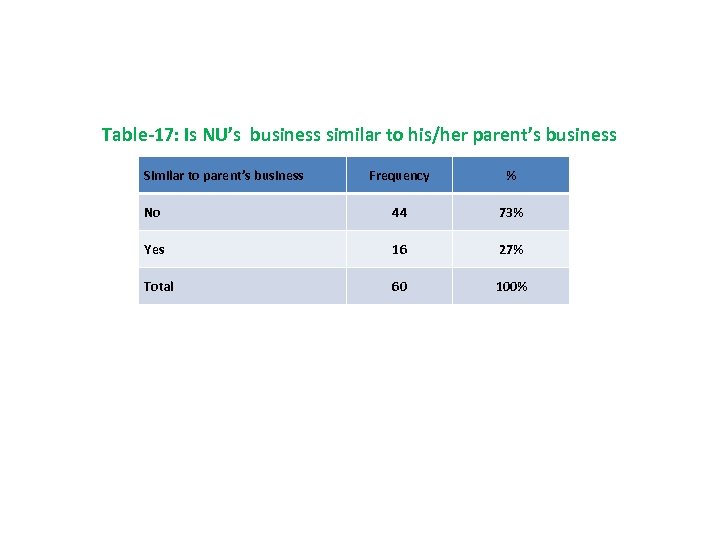
Table-17: Is NU’s business similar to his/her parent’s business Similar to parent’s business Frequency % No 44 73% Yes 16 27% Total 60 100%
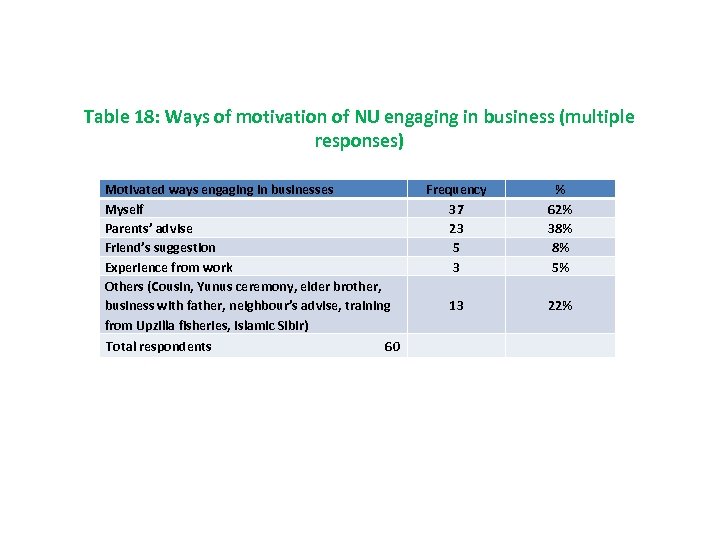
Table 18: Ways of motivation of NU engaging in business (multiple responses) Motivated ways engaging in businesses Myself Parents’ advise Friend’s suggestion Experience from work Others (Cousin, Yunus ceremony, elder brother, business with father, neighbour’s advise, training from Upzilla fisheries, Islamic Sibir) Total respondents 60 Frequency 37 23 5 3 % 62% 38% 8% 5% 13 22%
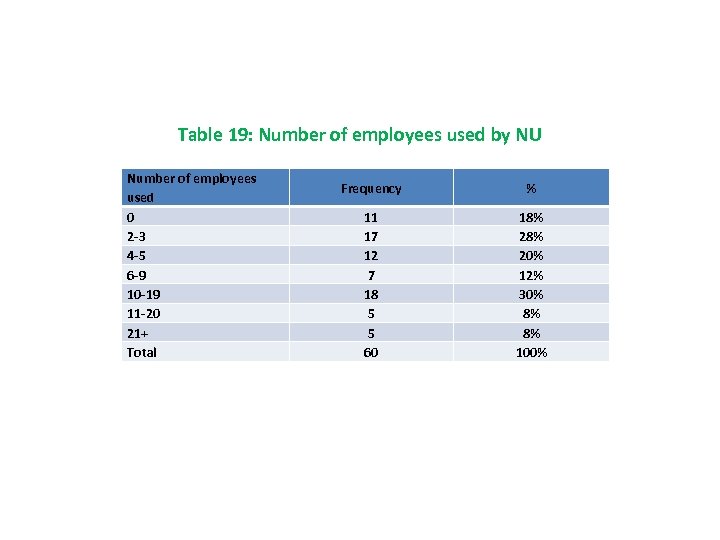
Table 19: Number of employees used by NU Number of employees used 0 2 -3 4 -5 6 -9 10 -19 11 -20 21+ Total Frequency % 11 17 12 7 18 5 5 60 18% 20% 12% 30% 8% 8% 100%
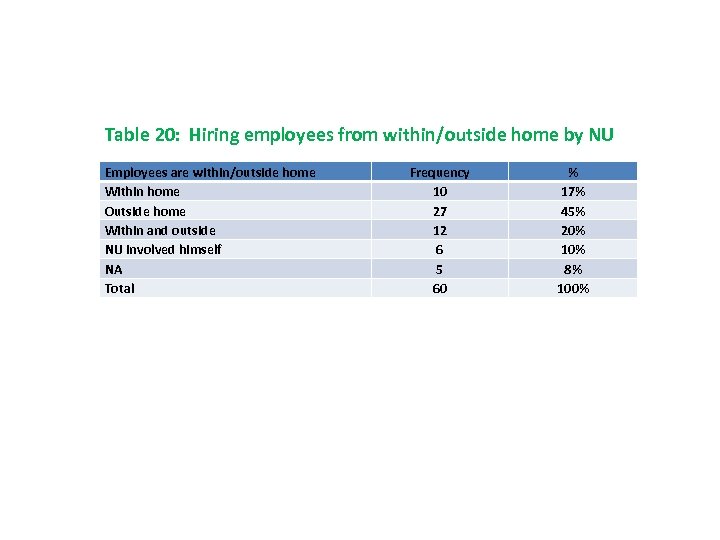
Table 20: Hiring employees from within/outside home by NU Employees are within/outside home Within home Outside home Within and outside NU involved himself NA Total Frequency 10 27 12 6 5 60 % 17% 45% 20% 10% 8% 100%
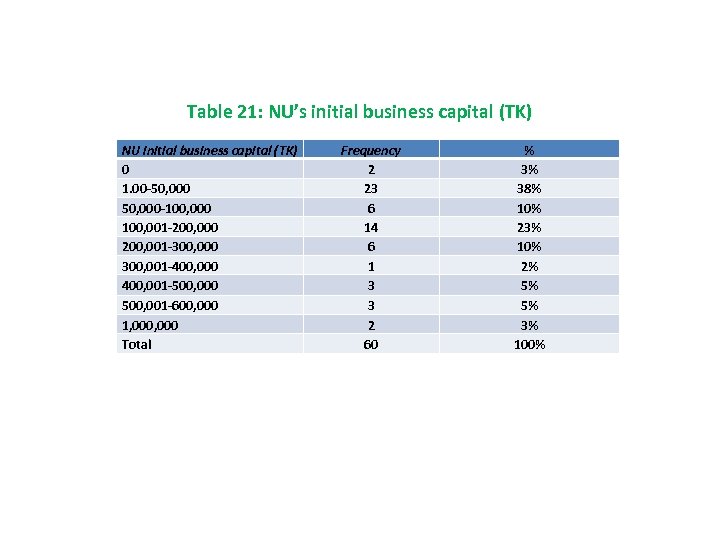
Table 21: NU’s initial business capital (TK) NU initial business capital (TK) 0 1. 00 -50, 000 -100, 000 100, 001 -200, 000 200, 001 -300, 000 300, 001 -400, 000 400, 001 -500, 000 500, 001 -600, 000 1, 000 Total Frequency 2 23 6 14 6 1 3 3 2 60 % 3% 38% 10% 23% 10% 2% 5% 5% 3% 100%
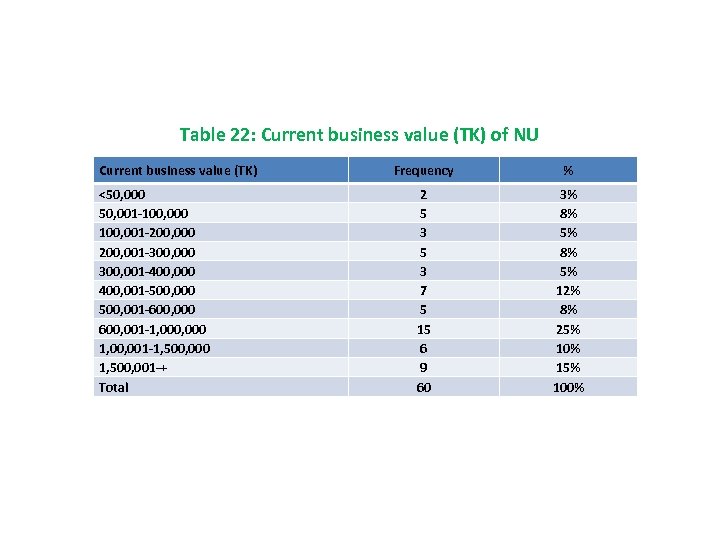
Table 22: Current business value (TK) of NU Current business value (TK) <50, 000 50, 001 -100, 000 100, 001 -200, 000 200, 001 -300, 000 300, 001 -400, 000 400, 001 -500, 000 500, 001 -600, 000 600, 001 -1, 000 1, 001 -1, 500, 000 1, 500, 001 -+ Total Frequency % 2 5 3 7 5 15 6 9 60 3% 8% 5% 12% 8% 25% 10% 15% 100%
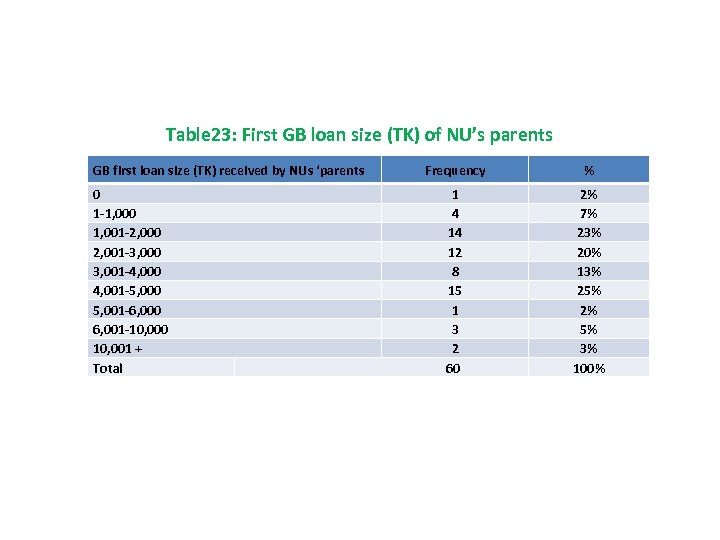
Table 23: First GB loan size (TK) of NU’s parents GB first loan size (TK) received by NUs ‘parents 0 1 -1, 000 1, 001 -2, 000 2, 001 -3, 000 3, 001 -4, 000 4, 001 -5, 000 5, 001 -6, 000 6, 001 -10, 000 10, 001 + Total Frequency 1 4 14 12 8 15 1 3 2 60 % 2% 7% 23% 20% 13% 25% 2% 5% 3% 100%
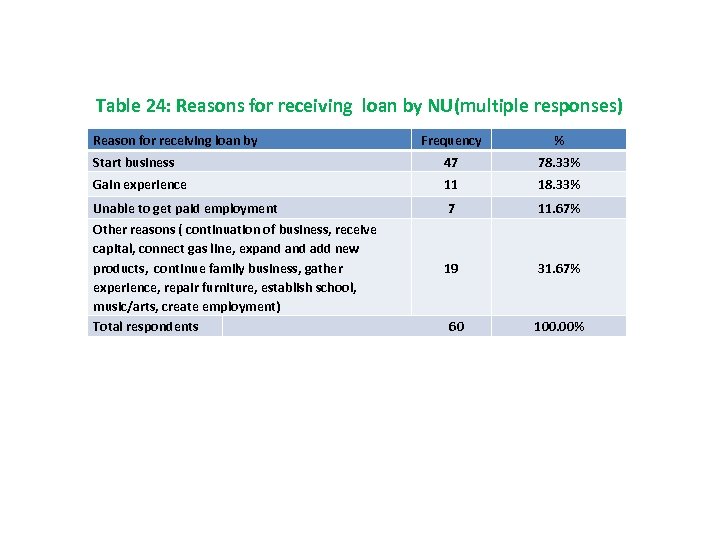
Table 24: Reasons for receiving loan by NU(multiple responses) Reason for receiving loan by Frequency % Start business 47 78. 33% Gain experience 11 18. 33% Unable to get paid employment 7 Other reasons ( continuation of business, receive capital, connect gas line, expand add new products, continue family business, gather 19 experience, repair furniture, establish school, music/arts, create employment) Total respondents 60 11. 67% 31. 67% 100. 00%
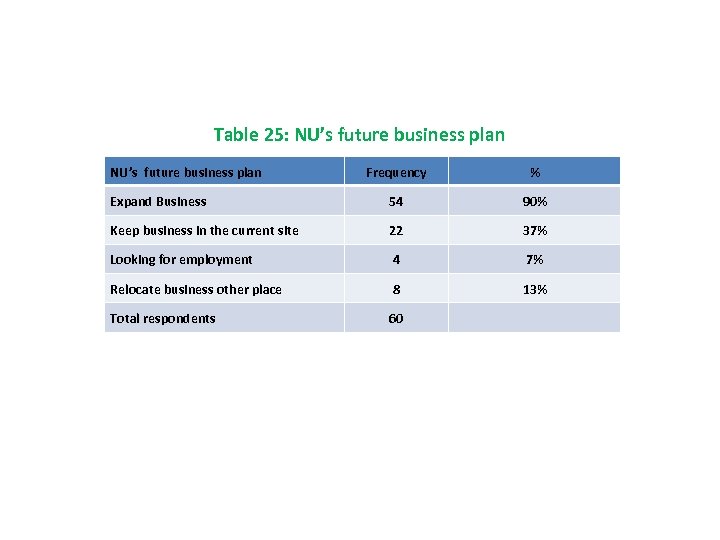
Table 25: NU’s future business plan Frequency % Expand Business 54 90% Keep business in the current site 22 37% Looking for employment 4 7% Relocate business other place 8 13% Total respondents 60
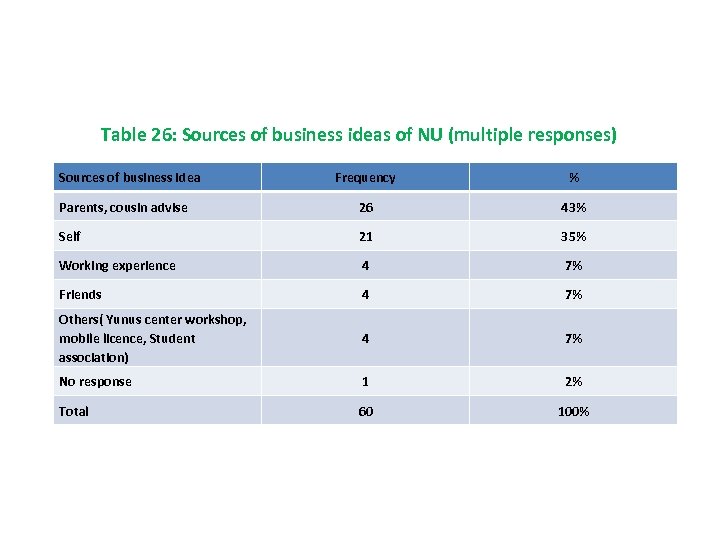
Table 26: Sources of business ideas of NU (multiple responses) Sources of business Idea Frequency % Parents, cousin advise 26 43% Self 21 35% Working experience 4 7% Friends 4 7% Others( Yunus center workshop, mobile licence, Student association) 4 7% No response 1 2% Total 60 100%
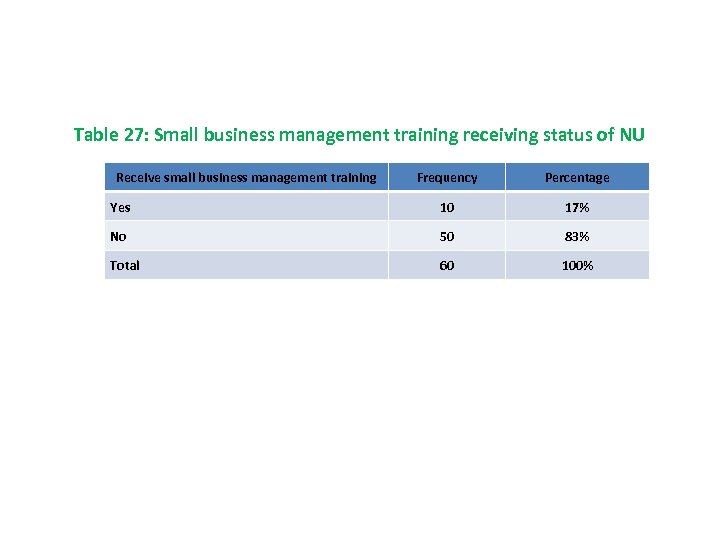
Table 27: Small business management training receiving status of NU Receive small business management training Frequency Percentage Yes 10 17% No 50 83% Total 60 100%
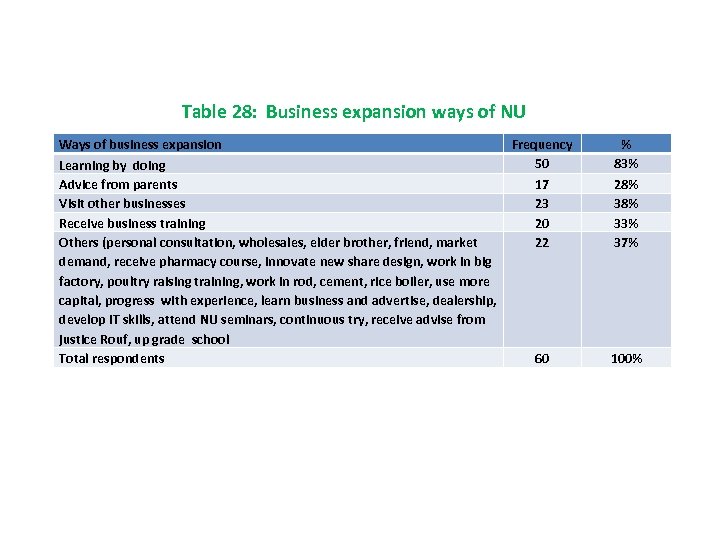
Table 28: Business expansion ways of NU Ways of business expansion Frequency 50 Learning by doing Advice from parents 17 Visit other businesses 23 Receive business training 20 Others (personal consultation, wholesales, elder brother, friend, market 22 demand, receive pharmacy course, innovate new share design, work in big factory, poultry raising training, work in rod, cement, rice boiler, use more capital, progress with experience, learn business and advertise, dealership, develop IT skills, attend NU seminars, continuous try, receive advise from justice Rouf, up grade school Total respondents 60 % 83% 28% 33% 37% 100%
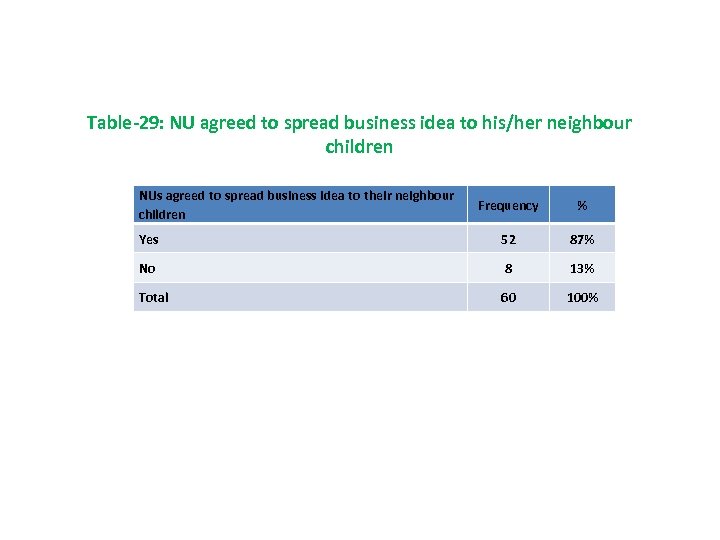
Table-29: NU agreed to spread business idea to his/her neighbour children NUs agreed to spread business idea to their neighbour children Frequency % Yes 52 87% No 8 13% Total 60 100%
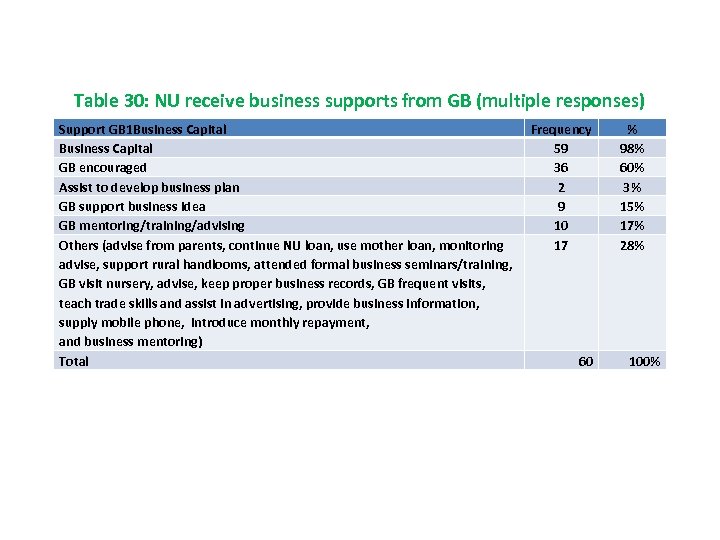
Table 30: NU receive business supports from GB (multiple responses) Support GB 1 Business Capital GB encouraged Assist to develop business plan GB support business idea GB mentoring/training/advising Others (advise from parents, continue NU loan, use mother loan, monitoring advise, support rural handlooms, attended formal business seminars/training, GB visit nursery, advise, keep proper business records, GB frequent visits, teach trade skills and assist in advertising, provide business information, supply mobile phone, introduce monthly repayment, and business mentoring) Total Frequency 59 36 2 9 10 17 60 % 98% 60% 3% 15% 17% 28% 100%
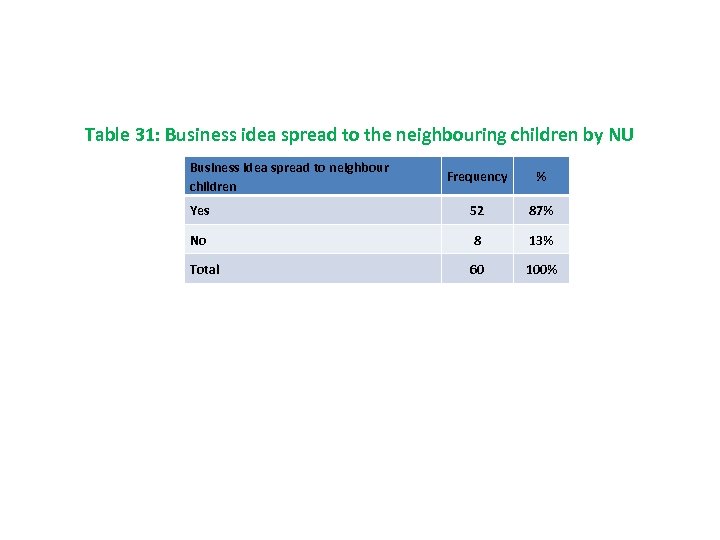
Table 31: Business idea spread to the neighbouring children by NU Business idea spread to neighbour children Frequency % Yes 52 87% No 8 13% Total 60 100%
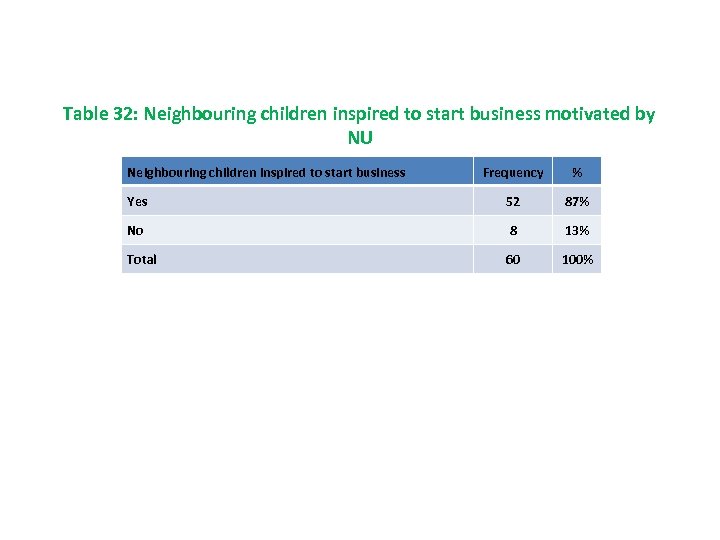
Table 32: Neighbouring children inspired to start business motivated by NU Neighbouring children inspired to start business Frequency % Yes 52 87% No 8 13% Total 60 100%
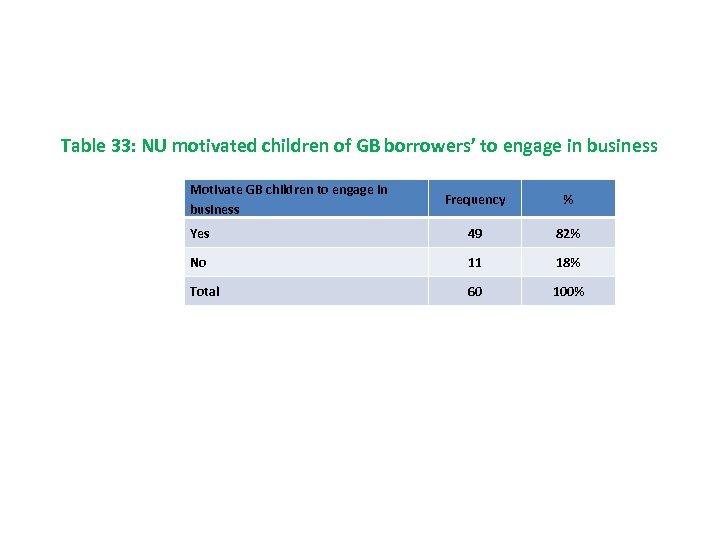
Table 33: NU motivated children of GB borrowers’ to engage in business Motivate GB children to engage in business Frequency % Yes 49 82% No 11 18% Total 60 100%
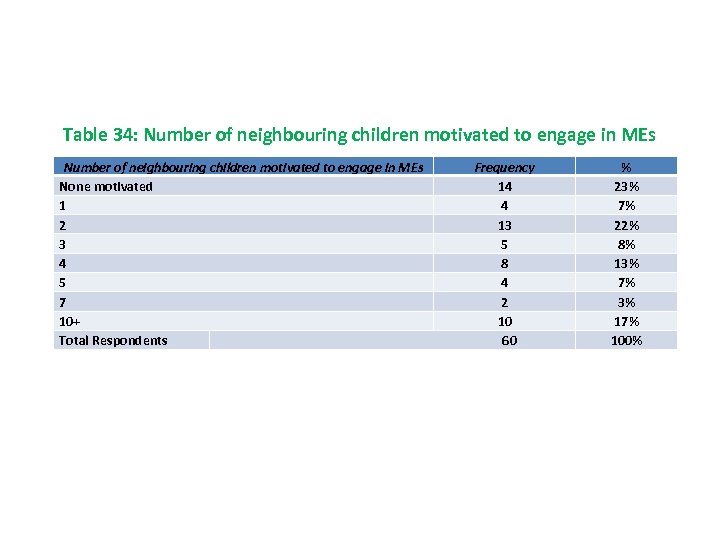
Table 34: Number of neighbouring children motivated to engage in MEs Frequency None motivated 14 1 4 2 13 3 5 4 8 5 4 7 2 10+ 10 Total Respondents 60 % 23% 7% 22% 8% 13% 7% 3% 17% 100%
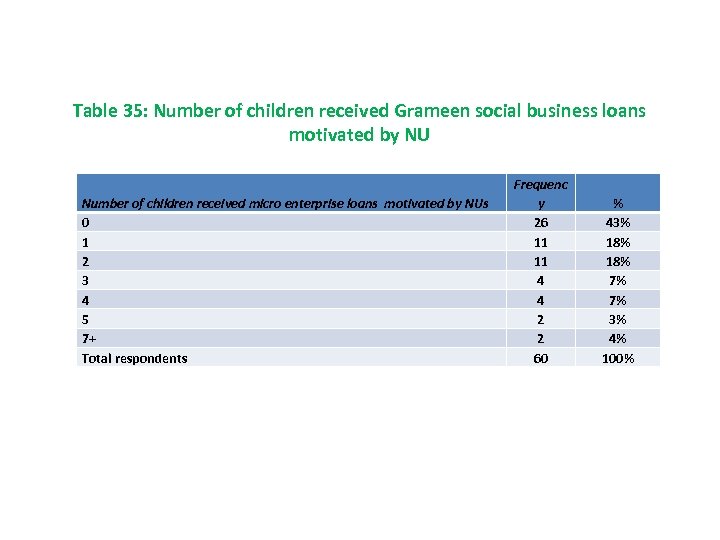
Table 35: Number of children received Grameen social business loans motivated by NU Number of children received micro enterprise loans motivated by NUs 0 1 2 3 4 5 7+ Total respondents Frequenc y 26 11 11 4 4 2 2 60 % 43% 18% 7% 7% 3% 4% 100%
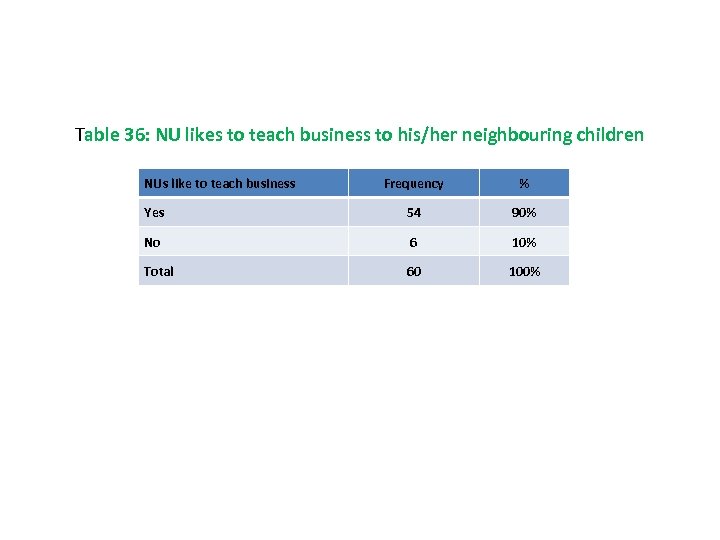
Table 36: NU likes to teach business to his/her neighbouring children NUs like to teach business Frequency % Yes 54 90% No 6 10% Total 60 100%
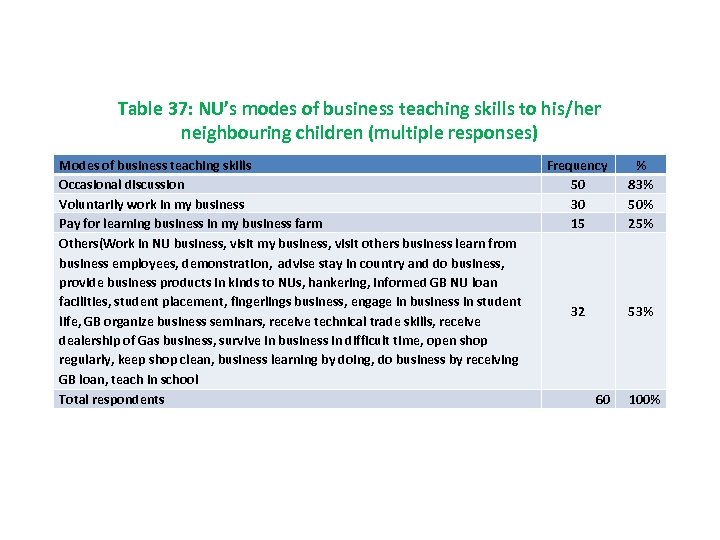
Table 37: NU’s modes of business teaching skills to his/her neighbouring children (multiple responses) Modes of business teaching skills Occasional discussion Voluntarily work in my business Pay for learning business in my business farm Others(Work in NU business, visit my business, visit others business learn from business employees, demonstration, advise stay in country and do business, provide business products in kinds to NUs, hankering, informed GB NU loan facilities, student placement, fingerlings business, engage in business in student life, GB organize business seminars, receive technical trade skills, receive dealership of Gas business, survive in business in difficult time, open shop regularly, keep shop clean, business learning by doing, do business by receiving GB loan, teach in school Total respondents Frequency 50 30 15 % 83% 50% 25% 32 53% 60 100%
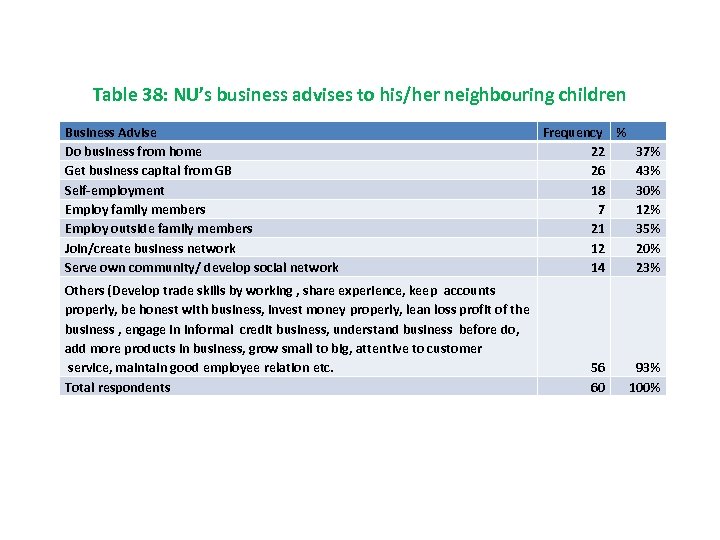
Table 38: NU’s business advises to his/her neighbouring children Business Advise Do business from home Get business capital from GB Self-employment Employ family members Employ outside family members Join/create business network Serve own community/ develop social network Others (Develop trade skills by working , share experience, keep accounts properly, be honest with business, invest money properly, lean loss profit of the business , engage in informal credit business, understand business before do, add more products in business, grow small to big, attentive to customer service, maintain good employee relation etc. Total respondents Frequency % 22 37% 26 43% 18 30% 7 12% 21 35% 12 20% 14 23% 56 60 93% 100%
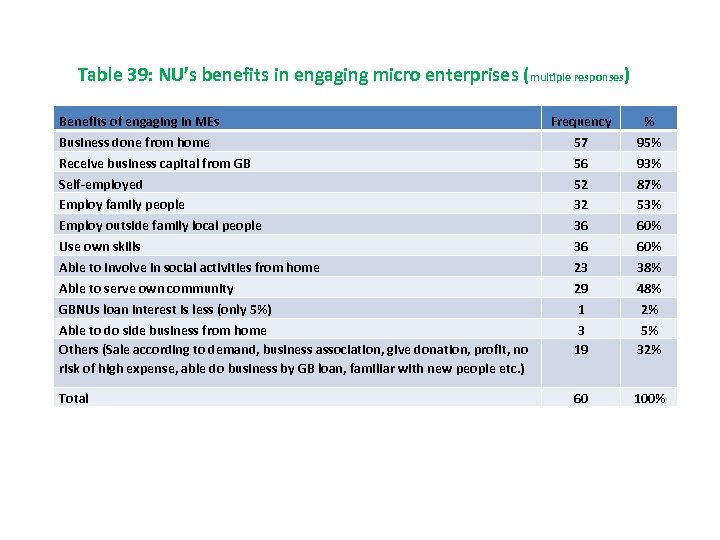
Table 39: NU’s benefits in engaging micro enterprises (multiple responses) Benefits of engaging in MEs Business done from home Receive business capital from GB Self-employed Employ family people Employ outside family local people Use own skills Able to involve in social activities from home Able to serve own community GBNUs loan interest is less (only 5%) Able to do side business from home Others (Sale according to demand, business association, give donation, profit, no risk of high expense, able do business by GB loan, familiar with new people etc. ) Total Frequency 57 56 52 32 36 36 23 29 1 3 19 % 95% 93% 87% 53% 60% 38% 48% 2% 5% 32% 60 100%
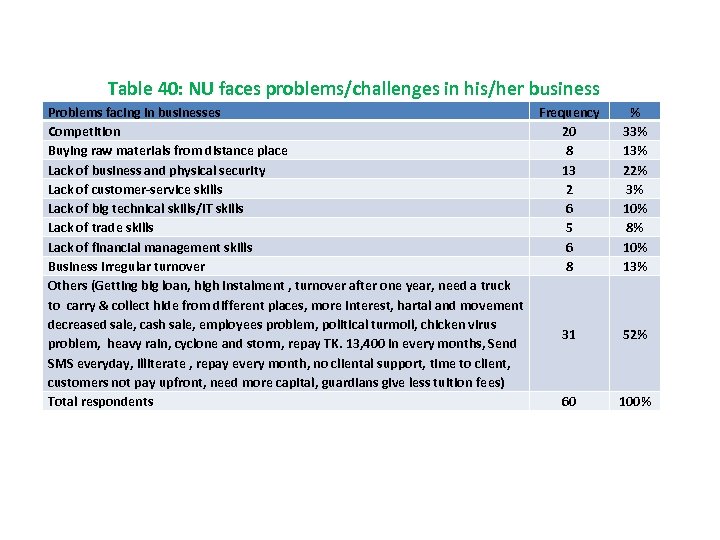
Table 40: NU faces problems/challenges in his/her business Problems facing in businesses Frequency Competition 20 Buying raw materials from distance place 8 Lack of business and physical security 13 Lack of customer-service skills 2 Lack of big technical skills/IT skills 6 Lack of trade skills 5 Lack of financial management skills 6 Business irregular turnover 8 Others (Getting big loan, high instalment , turnover after one year, need a truck to carry & collect hide from different places, more interest, hartal and movement decreased sale, cash sale, employees problem, political turmoil, chicken virus 31 problem, heavy rain, cyclone and storm, repay TK. 13, 400 in every months, Send SMS everyday, illiterate , repay every month, no cliental support, time to client, customers not pay upfront, need more capital, guardians give less tuition fees) Total respondents 60 % 33% 13% 22% 3% 10% 8% 10% 13% 52% 100%
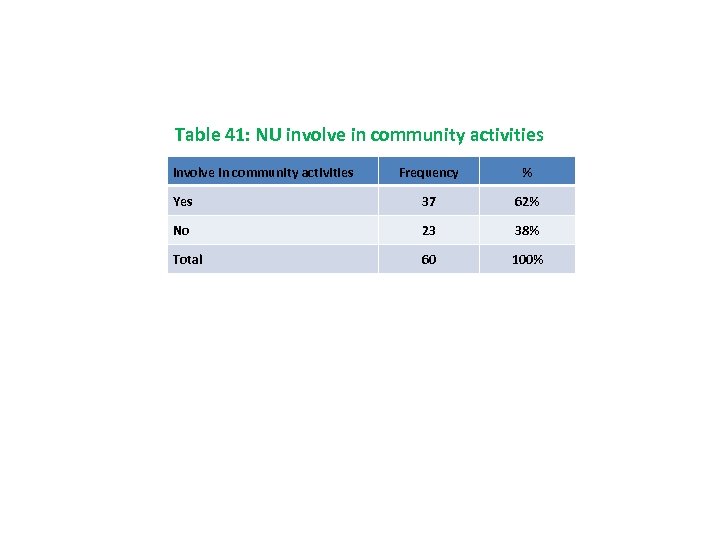
Table 41: NU involve in community activities Involve in community activities Frequency % Yes 37 62% No 23 38% Total 60 100%
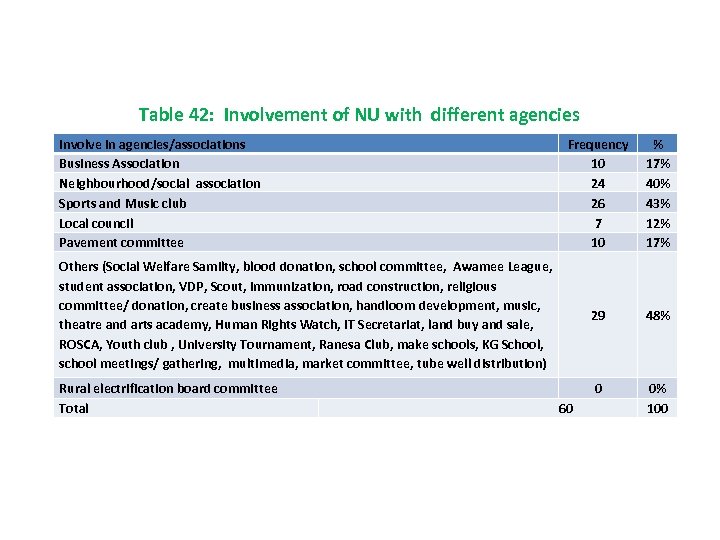
Table 42: Involvement of NU with different agencies Involve in agencies/associations Business Association Neighbourhood/social association Sports and Music club Local council Pavement committee Frequency 10 24 26 7 10 % 17% 40% 43% 12% 17% 29 48% 0 0% 100 Others (Social Welfare Samilty, blood donation, school committee, Awamee League, student association, VDP, Scout, immunization, road construction, religious committee/ donation, create business association, handloom development, music, theatre and arts academy, Human Rights Watch, IT Secretariat, land buy and sale, ROSCA, Youth club , University Tournament, Ranesa Club, make schools, KG School, school meetings/ gathering, multimedia, market committee, tube well distribution) Rural electrification board committee Total 60
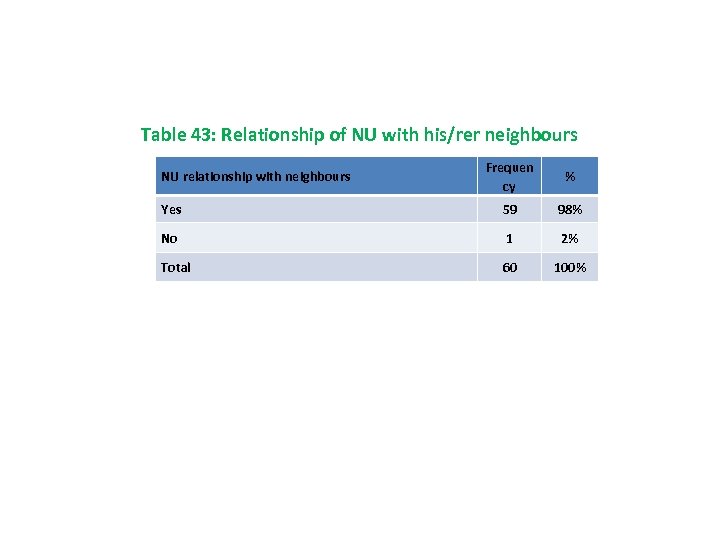
Table 43: Relationship of NU with his/rer neighbours Frequen cy % Yes 59 98% No 1 2% Total 60 100% NU relationship with neighbours
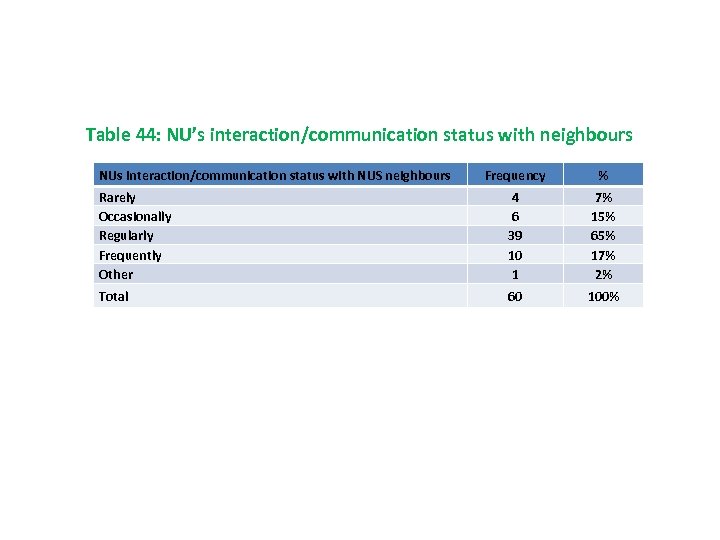
Table 44: NU’s interaction/communication status with neighbours NUs interaction/communication status with NUS neighbours Frequency % Rarely Occasionally Regularly Frequently Other 4 6 39 10 1 7% 15% 65% 17% 2% Total 60 100%
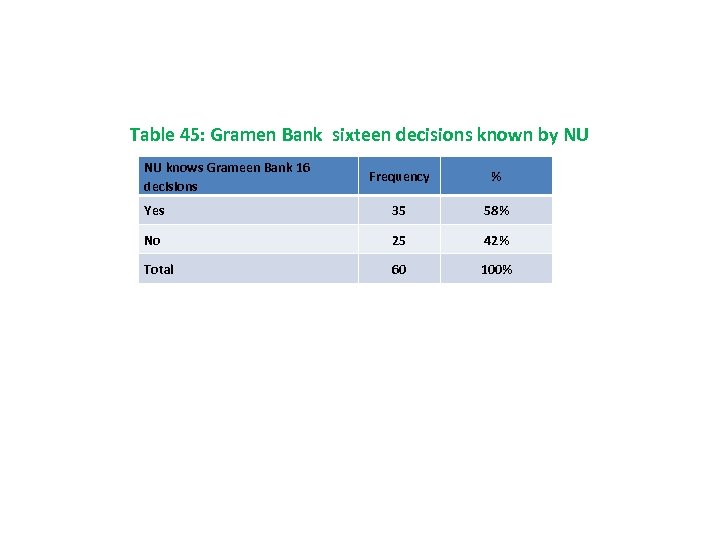
Table 45: Gramen Bank sixteen decisions known by NU NU knows Grameen Bank 16 decisions Frequency % Yes 35 58% No 25 42% Total 60 100%
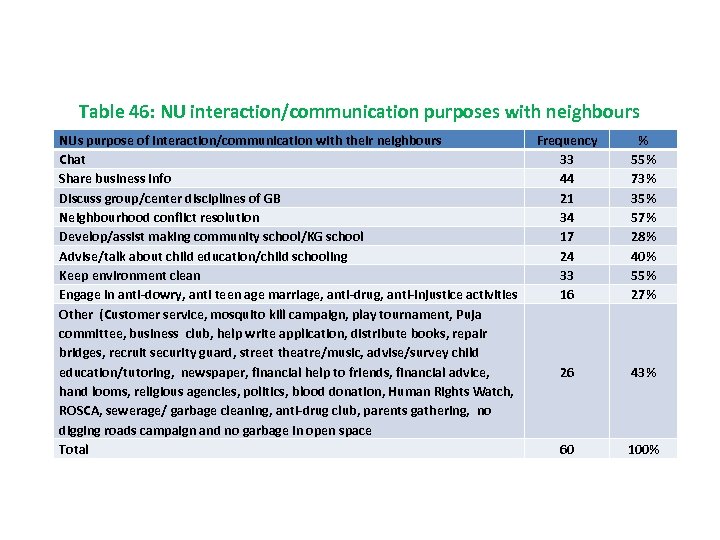
Table 46: NU interaction/communication purposes with neighbours NUs purpose of interaction/communication with their neighbours Chat Share business info Discuss group/center disciplines of GB Neighbourhood conflict resolution Develop/assist making community school/KG school Advise/talk about child education/child schooling Keep environment clean Engage in anti-dowry, anti teen age marriage, anti-drug, anti-injustice activities Other (Customer service, mosquito kill campaign, play tournament, Puja committee, business club, help write application, distribute books, repair bridges, recruit security guard, street theatre/music, advise/survey child education/tutoring, newspaper, financial help to friends, financial advice, hand looms, religious agencies, politics, blood donation, Human Rights Watch, ROSCA, sewerage/ garbage cleaning, anti-drug club, parents gathering, no digging roads campaign and no garbage in open space Total Frequency 33 44 21 34 17 24 33 16 % 55% 73% 35% 57% 28% 40% 55% 27% 26 43% 60 100%
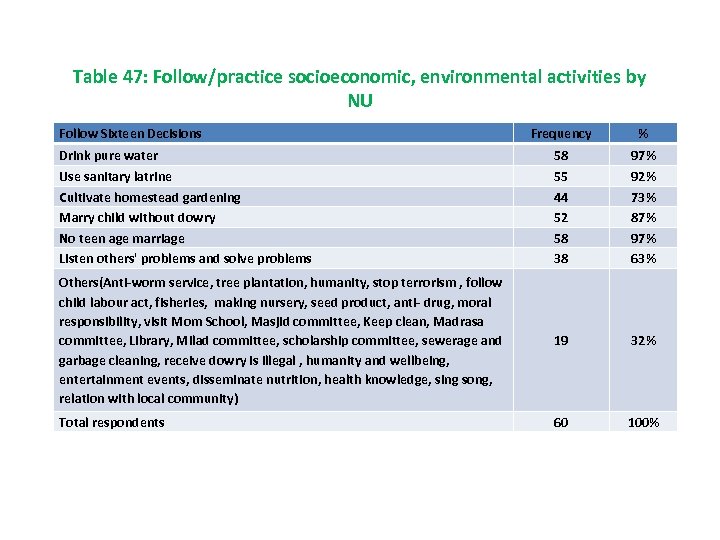
Table 47: Follow/practice socioeconomic, environmental activities by NU Follow Sixteen Decisions Frequency % Drink pure water 58 97% Use sanitary latrine Cultivate homestead gardening Marry child without dowry No teen age marriage Listen others' problems and solve problems 55 44 52 58 38 92% 73% 87% 97% 63% Others(Anti-worm service, tree plantation, humanity, stop terrorism , follow child labour act, fisheries, making nursery, seed product, anti- drug, moral responsibility, visit Mom School, Masjid committee, Keep clean, Madrasa committee, Library, Milad committee, scholarship committee, sewerage and garbage cleaning, receive dowry is illegal , humanity and wellbeing, entertainment events, disseminate nutrition, health knowledge, sing song, relation with local community) 19 32% Total respondents 60 100%
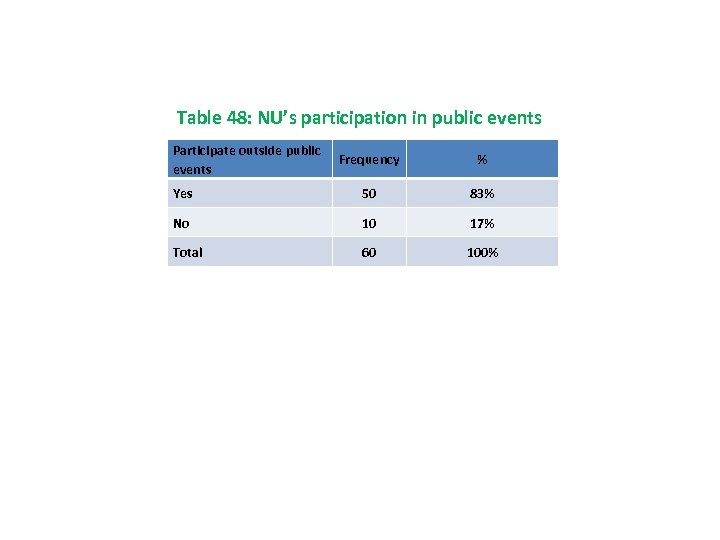
Table 48: NU’s participation in public events Participate outside public events Frequency % Yes 50 83% No 10 17% Total 60 100%
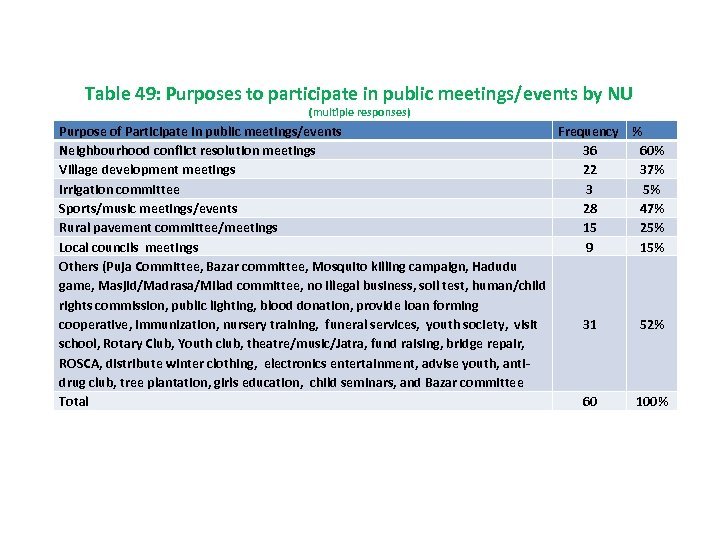
Table 49: Purposes to participate in public meetings/events by NU (multiple responses) Purpose of Participate in public meetings/events Frequency % Neighbourhood conflict resolution meetings 36 60% Village development meetings 22 37% Irrigation committee 3 5% Sports/music meetings/events 28 47% Rural pavement committee/meetings 15 25% Local councils meetings 9 15% Others (Puja Committee, Bazar committee, Mosquito killing campaign, Hadudu game, Masjid/Madrasa/Milad committee, no illegal business, soil test, human/child rights commission, public lighting, blood donation, provide loan forming cooperative, immunization, nursery training, funeral services, youth society, visit 31 52% school, Rotary Club, Youth club, theatre/music/Jatra, fund raising, bridge repair, ROSCA, distribute winter clothing, electronics entertainment, advise youth, antidrug club, tree plantation, girls education, child seminars, and Bazar committee Total 60 100%
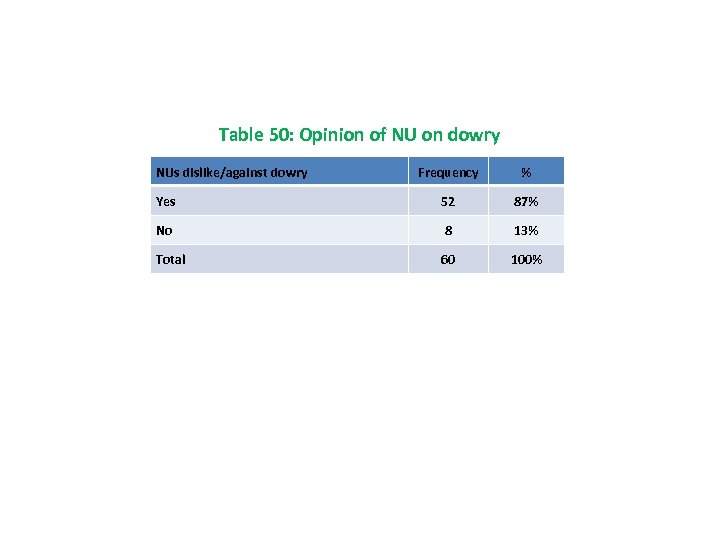
Table 50: Opinion of NU on dowry NUs dislike/against dowry Frequency % Yes 52 87% No 8 13% Total 60 100%
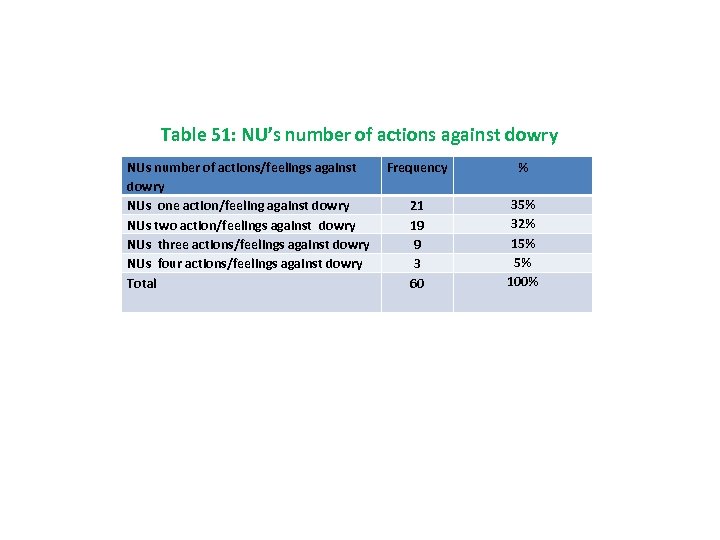
Table 51: NU’s number of actions against dowry NUs number of actions/feelings against dowry NUs one action/feeling against dowry NUs two action/feelings against dowry NUs three actions/feelings against dowry NUs four actions/feelings against dowry Total Frequency % 21 19 9 3 60 35% 32% 15% 5% 100%
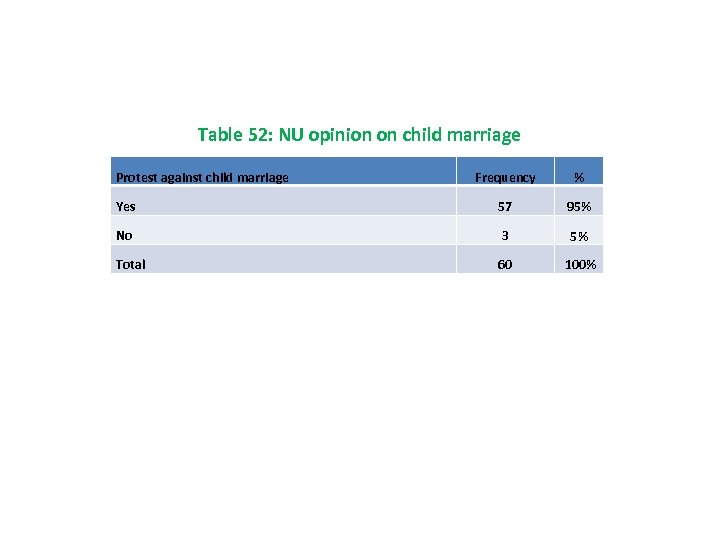
Table 52: NU opinion on child marriage Protest against child marriage Frequency % Yes 57 95% No 3 5% Total 60 100%
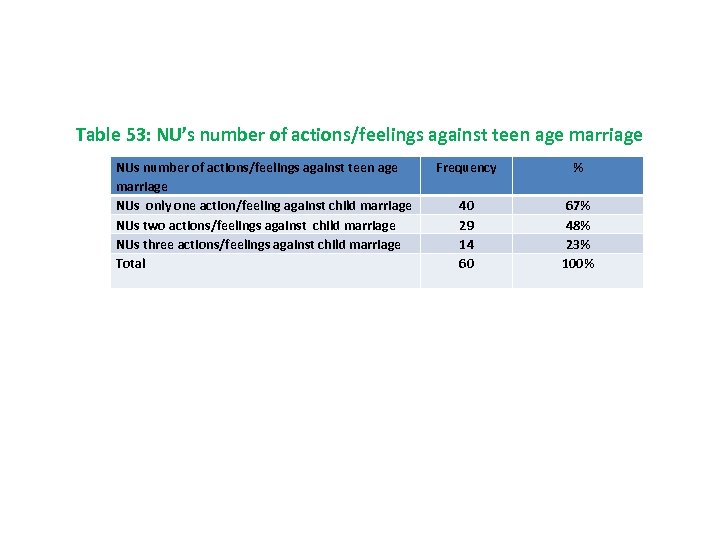
Table 53: NU’s number of actions/feelings against teen age marriage NUs only one action/feeling against child marriage NUs two actions/feelings against child marriage NUs three actions/feelings against child marriage Total Frequency % 40 29 14 60 67% 48% 23% 100%
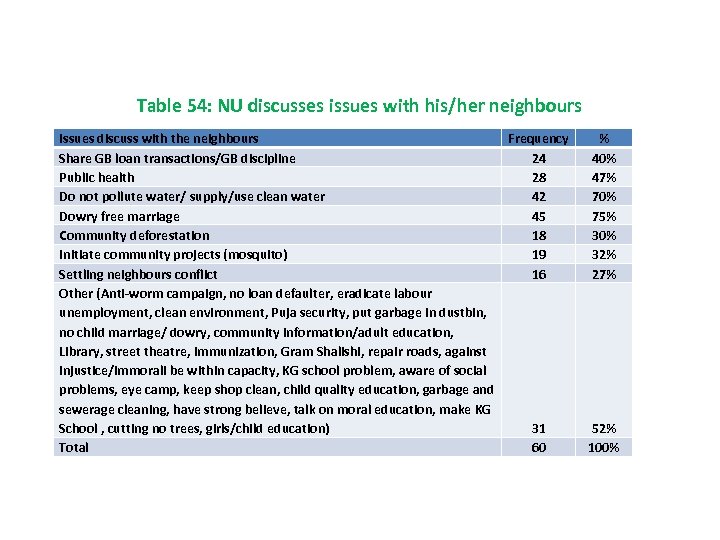
Table 54: NU discusses issues with his/her neighbours Issues discuss with the neighbours Frequency Share GB loan transactions/GB discipline 24 Public health 28 Do not pollute water/ supply/use clean water 42 Dowry free marriage 45 Community deforestation 18 Initiate community projects (mosquito) 19 Settling neighbours conflict 16 Other (Anti-worm campaign, no loan defaulter, eradicate labour unemployment, clean environment, Puja security, put garbage in dustbin, no child marriage/ dowry, community information/adult education, Library, street theatre, immunization, Gram Shalishi, repair roads, against injustice/immorali be within capacity, KG school problem, aware of social problems, eye camp, keep shop clean, child quality education, garbage and sewerage cleaning, have strong believe, talk on moral education, make KG 31 School , cutting no trees, girls/child education) Total 60 % 40% 47% 70% 75% 30% 32% 27% 52% 100%
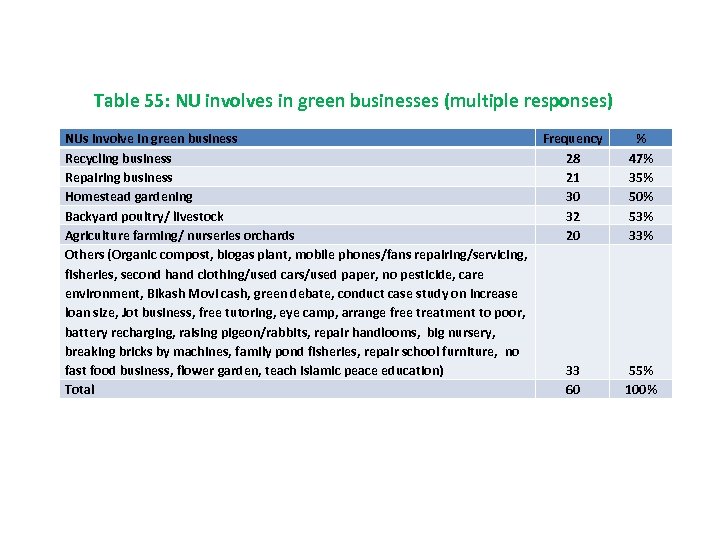
Table 55: NU involves in green businesses (multiple responses) NUs involve in green business Frequency Recycling business 28 Repairing business 21 Homestead gardening 30 Backyard poultry/ livestock 32 Agriculture farming/ nurseries orchards 20 Others (Organic compost, biogas plant, mobile phones/fans repairing/servicing, fisheries, second hand clothing/used cars/used paper, no pesticide, care environment, Bikash Movi cash, green debate, conduct case study on increase loan size, Jot business, free tutoring, eye camp, arrange free treatment to poor, battery recharging, raising pigeon/rabbits, repair handlooms, big nursery, breaking bricks by machines, family pond fisheries, repair school furniture, no fast food business, flower garden, teach Islamic peace education) 33 Total 60 % 47% 35% 50% 53% 33% 55% 100%
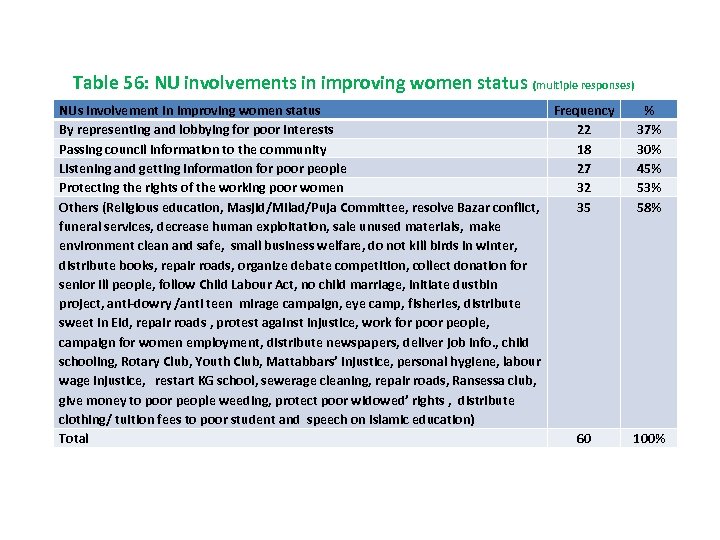
Table 56: NU involvements in improving women status (multiple responses) NUs involvement in improving women status Frequency By representing and lobbying for poor interests 22 Passing council information to the community 18 Listening and getting information for poor people 27 Protecting the rights of the working poor women 32 Others (Religious education, Masjid/Milad/Puja Committee, resolve Bazar conflict, 35 funeral services, decrease human exploitation, sale unused materials, make environment clean and safe, small business welfare, do not kill birds in winter, distribute books, repair roads, organize debate competition, collect donation for senior ill people, follow Child Labour Act, no child marriage, initiate dustbin project, anti-dowry /anti teen mirage campaign, eye camp, fisheries, distribute sweet in Eid, repair roads , protest against injustice, work for poor people, campaign for women employment, distribute newspapers, deliver job info. , child schooling, Rotary Club, Youth Club, Mattabbars’ injustice, personal hygiene, labour wage injustice, restart KG school, sewerage cleaning, repair roads, Ransessa club, give money to poor people weeding, protect poor widowed’ rights , distribute clothing/ tuition fees to poor student and speech on Islamic education) Total 60 % 37% 30% 45% 53% 58% 100%
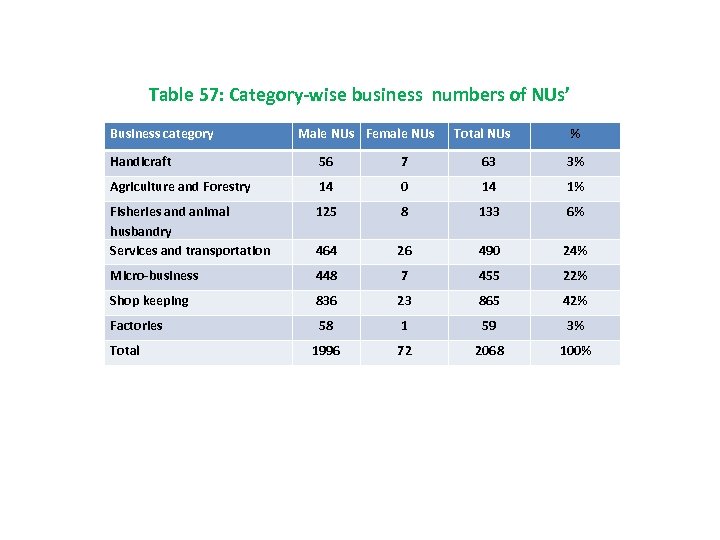
Table 57: Category-wise business numbers of NUs’ Business category Male NUs Female NUs Total NUs % Handicraft 56 7 63 3% Agriculture and Forestry 14 0 14 1% Fisheries and animal husbandry Services and transportation 125 8 133 6% 464 26 490 24% Micro-business 448 7 455 22% Shop keeping 836 23 865 42% Factories 58 1 59 3% 1996 72 2068 100% Total
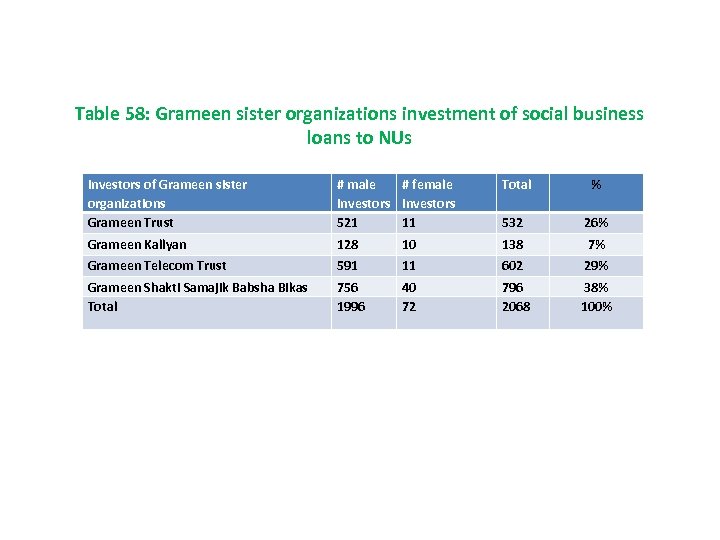
Table 58: Grameen sister organizations investment of social business loans to NUs Investors of Grameen sister organizations Grameen Trust # male # female investors 521 11 Total % 532 26% Grameen Kallyan 128 10 138 7% Grameen Telecom Trust 591 11 602 29% Grameen Shakti Samajik Babsha Bikas Total 756 1996 40 72 796 2068 38% 100%
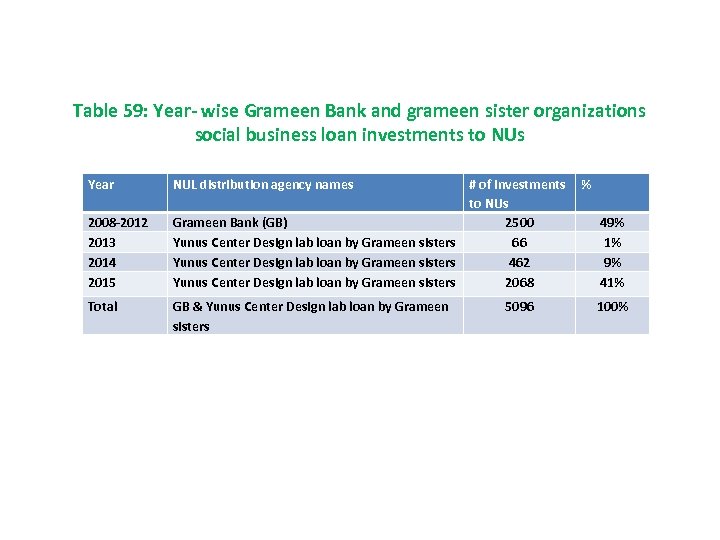
Table 59: Year- wise Grameen Bank and grameen sister organizations social business loan investments to NUs Year 2008 -2012 2013 2014 2015 Total NUL distribution agency names # of investments % to NUs Grameen Bank (GB) 2500 49% Yunus Center Design lab loan by Grameen sisters 66 1% Yunus Center Design lab loan by Grameen sisters 462 9% Yunus Center Design lab loan by Grameen sisters 2068 41% GB & Yunus Center Design lab loan by Grameen sisters 5096 100%

Thank You Comments/Questions
 Скачать презентацию Grameen Bank New Entrepreneurship Development in Bangladesh Dr
4b0a7642537ac1623dee960ac8597d5f.ppt