 Скачать презентацию Graham Steward 1 Vasily Lobzin 1 Mike Terkildsen
28baa62992e264004d90a5a83fbff979.ppt
- Количество слайдов: 1



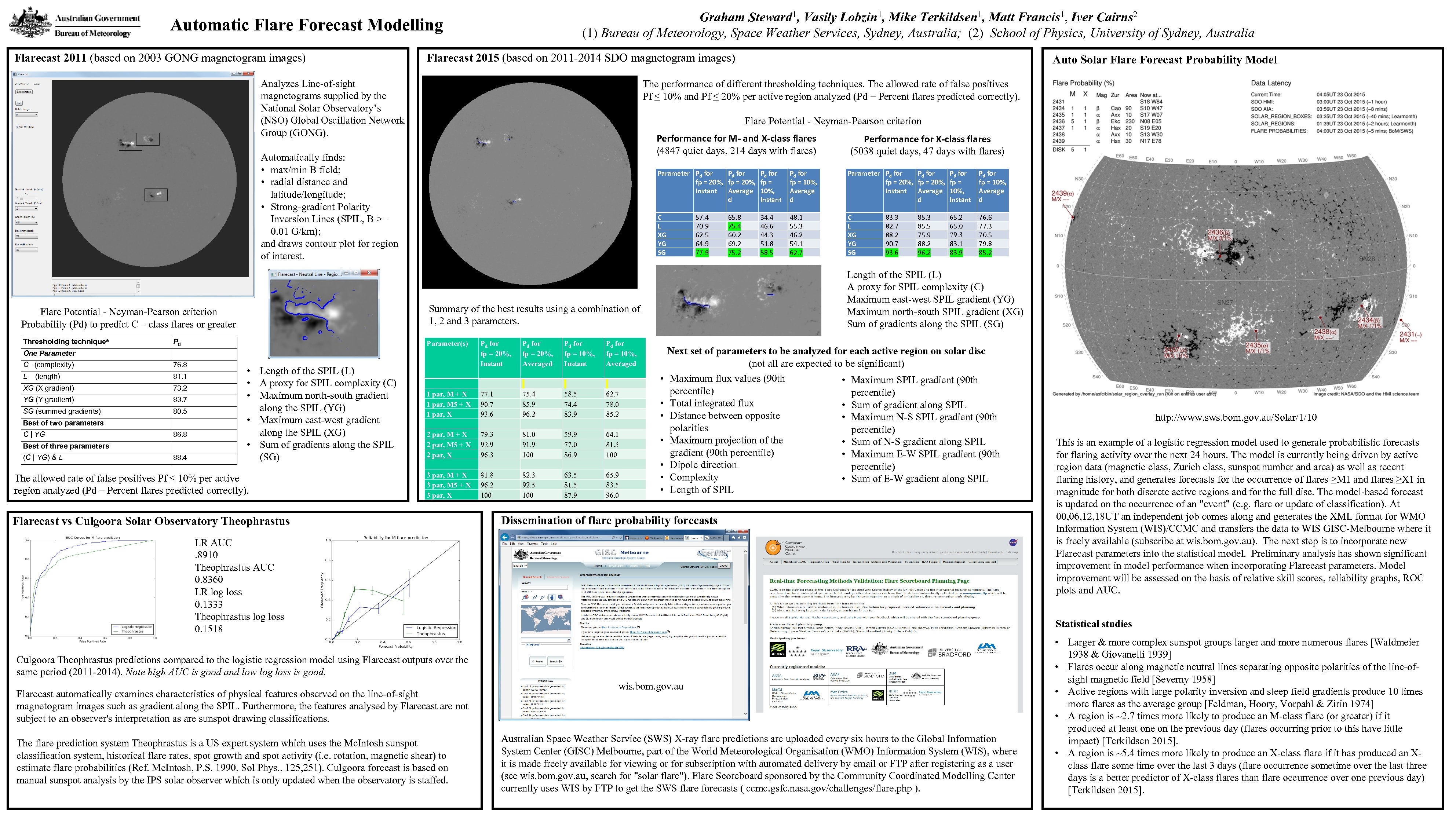
Graham Steward 1, Vasily Lobzin 1, Mike Terkildsen 1, Matt Francis 1, Iver Cairns 2 (1) Bureau of Meteorology, Space Weather Services, Sydney, Australia; (2) School of Physics, University of Sydney, Australia Automatic Flare Forecast Modelling Flarecast 2011 (based on 2003 GONG magnetogram images) Flarecast 2015 (based on 2011 -2014 SDO magnetogram images) Analyzes Line-of-sight magnetograms supplied by the National Solar Observatory’s (NSO) Global Oscillation Network Group (GONG). The performance of different thresholding techniques. The allowed rate of false positives Pf ≤ 10% and Pf ≤ 20% per active region analyzed (Pd − Percent flares predicted correctly). Flare Potential - Neyman-Pearson criterion Performance for M- and X-class flares (4847 quiet days, 214 days with flares) Automatically finds: • max/min B field; • radial distance and latitude/longitude; • Strong-gradient Polarity Inversion Lines (SPIL, B >= 0. 01 G/km); and draws contour plot for region of interest. Parameter Pd for fp = 20%, Instant C L XG YG SG Flare Potential - Neyman-Pearson criterion Probability (Pd) to predict C – class flares or greater Thresholding techniquea Parameter(s) 57. 4 70. 9 62. 5 64. 9 77. 9 One Parameter C (complexity) 76. 8 L (length) 81. 1 XG (X gradient) 73. 2 YG (Y gradient) 83. 7 SG (summed gradients) 80. 5 Best of two parameters C | YG 86. 8 Best of three parameters (C | YG) & L 88. 4 • Length of the SPIL (L) • A proxy for SPIL complexity (C) • Maximum north-south gradient along the SPIL (YG) • Maximum east-west gradient along the SPIL (XG) • Sum of gradients along the SPIL (SG) The allowed rate of false positives Pf ≤ 10% per active region analyzed (Pd − Percent flares predicted correctly). 1 par, M + X 1 par, M 5 + X 1 par, X 2 par, M + X 2 par, M 5 + X 2 par, X 3 par, M + X 3 par, M 5 + X 3 par, X Flarecast vs Culgoora Solar Observatory Theophrastus Pd for fp = 20%, Instant 77. 1 90. 7 93. 6 79. 3 92. 9 96. 3 81. 8 96. 2 100 Pd for fp = 20%, Averaged 75. 4 85. 9 96. 2 81. 0 91. 9 100 82. 3 92. 5 100 Pd for fp = 10%, Instant 58. 5 74. 4 83. 9 59. 9 77. 0 86. 9 63. 5 81. 5 87. 9 Pd for fp = 10%, Averaged 62. 7 78. 0 85. 2 64. 1 81. 5 100 65. 9 83. 5 96. 0 Pd for fp = 20%, Average d 65. 8 75. 4 60. 2 69. 2 75. 2 Pd for fp = 10%, Instant 34. 4 46. 6 44. 3 51. 8 58. 5 Pd for fp = 10%, Average d 48. 1 55. 3 46. 2 54. 1 62. 7 Performance for X-class flares (5038 quiet days, 47 days with flares) Parameter Pd for fp = 20%, Instant C L XG YG SG 83. 3 82. 7 88. 2 90. 7 93. 6 Pd for fp = 20%, Average d 85. 3 85. 5 75. 9 88. 2 96. 2 Pd for fp = 10%, Instant 65. 2 65. 0 79. 3 83. 1 83. 9 Pd for fp = 10%, Average d 76. 6 77. 3 70. 5 79. 8 85. 2 Length of the SPIL (L) A proxy for SPIL complexity (C) Maximum east-west SPIL gradient (YG) Maximum north-south SPIL gradient (XG) Sum of gradients along the SPIL (SG) Summary of the best results using a combination of 1, 2 and 3 parameters. Pd Auto Solar Flare Forecast Probability Model • • Next set of parameters to be analyzed for each active region on solar disc (not all are expected to be significant) Maximum flux values (90 th • Maximum SPIL gradient (90 th percentile) Total integrated flux • Sum of gradient along SPIL Distance between opposite • Maximum N-S SPIL gradient (90 th polarities percentile) Maximum projection of the • Sum of N-S gradient along SPIL gradient (90 th percentile) • Maximum E-W SPIL gradient (90 th Dipole direction percentile) Complexity • Sum of E-W gradient along SPIL Length of SPIL Dissemination of flare probability forecasts LR AUC . 8910 Theophrastus AUC 0. 8360 LR log loss 0. 1333 Theophrastus log loss 0. 1518 This is an example of a logistic regression model used to generate probabilistic forecasts for flaring activity over the next 24 hours. The model is currently being driven by active region data (magnetic class, Zurich class, sunspot number and area) as well as recent flaring history, and generates forecasts for the occurrence of flares ≥M 1 and flares ≥X 1 in magnitude for both discrete active regions and for the full disc. The model-based forecast is updated on the occurrence of an "event" (e. g. flare or update of classification). At 00, 06, 12, 18 UT an independent job comes along and generates the XML format for WMO Information System (WIS)/CCMC and transfers the data to WIS GISC-Melbourne where it is freely available (subscribe at wis. bom. gov. au). The next step is to incorporate new Flarecast parameters into the statistical model. Preliminary analysis has shown significant improvement in model performance when incorporating Flarecast parameters. Model improvement will be assessed on the basis of relative skill scores, reliability graphs, ROC plots and AUC. Statistical studies Culgoora Theophrastus predictions compared to the logistic regression model using Flarecast outputs over the same period (2011 -2014). Note high AUC is good and low log loss is good. Flarecast automatically examines characteristics of physical features observed on the line-of-sight magnetogram images such as gradient along the SPIL. Furthermore, the features analysed by Flarecast are not subject to an observer's interpretation as are sunspot drawing classifications. The flare prediction system Theophrastus is a US expert system which uses the Mc. Intosh sunspot classification system, historical flare rates, spot growth and spot activity (i. e. rotation, magnetic shear) to estimate flare probabilities (Ref. Mc. Intosh, P. S. 1990, Sol Phys. , 125, 251). Culgoora forecast is based on manual sunspot analysis by the IPS solar observer which is only updated when the observatory is staffed. http: //www. sws. bom. gov. au/Solar/1/10 wis. bom. gov. au Australian Space Weather Service (SWS) X-ray flare predictions are uploaded every six hours to the Global Information System Center (GISC) Melbourne, part of the World Meteorological Organisation (WMO) Information System (WIS), where it is made freely available for viewing or for subscription with automated delivery by email or FTP after registering as a user (see wis. bom. gov. au, search for "solar flare"). Flare Scoreboard sponsored by the Community Coordinated Modelling Center currently uses WIS by FTP to get the SWS flare forecasts ( ccmc. gsfc. nasa. gov/challenges/flare. php ). • Larger & more complex sunspot groups larger and more numerous flares [Waldmeier 1938 & Giovanelli 1939] • Flares occur along magnetic neutral lines separating opposite polarities of the line-ofsight magnetic field [Severny 1958] • Active regions with large polarity inversion and steep field gradients produce 10 times more flares as the average group [Feldman, Hoory, Vorpahl & Zirin 1974] • A region is ~2. 7 times more likely to produce an M-class flare (or greater) if it produced at least one on the previous day (flares occurring prior to this have little impact) [Terkildsen 2015]. • A region is ~5. 4 times more likely to produce an X-class flare if it has produced an Xclass flare some time over the last 3 days (flare occurrence sometime over the last three days is a better predictor of X-class flares than flare occurrence over one previous day) [Terkildsen 2015].
Скачать презентацию Graham Steward 1 Vasily Lobzin 1 Mike Terkildsen
28baa62992e264004d90a5a83fbff979.ppt