


 Скачать презентацию graduate studies — a survival guide tips
d5c73198c72423b7410ca59ee478bf64.ppt
- Количество слайдов: 32
 graduate studies - a survival guide • tips for MScs/ Ph. Ds • essential writing guide http: //homepages. ed. ac. uk/martinc/msc/ (click ‘news’)
 some eternal truths • you didn’t get here by mistake • you don’t need to be a genius – MSc/Ph. D = reasonable intelligence + tenacity + interest • MScs work disproportionately harder – MScs are advanced UGs, but expectations are FAR higher
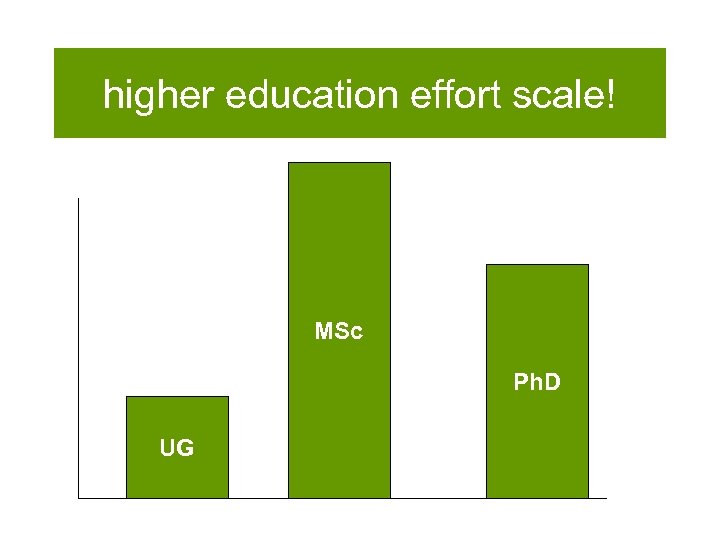 higher education effort scale! MSc Ph. D UG
 some eternal truths (cont) • stats are tough – Langdridge, D. (2004). Research Methods and Data Analysis in Psychology. London: Pearson Prentice Hill. • you’ll probably get miserable! – you will get over it – http: //www. student-counselling. ed. ac. uk/ • writing-up makes you fat!
 so why put yourself through it ? ? !? !!? ? • to enrich your life
 tips • ask someone – head of PG studies, lecturers, post-docs, older post-grads, peers – The Advice Place: www. eusa. ed. ac. uk/advice/ • academic issues, accommodation, council tax, harassment, health, legal, money, sexuality, sexual health, disability – Centre for Teaching Learning & Assessment: www. tla. ed. ac. uk • • one-to-one sessions on study difficulties workshops this term on: – Reading/Lectures/Your Time/Your Studies/Essays/ Long Essays and Dissertations/Exams/Procrastination
 tips (cont. ) • take initiative – – – supervisors have more work that you imagine choose essay/thesis titles early (talk to lecturer) for changing courses etc. act early, act quickly! • keep a routine – – stop work-time spreading over into rest-time uni diary £ 5. 70 (7 -11 Nicolson Street) • beware isolation! – take time to socialise: come to the BP!
 politics • foster good relations – don’t forget that the person you clash with today will be the reviewer of your paper tomorrow – appreciate the support staff “your success in graduate school and beyond depends a great deal upon your ability to build and maintain interpersonal relationships, with your adviser, the research staff, the support staff and your fellow students. ”
 tips: tension with supervisors • it happens! assess how serious it is… • irritating but not detrimental? – – take the time to explain how you feel (your supervisor can’t read your mind. . so say it) let off steam to your peers? (but remember the politics!) • if detrimental – protocols for switching supervisor – Code of Practice for Supervisors & Students – departmental PG contact points: Louise Kelly; Sergio della Sala; MSc’s: Martin Corley – School/College level: Ronnie Cann/Chris Clarke
 how not to get a Ph. D/MSc • not WANTING one • underestimating it – be prepared to work • overestimating it – your thesis should be your 1 st piece of work, not your best! • supervisory problems (see above!) • losing contact… with your supervisor/peers – don’t get lost!
 References • Phillips, E. M. and Pugh, D. S. (1987) How to get a Ph. D. A handbook for students and their supervisors. OUP Milton Keynes.
 and finally… • be enthusiastic about your strengths • find someone to complement your strengths • don’t struggle in silence
 A guide to essay writing. Or. . .
 how not to throw away marks…
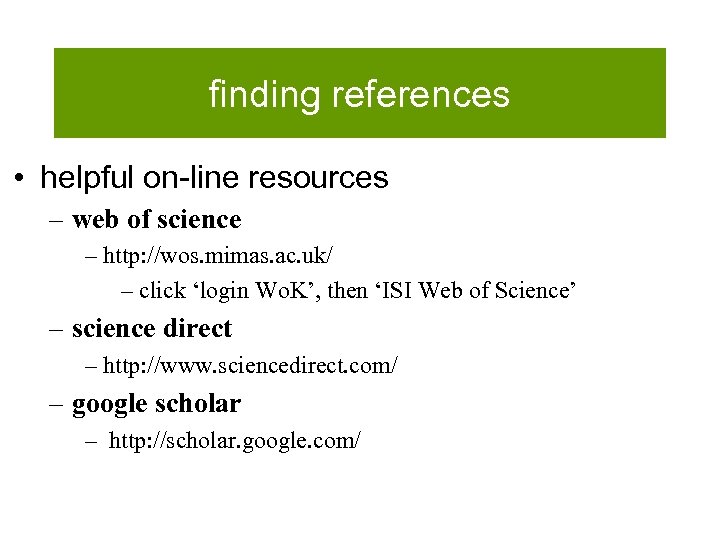 finding references • helpful on-line resources – web of science – http: //wos. mimas. ac. uk/ – click ‘login Wo. K’, then ‘ISI Web of Science’ – science direct – http: //www. sciencedirect. com/ – google scholar – http: //scholar. google. com/
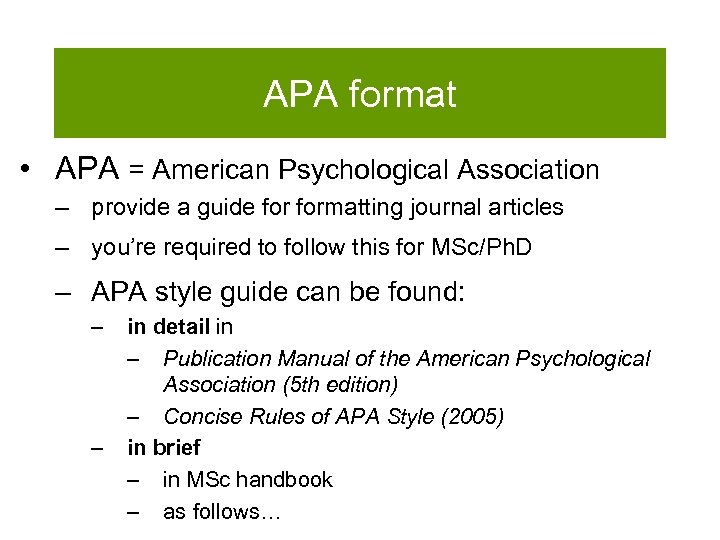 APA format • APA = American Psychological Association – provide a guide formatting journal articles – you’re required to follow this for MSc/Ph. D – APA style guide can be found: – – in detail in – Publication Manual of the American Psychological Association (5 th edition) – Concise Rules of APA Style (2005) in brief – in MSc handbook – as follows…
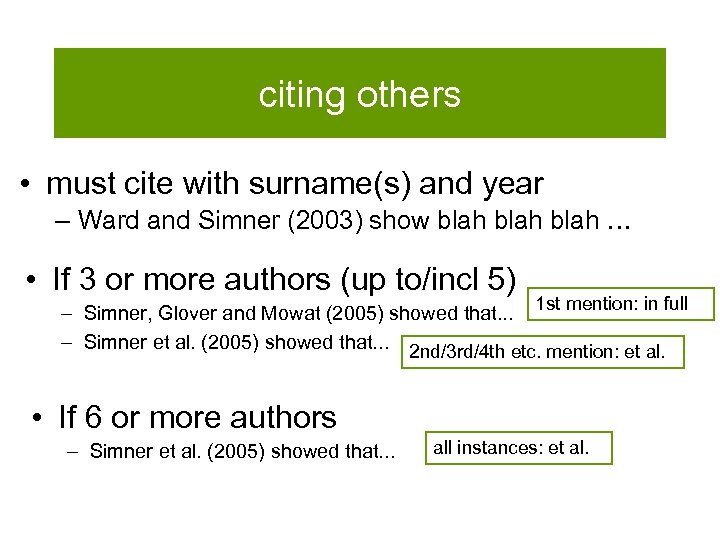 citing others • must cite with surname(s) and year – Ward and Simner (2003) show blah … • If 3 or more authors (up to/incl 5) 1 st mention: in full – Simner, Glover and Mowat (2005) showed that. . . – Simner et al. (2005) showed that. . . 2 nd/3 rd/4 th etc. mention: et al. • If 6 or more authors – Simner et al. (2005) showed that. . . all instances: et al.
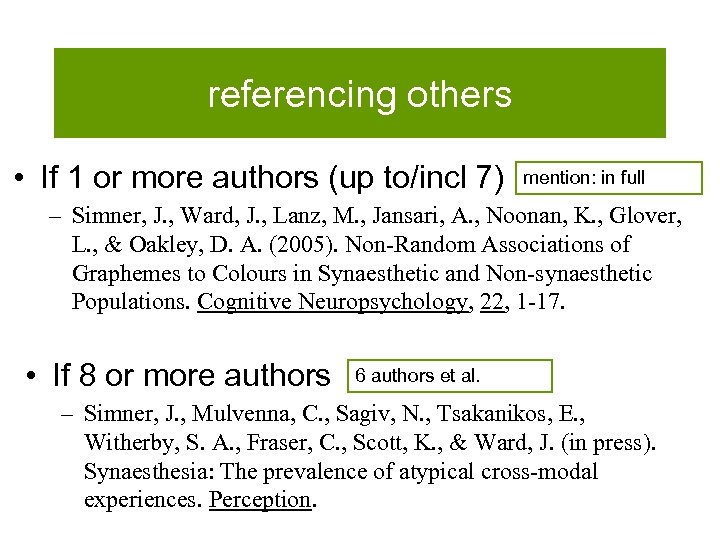 referencing others • If 1 or more authors (up to/incl 7) mention: in full – Simner, J. , Ward, J. , Lanz, M. , Jansari, A. , Noonan, K. , Glover, L. , & Oakley, D. A. (2005). Non-Random Associations of Graphemes to Colours in Synaesthetic and Non-synaesthetic Populations. Cognitive Neuropsychology, 22, 1 -17. • If 8 or more authors 6 authors et al. – Simner, J. , Mulvenna, C. , Sagiv, N. , Tsakanikos, E. , Witherby, S. A. , Fraser, C. , Scott, K. , & Ward, J. (in press). Synaesthesia: The prevalence of atypical cross-modal experiences. Perception.
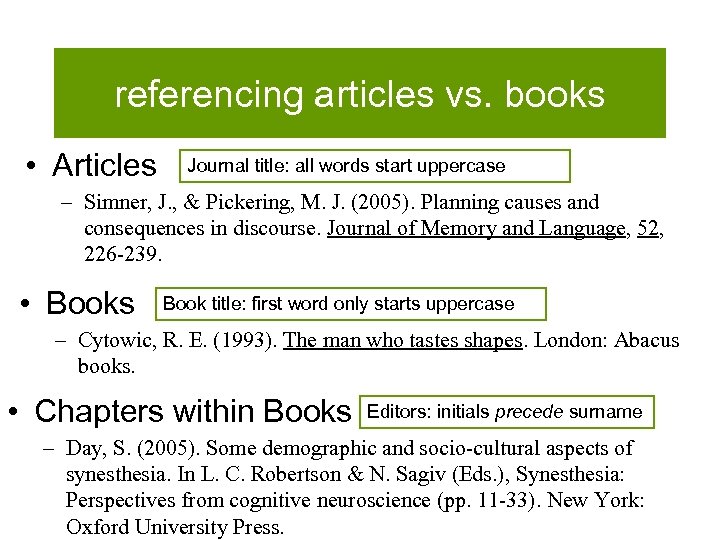 referencing articles vs. books • Articles Journal title: all words start uppercase – Simner, J. , & Pickering, M. J. (2005). Planning causes and consequences in discourse. Journal of Memory and Language, 52, 226 -239. • Books Book title: first word only starts uppercase – Cytowic, R. E. (1993). The man who tastes shapes. London: Abacus books. • Chapters within Books Editors: initials precede surname – Day, S. (2005). Some demographic and socio-cultural aspects of synesthesia. In L. C. Robertson & N. Sagiv (Eds. ), Synesthesia: Perspectives from cognitive neuroscience (pp. 11 -33). New York: Oxford University Press.
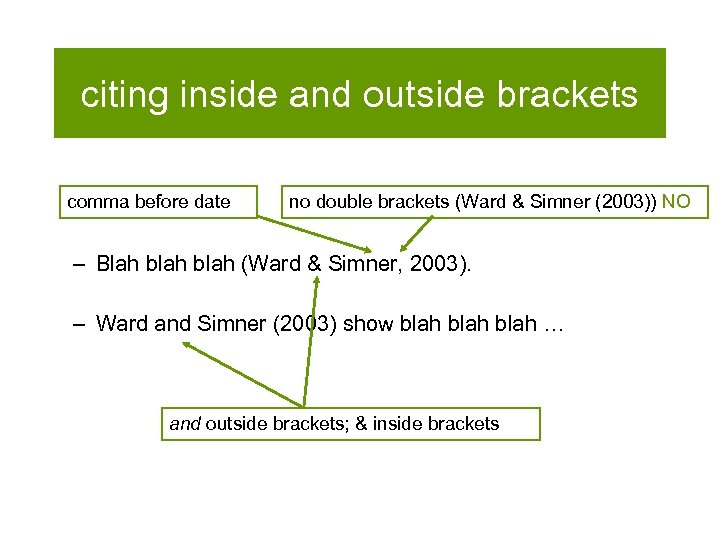 citing inside and outside brackets comma before date no double brackets (Ward & Simner (2003)) NO – Blah blah (Ward & Simner, 2003). – Ward and Simner (2003) show blah … and outside brackets; & inside brackets
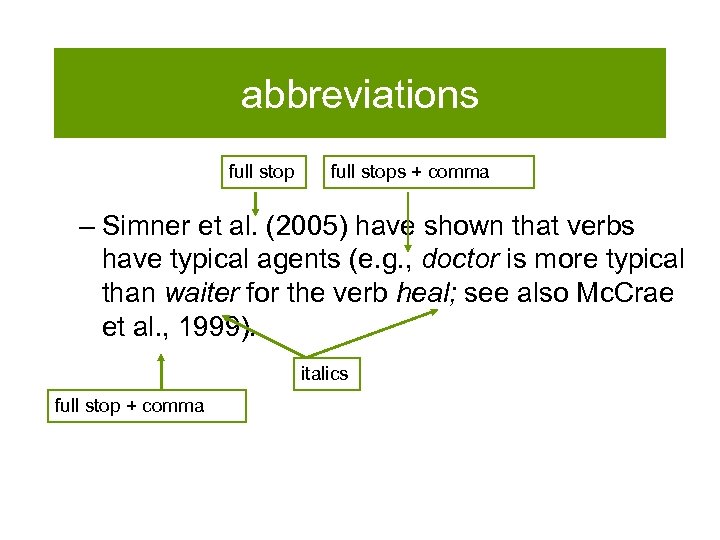 abbreviations full stops + comma – Simner et al. (2005) have shown that verbs have typical agents (e. g. , doctor is more typical than waiter for the verb heal; see also Mc. Crae et al. , 1999). italics full stop + comma
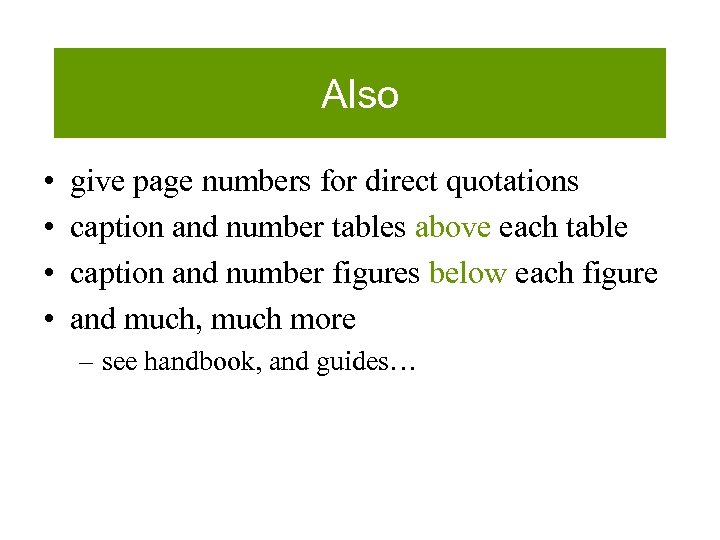 Also • • give page numbers for direct quotations caption and number tables above each table caption and number figures below each figure and much, much more – see handbook, and guides…
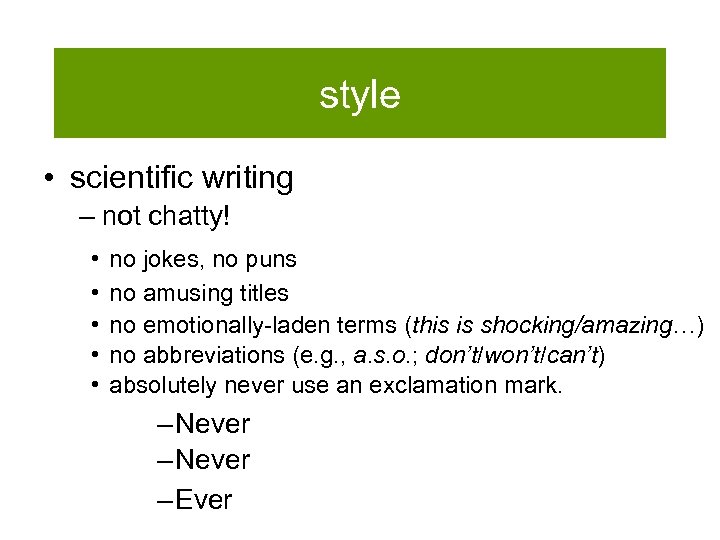 style • scientific writing – not chatty! • • • no jokes, no puns no amusing titles no emotionally-laden terms (this is shocking/amazing…) no abbreviations (e. g. , a. s. o. ; don’t/won’t/can’t) absolutely never use an exclamation mark. – Never – Ever
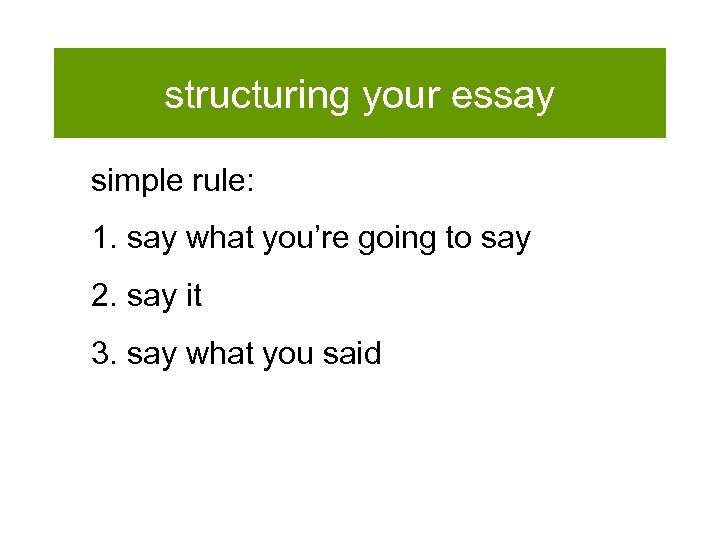 structuring your essay simple rule: 1. say what you’re going to say 2. say it 3. say what you said
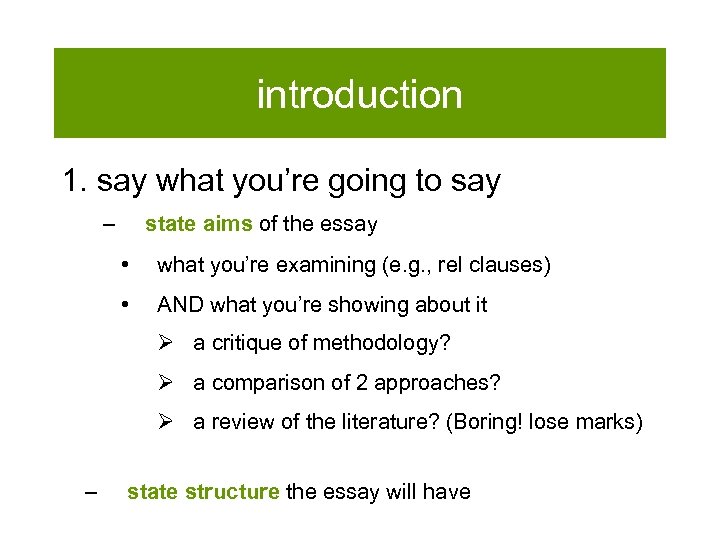 introduction 1. say what you’re going to say – state aims of the essay • what you’re examining (e. g. , rel clauses) • AND what you’re showing about it Ø a critique of methodology? Ø a comparison of 2 approaches? Ø a review of the literature? (Boring! lose marks) – state structure the essay will have
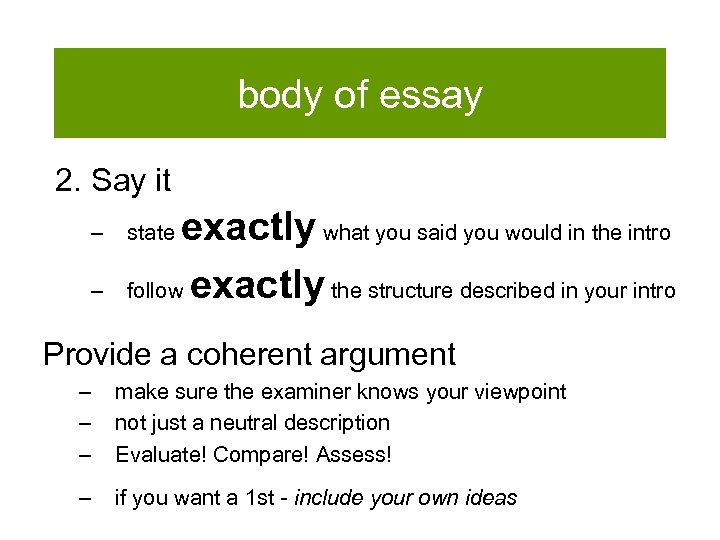 body of essay 2. Say it – – exactly what you said you would in the intro follow exactly the structure described in your intro state Provide a coherent argument – – – make sure the examiner knows your viewpoint not just a neutral description Evaluate! Compare! Assess! – if you want a 1 st - include your own ideas
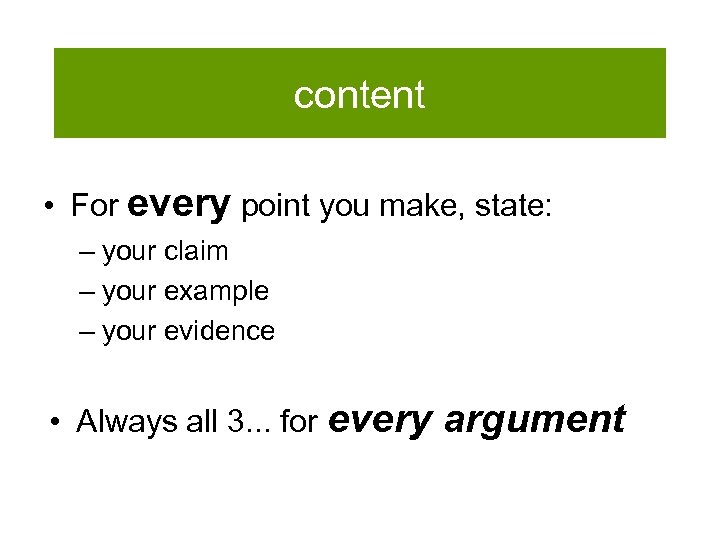 content • For every point you make, state: – your claim – your example – your evidence • Always all 3. . . for every argument
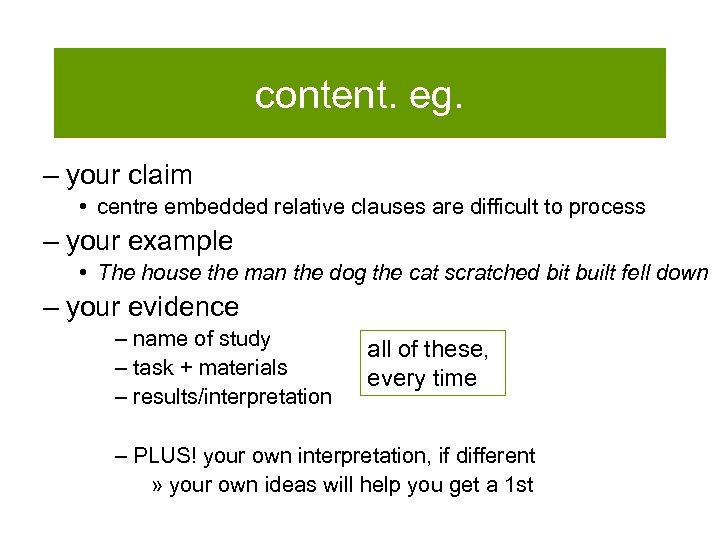 content. eg. – your claim • centre embedded relative clauses are difficult to process – your example • The house the man the dog the cat scratched bit built fell down – your evidence – name of study – task + materials – results/interpretation all of these, every time – PLUS! your own interpretation, if different » your own ideas will help you get a 1 st
 conclusion 3. say was you said – – – • sum up exactly what was said in the essay don’t introduce new findings include your own ideas! don’t include ‘undergrad style’ vagaries – – Many questions remain unanswered… This is an area of much debate… Rule: Don’t include anything that could fit into the conclusion of an entirely different essay
 non-native english speakers • marked at (approx) same standard as native speakers – – • slight dispensation for spelling errors e. g. , those overlooked by ‘spell-check’ (e. g. , two vs. too) ask a native English speaker to proof-read – they can comment only on your grammar, not content (i. e. , BEWARE PLAGERISM!)
 resources for non-native english speakers • English Language courses run throughout the year. – Contact: via International Student Homepage (http: //www. ed. ac. uk/internat/ Click on: ‘English Language Courses’ ) – e. g. , “IALS (Institute of Applied Language Studies) runs a special programme, free of charge, on behalf of the University, for postgraduate students registered for a degree who need help with their English” (see: http: //www. ed. ac. uk/studying/postgraduate/international_stu dents/lang_requirements. html)
 Good luck