


 Скачать презентацию Graduate Computer Architecture I Lecture 14 Network Processor
0e545b409234fbd6577361a1b89f5384.ppt
- Количество слайдов: 32
 Graduate Computer Architecture I Lecture 14: Network Processor
 Network Processor • Terminology emerged in the industry 1997 -1998 – Many startups competing for the network building-block – Broad variety of products are presented as an NP • Function – Integration and programmability – Efficient processing of network headers in packets – Support for higher-level flow management • Wide spectrum of capabilities and target markets 2 - CSE/ESE 560 M – Graduate Computer Architecture I
 Motivation • “Flexibility of a fully programmable processor with performance approaching that of a custom ASIC. ” – Faster time to market (no ASIC lead time) – Instead you get software development time • Field upgradability leading to longer lifetime – Ability to adapt deployed equipment to evolving and emerging standards and new application spaces – Enables multiple products using common hardware • Allows the network equipment vendors to focus on their value-add 3 - CSE/ESE 560 M – Graduate Computer Architecture I
 Usage • Integrated GPP + system controller + “acceleration” • Fast forwarding engine with access to a “slow-path” control agent • A smart DMA engine • An intelligent NIC • A highly integrated set of components to replace a bunch of ASICs and the blade control u. P 4 - CSE/ESE 560 M – Graduate Computer Architecture I
 Features • Integrated or attached GPP • Pool of multithreaded forwarding engines • High Bandwidth and High Capacity Mems – Embedded and external SRAM and DRAM • Variety of Communication mediums – Integrated media interface or media bus – Interface to a switching fabric or backplane – Interface to a “host” control processor – Interface to coprocessors 5 - CSE/ESE 560 M – Graduate Computer Architecture I
 Result • Higher Performance – Specialized network processing engines – Multiple processing elements – Low Latency • Intelligence – Network level without going to main processor • Modularity – Taking the processing load off GPP – NP handles the network – GPP handles the application 6 - CSE/ESE 560 M – Graduate Computer Architecture I
 NP Architectural Challenges • Application-specific architecture – Yet, covering a very broad space with varied (and ill-defined) requirements and no useful benchmarks – Need to understand the environment – Need to understand network protocols – Need to understand networking applications • Have to provide solutions before the actual problem is defined – Decompose into the things you can know – Flows, bandwidths, “Life-of-Packet” scenarios, specific common functions 7 - CSE/ESE 560 M – Graduate Computer Architecture I
 Network Application Partitioning • Network Processing Plane – Forwarding Plane: Data movement, protocol conversion, etc – Control Plane: Flow management, (de)fragmentation, protocol stacks and signaling stacks, statistics gathering, management interface, routing protocols, spanning tree etc. • Control Plane – Divided into Connection and Management Planes – Connections/second is a driving metric – Often connection management is handled closer to the data plane to improve performance-critical connection setup/teardown – Control processing is often distributed and hierarchical 8 - CSE/ESE 560 M – Graduate Computer Architecture I
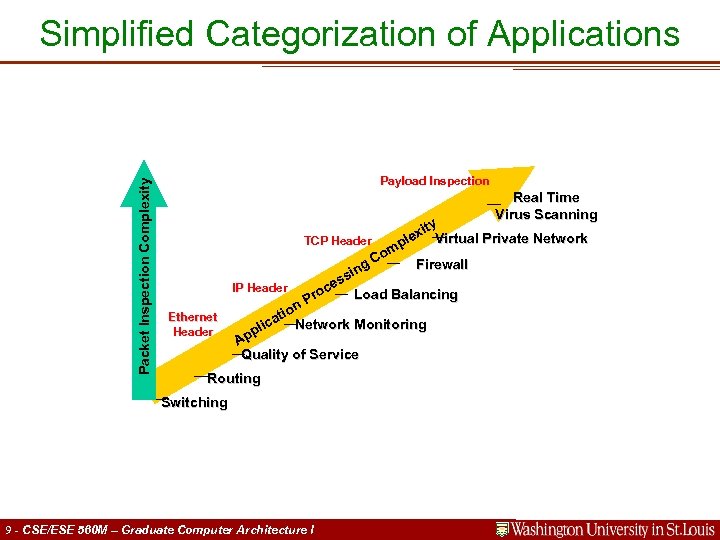 Packet Inspection Complexity Simplified Categorization of Applications Payload Inspection Real Time Virus Scanning TCP Header m Co g IP Header Ethernet Header ity lex Virtual Private Network p Firewall sin es oc Load Balancing Pr n tio ca Network Monitoring pli Ap Quality of Service Routing Switching 9 - CSE/ESE 560 M – Graduate Computer Architecture I
 Application • • Forwarding (bridging/routing) Protocol Conversion In-system data movement (DMA+) Encapsulation/Decapsulation to fabric/backplane/custom devices • Cell/packet conversion (SAR’ing) • L 4 -L 7 applications; content and/or flow-based • Security and Traffic Engineering – Firewall, Encryption (IPSEC, SSL), Compression – Rate shaping, Qo. S/Co. S • Intrusion Detection (IDS) and RMON – Particularly challenging due to processing many state elements in parallel, unlike most other networking apps which are more likely single-path per packet/cell 10 - CSE/ESE 560 M – Graduate Computer Architecture I
 NP Application Challenges for NPs • Infinitely variable problem space • “Wire speed”; small time budgets per cell/packet • Poor memory utilization; fragments, singles – Mismatched to burst-oriented memory • Poor locality, sparse access patterns, indirections – Memory latency dominates processing time – New data, new descriptor per cell/packet. Caches don’t help – Hash lookups and P-trie searches cascade indirections • Random alignments due to encapsulation – 14 -byte Ethernet headers, 5 -byte ATM headers, etc. – Want to process multiple bytes/cycle • High rate of Special Cases – Short-lived flows (esp. HTTP) – Sequential requirements within flows; sequencing overhead/locks 11 - CSE/ESE 560 M – Graduate Computer Architecture I
 Acceleration Techniques (1) • Offload high-touch portions of applications from the u. P – Header parsing, checksums/CRCs, Reg. Ex string search • Offload latency-intensive portions to reduce u. P stall time – Pointer-chasing in hash table lookups, tree traversals for e. g. routing LPM lookups, fetching of entire packet for high-touch work, fetch of candidate portion of packet for header parsing • Offload compute-intensive portions with specialized engines – Crypto computation, Reg. Ex string search computation, ATM CRC, packet classification (Reg. Ex is mainly bandwidth and stallintensive) • Provide efficient system management – Buffer management, descriptor management, communications among units, timers, queues, freelists, etc. 12 - CSE/ESE 560 M – Graduate Computer Architecture I
 Acceleration Techniques (2) • Media processing (framing etc) – Specialized units • Decouple hard real-time from budgeted-time – meet per-packet/cell time budgets – higher level processing via buffering (e. g. IP frag reass’y, TCP stream assembly and processing etc. ) • Efficient communication among units – Hardware and software must be well architected and designed to avoid this. – Keep compute: communicate ratio high. 13 - CSE/ESE 560 M – Graduate Computer Architecture I
 Acceleration via Pipelining • Goal is to increase total processing time per packet/cell by providing a chain of pipelined processing units – – May be specialized hardware functions May be flexible programmable elements Might be lockstep or elastic pipeline Communication costs between units must be minimized to ensure a compute: communicate ratio that makes the extra stages a win – Possible to hide some memory latency by having a predecessor request data for a successor in the pipeline – If a successor can modify memory state seen by a predecessor then there is a “time-skew” consistency problem that must be addressed 14 - CSE/ESE 560 M – Graduate Computer Architecture I
 Acceleration via Parallelism • Goal is to increase total processing time per packet/cell by providing several processing units in parallel – Generally these are identical programmable units – May be symmetric (same program/microcode) or asymmetric – If asymmetric, an early stage disaggregates different packet types to the appropriate type of unit (visualize a pipeline stage before a parallel farm) – Keeping packets ordered within the same flow is a challenge – Dealing with shared state among parallel units requires some form of locking and/or sequential consistency control which can eat some of the benefit of parallelism • Caveat; more parallel activity increases memory contention, thus latency 15 - CSE/ESE 560 M – Graduate Computer Architecture I
 Latency Hiding via Hardware Multi-Threading • Goal is to increase utilization of a hardware unit by sharing most of the unit, replicating some thread state, and switching to processing a different packet on a different thread while waiting for memory – Specialized case of parallel processing, with less hardware – Good utilization is under programmer control – Generally non-preemptable (explicit yield model instead) – As the ratio of memory latency to clock rate increases, more threads are needed to achieve the same utilization – Has all of the consistency challenges of parallelism plus a few more (e. g. spinlock hazards) – Opportunity for quick state sharing thread-to-thread, potentially enabling software pipelining within a group of threads on the same engine (threads may be asymmetric) 16 - CSE/ESE 560 M – Graduate Computer Architecture I
 Coprocessors: NP’s for NP’s • Sometimes specialized hardware is the best way to get the required speed for certain functions – Many NP’s provide a fast path to external coproc’s; sometimes slave devices, sometime masters. • Variety of functions – – – Encryption and Key Management Lookups, CAMs, Ternary CAMs Classification Reg. Ex string searches (often on reassembled frames) Statistics gathering 17 - CSE/ESE 560 M – Graduate Computer Architecture I
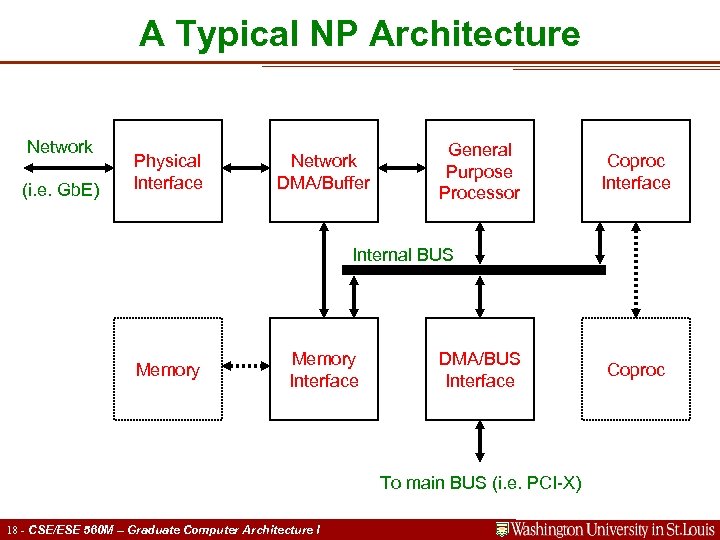 A Typical NP Architecture Network (i. e. Gb. E) Physical Interface Network DMA/Buffer General Purpose Processor Coproc Interface Internal BUS Memory Interface DMA/BUS Interface To main BUS (i. e. PCI-X) 18 - CSE/ESE 560 M – Graduate Computer Architecture I Coproc
 Myricom LANai • Processor on Myrinet NIC – Leading Interface card for Clustering – Offload Network processing from main Processor – One of the first “Network Processor” • Pipelined RISC processor – General Purpose Processor – Fully functional GCC with libraries • Interfaces – Network (Myrinet – High BW/Low Latency) – SRAM Memory Interface – BUS Interface 19 - CSE/ESE 560 M – Graduate Computer Architecture I
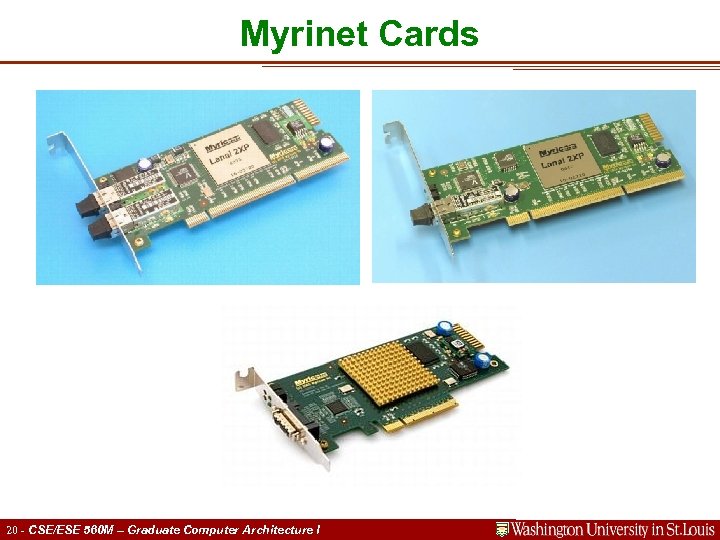 Myrinet Cards 20 - CSE/ESE 560 M – Graduate Computer Architecture I
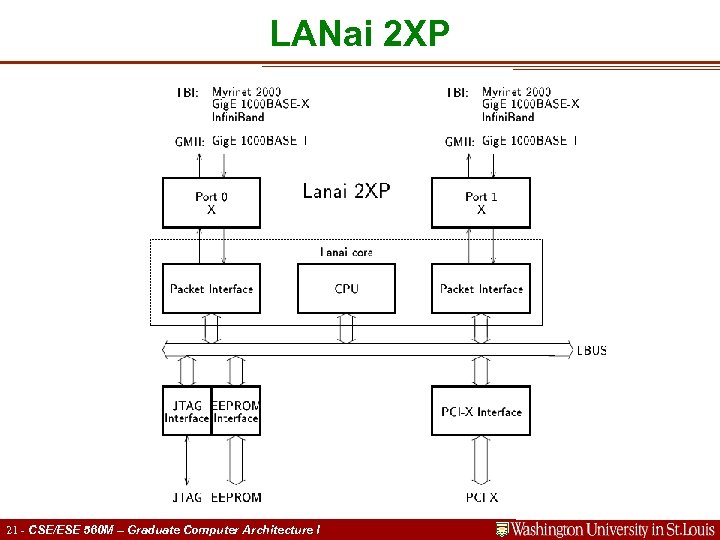 LANai 2 XP 21 - CSE/ESE 560 M – Graduate Computer Architecture I
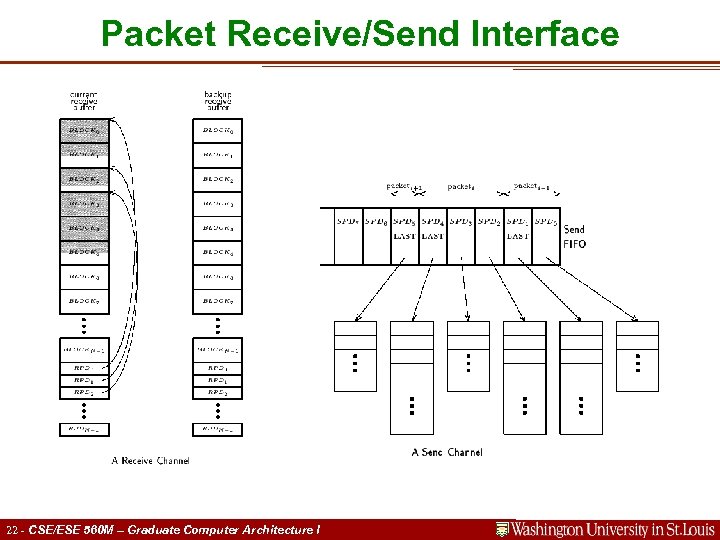 Packet Receive/Send Interface 22 - CSE/ESE 560 M – Graduate Computer Architecture I
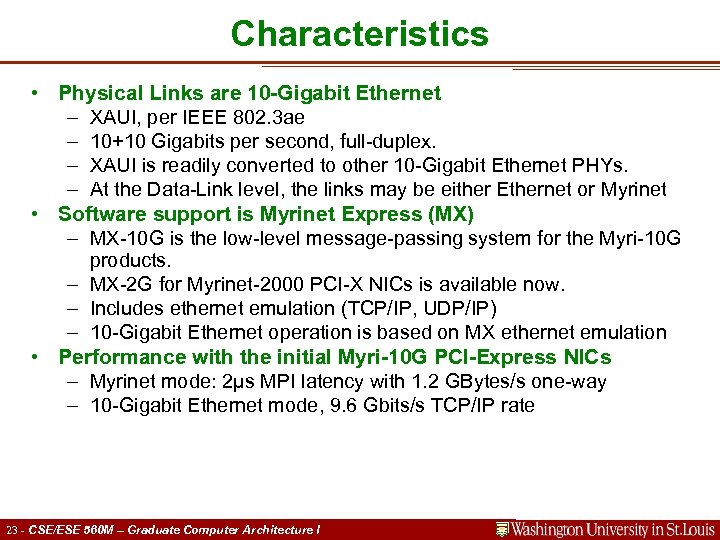 Characteristics • Physical Links are 10 -Gigabit Ethernet – XAUI, per IEEE 802. 3 ae – 10+10 Gigabits per second, full-duplex. – XAUI is readily converted to other 10 -Gigabit Ethernet PHYs. – At the Data-Link level, the links may be either Ethernet or Myrinet • Software support is Myrinet Express (MX) – MX-10 G is the low-level message-passing system for the Myri-10 G products. – MX-2 G for Myrinet-2000 PCI-X NICs is available now. – Includes ethernet emulation (TCP/IP, UDP/IP) – 10 -Gigabit Ethernet operation is based on MX ethernet emulation • Performance with the initial Myri-10 G PCI-Express NICs – Myrinet mode: 2µs MPI latency with 1. 2 GBytes/s one-way – 10 -Gigabit Ethernet mode, 9. 6 Gbits/s TCP/IP rate 23 - CSE/ESE 560 M – Graduate Computer Architecture I
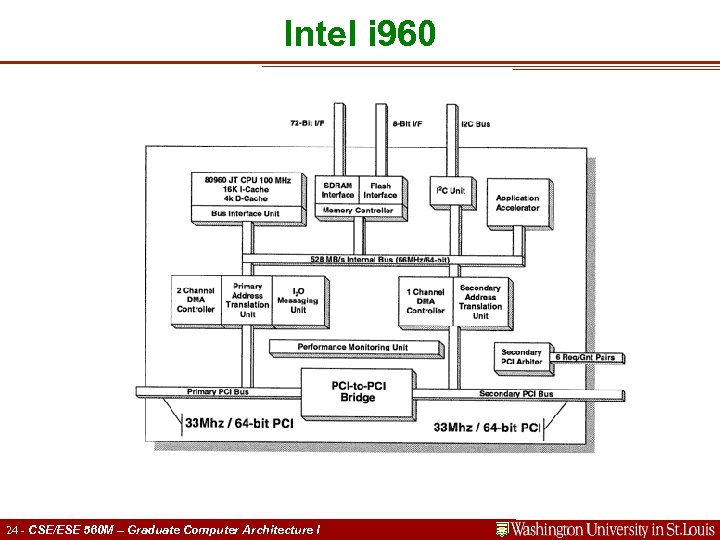 Intel i 960 24 - CSE/ESE 560 M – Graduate Computer Architecture I
 Intel i 960 • Embedded Processor – I/O Processor – Peer-to-peer – Network Processor • PCI Interface – One to the Main BUS – Other to the Network Interface • Similar to Myrinet LANai • Further development leading into IXA? 25 - CSE/ESE 560 M – Graduate Computer Architecture I
 Intel IXA • Current Routers – Involve general purpose CPUs – Lots of ASICs (Application Specific Integrated Circuits ). – The ASICs are necessary to keep up with the quantity and rate of the network traffic. • The Strong. ARM Core – Replace the general purpose CPUs • Microengines – Replace the bulk of the ASICs • Actually inherited IXA when they bought Digital. 26 - CSE/ESE 560 M – Graduate Computer Architecture I
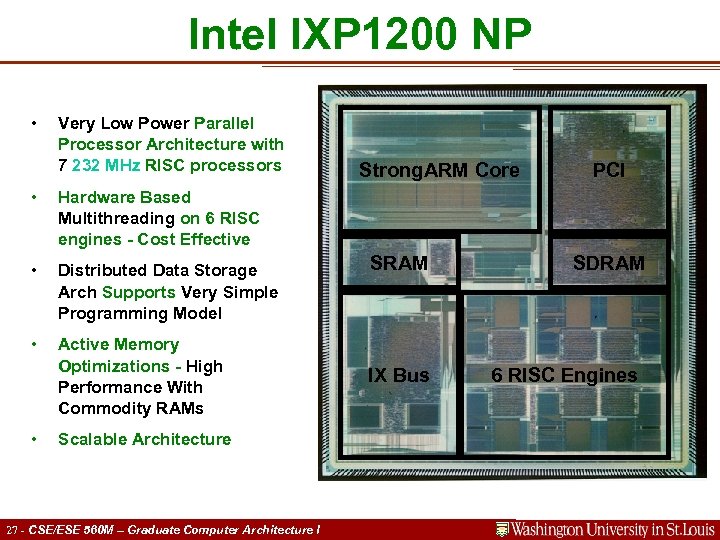 Intel IXP 1200 NP • Very Low Power Parallel Processor Architecture with 7 232 MHz RISC processors • Distributed Data Storage Arch Supports Very Simple Programming Model • Active Memory Optimizations - High Performance With Commodity RAMs PCI Hardware Based Multithreading on 6 RISC engines - Cost Effective • Strong. ARM Core • Scalable Architecture 27 - CSE/ESE 560 M – Graduate Computer Architecture I SRAM IX Bus SDRAM 6 RISC Engines
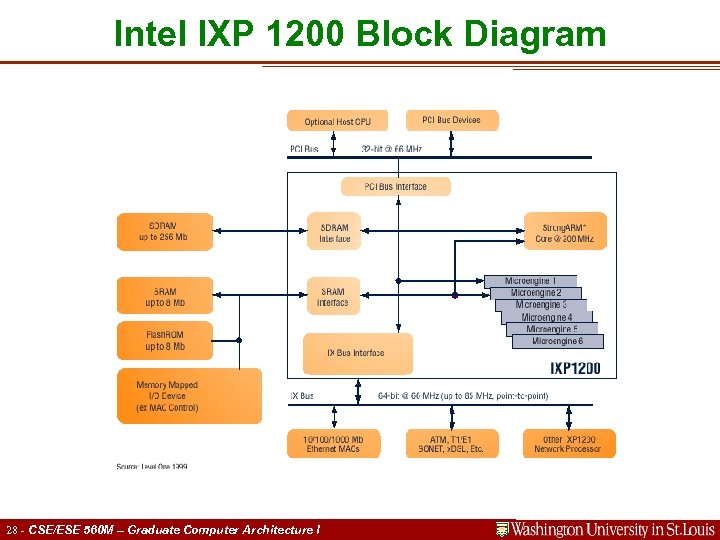 Intel IXP 1200 Block Diagram 28 - CSE/ESE 560 M – Graduate Computer Architecture I
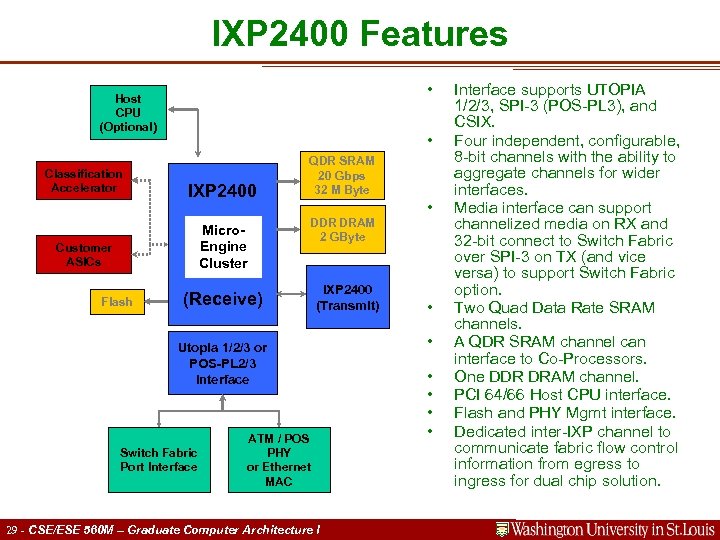 IXP 2400 Features • Host CPU (Optional) Classification Accelerator • IXP 2400 Micro. Engine Cluster Customer ASICs Flash QDR SRAM 20 Gbps 32 M Byte DDR DRAM 2 GByte (Receive) IXP 2400 (Transmit) Utopia 1/2/3 or POS-PL 2/3 Interface Switch Fabric Port Interface ATM / POS PHY or Ethernet MAC 29 - CSE/ESE 560 M – Graduate Computer Architecture I • • Interface supports UTOPIA 1/2/3, SPI-3 (POS-PL 3), and CSIX. Four independent, configurable, 8 -bit channels with the ability to aggregate channels for wider interfaces. Media interface can support channelized media on RX and 32 -bit connect to Switch Fabric over SPI-3 on TX (and vice versa) to support Switch Fabric option. Two Quad Data Rate SRAM channels. A QDR SRAM channel can interface to Co-Processors. One DDR DRAM channel. PCI 64/66 Host CPU interface. Flash and PHY Mgmt interface. Dedicated inter-IXP channel to communicate fabric flow control information from egress to ingress for dual chip solution.
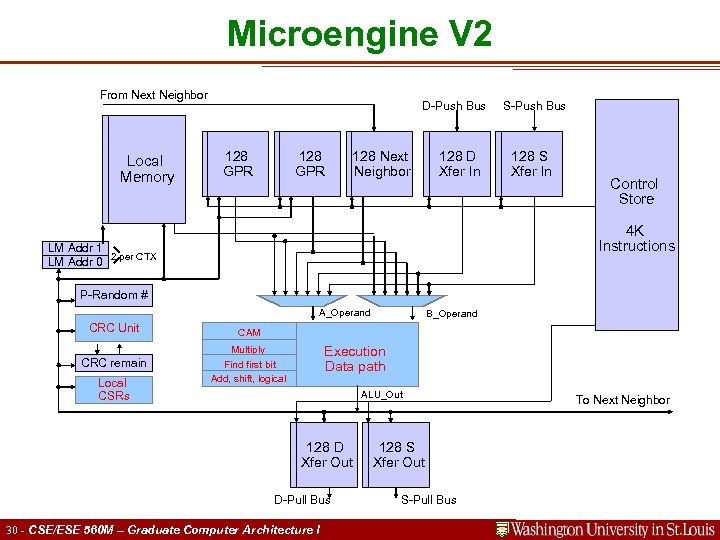 Microengine V 2 From Next Neighbor Local Memory D-Push Bus 128 GPR 128 Next Neighbor 128 D Xfer In S-Push Bus 128 S Xfer In Control Store 4 K Instructions LM Addr 1 2 per CTX LM Addr 0 P-Random # A_Operand CRC Unit CAM Execution Data path Multiply CRC remain Local CSRs B_Operand Find first bit Add, shift, logical ALU_Out 128 D Xfer Out D-Pull Bus 30 - CSE/ESE 560 M – Graduate Computer Architecture I 128 S Xfer Out S-Pull Bus To Next Neighbor
 IXP 2400 • Eight next generation Microengines (MEv 2) – Operating at 600 MHz – Automated packet scheduling and handling – Local data store enables higher performance • Hardware acceleration for Diff. Serv, MPLS, and other Qo. S schemes • ATM Segmentation and Reassembly (SAR) support with headroom. • Intel® Xscale. TM microarchitecture core operating at 600 MHz 31 - CSE/ESE 560 M – Graduate Computer Architecture I
 Summary • There are no typical applications – Many variety of applications • Network processing solution partitions – Forwarding plane – Connection management plane – Control plane • GPP with Application Specific Components – Higher data rates and complex applications – More specific to the application to beat GPP 32 - CSE/ESE 560 M – Graduate Computer Architecture I