

Graded readers. Обучение чтению подростков. Обзор разных

Graded readers. Обучение чтению подростков. Обзор разных видов чтения и их применение на уроке Мастюгина Дарья, методист компании Релод, представитель издательства Оксфордского университета
What is reading? Reading is. . . Richard Day’s definition: Reading is a number of interactive processes involving the reader and the text. The readers use their knowledge of the world, the topic, the language, to interact with the text to create, construct or build meaning.
How do we learn to read? • We learn to read by reading. There is no other way. • The more we read, the better readers we become. • The more the teacher talks, the less the students read.
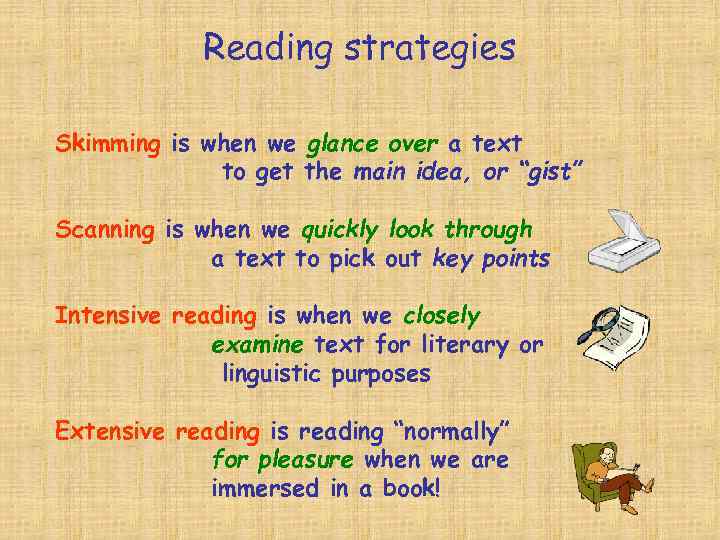
Reading strategies Skimming is when we glance over a text to get the main idea, or “gist” Scanning is when we quickly look through a text to pick out key points Intensive reading is when we closely examine text for literary or linguistic purposes Extensive reading is reading “normally” for pleasure when we are immersed in a book!
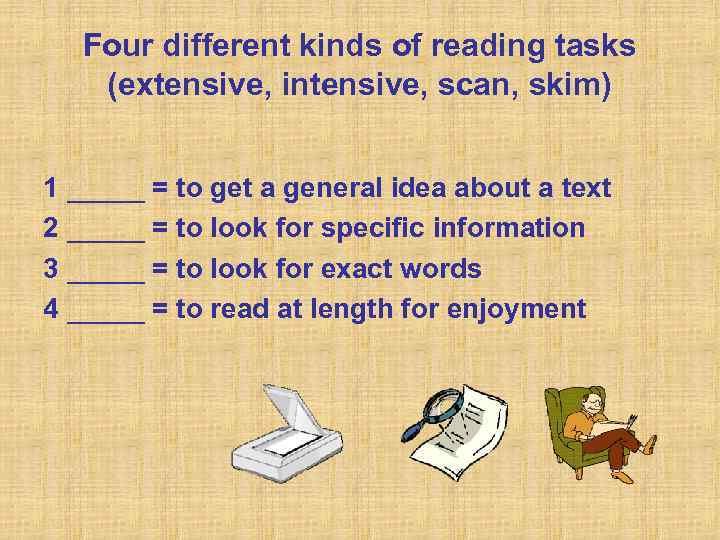
Four different kinds of reading tasks (extensive, intensive, scan, skim) 1 _____ = to get a general idea about a text 2 _____ = to look for specific information 3 _____ = to look for exact words 4 _____ = to read at length for enjoyment
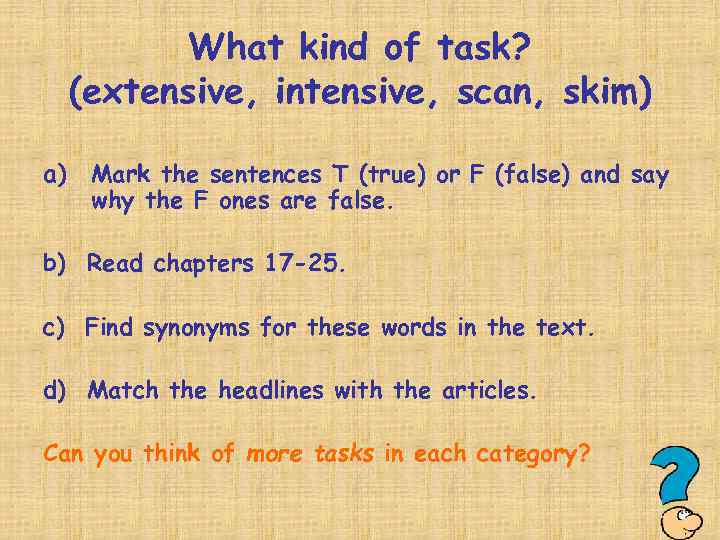
What kind of task? (extensive, intensive, scan, skim) a) Mark the sentences T (true) or F (false) and say why the F ones are false. b) Read chapters 17 -25. c) Find synonyms for these words in the text. d) Match the headlines with the articles. Can you think of more tasks in each category?
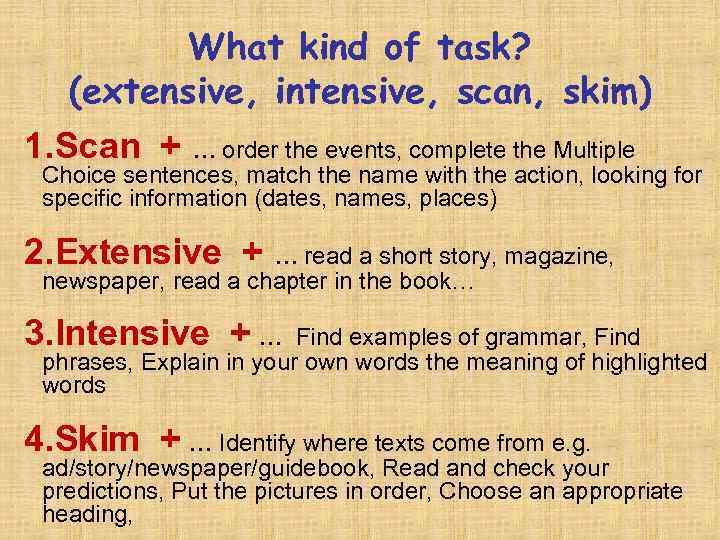
What kind of task? (extensive, intensive, scan, skim) 1. Scan + … order the events, complete the Multiple Choice sentences, match the name with the action, looking for specific information (dates, names, places) 2. Extensive + … read a short story, magazine, newspaper, read a chapter in the book… 3. Intensive + … Find examples of grammar, Find phrases, Explain in your own words the meaning of highlighted words 4. Skim + … Identify where texts come from e. g. ad/story/newspaper/guidebook, Read and check your predictions, Put the pictures in order, Choose an appropriate heading,

What kind of text? What goal?

What kind of text? Which goal?
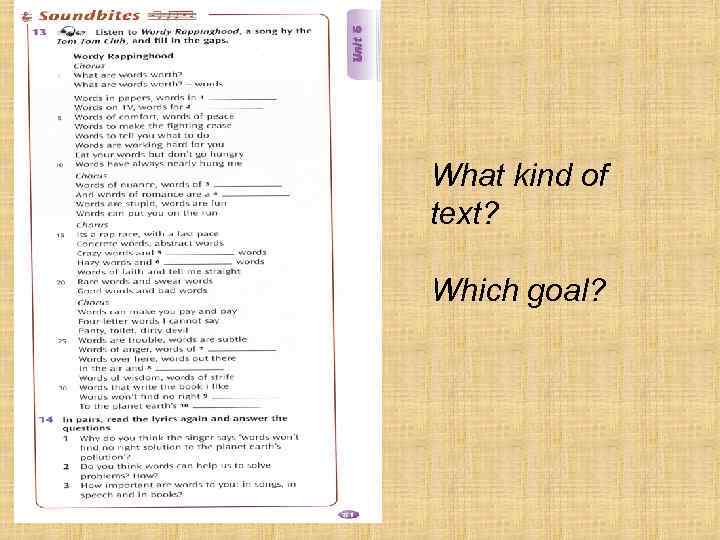
What kind of text? Which goal?
Example of exam practice: Variety of texts +goals…
The texts can: • Encourage students to develop reading strategies (skim/scan) • Show grammar and vocabulary used in context • Demonstrate the characteristics of different genre and styles • Model how to write • Stimulate spoken responses and discussions
Classic Classroom Procedure 1) Awaken interest in the topic of the text 2) Pre-teach/check key vocabulary 3) Set the reading task 4) Ss read text with the task in mind 5) Ss check answers to task in pairs 6) Whole class feedback/follow-up
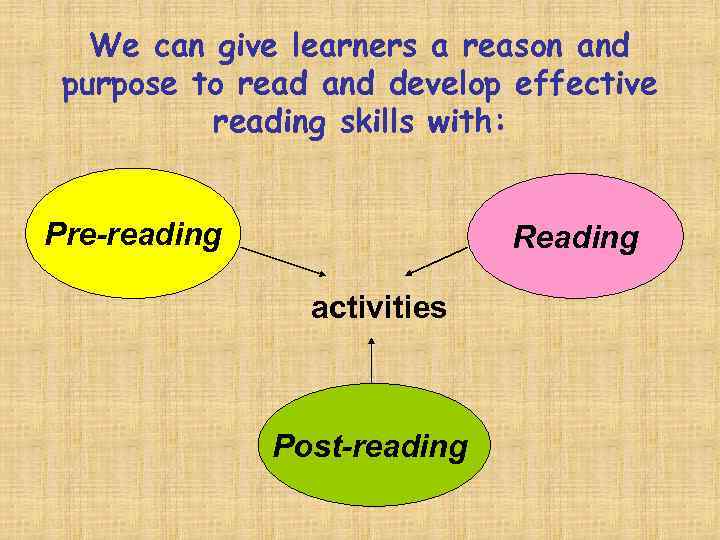
We can give learners a reason and purpose to read and develop effective reading skills with: Pre-reading Reading activities Post-reading
Reading depends on knowledge… • Schematic knowledge. We cannot make sense of ideas we have no prior knowledge of • Language knowledge We cannot make sense unless we understand the language structures and the vocabulary
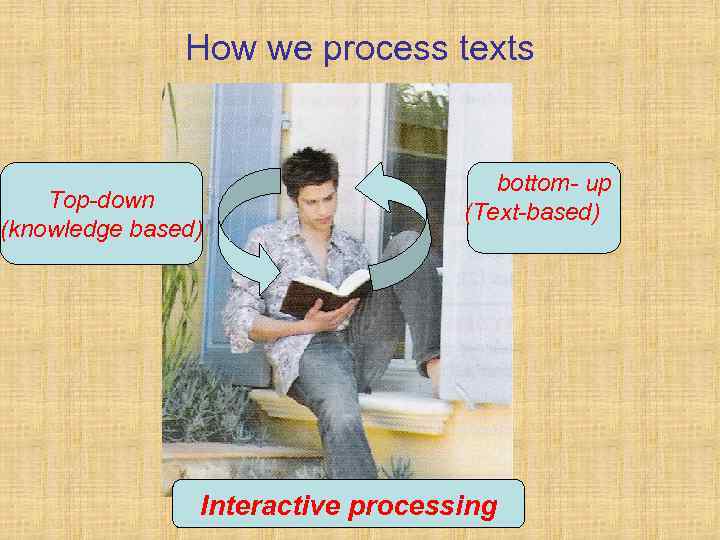
How we process texts bottom- up Top-down (Text-based) (knowledge based) Interactive processing
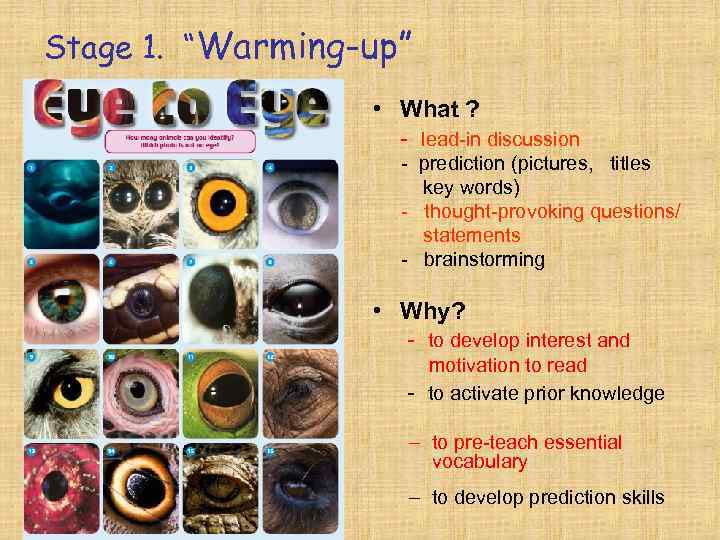
Stage 1. “Warming-up” • What ? - lead-in discussion - prediction (pictures, titles key words) - thought-provoking questions/ statements - brainstorming • Why? - to develop interest and motivation to read - to activate prior knowledge – to pre-teach essential vocabulary – to develop prediction skills
Stage 2. “ Thinking about the text” skimming? • What? - prediction - skimming - time limit • Why? - to support and guide students in what to read for - to get overall idea of the text - to check/compare expectations/predictions to ‘reality’ - to help gain confidence in understanding the text (but not every word)
Stage 3. “Reading for specific information” • What? - scanning (+ intensive reading) - time limit - key-words • Why? - to find specific information in the text - to develop the awareness of time - to confirm the choice
Stage 4. “Vocabulary” • What? - vocabulary in context - categorizing words - intensive reading • Why? - to practise/ check students’ grasp of the words - to personalize vocabulary
Stage 5. “Time to talk… or write? ” • What? - reaction to the text • Why? - to personalize reading - to integrate other skills (speaking/ writing) - to give a sense of completion/achievement
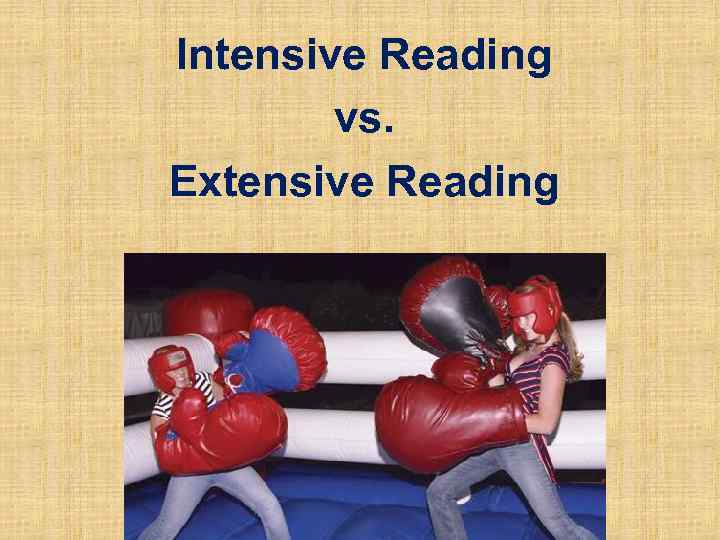
Intensive Reading vs. Extensive Reading
Extensive reading is what the students do at home when you’ve whetted their appetites with activities in the classroom and they can’t wait to see what happens next. . . ! It’s also something they start doing when they realise that reading in a foreign language can be as pleasurable as in their own language-if you don’t try and understand every word!
Extensive Reading • Extensive reading involves students reading a lot of easy, interesting books that they select themselves. • There are no comprehension questions. • Students often do activities based on the books they have read.
In extensive reading… • most time is spent reading • not answering questions • not writing reports • not translating Sometimes, unfortunately, students may do these - but not as the primary focus.
The Benefits of Extensive Reading • increased reading ability • improved vocabulary • improved listening ability • improved speaking ability
More Benefits • help learn grammar • spelling improvement • increased motivation • improved attitude
Even More Benefits • your students’ love lives improve! • their skin problems disappear! • you win the national lottery and get rich!! • (Or at least everyone can read about these topics. )
Comparing IR and ER Intensive Reading Extensive Reading • 100% understanding • Overall understanding • Limited reading • Reading a lot • Difficult texts • Easy texts • Word-for-word • Fluent reading • Ignore unknown • Use dictionaries words
Ten Principles of ER 1. The reading material is easy. It’s important to choose the right level! For beginners – 2 -3 unknown words per page For intermediate students - 5
Ten Principles of ER 2. There must be a wide variety of reading material on a large range of topics.
Ten Principles of ER 3. Learners choose what they want to read.
Ten Principles of ER 4. Learners read as much as possible. We know that the most important element in learning to read is the amount of time spent actually reading.
Ten Principles of ER 5. Reading is individual and silent.
Ten Principles of ER 6. The purpose of reading is usually related to pleasure, information and general understanding.
Ten Principles of ER 7. Reading speed is usually faster rather than slower. ü Reading rate, enjoyment and comprehension are closely linked with one another. ü Discourage your students from using dictionaries when they come across words they don’t understand. ü Looking up words in dictionaries slows down readers.
Fluency • Fluent readers are better readers than slow readers. • Extensive reading helps students to increase their reading rates. • Increased reading rates lead to increased fluency.
Rate builds fluency. Slow readers cannot be fluent readers.

meaning text. understand now, of o construct very but word, each the to easy is it doing are as time, af at one slowly read you When difficult word
How do we become fluent? By reading a lot of easy, enjoyable and interesting books.
Students have to choose their own books. • What is easy, interesting and enjoyable is unique to each student. • Students should be free to select their own books and to stop reading if their books are hard, boring, or not enjoyable.
How do we know students actually read and understand what they read? • Keep track of what and how much each student reads. • Do extensive reading activities. • If students have not read and understood their books, then they cannot do the activities.
A Note of Caution • Avoid activities that require students to remember things from their reading or that test them on their reading. • Such activities can interfere with students enjoying reading in English.
Ten Principles of ER 8. Reading is its own reward.
Ten Principles of ER 9. The teacher orients and guides students.
Introducing Extensive Reading • Explain the benefits of reading extensively to your students. • Tell them that a general, less than 100%, understanding of what they read is appropriate for most reading purposes.
• Emphasize that there will be no test after reading a book. • Introduce the library of reading materials and explain how it is divided into difficulty levels.
Ten Principles of ER 10. The teacher is a role model of a reader. • Is reading caught or taught? • Students do not just (or even) learn the subject matter we teach them; they learn their teachers. • We are selling reading.
Oxford Reading Winner ELT Innovaton Award Circles British Council are small groups of students who meet in the classroom to talk about stories. In a Reading Circle, each student plays a different role in the discussion • Discussion Leader – leads the discussion • Summarizer – summarizes the characters and the plot • Connector – finds connections between the story and the real world • Word Master – looks for important words and phrases • Passage Person – looks for important passages in the story • Culture Collector – looks for cultural points for discussion

Graded readers from Oxford University Press • Starter level (A 1) – 45 titles • Level 1 (A 1/A 2)– 141 titles • Level 2 (A 2/B 1) – 150 titles • Level 3 (B 1) – 122 titles • Level 4 (B 1/B 2) – 86 titles • Level 5 (B 2) – 44 titles • Level 6 (B 2/C 1) – 36 titles Oxford Bookworms Library www. oup. com, www. bookshop 247. com
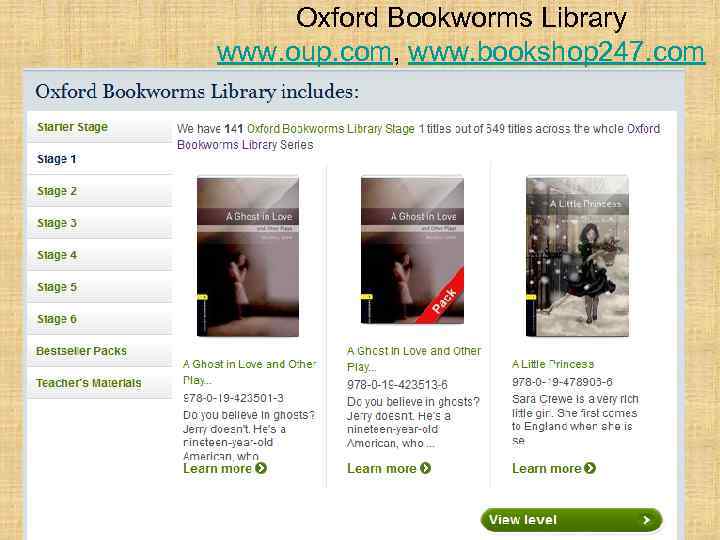
Oxford Bookworms Library www. oup. com, www. bookshop 247. com
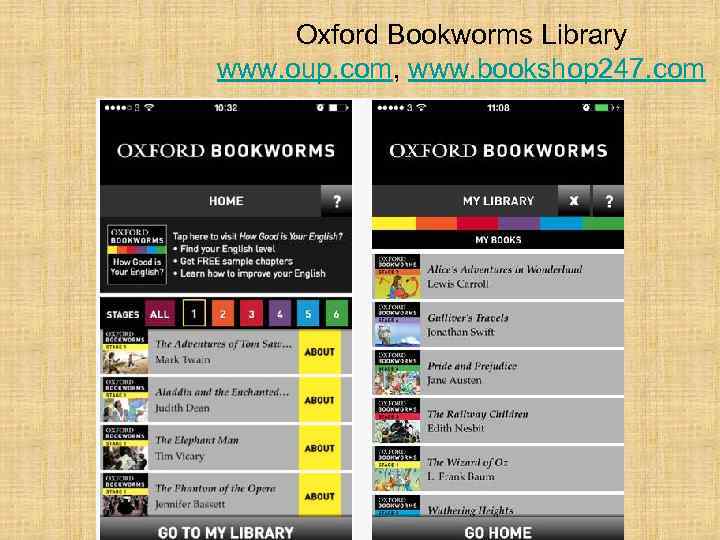
Oxford Bookworms Library www. oup. com, www. bookshop 247. com

Oxford Bookworms Library www. oup. com, www. bookshop 247. com
“What a reader brings to the text is often more important than what a text brings to us. ”

ЭМС «РЕЛОД-Новосибирск» Магазин «ОКСБРИДЖ» Каменская, 32 (за Оперным театром) т. 218 -83 -77, 286 -30 -72 Мастюгина Дарья т. 218 -84 -12, 8 -903 -934 -30 -98 daria_relod@ngs. ru Информация о конкурсах и семинарах: www. innyaz. ru
 Скачать презентацию Graded readers. Обучение чтению подростков. Обзор разных
Reading.ppt
- Количество слайдов: 55