


 Скачать презентацию Grade Inflation in the IOT Sector 1994 -04
fa9bb6805ed4689f94ad91f22deb6a9e.ppt
- Количество слайдов: 31
 Grade Inflation in the IOT Sector (1994 -04) Presentation at Limerick Institute of Technology - April 16 2008 by Martin O’Grady 1
 Grade Inflation o A pattern of improving grades over time that is not matched by improved learning and achievement. 2
 Grade Increase (1994 -2004) o Rate of Distinctions, First Class and 2. 1 awards o National Certificates, Diplomas and Degrees o Each IOT, combined IOTs o All graduates o Graduates in Business, Humanities, Engineering and Science/Technology 3
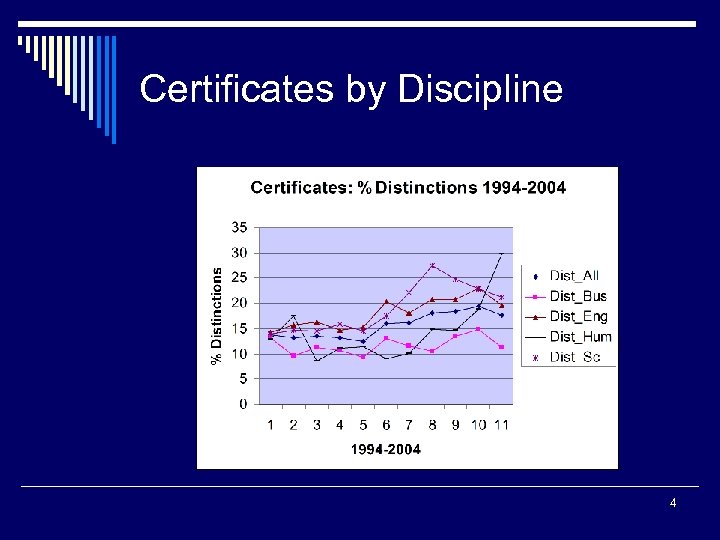 Certificates by Discipline 4
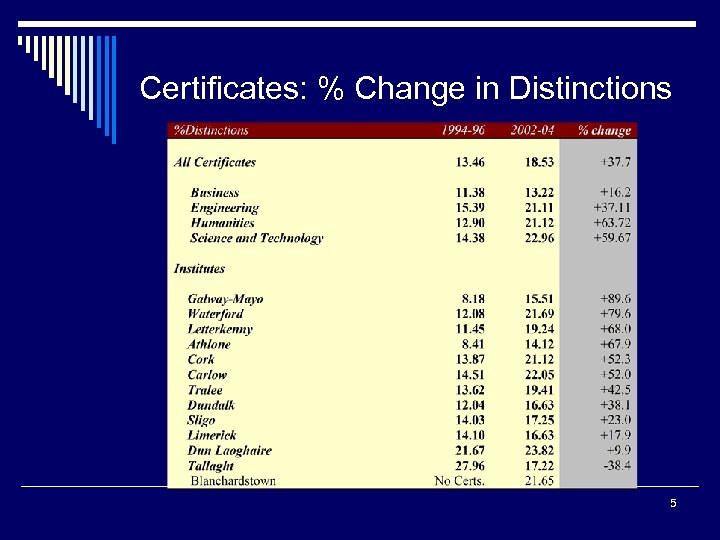 Certificates: % Change in Distinctions 5
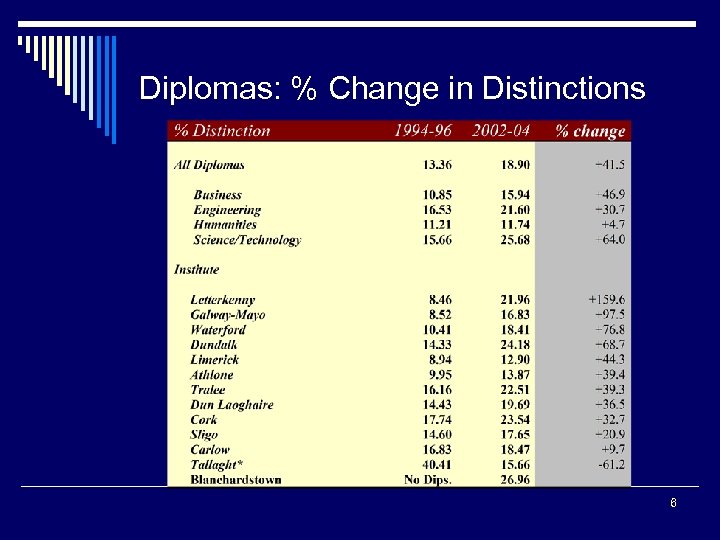 Diplomas: % Change in Distinctions 6
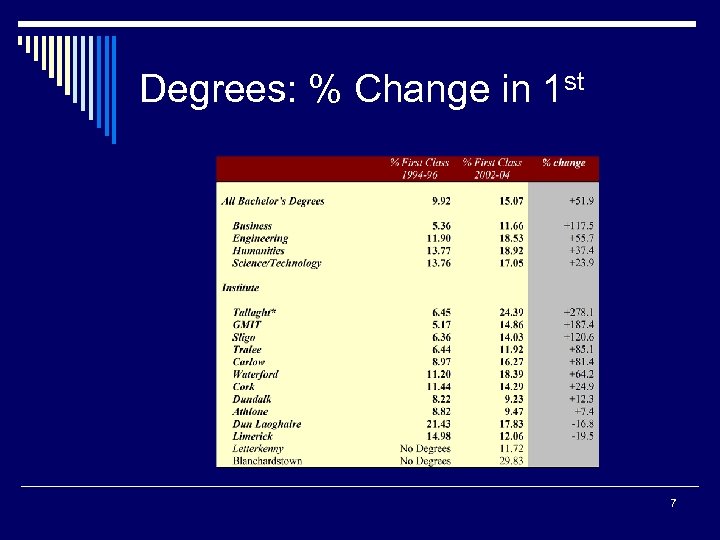 Degrees: % Change in 1 st 7
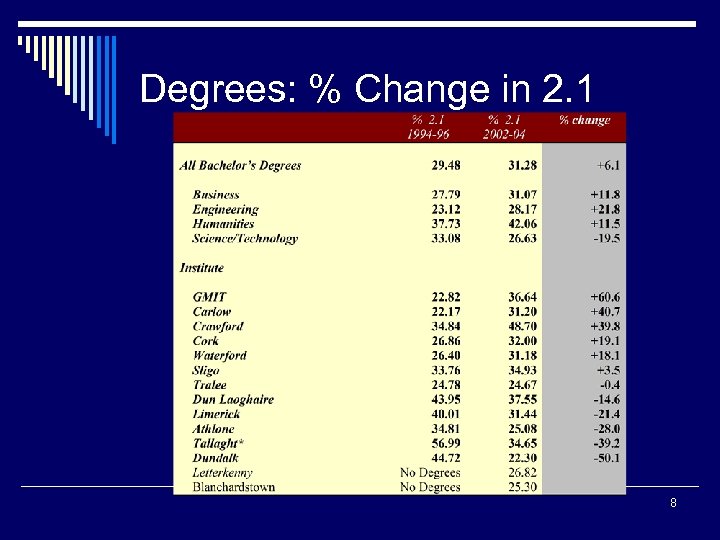 Degrees: % Change in 2. 1 8
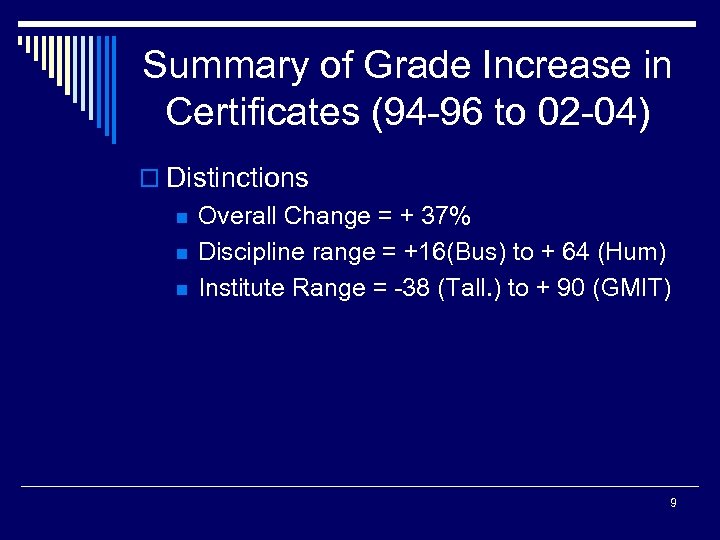 Summary of Grade Increase in Certificates (94 -96 to 02 -04) o Distinctions n n n Overall Change = + 37% Discipline range = +16(Bus) to + 64 (Hum) Institute Range = -38 (Tall. ) to + 90 (GMIT) 9
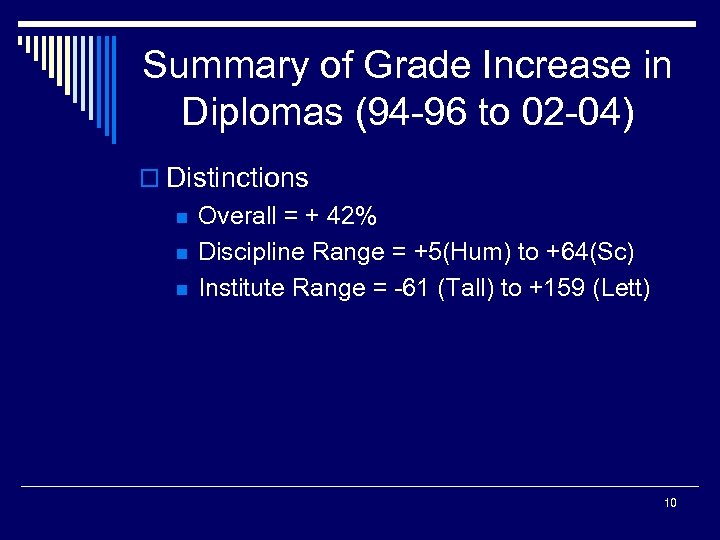 Summary of Grade Increase in Diplomas (94 -96 to 02 -04) o Distinctions n n n Overall = + 42% Discipline Range = +5(Hum) to +64(Sc) Institute Range = -61 (Tall) to +159 (Lett) 10
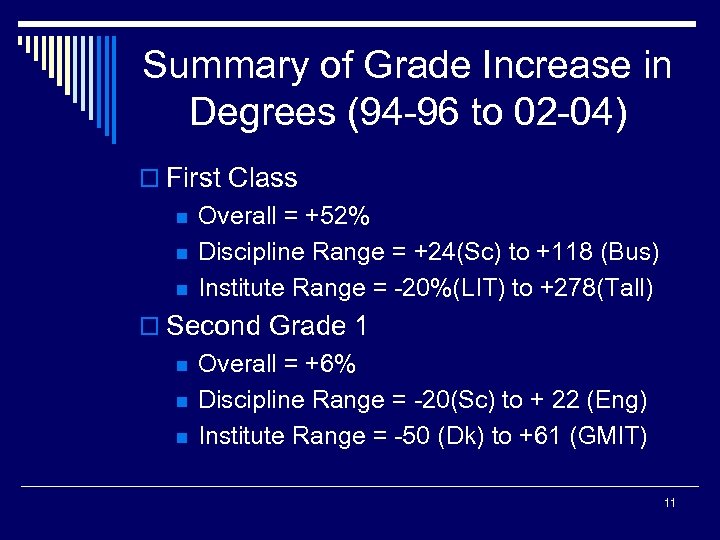 Summary of Grade Increase in Degrees (94 -96 to 02 -04) o First Class n n n Overall = +52% Discipline Range = +24(Sc) to +118 (Bus) Institute Range = -20%(LIT) to +278(Tall) o Second Grade 1 n n n Overall = +6% Discipline Range = -20(Sc) to + 22 (Eng) Institute Range = -50 (Dk) to +61 (GMIT) 11
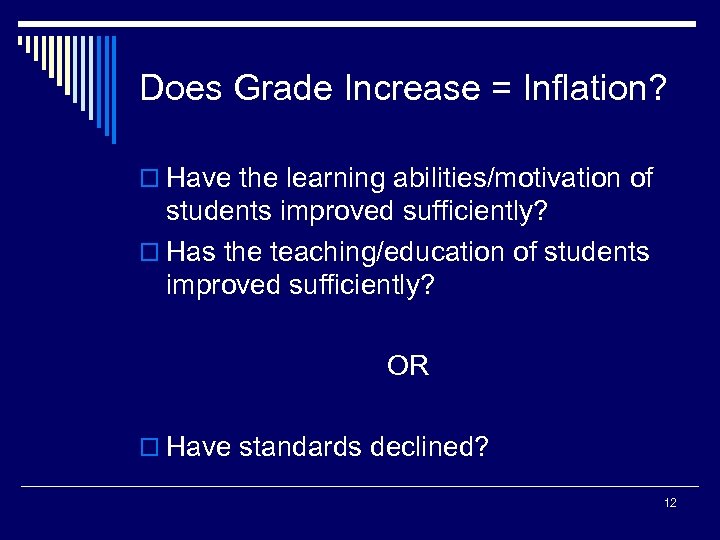 Does Grade Increase = Inflation? o Have the learning abilities/motivation of students improved sufficiently? o Has the teaching/education of students improved sufficiently? OR o Have standards declined? 12
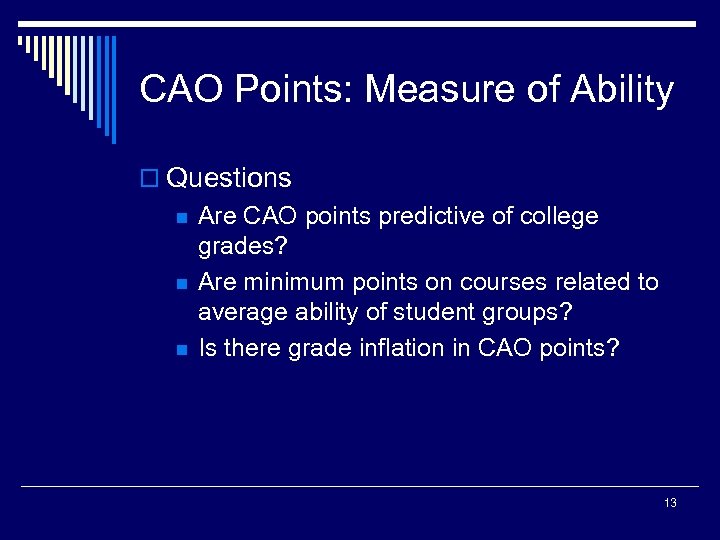 CAO Points: Measure of Ability o Questions n n n Are CAO points predictive of college grades? Are minimum points on courses related to average ability of student groups? Is there grade inflation in CAO points? 13
 Predictive power of CAO points – The NUI study o Unpublished NUI Study (2004) n n n UCD, UCC, NUIG, NUIM Arts, Commerce, Science, Law Graduates in 2003 and 2004 o Findings n n n +505 points vs. <405 + 3 times rate of 1/2. 1 405 -450 points = 7% firsts <405 points = 3% firsts 14
 Predictive power of CAO points: IT Tralee Data o Study of 591 1 st and 2 nd year students in Business School in 1999 -2000 o Study of 120 1 st year Certificate in Business studies students in 2003 -04 o Relationship between exam success and CAO points at entry for each individual student in both studies 15
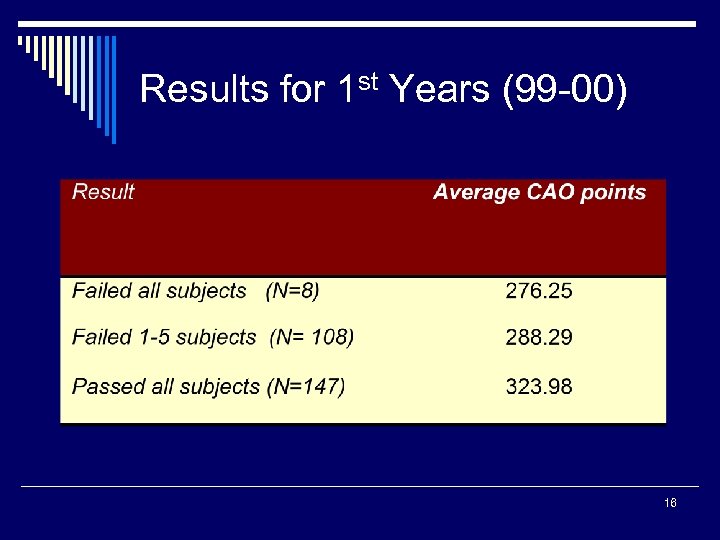 Results for 1 st Years (99 -00) 16
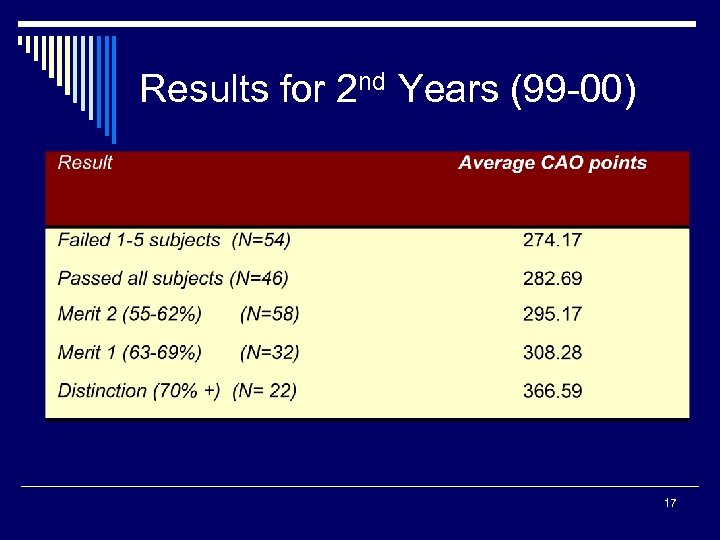 Results for 2 nd Years (99 -00) 17
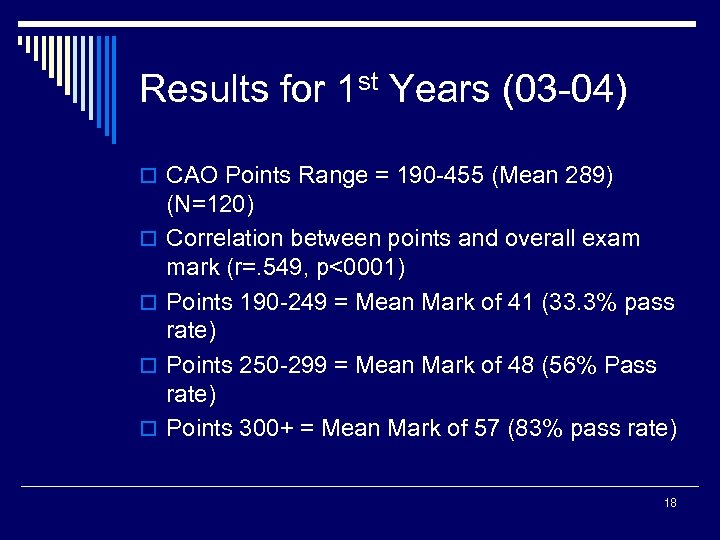 Results for 1 st Years (03 -04) o CAO Points Range = 190 -455 (Mean 289) o o (N=120) Correlation between points and overall exam mark (r=. 549, p<0001) Points 190 -249 = Mean Mark of 41 (33. 3% pass rate) Points 250 -299 = Mean Mark of 48 (56% Pass rate) Points 300+ = Mean Mark of 57 (83% pass rate) 18
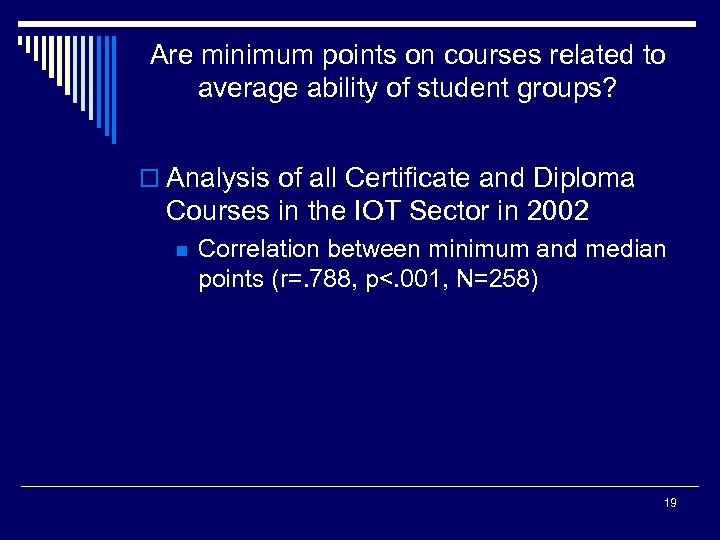 Are minimum points on courses related to average ability of student groups? o Analysis of all Certificate and Diploma Courses in the IOT Sector in 2002 n Correlation between minimum and median points (r=. 788, p<. 001, N=258) 19
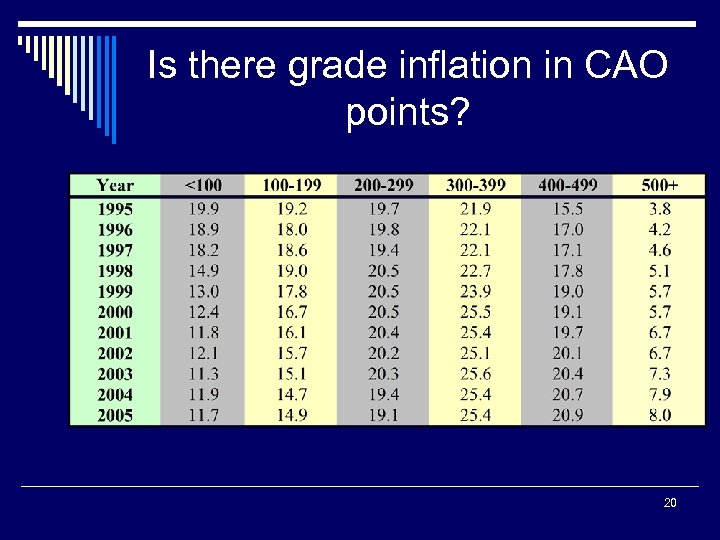 Is there grade inflation in CAO points? 20
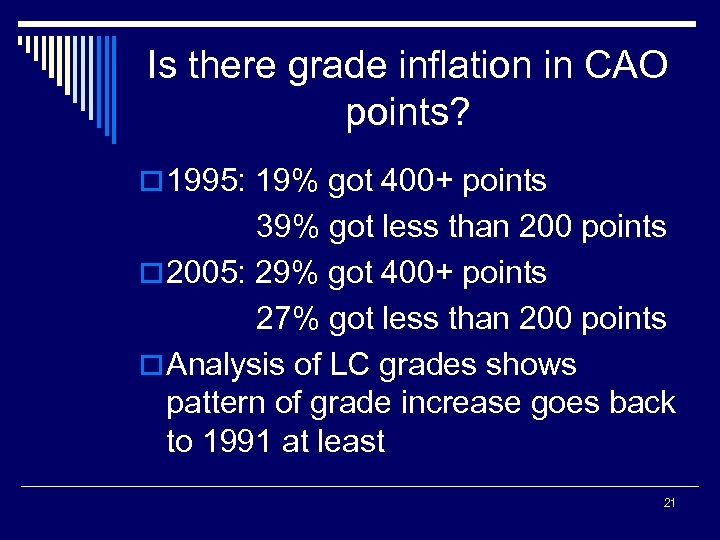 Is there grade inflation in CAO points? o 1995: 19% got 400+ points 39% got less than 200 points o 2005: 29% got 400+ points 27% got less than 200 points o Analysis of LC grades shows pattern of grade increase goes back to 1991 at least 21
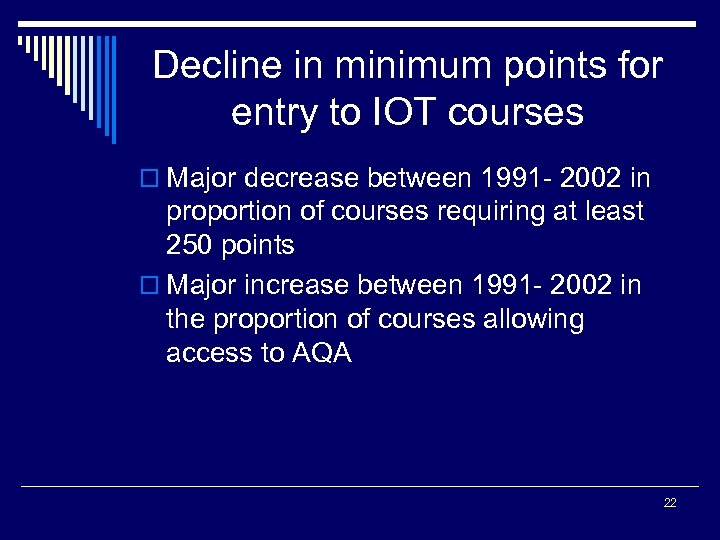 Decline in minimum points for entry to IOT courses o Major decrease between 1991 - 2002 in proportion of courses requiring at least 250 points o Major increase between 1991 - 2002 in the proportion of courses allowing access to AQA 22
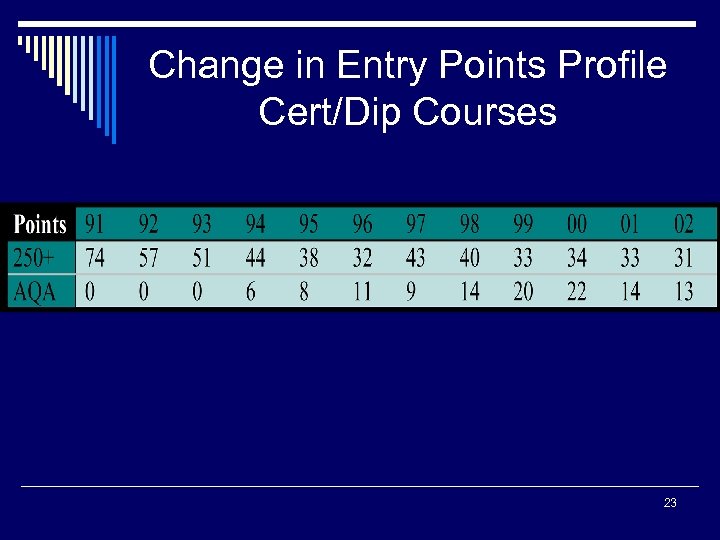 Change in Entry Points Profile Cert/Dip Courses 23
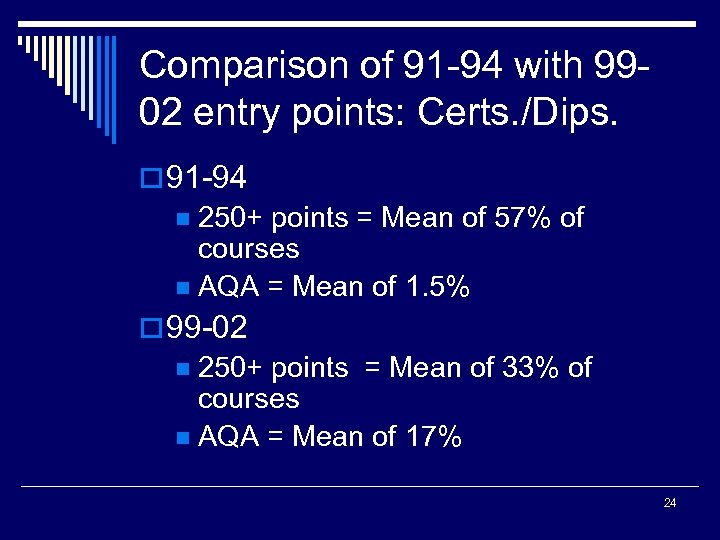 Comparison of 91 -94 with 9902 entry points: Certs. /Dips. o 91 -94 n 250+ points = Mean of 57% of courses n AQA = Mean of 1. 5% o 99 -02 n 250+ points = Mean of 33% of courses n AQA = Mean of 17% 24
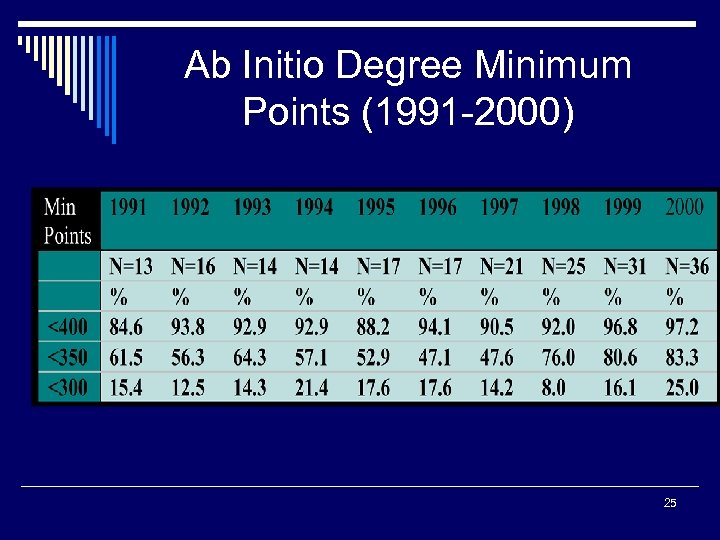 Ab Initio Degree Minimum Points (1991 -2000) 25
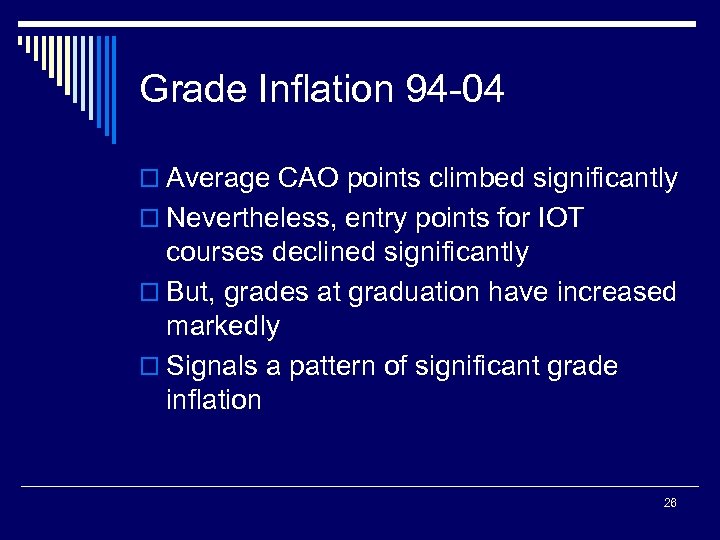 Grade Inflation 94 -04 o Average CAO points climbed significantly o Nevertheless, entry points for IOT courses declined significantly o But, grades at graduation have increased markedly o Signals a pattern of significant grade inflation 26
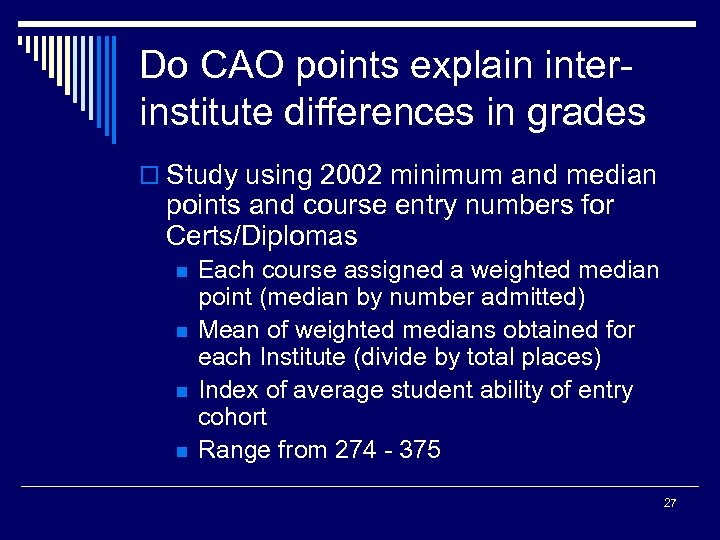 Do CAO points explain interinstitute differences in grades o Study using 2002 minimum and median points and course entry numbers for Certs/Diplomas n n Each course assigned a weighted median point (median by number admitted) Mean of weighted medians obtained for each Institute (divide by total places) Index of average student ability of entry cohort Range from 274 - 375 27
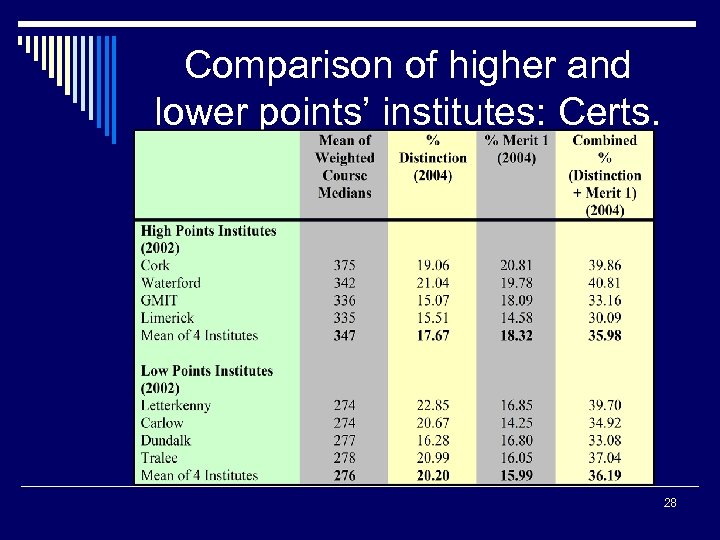 Comparison of higher and lower points’ institutes: Certs. 28
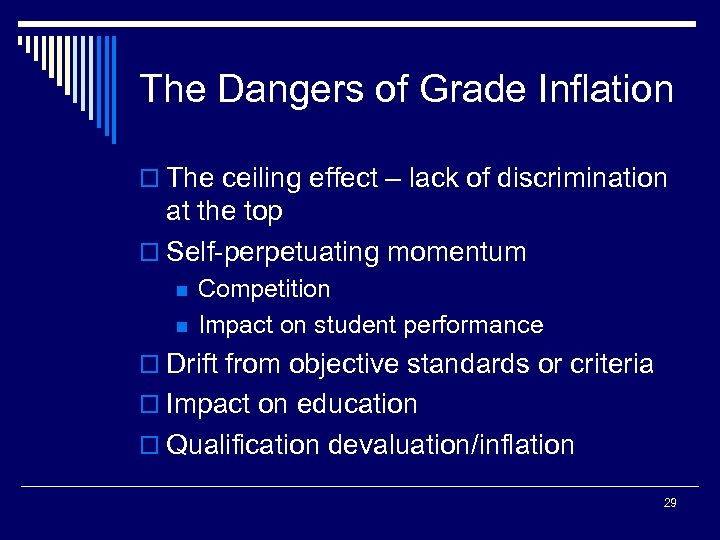 The Dangers of Grade Inflation o The ceiling effect – lack of discrimination at the top o Self-perpetuating momentum n n Competition Impact on student performance o Drift from objective standards or criteria o Impact on education o Qualification devaluation/inflation 29
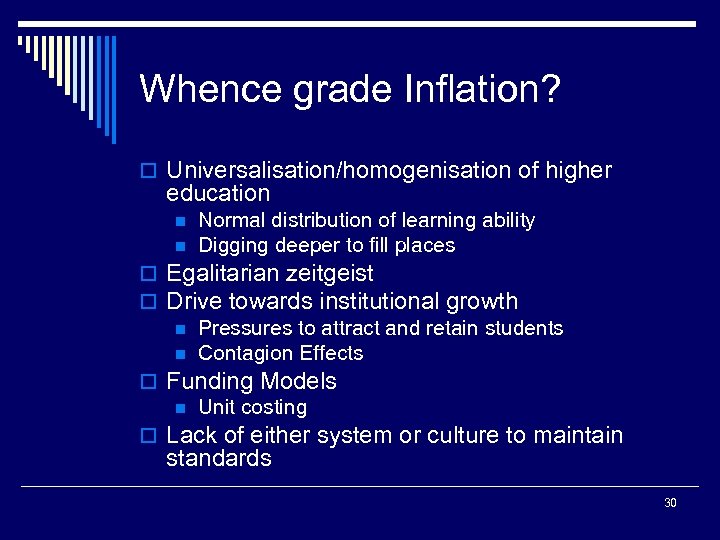 Whence grade Inflation? o Universalisation/homogenisation of higher education n n Normal distribution of learning ability Digging deeper to fill places o Egalitarian zeitgeist o Drive towards institutional growth n Pressures to attract and retain students n Contagion Effects o Funding Models n Unit costing o Lack of either system or culture to maintain standards 30
 Network for Irish Educational Standards o Data and research papers by Martin O’Grady, Simon Quinn and Brendan Guilfoyle on www. stopgradeinflation. ie o Network for Irish Educational Standards Research, information, opinion welcome n Join the network for updates n 31