


 Скачать презентацию GPS Water Vapour in the UK and the
9cba49df8eea5d0ce68444d8bb75dbd3.ppt
- Количество слайдов: 22
 GPS Water Vapour in the UK and the E-GVAP Project Jonathan Jones, Upper Air Team, Observations R&D, UK Met Office jonathan. jones@metoffice. gov. uk © Crown copyright Met Office
 Contents • How and Why • Operational Processing System • Collaborative Networks • Monitoring and Validation • Forecaster Case Studies • E-GVAP • Future GPSWV Developments © Crown copyright Met Office
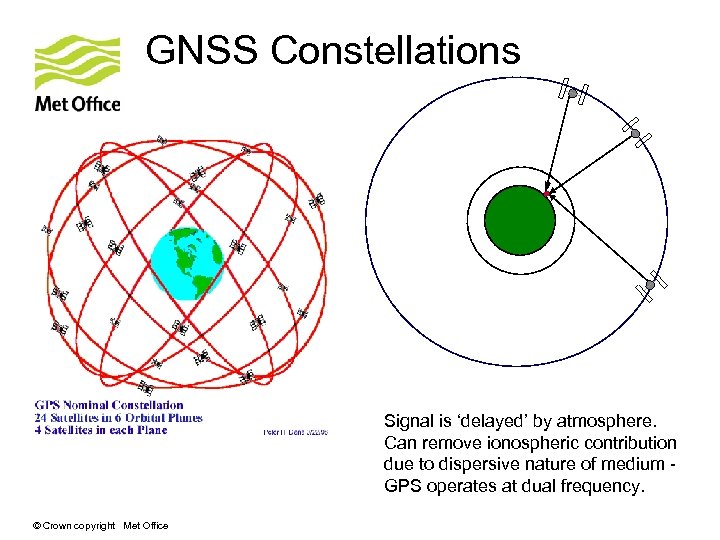 GNSS Constellations Signal is ‘delayed’ by atmosphere. May remove ionospheric contribution Can remove ionospheric contribution due to dispersive nature of medium GPS operates at dual frequency. © Crown copyright Met Office
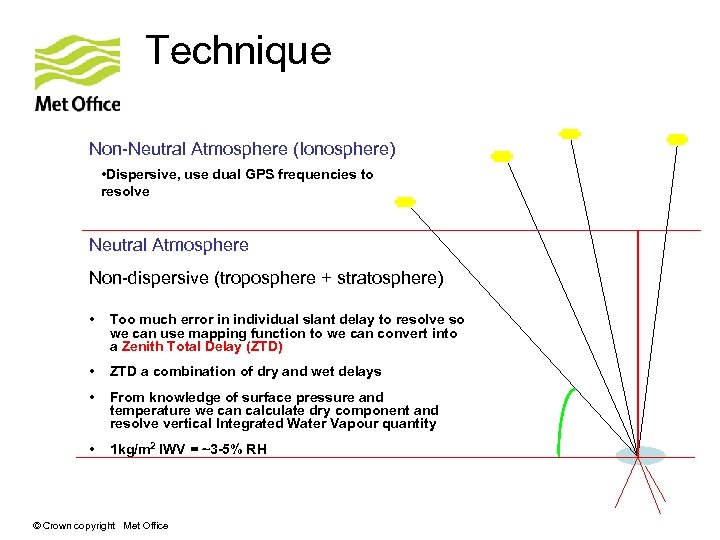 Technique Non-Neutral Atmosphere (Ionosphere) • Dispersive, use dual GPS frequencies to resolve Neutral Atmosphere Non-dispersive (troposphere + stratosphere) • Too much error in individual slant delay to resolve so we can use mapping function to we can convert into a Zenith Total Delay (ZTD) • ZTD a combination of dry and wet delays • From knowledge of surface pressure and temperature we can calculate dry component and resolve vertical Integrated Water Vapour quantity • 1 kg/m 2 IWV = ~3 -5% RH © Crown copyright Met Office
 Customers • NWP • Shown up to 4% reduction of Std. Dev by assimilation of GPS ZTD data • Forecasters • Produce IWV field plots to assist forecasters in identifying atmospheric features/phenomena • Climate • Also GPS is potentially a useful tool for climate monitoring but reprocessing is necessary to ensure common processing models/standards • Validation • Very useful tool for validation of other remote sensing instruments (radiosonde, WVR, satellite WV etc) © Crown copyright Met Office
 Cost-Effective GPS Processing • IESSG, Nottingham University contracted to develop and deliver operational processing servers • Intergovernmental resource sharing agreements with mapping agencies in UK • Agreement in place between EUREF and EUMETNET guaranteeing long term future GPS data access to Met community. Also providing positioning community with meteorological parameters © Crown copyright Met Office
 GPS Processing at METO • 4 Servers • 2 operational in Met Office IT halls, 1 mirror semi-operational server at IESSG, 1 development server at IESSG • Hourly Processing Solution • Bernese v 5. 0 processing software • Double Difference Network Approach • 30 -Day sliding window PPP a-priori coordinate • Absolute Antenna Phase Centres, IGS 05 and FES 2004 • Process network of ~250 stations in NRT in ~30 mins • ZTD/IWV estimates at 00, 15, 30, 45 and 59 mins © Crown copyright Met Office
 Data Providers • 162 EUREF Sites • 104 OSGB sites • 86 64 RGP sites • 20 UK scientific sites (incl. 11 Met Office) • 19 OSi and OSNI sites • 2 Icelandic sites • Attempted hourly ~ 400 • Downloaded hourly ~ 275 © Crown copyright Met Office
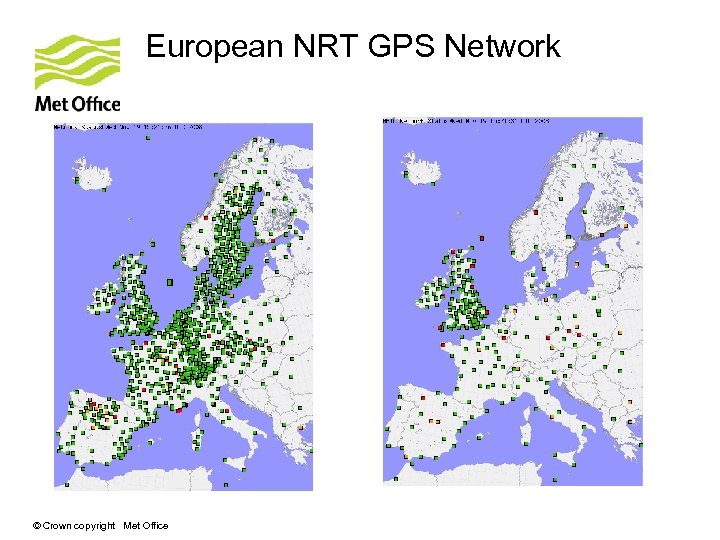 European NRT GPS Network © Crown copyright Met Office
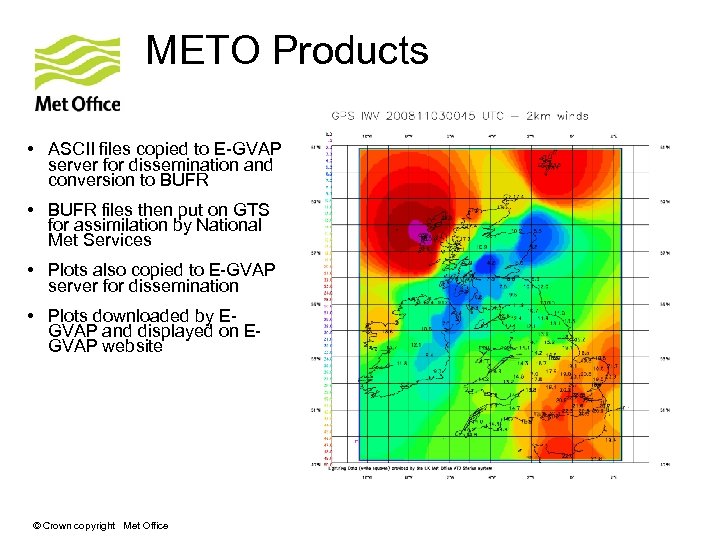 METO Products • ASCII files copied to E-GVAP server for dissemination and conversion to BUFR • BUFR files then put on GTS for assimilation by National Met Services • Plots also copied to E-GVAP server for dissemination • Plots downloaded by EGVAP and displayed on EGVAP website © Crown copyright Met Office
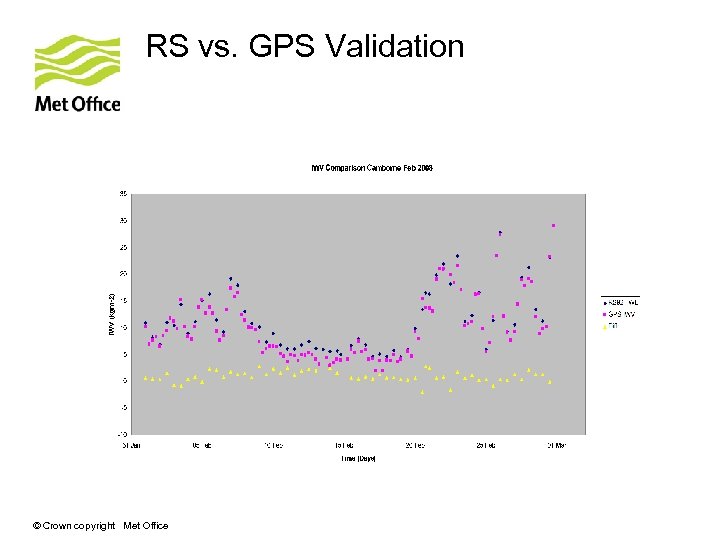 RS vs. GPS Validation © Crown copyright Met Office
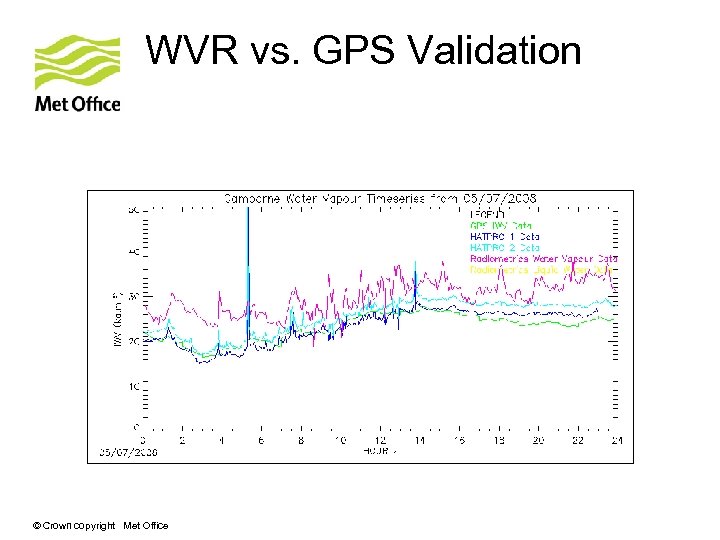 WVR vs. GPS Validation © Crown copyright Met Office
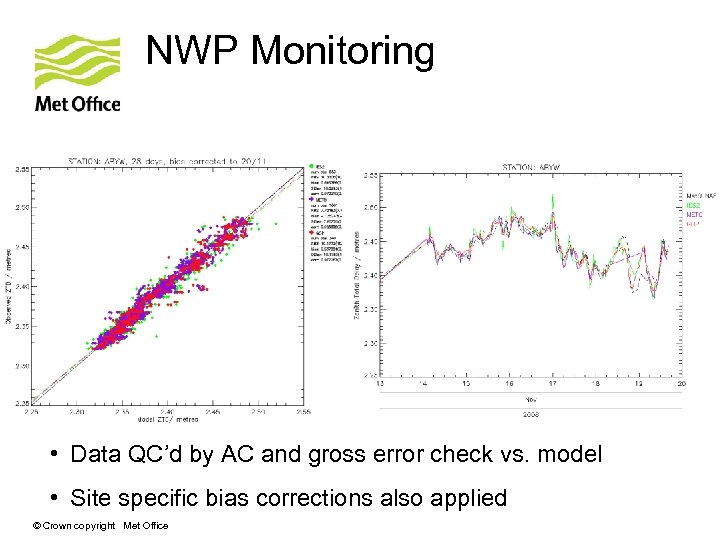 NWP Monitoring • Data QC’d by AC and gross error check vs. model • Site specific bias corrections also applied © Crown copyright Met Office
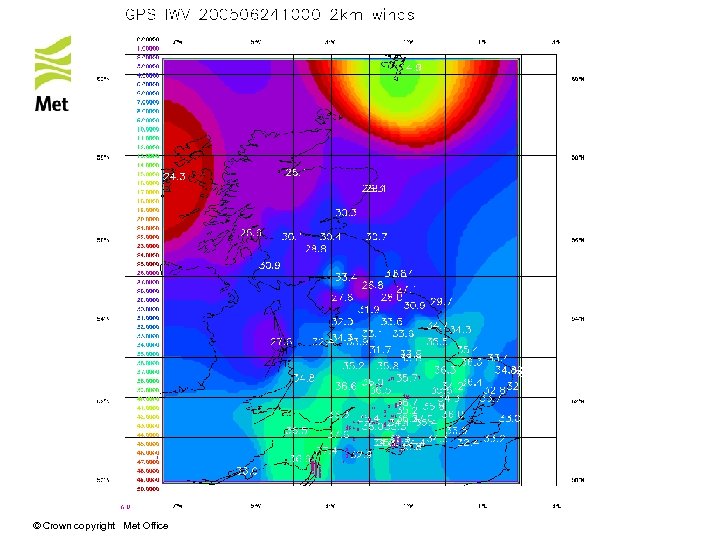
 Case Studies • 28 th July 2005 – Offset Dry Tongue • Dry tongue over south west not corresponding with satellite WV • By combination of satellite and GPS WV you can infer vertical structure • 24 th June 2005 – Cold Pool Identification • Trough progressing over southern UK from westerly direction with associated high IWV and convective thunderstorm cells • GPS IWV identified cold pool behind front which perpetuated instability and convection © Crown copyright Met Office
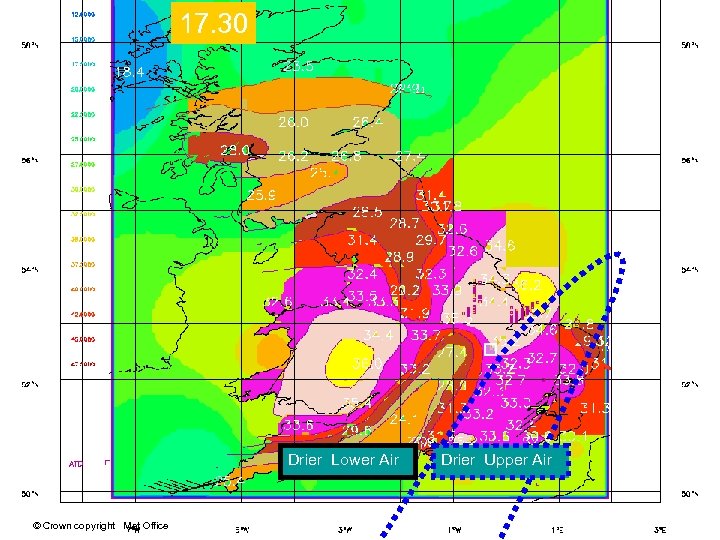 17. 30 Drier Lower Air © Crown copyright Met Office Drier Upper Air
 © Crown copyright Met Office
 E-GVAP and E-GVAP II • E-GVAP I – EUMETNET programme to take GPSWV to operations in Europe • Ensure common standards and formats in GNSS data processing • European network expansion • Assist ‘developing’ countries with GPS processing and assimilation techniques • Ensure close collaboration with geodetic community (experts) • E-GVAP II – continuation of E-GVAP I • Connect to EUCOS and WIS • Continued network expansion • Improve homogeneity and quality of GNSS products © Crown copyright Met Office
 E-GVAP Website and Server • Website v. useful tool for analysing data/biases etc • Compiling table of all AC’s GPS processing techniques, • Recently added Nordic and French regional plots • E-GVAP Server to be transitioned to more operational (backed-up) server by end of E-GVAP 1 • Server now hosting met data for EUREF community • Server soon to be hosting other data (microwave radiometer, NWP etc) © Crown copyright Met Office
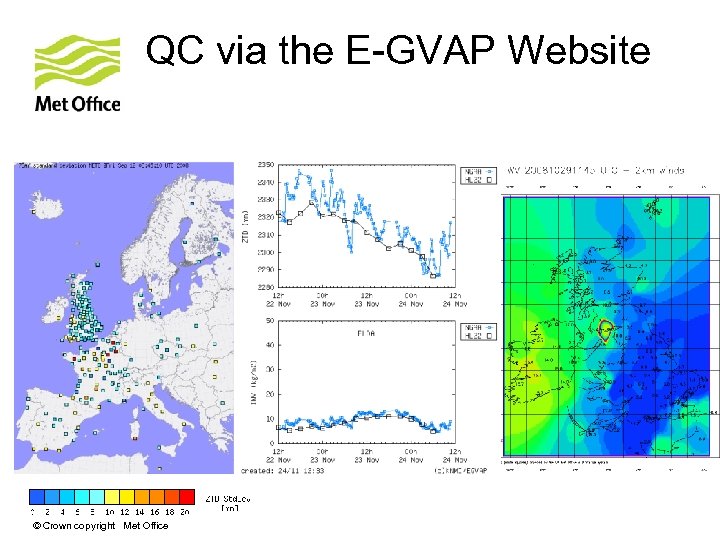 QC via the E-GVAP Website © Crown copyright Met Office
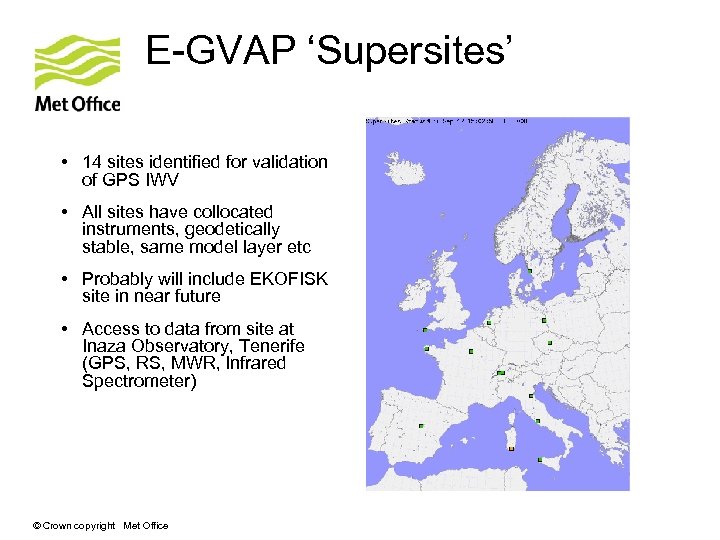 E-GVAP ‘Supersites’ • 14 sites identified for validation of GPS IWV • All sites have collocated instruments, geodetically stable, same model layer etc • Probably will include EKOFISK site in near future • Access to data from site at Inaza Observatory, Tenerife (GPS, RS, MWR, Infrared Spectrometer) © Crown copyright Met Office
 Future GPSWV Developments • Improved NRT Plots • Use NWP IWV over data sparse areas (Sea) • Produce O-B plots • Add satellite WV to plots to give some vertical structure • Real-Time GPS Processing (15 min/5 min) • Slants/Tomography • NWP ZTD forecasts © Crown copyright Met Office
 Questions and answers Jonathan. jones@metoffice. gov. uk http: //egvap. dmi. dk/ © Crown copyright Met Office