


 Скачать презентацию GPS and Galileo Progress through Partnership 13
d0f96d034460b933d29c6a8323dcdad8.ppt
- Количество слайдов: 21
 GPS and Galileo – Progress through Partnership 13 th ITS World Congress and Exhibition 9 October 2006 Michael E. Shaw Director, U. S. National Coordination Office for Space-Based Positioning, Navigation, and Timing
 Overview • GPS System and Performance • GPS Modernization • International Cooperation National Coordination Office for Space-Based PNT, USA 2
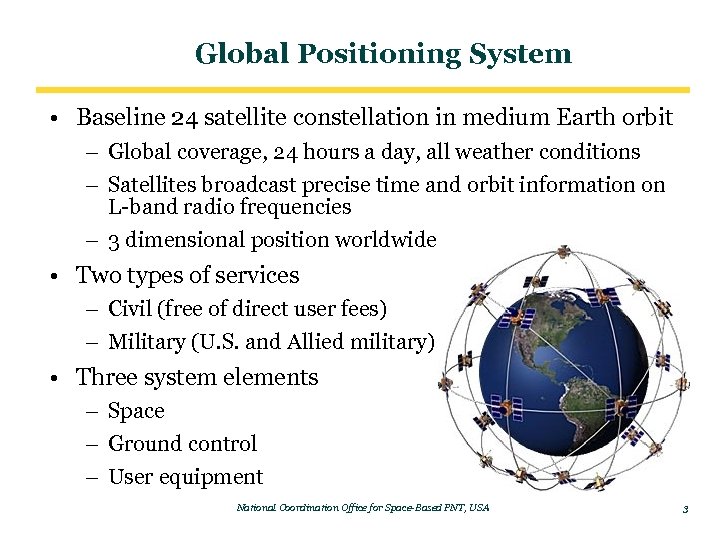 Global Positioning System • Baseline 24 satellite constellation in medium Earth orbit – Global coverage, 24 hours a day, all weather conditions – Satellites broadcast precise time and orbit information on L-band radio frequencies – 3 dimensional position worldwide • Two types of services – Civil (free of direct user fees) – Military (U. S. and Allied military) • Three system elements – Space – Ground control – User equipment National Coordination Office for Space-Based PNT, USA 3
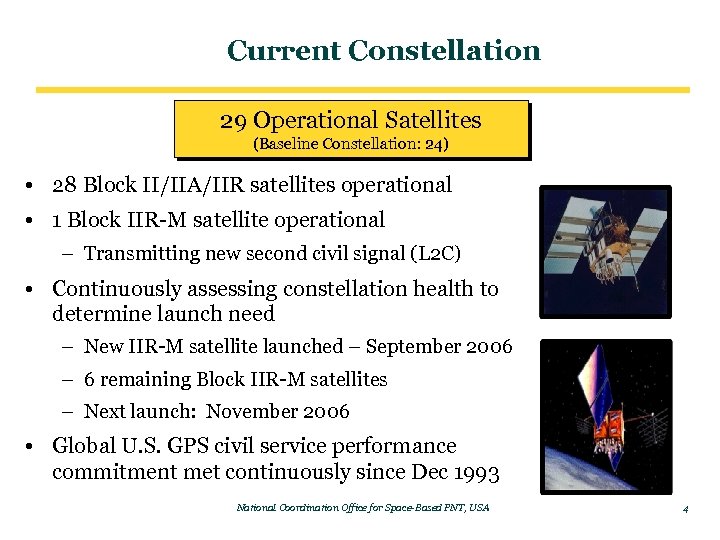 Current Constellation 29 Operational Satellites (Baseline Constellation: 24) • 28 Block II/IIA/IIR satellites operational • 1 Block IIR-M satellite operational – Transmitting new second civil signal (L 2 C) • Continuously assessing constellation health to determine launch need – New IIR-M satellite launched – September 2006 – 6 remaining Block IIR-M satellites – Next launch: November 2006 • Global U. S. GPS civil service performance commitment met continuously since Dec 1993 National Coordination Office for Space-Based PNT, USA 4
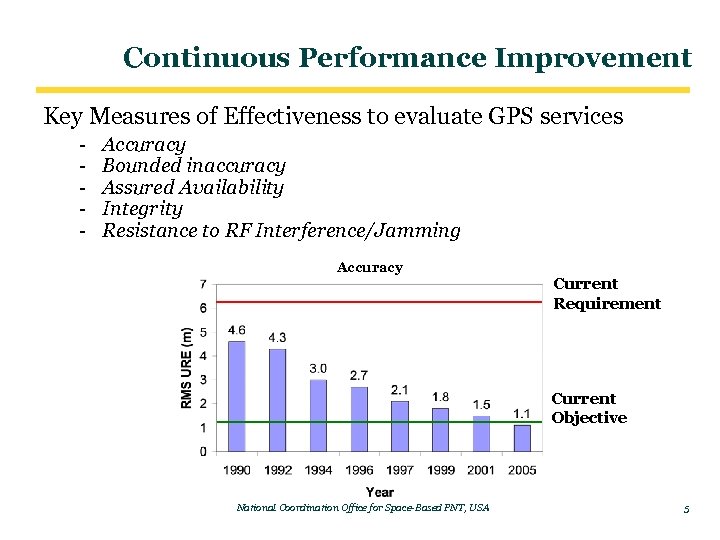 Continuous Performance Improvement Key Measures of Effectiveness to evaluate GPS services - Accuracy Bounded inaccuracy Assured Availability Integrity Resistance to RF Interference/Jamming Accuracy Current Requirement Current Objective National Coordination Office for Space-Based PNT, USA 5
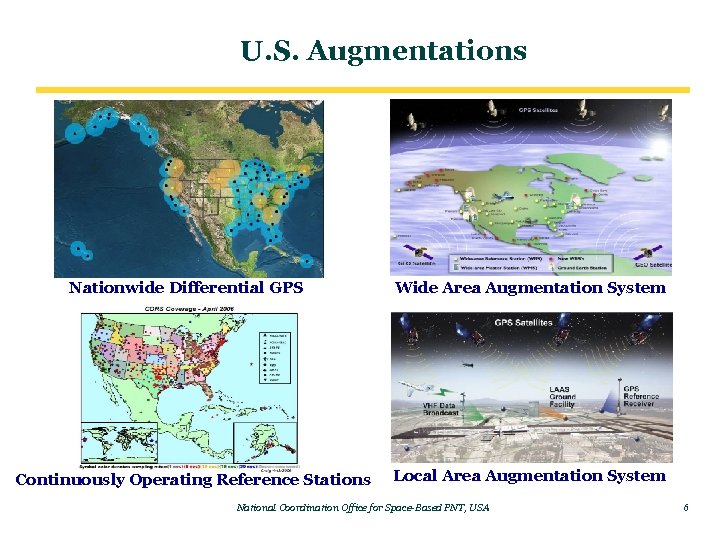 U. S. Augmentations Nationwide Differential GPS Continuously Operating Reference Stations Wide Area Augmentation System Local Area Augmentation System National Coordination Office for Space-Based PNT, USA 6
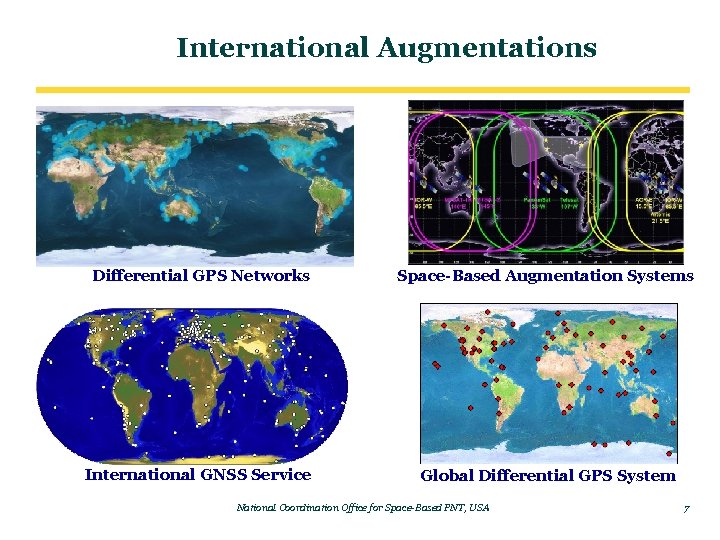 International Augmentations Differential GPS Networks Space-Based Augmentation Systems International GNSS Service Global Differential GPS System National Coordination Office for Space-Based PNT, USA 7
 Overview • GPS System and Performance • GPS Modernization • International Cooperation National Coordination Office for Space-Based PNT, USA 8
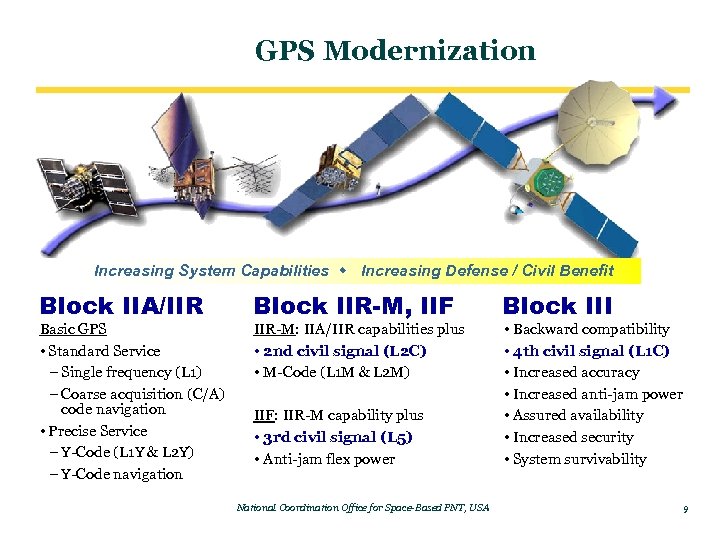 GPS Modernization Increasing System Capabilities w Increasing Defense / Civil Benefit Block IIA/IIR Basic GPS • Standard Service – Single frequency (L 1) – Coarse acquisition (C/A) code navigation • Precise Service – Y-Code (L 1 Y & L 2 Y) – Y-Code navigation Block IIR-M, IIF IIR-M: IIA/IIR capabilities plus • 2 nd civil signal (L 2 C) • M-Code (L 1 M & L 2 M) IIF: IIR-M capability plus • 3 rd civil signal (L 5) • Anti-jam flex power National Coordination Office for Space-Based PNT, USA Block III • Backward compatibility • 4 th civil signal (L 1 C) • Increased accuracy • Increased anti-jam power • Assured availability • Increased security • System survivability 9
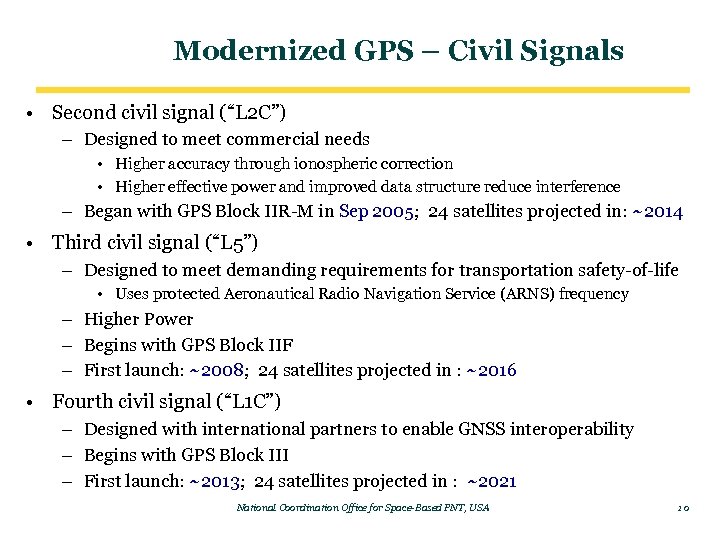 Modernized GPS – Civil Signals • Second civil signal (“L 2 C”) – Designed to meet commercial needs • Higher accuracy through ionospheric correction • Higher effective power and improved data structure reduce interference – Began with GPS Block IIR-M in Sep 2005; 24 satellites projected in: ~2014 • Third civil signal (“L 5”) – Designed to meet demanding requirements for transportation safety-of-life • Uses protected Aeronautical Radio Navigation Service (ARNS) frequency – Higher Power – Begins with GPS Block IIF – First launch: ~2008; 24 satellites projected in : ~2016 • Fourth civil signal (“L 1 C”) – Designed with international partners to enable GNSS interoperability – Begins with GPS Block III – First launch: ~2013; 24 satellites projected in : ~2021 National Coordination Office for Space-Based PNT, USA 10
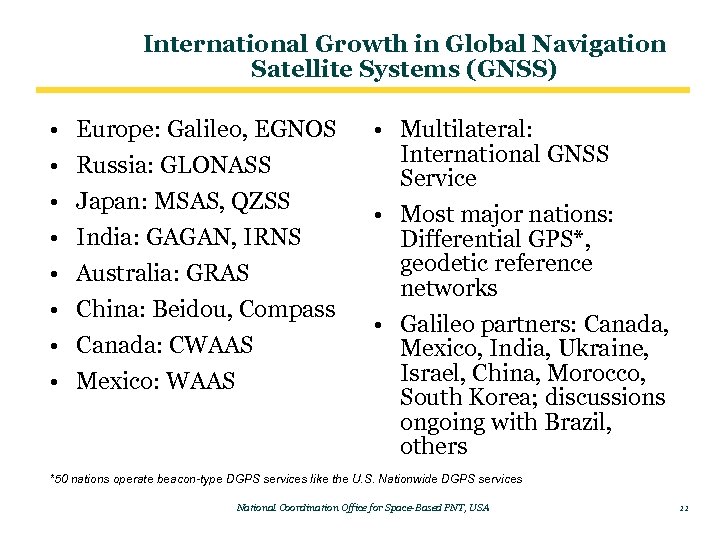 International Growth in Global Navigation Satellite Systems (GNSS) • • Europe: Galileo, EGNOS Russia: GLONASS Japan: MSAS, QZSS India: GAGAN, IRNS Australia: GRAS China: Beidou, Compass Canada: CWAAS Mexico: WAAS • Multilateral: International GNSS Service • Most major nations: Differential GPS*, geodetic reference networks • Galileo partners: Canada, Mexico, India, Ukraine, Israel, China, Morocco, South Korea; discussions ongoing with Brazil, others *50 nations operate beacon-type DGPS services like the U. S. Nationwide DGPS services National Coordination Office for Space-Based PNT, USA 11
 Overview • GPS System and Performance • GPS Modernization • International Cooperation National Coordination Office for Space-Based PNT, USA 12
 U. S. International Cooperation • U. S. Government has pursued formal cooperative arrangements with Europe, Japan, and Russia since 1996 – To ensure compatibility (non-interference) and interoperability with foreign systems – To maintain and promote a level playing field in the global market • Additional efforts ongoing with Australia, India, Brazil, and others • Multilateral cooperation established through U. N. International Committee on GNSS – As well as ICAO, IMO, and NATO National Coordination Office for Space-Based PNT, USA 13
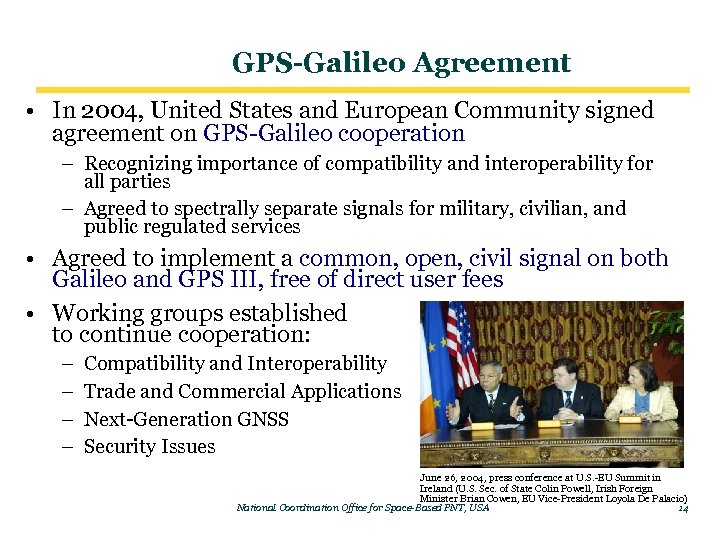 GPS-Galileo Agreement • In 2004, United States and European Community signed agreement on GPS-Galileo cooperation – Recognizing importance of compatibility and interoperability for all parties – Agreed to spectrally separate signals for military, civilian, and public regulated services • Agreed to implement a common, open, civil signal on both Galileo and GPS III, free of direct user fees • Working groups established to continue cooperation: – – Compatibility and Interoperability Trade and Commercial Applications Next-Generation GNSS Security Issues June 26, 2004, press conference at U. S. -EU Summit in Ireland (U. S. Sec. of State Colin Powell, Irish Foreign Minister Brian Cowen, EU Vice-President Loyola De Palacio) National Coordination Office for Space-Based PNT, USA 14
 U. S. International Cooperation Outlined in 2004 U. S. National Policy on Space-Based Positioning, Navigation, and Timing (PNT) • Provide civil GPS and augmentations free of direct user fees on a continuous, worldwide basis • Provide open, free access to information needed to develop equipment • Improve performance of civil GPS and augmentations to meet or exceed that of international systems • Encourage international development of PNT systems based on GPS • Seek to ensure international systems are interoperable with civil GPS and augmentations – Or at a minimum, are compatible • Address mutual security concerns with international providers to prevent hostile use National Coordination Office for Space-Based PNT, USA 15
 International Committee on GNSS • Multilateral group chartered through United Nations – First meeting: December 2005 – Next meeting: November 2006 • Purpose: Promote use of GNSS to improve efficiency and security of transport, search and rescue, geodesy, etc. , particularly in developing countries – Coordination among GNSS providers to ensure both compatibility and interoperability – Assistance to developing countries in use of PNT services – Focal point for international information exchange – Forum for addressing future user needs National Coordination Office for Space-Based PNT, USA 16
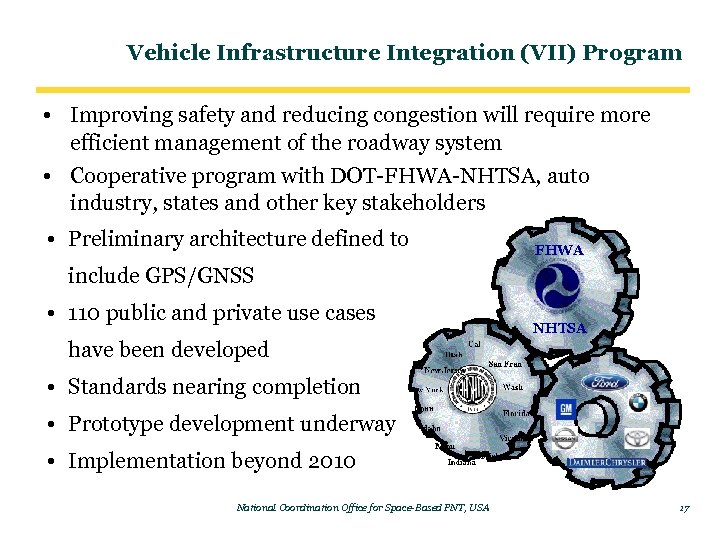 Vehicle Infrastructure Integration (VII) Program • Improving safety and reducing congestion will require more efficient management of the roadway system • Cooperative program with DOT-FHWA-NHTSA, auto industry, states and other key stakeholders • Preliminary architecture defined to FHWA include GPS/GNSS • 110 public and private use cases NHTSA have been developed • Standards nearing completion • Prototype development underway • Implementation beyond 2010 National Coordination Office for Space-Based PNT, USA 17
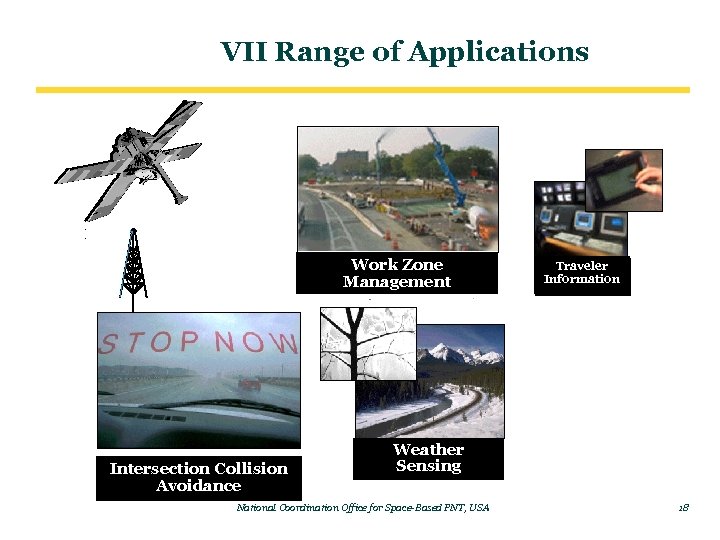 VII Range of Applications Work Zone Management Intersection Collision Avoidance Traveler Information Weather Sensing National Coordination Office for Space-Based PNT, USA 18
 Summary • U. S. policy promotes worldwide use of civil GPS and augmentations, and its interoperability/compatibility with other GNSS systems, specifically Galileo • GPS is getting better and will continue to improve – Augmentations enable high performance today – New GPS signal now available • International cooperation - a priority for all nations – Interoperability/compatibility are critical – Ever improving performance for applications worldwide GPS and Galileo: Progress through Partnership National Coordination Office for Space-Based PNT, USA 19
 Web-based Information • PNT. gov established to disseminate information on the U. S. National Executive Committee – Contains recent public presentations as well as information on Membership, Policy, the Advisory Board, and “frequently asked questions” • GPS. gov established to disseminate information on GPS applications – Brochure on GPS applications available for download • Copies available upon request – Contains additional links to various other websites National Coordination Office for Space-Based PNT, USA 20
 Contact Information Michael E. Shaw Director U. S. National Coordination Office for Space-Based PNT 14 th and Constitution Ave, N. W. Washington, D. C. 20230 Ph: (202) 482 -5809 Fax: (202) 482 -4429 Michael. Shaw@pnt. gov Presentation and other GPS information available: PNT. gov National Coordination Office for Space-Based PNT, USA 21