 Скачать презентацию GOVERNOR S ENERGY OFFICE Presented by Alexander Mack Community
0c582577ce19bcb72a3f97e12c4d3cdd.ppt
- Количество слайдов: 158



GOVERNOR’S ENERGY OFFICE Presented by Alexander Mack, Community Program Administrator 1
What We Do n n n Staff the Florida Energy and Climate Commission Administer the Florida Renewable Energy and Energy-Efficient Technologies Grants Program Administer State Energy Efficiency Grant Programs Administer federally delegated energy program Administer petroleum planning and emergency contingency planning Coordinate Emergency Support Function (ESF) #12 – Fuels 2
What We Do (con’t) n. Administer the Florida Green Government Grants Act n. Administer the information gathering and reporting functions pursuant to ss. 377. 601 – 377. 608 n. Provide technical assistance 3
The Purpose On February 17, 2009, the American Recovery and Reinvestment Act of 2009 P. L. 111 -5 (ARRA) was enacted. As a result of this new law, the State of Florida was allocated economic stimulus funds for various programs. Funding allocated to the Florida Energy and Climate Commission (FECC) is from the U. S. Department of Energy (DOE). Associated goals of the various programs include; (1) reducing energy use; (2) improving energy efficiency; (3) increasing renewable energy production; (4) reducing greenhouse gas emissions; (5) creating/retaining jobs. 4

GOVERNOR’S ENERGY OFFICE Presented by Travis Yelverton, Deputy Director 5
SEP & EECBG n Energy Efficiency Conservation Block Grants (EECBG) – Local Governments: EE/RE upgrades & retrofits – State Agency Projects: EE/RE upgrades & retrofits; Energy Code- Compliance, Training, Education; Economic Development Strategies; 6
SEP & EECBG n State Energy Program (SEP) – Rebate Programs: Solar Rebates; HVAC Rebates – Promote Fuel Diversity: Compressed Natural Gas (CNG); E 85 (ethanol mix); B 20 (biodiesel mix) – Grants to Non-profits; NGO’s – Access to Capital: Clean Energy Investment Program (loans & equity) 7
American Recovery and Reinvestment Act Overview $175, 958, 742. 00 – Total Federal ARRA Funding for 2009 -2012 8
Summary of American Recovery and Reinvestment Act of 2009 (ARRA) Requirements Presented by Gail Stafford, OMC Manager 9
ARRA Requirements n ARRA dramatically increased Energy Office funding. n Accountability and Transparency n Increased Workload n State Energy Program (SEP), Energy Efficiency and Conservation Block Grant Program (EECBG), Energy Star Rebate Program and Energy Assurance 10
ARRA Requirements n n n Compliance with Federal Provisions National Environmental Protection Act (NEPA) Buy American Labor Standards Historic Preservation Financial Management Reporting/Recordkeeping 11
ARRA Requirements n n n Legislation and Authority Public Law 111 -5 US Department of Energy (DOE) Weatherization and Intergovernmental Program (WIP) of the Office of Energy Efficiency and Renewable Energy (EERE) 10 CFR 600 and 10 CFR 420 Energy Policy and Conservation Act Energy Independence and Security Act 12
ARRA Requirements National Environmental Protection Act (NEPA) of 1969 n Environmental Impacts n NEPA Review Process n Categorical Exclusion (CE or CX) n Environmental Assessment (EA) or Environmental Impact Statement (EIS) 13
ARRA Requirements Buy American n Section 1605 of ARRA n 2 CFR 176 n All iron, steel and manufactured goods must be produced or manufactured in the United States. n Applicable to public buildings or public work projects only 14
ARRA Requirements Davis Bacon Act (DBA) n Section 1606 of ARRA n Applies to construction contracts over $2, 000 n Both public and non-public projects funded in whole or in part with federal funds n Flow-down provisions 15
ARRA Requirements Historic Preservation n Section 106 of the National Historic Preservation Act (NHPA) n Programmatic Agreement n Certified Local Governments n Exemptions 16
ARRA Requirements Reporting/Recordkeeping n 1512 Reporting n Metrics 17
ARRA Requirements QUESTIONS? 18
RESOURCES Presented by Jennifer Hartshorne 19
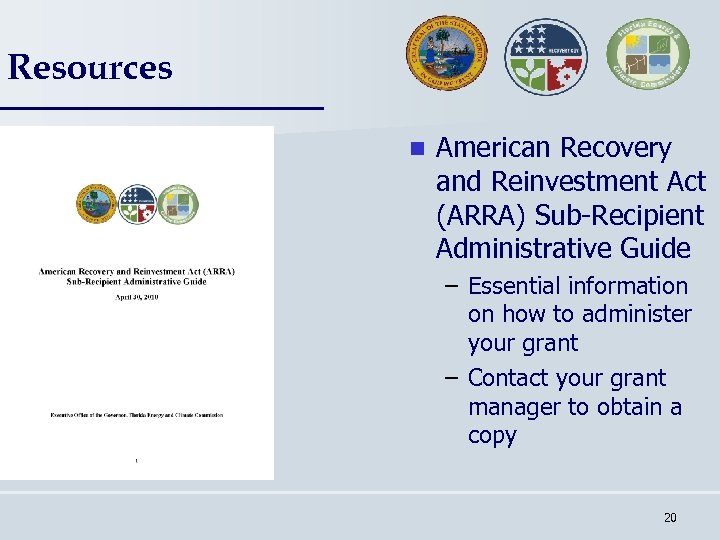
Resources n American Recovery and Reinvestment Act (ARRA) Sub-Recipient Administrative Guide – Essential information on how to administer your grant – Contact your grant manager to obtain a copy 20
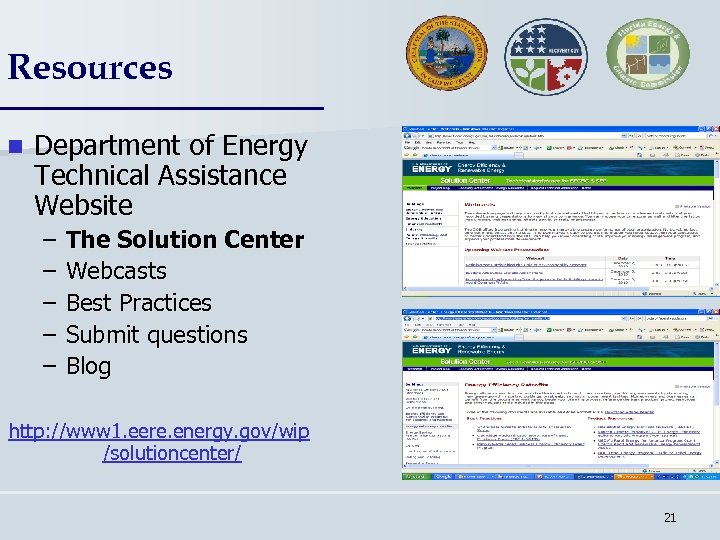
Resources n Department of Energy Technical Assistance Website – – – The Solution Center Webcasts Best Practices Submit questions Blog http: //www 1. eere. energy. gov/wip /solutioncenter/ 21
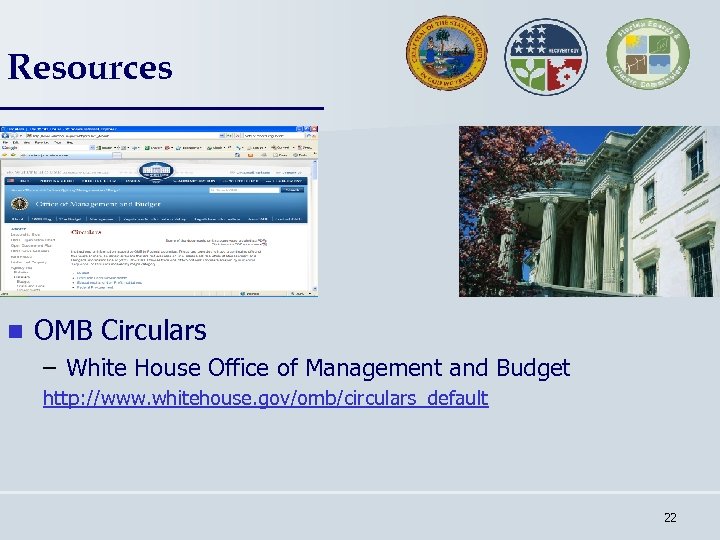
Resources n OMB Circulars – White House Office of Management and Budget http: //www. whitehouse. gov/omb/circulars_default 22
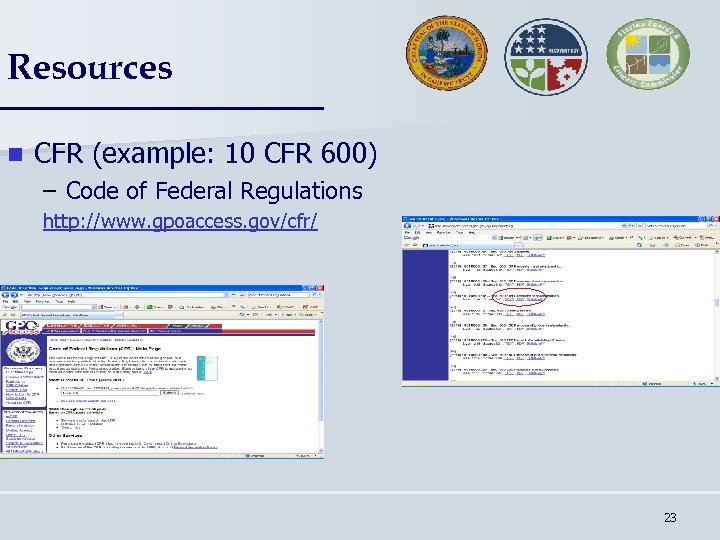
Resources n CFR (example: 10 CFR 600) – Code of Federal Regulations http: //www. gpoaccess. gov/cfr/ 23
Resources n Florida Statutes – http: //www. leg. state. fl. us/statutes/ 24
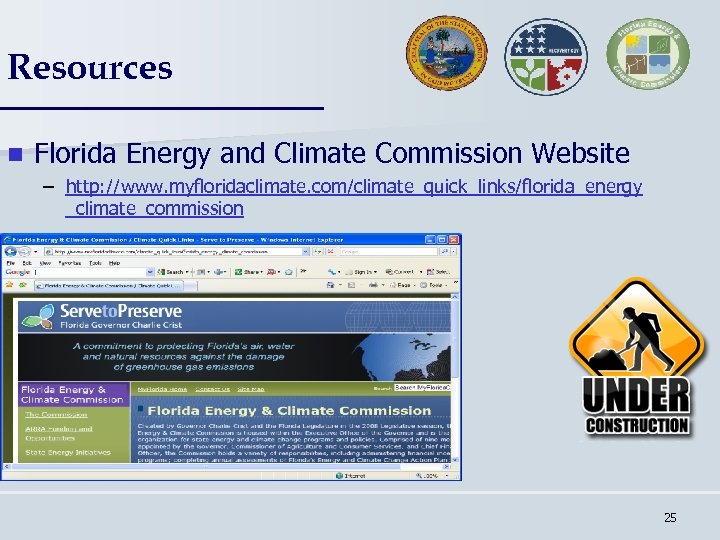
Resources n Florida Energy and Climate Commission Website – http: //www. myfloridaclimate. com/climate_quick_links/florida_energy _climate_commission 25
Resources n Your Grant Manager Travis Yelverton Tony Morgan Brenda Buchan Kelley Smith John Leeds Mark Hermanson Jennifer Hartshorne April Groover Fredericka Jones Matthew Faulk 26
Program Administration Presented by Gail Stafford, OMC Manager 27
Program Administration State’s Responsibilities n Informing Sub-Recipients n Ensuring Program Compliance n Ensuring Fiscal Compliance n Ensuring Audit Compliance 28
Program Administration Overview n Sub-Recipient Agreement n Project Management n On-Time Performance/Timeliness 29
Program Administration Sub-Recipient Agreement Scope of Work and Budget – Attachment A, Grant Work Plan n Agreement Period n Modifications n Recordkeeping n 30
Program Administration Sub-Recipient Agreement Audit Requirements – Records Available for Inspection – > 500, 000 – Audit Required n Reports – Monthly Reports – Final Report n 31
Program Administration Sub-Recipient Agreement Attachment A, Grant Work Plan n Attachment B, Payment Request Summary n Attachment E, Federal Regulations n Attachment F, Federal Funding Grantee, Subgrantee and Contractor Provisions n 32
Program Administration Project Management n Overall Supervisor n Trained Staff n Policies and Procedures n Inspection of work 33
Program Administration Project Management n Use of Consultants n Conflicts of Interest n Financial Management 34
Program Administration On-Time Performance/Timeliness n Managing program activities critical Most funds are in facility improvements/upgrades; No timeliness if work cannot proceed; n Issues before grant award Staffing n Issues after grant award Engineering design delays Permitting delays Local government issues Budget Issues 35
Program Administration On-Time Performance/Timeliness Grant Period – 2 Years n Project delays can have financial impact: Loss of funding for existing project if delayed too long; Possible reduction in funding to the State. n 36
Program Administration n n n On-Time Performance/Timeliness (Sub-Recipient Responsibilities) Engineer selection Contract penalties for non-performance Active role in monitoring design process Monthly meetings Weekly reports Implement the activity as planned Enhancement or expansion 37
Program Administration QUESTIONS? 38
Financial Management Presented by Kim Hoffman, Budget Officer 39
It’s Your Responsibility… Financial management and control of grant funds is the sole responsibility of the Sub-recipient that accepts the funds. 40
Sub-recipient Financial Management Systems Must be Sufficient to: 1. Permit preparation of reports as required by the grant agreement, and 2. Permit the tracing of funds to a level of expenditure adequate to establish that grant funds have not been used in violation of the restrictions or prohibitions of the grant agreement. 41
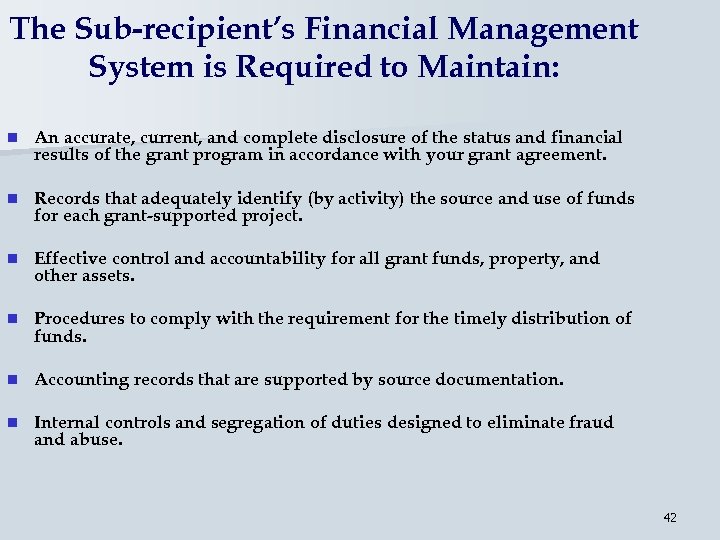
The Sub-recipient’s Financial Management System is Required to Maintain: n An accurate, current, and complete disclosure of the status and financial results of the grant program in accordance with your grant agreement. n Records that adequately identify (by activity) the source and use of funds for each grant-supported project. n Effective control and accountability for all grant funds, property, and other assets. n Procedures to comply with the requirement for the timely distribution of funds. n Accounting records that are supported by source documentation. n Internal controls and segregation of duties designed to eliminate fraud and abuse. 42
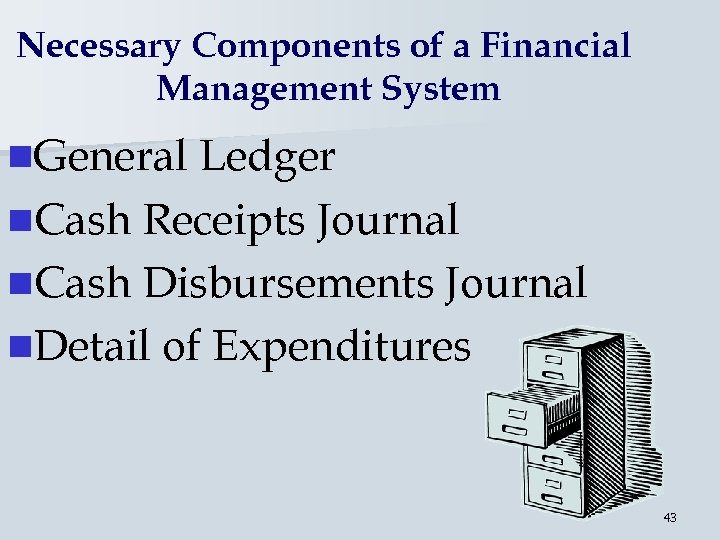
Necessary Components of a Financial Management System n. General Ledger n. Cash Receipts Journal n. Cash Disbursements Journal n. Detail of Expenditures 43
Financial Management Systems Must Meet the Following Minimum Standards: Financial reporting must be accurate, current and provide a complete disclosure of the financial records of grant activities. 44
Financial Management Systems Must Meet the Following Minimum Standards: Accounting records must adequately identify the source and use of grant funds. Local governments are required to formally incorporate grant funds into their local budgets. 45
Financial Management Systems Must Meet the Following Minimum Standards: Internal controls must be effective and provide accountability for all grant funded cash, real and personal property, and other assets, including the safeguarding of all such property to assure that it is used solely for authorized purposes. 46
Minimum Requirements of Internal Controls : A single individual must not be allowed to exercise complete control over all phases of any significant transaction. For example, that the same person cannot purchase materials, receive materials, authorize payment, and write the check to pay for materials. 47
Minimum Requirements of Internal Controls : Recordkeeping must be separate from operations and the handling and custody of assets. 48
Minimum Requirements of Internal Controls : Monthly reconciliation and verification of cash balances with bank statements must be made by employees who do not handle or record cash or sign checks. 49
Minimum Requirements of Internal Controls : Actual lines of responsibility must be clearly established and a single person identified to assume responsibility for management oversight of the entire financial management system. 50
Minimum Requirements of Internal Controls : The person who prepares payrolls should not handle the related paychecks. If signature stamps are used, they should not be under the control of the same individual who retains blank checks. 51
Minimum Requirements of Internal Controls : An adequate system of internal controls, with specific program and financial management responsibilities, will enable Subrecipients to maintain the records necessary to comply with Florida law and federal requirements. 52
Budget Control Must compare actual expenditures to budgeted amounts for each budget line-item. n All costs must be directly related to specific project deliverables. n Requests to modify a project budget must be submitted and approved by your Energy Office Grant Manager before incurring any of the related project costs to ensure that those costs are eligible for reimbursement with grant funds. n Any Program Generated Income (or PGI), that is income that is generated as a result of grant funded activities, must be included in an approved project budget and expended solely on allowable grant activities. If you anticipate generating any PGI, contact your Grant Manager for direction. n 53
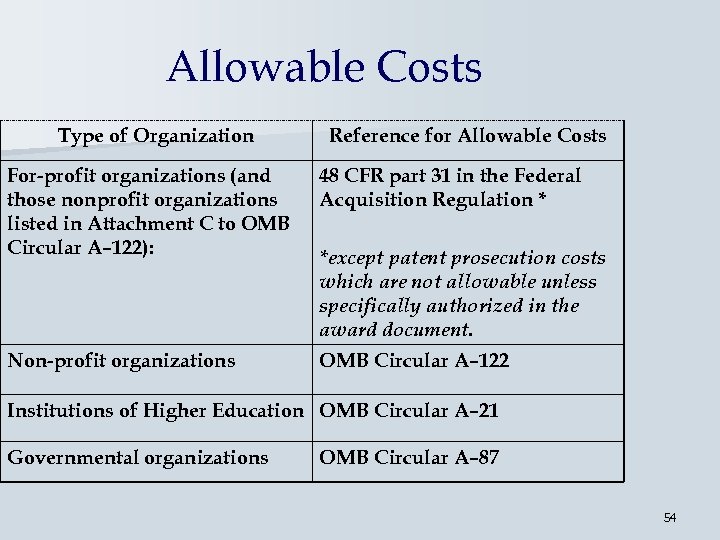
Allowable Costs Type of Organization Reference for Allowable Costs For-profit organizations (and those nonprofit organizations listed in Attachment C to OMB Circular A– 122): 48 CFR part 31 in the Federal Acquisition Regulation * Non-profit organizations OMB Circular A– 122 *except patent prosecution costs which are not allowable unless specifically authorized in the award document. Institutions of Higher Education OMB Circular A– 21 Governmental organizations OMB Circular A– 87 54
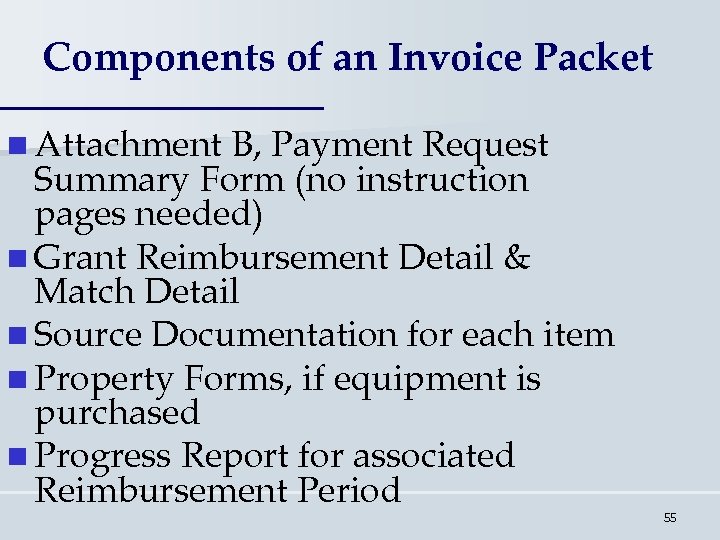
Components of an Invoice Packet n Attachment B, Payment Request Summary Form (no instruction pages needed) n Grant Reimbursement Detail & Match Detail n Source Documentation for each item n Property Forms, if equipment is purchased n Progress Report for associated Reimbursement Period 55
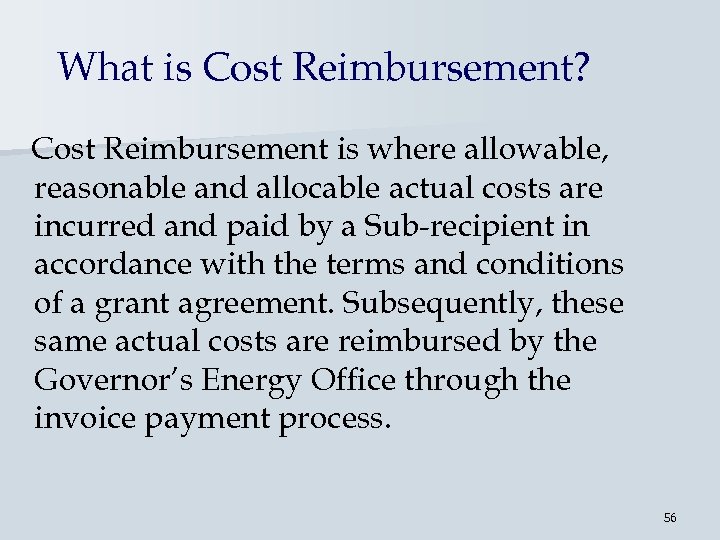
What is Cost Reimbursement? Cost Reimbursement is where allowable, reasonable and allocable actual costs are incurred and paid by a Sub-recipient in accordance with the terms and conditions of a grant agreement. Subsequently, these same actual costs are reimbursed by the Governor’s Energy Office through the invoice payment process. 56
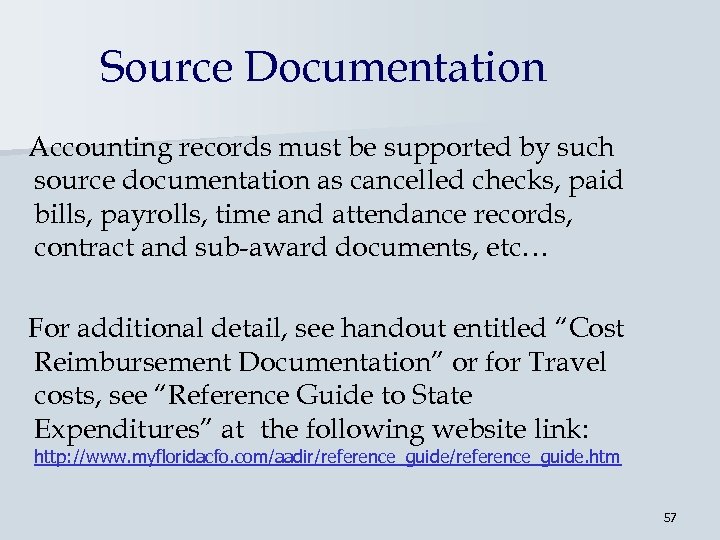
Source Documentation Accounting records must be supported by such source documentation as cancelled checks, paid bills, payrolls, time and attendance records, contract and sub-award documents, etc… For additional detail, see handout entitled “Cost Reimbursement Documentation” or for Travel costs, see “Reference Guide to State Expenditures” at the following website link: http: //www. myfloridacfo. com/aadir/reference_guide. htm 57
Hints for Invoice Packet Approval Reimbursement Period dates must be reflected as “mm/dd/yy” to “mm/dd/yy” with the same dates shown consistently throughout components of an Invoice Packet (Att. B, Grant Detail and Progress Report). For the 1 st invoice, Reimbursement Period dates must begin on the execution date of grant agreement; for Final invoice, Reimbursement Period dates must end on the last day of the grant agreement. 58
Hints for Invoice Packet Approval Double-check your math; accuracy matters! Invoice reviewers will only have a 10 -key calculator to verify the accuracy of your budget category sub-totals on the Grant Detail; inaccurate sub-totals require correction or explanation. Avoid payment delays due to “rounding to the nearest penny”, which commonly results from electronic generation of figures and causes subtotals to not match the sum of all line-items. 59
Hints for Invoice Packet Approval Anything listed on an invoice that was incurred or paid for outside of the Reimbursement Period reflected on your Invoice Packet, will need an explanation noted on the form. See “Invoice Hints” handout for additional details. 60
Hints for Invoice Packet Approval All items on a Grant Detail must correspond to items on an approved project budget, in the appropriate budget categories. 61
Hints for Invoice Packet Approval Approved budget category amounts (both grant and match) cannot be exceeded without prior written approval from your Grant Manger. 62
Travel Costs must be: n n Directly related to project deliverables; In compliance with State travel policies as described in: 1. 2. 3. n n Ch. 112. 061, FS; the Sub-Recipient Administrative Guide; and the Reference Guide for State Expenditures Directly related to project deliverables; and Accompanied by proper travel forms and receipts. 63
Retainage of 10% of approved, documented grant funds is deducted from each invoice for payment upon submission and approval of the Final Report. Even though payment is delayed, these funds are still reported as Expended on the Invoice, Detail and Progress Report. 64
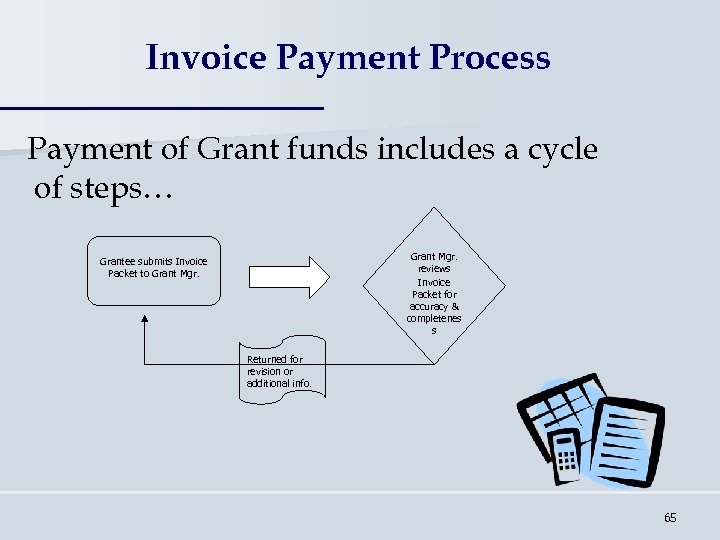
Invoice Payment Process Payment of Grant funds includes a cycle of steps… Grant Mgr. reviews Invoice Packet for accuracy & completenes s Grantee submits Invoice Packet to Grant Mgr. Returned for revision or additional info. 65
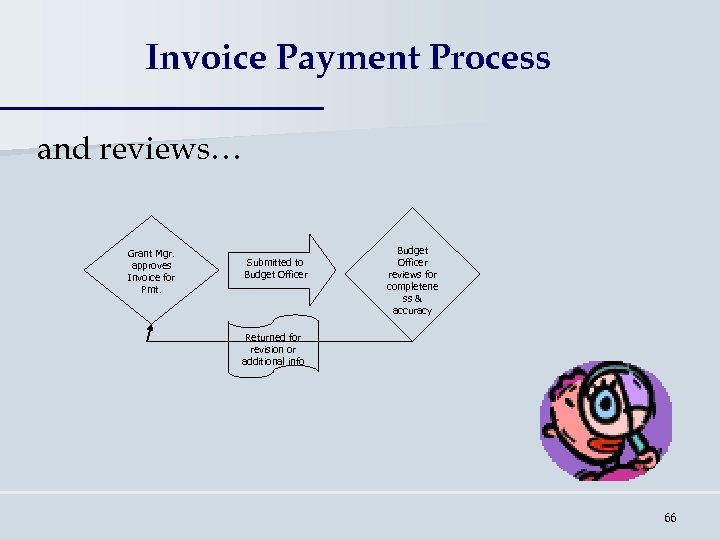
Invoice Payment Process and reviews… Grant Mgr. approves Invoice for Pmt. Submitted to Budget Officer reviews for completene ss & accuracy Returned for revision or additional info 66
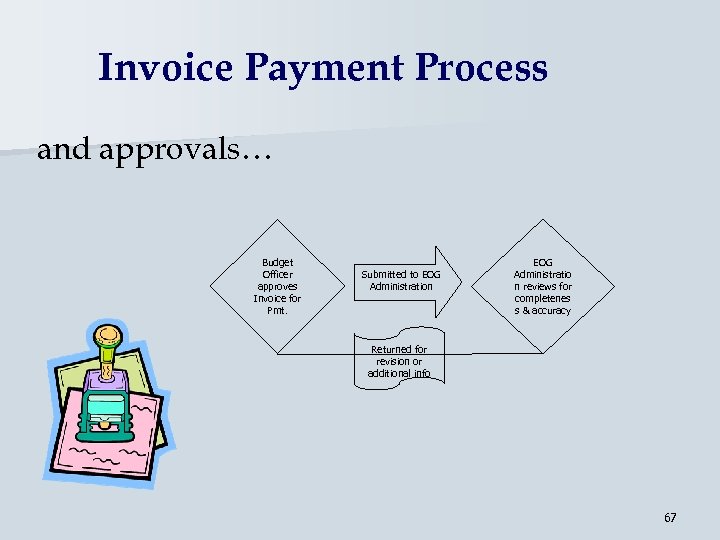
Invoice Payment Process and approvals… Budget Officer approves Invoice for Pmt. Submitted to EOG Administration EOG Administratio n reviews for completenes s & accuracy Returned for revision or additional info 67
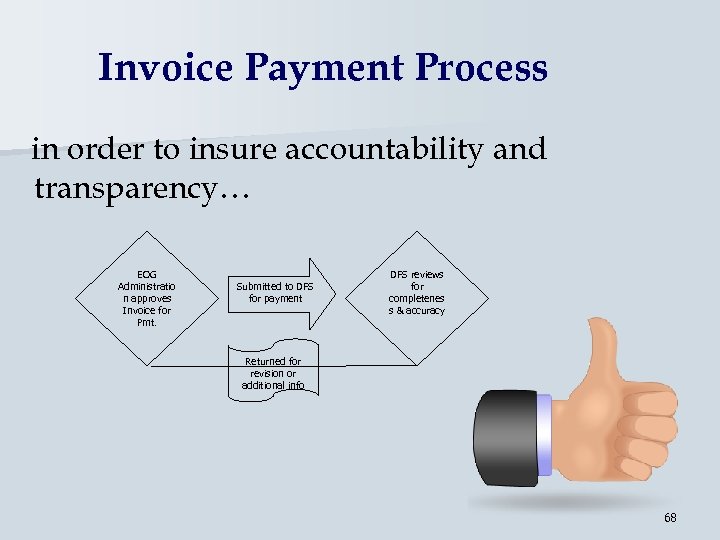
Invoice Payment Process in order to insure accountability and transparency… EOG Administratio n approves Invoice for Pmt. Submitted to DFS for payment DFS reviews for completenes s & accuracy Returned for revision or additional info 68
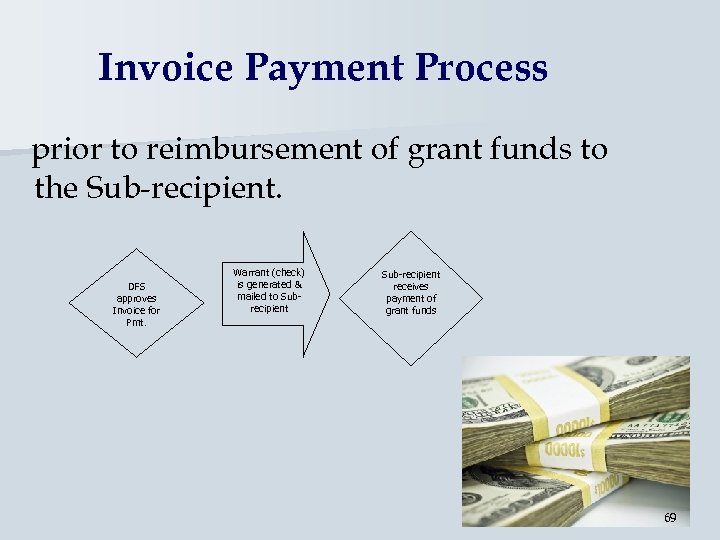
Invoice Payment Process prior to reimbursement of grant funds to the Sub-recipient. DFS approves Invoice for Pmt. Warrant (check) is generated & mailed to Subrecipient Sub-recipient receives payment of grant funds 69
Status of your Invoice Payment In order to check on the status of your Invoice Payment, click on the following link: https: //flair. dbf. state. fl. us/caspub/vnpayhst. htm n Enter your Federal Tax ID (FEID #); Select the month & year of the payment; and n Select “Executive Office of the Governor” n 70
To update your payment address Invoice payments addresses are linked to the Subrecipient’s Federal Identification Number (FEID or FEIN) that was registered with the My. Florida. Market. Place (MFMP) website below: http: //dms. myflorida. com/business_operations/state_purc hasing/myflorida_marketplace/mfmp_vendors/vendor_to olkit/mfmp_vendor_registration If the address changes, an updated payment address at the MFMP website and email your Grant Manger with the new address and new 3 -digit sequence # that the MFMP will assign for the new address. 71
Labor Standards Presented by Tony Morgan, Grant Manager 72
Labor Standards n Background – Section 1606 of the American Recovery and Reinvestment Act requires that all laborers and mechanics employed by contractors and subcontractors on projects funded directly by or assisted in whole or in part by and through the Federal Government pursuant to the Recovery Act shall be paid wages at rates not less than those prevailing on projects of a character similar in the locality as determined by the Secretary of Labor in accordance with subchapter IV of Chapter 31 of title 40, United States Code.
Labor Standards n Background Cont. – Federal agencies providing grants, cooperative agreements, and loans under ARRA shall ensure that the standard Davis- Bacon contract clauses found in 29 CFR 5. 5(a) are incorporated in any resultant construction contracts that are in excess of $2, 000.
Labor Standards n Three Key Federal Statutes – Davis-Bacon Act/Davis-Bacon Related Acts § 40 U. S. C. 3141 § http: //www. dol. gov/whd/contracts/dbra. htm – Contract Work Hours and Safety Standards Act § 40 U. S. C. 3701 § http: //www. dol. gov/whd/regs/statutes/safe 01. pdf – Copeland Act § 40 U. S. C. 3145 § http: //www. dol. gov/whd/regs/statutes/copeland. htm
Labor Standards n Davis-Bacon Act (29 CFR Parts 1, 3, and 5) – Originally Enacted 1931, amended 1935 & 1964 – Protects workers from nonlocal contractors underbidding local wage levels – Applies to Federal construction contracts over $2, 000 – The Act is “site-based” – Includes alteration, repair, painting & decorating – Applies to all laborers & mechanics – Requires payment of prevailing wages – Requires weekly payment of wages
Labor Standards n Contract Work Hours and Safety Standards Act (CWHSSA) – Enacted in 1962 – Provides for overtime for all contract work over 40 hrs/week – Applies to contracts over $100, 000 – Liquidated damages apply to violations ($10/day/violation) – Paid at 1½ times the regular rate of basic pay plus the straight-time rate of fringe benefits § Straight time: $20 + $5 § Overtime: $30 + $5
Labor Standards n Copeland Act – Enacted in 1934 – Prohibits “kickback” of wages and/or back wages – Requires contractors on Davis Bacon/Davis Bacon Related Acts covered projects to submit a certified payroll with a signed “statement of compliance” each week
Labor Standards n Laborers and Mechanics – Workers whose duties are manual or physical in nature – Includes apprentices, trainees and helpers – Exemptions: § As a general rule, an employee who spends the majority of time in a supervisory position at the job site, and who spends less than 20% of the work week engaged in skilled labor, is exempt from Davis-Bacon requirements for the percentage of time spent in that skilled time. § Clerical staff such as timekeepers; professionals such as architects, engineers; and inspectors and certain utility installers are also exempt.
Labor Standards n Site of Work – Davis-Bacon applies only to laborers and mechanics employed “directly upon the site of the work. ” – Site of work is: § The physical place or places where the construction is called for in the contract or will remain after work has been completed; and, § Any other site where a significant portion of the building or work is constructed, provided that such site is established specifically for the contract. § May also include job headquarters, tool yards, batch plants, borrow pits, etc. , provided they are: – Located adjacent or virtually adjacent to the “site of work” and dedicated exclusively or nearly so to the performance of the contract or project
Labor Standards n Davis-Bacon requirements extend to numerous “Related Acts” that provide federal assistance by: – Grants – Loan guarantees
Labor Standards n Flow-Down Responsibilities – All grants and contracts must contain labor standard clauses – All recipients and sub-recipients must collect and retain certified payrolls for five years after completion of projects – All of the States’ sub-recipients and third tier sub-recipients must provide the State with copies of all certified payrolls
Labor Standards n Sub-Recipient Responsibilities – Is the correct wage determination being used? – Has the contractor paid the correct rate for the job classification? – Has the contractor paid fringe benefits appropriately? – Is the certification signed? – Check the math – does the number of hours of DBA work correlate to the gross wages paid? – Are deductions appropriate? 83
Labor Standards n Sub-Recipient Responsibilities (Cont. ) – Investigate, monitor, and enforce DBA requirements – Conduct compliance audits – Investigate potential violations or complaints – Employee interviews and investigations 84
Labor Standards n Sub-Recipient Responsibilities (Cont. ) – Employee Interviews: § Information provided is confidential § Interview statements should contain: – – Place and date of interview Name and address of employer/employee Employment status and classification Alleged violations 85
Labor Standards n Wage Determinations – Wages and Fringe benefits – DOL has found to be prevailing – For the job classification – In the locality (usually by County) – For the category of construction (eg. , Building, Residential, Heavy, Highway) involved 86
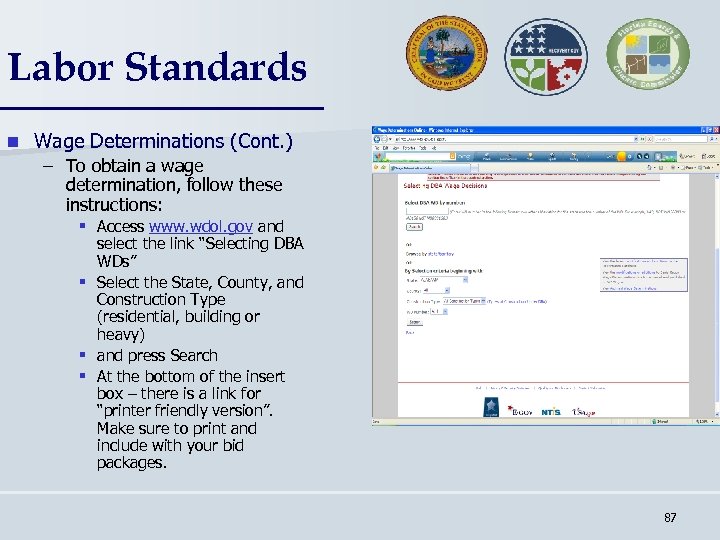
Labor Standards n Wage Determinations (Cont. ) – To obtain a wage determination, follow these instructions: § Access www. wdol. gov and select the link “Selecting DBA WDs” § Select the State, County, and Construction Type (residential, building or heavy) § and press Search § At the bottom of the insert box – there is a link for “printer friendly version”. Make sure to print and include with your bid packages. 87
Labor Standards n Conformance Request – Necessary when the locality where the construction is being performed has no classification for the specific work – Example: § No HVAC Mechanic in Clay County, FL § Contract requires installation of HVAC units in Orange Park City Hall. – Contact your grant manager for assistance – DOL wants all correspondence to come from the State 88
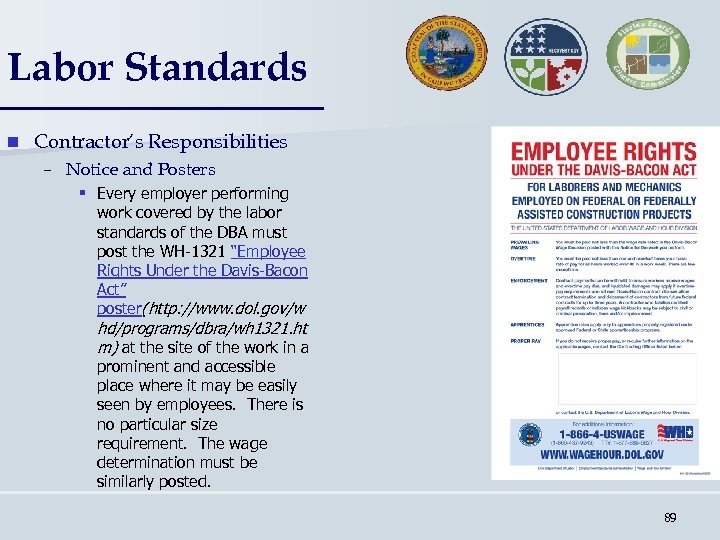
Labor Standards n Contractor’s Responsibilities – Notice and Posters § Every employer performing work covered by the labor standards of the DBA must post the WH-1321 “Employee Rights Under the Davis-Bacon Act” poster(http: //www. dol. gov/w hd/programs/dbra/wh 1321. ht m) at the site of the work in a prominent and accessible place where it may be easily seen by employees. There is no particular size requirement. The wage determination must be similarly posted. 89
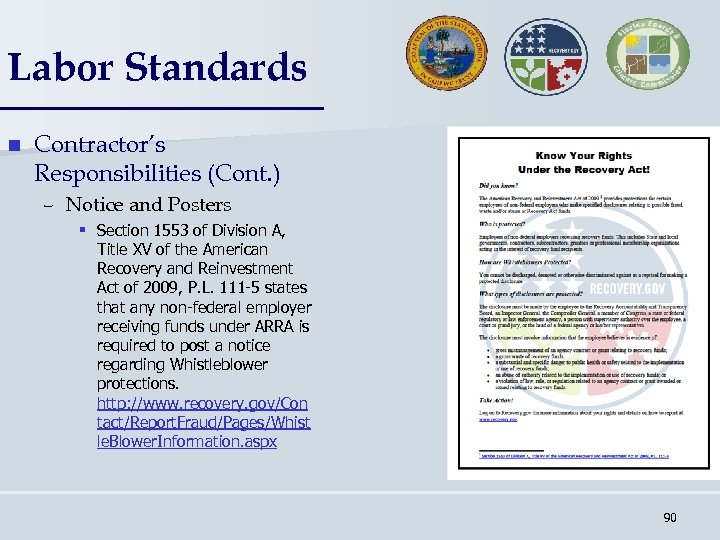
Labor Standards n Contractor’s Responsibilities (Cont. ) – Notice and Posters § Section 1553 of Division A, Title XV of the American Recovery and Reinvestment Act of 2009, P. L. 111 -5 states that any non-federal employer receiving funds under ARRA is required to post a notice regarding Whistleblower protections. http: //www. recovery. gov/Con tact/Report. Fraud/Pages/Whist le. Blower. Information. aspx 90
Labor Standards n Contractor's Responsibilities (cont. ) – Record Keeping § Under the DBA, covered contractors must maintain payroll and basic records for all laborers and mechanics during the course of the work and for a period of five years thereafter. Records to be maintained include: § Name, address, and Social Security number of each employee § Each employee's work classifications § Hourly rates of pay, including rates of contributions or costs anticipated for fringe benefits or their cash equivalents 91
Labor Standards n Contractor's Responsibilities (cont. ) – Record Keeping (Cont. ) Daily and weekly numbers of hours worked Deductions made Actual wages paid If applicable, detailed information regarding various fringe benefit plans and programs, including records that show that the plan or program has been communicated in writing to the laborers and mechanics affected § If applicable, detailed information regarding approved apprenticeship or trainee programs § § 92
Labor Standards n Employer Responsibilities (cont. ) – Certified Payroll § Required by DOL – May use form WH-347 – http: //www. dol. gov/esa/whd/forms/wh 347. pdf § Contractors must pay employees weekly § Contractors must send original certified payroll to the recipient § Recipients must maintain the original certified payroll on behalf of the DOE 93
Labor Standards n Sub-Recipient’s Monitoring Issues – Misclassification of job Title – Classification not on Payroll – “Salaried” worker not paid overtime – “Leased” workers need separate payroll – Authorized Deductions 94
Labor Standards n Resources – – – Available http: //www 1. eere. energy. gov/wip/davis-bacon_act. html http: //www 1. eere. energy. gov/wip/guidance. html www. dol. gov www. wdol. gov Your grant manager 95
Labor Standards n Questions ? 96
PROCUREMENT Presented by John Leeds, Grant Manager 97
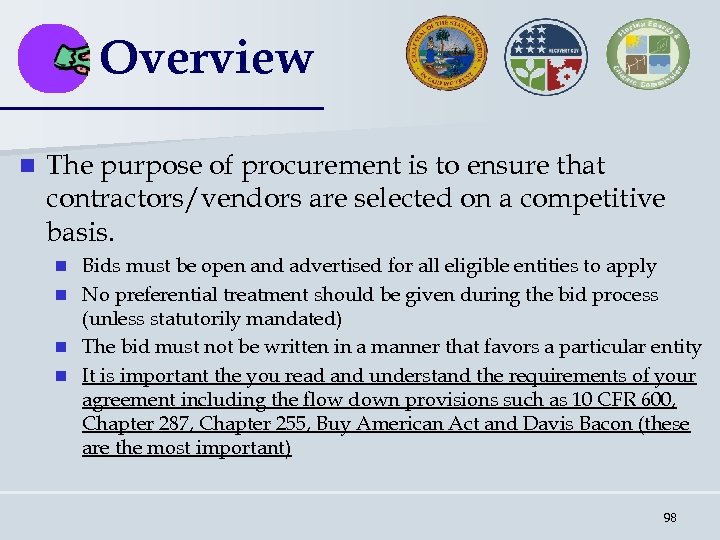
Overview n The purpose of procurement is to ensure that contractors/vendors are selected on a competitive basis. Bids must be open and advertised for all eligible entities to apply n No preferential treatment should be given during the bid process (unless statutorily mandated) n The bid must not be written in a manner that favors a particular entity n It is important the you read and understand the requirements of your agreement including the flow down provisions such as 10 CFR 600, Chapter 287, Chapter 255, Buy American Act and Davis Bacon (these are the most important) n 98
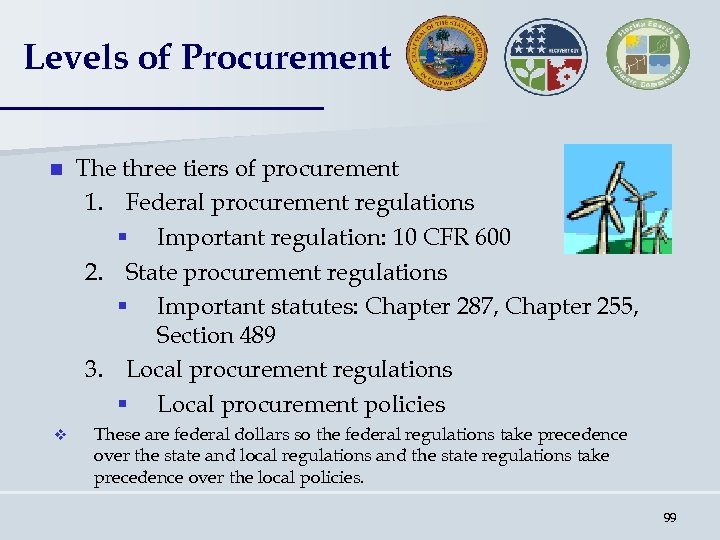
Levels of Procurement n The three tiers of procurement 1. Federal procurement regulations § Important regulation: 10 CFR 600 2. State procurement regulations § Important statutes: Chapter 287, Chapter 255, Section 489 3. Local procurement regulations § Local procurement policies v These are federal dollars so the federal regulations take precedence over the state and local regulations and the state regulations take precedence over the local policies. 99
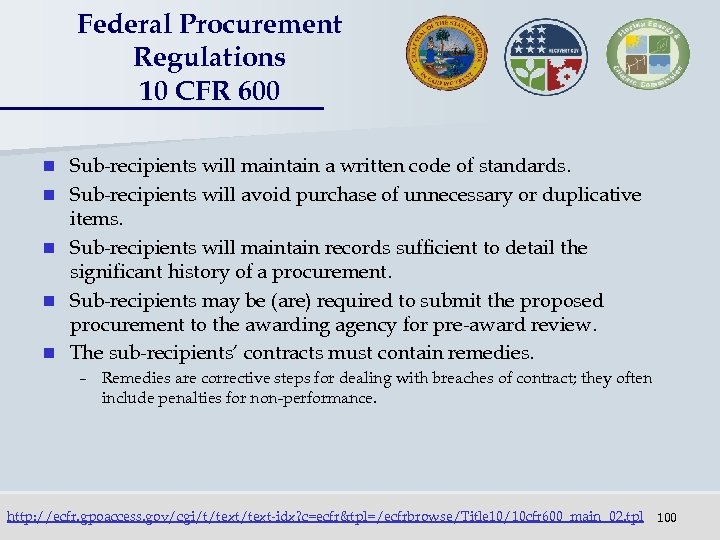
Federal Procurement Regulations 10 CFR 600 n n n Sub-recipients will maintain a written code of standards. Sub-recipients will avoid purchase of unnecessary or duplicative items. Sub-recipients will maintain records sufficient to detail the significant history of a procurement. Sub-recipients may be (are) required to submit the proposed procurement to the awarding agency for pre-award review. The sub-recipients’ contracts must contain remedies. – Remedies are corrective steps for dealing with breaches of contract; they often include penalties for non-performance. http: //ecfr. gpoaccess. gov/cgi/t/text-idx? c=ecfr&tpl=/ecfrbrowse/Title 10/10 cfr 600_main_02. tpl 100
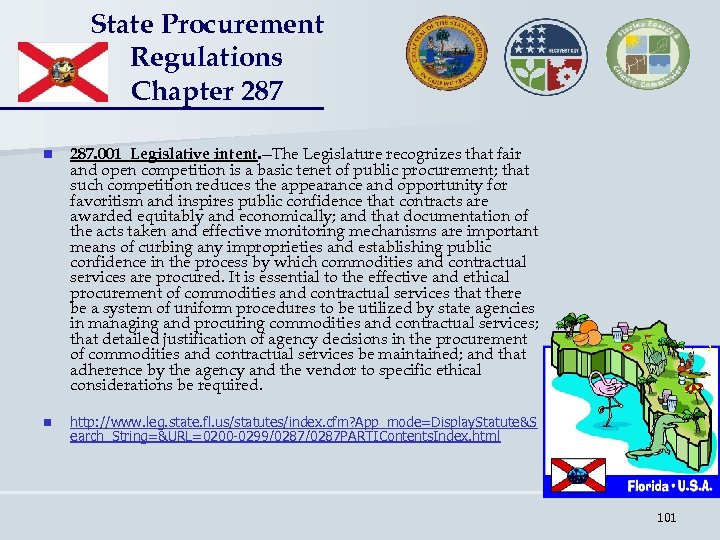
State Procurement Regulations Chapter 287 n 287. 001 Legislative intent. --The Legislature recognizes that fair and open competition is a basic tenet of public procurement; that such competition reduces the appearance and opportunity for favoritism and inspires public confidence that contracts are awarded equitably and economically; and that documentation of the acts taken and effective monitoring mechanisms are important means of curbing any improprieties and establishing public confidence in the process by which commodities and contractual services are procured. It is essential to the effective and ethical procurement of commodities and contractual services that there be a system of uniform procedures to be utilized by state agencies in managing and procuring commodities and contractual services; that detailed justification of agency decisions in the procurement of commodities and contractual services be maintained; and that adherence by the agency and the vendor to specific ethical considerations be required. n http: //www. leg. state. fl. us/statutes/index. cfm? App_mode=Display. Statute&S earch_String=&URL=0200 -0299/0287 PARTIContents. Index. html 101
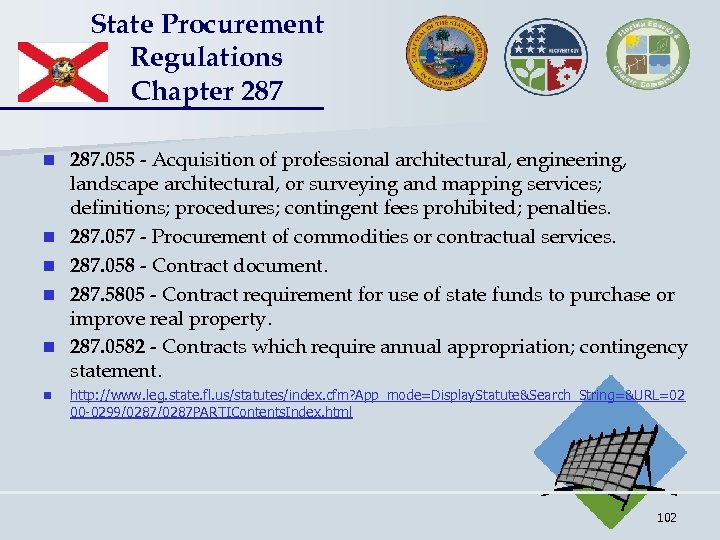
State Procurement Regulations Chapter 287 n n n 287. 055 - Acquisition of professional architectural, engineering, landscape architectural, or surveying and mapping services; definitions; procedures; contingent fees prohibited; penalties. 287. 057 - Procurement of commodities or contractual services. 287. 058 - Contract document. 287. 5805 - Contract requirement for use of state funds to purchase or improve real property. 287. 0582 - Contracts which require annual appropriation; contingency statement. http: //www. leg. state. fl. us/statutes/index. cfm? App_mode=Display. Statute&Search_String=&URL=02 00 -0299/0287 PARTIContents. Index. html 102
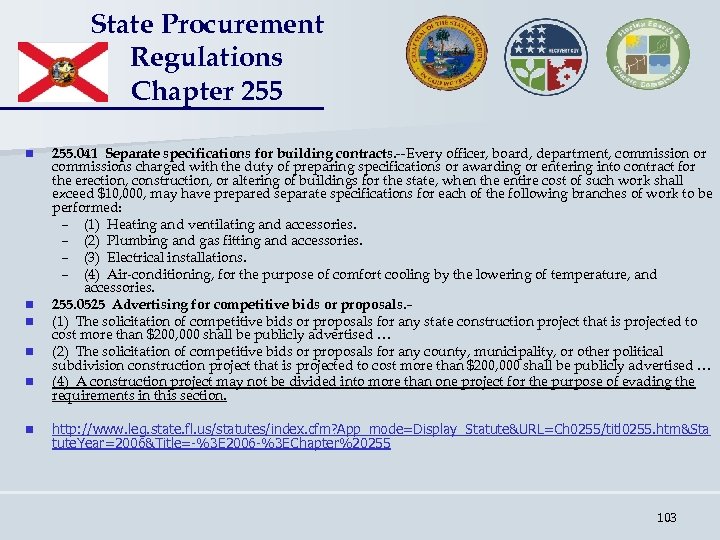
State Procurement Regulations Chapter 255 n n n 255. 041 Separate specifications for building contracts. --Every officer, board, department, commission or commissions charged with the duty of preparing specifications or awarding or entering into contract for the erection, construction, or altering of buildings for the state, when the entire cost of such work shall exceed $10, 000, may have prepared separate specifications for each of the following branches of work to be performed: – (1) Heating and ventilating and accessories. – (2) Plumbing and gas fitting and accessories. – (3) Electrical installations. – (4) Air-conditioning, for the purpose of comfort cooling by the lowering of temperature, and accessories. 255. 0525 Advertising for competitive bids or proposals. – (1) The solicitation of competitive bids or proposals for any state construction project that is projected to cost more than $200, 000 shall be publicly advertised … (2) The solicitation of competitive bids or proposals for any county, municipality, or other political subdivision construction project that is projected to cost more than $200, 000 shall be publicly advertised … (4) A construction project may not be divided into more than one project for the purpose of evading the requirements in this section. http: //www. leg. state. fl. us/statutes/index. cfm? App_mode=Display_Statute&URL=Ch 0255/titl 0255. htm&Sta tute. Year=2006&Title=-%3 E 2006 -%3 EChapter%20255 103
Local Procurement Policies Sub-recipients should have their own written procurement policy n Sub-recipients will maintain a written code of standards… n Sub-recipients will maintain records sufficient to detail the significant history of a procurement – Sub-recipient must create a file for each procurement n * The Energy Office will request your procurement policy 104
Flow Through Requirements / Contract Provisions n n n n Davis Bacon – Tony Morgan Reporting Requirements – Brenda Buchan Buy American Historic Preservation Employment of Unauthorized Aliens Minority Owned Bonds for Construction 105
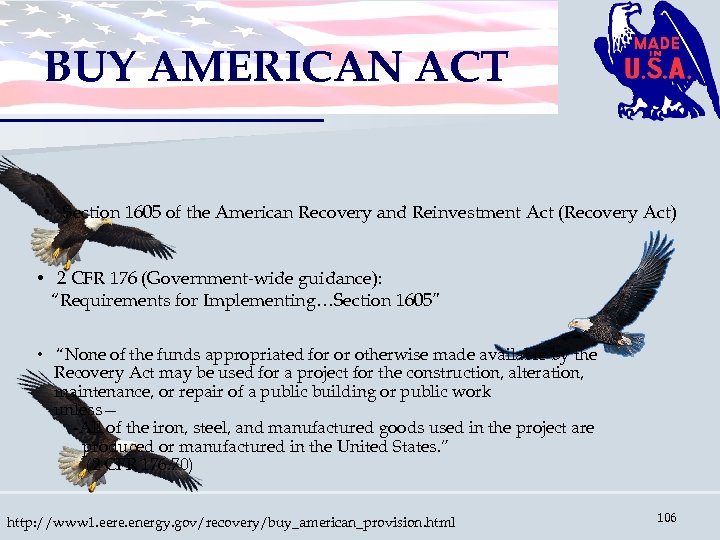
BUY AMERICAN ACT • Section 1605 of the American Recovery and Reinvestment Act (Recovery Act) • 2 CFR 176 (Government-wide guidance): “Requirements for Implementing…Section 1605” • “None of the funds appropriated for or otherwise made available by the Recovery Act may be used for a project for the construction, alteration, maintenance, or repair of a public building or public work unless— -All of the iron, steel, and manufactured goods used in the project are produced or manufactured in the United States. ” (2 CFR 176. 70) http: //www 1. eere. energy. gov/recovery/buy_american_provision. html 106
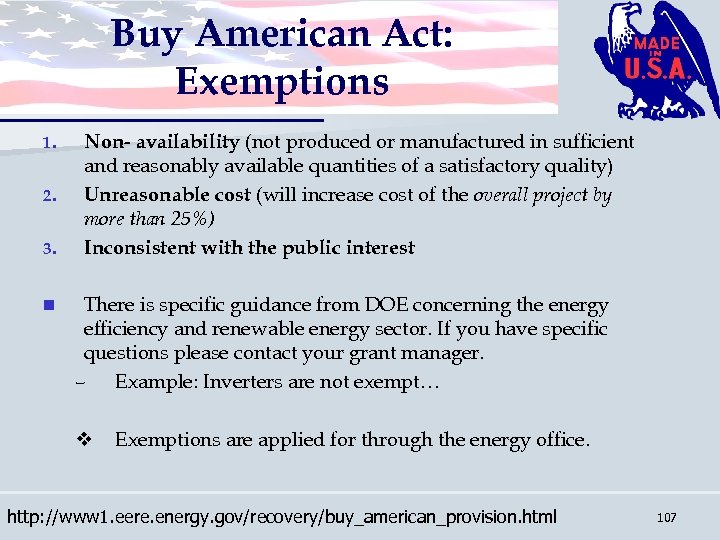
Buy American Act: Exemptions 1. 2. 3. n Non- availability (not produced or manufactured in sufficient and reasonably available quantities of a satisfactory quality) Unreasonable cost (will increase cost of the overall project by more than 25%) Inconsistent with the public interest There is specific guidance from DOE concerning the energy efficiency and renewable energy sector. If you have specific questions please contact your grant manager. – Example: Inverters are not exempt… v Exemptions are applied for through the energy office. http: //www 1. eere. energy. gov/recovery/buy_american_provision. html 107
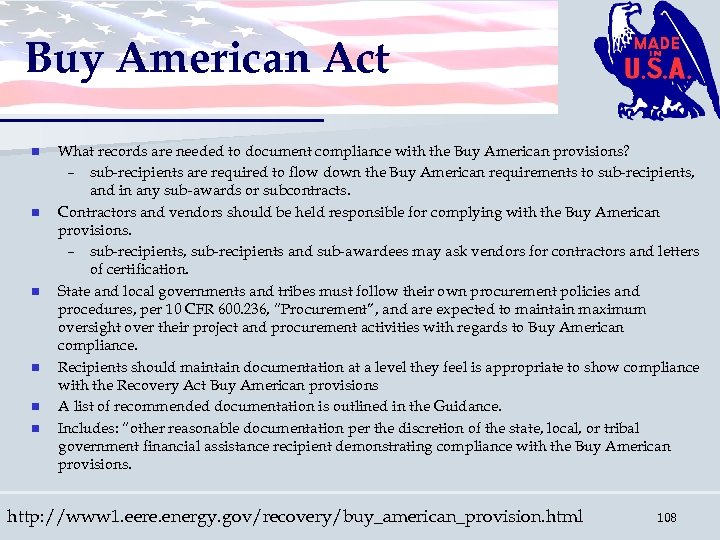
Buy American Act n n n What records are needed to document compliance with the Buy American provisions? – sub-recipients are required to flow down the Buy American requirements to sub-recipients, and in any sub-awards or subcontracts. Contractors and vendors should be held responsible for complying with the Buy American provisions. – sub-recipients, sub-recipients and sub-awardees may ask vendors for contractors and letters of certification. State and local governments and tribes must follow their own procurement policies and procedures, per 10 CFR 600. 236, “Procurement”, and are expected to maintain maximum oversight over their project and procurement activities with regards to Buy American compliance. Recipients should maintain documentation at a level they feel is appropriate to show compliance with the Recovery Act Buy American provisions A list of recommended documentation is outlined in the Guidance. Includes: “other reasonable documentation per the discretion of the state, local, or tribal government financial assistance recipient demonstrating compliance with the Buy American provisions. http: //www 1. eere. energy. gov/recovery/buy_american_provision. html 108
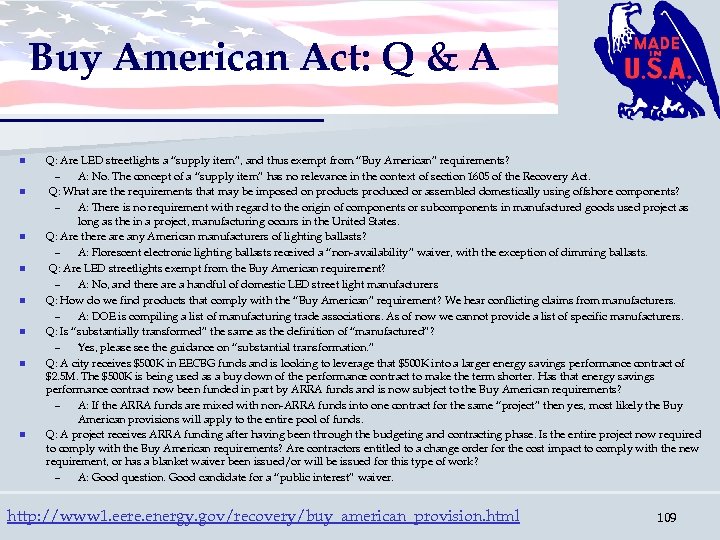
Buy American Act: Q & A n n n n Q: Are LED streetlights a “supply item”, and thus exempt from “Buy American” requirements? – A: No. The concept of a “supply item” has no relevance in the context of section 1605 of the Recovery Act. Q: What are the requirements that may be imposed on products produced or assembled domestically using offshore components? – A: There is no requirement with regard to the origin of components or subcomponents in manufactured goods used project as long as the in a project, manufacturing occurs in the United States. Q: Are there any American manufacturers of lighting ballasts? – A: Florescent electronic lighting ballasts received a “non-availability” waiver, with the exception of dimming ballasts. Q: Are LED streetlights exempt from the Buy American requirement? – A: No, and there a handful of domestic LED street light manufacturers Q: How do we find products that comply with the “Buy American” requirement? We hear conflicting claims from manufacturers. – A: DOE is compiling a list of manufacturing trade associations. As of now we cannot provide a list of specific manufacturers. Q: Is “substantially transformed” the same as the definition of “manufactured”? – Yes, please see the guidance on “substantial transformation. ” Q: A city receives $500 K in EECBG funds and is looking to leverage that $500 K into a larger energy savings performance contract of $2. 5 M. The $500 K is being used as a buy down of the performance contract to make the term shorter. Has that energy savings performance contract now been funded in part by ARRA funds and is now subject to the Buy American requirements? – A: If the ARRA funds are mixed with non-ARRA funds into one contract for the same “project” then yes, most likely the Buy American provisions will apply to the entire pool of funds. Q: A project receives ARRA funding after having been through the budgeting and contracting phase. Is the entire project now required to comply with the Buy American requirements? Are contractors entitled to a change order for the cost impact to comply with the new requirement, or has a blanket waiver been issued/or will be issued for this type of work? – A: Good question. Good candidate for a “public interest” waiver. http: //www 1. eere. energy. gov/recovery/buy_american_provision. html 109
National Historic Preservation Act (NHPA) n n Prior to the expenditure of funds to alter any structure or site, the sub-recipient is required to comply with Section 106 of the NHPA. Section 106 applies to historic properties or sites that are listed on or eligible for listing on the National Register of Historic Places. In order to fulfill the requirements of Section 106, the sub-recipient must contact the State Historic Preservation Officer (SHPO) to coordinate the Section 106 review as set for in 36 CFR 800. – The regulations are published in the Code of Federal Regulations at 36 CFR Part 800, “Protecting Historic Properties” If the structure or site is 50 years or older then the NHPA may take effect and the sub-recipient should research the site. Advisory Council on Historic Preservation: http: //www. achp. gov/ 110
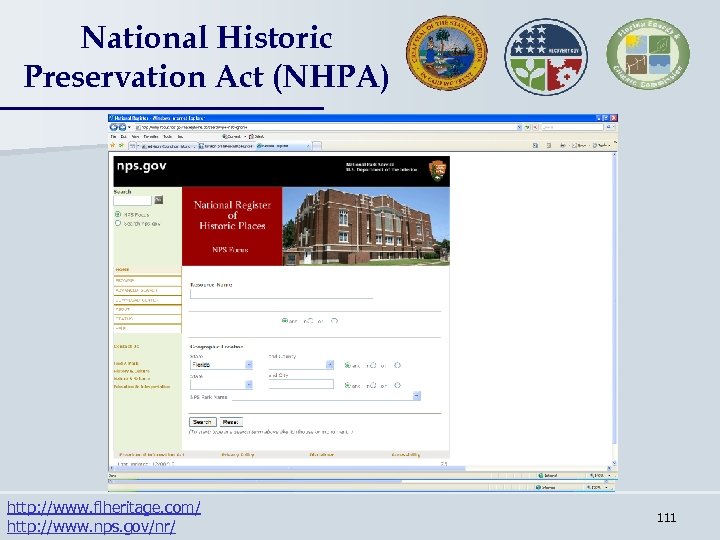
National Historic Preservation Act (NHPA) http: //www. flheritage. com/ http: //www. nps. gov/nr/ 111
Other Provisions n Employment of Unauthorized Aliens – The employment of unauthorized aliens by any Grantee/vendor is considered a violation of Section 274 A(e) of the Immigration and Nationality Act. n Minority Preferences – 287. 093 - Minority business enterprises; procurement of personal property and services from funds set aside for such purpose. – 287. 094 - Minority business enterprise programs; penalty for discrimination and false representation. n Bonds for Construction Projects – A performance bond on the part of the contractor is required for 100% of the contract price and a payment bond on the part of the contractor is required for 100% of the contract price 112
State Term Contracts n State term contracts for Guaranteed Energy, Water, and Wastewater Performance Savings Contracts are allowable in accordance with Florida Statutes, Section 489. 145 n Contact your grant manager for specific information http: //dms. myflorida. com/business_operations/state_purchasing/vendor_information/state_contracts_agreements_and_price_lists 113
General Services Administration (GSA) The GSA has ARRA certified vendors n The GSA Order 4800 “Eligibility to Use GSA Sources of Supplies and Services”, Section 7, Eligible Activities under (d)(6) includes the limitations for state and local governments. n – Local governments are only eligible to purchase from certain schedules § Local governments are eligible to purchase from Schedule 84 which deals with energy and facility management n Website: http: //www. gsa. gov/portal/content/104039 114
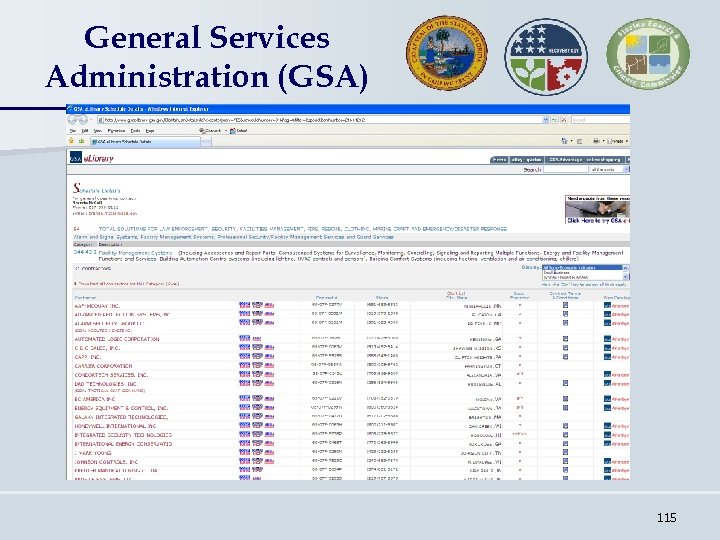
General Services Administration (GSA) 115
Pre-Existing Procurements If you are trying to use existing services that were previously procured; the previous procurement must have been done for the specific project that is being funded and it must have included ARRA requirements. n No retainer contracts n – Cannot use contracts/agreements from other solicitations and no extensions of existing contracts/agreements are allowed. n No piggy backing on other localities procurements. – Cannot use the procurements of other entities and you cannot contract with contractors/vendor procured by another entity. 116
Local Preferences n sub-recipients are prohibited from the use of statutorily or administratively imposed in state or local geographical preferences. – The exception is for engineering and architectural services only. 117
Conflicts of Interest 255. 558 Conflict of interest. --Prior to issuing any abatement contract, the asbestos contractor must submit a sworn affidavit, on a form acceptable to the asbestos program administrator, to the contracting agency attesting that he or she has no financial or other interest in the asbestos consultant who prepared the building survey report, operation and maintenance plan, or abatement specifications for the building covered by the contract. n Arms length transactions…. – A third tier contractor/vendor cannot assist the sub-recipient with a procurement that the third tier contractor/vendor will bid on. – The “Mayor’s brother” cannot bid on procurements unless a non-disclosure form is filled out. n 118
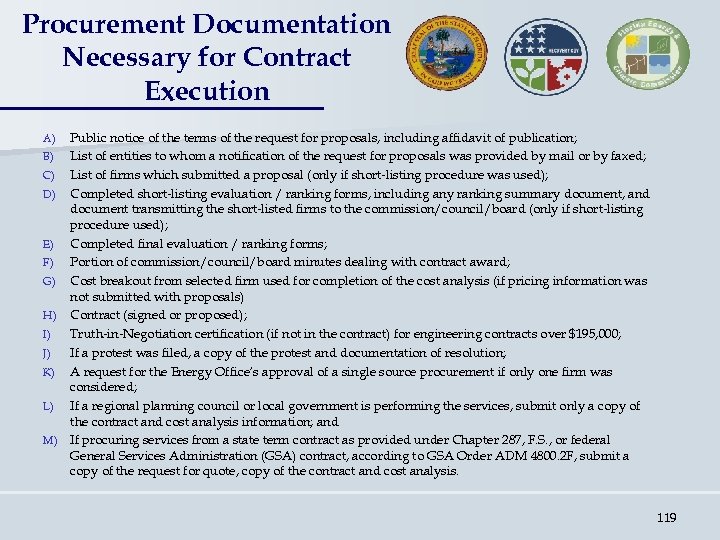
Procurement Documentation Necessary for Contract Execution A) B) C) D) E) F) G) H) I) J) K) L) M) Public notice of the terms of the request for proposals, including affidavit of publication; List of entities to whom a notification of the request for proposals was provided by mail or by faxed; List of firms which submitted a proposal (only if short-listing procedure was used); Completed short-listing evaluation / ranking forms, including any ranking summary document, and document transmitting the short-listed firms to the commission/council/board (only if short-listing procedure used); Completed final evaluation / ranking forms; Portion of commission/council/board minutes dealing with contract award; Cost breakout from selected firm used for completion of the cost analysis (if pricing information was not submitted with proposals) Contract (signed or proposed); Truth-in-Negotiation certification (if not in the contract) for engineering contracts over $195, 000; If a protest was filed, a copy of the protest and documentation of resolution; A request for the Energy Office’s approval of a single source procurement if only one firm was considered; If a regional planning council or local government is performing the services, submit only a copy of the contract and cost analysis information; and If procuring services from a state term contract as provided under Chapter 287, F. S. , or federal General Services Administration (GSA) contract, according to GSA Order ADM 4800. 2 F, submit a copy of the request for quote, copy of the contract and cost analysis. 119
Questions? 120
REPORTING Presented by Brenda Buchan, Chief Analyst 121
No Reports No Pay! n The most important point of this section to remember is that if you do not submit your reports, you will not be paid. n Your monthly reports must be included with the payment invoice package sent to the Energy Office. n If your monthly reports are not provided, your invoice will sit on a desk until it arrives. 122
Grant Agreement Within the Grant Agreement the Sub-recipient agrees to submit progress reports that provide: (a) The project progress (b) Work performed (c) Problems encountered (d) Problems resolved (e) Schedule Updates, and (f) Proposed work for the next reporting period (g) Budget Update (h) Subcontractor disclosure list 123
What to Report The Monthly Report is Attachment C n Provide sufficient information to justify the payment and demonstrate progress. n Be sure to sign and date your submission. n Pay attention to and provide the required metrics. n ─Energy Savings ─Jobs ─Energy Audits ─Transportation ─Workshops ─Lots of others 124
Monthly Reports The “invoice” or Payment Request Summary Form, Attachment B, is encouraged to be submitted monthly. n It must be accompanied by a Monthly Progress Report, Attachment C, for the corresponding month. n The Monthly Progress Reports is supposed to be submitted to the Energy Office no later than 3 calendar days following the completion of the month. n The Energy Office requires that reporting early in the month because we must report to USDOE thereafter. n 125
Annual Reports n The Sub-recipient shall submit an Annual Report 15 calendar days after the end of the first year of the project, if the term of the project exceeds one year. n The Annual Report shall provide a narrative detailing and evaluating the accomplishments and impact of the project in the prior twelve months. n The Annual Report shall follow the format similar to the monthly report, Attachment K. 126
Final Report The Sub-recipient shall also submit a Final Report 15 calendar days prior to the expiration date of the Agreement and it will include: Narrative detailing and evaluating the accomplishments and impact of the project n an evaluation of the energy savings directly attributable to the project, n projections of estimated energy savings expected to accrue from the project and n policy recommendations, which may be helpful in implementing other projects of similar nature. n Pursuant to the Agreement, 10% of the total Agreement amount will be withheld from each invoice until receipt and approval of the Final Report. 127
Property Reports In those instances where the Sub-recipient’s nonexpendable equipment is purchased with ARRA funds in whole or in part: – Attachment J, the Property Reporting Form must be filed along with the “invoice” or Payment Request Form when these costs are documented for reimbursement or match. – The Sub-recipient must complete and sign the Form. n According to the agreement, the purchase of nonexpendable personal property or equipment costing $1, 000 or more remains the property of the Commission. – If the equipment is a component of a functional unit it does not apply. n 128
Property Reporting Form List equipment costing $1, 000 or more. n Sub-recipient must provide: n – – Description of property Serial number and Cost Where it is located Property Control Number Sub-recipient must use an assigned Property Control Number to track its inventory. n Sub-recipient must conduct an annual inventory of property purchased through this agreement. n 129
Reporting The final thought is: Reports = Invoice Payment If you want to be paid you need to submit complete and detailed reports. Questions? 130
AUDITING Presented by Kelley Smith, Grant Manager 131
Auditing is the assertion of objective evidence related to the reliability and integrity of financial and, occasionally, operating information n The examination of the objective evidence underlying the financial data as reported is called an audit n Each sub-recipient maybe subject to federal and/or state auditing requirements, pending the amount of the grant n 132
Grant Agreement n Section 17 – The Sub-recipients shall retain and maintain all records in relation to this grant – Must comply with auditing requirements in Attachment D – Must maintain records in regard to subcontractors working on this grant project – Must provide copies of any audit to the Commission within 30 calendar days of receipt of audit report 133
Attachment D n Part 1: Federally Funded – Sub-recipients who expend $500, 000 or more must have a single or program –specific audit conducted in accordance with OMB Circular A-133 http: //www. whitehouse. gov/sites/default/files/omb/ assets/a 133_revised_2007. pdf – Sub-recipients who expend less than $500, 000, an audit is not required but elective – Administrative costs from the grant can be used for payment of the audit. – If the audit is elective then grant funds cannot be used to pay for the audit 134
Attachment D cont. n Part II – State Funded – Sub-recipients who expend $500, 000 or more must have a State single or project-specific audit in accordance with Section 215. 97 of Florida Statute http: //www. leg. state. fl. us/STATUTES/index. cfm? Ap p_mode=Display_Statute&Search_String=&URL=02 00 -0299/0215/Sections/0215. 97. html – Sub-recipients who expend less than $500, 000, an audit is not required but elective – Sub-recipients must include the record keeping requirements in all subcontractor agreements for work related to this grant 135
Attachment D cont. n Part III: Report Submissions – If sub-recipient is subject to the Federal audit, then a copy of the audit report must be sent to the Commission and the Federal Audit Clearing House – If sub-recipient is subject to the State audit, then a copy of the audit report must be sent to the Commission and the State Auditor General 136
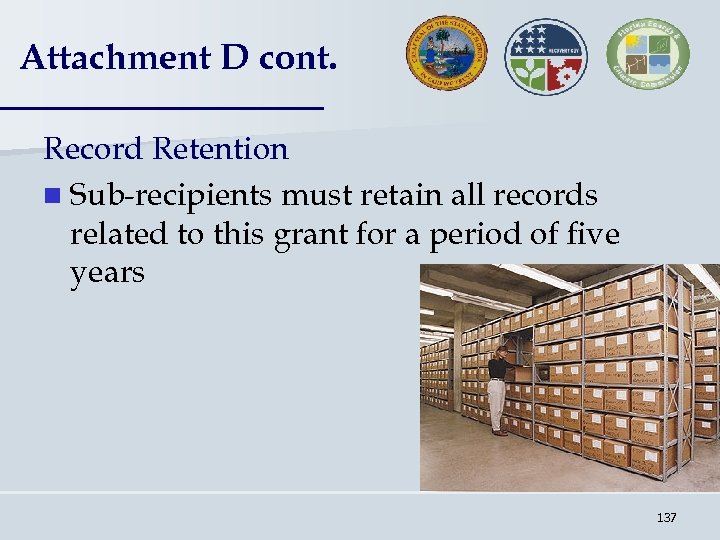
Attachment D cont. Record Retention n Sub-recipients must retain all records related to this grant for a period of five years 137
Questions? n Contact your Grant Manager for specific questions related to your grant 138

139
Monitoring Presented by Matthew J Stamatoff, Grant Manager 140
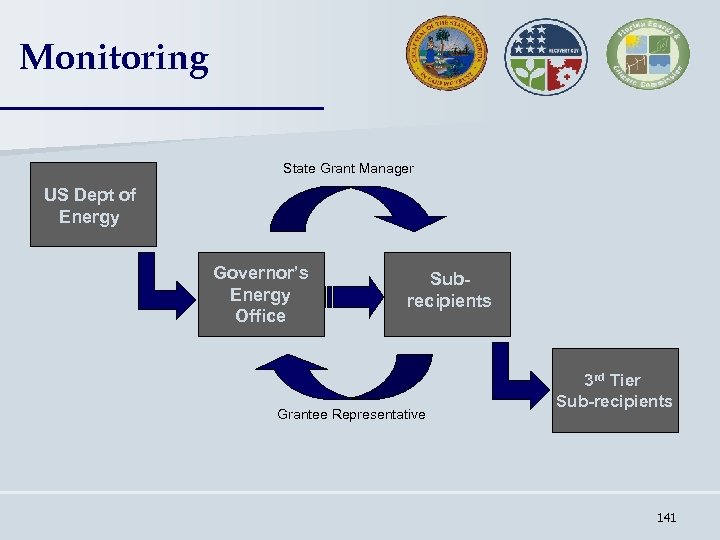
Monitoring State Grant Manager US Dept of Energy Governor’s Energy Office Subrecipients Grantee Representative 3 rd Tier Sub-recipients 141
Monitoring n Each Sub-recipient, the signatory of the grant agreement, is responsible for compliance with the terms and conditions of the grant agreement – The Energy Office will be monitoring the Subrecipient – The Sub-recipient will be responsible for ensuring that all 3 rd Tier Sub-recipients, vendors and contractors adhere to the terms and conditions of the grant agreement 142
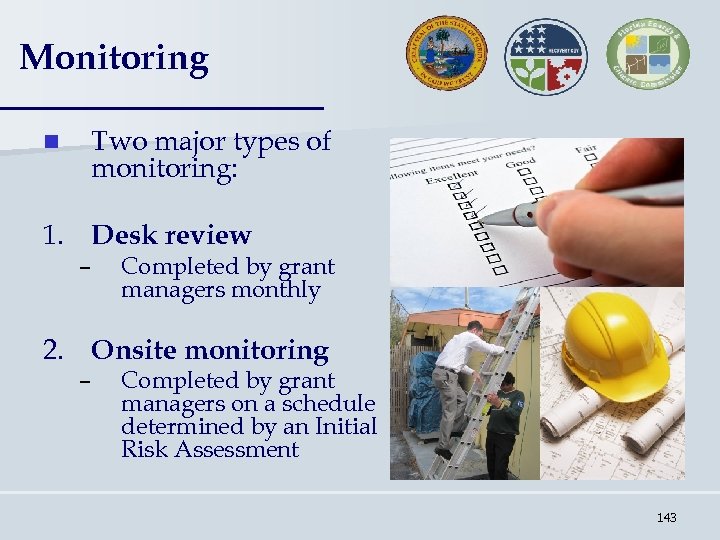
Monitoring n Two major types of monitoring: 1. Desk review – Completed by grant managers monthly 2. Onsite monitoring – Completed by grant managers on a schedule determined by an Initial Risk Assessment 143
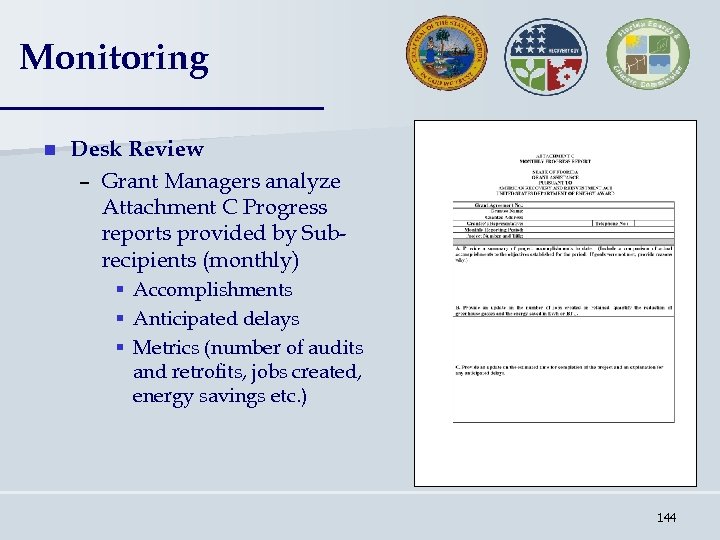
Monitoring n Desk Review – Grant Managers analyze Attachment C Progress reports provided by Subrecipients (monthly) § Accomplishments § Anticipated delays § Metrics (number of audits and retrofits, jobs created, energy savings etc. ) 144
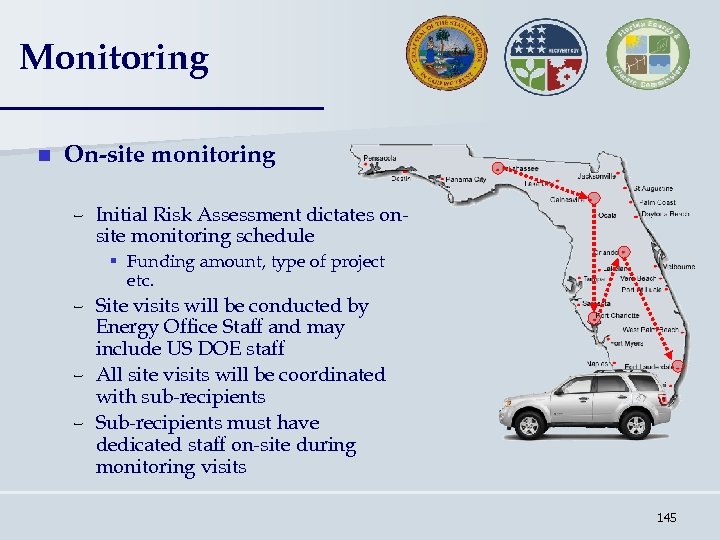
Monitoring n On-site monitoring – Initial Risk Assessment dictates onsite monitoring schedule § Funding amount, type of project etc. – Site visits will be conducted by Energy Office Staff and may include US DOE staff – All site visits will be coordinated with sub-recipients – Sub-recipients must have dedicated staff on-site during monitoring visits 145
Monitoring Tool n During site visits five areas of accountability and compliance will be evaluated: – Financial § e. g. Is there an accounting system? Are there controls for mitigating fraud, waste, and abuse? – Procurement § e. g. Is the Grantee following Federal, State and Local procurement standards? Is there a clear process for determining the use and selection of sub-contractors/vendors? – Property Management § e. g. Does the Recipient maintain a system of internal controls that provides reasonable assurance against loss, theft, damage, or unauthorized use of equipment? – Labor Standards § e. g. What is the wage decision? Is the recipient aware of which labor and wage requirements apply to their activities? – Program Administration 146
Monitoring Reports n At the start of Onsite Monitoring, the review team will conduct an entrance interview. At the end of monitoring, the review team will provide a exit interview n A Monitoring Report will be generated within (30) days of final date of the visit n Report evaluates compliance with agreement terms and conditions n Report will be provided to Grantee upon completion n Report may display concerns, requiring a change in the project’s direction n Report may have findings that show a violation of the terms and agreements. This will require corrective actions 147
Monitoring n Corrective Actions – If findings are identified during on-site monitoring, the Monitoring Report will show observed findings – Grantee must provide a Corrective Action Plan (within 10 days of receipt of Monitoring Report) – The Corrective Action Plan must convey to Energy Office a strategy, with a timeline, to remediate any findings 148
Monitoring Questions? 149

150

GRANT CLOSEOUT Presented by April Groover 151
Grant Closeout Required Forms for Closeout Package n Attachment K, Final Report n Attachment B, Final Payment Request n Attachment J, Property Reporting Form n Closeout Certification 152
Attachment K Final Report A summary of project accomplishments and the total number of jobs created or retained, the total reduction of greenhouse gasses and the energy saved in k. Wh or BTU for the project. n Have all required projects or activities been completed? n Have all reports been received? n Have program objectives been met? 153
Attachment B Final Payment Request n n n Do all budget line items reconcile? Have liquidated damages/sanctions been assessed for nonperformance/non-compliance? Have disallowed costs and/or unused grant funds been recovered? Will the project result in program income? (Program income earned but not expended before closeout must be returned to the FECC). Have all required audits been received, reviewed any deficiencies noted in the audit report have been corrected? 154
Attachment J Property Reporting Form n List non-expendable equipment/personal property costing $1, 000 or more purchased under the grant agreement. 155
Closeout Certification n Grantee certifies all activities under this grant agreement have been carried out in accordance with the grant agreement and that proper provision has been made for the payment of all paid costs identified. 156
After Closeout n Grantee retains sufficient records (reports, pictures, financial records, correspondence) demonstrating its compliance with the terms of this Agreement for a period of five years and allows access to such records upon request by the Commission or its designee, Chief Financial Officer or Auditor General. 157
Questions or Comments? 158
Скачать презентацию GOVERNOR S ENERGY OFFICE Presented by Alexander Mack Community
0c582577ce19bcb72a3f97e12c4d3cdd.ppt