 Скачать презентацию Governmental use of sustainability standards examples lessons
c6126977e4d28ca9bb5a217d57e9014e.ppt
- Количество слайдов: 22



Governmental use of sustainability standards: examples & lessons from the UK RTFO ISEAL conference, Zurich, 8 June 2011 Dr Keeley Bignal - Sustainability Technical Guidance Specialist RTFO Unit, Low Carbon Fuels, UK Department for Transport
Overview • • UK biofuel policy C&S reporting RTFO Biofuel Sustainability Meta-standard Benchmarks of sustainability schemes against the Meta-standard • Benchmarks against the RED carbon stock and biodiversity criteria • Uptake of standards by suppliers of biofuel to the UK • Lessons learnt
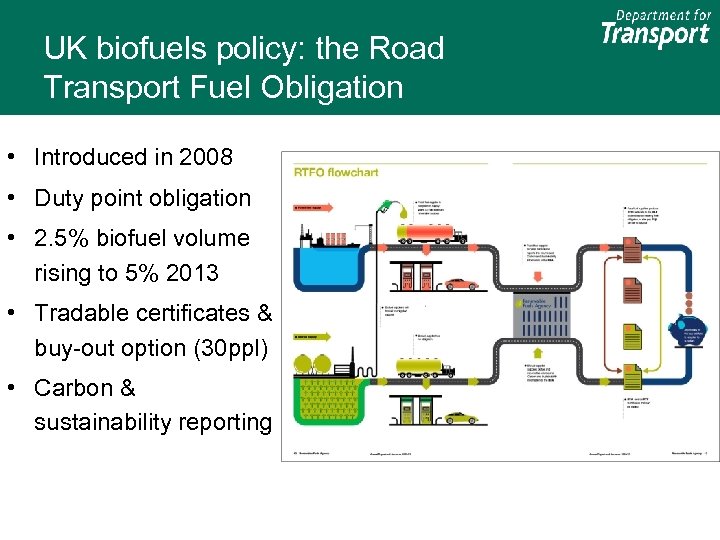
UK biofuels policy: the Road Transport Fuel Obligation • Introduced in 2008 • Duty point obligation • 2. 5% biofuel volume rising to 5% 2013 • Tradable certificates & buy-out option (30 ppl) • Carbon & sustainability reporting
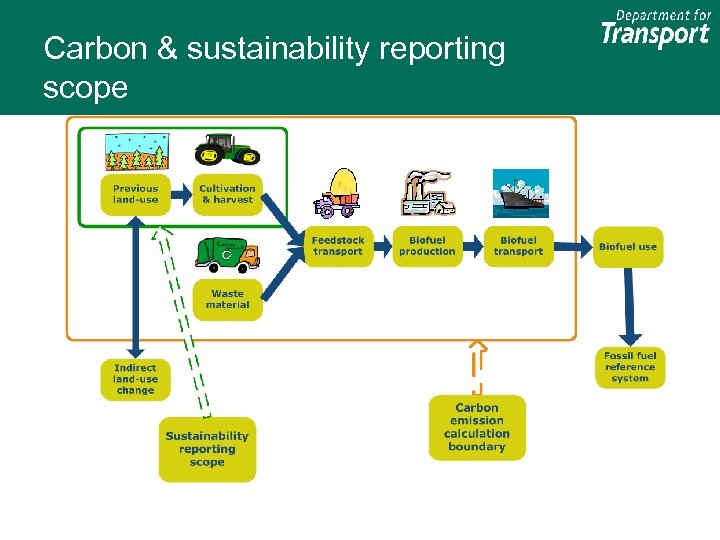
Carbon & sustainability reporting scope
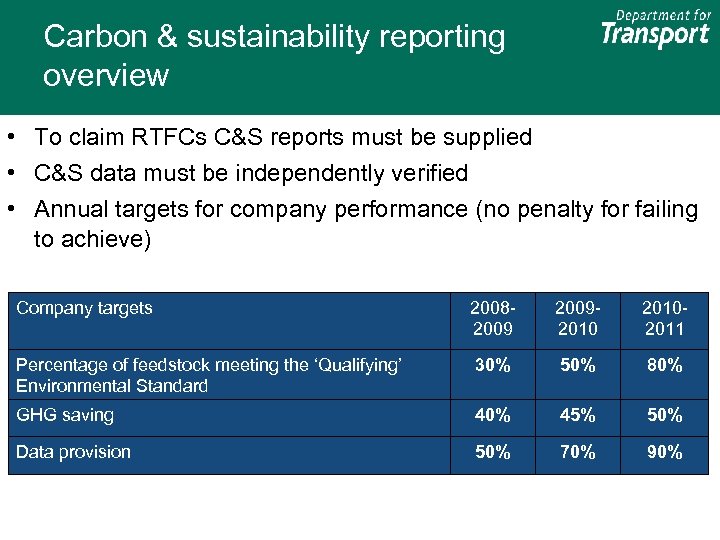
Carbon & sustainability reporting overview • To claim RTFCs C&S reports must be supplied • C&S data must be independently verified • Annual targets for company performance (no penalty for failing to achieve) Company targets 2008200920102011 Percentage of feedstock meeting the ‘Qualifying’ Environmental Standard 30% 50% 80% GHG saving 40% 45% 50% Data provision 50% 70% 90%
C&S reporting - the 'RED-ready' approach • RTFO C&S reporting adapted to be as consistent as possible with the EC requirements from the start of the third year of the RTFO on 15 April 2010 • Aim to help UK industry best prepare for the RED • Aim to be transparent about which batches of fuel are indicatively RED-ready • RTFO continues to require C&S reporting rather than mandatory minimum performance until RED implementation
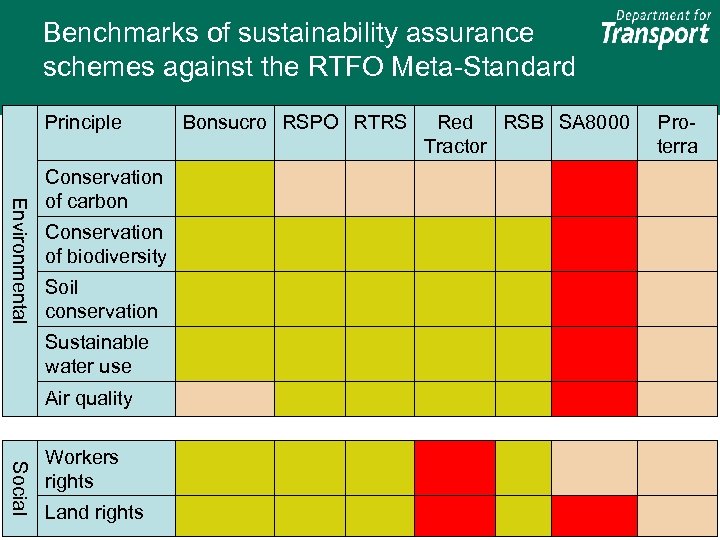
Benchmarks of sustainability assurance schemes against the RTFO Meta-Standard Principle Environmental Conservation of carbon Conservation of biodiversity Soil conservation Sustainable water use Air quality Social Workers rights Land rights Bonsucro RSPO RTRS Red RSB SA 8000 Tractor Proterra
The norm for Qualifying Standards • Qualifying Environmental Standard: – Full compliance with all criteria referring to compliance with national legislation (2. 1, 3. 1, 4. 1, 5. 1); – On all principles one ‘partial compliance’ criterion is permitted per principle, with a maximum of three in total. • Qualifying Social Standard: – On principle 6, seven of the 11 criteria must be fully complied with; – On principle 7 on land right issues and community relations, one partial compliance is permitted.
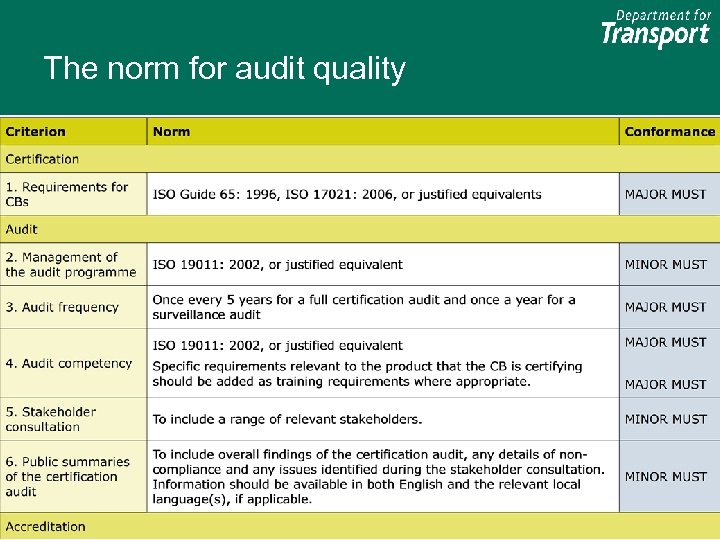
The norm for audit quality
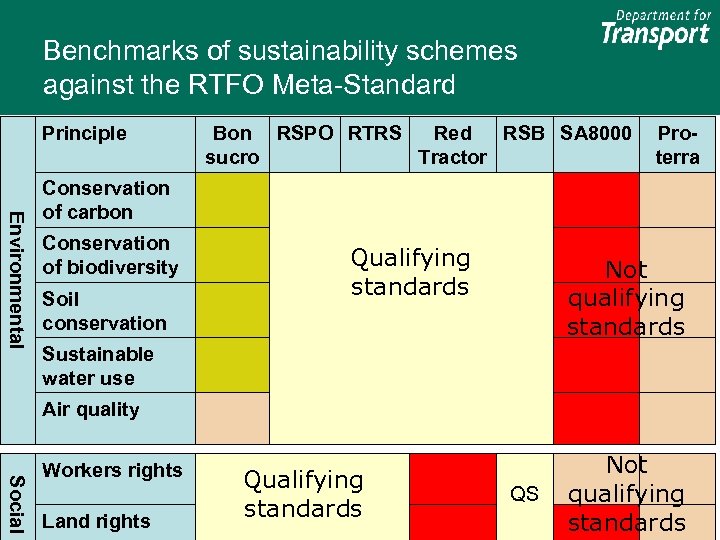
Benchmarks of sustainability schemes against the RTFO Meta-Standard Principle Bon RSPO RTRS Red RSB SA 8000 sucro Tractor Proterra Environmental Conservation of carbon Conservation of biodiversity Soil conservation Qualifying standards Not qualifying standards Sustainable water use Air quality Social Workers rights Land rights Qualifying standards QS Not qualifying standards
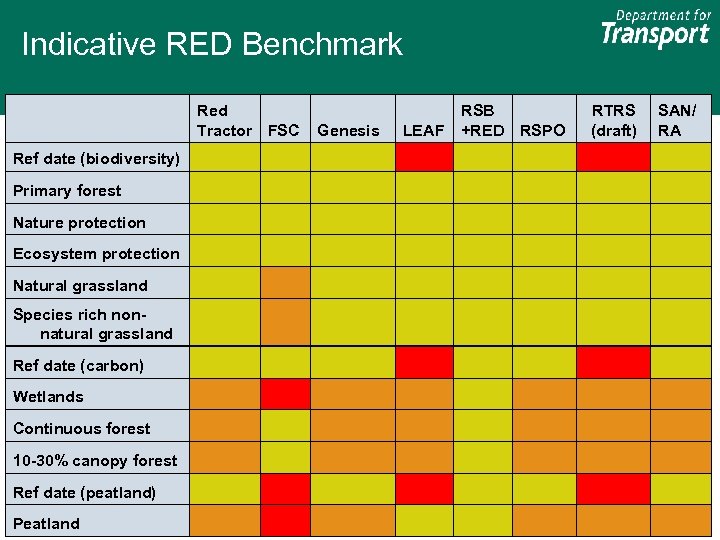
Indicative RED Benchmark Red Tractor FSC Genesis LEAF RSB +RED RSPO RTRS (draft) SAN/ RA Ref date (biodiversity) Primary forest Nature protection Ecosystem protection Natural grassland Species rich nonnatural grassland Ref date (carbon) Wetlands Continuous forest 10 -30% canopy forest Ref date (peatland) Peatland
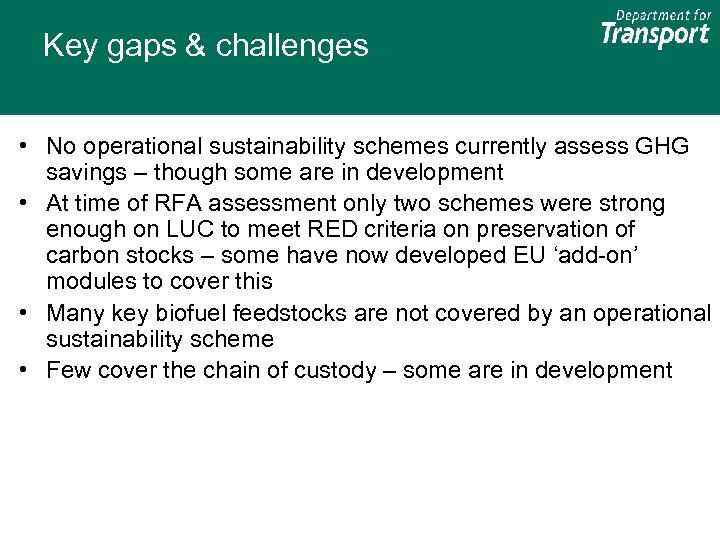
Key gaps & challenges • No operational sustainability schemes currently assess GHG savings – though some are in development • At time of RFA assessment only two schemes were strong enough on LUC to meet RED criteria on preservation of carbon stocks – some have now developed EU ‘add-on’ modules to cover this • Many key biofuel feedstocks are not covered by an operational sustainability scheme • Few cover the chain of custody – some are in development
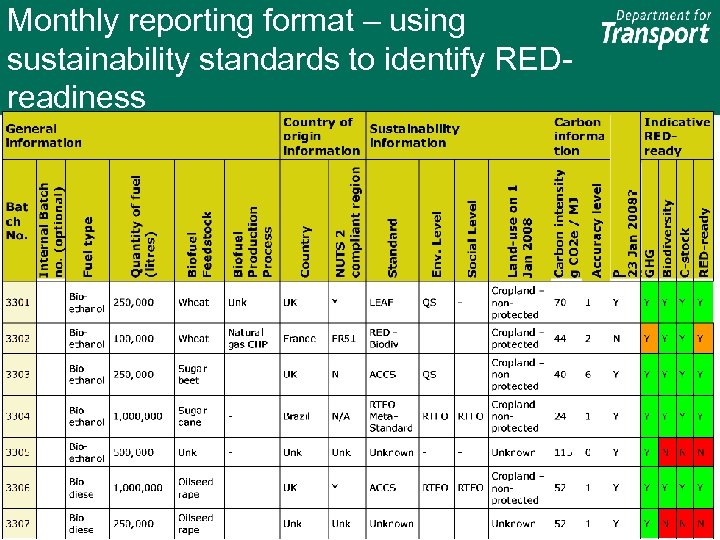
Monthly reporting format – using sustainability standards to identify REDreadiness
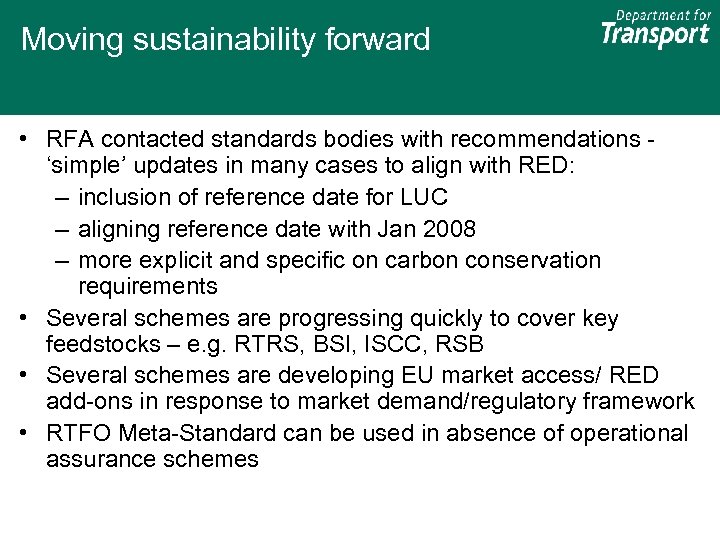
Moving sustainability forward • RFA contacted standards bodies with recommendations ‘simple’ updates in many cases to align with RED: – inclusion of reference date for LUC – aligning reference date with Jan 2008 – more explicit and specific on carbon conservation requirements • Several schemes are progressing quickly to cover key feedstocks – e. g. RTRS, BSI, ISCC, RSB • Several schemes are developing EU market access/ RED add-ons in response to market demand/regulatory framework • RTFO Meta-Standard can be used in absence of operational assurance schemes
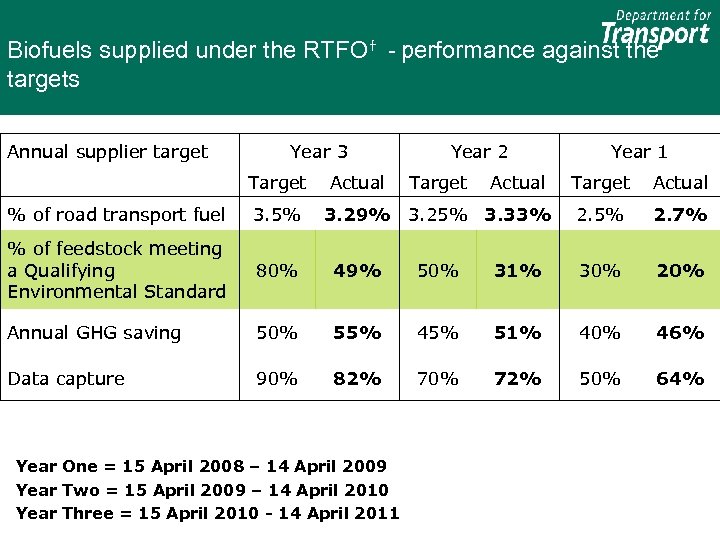
Biofuels supplied under the RTFO† - performance against the targets Annual supplier target Year 3 Actual Year 2 Target % of road transport fuel 3. 5% % of feedstock meeting a Qualifying Environmental Standard 80% 49% 50% Annual GHG saving 50% 55% Data capture 90% 82% Actual Target Actual 2. 5% 2. 7% 31% 30% 20% 45% 51% 40% 46% 70% 72% 50% 64% 3. 29% 3. 25% 3. 33% Year One = 15 April 2008 – 14 April 2009 Year Two = 15 April 2009 – 14 April 2010 Year Three = 15 April 2010 - 14 April 2011 Year 1
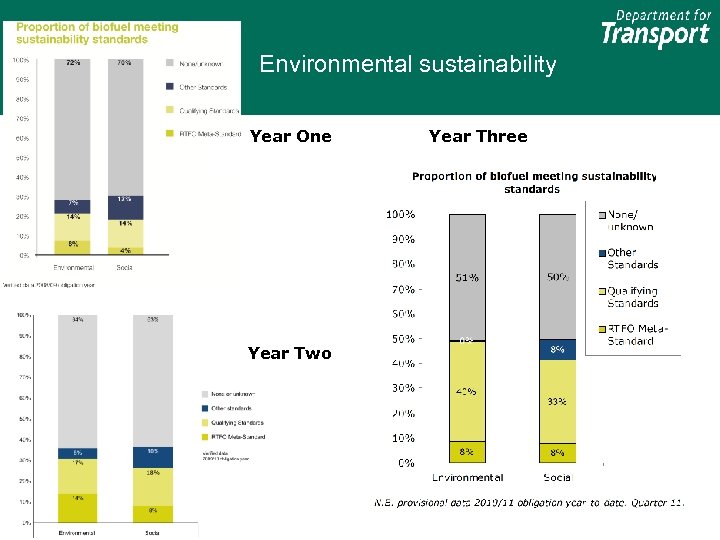
Environmental sustainability Year One Year Two Year Three
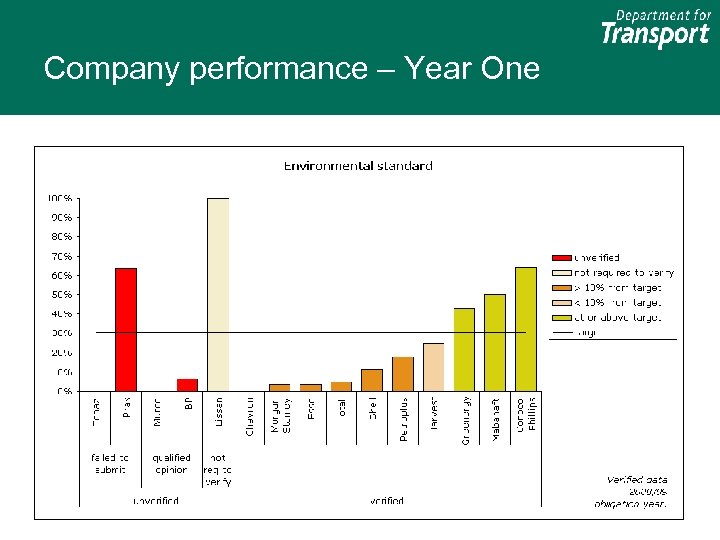
Company performance – Year One Environmental sustainability by company
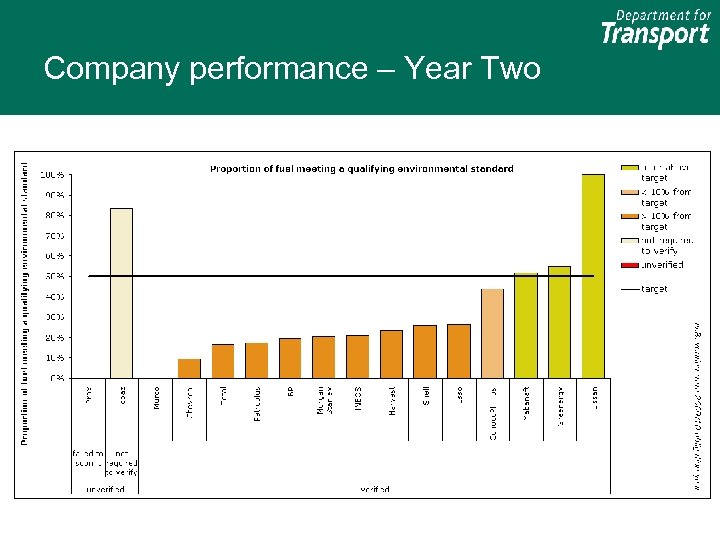
Company performance – Year Two Environmental sustainability by company
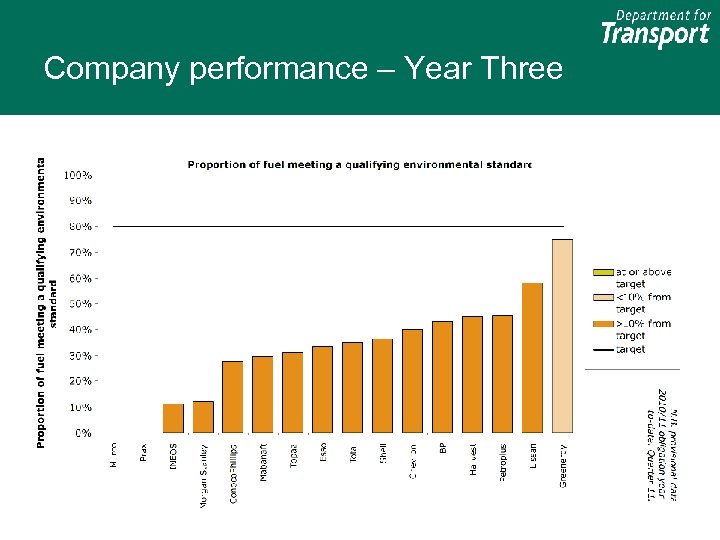
Company performance – Year Three Environmental sustainability by company
Key RED sustainability features • 35% GHG savings • Cross-compliance • High carbon stock protection* – Wetlands – Peatlands – Continuous forest • High biodiversity protection* – Undisturbed primary forest – Conservation areas – Biodiverse grassland *Post Jan 2008 RTFO data – are we ready for RED? First 9 months of Yr 3 • 71% of biofuel met the 35% GHG saving threshold (may not have met all sustainability criteria e. g. unknown land use) • 13% from unknown land use • 49% met an environmental standard
Lessons learnt • The standard must be fit for purpose e. g. a scheme may be designed for food safety but not for environmental sustainability • Engage the standard owner – Inform them of process and purpose of benchmarking – Ensure you have the latest (and all) documentation – Inform them of the results before finalising – Can work with the standard owners to drive sustainability • Consult with experts and stakeholders on benchmark results • Be realistic – set the ‘standard’ you are aiming for but recognise that there may be interim steps to get there • Get ‘buy-in’ from stakeholders – need the fuel suppliers and supply chain to provide the demand for sustainability schemes
Lessons learnt • Voluntary C&S reporting works – Uptake of sustainability schemes has increased over time – Providing public access to data has driven individual companies to improve performance • Voluntary reporting can provide a ‘stepping stone’ to mandatory sustainability
Скачать презентацию Governmental use of sustainability standards examples lessons
c6126977e4d28ca9bb5a217d57e9014e.ppt