


 Скачать презентацию Government Striking Out A Recession Fiscal Policy
75690eae2bea0850be0688eac78dd7c5.ppt
- Количество слайдов: 39
 Government “Striking Out” A Recession Fiscal Policy
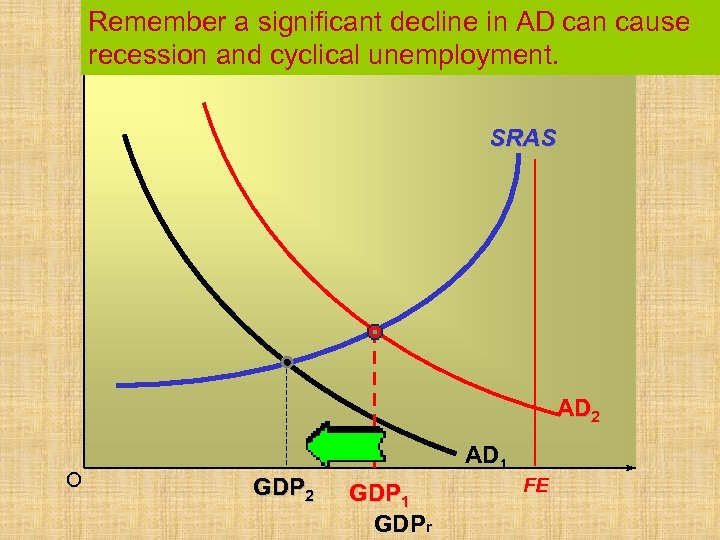 Remember a significant decline in AD can cause recession and cyclical unemployment. SRAS AD 2 O AD 1 GDP 2 GDP 1 GDPr FE
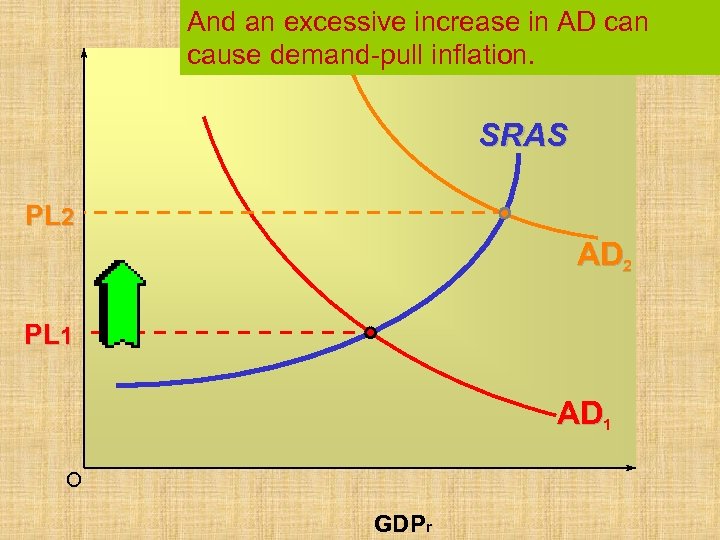 And an excessive increase in AD can cause demand-pull inflation. SRAS PL 2 AD 2 PL 1 AD 1 O GDPr
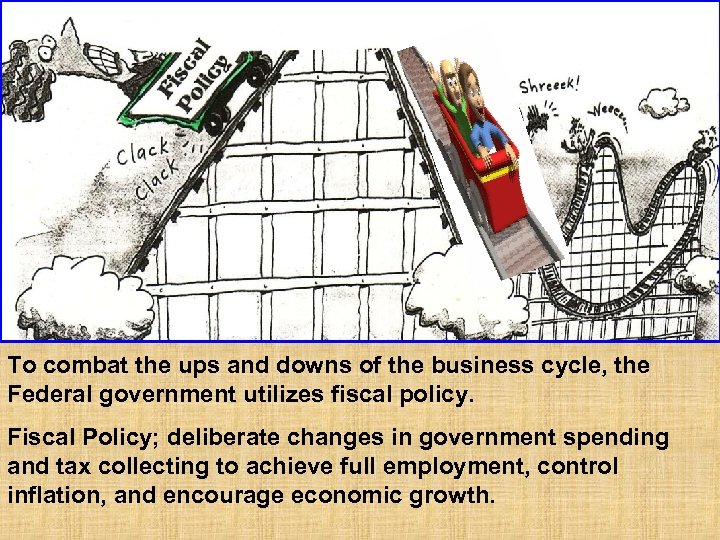 To combat the ups and downs of the business cycle, the Federal government utilizes fiscal policy. Fiscal Policy; deliberate changes in government spending and tax collecting to achieve full employment, control inflation, and encourage economic growth.
 • Fiscal policy (Keynesian economics) emerged out the Great Depression of the 1930 s. But it was not until 1946 that it became a mandatory government function. • Employment Act of 1946; commits the Federal government to take action through fiscal or monetary policy in order to maintain economic stability.
 • The Humphrey-Hawkins Act (1978); requires the Federal government to provide five-year economic goals, with the primary goal of maintaining 4% unemployment and 3% inflation rates. • Council of Economic Advisers (CEA); organized to help the president met these primary goals.
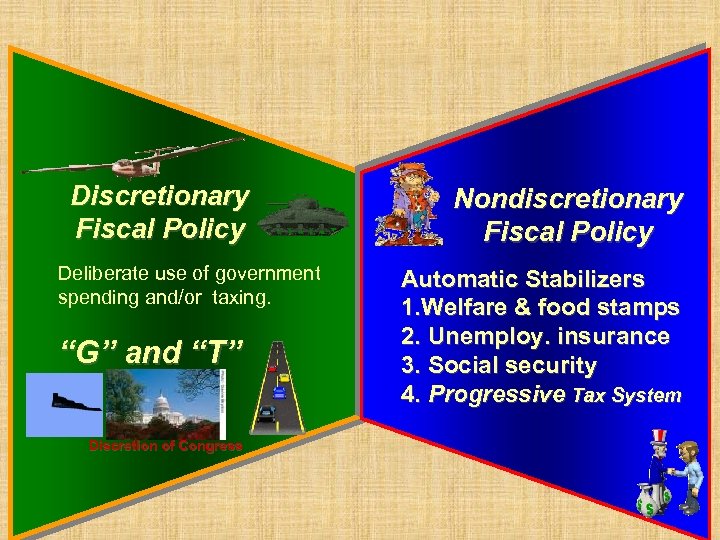 Discretionary Fiscal Policy Deliberate use of government spending and/or taxing. “G” and “T” Discretion of Congress Nondiscretionary Fiscal Policy Automatic Stabilizers 1. Welfare & food stamps 2. Unemploy. insurance 3. Social security 4. Progressive Tax System
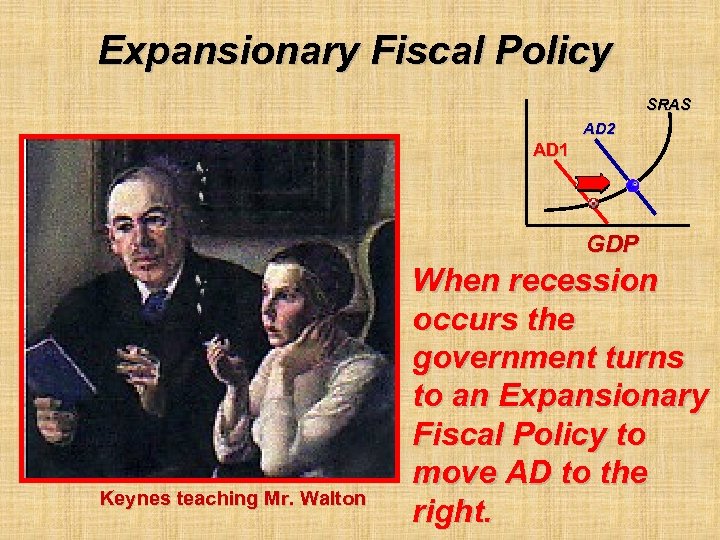 Expansionary Fiscal Policy SRAS AD 2 AD 1 GDP Keynes teaching Mr. Walton When recession occurs the government turns to an Expansionary Fiscal Policy to move AD to the right.
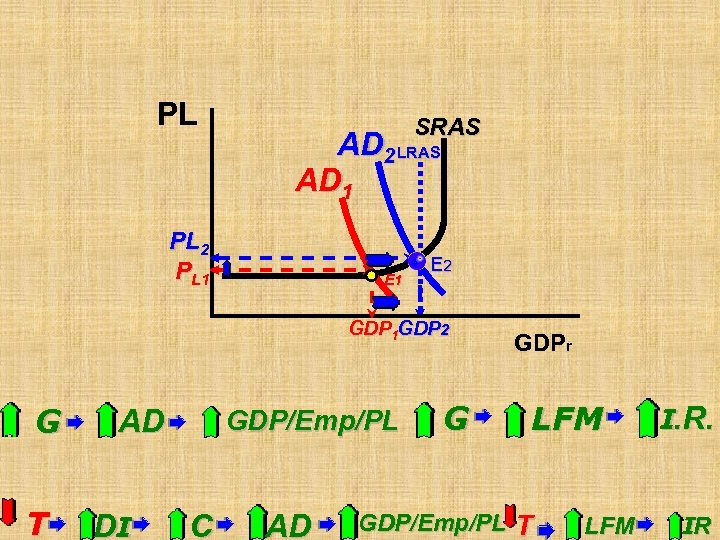 PL SRAS AD 2 LRAS AD 1 PL 2 PL 1 E 2 GDP 1 GDP 2 G T AD DI GDP/Emp/PL C AD G GDPr LFM GDP/Emp/PL T LFM I. R. IR
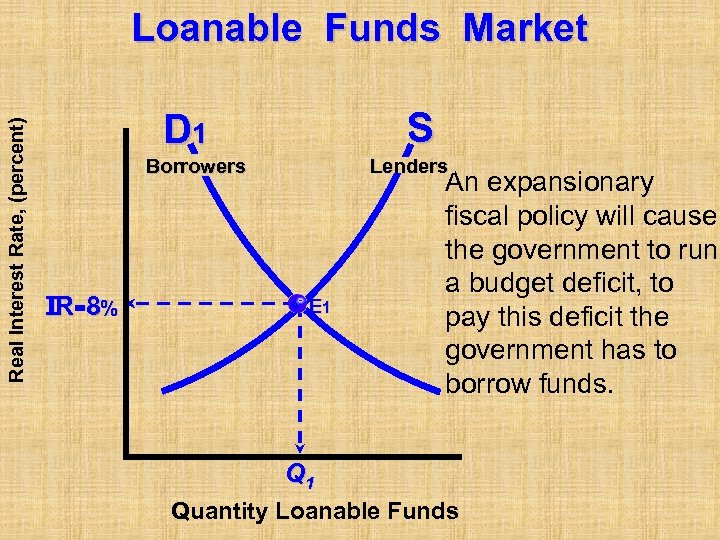 Real Interest Rate, (percent) Loanable Funds Market S D 1 Lenders Borrowers IR=8% E 1 An expansionary fiscal policy will cause the government to run a budget deficit, to pay this deficit the government has to borrow funds. Q 1 Quantity Loanable Funds
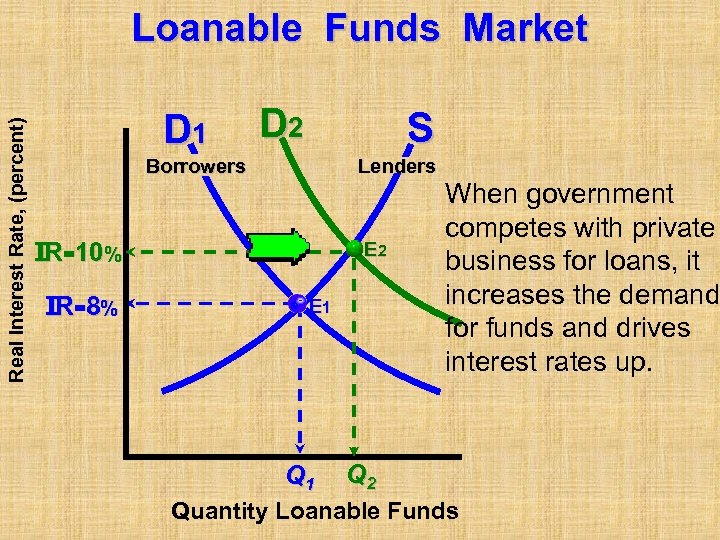 Real Interest Rate, (percent) Loanable Funds Market D 1 D 2 S Lenders Borrowers IR=10% IR=8% E 2 E 1 Q 1 When government competes with private business for loans, it increases the demand for funds and drives interest rates up. Q 2 Quantity Loanable Funds
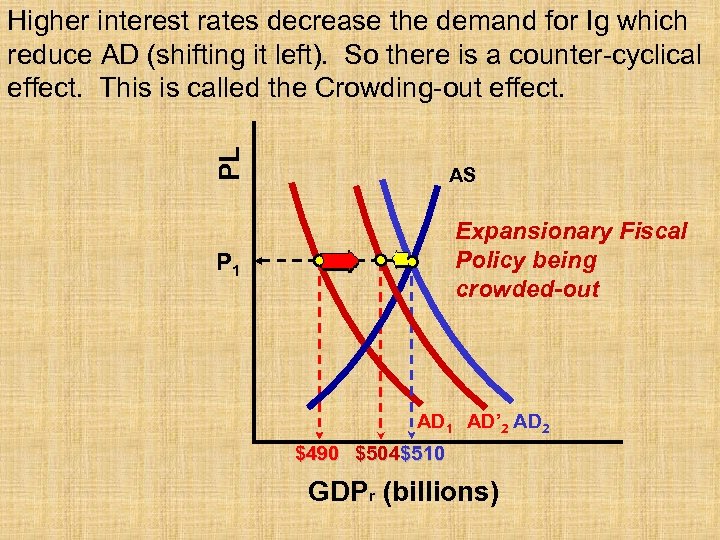 PL Higher interest rates decrease the demand for Ig which reduce AD (shifting it left). So there is a counter-cyclical effect. This is called the Crowding-out effect. AS Expansionary Fiscal Policy being crowded-out P 1 AD’ 2 AD 2 $490 $504 $510 GDPr (billions)
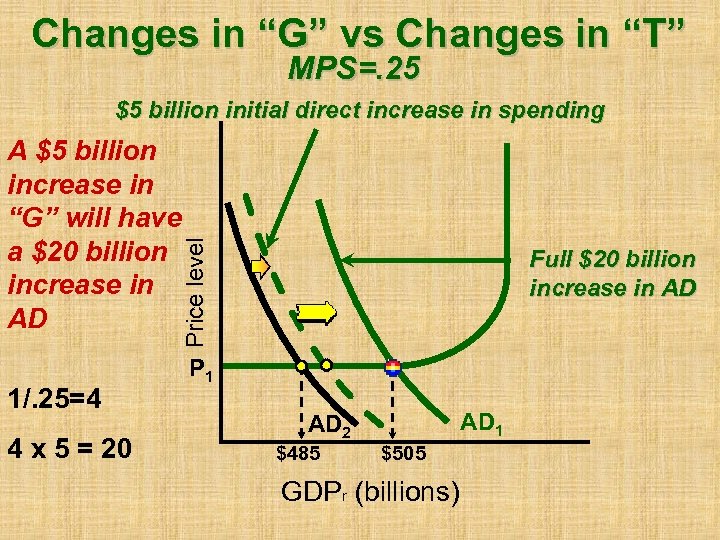 Changes in “G” vs Changes in “T” MPS=. 25 A $5 billion increase in “G” will have a $20 billion increase in AD 1/. 25=4 4 x 5 = 20 Price level $5 billion initial direct increase in spending Full $20 billion increase in AD P 1 AD 2 $485 $505 GDPr (billions) AD 1
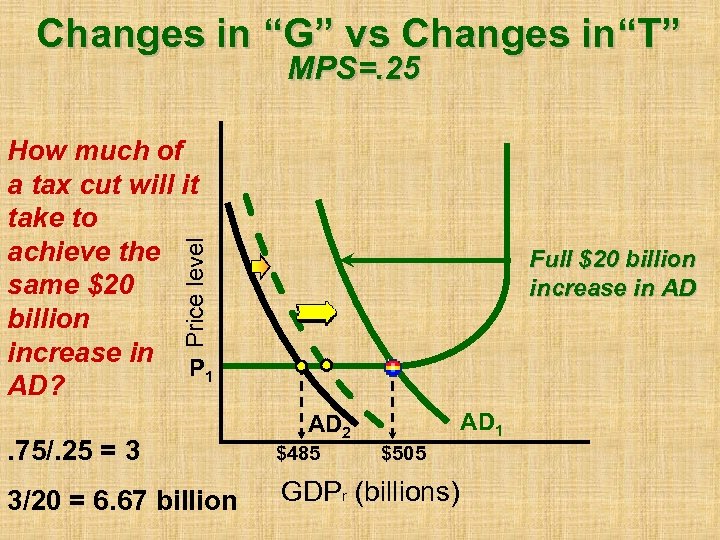 Changes in “G” vs Changes in“T” MPS=. 25 Price level How much of a tax cut will it take to achieve the same $20 billion increase in P 1 AD? Full $20 billion increase in AD AD 2 . 75/. 25 = 3 $485 $505 3/20 = 6. 67 billion GDPr (billions) AD 1
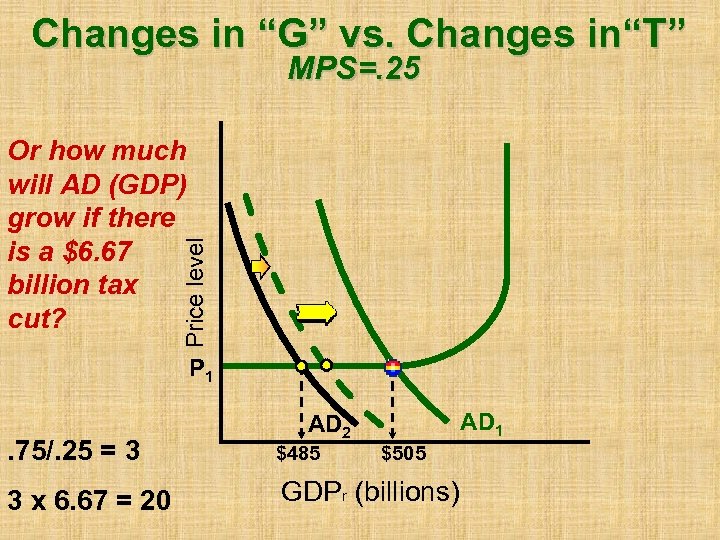 Changes in “G” vs. Changes in“T” MPS=. 25 Price level Or how much will AD (GDP) grow if there is a $6. 67 billion tax cut? P 1 AD 2 . 75/. 25 = 3 $485 $505 3 x 6. 67 = 20 GDPr (billions) AD 1
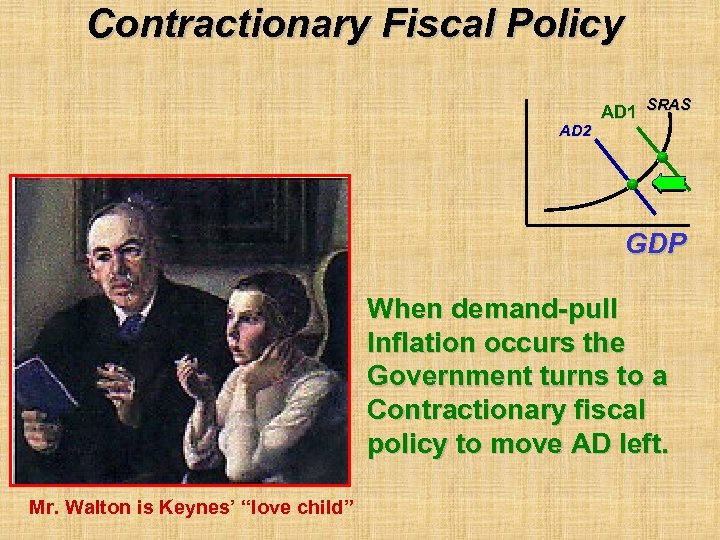 Contractionary Fiscal Policy AD 2 AD 1 SRAS GDP When demand-pull Inflation occurs the Government turns to a Contractionary fiscal policy to move AD left. Mr. Walton is Keynes’ “love child”
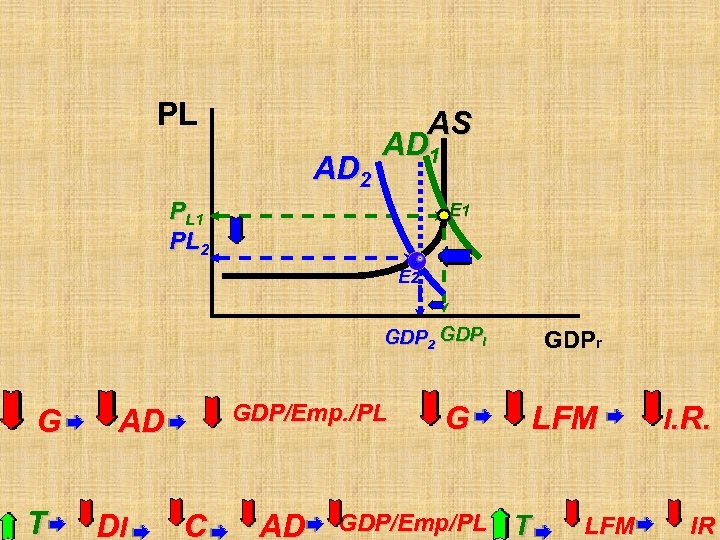 PL AD 2 AS AD 1 PL 2 E 1 E 2 GDPI G T GDP/Emp. /PL AD DI C AD G GDP/Emp/PL GDPr LFM T LFM I. R. IR
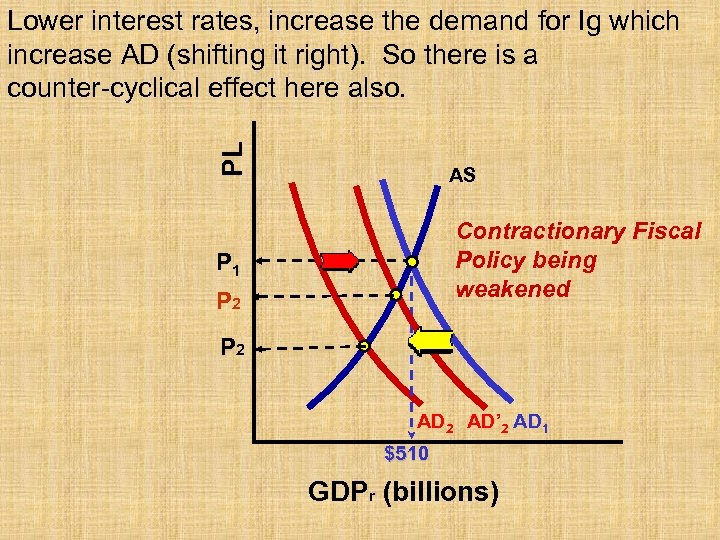 PL Lower interest rates, increase the demand for Ig which increase AD (shifting it right). So there is a counter-cyclical effect here also. AS Contractionary Fiscal Policy being weakened P 1 P 2 AD’ 2 AD 1 $510 GDPr (billions)
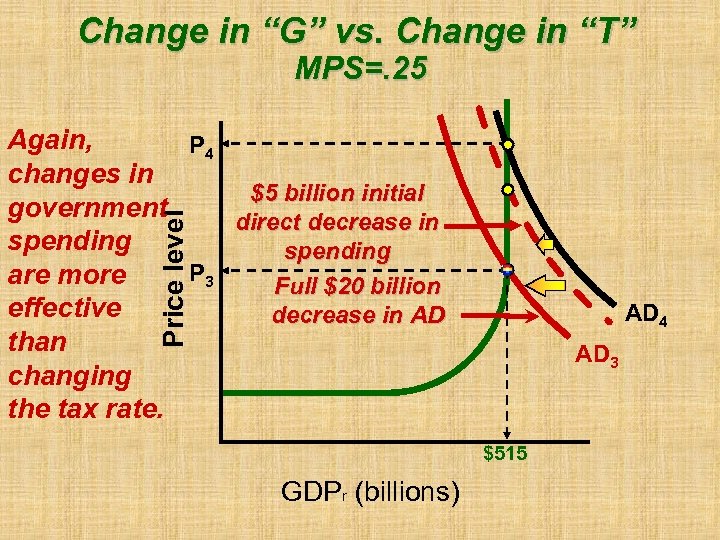 Change in “G” vs. Change in “T” MPS=. 25 Price level Again, P 4 changes in $5 billion initial government direct decrease in spending P 3 are more Full $20 billion effective decrease in AD than changing the tax rate. AD 4 AD 3 $515 GDPr (billions)
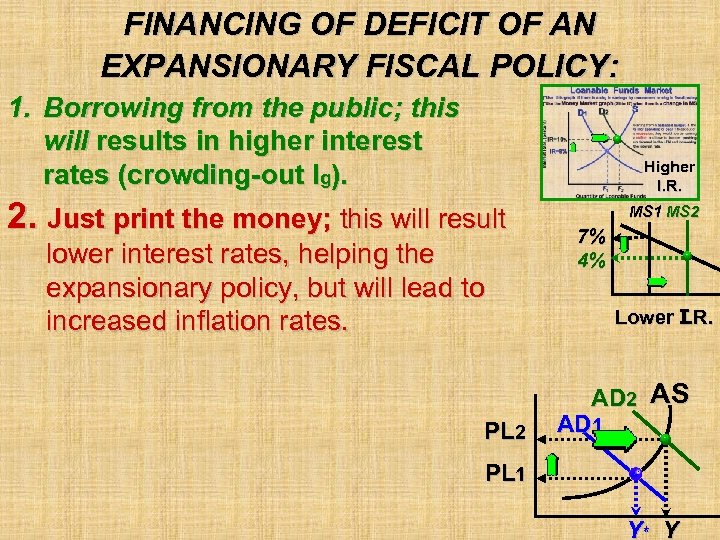 FINANCING OF DEFICIT OF AN EXPANSIONARY FISCAL POLICY: 1. Borrowing from the public; this will results in higher interest rates (crowding-out Ig). 2. Just print the money; this will result lower interest rates, helping the expansionary policy, but will lead to increased inflation rates. PL 2 Higher I. R. MS 1 MS 2 7% 4% Lower I. R. AD 2 AS AD 1 PL 1 Y* Y
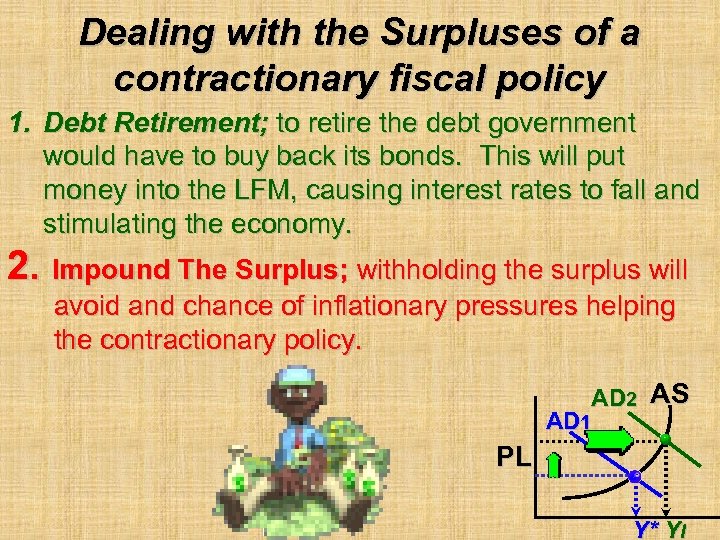 Dealing with the Surpluses of a contractionary fiscal policy 1. Debt Retirement; to retire the debt government would have to buy back its bonds. This will put money into the LFM, causing interest rates to fall and stimulating the economy. 2. Impound The Surplus; withholding the surplus will avoid and chance of inflationary pressures helping the contractionary policy. AD 2 AS AD 1 PL Y* YI
 Automatic Stabilizers • The automatic stabilizers may be called the automatic pilot of our economy, not very economy well suited for takeoffs and landings, but fine for the smooth part of the flight. But when the going gets rough, the economy must rough use manual controls. [discretionary G&T] controls G&T • A pilot may take a stroll thru & let the co-pilot cruise. If there is turbulence, the pilot will rush cruise turbulence back to the cockpit [Congress] and use manual controls to correct economic turbulence Discretionary fiscal policy is our manual control system
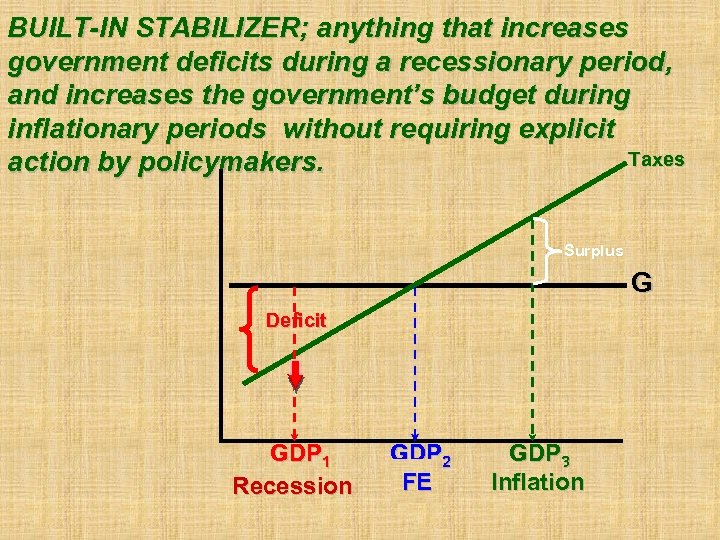 BUILT-IN STABILIZER; anything that increases government deficits during a recessionary period, and increases the government’s budget during inflationary periods without requiring explicit Taxes action by policymakers. Surplus G Deficit GDP 1 Recession GDP 2 FE GDP 3 Inflation
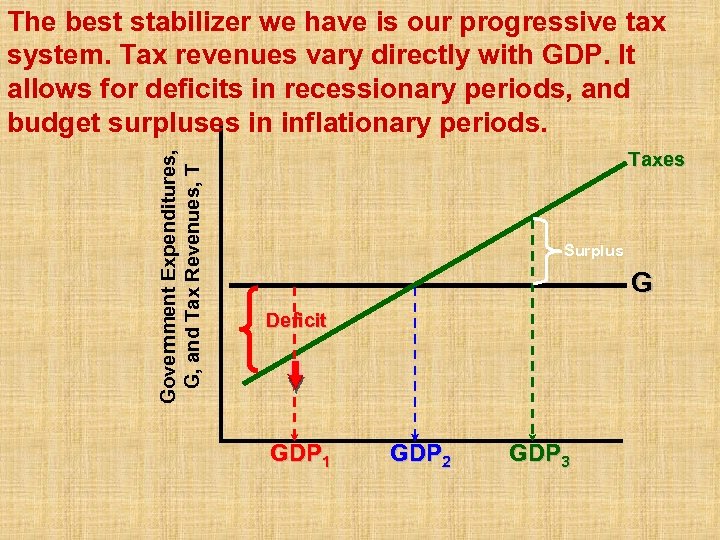 Government Expenditures, G, and Tax Revenues, T The best stabilizer we have is our progressive tax system. Tax revenues vary directly with GDP. It allows for deficits in recessionary periods, and budget surpluses in inflationary periods. Taxes Surplus G Deficit GDP 1 GDP 2 GDP 3
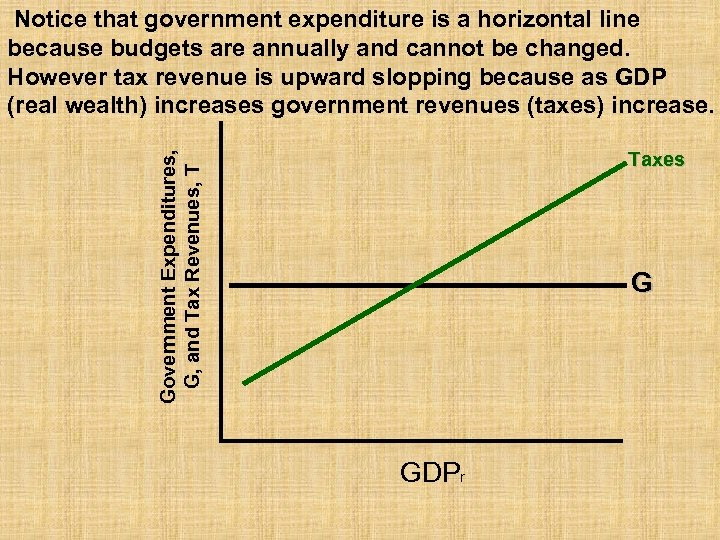 Notice that government expenditure is a horizontal line because budgets are annually and cannot be changed. However tax revenue is upward slopping because as GDP (real wealth) increases government revenues (taxes) increase. Government Expenditures, G, and Tax Revenues, T Taxes G GDPr
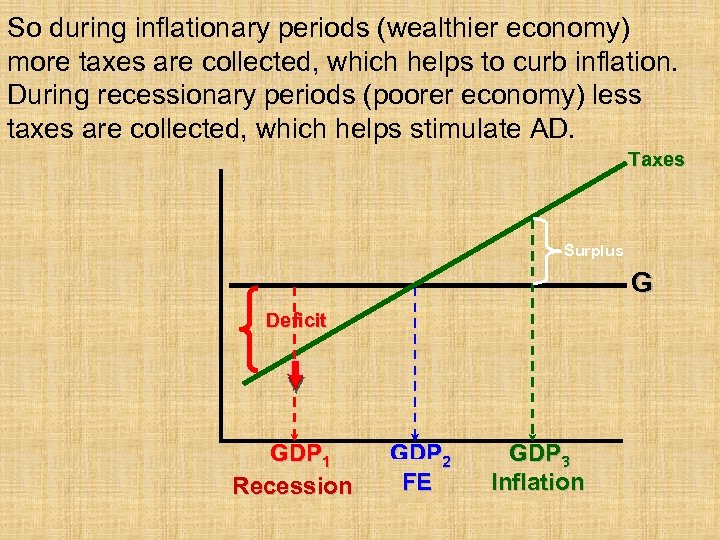 So during inflationary periods (wealthier economy) more taxes are collected, which helps to curb inflation. During recessionary periods (poorer economy) less taxes are collected, which helps stimulate AD. Taxes Surplus G Deficit GDP 1 Recession GDP 2 FE GDP 3 Inflation
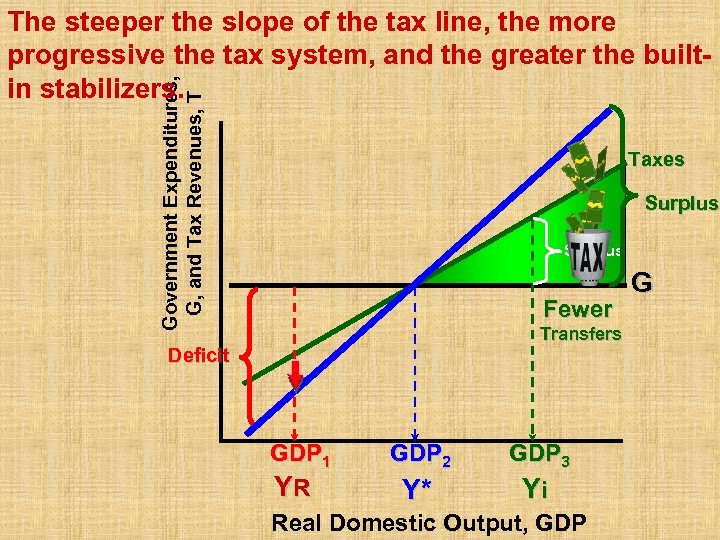 Government Expenditures, G, and Tax Revenues, T The steeper the slope of the tax line, the more progressive the tax system, and the greater the builtin stabilizers. Deficit Taxes Surplus Fewer Transfers GDP 1 GDP 2 GDP 3 YR Yi Y* Real Domestic Output, GDP G
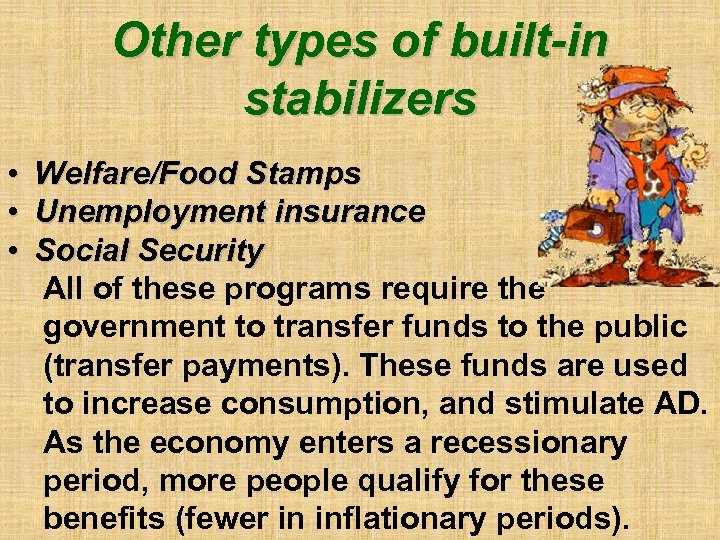 Other types of built-in stabilizers • • • Welfare/Food Stamps Unemployment insurance Social Security All of these programs require the government to transfer funds to the public (transfer payments). These funds are used to increase consumption, and stimulate AD. As the economy enters a recessionary period, more people qualify for these benefits (fewer in inflationary periods).
 Full-Employment Budget • The full-employment budget measures what the Federal budget deficit or surplus would be with existing tax rates and government spending levels if the economy had achieved its full-employment level of GDP.
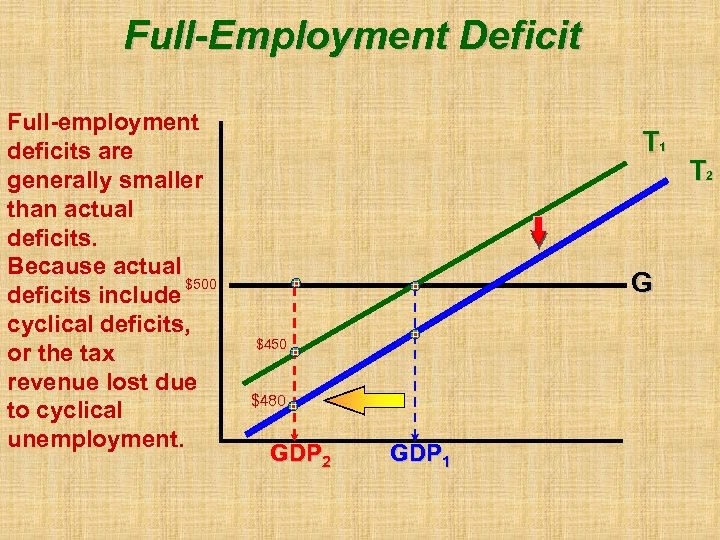 Full-Employment Deficit Full-employment deficits are generally smaller than actual deficits. Because actual $500 deficits include cyclical deficits, or the tax revenue lost due to cyclical unemployment. T 1 G $450 $480 GDP 2 GDP 1 T 2
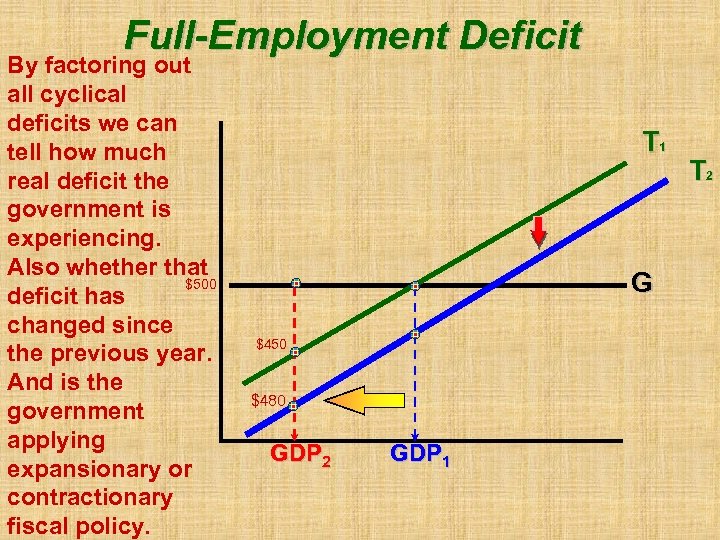 Full-Employment Deficit By factoring out all cyclical deficits we can tell how much real deficit the government is experiencing. Also whether that $500 deficit has changed since the previous year. And is the government applying expansionary or contractionary fiscal policy. T 1 G $450 $480 GDP 2 GDP 1 T 2
 Congress is like the man in the Shower The shower starts out too cold, because the pipes have not yet warmed up. So the Congress turns up the hot water too high and ends up getting scalded. Congress then turns down the hot water and turns up the cold water; now the shower too cold, and so the battle goes on unable to get things right.
 Timing Problems of Fiscal Policy: 1. Recognition lags – the time between the beginning of a recession or inflationary gap and the awareness that it is actually happening (usually 4 -6 months). 2. Administrative action lags – the time it takes Congress to debate and decide on a course of action (usually 6 -12 months). 3. Operational lags – the time it takes to plan and implement government projects that will support the right fiscal policy. Taxes rates can not be changed till the next fiscal year.
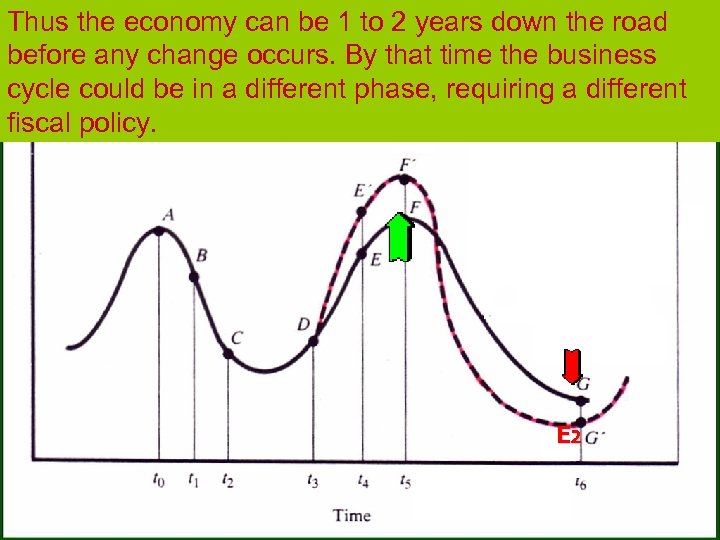 Thus the economy can be 1 to 2 years down the road before any change occurs. By that time the business cycle could be in a different phase, requiring a different fiscal policy. E 4 E 2
 *Tell them what they want to hear. Political Business Cycle – The Cycle economy is manipulated to get voter support. No politician wants to campaign as the “tax rising”, “project killing”, “economic wimp”. So politicians use fiscal policy during an election year to stimulate the economy. After the election voters get a “Made in Washington” Washington recession as fiscal policy is used to curb inflationary pressures.
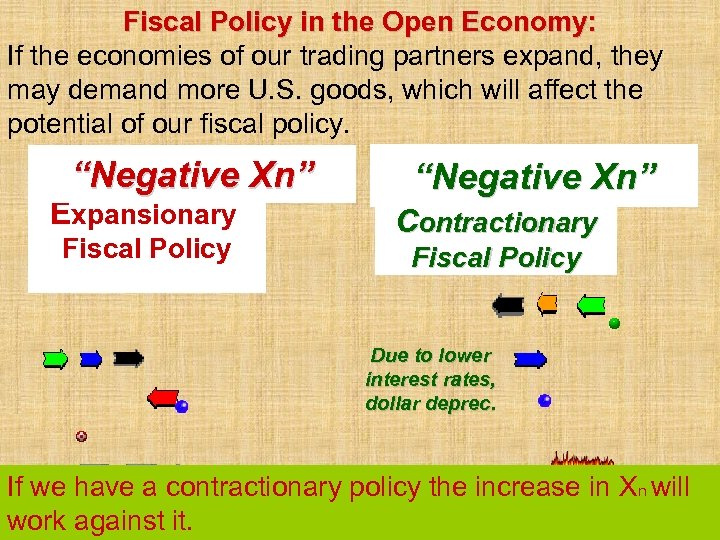 Fiscal Policy in the Open Economy: If the economies of our trading partners expand, they may demand more U. S. goods, which will affect the potential of our fiscal policy. “Negative Xn” Expansionary Fiscal Policy “Negative Xn” Contractionary Fiscal Policy Due to lower interest rates, dollar deprec. If we have a contractionary policy the increase in Xn will work against it.
 • An expansionary fiscal policy increases interest rates. Foreign investors will purchase dollars to invest in our economy (must have dollars to loan to U. S. businesses). This will increase the demand for dollars (appreciation). Appreciation of the dollar will inflate the price of domestic goods, which will decrease net exports decreasing AD.
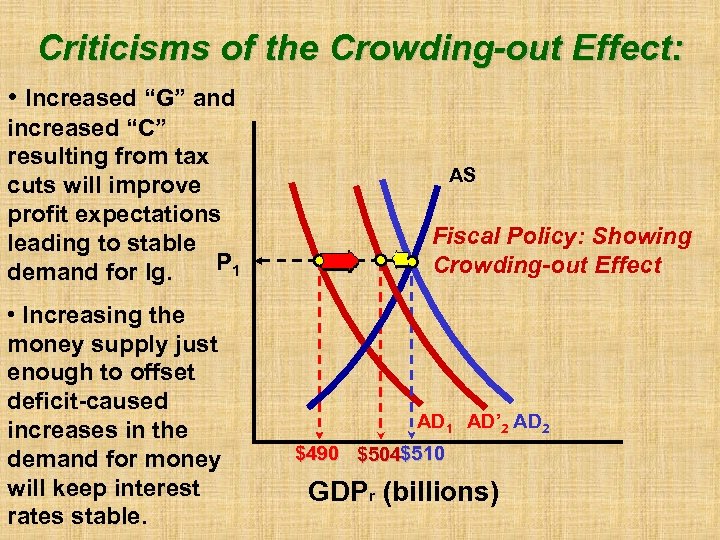 Criticisms of the Crowding-out Effect: • Increased “G” and increased “C” resulting from tax cuts will improve profit expectations leading to stable P 1 demand for Ig. • Increasing the money supply just enough to offset deficit-caused increases in the demand for money will keep interest rates stable. AS Fiscal Policy: Showing Crowding-out Effect AD 1 AD’ 2 AD 2 $490 $504$510 GDPr (billions)
 E-con The End