


 Скачать презентацию Government Spending in a Simple Model of Endogenous
Belkova_K.pptx
- Количество слайдов: 3
 Government Spending in a Simple Model of Endogenous Growth Idea: Models of economic growth can generate long-term growth without relying on exogenous changes in technology or population. Subject: Which are the relations among the size of government, the saving rate and the rate of economic growth? Assumptions: • Constant returns to a broad concept of capital; • Incorporating a public sector into a simple: Ø The representative, infinite-lived household in a closed economy seeks to maximize overall utility; Ø Population = the number of workers and consumers, is constant; Ø The economy is not so productive that it allows the attained utility to become unbounded; Ø The model abstracts from externalities associated with the use of public services;
 Government Spending in a Simple Model of Endogenous Growth Studding the effects of government policies on growth rate and savings: 1. Model with Optimizing Household (economy seeks to maximize overall utility); 2. A Planning Problem for the Government (the government chooses a constant expenditure ratio, and can then dictate each household's choices for consumption over time); 3. Government Consumption Services (the government's expenditures also finance some services that enter into households' utility functions); 4. Self-interested Government (The government agent seeks to maximize his own utility )
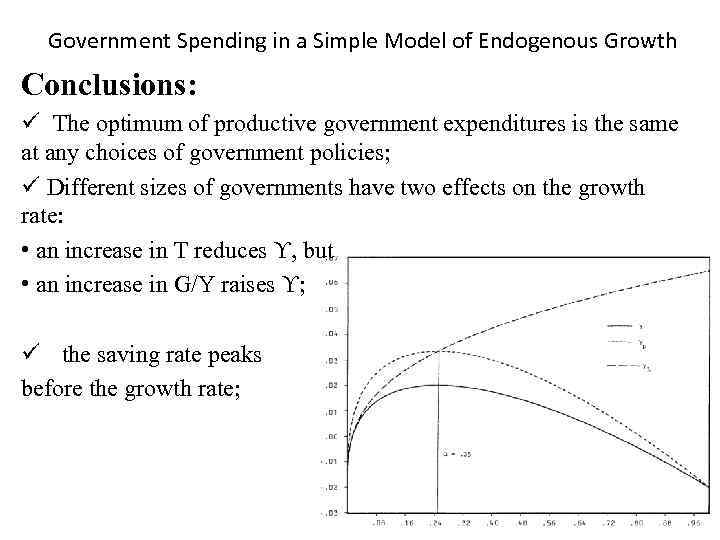 Government Spending in a Simple Model of Endogenous Growth Conclusions: ü The optimum of productive government expenditures is the same at any choices of government policies; ü Different sizes of governments have two effects on the growth rate: • an increase in T reduces ϒ, but • an increase in G/Y raises ϒ; ü the saving rate peaks before the growth rate;