


 Скачать презентацию Government Intervention and the Market System Session 4
cda485c1e4b6fed75aead946db6d8260.ppt
- Количество слайдов: 53
 Government Intervention and the Market System Session 4 (chs 8, 6, 7, 9) Professor Dermot Mc. Aleese
 OUTLINE Government spending in the economy Case for government intervention Types of government intervention Problem of government failure
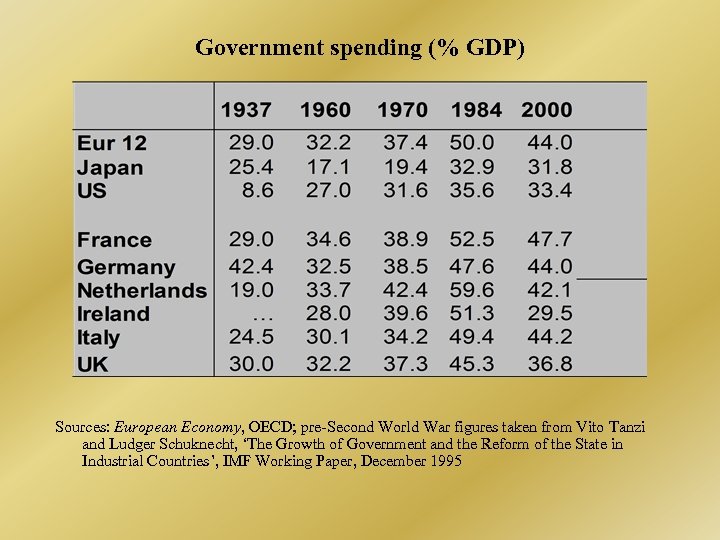 Government spending (% GDP) Sources: European Economy, OECD; pre-Second World War figures taken from Vito Tanzi and Ludger Schuknecht, ‘The Growth of Government and the Reform of the State in Industrial Countries’, IMF Working Paper, December 1995
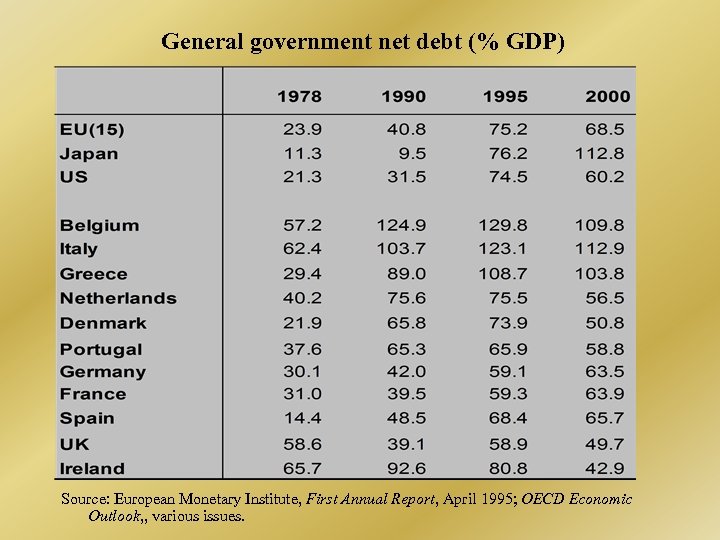 General government net debt (% GDP) Source: European Monetary Institute, First Annual Report, April 1995; OECD Economic Outlook, , various issues.
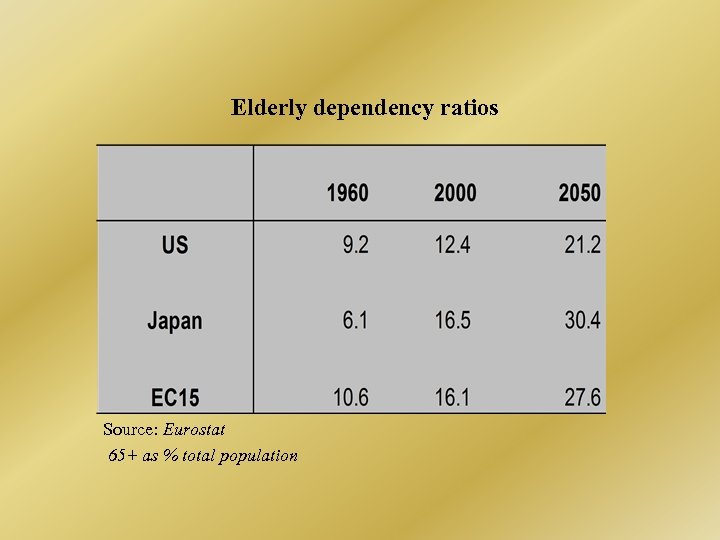 Elderly dependency ratios Source: Eurostat 65+ as % total population
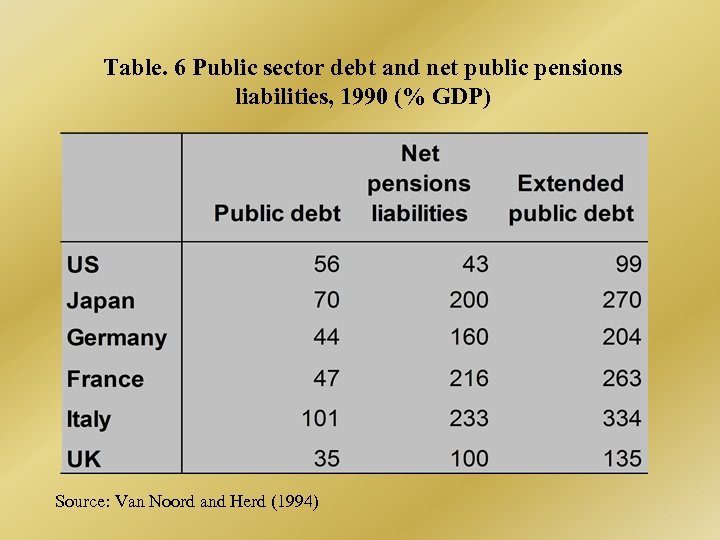 Table. 6 Public sector debt and net public pensions liabilities, 1990 (% GDP) Source: Van Noord and Herd (1994)
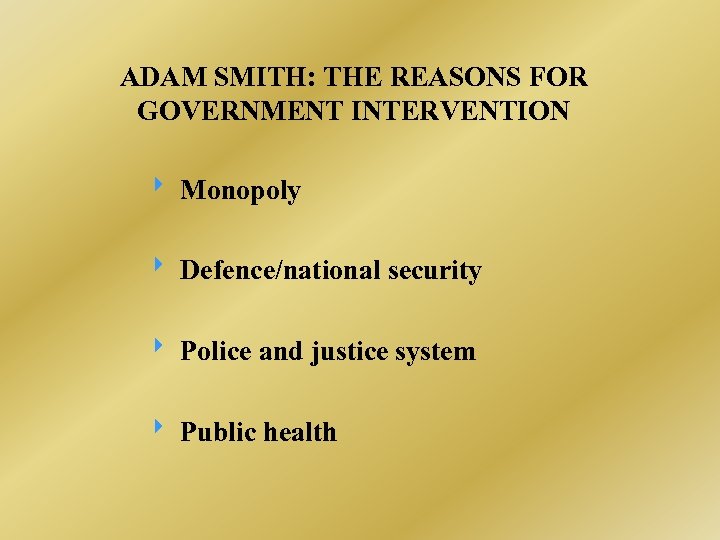 ADAM SMITH: THE REASONS FOR GOVERNMENT INTERVENTION Monopoly Defence/national security Police and justice system Public health
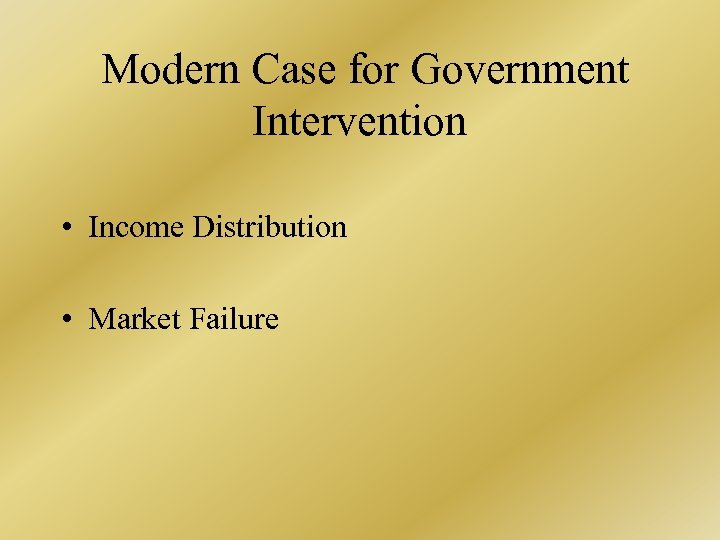 Modern Case for Government Intervention • Income Distribution • Market Failure
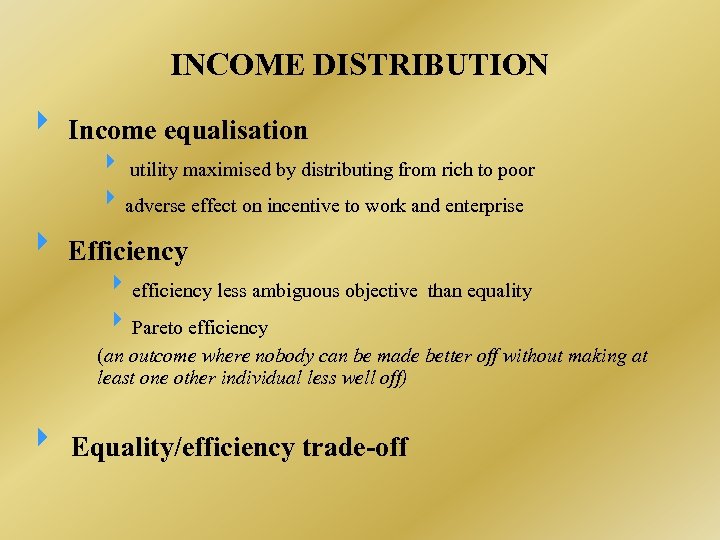 INCOME DISTRIBUTION Income equalisation utility maximised by distributing from rich to poor adverse effect on incentive to work and enterprise Efficiency efficiency less ambiguous objective than equality Pareto efficiency (an outcome where nobody can be made better off without making at least one other individual less well off) Equality/efficiency trade-off
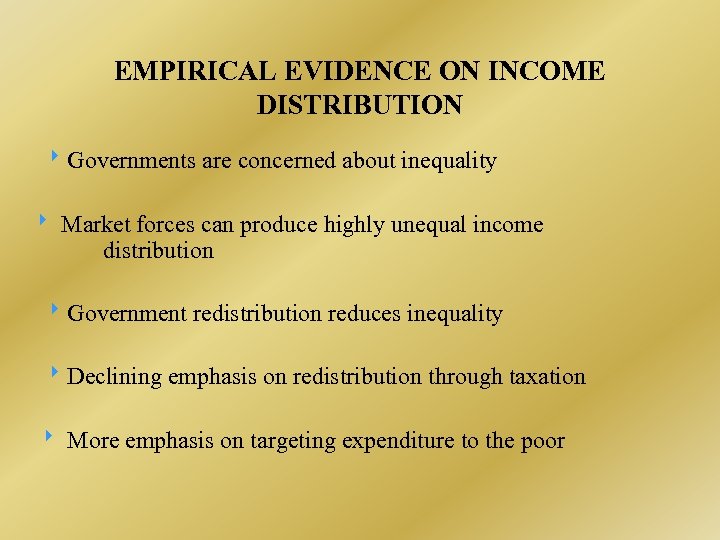 EMPIRICAL EVIDENCE ON INCOME DISTRIBUTION Governments are concerned about inequality Market forces can produce highly unequal income distribution Government redistribution reduces inequality Declining emphasis on redistribution through taxation More emphasis on targeting expenditure to the poor
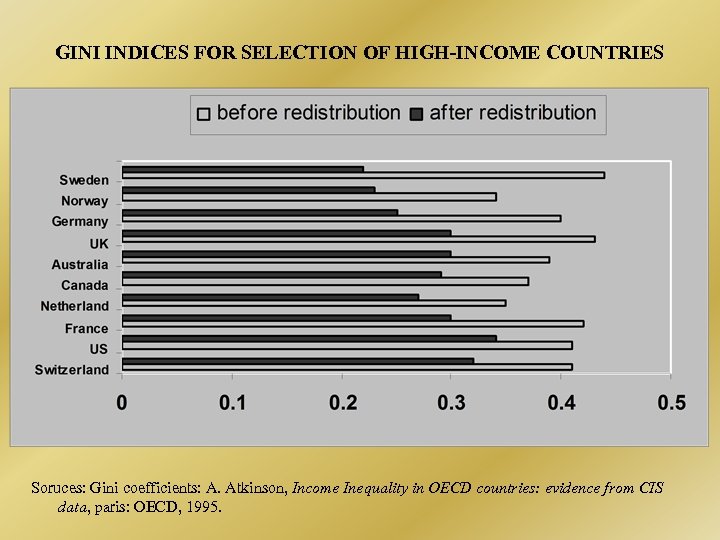 GINI INDICES FOR SELECTION OF HIGH-INCOME COUNTRIES Soruces: Gini coefficients: A. Atkinson, Income Inequality in OECD countries: evidence from CIS data, paris: OECD, 1995.
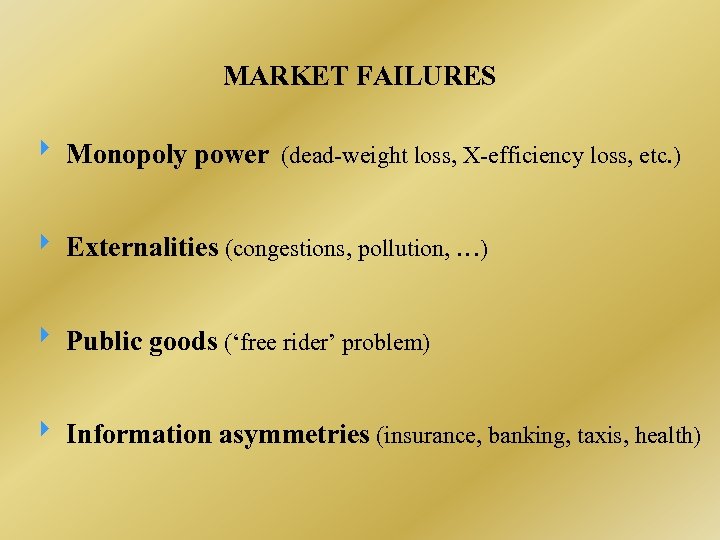 MARKET FAILURES Monopoly power (dead-weight loss, X-efficiency loss, etc. ) Externalities (congestions, pollution, …) Public goods (‘free rider’ problem) Information asymmetries (insurance, banking, taxis, health)
 Begin with monopoly – one seller only -- the extreme case of absence of competition
 THE THEORY OF MONOPOLY Static Efficiency effect Income distribution effect Dynamic effects
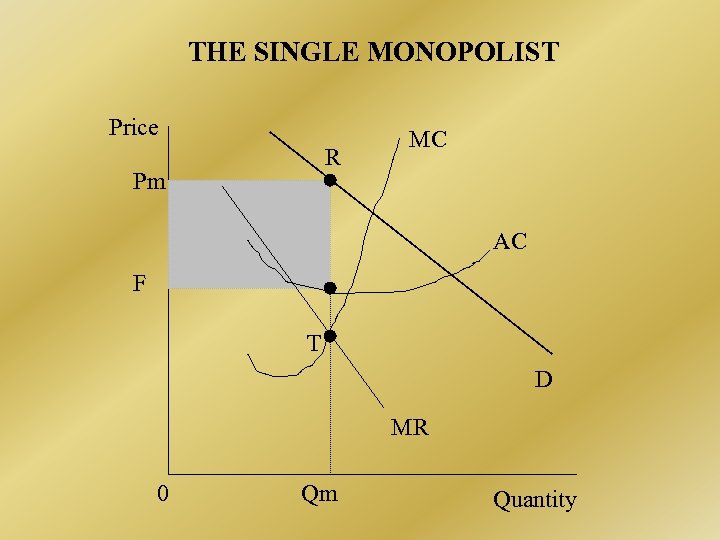 THE SINGLE MONOPOLIST Price R Pm MC AC S F T D MR 0 Qm Quantity
 Profit maximisation dictates that firms in the market system are motivated to discover, exploit and ruthlessly protect a monopoly niche.
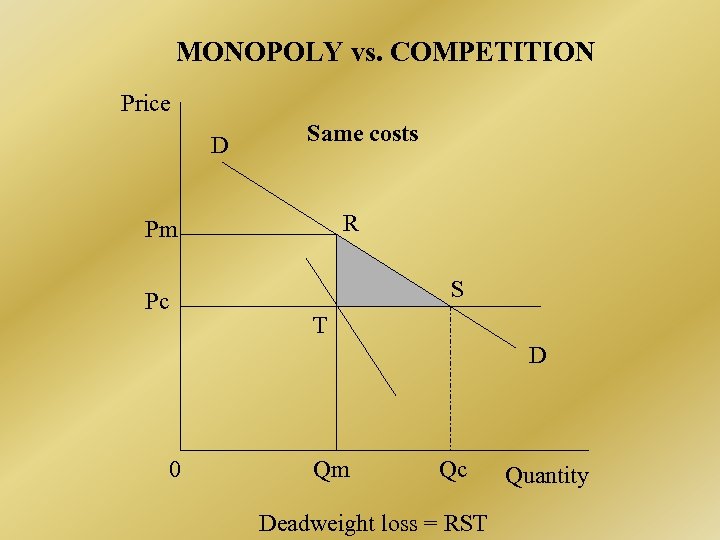 MONOPOLY vs. COMPETITION Price D Same costs R Pm S Pc T D 0 Qm Qc Deadweight loss = RST Quantity
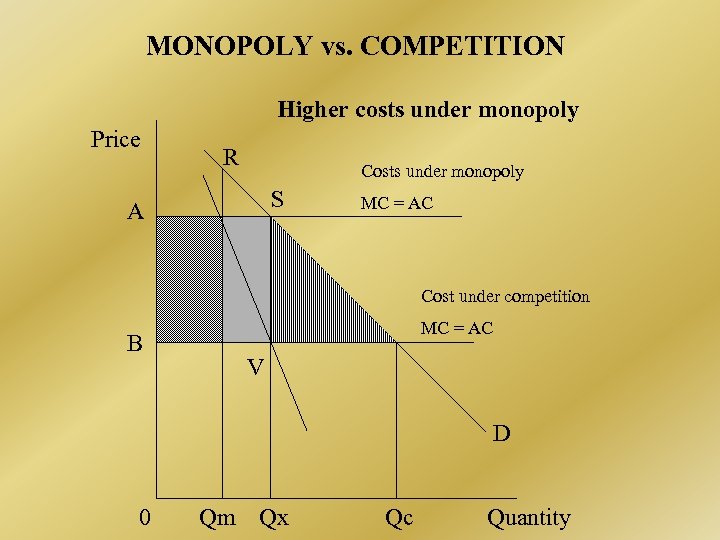 MONOPOLY vs. COMPETITION Higher costs under monopoly Price R Costs under monopoly S A MC = AC Cost under competition MC = AC B V D 0 Qm Qx Qc Quantity
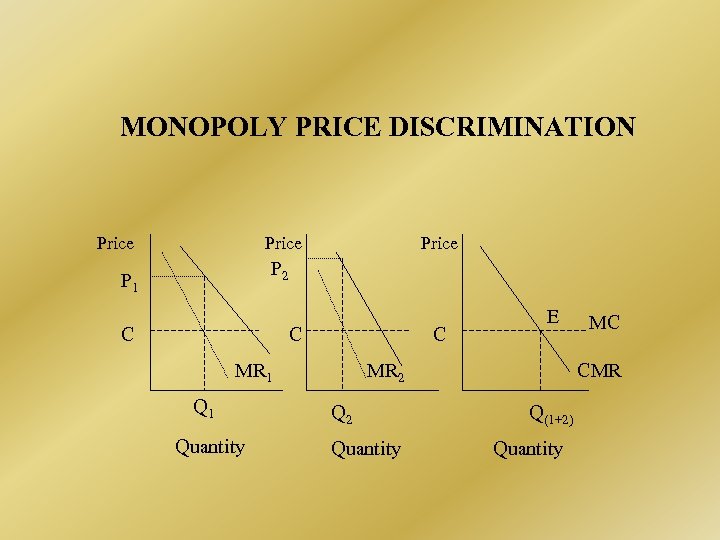 MONOPOLY PRICE DISCRIMINATION Price P 2 P 1 C C C MR 1 Quantity E MR 2 Quantity MC CMR Q(1+2) Quantity
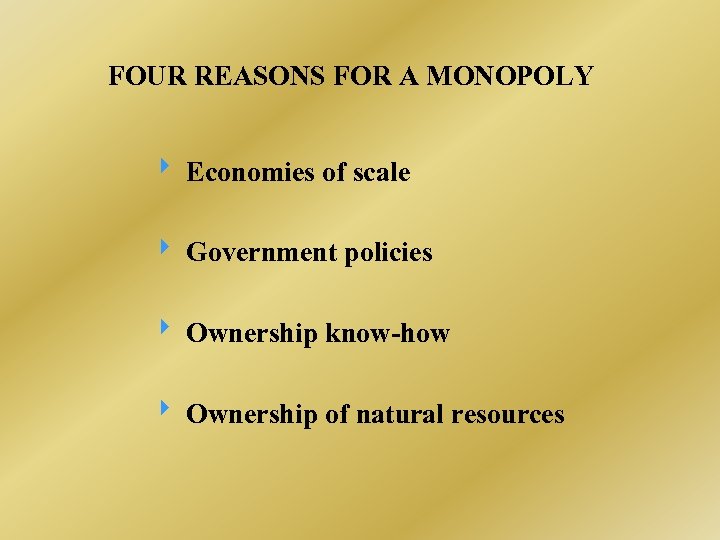 FOUR REASONS FOR A MONOPOLY Economies of scale Government policies Ownership know-how Ownership of natural resources
 SUSTAINING MARKET POWER Distinctive capability Architecture Reputation Innovation Strategic entry-deterrent measures Setting price deliberately below profit-maximising level in order to reduce attractiveness of the industry to the outsiders Conceasing profit figures for monopolised parts of business Below cost selling, predatory pricing and dumping Deliberate over-investment in capacity and extension of product range
 MARKET POWER WITH A FEW FIRMS The case of cartel Price leadership Kinked oligopoly model Non-price competition
 CONCLUSIONS Large section of modern industrial economies can be described as ‘effectively competitive’ Yet monopolies influence and market power are important realities in the business world Hence need for competition policy
 MARKET STRUCTURE IS DETERMINED BY Numbers and size-distribution of sellers and buyers Characteristics of the product and degree of market segmentation Barriers to entry into the industry Barriers to exit from the industry
 MARKET STRUCTURE AND FIRMS PERFORMANCE Contestability – firms may be few in number and yet competition can be intense Innovation – thrives more in competitive conditions than under monopoly
 COMPETITION – ADVANTAGES OVER MONOPOLY It makes organisations internally more efficient It allows the more efficient organisations to prosper at the expense of the inefficient (selection process) It improves dynamic efficiency by stimulating innovation
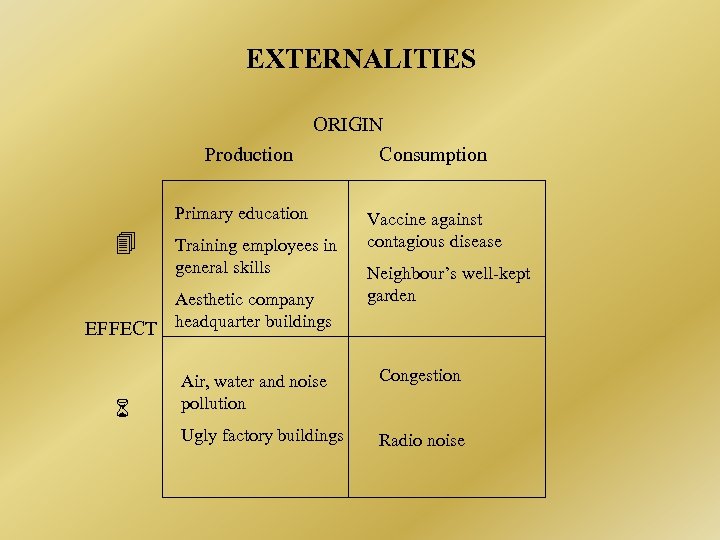 EXTERNALITIES ORIGIN Production Primary education 4 Training employees in general skills Aesthetic company EFFECT headquarter buildings 6 Consumption Vaccine against contagious disease Neighbour’s well-kept garden Air, water and noise pollution Congestion Ugly factory buildings Radio noise
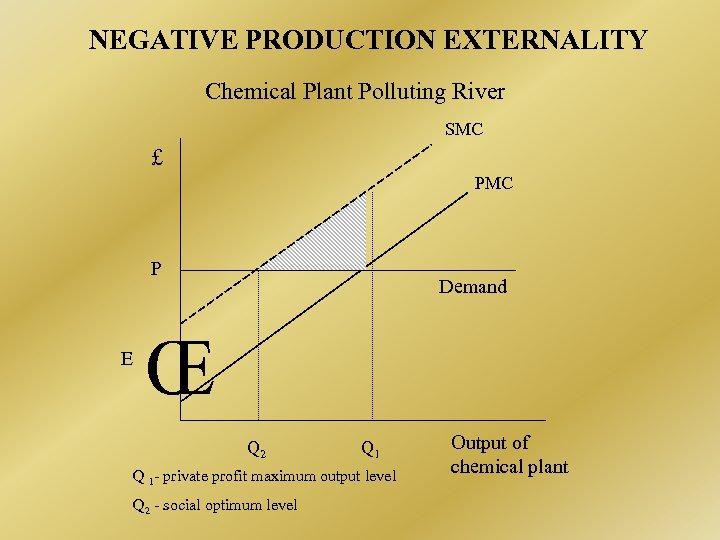 NEGATIVE PRODUCTION EXTERNALITY Chemical Plant Polluting River SMC £ PMC P E Demand Œ Q 2 Q 1 - private profit maximum output level Q 2 - social optimum level Output of chemical plant
 DEFINITION OF A PUBLIC GOOD Non-Rivalrous the marginal cost of an additional individual consuming the good is zero, at least up to a certain level Non-Excludable the cost of excluding an individual from consuming it is prohibitively high Note: Public goods are not the same as merit goods
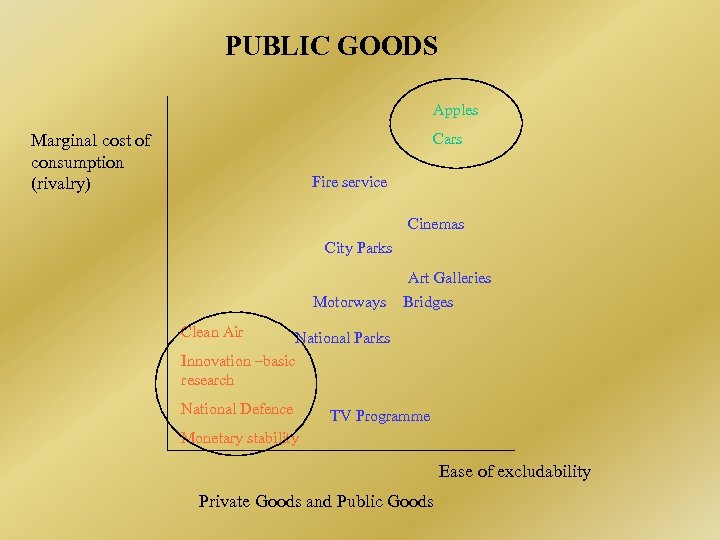 PUBLIC GOODS Apples Cars Marginal cost of consumption (rivalry) Fire service Cinemas City Parks Motorways Art Galleries Bridges Clean Air National Parks Innovation –basic research National Defence TV Programme Monetary stability Ease of excludability Private Goods and Public Goods
 Examples of Information Asymmetries • • Medical bills – inflated demand Fake antiques Gasoline Bank deposits
 Government Action is needed to Prevent or Correct Market Failure
 COMPETITION POLICY IN ACTION – THE EXAMPLE OF EU Prohibited agreements Abuse of dominant position Control of mergers State aids
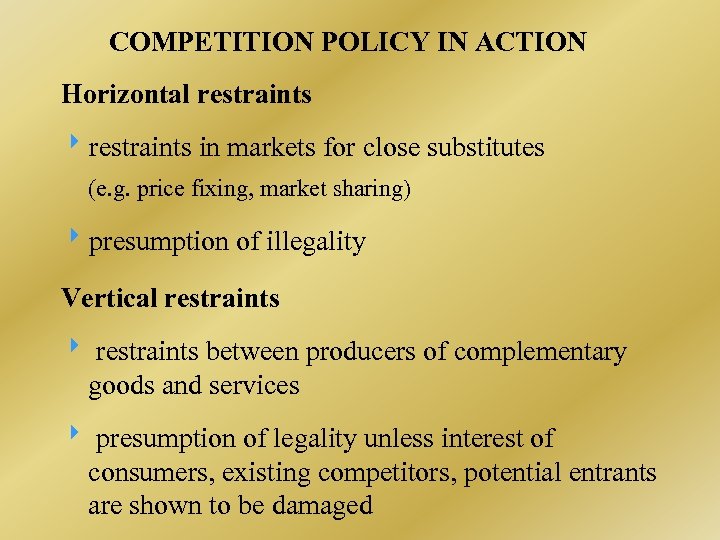 COMPETITION POLICY IN ACTION Horizontal restraints in markets for close substitutes (e. g. price fixing, market sharing) presumption of illegality Vertical restraints between producers of complementary goods and services presumption of legality unless interest of consumers, existing competitors, potential entrants are shown to be damaged
 COMPETITION LAW WITH TEETH Breaches of competition law can carry severe penalties. In 1999, two top European companies were fined a record $725 million in the US for their part in a worldwide conspiracy to control the market in vitamins. According to US investigators, the executives met once a year to fix the annual “budget” of a fictitious company Vitamins Inc. In practice this involved setting prices, sharing geographic markets and setting sales volume. The annual summit was followed by meetings, quarterly reviews and frequent correspondence. The cartel controlled the most popular vitamins including vitamins A, C and vitamin premixes. A former executive of Roche agreed to serve a four-month prison sentence; he was the first European national to submit to such a sentence for antitrust offences. The European Commission said it was investigating the same matter. Practices that once would have been tolerated if not condoned in the past are now being subjected to the full rigour of the law.
 COMPETITION AND GLOBALISATION A more open market is more competitive A need for ‘level playing field’ Monopoly power by giant multinationals
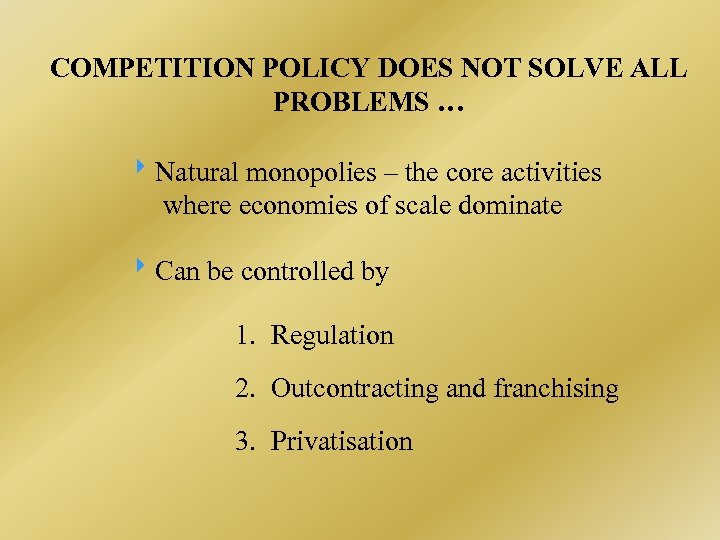 COMPETITION POLICY DOES NOT SOLVE ALL PROBLEMS … Natural monopolies – the core activities where economies of scale dominate Can be controlled by 1. Regulation 2. Outcontracting and franchising 3. Privatisation
 REASONS FOR PRIVATISATION new managerial ‘culture’ source of funds for government disposes of loss making weaken trade unions encourage efficiency (access to capital, avoid policy confusion) develop and expand domestic capital market engender competition
 METHODS OF PRIVATISATION Share flotation (British Telecom 1984) Direct sale to existing private sector business or institutional buyers (Rover cars to British Aerospace) Management buy-outs (National Freight corporation 1982) Contracting out (competitive tender)
 EFFECTS OF PRIVATISATION Efficiency Government revenue Income distribution Privatsation not necessarily superior to state ownership (Railways, London underground)
 DEREGULATION – THE CASE OF NATURAL MONOPOLY Isolate the core natural monopoly element in the industry Deal with the natural monopoly element: Pricing: Access Quality P = MC; break-even or average return on K; RPI minus X
 REGULATION Costs of direct regulation can be high Incentive regulation can also be problematic - RPI minus X (UK) - ‘Fair’ return on capital (US) Competition the best solution - Break up into separate competing firms - Competitive tendering for provision of services - Encourage new entrants (including foreign) - Separate ‘natural’ monopoly (network) and regulate that only
 Solutions to Market Failure -- Externalities Taxes and subsidies Regulation State provision
 COASE THEOREM Externalities do not necessarily require government intervention. Market system can correct externalities, provided property rights are defined and transactions costs are low.
 REGULATION Regulation is costly … High administrative costs Insufficient flexibility in implementation Stultifying effects of standardisation on industrial innovation … but necessary … Natural monopolies Asymmetric information When risks of catastrophic failure exists When the pollution generated by the polluter cannot be measured When major health risks are involved
 Solutions to Market Failure – Public Goods Asymmetric Information YOUR SOLUTIONS!
 GOVERNMENT FAILURE Government failure arises when the cost of attempting to ‘correct’ free market distortions turn out to be greater than the cost of the original distortion itself.
 CAUSES OF GOVERNMENT FAILURE Absence of ‘invisible hand’ Absence of full information Theory of public choice ‘political parties formulate policies in order to win elections, rather than win elections in order to formulate policies’ Prof. Anthony Down Distortions created by taxes and subsidies (rent-seeking society and the ‘grantepreneurs’)
 RESPONSE TO GOVERNMENT FAILURE Reduce direct public provision (1) privatisation out-contracting Standards regulation
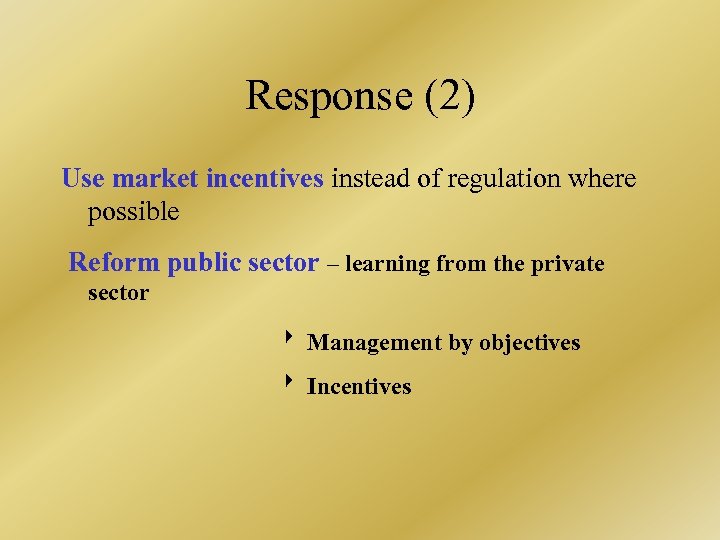 Response (2) Use market incentives instead of regulation where possible Reform public sector – learning from the private sector Management by objectives Incentives
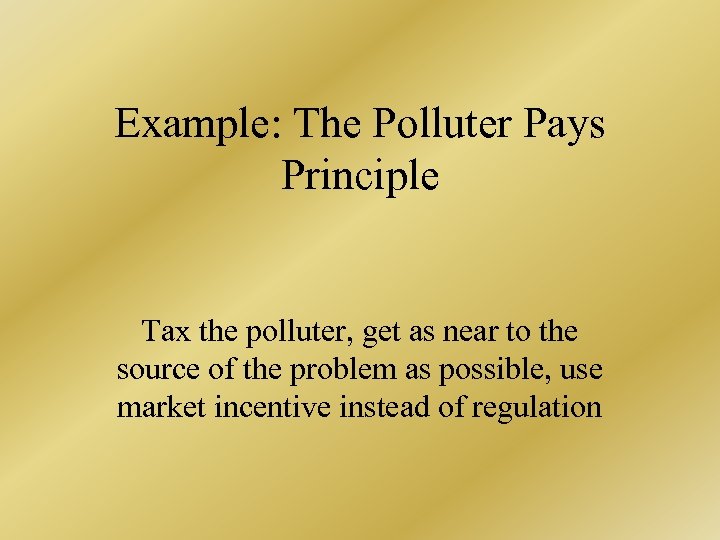 Example: The Polluter Pays Principle Tax the polluter, get as near to the source of the problem as possible, use market incentive instead of regulation
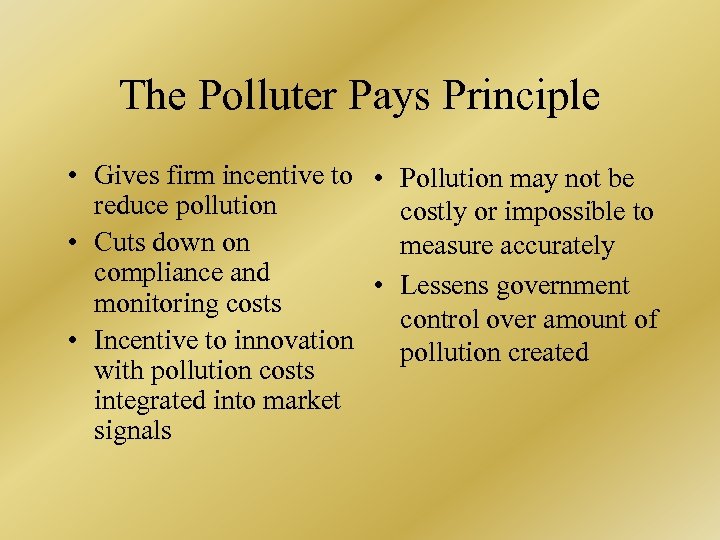 The Polluter Pays Principle • Gives firm incentive to • reduce pollution • Cuts down on compliance and • monitoring costs • Incentive to innovation with pollution costs integrated into market signals Pollution may not be costly or impossible to measure accurately Lessens government control over amount of pollution created
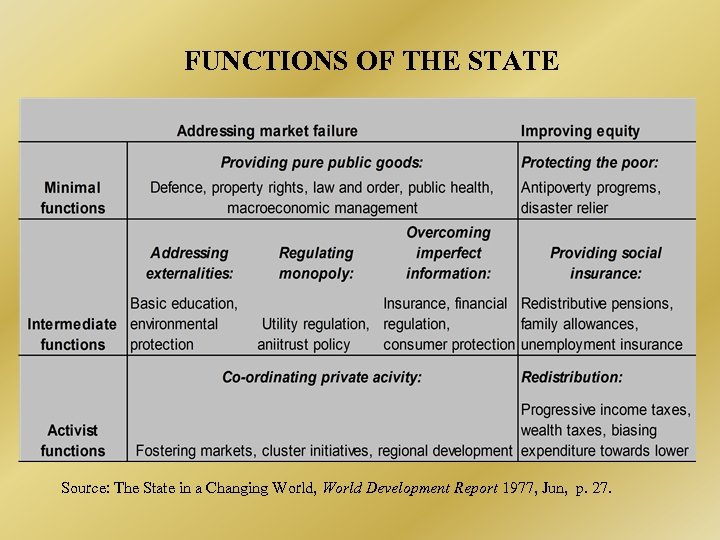 FUNCTIONS OF THE STATE Source: The State in a Changing World, World Development Report 1977, Jun, p. 27.