


 Скачать презентацию Government Goals Policy n n n 1
336a000b655e1c678de3975e9e148620.ppt
- Количество слайдов: 27
 Government Goals & Policy n n n 1. Government Intervention: 1) Market Failure 2) When the market fails to perform in line with the goals that we have for performance then there is a role for government policy Eg) equitable distribution of income u when markets fail to achieve social goals for equity, government policy is called for; eg, government redistribution programs
 Measuring Economic Inequality n n Poverty: u is a situation where a family’s income is too low to be able to buy the quantities of food, shelter, and clothing that are deemed necessary. u is a relative concept. In Canada, poverty is measured by using a lowincome cutoff. « low-income cutoff is the income level at which a family spends 54. 7 percent of its income on food, shelter, and clothing.
 The Sources of Economic Inequality u The combination of higher demand lower supply for high-skilled workers relative to low-skilled workers creates a higher equilibrium wage rate for those workers who have attained greater levels of human capital.
 Income Redistribution n In Canada, governments use three main ways to redistribute income to reduce the degree of economic inequality: u Income taxes u Income maintenance programs « Social security programs « Employment Insurance program « Welfare programs u Subsidized services. « education
 Income Redistribution: n Leads to “The Big Tradeoff” between equity and efficiency u Income redistribution can be inefficient for three reasons: « The process of redistribution uses resources « Taxes create deadweight loss « Taxes weaken the incentive to work, save, and invest
 Government Goals & Policy 1. 2. 3. Ensure an equitable distribution of income u when markets fail to achieve social goals for equity, government policy is called for; eg, government redistribution programs Ensure the legal framework • Provide a legal system Define property rights Establish legal rules of behaviour Ensure economy wide stability & growth Macro economic policy
 Economic Functions of Government 4. n Ensure efficiency Markets sometimes fail to achieve “efficiency” in the use and allocation of society’s resources Government policy action when…. . Markets Fail: 1. ) Imperfect Competition n Market failure occurs if markets are not competitive regulation of monopoly anti-combines legislation
 Market Failure: 2. ) Public Goods n Market failure occurs when markets fail to provide Public Goods u Private Goods: can be consumed by only one individual at a time: are both rival and excludable Public goods: can be consumed simultaneously by everyone, that is, no one can be excluded once the good is produced, & no one’s consumption reduces the amount available for another.
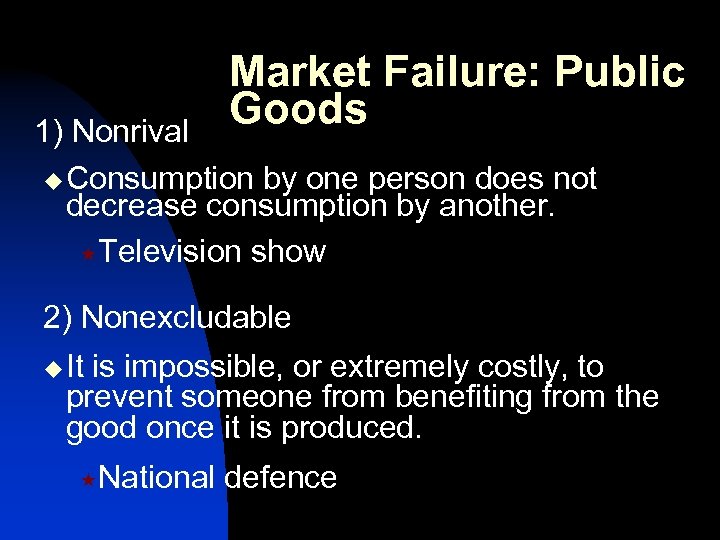 Market Failure: Public Goods 1) Nonrival u Consumption by one person does not decrease consumption by another. «Television show 2) Nonexcludable u It is impossible, or extremely costly, to prevent someone from benefiting from the good once it is produced. «National defence
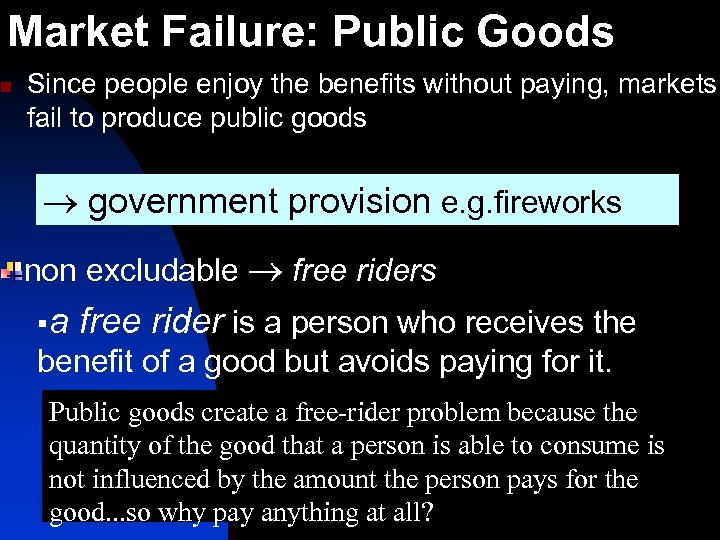 Market Failure: Public Goods n Since people enjoy the benefits without paying, markets fail to produce public goods government provision e. g. fireworks non excludable free riders §a free rider is a person who receives the benefit of a good but avoids paying for it. Public goods create a free-rider problem because the quantity of the good that a person is able to consume is not influenced by the amount the person pays for the good. . . so why pay anything at all?
 Public Goods n n The marginal benefit of a public good to an individual is the increase in total benefit that results from a oneunit increase in the quantity provided. The marginal benefit of a public good diminishes with the level of the good provided. Everyone can consume each unit of a public good, which means the marginal benefit for the economy is the sum of marginal benefits of each person at each quantity.
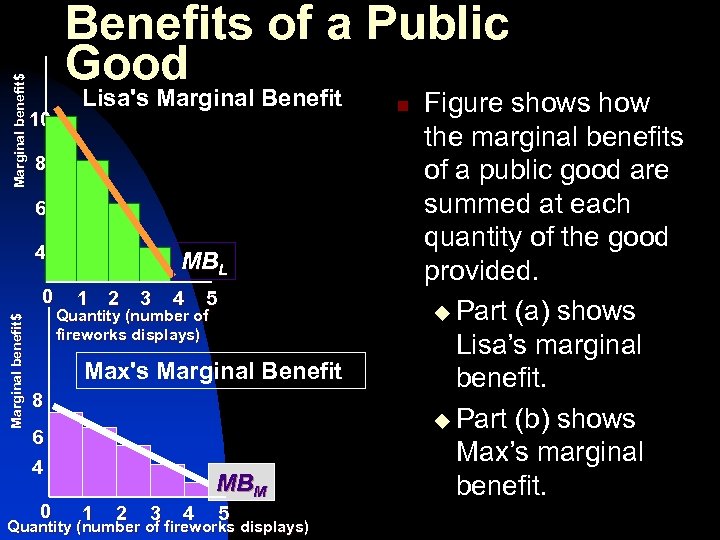 Marginal benefit$ Benefits of a Public Good 10 Lisa's Marginal Benefit 8 6 4 Marginal benefit$ 0 MBL 1 2 3 4 5 Quantity (number of fireworks displays) Max's Marginal Benefit 8 6 4 0 MBM 1 2 3 4 5 Quantity (number of fireworks displays) n Figure shows how the marginal benefits of a public good are summed at each quantity of the good provided. u Part (a) shows Lisa’s marginal benefit. u Part (b) shows Max’s marginal benefit.
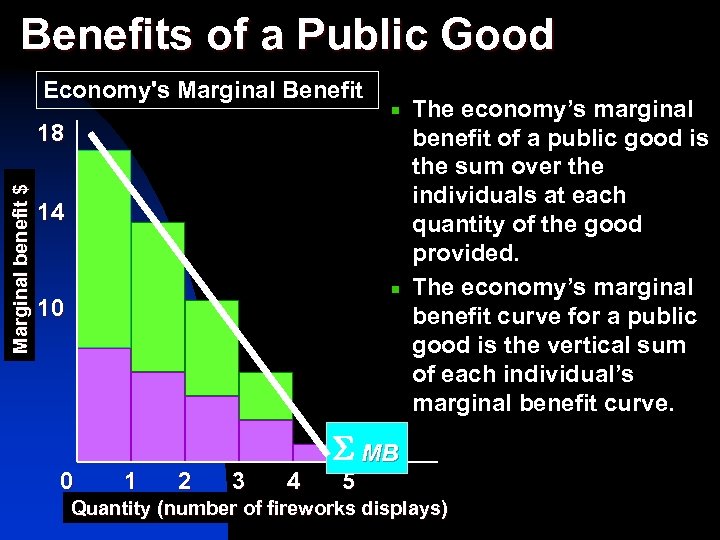 Benefits of a Public Good Economy's Marginal Benefit Marginal benefit $ 18 14 10 0 1 2 3 4 The economy’s marginal benefit of a public good is the sum over the individuals at each quantity of the good provided. The economy’s marginal benefit curve for a public good is the vertical sum of each individual’s marginal benefit curve. MB 5 Quantity (number of fireworks displays)
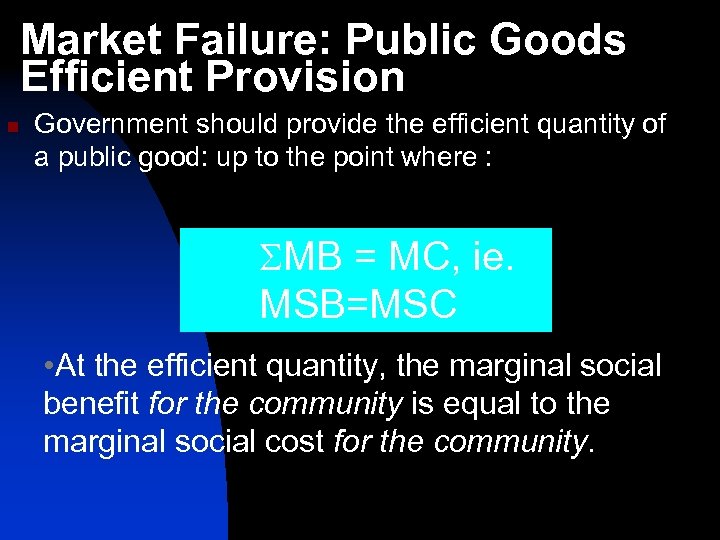 Market Failure: Public Goods Efficient Provision n Government should provide the efficient quantity of a public good: up to the point where : MB = MC, ie. MSB=MSC • At the efficient quantity, the marginal social benefit for the community is equal to the marginal social cost for the community.
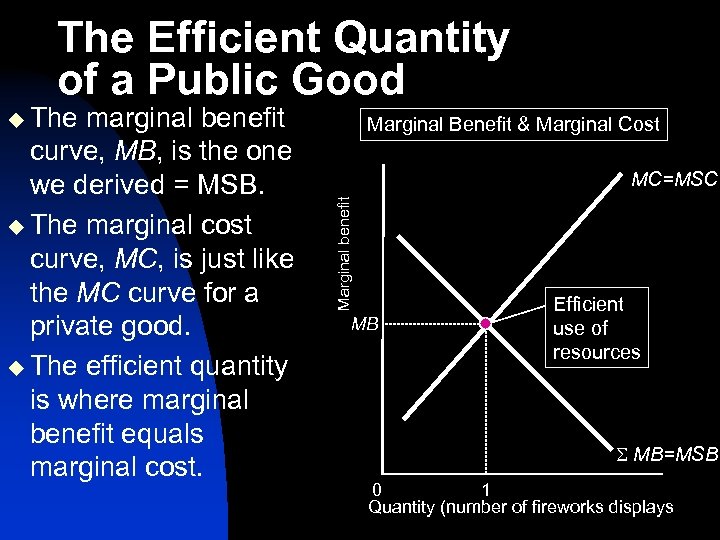 The Efficient Quantity of a Public Good u The Marginal Benefit & Marginal Cost MC=MSC Marginal benefit marginal benefit curve, MB, is the one we derived = MSB. u The marginal cost curve, MC, is just like the MC curve for a private good. u The efficient quantity is where marginal benefit equals marginal cost. MB Efficient use of resources MB=MSB 0 1 Quantity (number of fireworks displays
 Market Failure: 3. ) Externaility n Market failure occurs when all the relevant costs and benefits are not registered by the market u Externality: « Cost or Benefit resulting from some activity or transaction that is imposed on parties outside the activity or transaction; that is not registered by the market
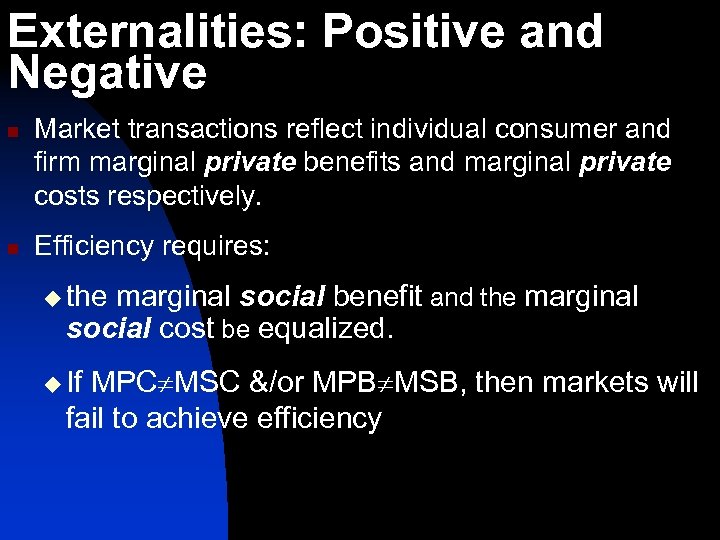 Externalities: Positive and Negative n n Market transactions reflect individual consumer and firm marginal private benefits and marginal private costs respectively. Efficiency requires: u the marginal social benefit and the marginal social cost be equalized. u If MPC¹MSC &/or MPB¹MSB, then markets will fail to achieve efficiency
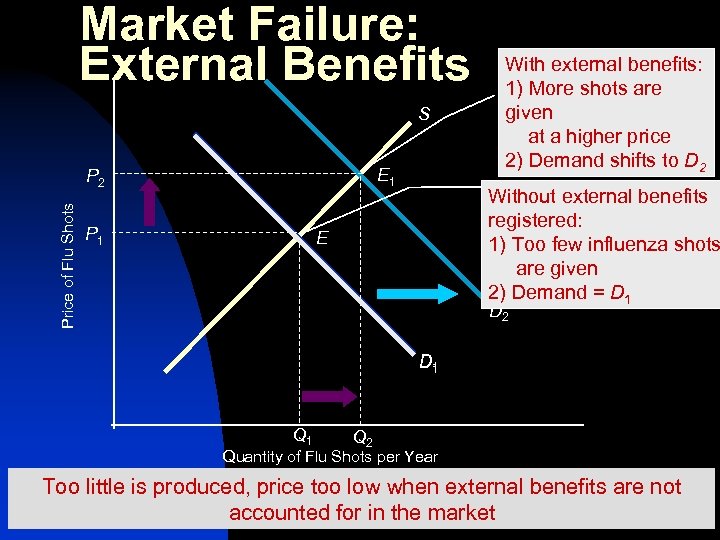 Market Failure: External Benefits S E 1 Price of Flu Shots P 2 P 1 With external benefits: 1) More shots are given at a higher price 2) Demand shifts to D 2 Without external benefits registered: 1) Too few influenza shots are given 2) Demand = D 1 E D 2 D 1 Q 2 Quantity of Flu Shots per Year Too little is produced, price too low when external benefits are not accounted for in the market
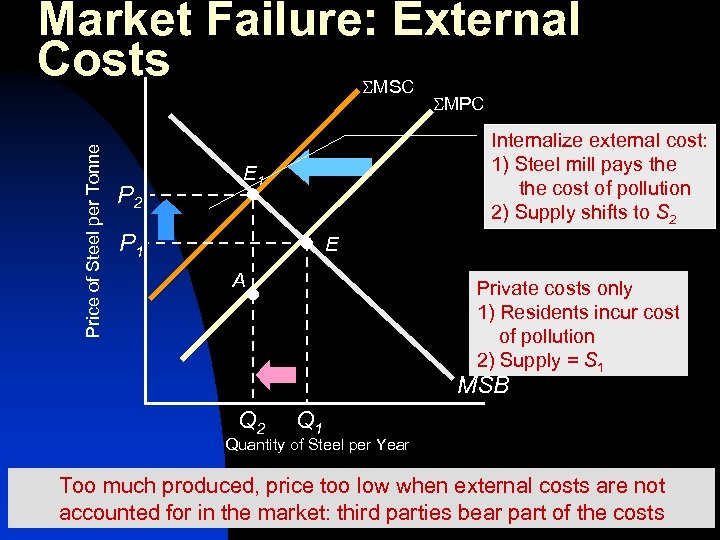 Market Failure: External Costs Price of Steel per Tonne MSC P 2 MPC Internalize external cost: 1) Steel mill pays the cost of pollution 2) Supply shifts to S 2 E 1 P 1 E A Private costs only 1) Residents incur cost of pollution 2) Supply = S 1 MSB Q 2 Q 1 Quantity of Steel per Year Too much produced, price too low when external costs are not accounted for in the market: third parties bear part of the costs
 Negative Externalities: Pollution n n Pollution is an old problem and is faced by both rich industrial countries and poor developing countries. It is an economic problem that is coped with by balancing benefits and costs, using policies that internalize the external costs of production.
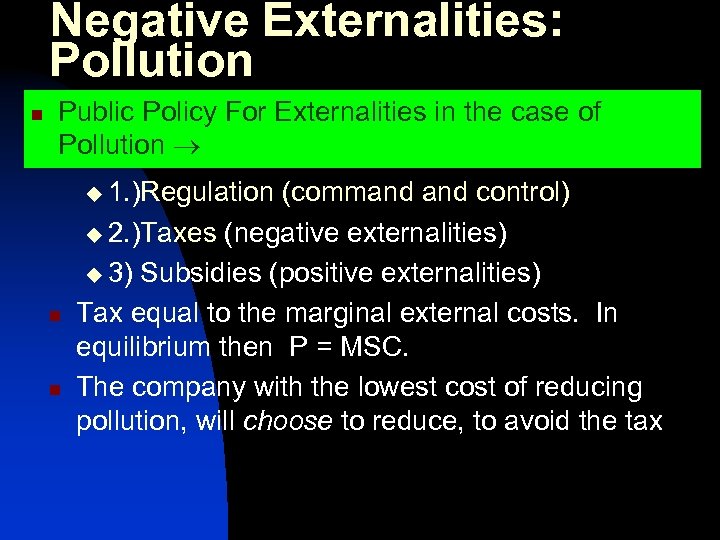 Negative Externalities: Pollution n Public Policy For Externalities in the case of Pollution u 1. )Regulation n n (command control) u 2. )Taxes (negative externalities) u 3) Subsidies (positive externalities) Tax equal to the marginal external costs. In equilibrium then P = MSC. The company with the lowest cost of reducing pollution, will choose to reduce, to avoid the tax
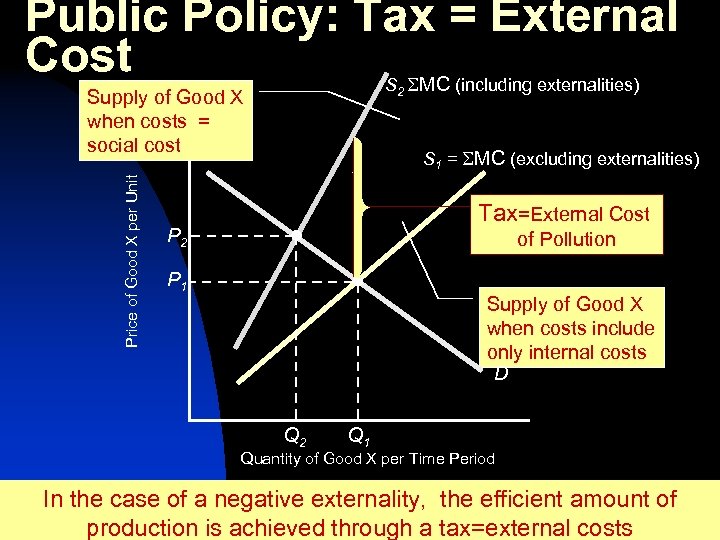 Public Policy: Tax = External Cost MC S 2 Price of Good X per Unit Supply of Good X when costs = social cost (including externalities) S 1 = MC (excluding externalities) Tax=External Cost P 2 of Pollution P 1 Supply of Good X when costs include only internal costs D Q 2 Q 1 Quantity of Good X per Time Period In the case of a negative externality, the efficient amount of production is achieved through a tax=external costs
 External Costs: Public Policy: Tax n n Taxes provide incentives for producers or consumers to cut back on an activity that creates external costs. Taxing an externality does not eliminate all pollution. Taxes force decision makers to consider the full costs of their decisions: internalize the externality.
 External Costs: Public Policy: Tax n Taxes, have two advantages over regulation because of their incentive effects: u they give owners an economic incentive to reduce pollution – avoid the tax, u they bring about a given amount of pollution reduction in the most efficient – least costly – way possible.
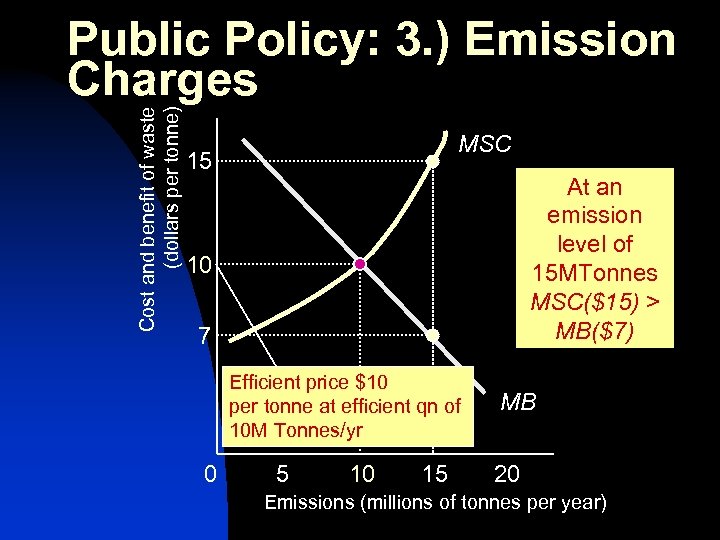 Cost and benefit of waste (dollars per tonne) Public Policy: 3. ) Emission Charges MSC 15 At an emission level of 15 MTonnes MSC($15) > MB($7) 10 7 Efficient price $10 per tonne at efficient qn of 10 M Tonnes/yr 0 5 10 15 MB 20 Emissions (millions of tonnes per year)
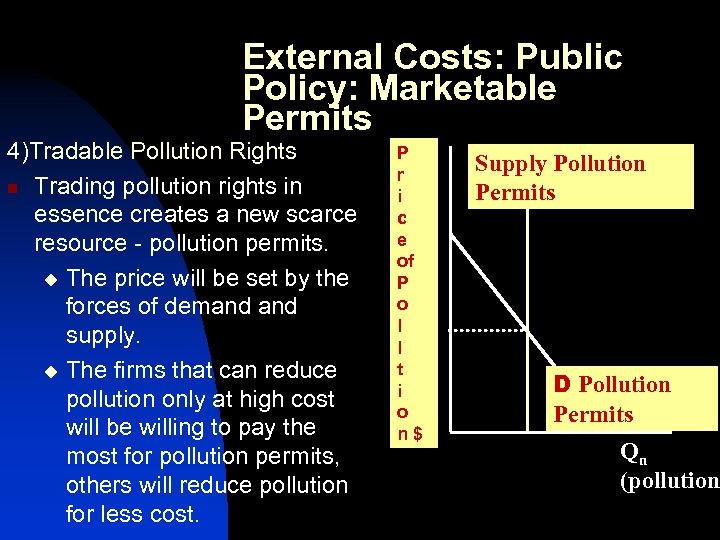 External Costs: Public Policy: Marketable Permits 4)Tradable Pollution Rights n Trading pollution rights in essence creates a new scarce resource - pollution permits. u The price will be set by the forces of demand supply. u The firms that can reduce pollution only at high cost will be willing to pay the most for pollution permits, others will reduce pollution for less cost. P r i c e of P o l l t i o n$ Supply Pollution Permits D Pollution Permits Qn (pollution
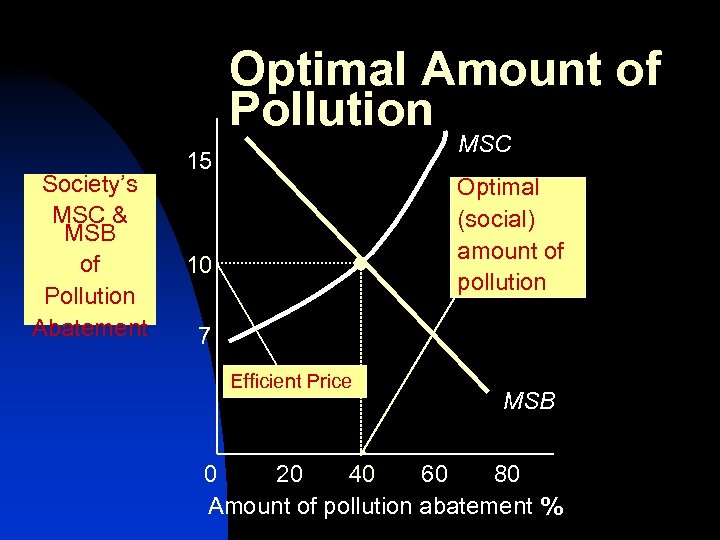 Optimal Amount of Pollution Society’s MSC & MSB of Pollution Abatement MSC 15 Optimal (social) amount of pollution 10 7 Efficient Price MSB 0 20 40 60 80 Amount of pollution abatement %