


 Скачать презентацию Government Civics Domain Sixth and Seventh Grade Social Studies
ffb032cbb013095fd516d162f5f3f4e9.ppt
- Количество слайдов: 44
 Government/Civics Domain Sixth and Seventh Grade Social Studies
 Compare & Contrast Various Forms of Government Describe the ways government systems distribute power: unitary, confederation, and federal SS 6 - CG 1 a, CG 4 a, CG 6 a SS 7 – CG 1 a, CG 4 a, CG 6 a
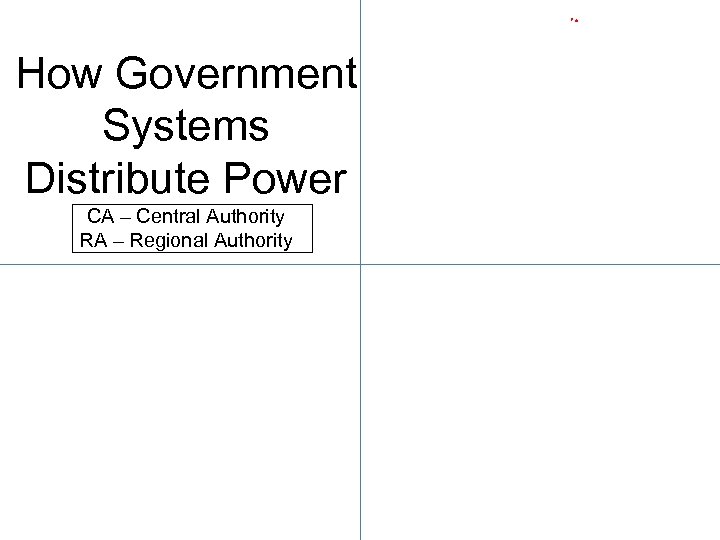 How Government Systems Distribute Power CA – Central Authority RA – Regional Authority
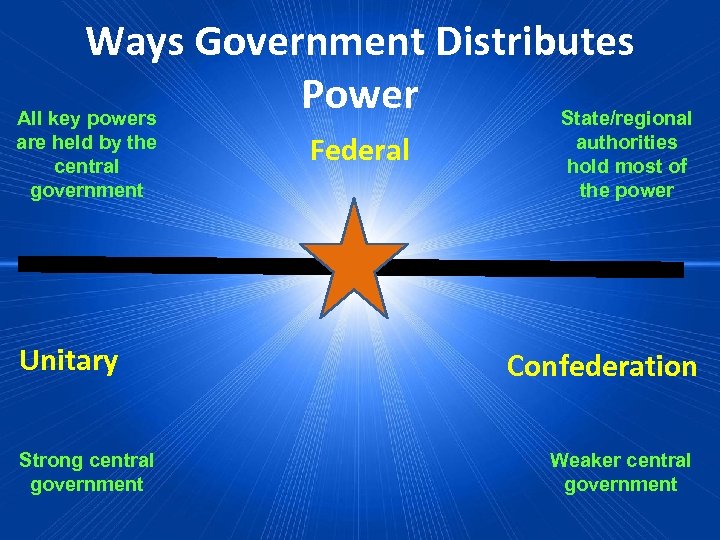
 Unitary Power is held by one central authority.
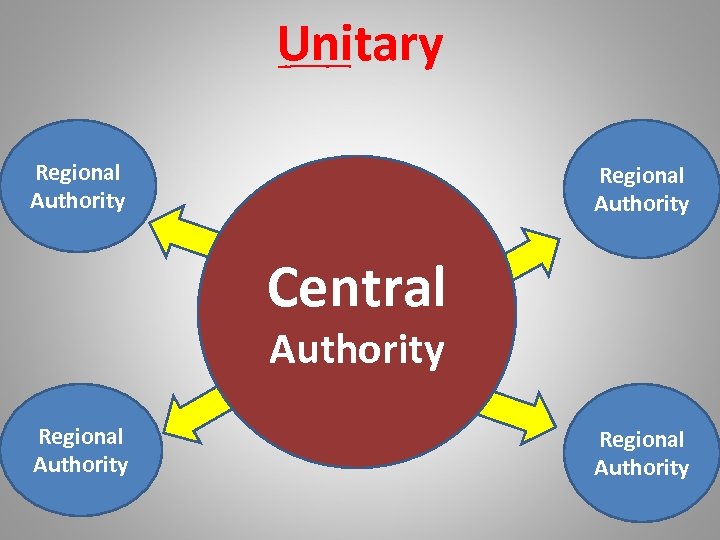 Unitary Regional Authority Central Authority Regional Authority
 Confederation • Voluntary association of independent states that come together for a common purpose. They only give a few powers to the central authority.
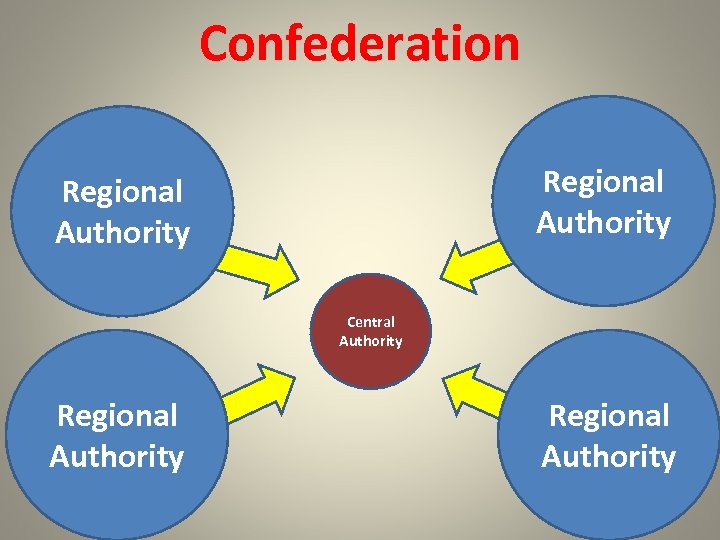 Confederation Regional Authority Central Authority Regional Authority
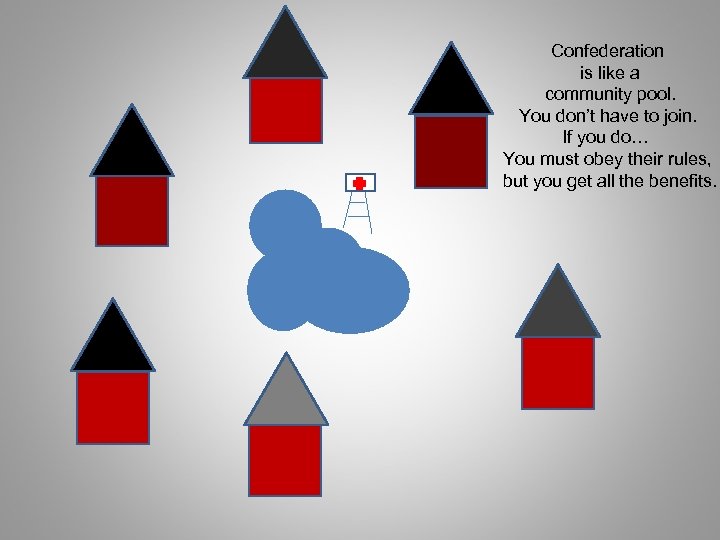 Confederation is like a community pool. You don’t have to join. If you do… You must obey their rules, but you get all the benefits.
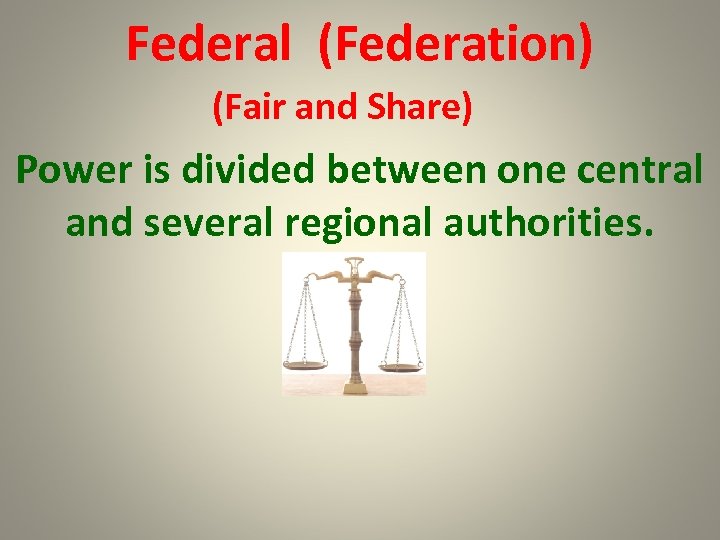 Federal (Federation) (Fair and Share) Power is divided between one central and several regional authorities.
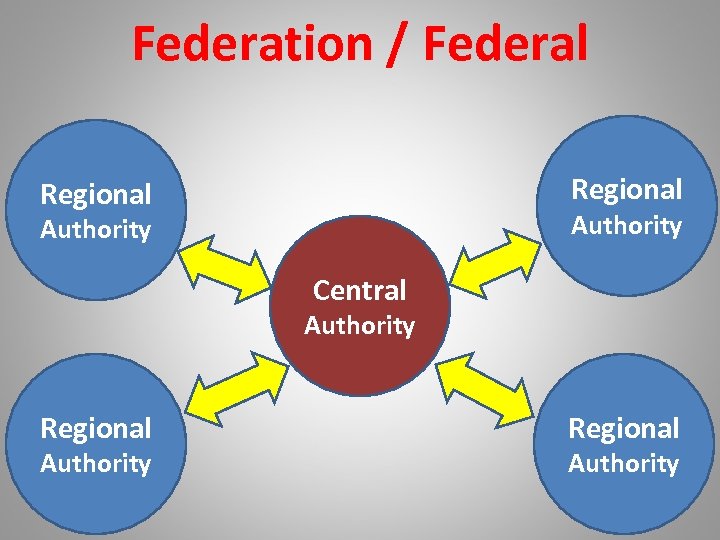 Federation / Federal Regional Authority Central Authority Regional Authority
 Sample Test Question In the United States’ government, power is divided between Central and regional authorities. This is an example of which government type? Corresponds to SS 6 - CG 1 a, CG 4 a, CG 6 a SS 7 - CG 1 a , CG 4 a, CG 6 a
 Sample Test Question In the United States’ government, power is divided between Central and regional authorities. This is an example of which government type? Federal Corresponds to SS 6 - CG 1 a, CG 4 a, CG 6 a SS 7 - CG 1 a , CG 4 a, CG 6 a
 Sample Test Question You live in a country that is ruled by a dictator that has control over all areas of the government. This is an example of which form of government? Corresponds to SS 6 - CG 1 a, CG 4 a, CG 6 a SS 7 - CG 1 a , CG 4 a, CG 6 a
 Sample Test Question You live in a country that is ruled by a dictator that has control over all areas of the government. This is an example of which form of government? Unitary Corresponds to SS 6 - CG 1 a, CG 4 a, CG 6 a SS 7 - CG 1 a , CG 4 a, CG 6 a
 Sample Test Question Your country has decided to join the European Union. In joining they give up some control, but will still maintain most of the control. What form of government is this?
 Sample Test Question Your country has decided to join the European Union. In joining they give up some control, but will still maintain most of the control. What form of government is this? Confederation
 Ways Government Distributes Power All key powers State/regional are held by the central government Unitary Strong central government Federal authorities hold most of the power Confederation Weaker central government
 Compare & Contrast Various Forms of Government How governments determine citizen participation: SS 6 - CG 1 b, CG 4 b, CG 6 b SS 7 – CG 1 b, CG 4 b, CG 6 b
 Low or No Participation Autocratic Low or No Participation Oligarchic Citizen Participation Government Power General Citizens’ Participation Select Citizens’ Participation Government Power Citizen Participation Government Power How Governments Determine Citizen High Participation Low or No Participation Democracy
 Autocratic One person possesses unlimited power. The citizen has limited, if any, role in government.
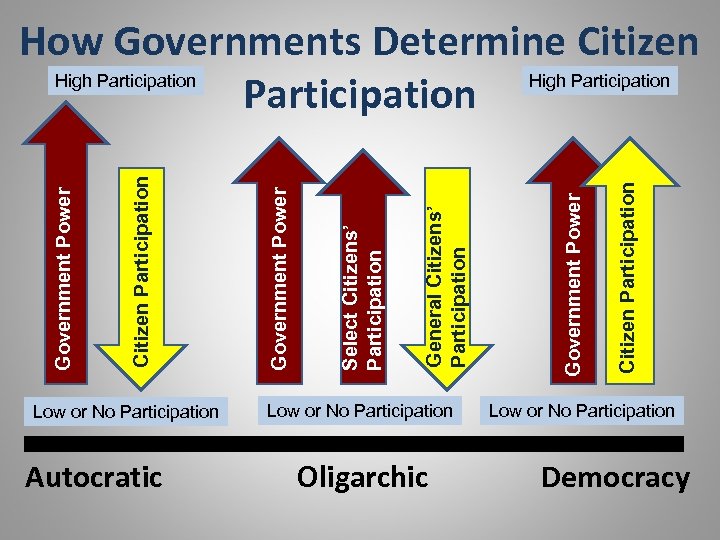
 Autocratic Power is maintained or kept through inheritance or use of military and police force. •
 Forms of Autocratic Govts. • Absolute or Totalitarian Dictatorship • Ideas of a single leader glorified. • Government tries to control all aspects of social and economic life. • Government is not responsible to the people. • People lack the power to limit their rulers. • Examples- Adolf Hitler, Benito Mussolini, Joseph Stalin
 Forms of Autocratic Govts. • Absolute Monarchy • King, queen, or emperor exercises the supreme powers of government/unlimited power. • Position is usually inherited. • People lack the power to limit their rulers. • Absolute monarchs are rare today but from the 1400 s to the 1700 s they ruled most of Western Europe. • Examples- King of Saudi Arabia.
 How Governments Determine Citizen Participation Forms of Autocratic Govts. • Absolute Monarchy • King, queen, or emperor exercises the supreme powers of government/unlimited power. • Position is usually inherited. • People lack the power to limit their rulers. • Absolute monarchs are rare today but from the 1400 s to the 1700 s they ruled most of Western Europe. • Examples- King of Saudi Arabia.
 Oligarchy Government by the few. Sometimes a small group exercises control, especially for corrupt and selfish purposes. The citizen has a very limited role.
 Oligarchy • The group gets its power from military power, social power, wealth, religion or a combination. • Political opposition is usually suppressedsometimes violently. • Examples- Communist countries such as China. • Leaders in the party and armed forces control government.
 Autocracy & Oligarchy • Sometimes claim they rule for the people. • In reality, the people have very little say in both types of government. • Examples- May hold elections with only one candidate or control the results in various ways. • Examples- Even when these governments have a legislature or national assembly, they often only approve decisions made by the leaders.
 Sample Test Question What is a basic way citizens of a democratic nation can influence the government? A. voting B. working C. obeying laws D. consuming goods OAS Database Question - Corresponds to SS 6 - CG 1 b, CG 4 b, CG 6 b SS 7 - CG 1 b , CG 4 b, CG 6 b
 Sample Test Question What is a basic way citizens of a democratic nation can influence the government? A. voting* B. working C. obeying laws D. consuming goods OAS Database Question - Corresponds to SS 6 - CG 1 b, CG 4 b, CG 6 b SS 7 - CG 1 b , CG 4 b, CG 6 b
 Compare & Contrast Various Forms of Government Describe the two predominant forms of democratic governments: Parliamentary & Presidential SS 6 - CG 1 c, CG 4 c, CG 6 c SS 7 – CG 1 c, CG 4 c, CG 6 c
 Parliamentary Democracy A system of government in which executive power comes from and is connected to the legislature (parliament). May have a Prime Minister elected by the legislature.
 Presidential Democracy A system of government in which the president is constitutionally independent of the legislature. The executive branch exists separately from the legislature (to which it is generally not accountable).
 Sample Test Question In which system of government does the legislature elect the executive leader of the government? A. democratic B. communist C. parliamentary D. totalitarian OAS Database Question - Corresponds to SS 6 - CG 1 c, CG 4 c, CG 6 c SS 7 - CG 1 c , CG 4 c, CG 6 c
 Sample Test Question In which system of government does the legislature elect the executive leader of the government? A. democratic B. communist C. parliamentary* D. totalitarian OAS Database Question - Corresponds to SS 6 - CG 1 c, CG 4 c, CG 6 c SS 7 - CG 1 c , CG 4 c, CG 6 c
 Sample Test Question Which statement about Great Britain's parliamentary system of government today is true? A. Members of both houses of Parliament are elected for life. B. The queen decides which laws Parliament will debate. C. Members of Parliament do not belong to political parties. D. The prime minister is not directly chosen by voters. OAS Database Question - Corresponds to SS 6 - CG 1 c, CG 4 c, CG 6 c SS 7 - CG 1 c , CG 4 c, CG 6 c
 Sample Test Question Which statement about Great Britain's parliamentary system of government today is true? A. Members of both houses of Parliament are elected for life. B. The queen decides which laws Parliament will debate. C. Members of Parliament do not belong to political parties. D. The prime minister is not directly chosen by voters. * OAS Database Question - Corresponds to SS 6 - CG 1 c, CG 4 c, CG 6 c SS 7 - CG 1 c , CG 4 c, CG 6 c
 Sample Test Question In most democratic countries, the government is divided into three branches: executive, legislative, and judicial. In Canada, the legislative branch is the A. Parliament B. prime minister C. Supreme Court D. governor general OAS Database Question - Corresponds to SS 6 - CG 1 b, CG 4 b, CG 6 b SS&- CG 1 b , CG 4 b, CG 6 b
 Sample Test Question In most democratic countries, the government is divided into three branches: executive, legislative, and judicial. In Canada, the legislative branch is the A. Parliament* B. prime minister C. Supreme Court D. governor general OAS Database Question - Corresponds to SS 6 - CG 1 b, CG 4 b, CG 6 b SS&- CG 1 b , CG 4 b, CG 6 b
 Federal (Federation) Germany, Russia, Canada, Australia A form of government in which sovereign power is formally divided - usually by means of a constitution - between a central authority and a number of constituent regions (states, colonies, or provinces) so that each region retains some management of its internal affairs; differs from a confederacy in that the central government exerts influence directly upon both individuals as well as upon the regional Compare types of governments from various countries. units. Distinguish the form of leadership and the role of the citizen in terms of voting rights and personal freedoms.
 Parliamentary Democracy Israel, Canada, Australia A political system in which the legislature (parliament) selects the government - a prime minister, premier, or chancellor along with the cabinet ministers - according to party strength as expressed in elections; by this system, the government acquires a dual responsibility: to the people as well as to the parliament. Compare types of governments from various countries. Distinguish the form of leadership and the role of the citizen in terms of voting rights and personal freedoms.
 Parliamentary Democracy United Kingdom Government in which members of an executive branch (the cabinet and its leader - a prime minister, premier, or chancellor) are nominated to their positions by a legislature or parliament, and are directly responsible to it; this type of government can be dissolved at will by the parliament (legislature) by means of a no confidence vote or the leader of the cabinet may dissolve the parliament if it can no longer function. Also see Constitutional Monarchy. Compare types of governments from various countries. Distinguish the form of leadership and the role of the citizen in terms of voting rights and personal freedoms.
 Absolute Monarchy Saudi Arabia A government in which the supreme power is lodged in the hands of a monarch who reigns over a state or territory, usually for life and by hereditary right; the monarch may be either a sole absolute ruler or a sovereign - such as a king, queen, or prince - with constitutionally limited authority. Compare types of governments from various countries. Distinguish the form of leadership and the role of the citizen in terms of voting rights and personal freedoms.
 Constitutional Monarchy Japan and Canada A system of government in which a monarch is guided by a constitution whereby his/her rights, duties, and responsibilities are spelled out in written law or by custom. Compare types of governments from various countries. Distinguish the form of leadership and the role of the citizen in terms of voting rights and personal freedoms.
 Dictatorships Cuba A form of government in which a ruler or small clique wield absolute power (not restricted by a constitution or laws). Compare types of governments from various countries. Distinguish the form of leadership and the role of the citizen in terms of voting rights and personal freedoms.