


 Скачать презентацию Government and Health Care in China Ling Li
ab3976750fc5a3a68ef38a1ae73f5f9d.ppt
- Количество слайдов: 25
 Government and Health Care in China Ling Li China Center For Economic Research at Peking University
 Chinese health care system n When health care was lead by government, during the period between 1950 to 1978, China had many achievements in health field to be proud of n n n rapid and large reductions in mortality rate, despite China’s low income per capita at the time create a low cost, wide coverage primary health care model When health care is based on market mechanism n n n After 20 years of economic reform, China’s healthcare system has not improved as well as the economy has. Instead, it has deteriorated in many aspects Patients, providers and government are all unsatisfied Medical costs are escalating rapidly
 The existing problems n n Rapid increase in health care expenditure Increase share of personal income spent on health care n n n Limited access to health care service n n n Decrease in government health input Decrease in health insurance coverage High medical expenses Poor service qualities Health Inequality n n Regional Economic
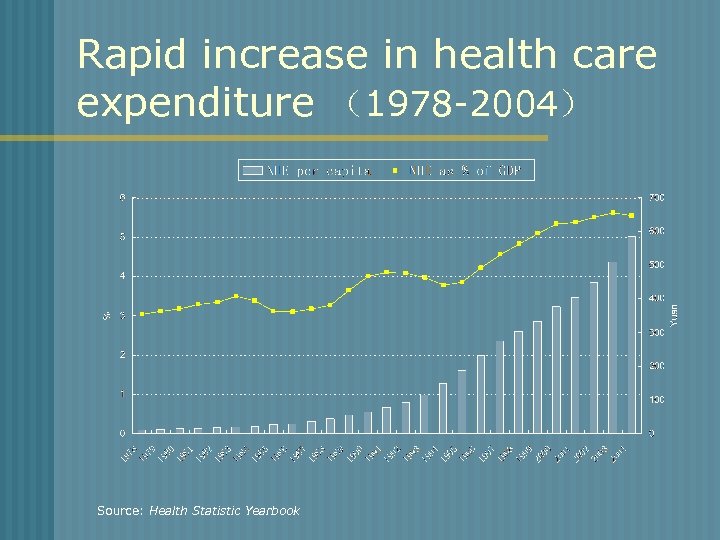 Rapid increase in health care expenditure (1978 -2004) Source: Health Statistic Yearbook
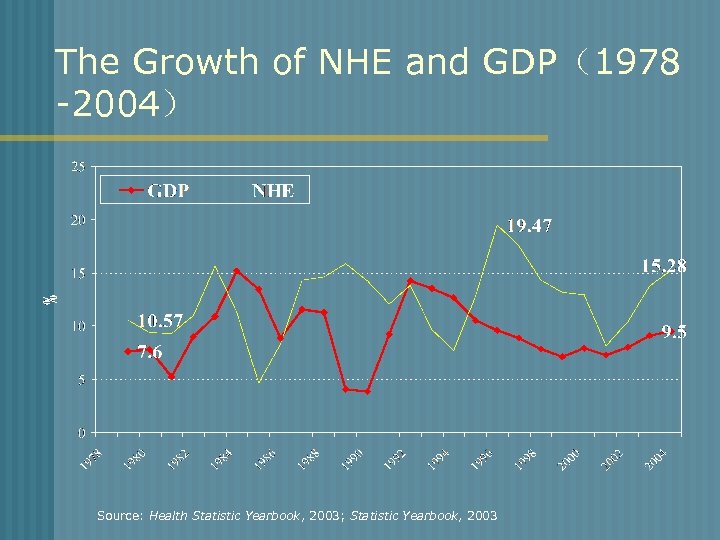 The Growth of NHE and GDP(1978 -2004) Source: Health Statistic Yearbook, 2003; Statistic Yearbook, 2003
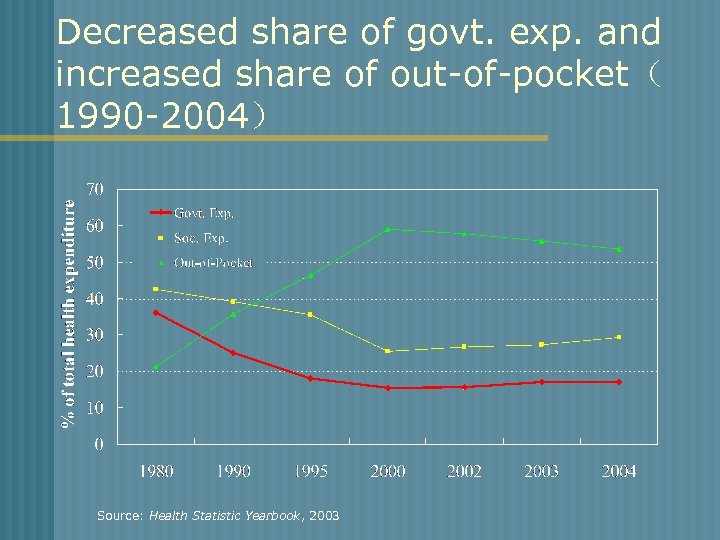 Decreased share of govt. exp. and increased share of out-of-pocket( 1990 -2004) Source: Health Statistic Yearbook, 2003
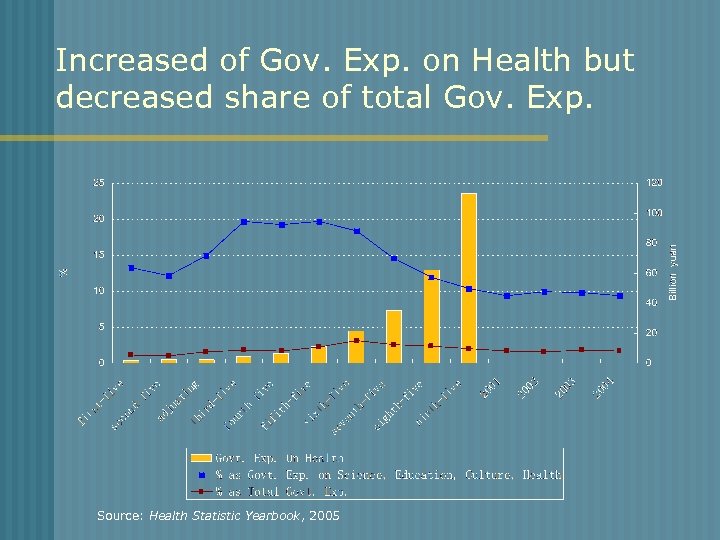 Increased of Gov. Exp. on Health but decreased share of total Gov. Exp. Source: Health Statistic Yearbook, 2005
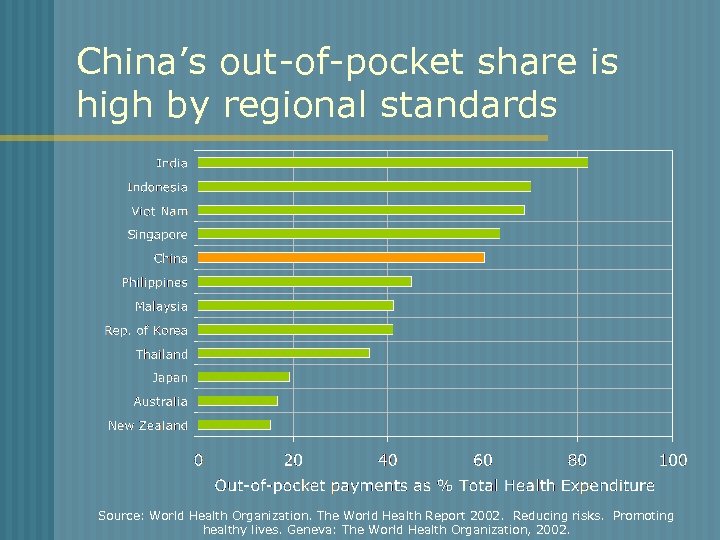 China’s out-of-pocket share is high by regional standards Source: World Health Organization. The World Health Report 2002. Reducing risks. Promoting healthy lives. Geneva: The World Health Organization, 2002.
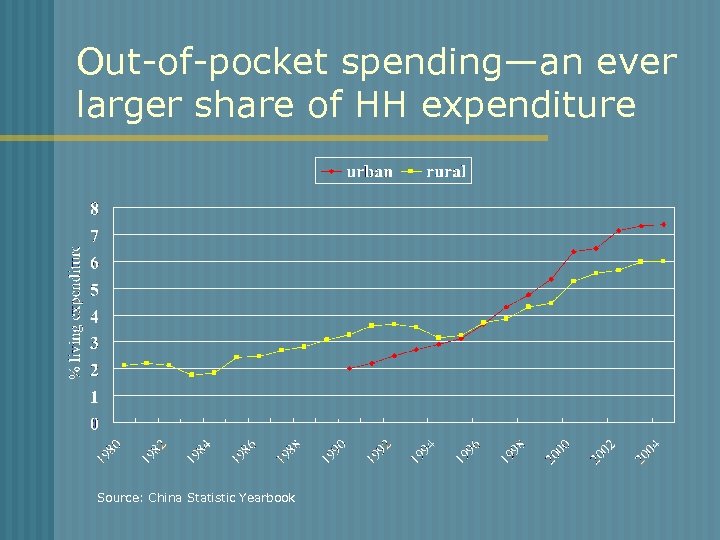 Out-of-pocket spending—an ever larger share of HH expenditure Source: China Statistic Yearbook
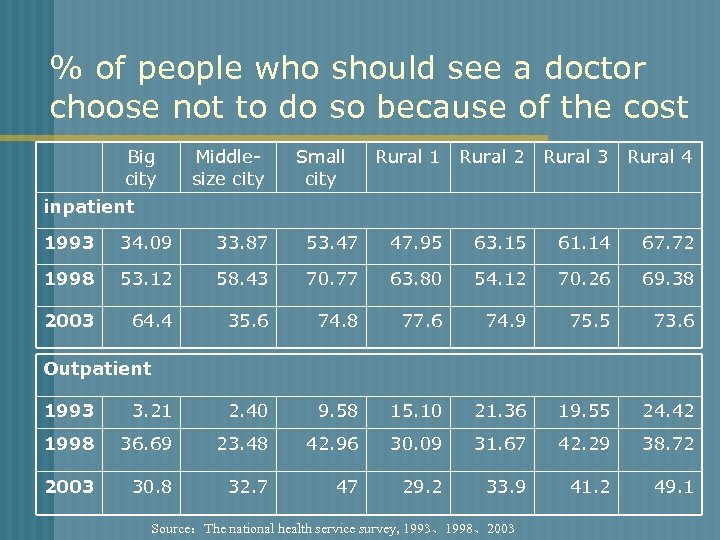 % of people who should see a doctor choose not to do so because of the cost Big city Middlesize city Small city Rural 1 Rural 2 Rural 3 Rural 4 inpatient 1993 34. 09 33. 87 53. 47 47. 95 63. 15 61. 14 67. 72 1998 53. 12 58. 43 70. 77 63. 80 54. 12 70. 26 69. 38 2003 64. 4 35. 6 74. 8 77. 6 74. 9 75. 5 73. 6 Outpatient 1993 3. 21 2. 40 9. 58 15. 10 21. 36 19. 55 24. 42 1998 36. 69 23. 48 42. 96 30. 09 31. 67 42. 29 38. 72 2003 30. 8 32. 7 47 29. 2 33. 9 41. 2 49. 1 Source:The national health service survey, 1993、1998、2003
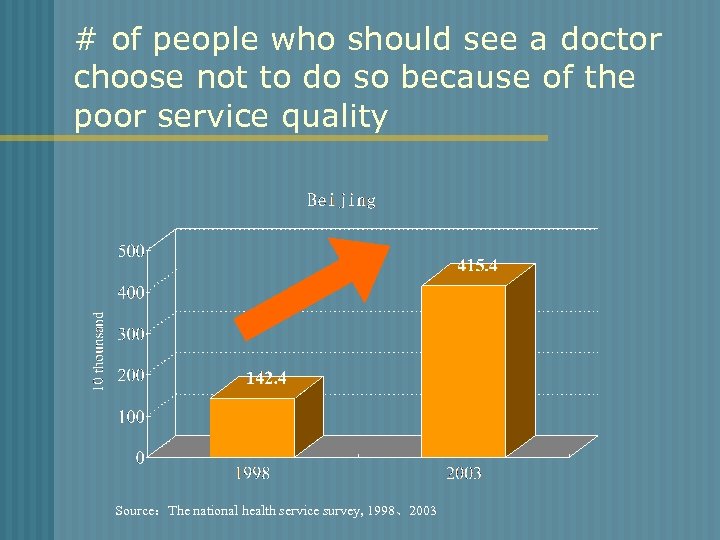 # of people who should see a doctor choose not to do so because of the poor service quality Source:The national health service survey, 1998、2003
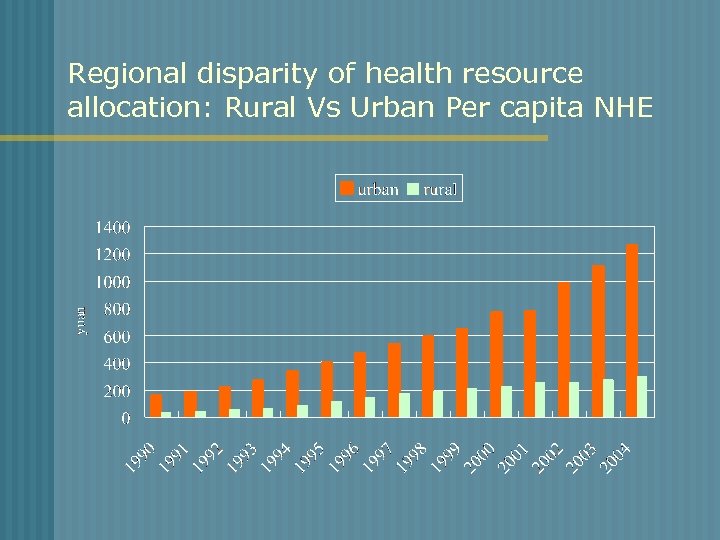 Regional disparity of health resource allocation: Rural Vs Urban Per capita NHE
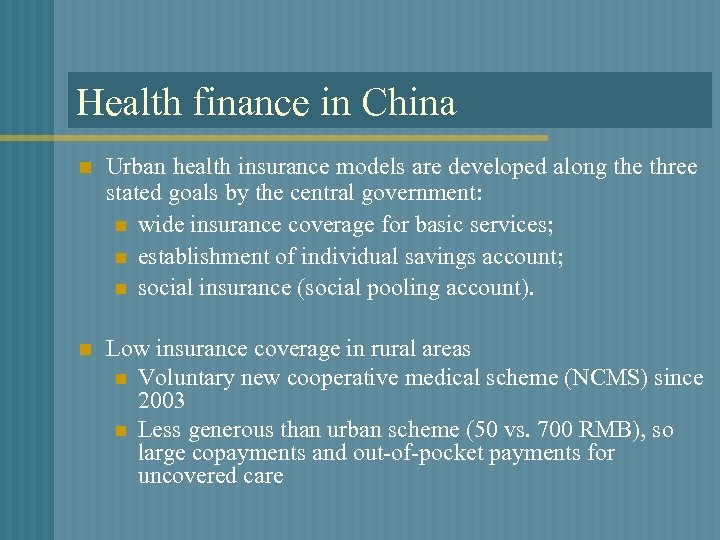 Health finance in China n Urban health insurance models are developed along the three stated goals by the central government: n wide insurance coverage for basic services; n establishment of individual savings account; n social insurance (social pooling account). n Low insurance coverage in rural areas n Voluntary new cooperative medical scheme (NCMS) since 2003 n Less generous than urban scheme (50 vs. 700 RMB), so large copayments and out-of-pocket payments for uncovered care
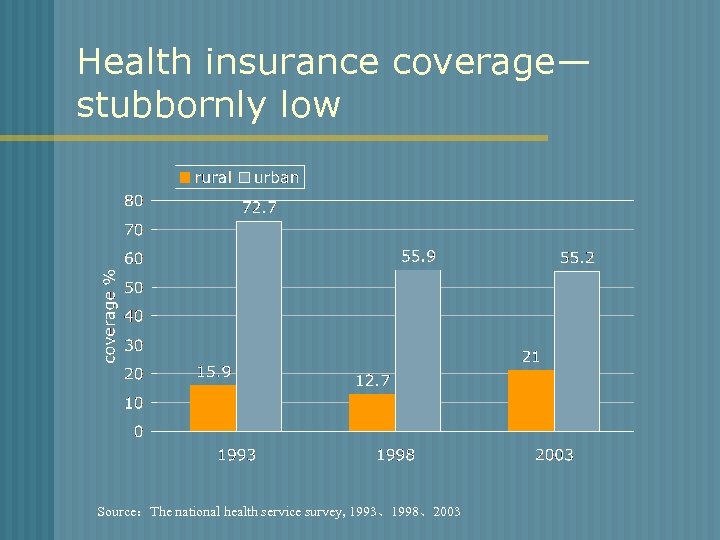 Health insurance coverage— stubbornly low Source:The national health service survey, 1993、1998、2003
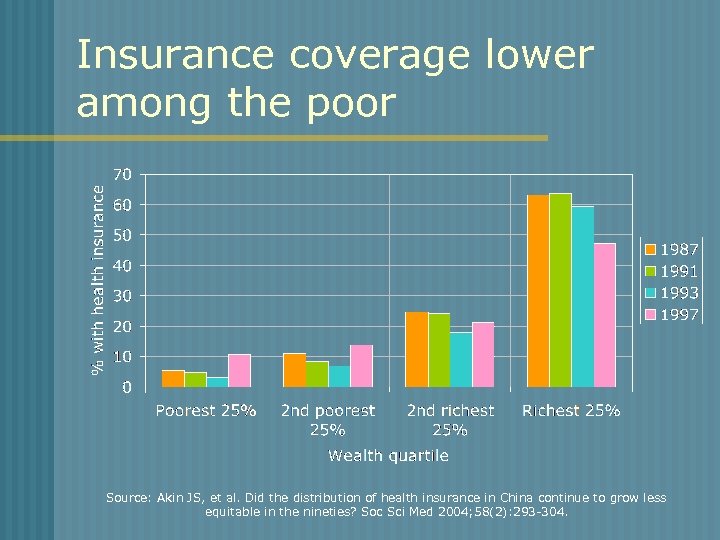 Insurance coverage lower among the poor Source: Akin JS, et al. Did the distribution of health insurance in China continue to grow less equitable in the nineties? Soc Sci Med 2004; 58(2): 293 -304.
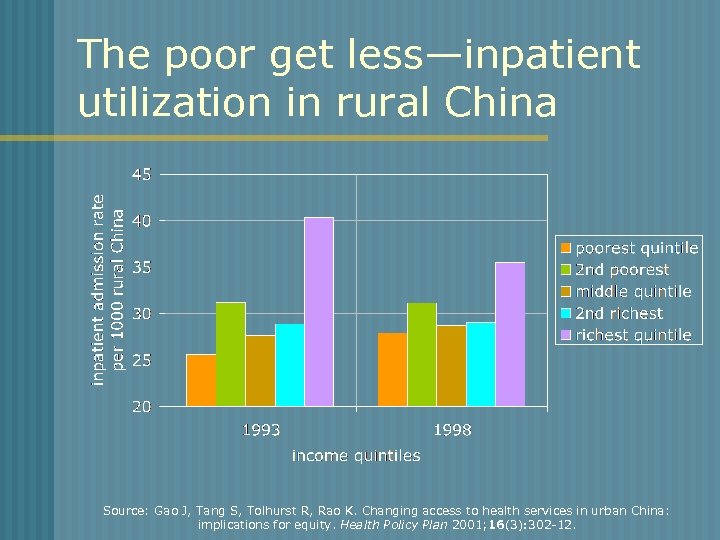 The poor get less—inpatient utilization in rural China Source: Gao J, Tang S, Tolhurst R, Rao K. Changing access to health services in urban China: implications for equity. Health Policy Plan 2001; 16(3): 302 -12.
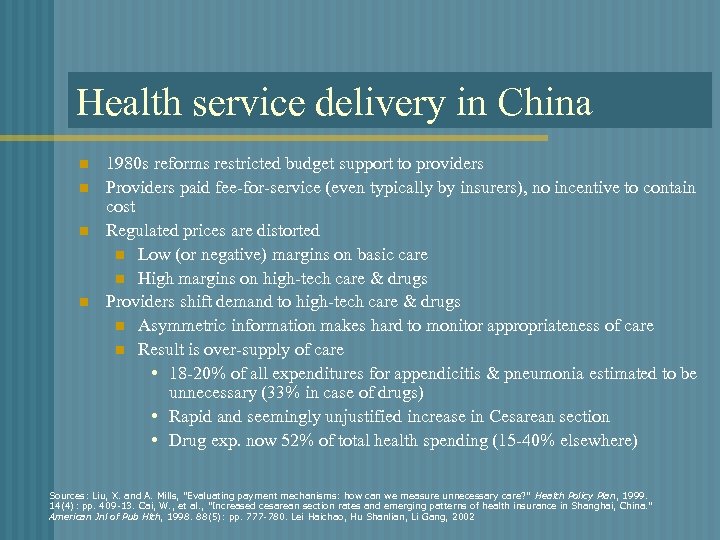 Health service delivery in China n n 1980 s reforms restricted budget support to providers Providers paid fee-for-service (even typically by insurers), no incentive to contain cost Regulated prices are distorted n Low (or negative) margins on basic care n High margins on high-tech care & drugs Providers shift demand to high-tech care & drugs n Asymmetric information makes hard to monitor appropriateness of care n Result is over-supply of care • 18 -20% of all expenditures for appendicitis & pneumonia estimated to be unnecessary (33% in case of drugs) • Rapid and seemingly unjustified increase in Cesarean section • Drug exp. now 52% of total health spending (15 -40% elsewhere) Sources: Liu, X. and A. Mills, "Evaluating payment mechanisms: how can we measure unnecessary care? " Health Policy Plan, 1999. 14(4): pp. 409 -13. Cai, W. , et al. , "Increased cesarean section rates and emerging patterns of health insurance in Shanghai, China. " American Jnl of Pub Hlth, 1998. 88(5): pp. 777 -780. Lei Haichao, Hu Shanlian, Li Gang, 2002
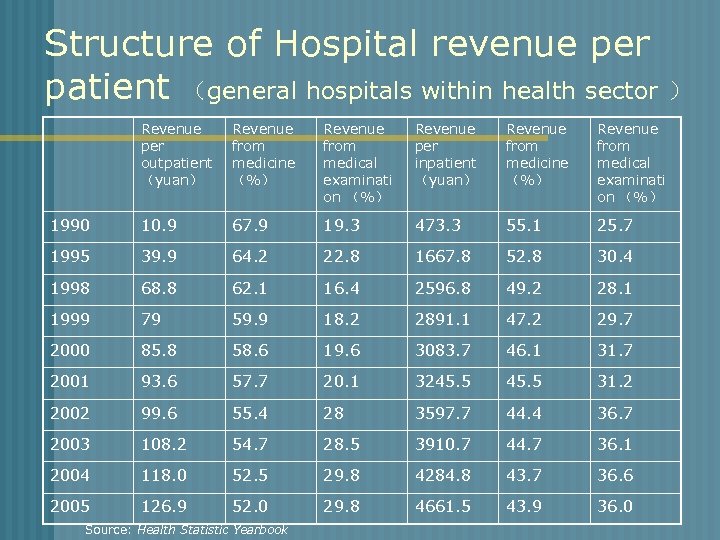 Structure of Hospital revenue per patient (general hospitals within health sector ) Revenue per outpatient (yuan) Revenue from medicine (%) Revenue from medical examinati on (%) Revenue per inpatient (yuan) Revenue from medicine (%) Revenue from medical examinati on (%) 1990 10. 9 67. 9 19. 3 473. 3 55. 1 25. 7 1995 39. 9 64. 2 22. 8 1667. 8 52. 8 30. 4 1998 68. 8 62. 1 16. 4 2596. 8 49. 2 28. 1 1999 79 59. 9 18. 2 2891. 1 47. 2 29. 7 2000 85. 8 58. 6 19. 6 3083. 7 46. 1 31. 7 2001 93. 6 57. 7 20. 1 3245. 5 31. 2 2002 99. 6 55. 4 28 3597. 7 44. 4 36. 7 2003 108. 2 54. 7 28. 5 3910. 7 44. 7 36. 1 2004 118. 0 52. 5 29. 8 4284. 8 43. 7 36. 6 2005 126. 9 52. 0 29. 8 4661. 5 43. 9 36. 0 Source: Health Statistic Yearbook
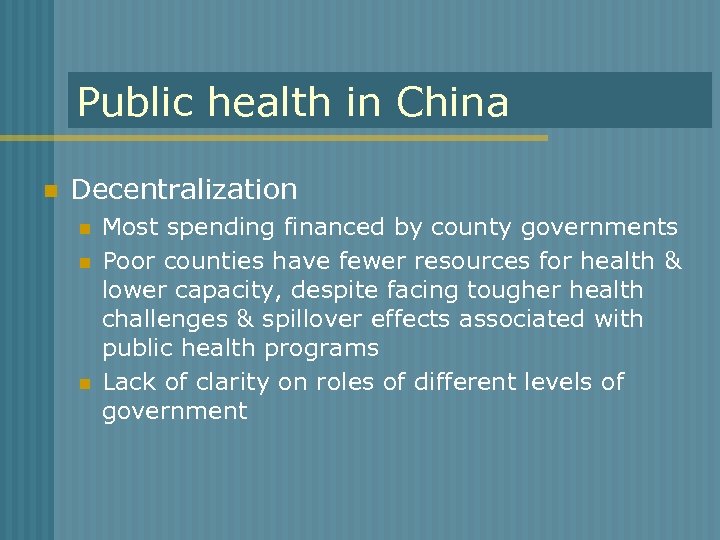 Public health in China n Decentralization n Most spending financed by county governments Poor counties have fewer resources for health & lower capacity, despite facing tougher health challenges & spillover effects associated with public health programs Lack of clarity on roles of different levels of government
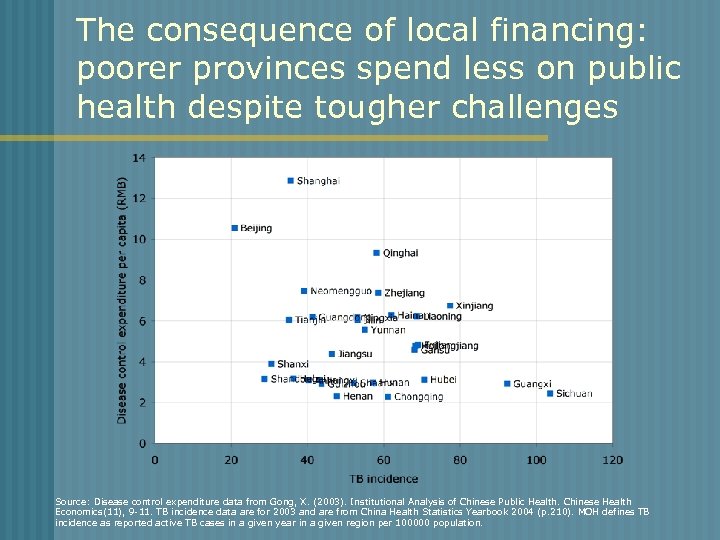 The consequence of local financing: poorer provinces spend less on public health despite tougher challenges Source: Disease control expenditure data from Gong, X. (2003). Institutional Analysis of Chinese Public Health. Chinese Health Economics(11), 9 -11. TB incidence data are for 2003 and are from China Health Statistics Yearbook 2004 (p. 210). MOH defines TB incidence as reported active TB cases in a given year in a given region per 100000 population.
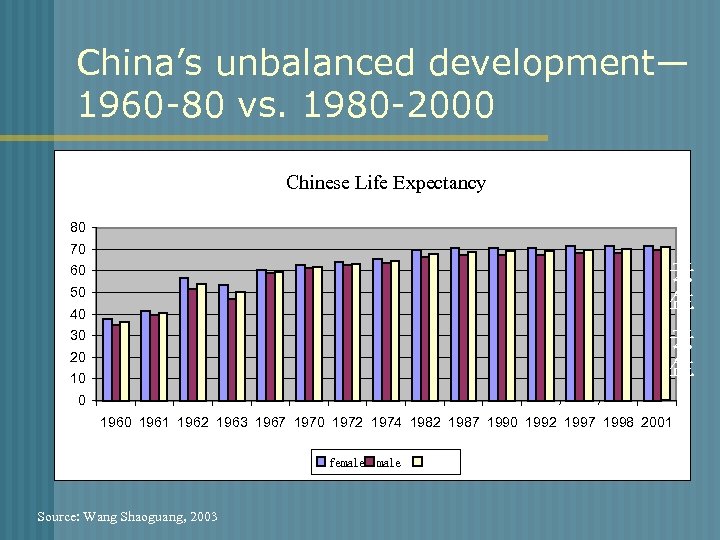 China’s unbalanced development— 1960 -80 vs. 1980 -2000 图:中国人口平均预期寿命 Chinese Life Expectancy 80 70 去 年 60 50 40 30 20 10 0 1961 1962 1963 1967 1970 1972 1974 1982 1987 1990 1992 1997 1998 2001 female Source: Wang Shaoguang, 2003 male Ave.
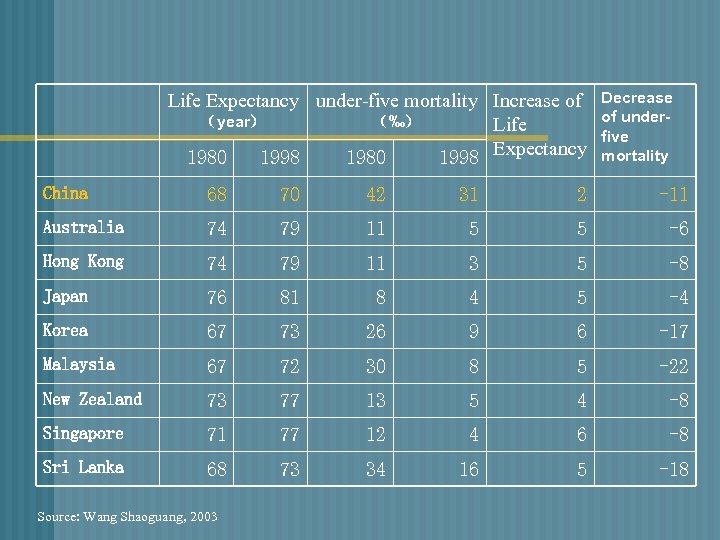 Life Expectancy under-five mortality Increase of (year) (‰) Life 1980 1998 Expectancy Decrease of underfive mortality China 68 70 42 31 2 -11 Australia 74 79 11 5 5 -6 Hong Kong 74 79 11 3 5 -8 Japan 76 81 8 4 5 -4 Korea 67 73 26 9 6 -17 Malaysia 67 72 30 8 5 -22 New Zealand 73 77 13 5 4 -8 Singapore 71 77 12 4 6 -8 Sri Lanka 68 73 34 16 5 -18 Source: Wang Shaoguang, 2003
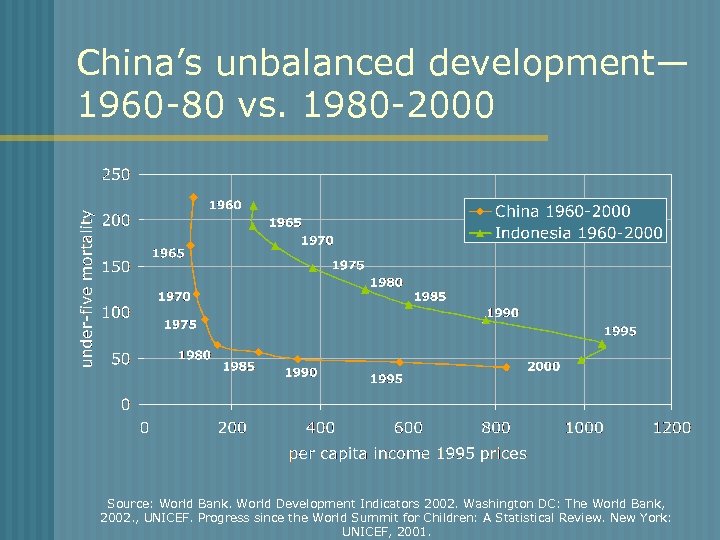 China’s unbalanced development— 1960 -80 vs. 1980 -2000 Source: World Bank. World Development Indicators 2002. Washington DC: The World Bank, 2002. , UNICEF. Progress since the World Summit for Children: A Statistical Review. New York: UNICEF, 2001.
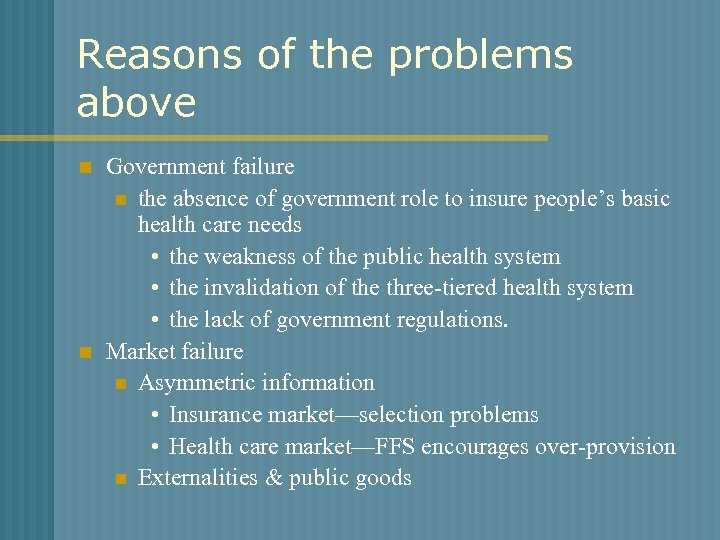 Reasons of the problems above n n Government failure n the absence of government role to insure people’s basic health care needs • the weakness of the public health system • the invalidation of the three-tiered health system • the lack of government regulations. Market failure n Asymmetric information • Insurance market—selection problems • Health care market—FFS encourages over-provision n Externalities & public goods
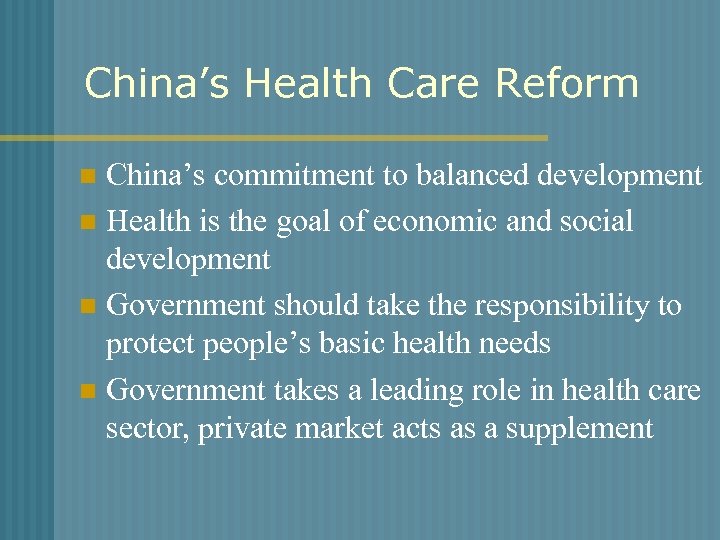 China’s Health Care Reform China’s commitment to balanced development n Health is the goal of economic and social development n Government should take the responsibility to protect people’s basic health needs n Government takes a leading role in health care sector, private market acts as a supplement n