 Скачать презентацию Government Affairs Update NEIL REICHENBERG IPMA-HR EXECUTIVE DIRECTOR
88e484a6974c93f05537c36ad1fda03e.ppt
- Количество слайдов: 28



Government Affairs Update NEIL REICHENBERG IPMA-HR EXECUTIVE DIRECTOR JANUARY 21, 2015 ipma-hr. org
Election Low voter turnout in the 2014 election with only 36% of eligible voters participating The election resulted in the Republicans continuing control of the House of Representatives and regaining control of the Senate Republicans will control 247 seats, the largest majority in the House of Representatives since 1931 In the Senate, Republicans will control 54 seats They are short of the 60 votes needed to prevent a filibuster Republicans want to show that they can move beyond blocking legislative proposals to passing bills Focus now shifts to the 2016 election
Congress The 113 th Congress was the second least productive Congress in modern times 16% approve and 80% disapprove of the job that Congress is doing Despite this, 95% of incumbents were reelected
Post-Election Session In the post-election session, Congress passed a bill funding the federal government through September 30 th, the end of the fiscal year for all departments except for the Department of Homeland Security which was funded only through the end of February This is a reaction to the immigration executive order issued by President Obama In January, the House passed a bill prohibiting any funds being spent on implementing the immigration executive order
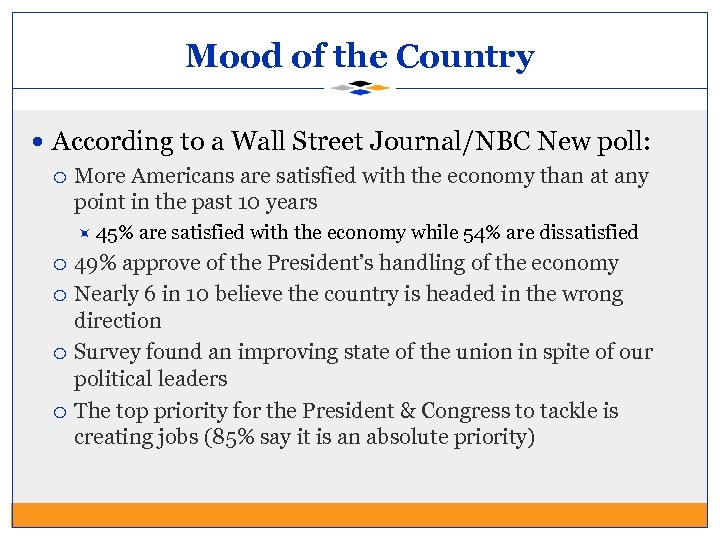
Mood of the Country According to a Wall Street Journal/NBC New poll: More Americans are satisfied with the economy than at any point in the past 10 years 45% are satisfied with the economy while 54% are dissatisfied 49% approve of the President’s handling of the economy Nearly 6 in 10 believe the country is headed in the wrong direction Survey found an improving state of the union in spite of our political leaders The top priority for the President & Congress to tackle is creating jobs (85% say it is an absolute priority)
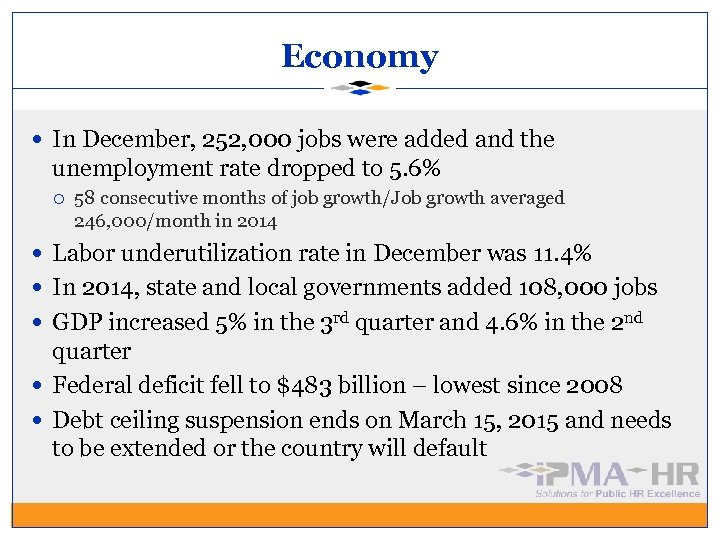
Economy In December, 252, 000 jobs were added and the unemployment rate dropped to 5. 6% 58 consecutive months of job growth/Job growth averaged 246, 000/month in 2014 Labor underutilization rate in December was 11. 4% In 2014, state and local governments added 108, 000 jobs GDP increased 5% in the 3 rd quarter and 4. 6% in the 2 nd quarter Federal deficit fell to $483 billion – lowest since 2008 Debt ceiling suspension ends on March 15, 2015 and needs to be extended or the country will default
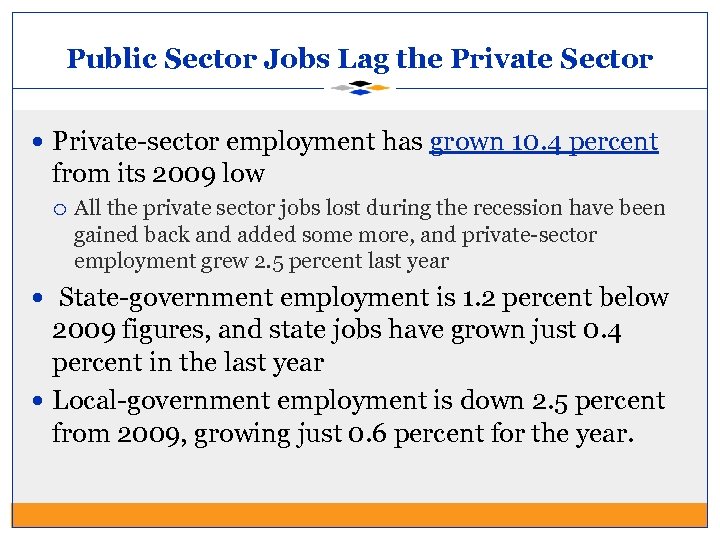
Public Sector Jobs Lag the Private Sector Private-sector employment has grown 10. 4 percent from its 2009 low All the private sector jobs lost during the recession have been gained back and added some more, and private-sector employment grew 2. 5 percent last year State-government employment is 1. 2 percent below 2009 figures, and state jobs have grown just 0. 4 percent in the last year Local-government employment is down 2. 5 percent from 2009, growing just 0. 6 percent for the year.
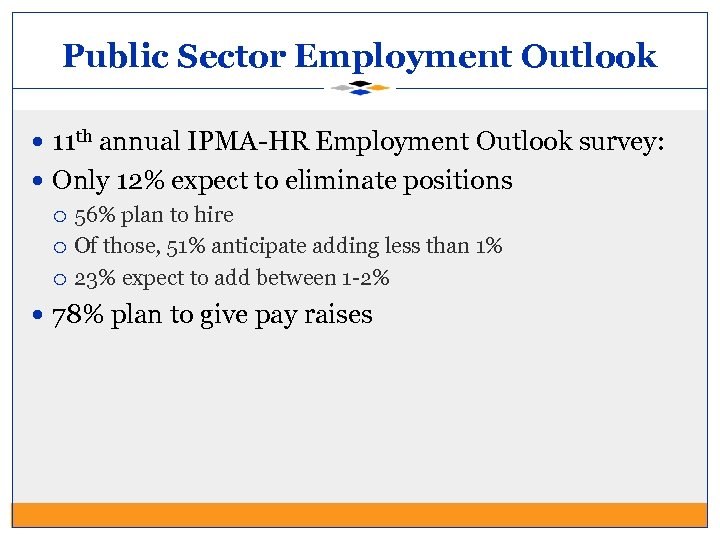
Public Sector Employment Outlook 11 th annual IPMA-HR Employment Outlook survey: Only 12% expect to eliminate positions 56% plan to hire Of those, 51% anticipate adding less than 1% 23% expect to add between 1 -2% 78% plan to give pay raises
Wages
Income Inequality
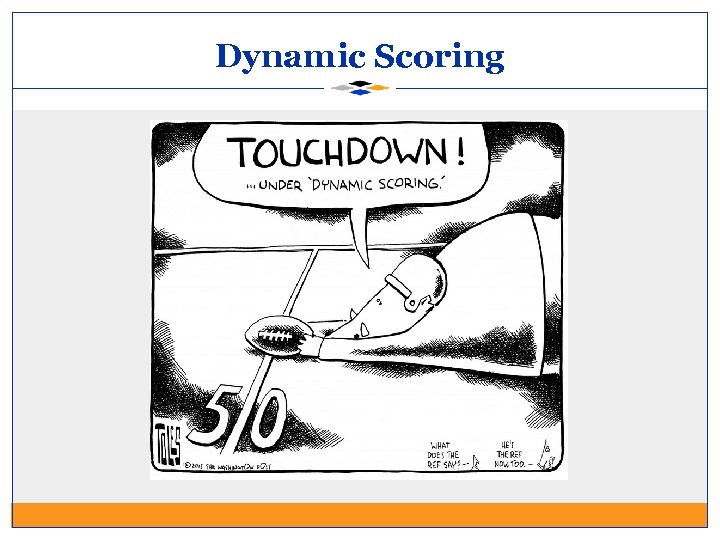
Tax Reform Both parties want to focus on policies designed to assist working families President Obama and congressional Democrats support raising taxes on the wealthy and large financial firms to finance tax cuts for the middle class Interest in tax reform is growing: Tax-free employee benefits such as pension contributions ($137 billion in 2013), and employer sponsored health insurance ($248 billion in 2013) may be looked at as a source of revenue Republicans favor the use of ‘dynamic scoring’ when examining the revenue impact of tax cuts This will make tax cuts appear more affordable
Dynamic Scoring
Overtime Regulations President directed the Secretary of Labor to revise the FLSA overtime regulations for executive, administrative, and professional employees Goal is to increase the number of employees who qualify for overtime To be considered exempt, employees must be paid at least $455/week – this amount is expected to be increased Media reports indicate that the salary basis will be increased to $42, 000/year Raising the exemption to this level would affect 2. 6 million workers or about 5% of all salaried workers
Overtime Regulations The duties tests for each of the exemptions are likely to be revised Labor Department delayed the release of the proposed regulations from November 2014 to February 2015 IPMA-HR will be involved in the revisions
Minimum Wage President Obama and Congressional Democrats support increasing the minimum wage to $10. 10/hour President raised the minimum wage to $10. 10/hour for federal contractors In the November election, voters in four states (Alaska, Arkansas, Nebraska, and South Dakota) raised the minimum wage For the first time, a majority of states – 29 + the District of Columbia have minimum wages above the federal minimum The average minimum wage is $8. 42/hour
Paid Leave President Obama has called on Congress to pass a bill that would allow workers to earn up to 7 paid sick days a year and would create a $2 billion incentive fund to help states pay for family leave programs The President signed a presidential memorandum providing 6 weeks of administrative leave to federal employees with a new child He urged Congress to adopt legislation giving an extra 6 weeks of paid leave
Misclassification of Employees The Labor Department has an ongoing initiative to identify employees who are improperly classified as independent contractors The Labor Department has signed MOU’s with 20 states to work cooperatively on this issue Additional information available at - http: //www. dol. gov/whd/workers/misclassification/
Healthcare Reform The US Supreme Court has accepted a case (King v. Burwell) due to conflicting rulings that have been issued by appellate courts as to whether the ACA allows subsidies to those who sign up through the federal exchange Oral argument will be held on March 4 th The challengers believe that those subsidies are being provided unlawfully in 36 states that use the federal exchange The law as drafted limits subsidies to an exchange established by the state IRS issued a regulation saying subsidies are allowed whether it is through a state or federal exchange
Healthcare Reform The Rand Corporation estimates that eliminating the subsidies provided for people who purchase coverage through federally run health insurance markets would sharply boost costs and reduce enrollment in the individual market from 13. 7 million people to 4. 1 million Unsubsidized individual market premiums would rise by 47%
Definition of Full-Time Employees By a vote of 252 – 172, the House of Representatives passed a bill (H. R. 30) that would raise the definition of full-time employment under the ACA from 30 hours per week to 40 hours per week A similar bill (S. 30) has been introduced in the Senate The Congressional Budget Office estimates that the bill would add $50 billion to the deficit over the next decade and result in 1 million fewer people getting health insurance benefits at work The White House said the president would veto the bill IPMA-HR supports the bill
Healthcare Reform House Republicans have filed a lawsuit against the Obama Administration over actions taken on the health care law that they say are abuses of the president’s executive authority The lawsuit accuses the administration of unlawfully postponing a requirement that larger employers with at least 50 employees offer health coverage to full-time employees The lawsuit also challenges what it alleges is the president’s giving about $175 billion to insurance companies over the next 10 years, although the funds have not been appropriated
Wellness Programs The EEOC has been pursuing litigation against wellness programs arguing that penalties render participation in wellness programs involuntary & could violate the ADA & GINA Three lawsuits brought in the past 2 months and corporations alleging that wellness programs were not voluntary due to the large and substantial penalties to those who choose not to participate The ADA allows disability related questions & medical exams as part of a wellness program as long as it is voluntary, the information obtained is kept confidential, & not used to discriminate on the basis of a disability The incentives involved in these cases are significant – employees who elect not to participate lose incentives such as eligibility for health insurance coverage or 100% employer-paid premiums
EEO-4 On July 29 th, the EEOC approved a modification to the EEO -4 reporting form to allow respondents to select more than one race/ethnicity similar to the EEO-1 for the private sector IPMA-HR submitted comments thanking the EEOC for taking this action The EEOC advised that the revisions will be effective for the 2015 reporting cycle IPMA-HR had written to the EEOC urging this modification
Gender Identity The Justice Department announced in December that it will take the position in litigation that the protection of Title VII of the Civil Rights Act of 1964 extends to claims of discrimination based on an individual’s gender identity, including transgender status This reverses a previous Department of Justice position The memo clarifies the Civil Rights Division’s ability to file Title VII claims against state and local public employers on behalf of transgender individuals
FLSA Decision The US Supreme Court ruled unanimously in the case of Integrity Staffing Solutions v. Busk that the time employees spent at the end of a shift waiting to undergo a security screening was not compensable under the FLSA An activity must be integral and indispensable to the principal activities that an employee is employed to perform in order to be compensable The work of the employees was to gather & ship products from the warehouse shelves and the screenings were not an intrinsic element of either retrieving products or packaging them IPMA-HR joined with other state/local government associations in filing an amicus brief urging that the time spent by the employees undergoing security screening should not be compensable
Administrative Procedure Act Amicus Brief IPMA-HR joined other state/local government associations in filing an amicus brief in a Supreme Court case (Perez v. Mortgage Bankers Association) The case raises the issue of whether a federal agency must engage in notice-and-comment rulemaking before it can significantly alter an interpretive rule of an agency regulation DOL issued an opinion letter saying mortgage loan officers were exempt employees – 4 years later, DOL withdrew the opinion letter in an Administrator’s Interpretation that reached the opposite conclusion Case was brought on behalf of employers who believed that DOL should be required to issue notice and allow public comment before changing an interpretation relied on by employers The brief argues that notice and comment is legally required when significant changes are contemplated
Religious Accommodation IPMA-HR will be filing an amicus brief with other state/local government associations in the case of EEOC v. Abercrombie, which involves the question of whether an employer is required to provide a religious accommodation for an employee or prospective employee even where the employer does not have actual knowledge of the employee’s religion The EEOC argues that where an employer “correctly understands” or “correctly perceives” that an employee or prospective employee would require an accommodation, the employer can be liable under Title VII for failing to accommodate the religious need even if the employer’s socalled knowledge would be based on stereotyping and assumptions Therefore, if the EEOC’s rule is adopted by the Supreme Court, the burden could be shifted on to employers to ask prospective employees whether they need a religious accommodation even when the employee does not mention his or her religion or any need for an accommodation or else face the possibility of liability.
Questions? Contact: Neil Reichenberg nreichenberg@ipma-hr. org or call (703) 549 -7100
Скачать презентацию Government Affairs Update NEIL REICHENBERG IPMA-HR EXECUTIVE DIRECTOR
88e484a6974c93f05537c36ad1fda03e.ppt