 Скачать презентацию Governance committee for the ADEME s database Technical Committee
75f24dd8549ef63013f84332fb89b45d.ppt
- Количество слайдов: 69



Governance committee for the ADEME’s database Technical Committee Database management and quality 6 th of June 2011 Service Eco-Conception & Consommation Durable (SECCD) ADEME Avec RDC Environment
Goal of the meeting § General goal : write a specification document to any provider of LCA datasets in order to supply the database § Goal of the meeting : Define / validate the proposals of guidelines for the ADEME’s database management and quality § These requirements will have to be fulfilled by any provider of LCA data § These requirements will be in annex to all technical specification document in every future calls to tender. 2
General approach § Analysis of the ADEME’s database needs : § § § Recognition at national and international level Tool to help environmental labeling Compliance to the guidelines of the BPX 30 -323 referential and the general principles of LCA § How do the existing databases answer to these needs ? (ILCD, Eco. Invent, Ga. Bi, DEAM, CODDE-BV-TEX) § Analysis of the data quality guidelines that the databases have developed § Proposal of quality and management guidelines for the ADEME’s database 3
Agenda § Background and goal § The ADEME’s database § Content of the ADEME’s database § Goal for management and quality guidelines § Database building guidelines § Format § Homogeneity § Quality § Database utilization guidelines § § Update Integration of data Need for « default datasets » Confidentiality 4
Background and goal § Support environmental labeling for consumers goods § Help to make a LCA assessment (based on several impact categories and on a life cycle approach) by providing : § A methodology § Common methodology : BPX 30 -323 § Sector-specific methodology : one per product category referential § Some generic LCA data The ADEME’s database will be the recognized generic LCA database in France and at international level : § Quality of the database § Co-construction : governance 5
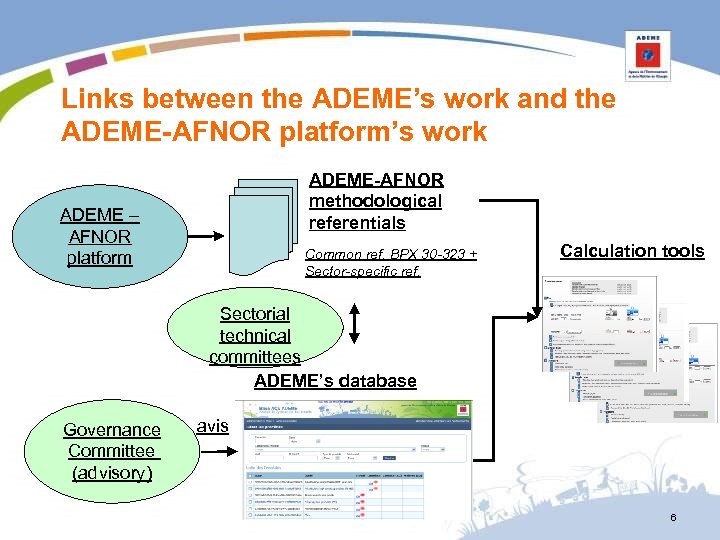
Links between the ADEME’s work and the ADEME-AFNOR platform’s work ADEME-AFNOR methodological referentials ADEME – AFNOR platform Common ref. BPX 30 -323 + Sector-specific ref. Calculation tools Sectorial technical committees ADEME’s database Governance Committee (advisory) avis 6
Database governance § Sector-specific working groups of ADEME-AFNOR platform § Definition of needs from : a preliminary study and some specification in the specific product category referentials § Technical Committees § Needs refinement § Confrontation to available data § Till the specification document redaction that will explain the data that are needed (precise type of process) and the management and quality requirements § Governance Committee § Administration § NGO § Enterprises 7
Content of the ADEME’s database § Some processes § § One reference flow (unit of the process) An elementary flows list An impact categories list Some metadata § Some characterization factors 8
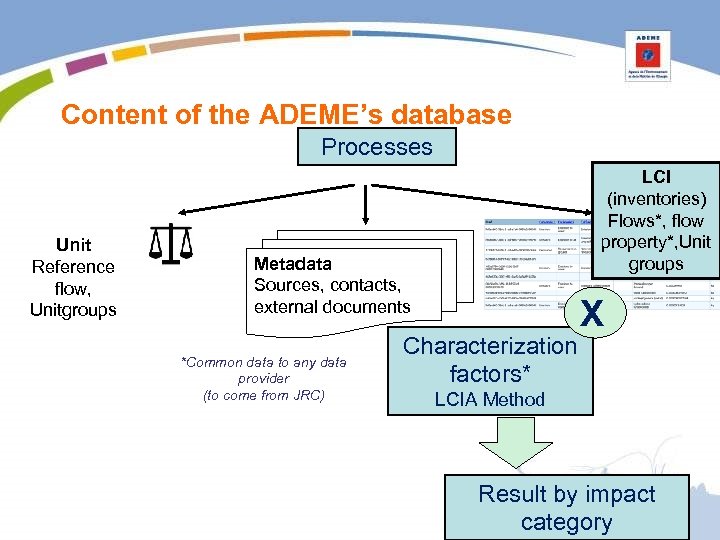
Content of the ADEME’s database Processes Unit Reference flow, Unitgroups LCI (inventories) Flows*, flow property*, Unit groups Metadata Sources, contacts, external documents *Common data to any data provider (to come from JRC) X Characterization factors* LCIA Method Result by impact category 9
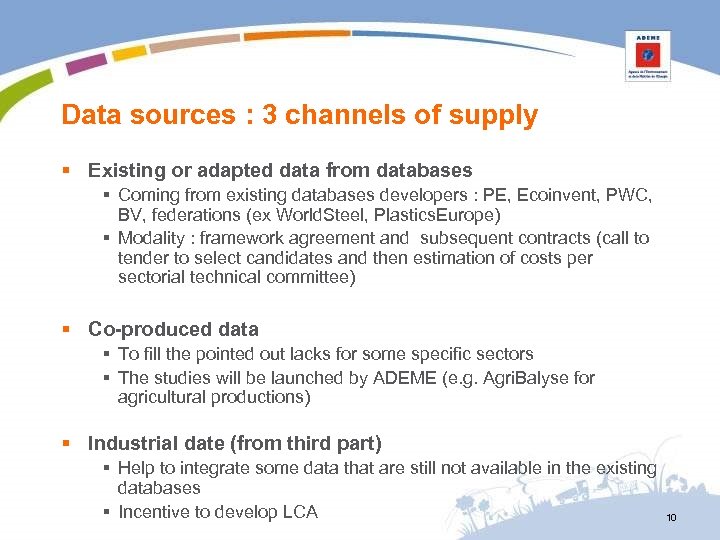
Data sources : 3 channels of supply § Existing or adapted data from databases § Coming from existing databases developers : PE, Ecoinvent, PWC, BV, federations (ex World. Steel, Plastics. Europe) § Modality : framework agreement and subsequent contracts (call to tender to select candidates and then estimation of costs per sectorial technical committee) § Co-produced data § To fill the pointed out lacks for some specific sectors § The studies will be launched by ADEME (e. g. Agri. Balyse for agricultural productions) § Industrial date (from third part) § Help to integrate some data that are still not available in the existing databases § Incentive to develop LCA 10
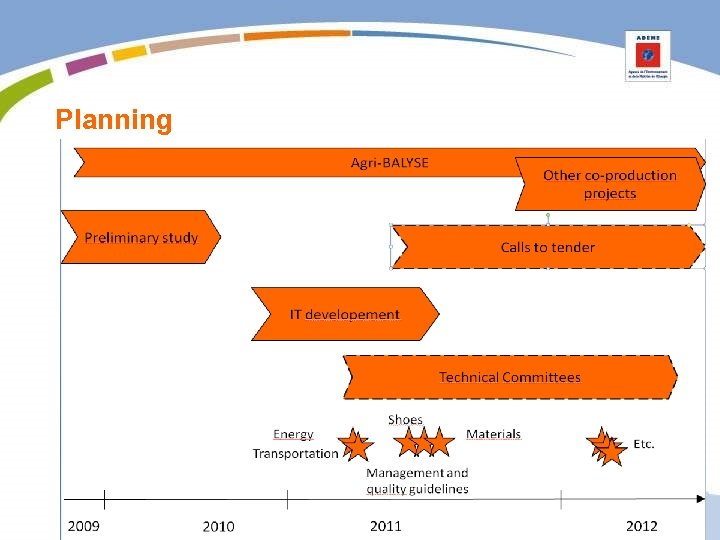
Planning 11
Questions that have structured the work § Content of the database (substance) : Which data ? § Content of the database (form) : § Which format ? § Which building rules ? § IT development § Which integration rules ? § Which management rule over the time ? 12
Content of the « ADEME’s database management and quality guidelines » document § Structure of the database : which criteria? § Format § Homogeneity § Quality of data § § Methodological conformity Inventorities clarity Recognition Transparency § Utilization practice § § Update Integration of data Need for « default » datasets Confidentiality 13
Agenda § Background and goal § The ADEME’s database § Content of the ADEME’s database § Goal for management and quality guidelines § Database building guidelines § Format § Homogeneity § Quality § Database utilization guidelines § § Update Integration of data Need for « default datasets » Confidentiality 14
Format – Definition of needs § Format must help to : § § § Structure information Exchange data (import/ export) Be internationally recognized Provide impact categories results Provide transparency on methodology and more especially on BPX 30 -323 referential 15
Format – How do the databases answer to the needs ? § 2 major formats : § XML – ILCD : complete architecture that will be the future European exchange format Problem : the today format does not provide a mandatory flows list and does not contain many mandatory fields for metadata Ga. Bi, CODDE-BV-TEX et DEAM are also developing processes in the ILCD format. § XML – Ecospold (Eco. Invent) : format with a different structure from ILCD Problem : the format is not the European exchange format. However some conversion systems to ILCD format exist. 16
Format – Proposal for ADEME DB § The selected format is ILCD format because : § § § It is developed by European commission It ensures international recognition It is easy to export in XML or Excel files The metadata are well and finely structured It provides a tool for industrial (third part) providers : ILCD Editor § A new « Extension » file is added to check compliance with BP X 30 -323 referential (Cf. homogeneity) § Requirements for the providers § LCI delivery according to the elementary flows list defined by the ADEME § Some fields of metadata are mandatory because they need to be visible at first glance § Rules in matter of reference (UUID, URI, links to other files…) § Uniqueness of reference flows in the processes § Uniqueness of the value for an elementary flow 17
Agenda § Background and goal § The ADEME’s database § Content of the ADEM’s database § Goal for management and quality guidelines § Database building guidelines § Format § Homogeneity § Quality § Database utilization guidelines § § Update Integration of data Need for « default datasets » Confidentiality 18
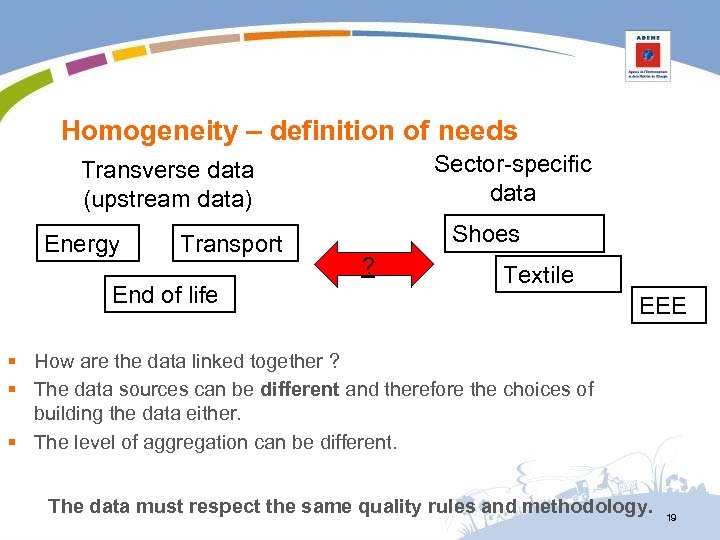
Homogeneity – definition of needs Sector-specific data Transverse data (upstream data) Energy Transport End of life Shoes ? Textile EEE § How are the data linked together ? § The data sources can be different and therefore the choices of building the data either. § The level of aggregation can be different. The data must respect the same quality rules and methodology. 19
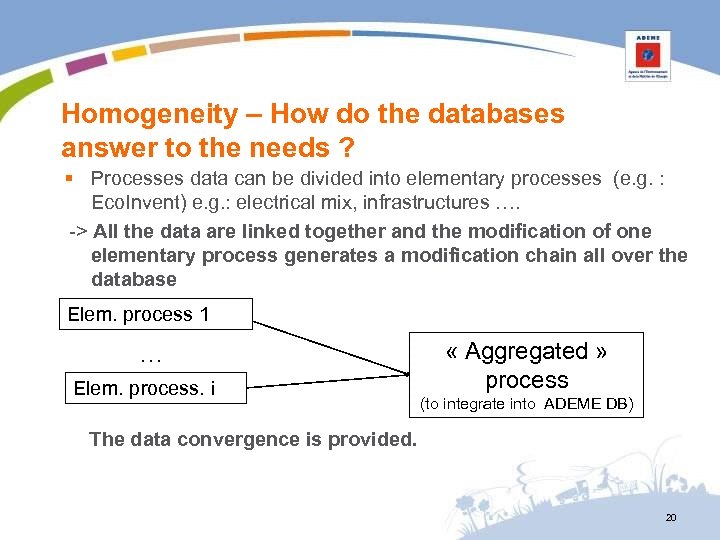
Homogeneity – How do the databases answer to the needs ? § Processes data can be divided into elementary processes (e. g. : Eco. Invent) e. g. : electrical mix, infrastructures …. -> All the data are linked together and the modification of one elementary process generates a modification chain all over the database Elem. process 1 … Elem. process. i « Aggregated » process (to integrate into ADEME DB) The data convergence is provided. 20
Homogeneity – Proposal for ADEME DB § Constrain for ADEME DB : § No complete dynamic structure that will link all the data. § Proposal : § Homogeneity could at least be ensured by industrial sector Selection of a unique provider by sector (ex : Energy, Textile, Chemistry, Plastics …) § Limit desaggregation of the data to upstream data such as : § Electrical mix : all (or only a part of) processes could be delivered as desaggregated processes to which electrical mix from the database would be added § Infrastructures § Fulfillment of common quality guidelines (including methodology) 21
Homogeneity – Questions § Sectorial homogeneity Can only one provider per industrial sector ensure homogeneity? § Limited desaggregation Must these desaggregation rules be fulfilled for all the processes or only for a part ? Is it possible to make such a desaggregation ? Must ADEME ask to provider for all processes (1 per country) or only one, that any user of the database could adapt with the correct electrical mix ? § Common quality requirements (cf. quality) 22
Agenda § Background and goal § The ADEME’s database § Content of the ADEM’s database § Goal for management and quality guidelines § Database building guidelines § Format § Homogeneity § Quality § Database utilization guidelines § § Update Integration of data Need for « default datasets » Confidentiality 23
Quality criteria proposed by ADEME § Inherent quality § Methodology conformity § Inventories clarity § Recognition § Transparency 24
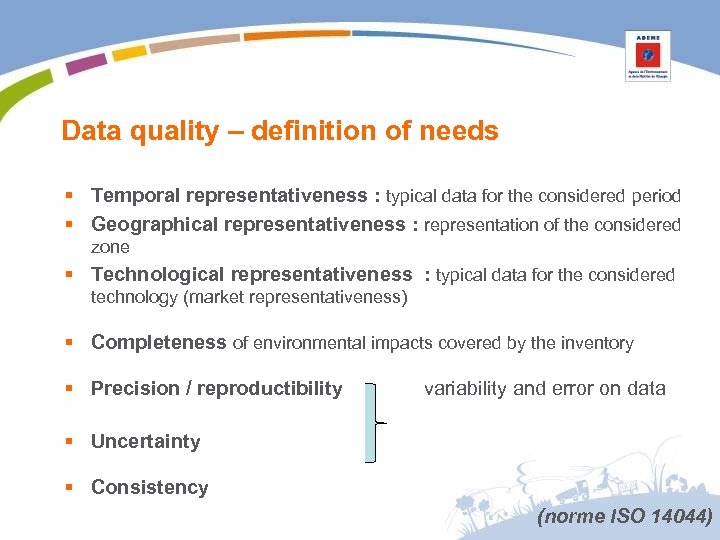
Data quality – definition of needs § Temporal representativeness : typical data for the considered period § Geographical representativeness : representation of the considered zone § Technological representativeness : typical data for the considered technology (market representativeness) § Completeness of environmental impacts covered by the inventory § Precision / reproductibility variability and error on data § Uncertainty § Consistency (norme ISO 14044)
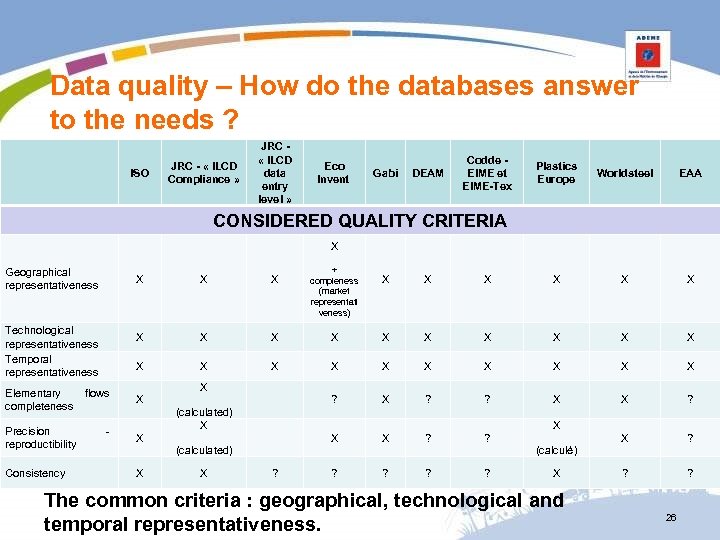
Data quality – How do the databases answer to the needs ? ISO JRC - « ILCD Compliance » JRC - « ILCD data entry level » Eco Invent Gabi DEAM Codde - EIME et EIME-Tex Plastics Europe Worldsteel EAA CONSIDERED QUALITY CRITERIA X Geographical representativeness X flows Precision reproductibility - Consistency X X X Elementary completeness X X Technological representativeness Temporal representativeness X X X + compleness (market representati veness) X X X X X ? X ? ? X ? ? ? X X (calculated) X X (calculé) ? ? ? X The common criteria : geographical, technological and temporal representativeness. 26
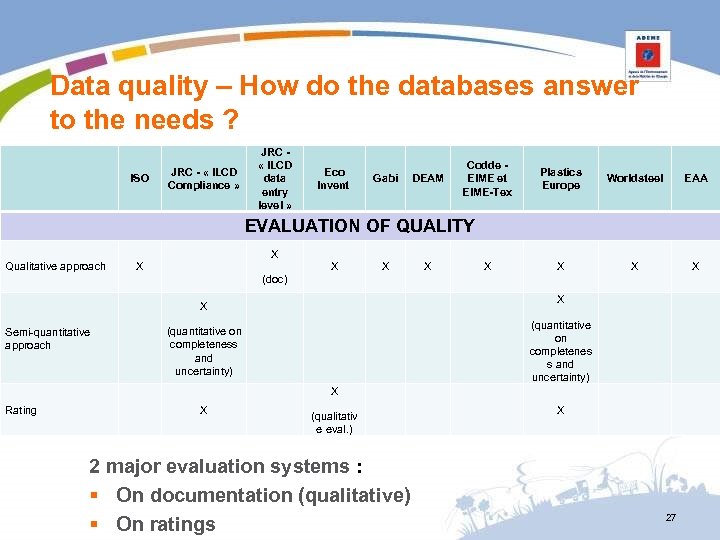
Data quality – How do the databases answer to the needs ? ISO JRC - « ILCD data entry level » JRC - « ILCD Compliance » Eco Invent Gabi DEAM Codde - EIME et EIME-Tex Plastics Europe Worldsteel EAA X X X EVALUATION OF QUALITY X Qualitative approach X X X (doc) X X Semi-quantitative approach (quantitative on completenes s and uncertainty) (quantitative on completeness and uncertainty) X Rating X (qualitativ e eval. ) 2 major evaluation systems : § On documentation (qualitative) § On ratings X 27
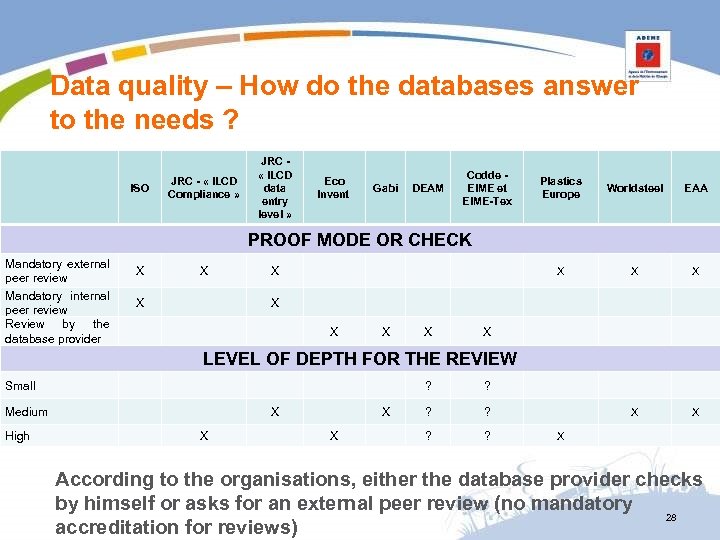
Data quality – How do the databases answer to the needs ? ISO JRC - « ILCD Compliance » JRC - « ILCD data entry level » Eco Invent Codde - EIME et EIME-Tex DEAM Plastics Europe Worldsteel EAA X Gabi X X PROOF MODE OR CHECK Mandatory external peer review Mandatory internal peer review Review by the database provider X X X X X LEVEL OF DEPTH FOR THE REVIEW Small ? Medium High X X ? ? ? X According to the organisations, either the database provider checks by himself or asks for an external peer review (no mandatory 28 accreditation for reviews)
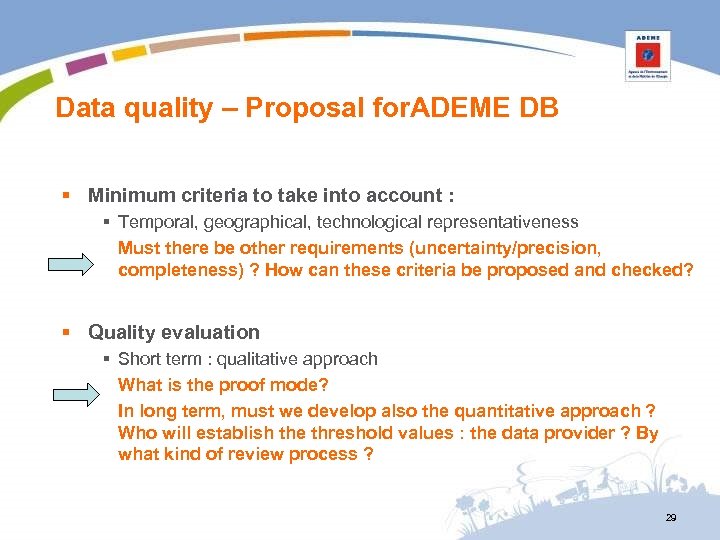
Data quality – Proposal for. ADEME DB § Minimum criteria to take into account : § Temporal, geographical, technological representativeness Must there be other requirements (uncertainty/precision, completeness) ? How can these criteria be proposed and checked? § Quality evaluation § Short term : qualitative approach What is the proof mode? In long term, must we develop also the quantitative approach ? Who will establish the threshold values : the data provider ? By what kind of review process ? 29
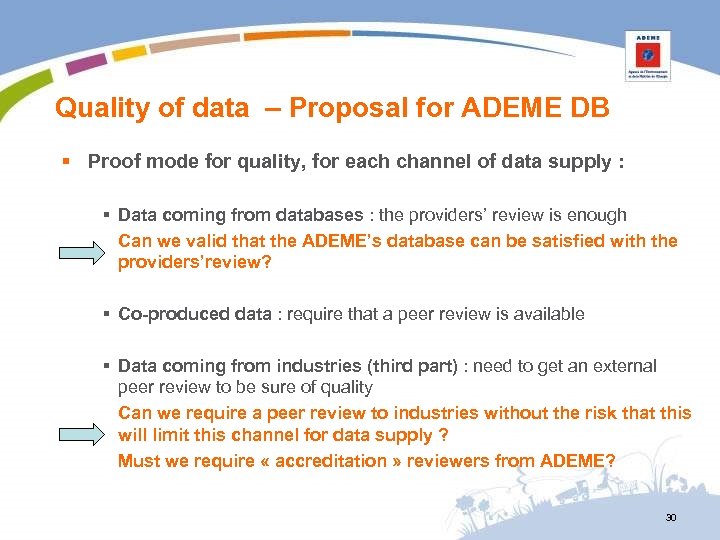
Quality of data – Proposal for ADEME DB § Proof mode for quality, for each channel of data supply : § Data coming from databases : the providers’ review is enough Can we valid that the ADEME’s database can be satisfied with the providers’review? § Co-produced data : require that a peer review is available § Data coming from industries (third part) : need to get an external peer review to be sure of quality Can we require a peer review to industries without the risk that this will limit this channel for data supply ? Must we require « accreditation » reviewers from ADEME? 30
Quality criteria proposed by ADEME § Inherent quality § Methodology conformity § Inventories clarity § Recognition § Transparency 31
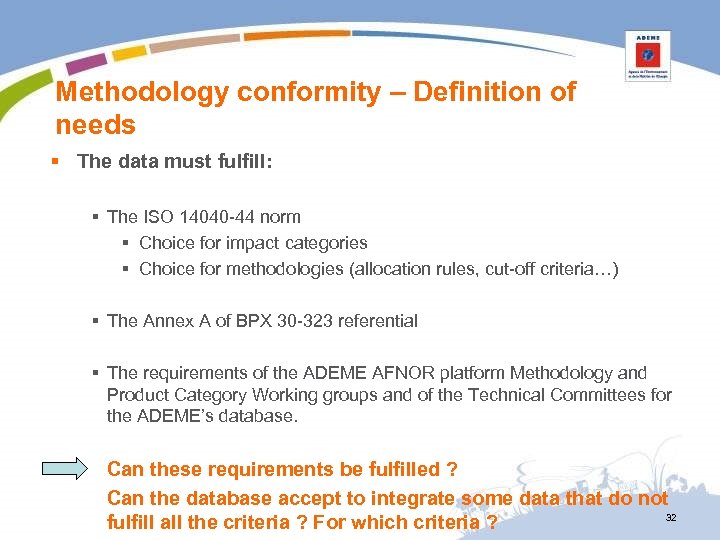
Methodology conformity – Definition of needs § The data must fulfill: § The ISO 14040 -44 norm § Choice for impact categories § Choice for methodologies (allocation rules, cut-off criteria…) § The Annex A of BPX 30 -323 referential § The requirements of the ADEME AFNOR platform Methodology and Product Category Working groups and of the Technical Committees for the ADEME’s database. Can these requirements be fulfilled ? Can the database accept to integrate some data that do not 32 fulfill all the criteria ? For which criteria ?
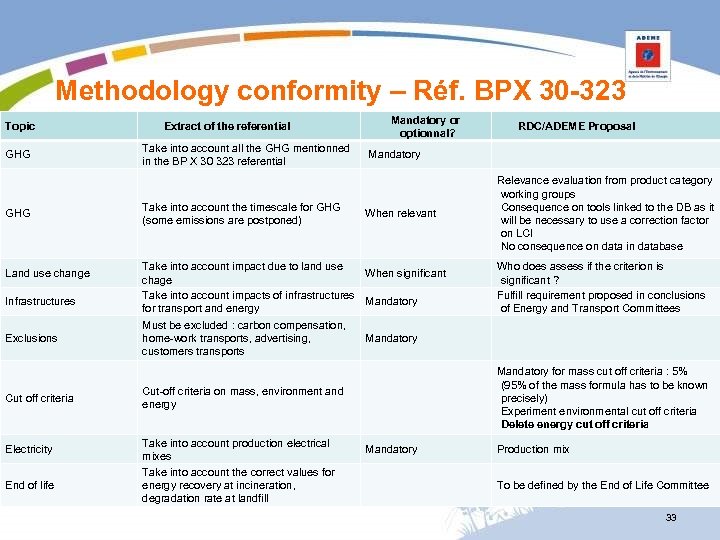
Methodology conformity – Réf. BPX 30 -323 Topic GHG Extract of the referential Land use change Infrastructures Exclusions Cut off criteria End of life RDC/ADEME Proposal Mandatory § Le référentiel BP X 30 -323 s données doivent respecter : GHG Electricity Take into account all the GHG mentionned in the BP X 30 323 referential Mandatory or optionnal? Take into account the timescale for GHG (some emissions are postponed) When relevant Take into account impact due to land use When significant chage Take into account impacts of infrastructures Mandatory for transport and energy Must be excluded : carbon compensation, home-work transports, advertising, customers transports Who does assess if the criterion is significant ? Fulfill requirement proposed in conclusions of Energy and Transport Committees Mandatory for mass cut off criteria : 5% (95% of the mass formula has to be known precisely) Experiment environmental cut off criteria Delete energy cut off criteria Cut-off criteria on mass, environment and energy Take into account production electrical mixes Take into account the correct values for energy recovery at incineration, degradation rate at landfill Relevance evaluation from product category working groups Consequence on tools linked to the DB as it will be necessary to use a correction factor on LCI No consequence on data in database Mandatory Production mix To be defined by the End of Life Committee 33
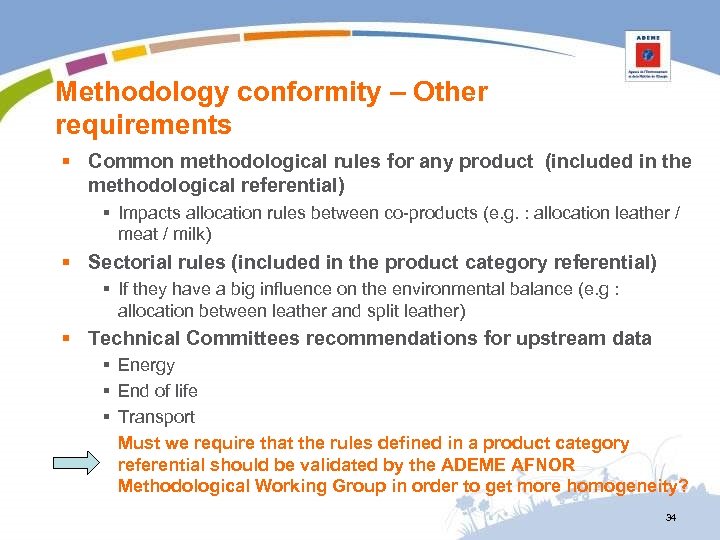
Methodology conformity – Other requirements § Common methodological rules for any product (included in the methodological referential) § Impacts allocation rules between co-products (e. g. : allocation leather / meat / milk) § Sectorial rules (included in the product category referential) § If they have a big influence on the environmental balance (e. g : allocation between leather and split leather) § Technical Committees recommendations for upstream data § Energy § End of life § Transport Must we require that the rules defined in a product category referential should be validated by the ADEME AFNOR Methodological Working Group in order to get more homogeneity? 34
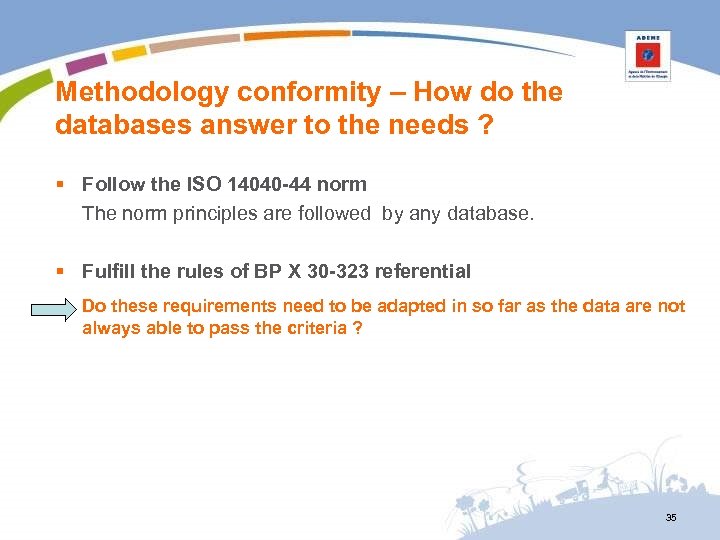
Methodology conformity – How do the databases answer to the needs ? § Follow the ISO 14040 -44 norm The norm principles are followed by any database. § Fulfill the rules of BP X 30 -323 referential Do these requirements need to be adapted in so far as the data are not always able to pass the criteria ? 35
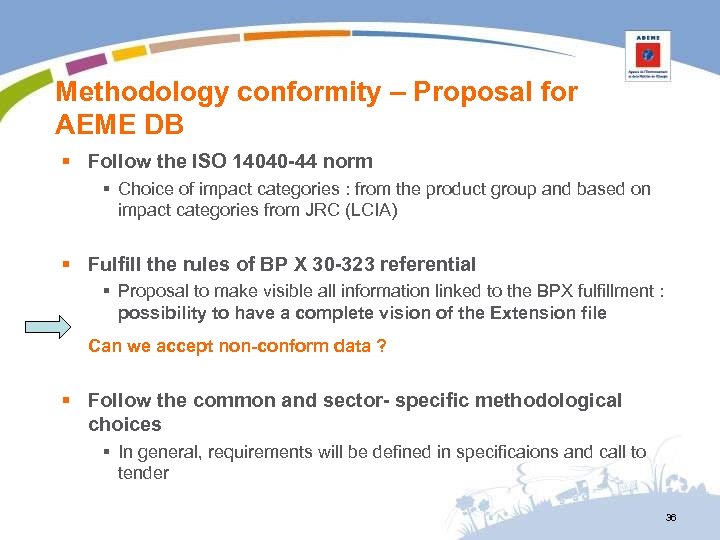
Methodology conformity – Proposal for AEME DB § Follow the ISO 14040 -44 norm § Choice of impact categories : from the product group and based on impact categories from JRC (LCIA) § Fulfill the rules of BP X 30 -323 referential § Proposal to make visible all information linked to the BPX fulfillment : possibility to have a complete vision of the Extension file Can we accept non-conform data ? § Follow the common and sector- specific methodological choices § In general, requirements will be defined in specificaions and call to tender 36
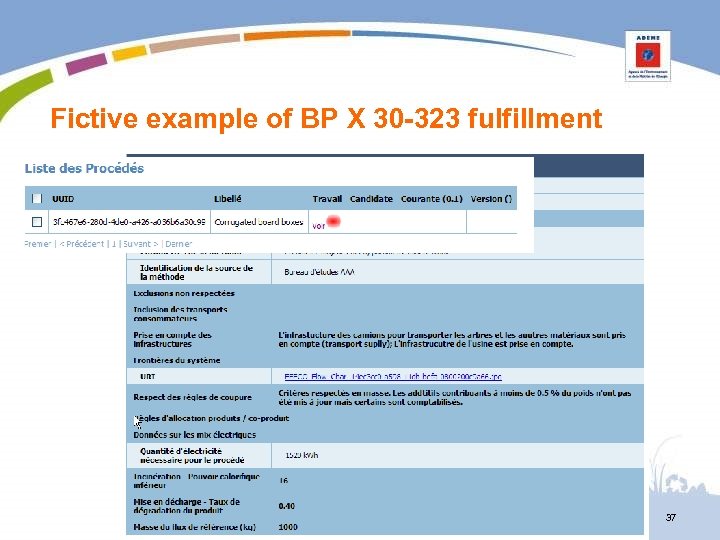
Fictive example of BP X 30 -323 fulfillment 37
Quality criteria proposed by ADEME § Inherent quality § Methodology conformity § Inventories clarity § Recognition § Transparency 38
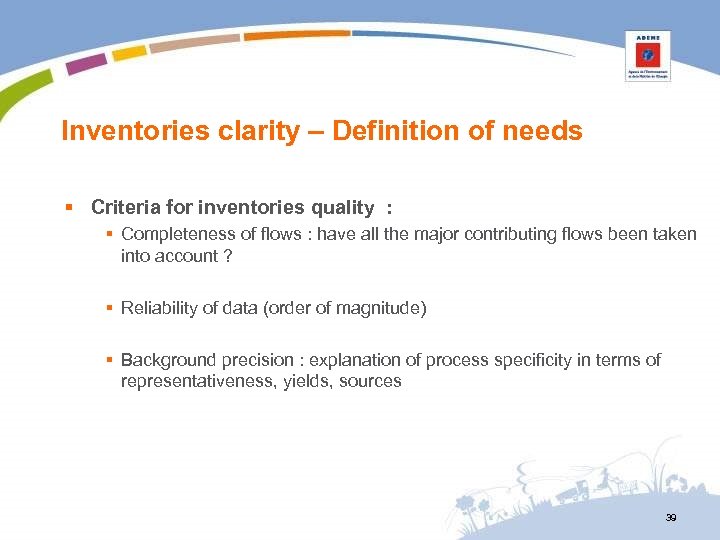
Inventories clarity – Definition of needs § Criteria for inventories quality : § Completeness of flows : have all the major contributing flows been taken into account ? § Reliability of data (order of magnitude) § Background precision : explanation of process specificity in terms of representativeness, yields, sources 39
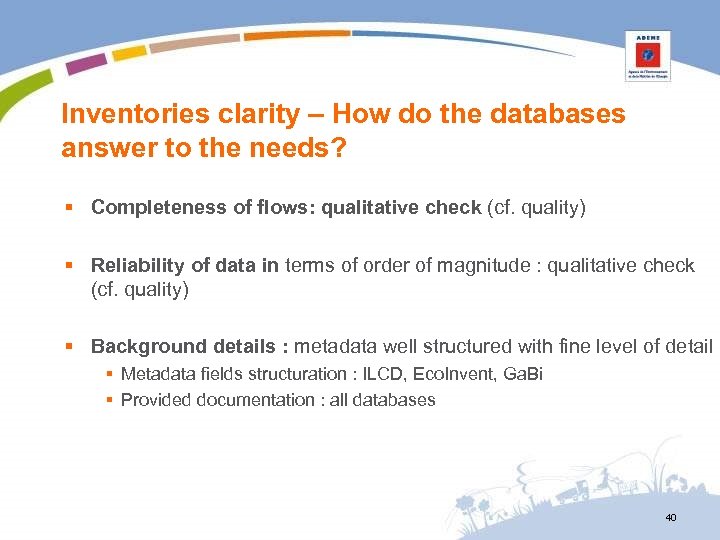
Inventories clarity – How do the databases answer to the needs? § Completeness of flows: qualitative check (cf. quality) § Reliability of data in terms of order of magnitude : qualitative check (cf. quality) § Background details : metadata well structured with fine level of detail § Metadata fields structuration : ILCD, Eco. Invent, Ga. Bi § Provided documentation : all databases 40
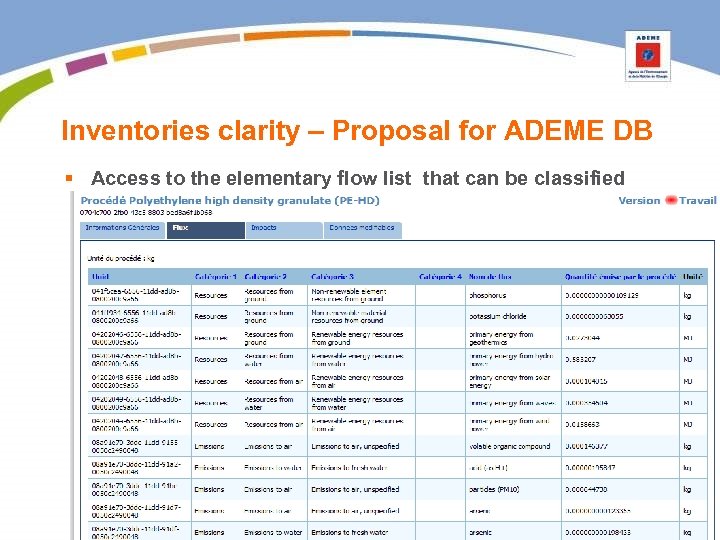
Inventories clarity – Proposal for ADEME DB § Access to the elementary flow list that can be classified 41
Inventories clarity– Proposal for ADEME DB § Automatic checks in order to check orders of magnitude : if the checks are not fullfilles , then alerts are created § § § Check links between CO 2 emissions and use of fossile fuels burning Check links between combustion processes and NOX and SOX emissions Check links between electricity processes and resource depletion Check links between transport, oil consumption and CO 2 emissions Check links between water emissions and water consumption Check values for « Exotic flows » (usually very weak) 42
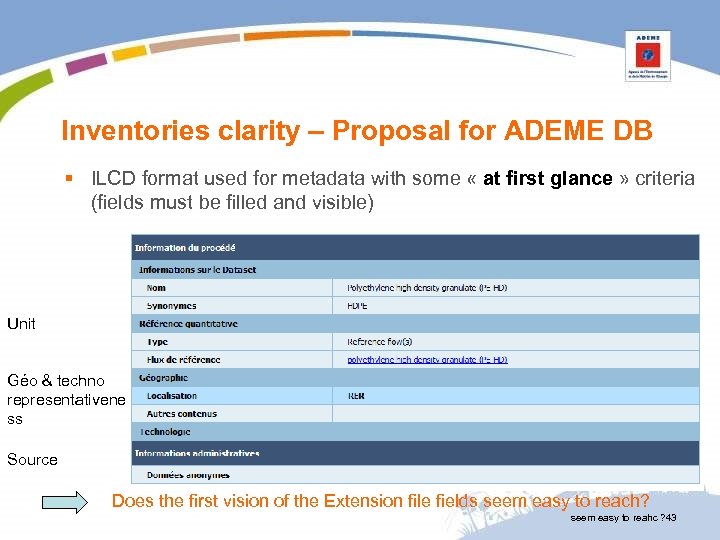
Inventories clarity – Proposal for ADEME DB § ILCD format used for metadata with some « at first glance » criteria (fields must be filled and visible) Unit Géo & techno representativene ss Source Does the first vision of the Extension file fields seem easy to reach? seem easy to reahc ? 43
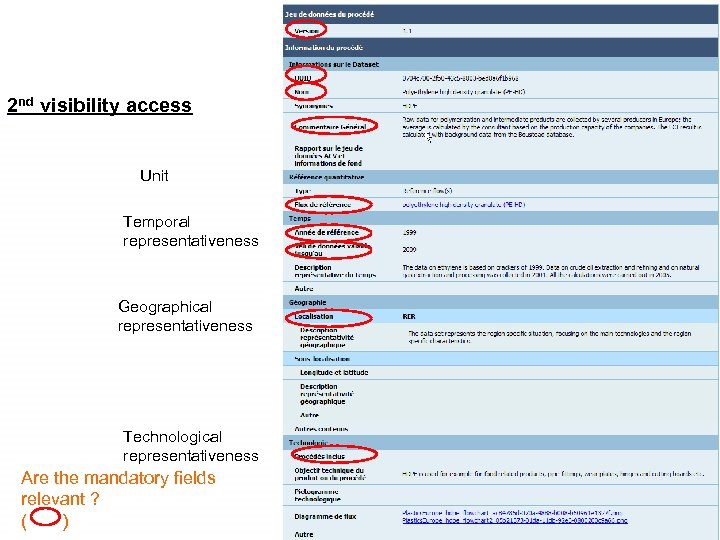
2 nd visibility access Unit Temporal representativeness Geographical representativeness Technological representativeness Are the mandatory fields relevant ? ( ) 44
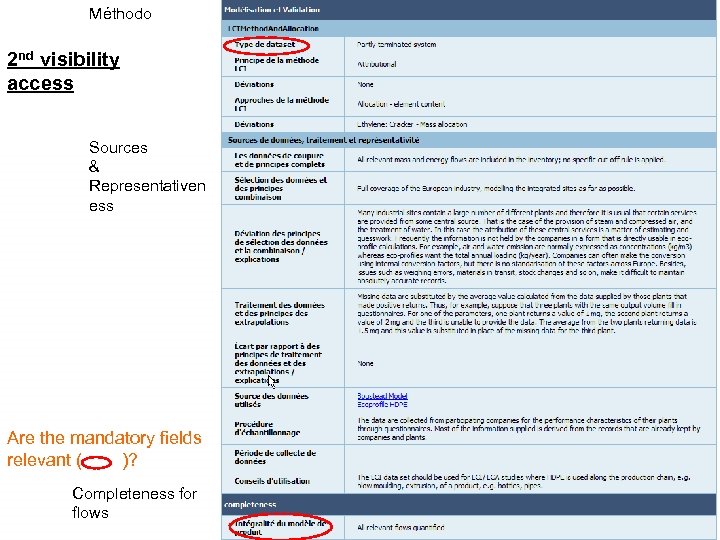
Méthodo 2 nd visibility access Sources & Representativen ess Are the mandatory fields relevant ( )? Completeness for flows 45
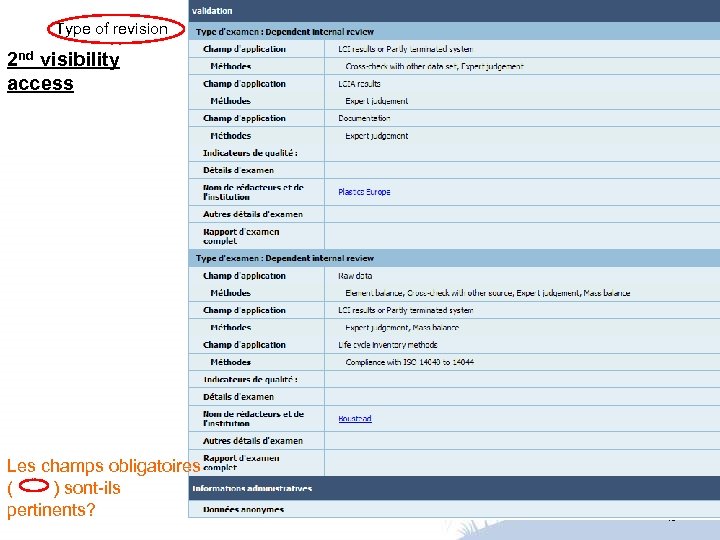
Type of revision 2 nd visibility access Les champs obligatoires ( ) sont-ils pertinents? 46
Quality criteria proposed by ADEME § Inherent quality § Methodology conformity § Inventories clarity § Recognition § Transparency 47
Recognition – Definition of needs § The ADEME’s database will be public § National recognition § ADEME would like to join the ILCD Network § International recognition § What steps to check recognition ? § Data supply § Data quality requirement § Calendar 48
Recognition –How do the dabases answer to the needs ? § Quality and peer acceptance § Documentation § Provide a documentation § Structure data into the ILCD fields (ILCD, Eco. Invent) 49
Recognition – Proposal for ADEME DB § Recognition is insured because of: § Governance (data supply) § Data quality validation § Use of ILCD format 50
Quality criteria proposed by ADEME § Inherent quality § Methodology conformity § Inventories clarity § Recognition § Transparency 51
Data transparency– Definition of needs § Need to have a documentation and an access for the following topics: § Data quality § Data sources § Methodogical assumptions 52
Data transparency – How do the databases answer to the needs ? § Documentation § Provide a documentation § Structure data in some fields (ILCD, Eco. Invent) 53
Data transparency – Proposal for ADEME DB § Some fields of ILCD format will be mandatory § § Geographical, temporal and technological repesentativeness Short description of the data set Sources Date for the delivered version § Availability of the documentation data in the supply channels § Database providers: internet link to the source § Co-production : available report Must this accessibility be systematic or on demand ? § Industrial data (third part): availability before integration in the database According to the level of confidentiality, is it possible to remain data available ? 54
Agenda § Background and goal § The ADEME’s database § Content of the ADEME’s database § Goal for management and quality guidelines § Database building guidelines § Format § Homogeneity § Quality § Database utilization guidelines § § Update Integration of data Need for « default datasets » Confidentiality 55
Update – definition of needs § The database will evolve according to the principles of continuous improvement § The needs for update are different : § Deep update : modification of structure (in link with ILCD) § Mid update : general modification due to a methodological modification § Light update : ponctual update due to : § Better knowledge § Improvement in data quality and reliability 56
Update – How do the databases answer to the needs ? § Frequence for update depends on refinement of methodologies § What is the frequency of the update for ILCD database ? § What is the frequency of the update for other databases ? 57
Update – proposal for ADEME DB § Structure update mainly linked to evolutions of ILCD format § Frequent revision according to some changes on upstream data (e. g. : electrical mix or new common data) : every 3 to 5 years § Very frequent update for processes modfications § Version nomenclature : XX. YY. ZZ. Z: minor modif, Y= common modif. , X : structure modif Are the frequency proposed appropriate ? 58
Agenda § Background and goal § The ADEME’s database § Content of the ADEME’s database § Goal for management and quality guidelines § Database building guidelines § Format § Homogeneity § Quality § Database utilization guidelines § § Update Integration of data Need for « default datasets » Confidentiality 59
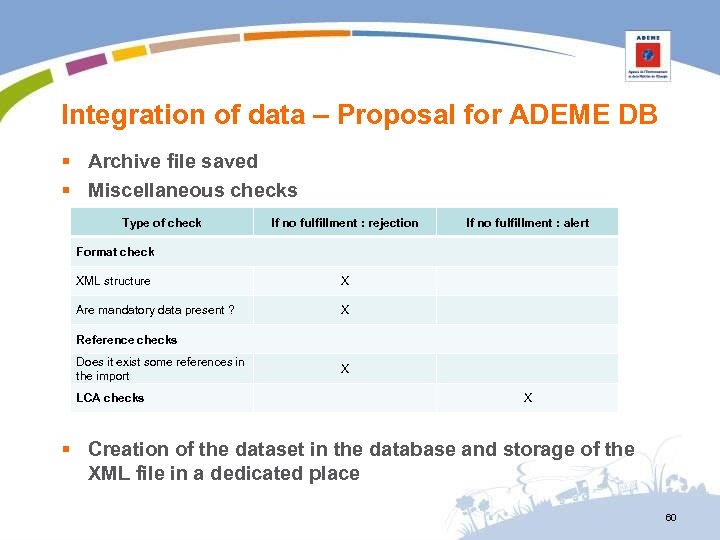
Integration of data – Proposal for ADEME DB § Archive file saved § Miscellaneous checks Type of check If no fulfillment : rejection If no fulfillment : alert Format check XML structure X Are mandatory data present ? X Reference checks Does it exist some references in the import LCA checks X X § Creation of the dataset in the database and storage of the XML file in a dedicated place 60
Agenda § Background and goal § The ADEME’s database § Content of the ADEME’s database § Goal for management and quality guidelines § Database building guidelines § Format § Homogeneity § Quality § Database utilization guidelines § § Update Integration of data Need for « default datasets » Confidentiality 61
Default dataset – definition of needs § The default datasets will more especially help to model for environmental labeling § When the provider of data does not very precisely know the formulation of his product, he can ask for a default dataset that will help him : § To check the mass cut off criteria § To calculate the environmental balance 62
Default dataset – proposal for ADEME DB 2 possibilities for 2 needs : § 1 : Definition of the build of materials : « I know what is in my product but I can not find the exact data set in the database » Model with a « default dataset » to choose Search for the user : § « nearest dataset » : the user will choose the nearest dataset according to its knowledge § And ADEME creates and proposes an average or maximum default dataset : average of maximum of impacts for the same kind of processes = « precise default dataset » What choice for non precise default dataset ? average , max or percentile ?
Default dataset – Proposal for ADEME DB Once the mass cut off criteria has been passed : § 2 : Check environmental cut off criteria « How can we assess the environmental impact for the X% not modelled (X<5%) ? » § ADEME creates and proposes a default dataset (maximum a priori). § Each default dataset is defined on the basis of a large family of products (e. g. vegetables, …) = Non precise default dataset What choice for non precise default dataset ? average , max or percentile ? Must we leave this default datasets non visible in the database as they are very imprecise ?
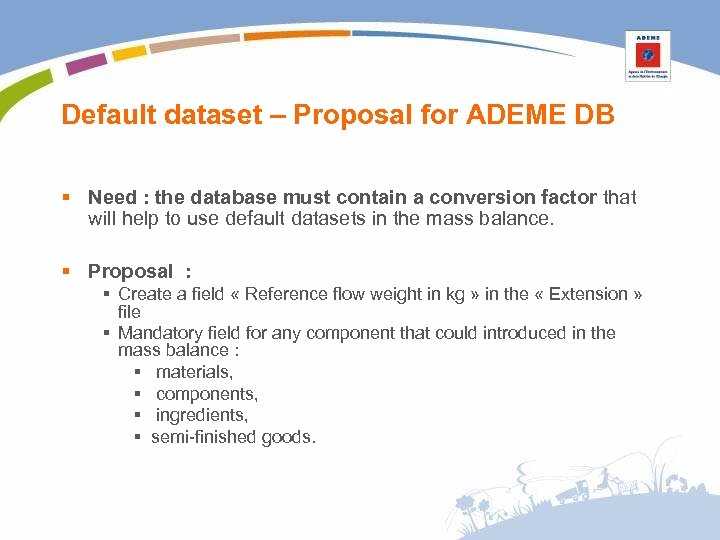
Default dataset – Proposal for ADEME DB § Need : the database must contain a conversion factor that will help to use default datasets in the mass balance. § Proposal : § Create a field « Reference flow weight in kg » in the « Extension » file § Mandatory field for any component that could introduced in the mass balance : § materials, § components, § ingredients, § semi-finished goods.
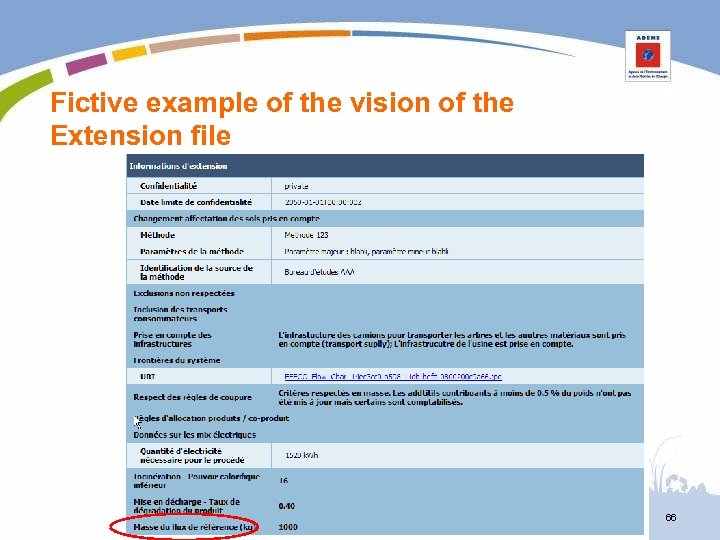
Fictive example of the vision of the Extension file 66
Agenda § Background and goal § The ADEME’s database § Content of the ADEME’s database § Goal for management and quality guidelines § Database building guidelines § Format § Homogeneity § Quality § Database utilization guidelines § § Update Integration of data Need for « default datasets » Confidentiality 67
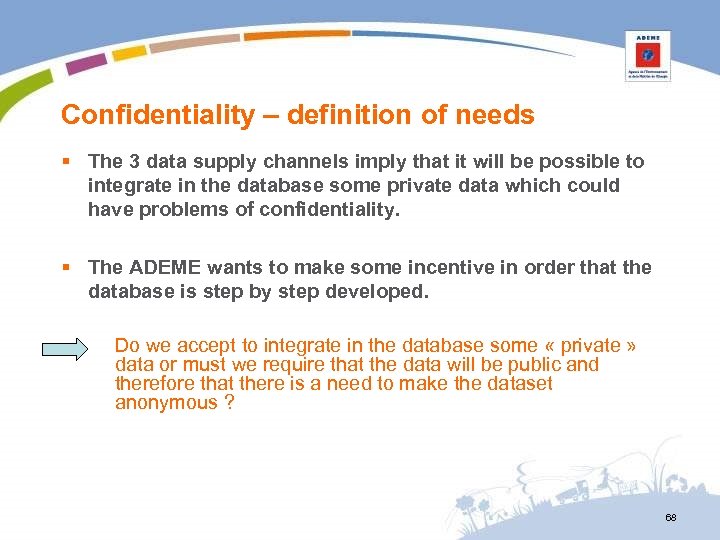
Confidentiality – definition of needs § The 3 data supply channels imply that it will be possible to integrate in the database some private data which could have problems of confidentiality. § The ADEME wants to make some incentive in order that the database is step by step developed. Do we accept to integrate in the database some « private » data or must we require that the data will be public and therefore that there is a need to make the dataset anonymous ? 68
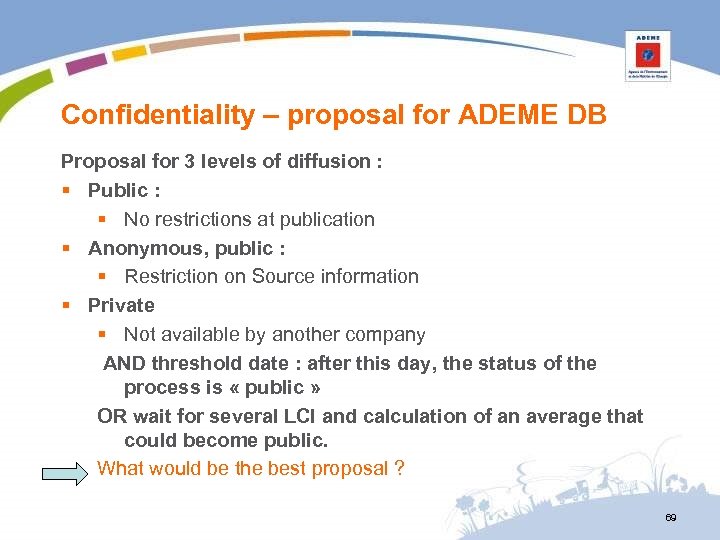
Confidentiality – proposal for ADEME DB Proposal for 3 levels of diffusion : § Public : § No restrictions at publication § Anonymous, public : § Restriction on Source information § Private § Not available by another company AND threshold date : after this day, the status of the process is « public » OR wait for several LCI and calculation of an average that could become public. What would be the best proposal ? 69
Скачать презентацию Governance committee for the ADEME s database Technical Committee
75f24dd8549ef63013f84332fb89b45d.ppt