


 Скачать презентацию Governance as a Continuous Learning Process Erik Arnold
147ae5fef71caf45b136124f29914cb2.ppt
- Количество слайдов: 21
 Governance as a Continuous Learning Process? Erik Arnold 24 May 2006 www. technopolis-group. com 1
 Road map and acknowledgements • • A worry What is governance and why does it matter? What goes wrong? Factors in designing governance systems Sweden: how not to do it? European Commission: changing the rules? Some tentative conclusions • Thanks to: EZ, RCN, BMVIT, NMR, ECA, CEC, NSTDA (Thailand), Foreign Ministry of Denmark, Teknisk Framsyn 2
 Can we talk about ‘learning’ in systems as irrational as research and innovation governance? • Politics at the expense of policy • The power of personalities in determining outcomes • Limited connection between policy and an evidence base • Politicisation of evidence • Personnel policy as an instrument of political control 3
 Governance - the action or manner of governing - is firmly onto the policy agenda • The nature of the ‘social contract’ between science and society continues to shift, with society demanding that science be relevant to its needs, making it natural that there be increased extra-scientific involvement in the governance of research • The continuing spread of the so-called New Public Management among administrations provides a more general impetus towards transparency and efficiency in the use of taxpayers’ money to achieve social goals, in innovation and research policy as elsewhere • Shifts in the way knowledge is produced and used imply a need to bring together different knowledges and knowledge producers, both across disciplines and between fundamental and applied work • Theory increasingly emphasises the systemic nature of research and innovation in economic and social development, tying more closely together the performance and management of research and innovation with the levels of policy and politics • Whereas research and innovation still is predominantly a national policy responsibility, international and regional actors are claiming a larger role in the whole policy cycle, thus asking for a change in the rules of the game 4
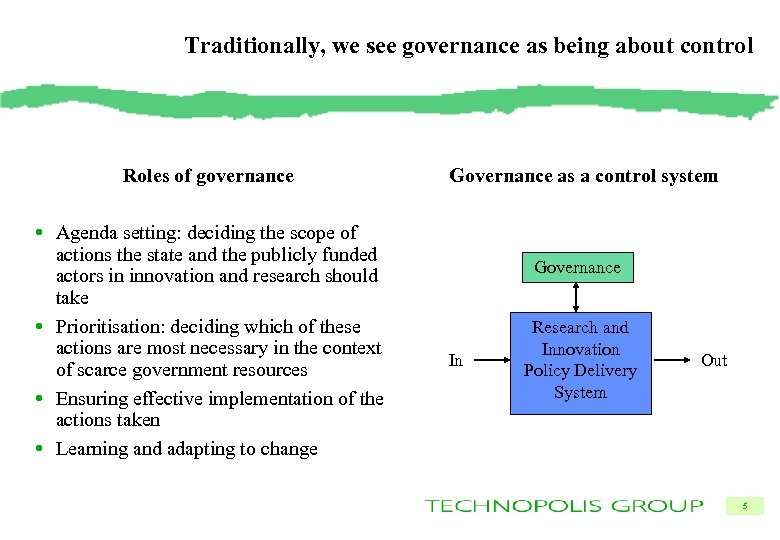 Traditionally, we see governance as being about control Roles of governance • Agenda setting: deciding the scope of actions the state and the publicly funded actors in innovation and research should take • Prioritisation: deciding which of these actions are most necessary in the context of scarce government resources • Ensuring effective implementation of the actions taken • Learning and adapting to change Governance as a control system Governance In Research and Innovation Policy Delivery System Out 5
 How does the governance system learn? • • • Building institutions Evolving organisation, routines and processes Organisational memory (and organisational forgetting) Developing strategic intelligence Evaluation Theory building 6
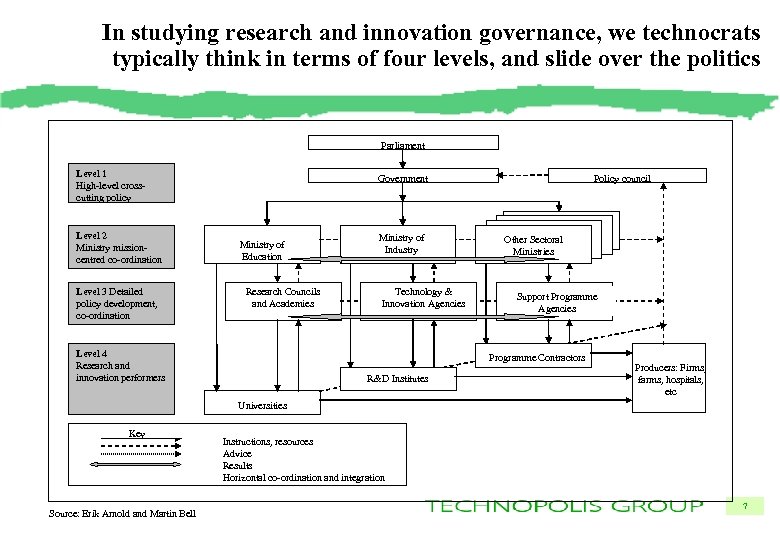 In studying research and innovation governance, we technocrats typically think in terms of four levels, and slide over the politics Parliament Level 1 High-level crosscutting policy Level 2 Ministry missioncentred co-ordination Level 3 Detailed policy development, co-ordination Government Ministry of Education Research Councils and Academies Level 4 Research and innovation performers Ministry of Industry Technology & Innovation Agencies Policy council Other Sectoral Ministries Support Programme Agencies Programme Contractors R&D Institutes Producers: Firms, farms, hospitals, etc Universities Key Source: Erik Arnold and Martin Bell Instructions, resources Advice Results Horizontal co-ordination and integration 7
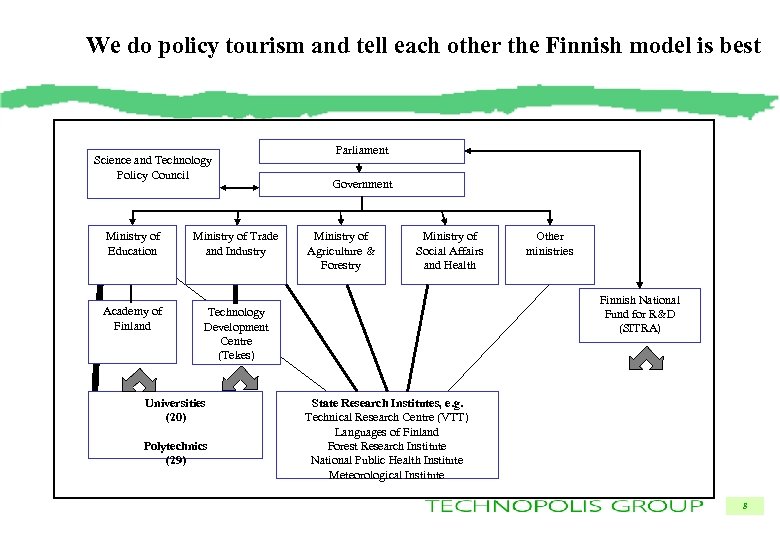 We do policy tourism and tell each other the Finnish model is best Science and Technology Policy Council Ministry of Education Academy of Finland Ministry of Trade and Industry Parliament Government Ministry of Agriculture & Forestry Ministry of Social Affairs and Health Finnish National Fund for R&D (SITRA) Technology Development Centre (Tekes) Universities (20) Polytechnics (29) Other ministries State Research Institutes, e. g. Technical Research Centre (VTT) Languages of Finland Forest Research Institute National Public Health Institute Meteorological Institute 8
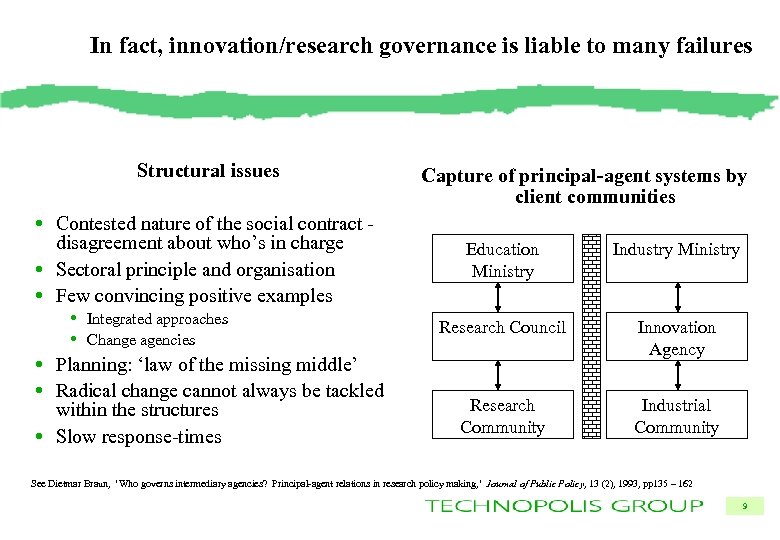 In fact, innovation/research governance is liable to many failures Structural issues • Contested nature of the social contract disagreement about who’s in charge • Sectoral principle and organisation • Few convincing positive examples • Integrated approaches • Change agencies • Planning: ‘law of the missing middle’ • Radical change cannot always be tackled within the structures • Slow response-times Capture of principal-agent systems by client communities Education Ministry Industry Ministry Research Council Innovation Agency Research Community Industrial Community See Dietmar Braun, ‘Who governs intermediary agencies? Principal-agent relations in research policy making, ’ Journal of Public Policy, 13 (2), 1993, pp 135 – 162 9
 Strategic intelligence is one of the keys to making the system work • Doing the work needed to gain a descriptive understanding of relevant features of the research and innovation system, in order to provide an evidence base for policy making • Diagnosing problems or bottlenecks in that system, understanding changes and identifying opportunities to improve its performance • Anticipating the effects of interventions and setting objectives for improvement • Designing policies, programmes and instruments with the aim of making these improvements • Obtaining feedback about present and past interventions, thereby learning how to improve future actions 10
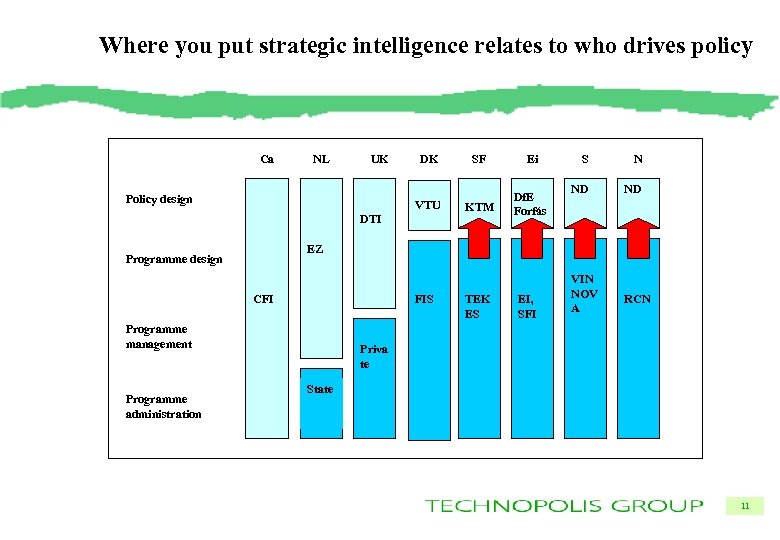 Where you put strategic intelligence relates to who drives policy Ca NL UK Policy design DK VTU DTI Ei KTM Df. E Forfás S N ND ND VIN NOV A RCN EZ Programme design FIS CFI Programme management Programme administration SF TEK ES EI, SFI Priva te State 11
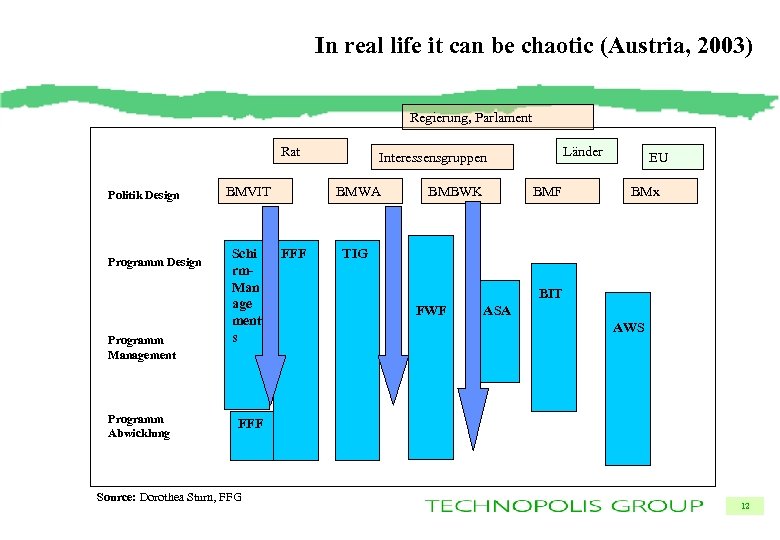 In real life it can be chaotic (Austria, 2003) Regierung, Parlament Rat Politik Design Programm Management Programm Abwicklung BMVIT Schi rm. Man age ment s BMWA FFF Länder Interessensgruppen BMBWK BMF EU BMx TIG BIT FWF ASA AWS FFF Source: Dorothea Sturn, FFG 12
 In addition to vertical steering, horizontal co-ordination is needed • Compartmentalisation between research and innovation and between sectors is a significant obstacle to a more integrative approach to research and innovation • Some societal issues are too big to address from one sectoral perspective only • The creation of separate relatively closed departmental research and innovation networks means government receives poor quality advice • From the perspective of the user (industry, research ) a large diversity of R&D support mechanisms hinders transparency • A growing number of knowledge and policy challenges appear to span multiple sectoral responsibilities. 13
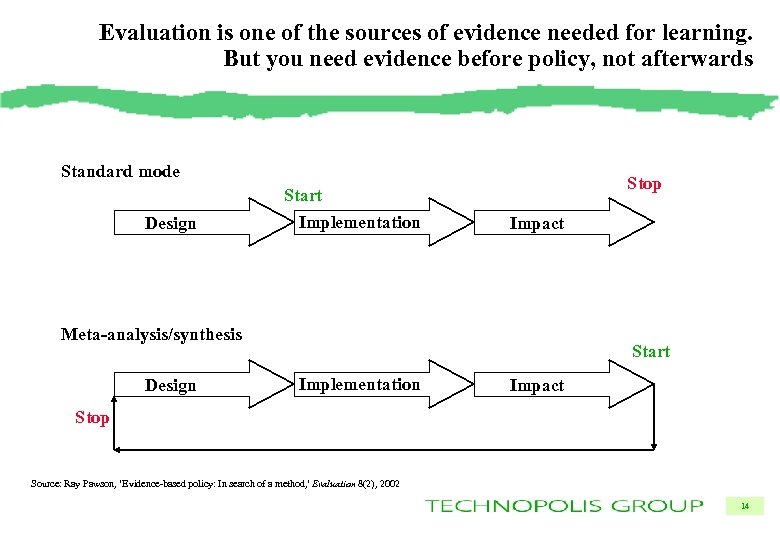 Evaluation is one of the sources of evidence needed for learning. But you need evidence before policy, not afterwards Standard mode Stop Start Design Implementation Impact Meta-analysis/synthesis Design Start Implementation Impact Stop Source: Ray Pawson, ‘Evidence-based policy: In search of a method, ’Evaluation 8(2), 2002 14
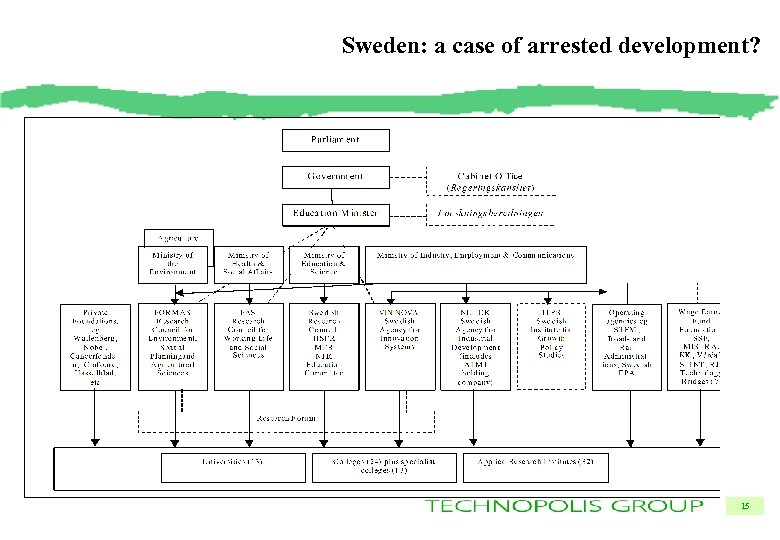 Sweden: a case of arrested development? 15
 “We have politics but no policy” (Industry ministry official) Some consequences • • Agency-driven policies, with policy competition Teknisk Framsyn 2 essentially had no audience Lowest Research Institute funding in the OECD. No clear future Knowledge Foundation tries to develop research capabilities in regional universities, in the absence of complementary instruments • 30 years of long-term energy research, focusing increasingly on fundamental research and unable to spend the implementation budget • Continuing (and increasing) fragmentation of the academic system, both within and between universities • Innovative Sweden - light at the end of the tunnel? Another train? 16
 Time to ditch Axel Oxenstierna? • The traditional model of ‘thin’ ministries with limited strategic intelligence struggles to cope with modern reality • The Swedish research and innovation governance and funding system is fragmented • It lacks effective change-agency and suffers from lock-ins • Horizontal coordination is poor • Is it time for a national debate that goes beyond the box-shuffling exercise of 2000? 17
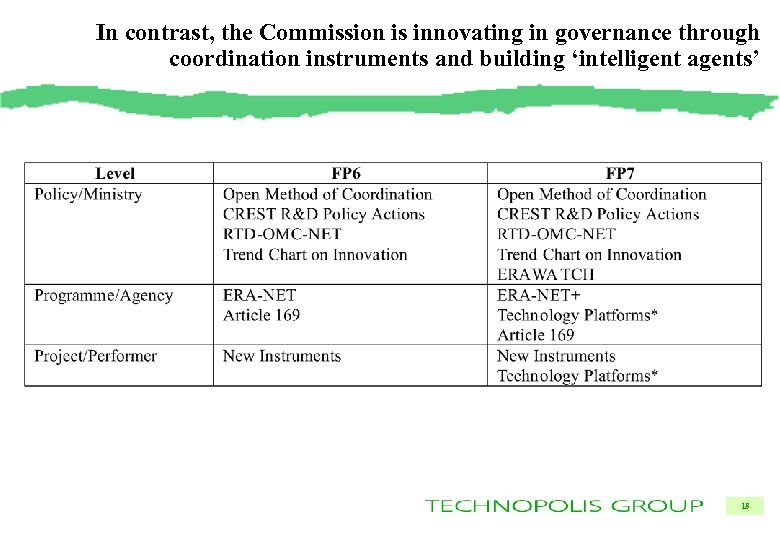 In contrast, the Commission is innovating in governance through coordination instruments and building ‘intelligent agents’ 18
 The essence of Commission strategy for opening R&D borders is thus to redefine governance • To operate simultaneously at policy, agency and research performer levels • To use variable geometry as a device to bypass objections and objectors • To build constituencies bottom up around needs and problems in the research and innovation system, which are likely both to produce valid grounds for intervention and to act as lobby groups for cross-border action • To devolve at least some of the new administrative burdens created to the beneficiaries • As a result, to shift power from the member states to Brussels 19
 We can generalise a little about what works in governance • One or more arenas are required, in which policy can be negotiated • Strategic intelligence needs to be distributed in order to be effective. (What you can see depends partly on where you stand) • Intelligence needs to be vertically as well as horizontally distributed • A measure of continuity is needed in policy, institutions and people 20
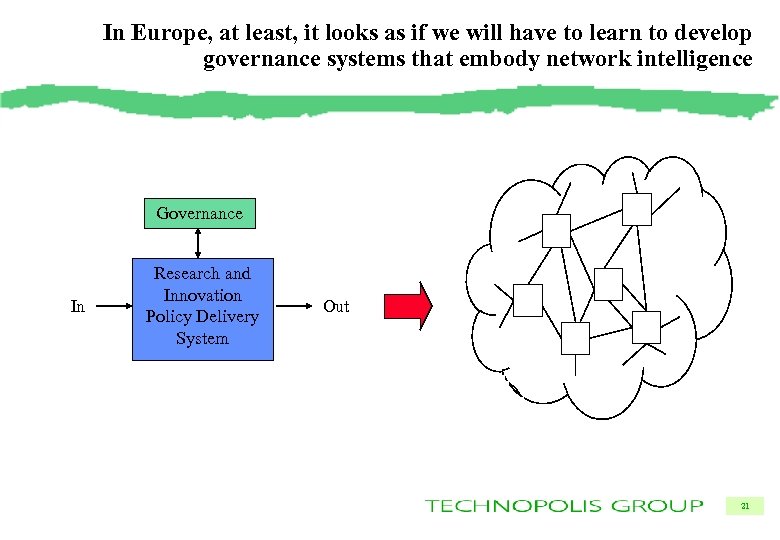 In Europe, at least, it looks as if we will have to learn to develop governance systems that embody network intelligence Governance In Research and Innovation Policy Delivery System Out 21