


 Скачать презентацию Governance and Corruption Worldwide Empirical Evidence and Lessons
ef6e4a6b67c1c59b8b69055e1f6c2807.ppt
- Количество слайдов: 27
 Governance and Corruption Worldwide: Empirical Evidence and Lessons for Policy Daniel Kaufmann, The World Bank Institute www. worldbank. org/wbi/governance Global Issues Seminar Series, March 1 st, 2006 "If you cannot measure it, you cannot improve it. " -- Lord Kelvin 1
 Challenging Convention – key tenets 1. Governance and Corruption are Unmeasurable 2. Some evidence: Governance has improved globally? 3. Good Governance: outcome of development and growth? – & emerging economies are corrupt…? 4. The trouble is with Public Sector & Officials in LDCs 5. Cultural & Historical Determinism of Corruption 6. Fighting corruption by ‘Fighting Corruption’ (Laws, Codes, Campaigns, Agencies & More Regulations) 2
 Tenet # 7: Challenging the previous ‘popular notions’ 1. Data Matters -- on Governance & Institutions: while ‘sensitive’, & margins of error (not uniquely) – data can be gathered, analyzed, and used judiciously 2. Expanding Beyond the Washington Consensus-- Adding to the Macro and the Structural’/Sectoral: Institutions, Governance and Corruption Matters 3. On Average: stagnation on Governance, and level is low - Has it become a binding constraint nowadays? 4. Significant variance: some countries show that it is feasible to improve governance in the short term 5. Interventions that have not worked – vs. what may work better in the future? – Transparency, Meritocracy and Deregulation matters – within collective action with private 3 sector, legislative and judiciary
 Six Dimensions of Governance as the set of traditions and institutions by which authority in a country is exercised -- specifically: • The process by which those in authority are selected and replaced – VOICE AND ACCOUNTABILITY – POLITICAL STABILITY & ABSENCE OF VIOLENCE/TERRORISM • The capacity of government to formulate and implement policies – GOVERNMENT EFFECTIVENESS – REGULATORY QUALITY • The respect of citizens and state for institutions that govern interactions among them – RULE OF LAW – CONTROL OF CORRUPTION 5
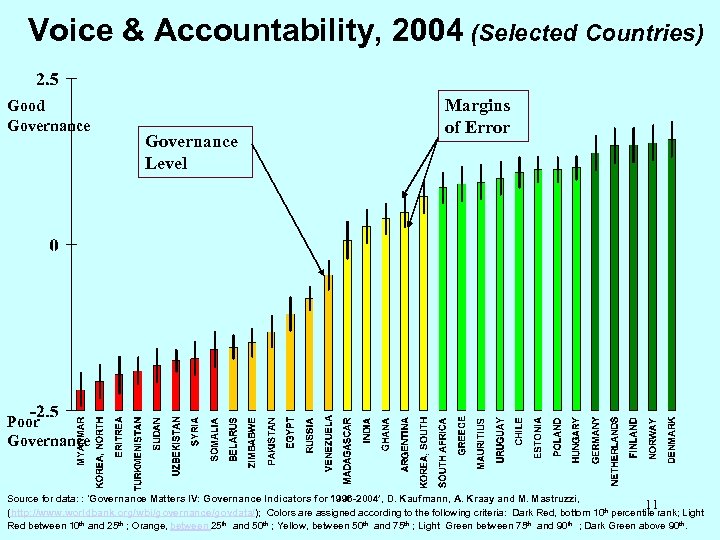 Voice & Accountability, 2004 (Selected Countries) Good Governance Level Margins of Error Poor Governance Source for data: : 'Governance Matters IV: Governance Indicators for 1996 -2004’, D. Kaufmann, A. Kraay and M. Mastruzzi, 11 (http: //www. worldbank. org/wbi/governance/govdata/); Colors are assigned according to the following criteria: Dark Red, bottom 10 th percentile rank; Light Red between 10 th and 25 th ; Orange, between 25 th and 50 th ; Yellow, between 50 th and 75 th ; Light Green between 75 th and 90 th ; Dark Green above 90 th.
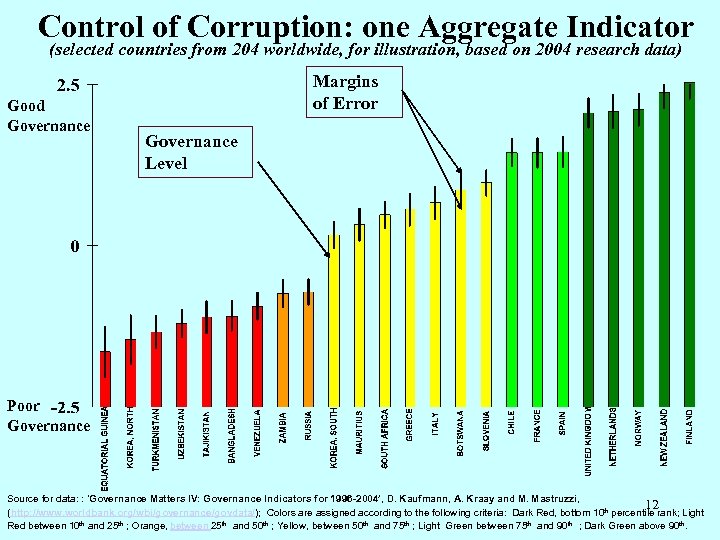 Control of Corruption: one Aggregate Indicator (selected countries from 204 worldwide, for illustration, based on 2004 research data) Good Governance Margins of Error Governance Level Poor Governance Source for data: : 'Governance Matters IV: Governance Indicators for 1996 -2004’, D. Kaufmann, A. Kraay and M. Mastruzzi, 12 (http: //www. worldbank. org/wbi/governance/govdata/); Colors are assigned according to the following criteria: Dark Red, bottom 10 th percentile rank; Light Red between 10 th and 25 th ; Orange, between 25 th and 50 th ; Yellow, between 50 th and 75 th ; Light Green between 75 th and 90 th ; Dark Green above 90 th.
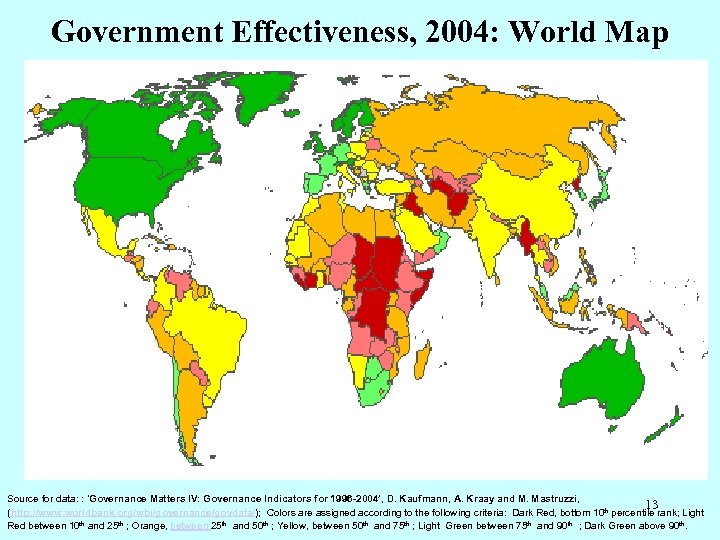 Government Effectiveness, 2004: World Map Source for data: : 'Governance Matters IV: Governance Indicators for 1996 -2004’, D. Kaufmann, A. Kraay and M. Mastruzzi, 13 (http: //www. worldbank. org/wbi/governance/govdata/); Colors are assigned according to the following criteria: Dark Red, bottom 10 th percentile rank; Light Red between 10 th and 25 th ; Orange, between 25 th and 50 th ; Yellow, between 50 th and 75 th ; Light Green between 75 th and 90 th ; Dark Green above 90 th.
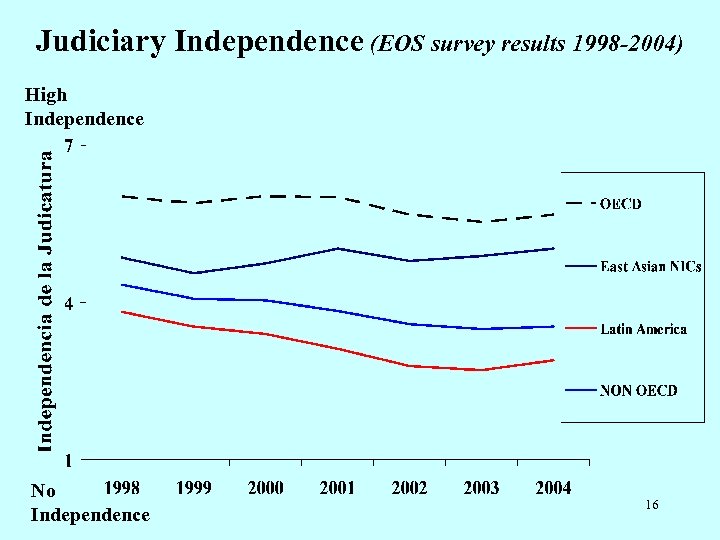 Judiciary Independence (EOS survey results 1998 -2004) High Independence No Independence 16
 Are all Countries Stagnating in Governance? • The world on average has not improved • But large or small variation across countries? • New method: for each country, we can identify whethere are significant changes over time • It is found that changes can take place in the short-term: in 6 -to-8 years, some deteriorations as well as some significant improvements as well 18
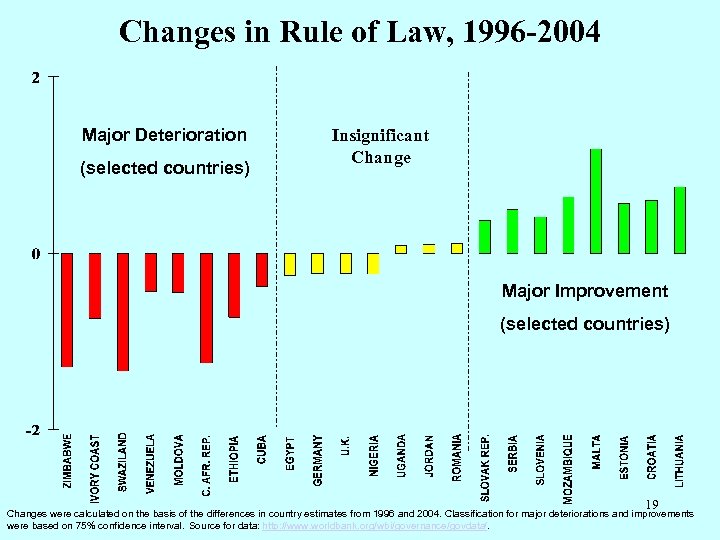 Changes in Rule of Law, 1996 -2004 Major Deterioration (selected countries) Insignificant Change Major Improvement (selected countries) 19 Changes were calculated on the basis of the differences in country estimates from 1996 and 2004. Classification for major deteriorations and improvements were based on 75% confidence interval. Source for data: http: //www. worldbank. org/wbi/governance/govdata/.
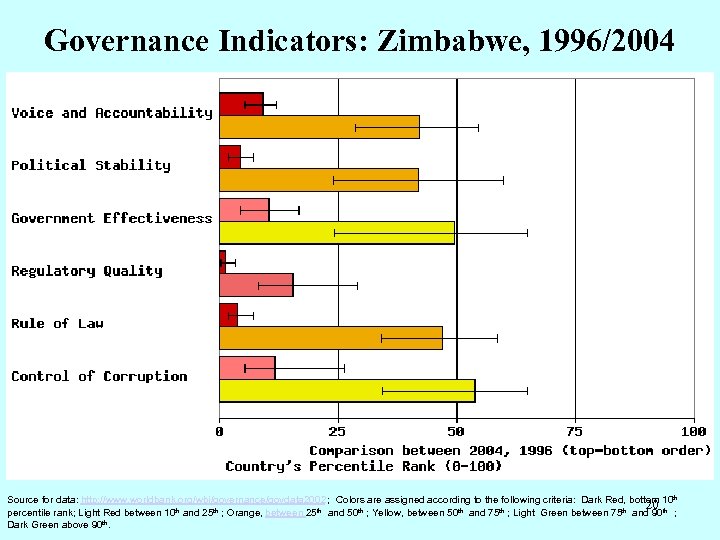 Governance Indicators: Zimbabwe, 1996/2004 Source for data: http: //www. worldbank. org/wbi/governance/govdata 2002 ; Colors are assigned according to the following criteria: Dark Red, bottom 10 th 20 percentile rank; Light Red between 10 th and 25 th ; Orange, between 25 th and 50 th ; Yellow, between 50 th and 75 th ; Light Green between 75 th and 90 th ; Dark Green above 90 th.
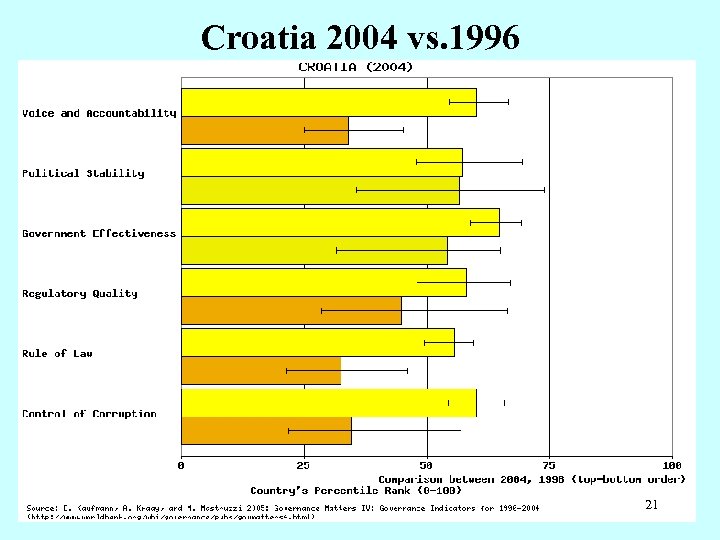 Croatia 2004 vs. 1996 21
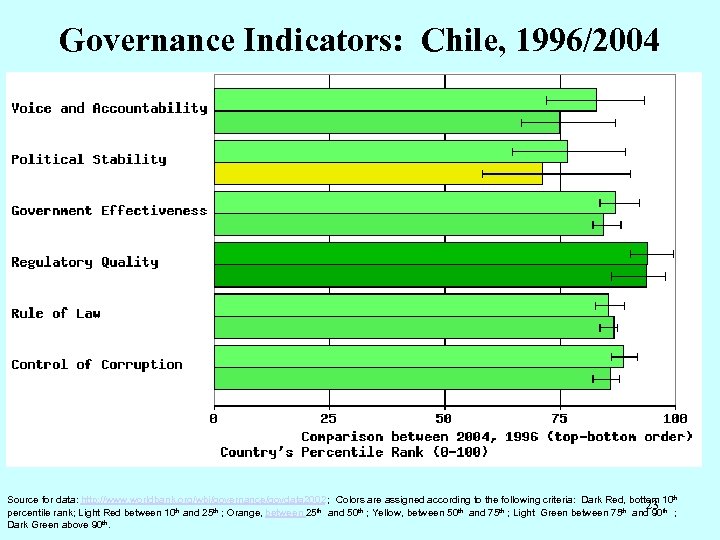 Governance Indicators: Chile, 1996/2004 Source for data: http: //www. worldbank. org/wbi/governance/govdata 2002 ; Colors are assigned according to the following criteria: Dark Red, bottom 10 th 23 percentile rank; Light Red between 10 th and 25 th ; Orange, between 25 th and 50 th ; Yellow, between 50 th and 75 th ; Light Green between 75 th and 90 th ; Dark Green above 90 th.
 Governance Matters: The 300% ‘Dividend’ 1. Large Development Dividend of Good Governance: a one-standard-deviation improvement in governance raise incomes per capita in a country by about 300% in long-run 2. But is such a decline in corruption unrealistically large? : NO -- One S. D. is the difference from: Eq. Guinea Iran or Uganda Mauritius Portugal Finland or New Zealand 3. The impact is from governance to incomes, and not viceversa -- higher incomes alone will not do 4. Urgency of interventions to improve governance 24
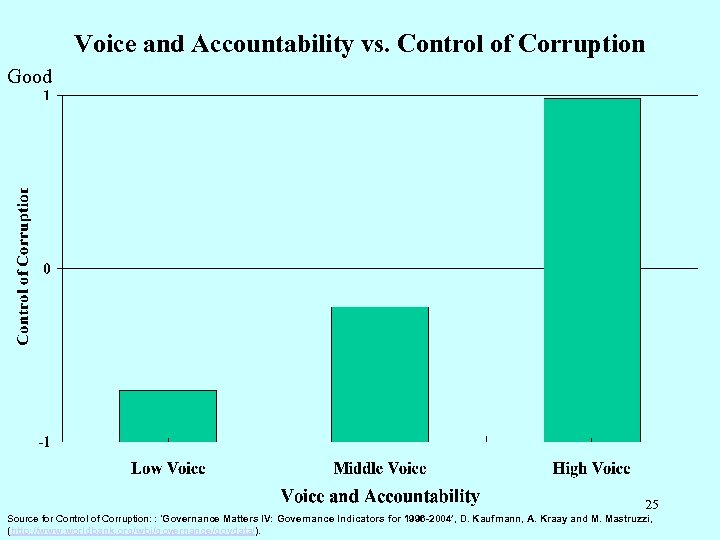 Voice and Accountability vs. Control of Corruption Good 25 Source for Control of Corruption: : 'Governance Matters IV: Governance Indicators for 1996 -2004’, D. Kaufmann, A. Kraay and M. Mastruzzi, (http: //www. worldbank. org/wbi/governance/govdata/).
 The ‘Mezzo’ Level of Governance Measurement • Based on cross-country surveys, mainly of enterprises – (such as the EOS of WEF, BEEPS/WBES of WB, etc. ) • Thousands of firms interviewed on a range of issues; focus on governance, specialized questions • More detailed unbundling of governance and corruption phenomena than aggregate indicators • Relatively broad country coverage, but less than aggregate governance indicators • Measuring what is taking place De Facto matters: it uncovers stark realities masked in De Jure indicators • Addresses empirically: ‘It takes two to “tango”’ 26
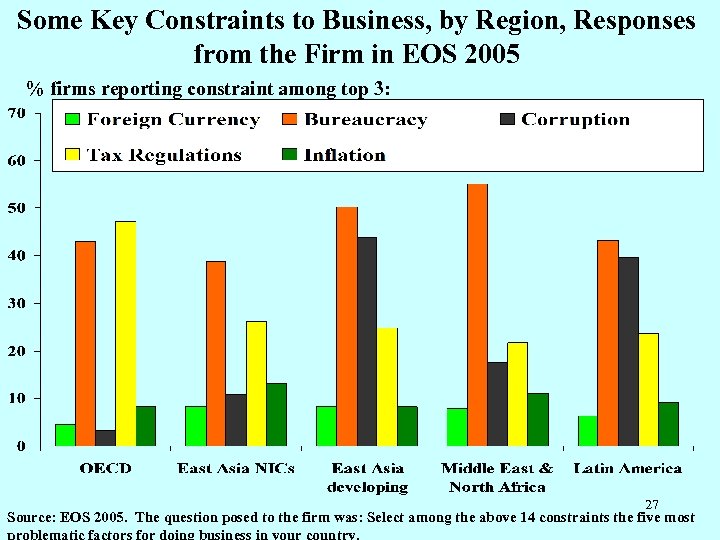 Some Key Constraints to Business, by Region, Responses from the Firm in EOS 2005 % firms reporting constraint among top 3: 27 Source: EOS 2005. The question posed to the firm was: Select among the above 14 constraints the five most
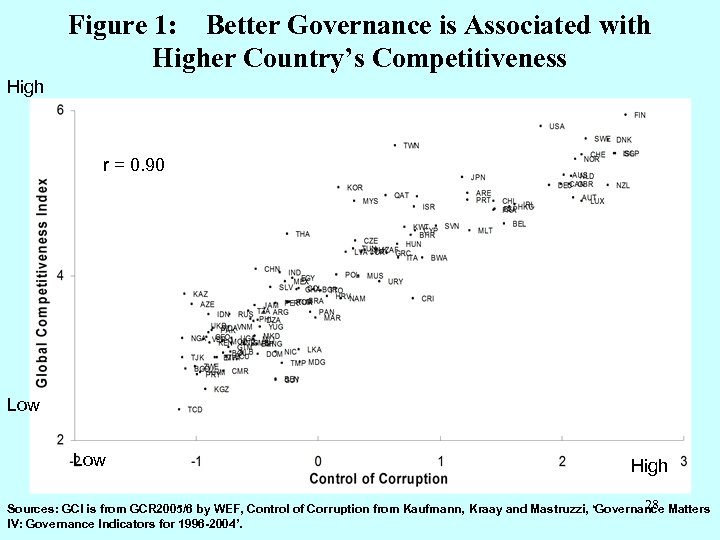 Figure 1: Better Governance is Associated with Higher Country’s Competitiveness High r = 0. 90 Low High 28 Sources: GCI is from GCR 2005/6 by WEF, Control of Corruption from Kaufmann, Kraay and Mastruzzi, ‘Governance Matters IV: Governance Indicators for 1996 -2004’.
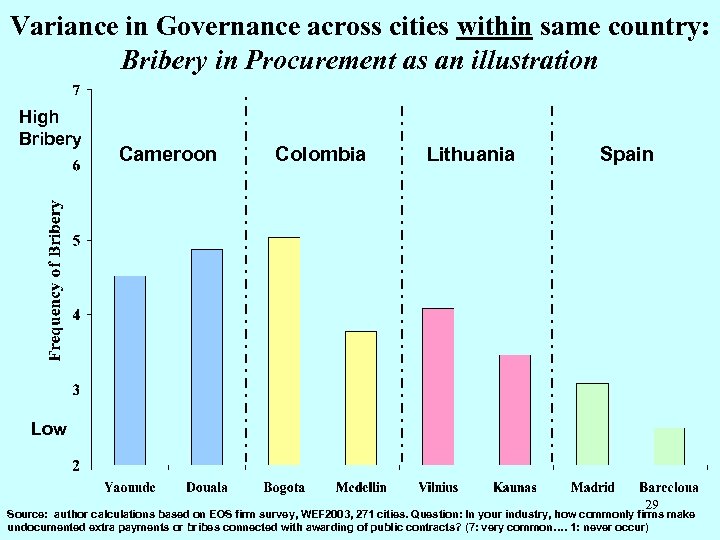 Variance in Governance across cities within same country: Bribery in Procurement as an illustration High Bribery Cameroon Colombia Lithuania Spain Low 29 Source: author calculations based on EOS firm survey, WEF 2003, 271 cities. Question: In your industry, how commonly firms make undocumented extra payments or bribes connected with awarding of public contracts? (7: very common…. 1: never occur)
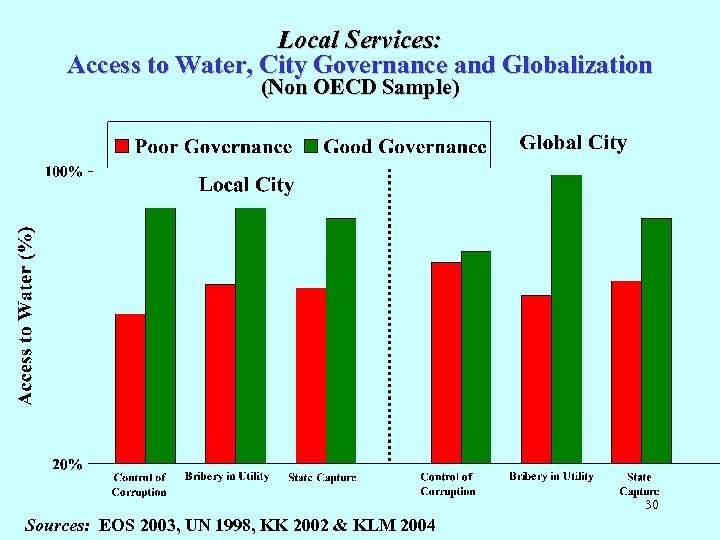 Local Services: Access to Water, City Governance and Globalization (Non OECD Sample) 30 Sources: EOS 2003, UN 1998, KK 2002 & KLM 2004
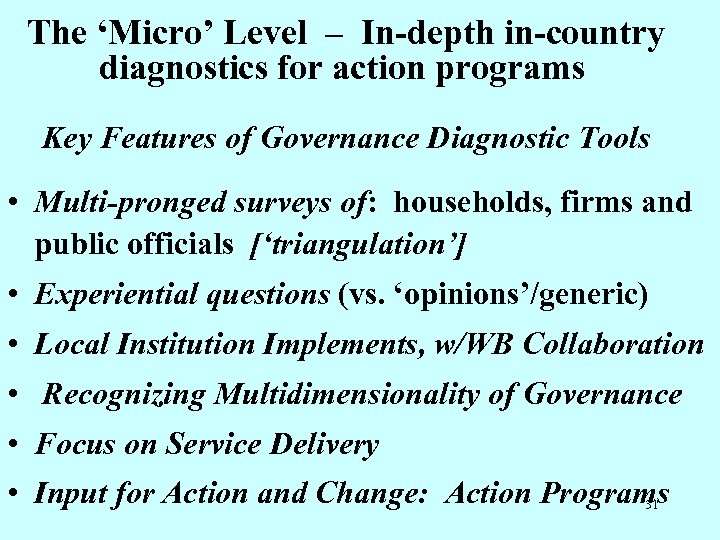 The ‘Micro’ Level – In-depth in-country diagnostics for action programs Key Features of Governance Diagnostic Tools • Multi-pronged surveys of: households, firms and public officials [‘triangulation’] • Experiential questions (vs. ‘opinions’/generic) • Local Institution Implements, w/WB Collaboration • Recognizing Multidimensionality of Governance • Focus on Service Delivery • Input for Action and Change: Action Programs 31
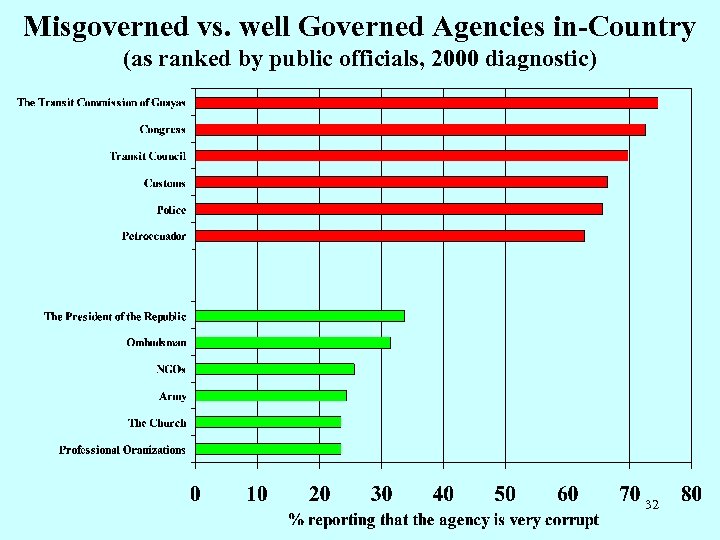 Misgoverned vs. well Governed Agencies in-Country (as ranked by public officials, 2000 diagnostic) 32
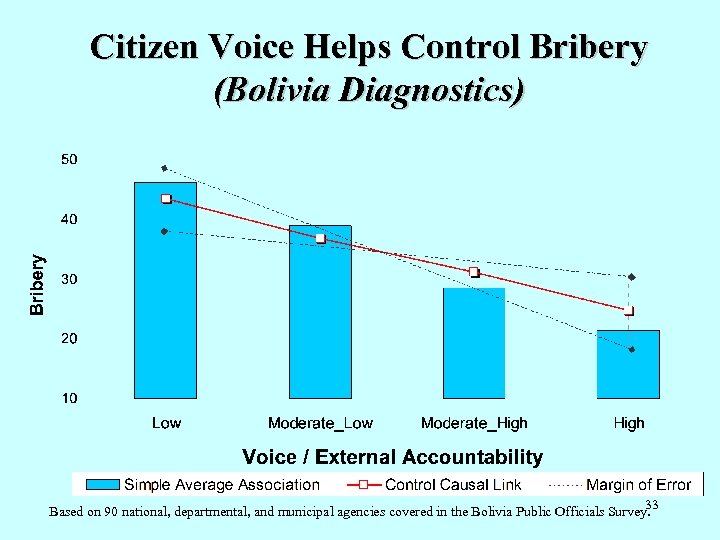 Citizen Voice Helps Control Bribery (Bolivia Diagnostics) 33 Based on 90 national, departmental, and municipal agencies covered in the Bolivia Public Officials Survey.
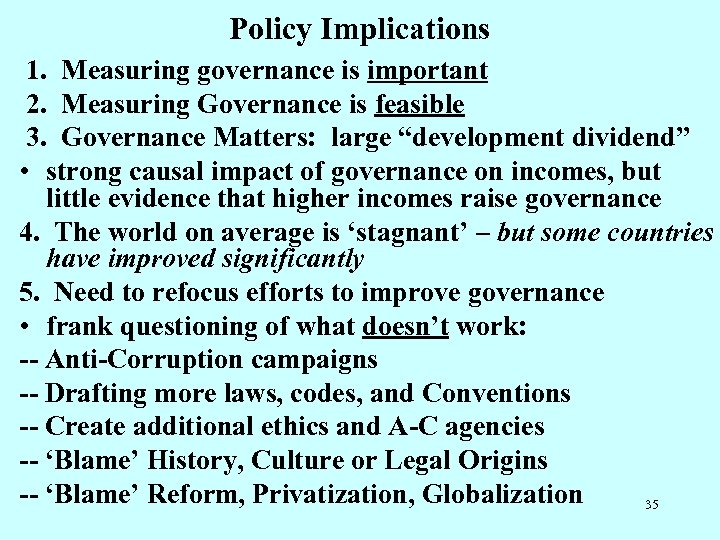 Policy Implications 1. Measuring governance is important 2. Measuring Governance is feasible 3. Governance Matters: large “development dividend” • strong causal impact of governance on incomes, but little evidence that higher incomes raise governance 4. The world on average is ‘stagnant’ – but some countries have improved significantly 5. Need to refocus efforts to improve governance • frank questioning of what doesn’t work: -- Anti-Corruption campaigns -- Drafting more laws, codes, and Conventions -- Create additional ethics and A-C agencies -- ‘Blame’ History, Culture or Legal Origins -- ‘Blame’ Reform, Privatization, Globalization 35
 What Appears to Work… 1. ‘Data Power’ + Transparency Strategy & Reforms 2. Voice and Accountability – incl. Freedom of the Press 3. Subnational Level Reforms and Focus (cities, villages. . ) 4. Deregulation/ Integrate to world economy & markets 5. Focus on Incentives and on Prevention 6. Meritocratic Civil Service & Oversight Institutions 7. Budgetary/Public Expenditure Reforms 8. Political Finance Reform 9. Role of Corporate/Banking Sectors & Multinationals 10. Judicial Reform 36
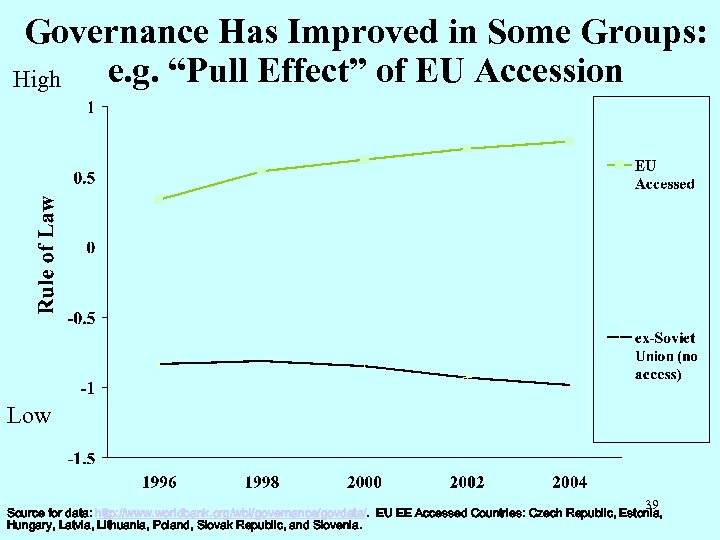 Governance Has Improved in Some Groups: e. g. “Pull Effect” of EU Accession High Low 39 Source for data: http: //www. worldbank. org/wbi/governance/govdata/. EU EE Accessed Countries: Czech Republic, Estonia, Hungary, Latvia, Lithuania, Poland, Slovak Republic, and Slovenia.
 Bibliographical References 1. Kaufmann, D. , A. Kraay, and M. Mastruzzi. 2005. "Governance Matters IV: Governance Indicators for 1996 -2004. " http: //www. worldbank. org/wbi/governance/pdf/Synthesis_Gov. Matters_IV. pdf (synthesis), and, http: //www. worldbank. org/wbi/governance/pdf/Synthesis_Gov. Matters_IV. pdf (full paper) 2. Kaufmann, D. and A. Kraay. 2003. "Governance and Growth: Causality Which Way? " http: //worldbank. org/wbi/governance/pdf/growthgov_synth. pdf. 3. Kaufmann, D. 2003. "Rethinking Governance: Empirical Lessons Challenge Orthodoxy. " http: //worldbank. org/wbi/governance/pdf/rethink_gov_stanford. pdf. 4. Kaufmann, D. 2004. "Corruption, Governance and Security: Challenges for the Rich Countries and the World. " http: //worldbank. org/wbi/governance/pdf/Kaufmann_GCR_101904_B. pdf. 5. Bellver, A. and D. Kaufmann (2005). "Transparenting Transparency: Initial Empirics and Policy Applications". http: //worldbank. org/wbi/governance/pubs/Transparency. IMF. html Governance Indicators User Interface: http: //www. worldbank. org/wbi/governance/govdata/. 40