 Скачать презентацию Gov t Foldable What is the first need
28c00ee475916b12e790a87356915a80.ppt
- Количество слайдов: 34



Gov’t Foldable
What is the first need 4 former colonies?
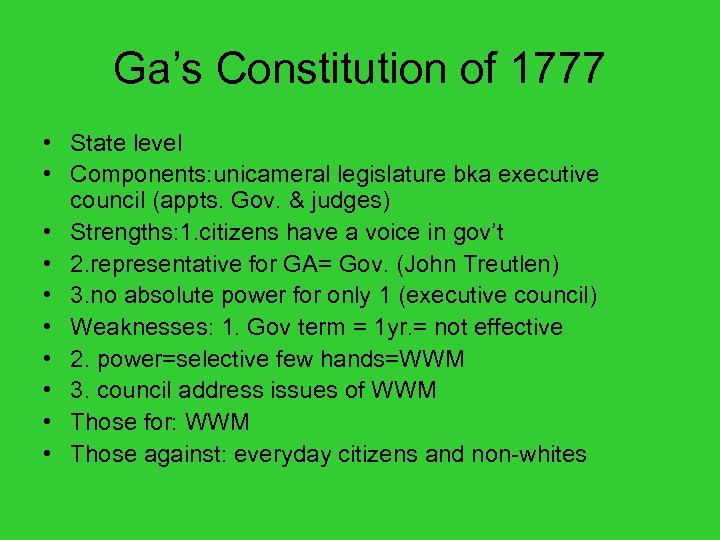
Ga’s Constitution of 1777 • State level • Components: unicameral legislature bka executive council (appts. Gov. & judges) • Strengths: 1. citizens have a voice in gov’t • 2. representative for GA= Gov. (John Treutlen) • 3. no absolute power for only 1 (executive council) • Weaknesses: 1. Gov term = 1 yr. = not effective • 2. power=selective few hands=WWM • 3. council address issues of WWM • Those for: WWM • Those against: everyday citizens and non-whites
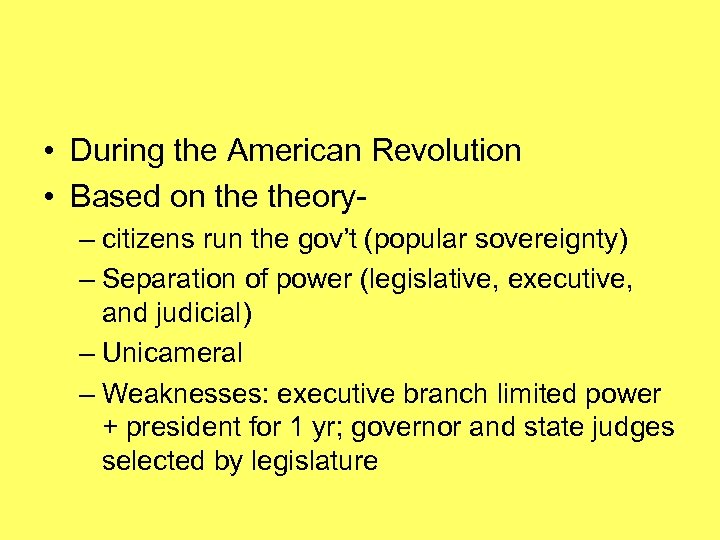
• During the American Revolution • Based on theory– citizens run the gov’t (popular sovereignty) – Separation of power (legislative, executive, and judicial) – Unicameral – Weaknesses: executive branch limited power + president for 1 yr; governor and state judges selected by legislature
Aspects of colonists • GA’s economy ruined • Families needed basic foods (corn meal, flour) • Former soldiers looking payment for services-white=land; blacks=freedom • Former soldiers can’t pay taxes & in jeopardy of loosing land =Shays Rebellion
• War affect trade & farming • Local manufacturing sprang up due to stipulations and higher $(Navigation Acts) • When peace restored (British lowers prices to compete for customers) No tax on British goods. Competition between British & local • Congress began to print paper $=value to fluctuate; people prefer coins (metal). • Paper $=inflation (more $ w/o increase in amt. of goods=increase in taxes • Depression of 1784 -86 states don’t want to send $ to gov’t, pay for direct needs not nat’l needs. • Ex. Exposed border states will pay for defense (N. C); S. C not exposed
Articles of Confederation • • Objective. Positives/strengths. Negatives/weaknesses. Who benefits. Structure of gov’t. Big problem. Conclusion-
Virginia Plan • Proposed by-Gov Edmund Randolph • bka: large state plan Structure of gov’t & powers • 3 branches: executive, judicial, and legislative • 2 house legislature: upper house- appt. by state legislatures • lower house: elected by qualified voters
• Powers of legislature/Congress= make laws, choose chief executive, set up court systems • Why? Trying to give nat’l gov’t more power • Sharing of powers= check & balances • Why do small states disagree? Gives more power to fed. Gov’t
• • • Fear large states will outlaw slavery Federalist/Anti-Federalist? Federalist Beliefs: 1. in separation of powers 2. legislature should be based on free population • 3. strong federal gov’t • 4. House of Representatives (lower houseelected by the people; protect CITIZEN’S
The Virginia Plan • • • Proposed bybka______ Structure of gov’t & powers 2 house legislature: upper- ____ lower-__ Powers of legislature/Congress Why? Sharing of powers= Why do small states disagree? Federalist/Anti-Federalist? Beliefs: • • • 1. 2. 3.
The New Jersey Plan • • • Bka: small states plan Comparable to: Articles of Confederation Structure of govt: unicameral Components: 1 state=1 vote Regulate interstate and international trade Tax citizens (federal tax)
• Federalist/Anti? • Anti-Federalists (against a strong nat’l gov’t) • Beliefs: feared the VA Plan would give Congress too much power • Believed Bill of Rights were needed for citizens • Worry large states will outlaw slavery • (large states typically do not practice
The New Jersey Plan • • • Bka: Comparable to: Structure of govt: Components: Federalist/Anti? Beliefs
Conflict vs. Compromise • 1. VA Plan-state rep. based on pop. • NJ Plan-1 state=1 vote • House of Reps (lower house)= based on pop. • Senate (upper house)=2 reps per state
2 states • 3/5 compromise want slaves = 5 slaves counted for pop counted as 3 people • Northern statesslaves can’t vote, so should not be counted for rep • . Southern
3 • N. shippers wanted • Congress control Congress to control foreign trade, but foreign trade denied the power • S. growers wanted to tax exports each state to set own trade laws (to prevent taxes on exports)
Constitution (future) • Amendments • 1 -10 amendments= GA signers: Abraham Baldwin & William Few • GA ratified: Jan. 2, 1788 • 1 st President: George Washington • Capital of GA in 1785: Augusta
• Considered as capital: • Easily accessible; centrally located; support the reps (lodging, food, place 4 meetings) • + capital: $>build capitol, + pop, +stores, +hotels, +salaries, + taxes
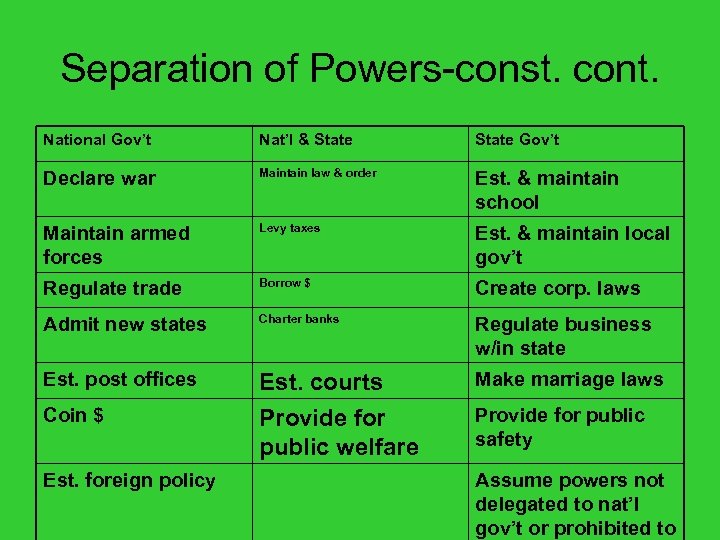
Separation of Powers-const. cont. National Gov’t Nat’l & State Gov’t Declare war Maintain law & order Est. & maintain school Maintain armed forces Levy taxes Est. & maintain local gov’t Regulate trade Borrow $ Create corp. laws Admit new states Charter banks Regulate business w/in state Est. post offices Est. courts Provide for public welfare Make marriage laws Coin $ Est. foreign policy Provide for public safety Assume powers not delegated to nat’l gov’t or prohibited to
• Amendment process • 1 must be proposed – A) 2/3 of both houses of Congress can vote to propose or – B) 2/3 of state requests special conventions to propose • 2 to be ratified- ¾ states must approve
Bill of Rights • *1. guarantees free speech, religion, press, right to assemble peacefully & petition the gov’t • *2. bear arms • *3. prevents Congress from forcing citizens to house soldiers • *4. protects from unreasonable searches and seizures • *Comes from struggle w/ Britain
• 5. due process of law • 6. prompt trial and trial by jury; told why tried • 7. jury trial in civil cases • 8. no excessive bail or cruel & unusual punishment • 9. rights listed not the only one exists • 10. all powers not nat’l gov’t & not denied to states are reserved for the people
Ga State const. 1789 • Gone from bicameral bka General Assembly • General assembly is divided by Senate and House of Representatives • Members of the House and Senate are elected by popular vote • Powers=pick Governor, pick judges, state officers • Decide how $ is to be raised and spent
• 3 branches= legislative (General Assembly) • Executive (Governor) • Judicial (Judges)
GA State Const. 1983 • We can vote for who we want in office. If we feel they aren’t handling our responsibilities, we vote 4 someone else. • Still have 3 branches • Governor elected by the people not appt. • Time limits 4 being in office. Can only have 2 consecutive terms. 1 term = 4 yrs
Back of foldable • Citizen- you are born on U. S. soil • Born to parents that are US citizens • Naturalized citizen- born in another country, but meet qualifications for US citizenship • Qualifications: must speak, read, & write English • Must pass background check
• Process- study American History, US const. /political parties, democracy. Tested on history/const/political parties/democracy. Swear allegiance to US • Citizens’ rights- refers to amendments 1 -8
• Citizens’ responsibilities- pay fed/state/local taxes. Participation in gov’t, vote, obey laws, defend the nation, jury duty, register 4 selective services (males 18) • You can ONLY vote & run for office in your district
Problems in Society • Problem 1 - littering • Contributing • solution/law-
Problems in Society • Problem 2 - DUI (teenagers) • Contributing factors • Solution/law=
Problems in Society • Problem 3 -increase in violent crimes (juveniles) • Contributing factors • Solution/law=
Problems in Society • Problem 4 - reduced numbers of students passing graduation test the first time • Contributing factors • Solution/law-
Problems in Society • Problem 5 - increase number of juveniles qualifying as “unruly” • Contributing factors • Solution/law-
Скачать презентацию Gov t Foldable What is the first need
28c00ee475916b12e790a87356915a80.ppt