


 Скачать презентацию Google Online Marketing Challenge GOMC Master Class Samara
Master Class GOMC.pptx
- Количество слайдов: 19
 Google Online Marketing Challenge (GOMC) Master Class Samara
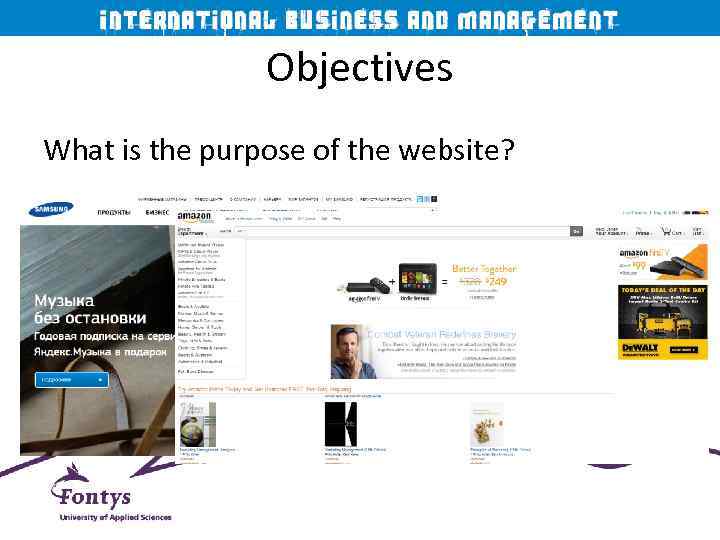 Objectives What is the purpose of the website?
 Challenges • The landing page is not optimised for important keywords; • The landing page is not specifically designed for the product/service advertised for; • The company’s website does not create trust; • The company’s website has usability issues; • Long page load.
 Pre-Campaign Report Contents: 1. Client overview; 1. 1 Client profile; 1. 2 Market analysis; 1. 3 Current marketing. 2. Proposed Ad. Words strategy; 3. Communication and readability.
 1. 1 Client Profile • • • Name, location; Number of employees; Goods and services offered; Key online marketing personnel; Age of the company; URL; Website age; Website management; Social media such as Google+; Company presence and sales via online and offline channels; Other relevant information.
 1. 2 Market Analysis • Current and potential customers; • Current and potential competitors; • Overview of the industry (key characteristics, competitive/saturated/mature); • Projected and historical online spend for the industry; • Market position/specialties; • Unique selling points of the goods/services offered; • Seasonality of their goods/services or seasonality that the company has identified (use Google Trends); • Other relevant market information.
 1. 3 Current Marketing • Website uses, e. g. sales, customer service; • Website strengths and weaknesses; • Website visibility, such as Google Page. Rank, incoming links, a few keyword search results; • If available, summary information from Google Analytics or other third party web tracking software; • Other online advertising and offline promotion of the url; • Conclusion on How the Ad. Words Campaign Aligns with the Client's Business.
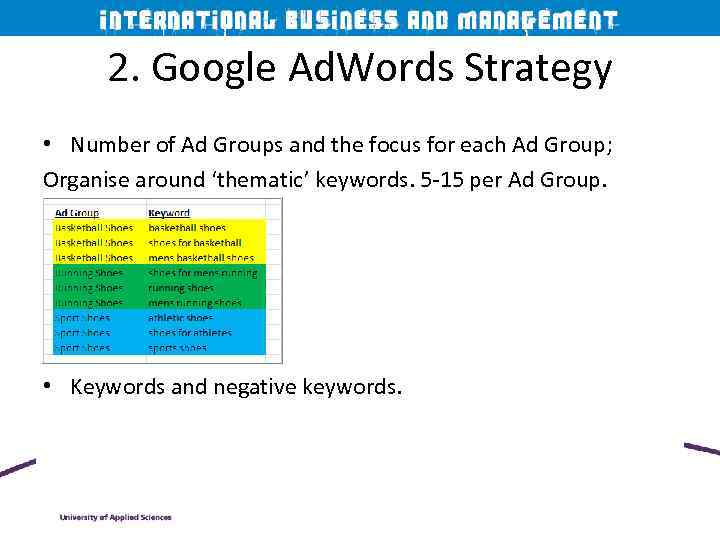 2. Google Ad. Words Strategy • Number of Ad Groups and the focus for each Ad Group; Organise around ‘thematic’ keywords. 5 -15 per Ad Group. • Keywords and negative keywords.
 2. Google Ad. Words Strategy Keywords research: 1. Think about the products/services you are offering and what people might be searching for. 2. Think about keywords people might use when searching for these products/services and write them down. 3. Use Google Trends and Google Keyword tool to find suggested keywords.
 2. Google Ad. Words Strategy Keywords research: Which keywords result in more clicks and higher conversions? Ask yourself: ‘Is the keyword relevant to your website's content? Will searchers find what they are looking for on your site when they search using these keywords? Will they be happy with what they find (Moz. com, 2014)? ’
 2. Google Ad. Words Strategy Determine the value per keyword: If your ad generated 5, 000 views, of which 100 visitors have come to your site and three have placed an order $300 worth of profit (not revenue!), then a single visitor for that keyword is worth ($300/100=) $3 to your business (Moz. com, 2014)’. Use this value when placing bids.
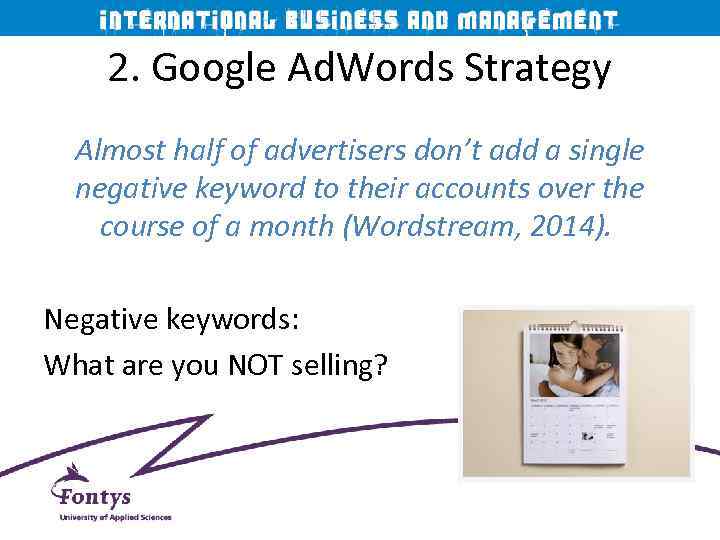 2. Google Ad. Words Strategy Almost half of advertisers don’t add a single negative keyword to their accounts over the course of a month (Wordstream, 2014). Negative keywords: What are you NOT selling?
 2. Google Ad. Words Strategy Make a search terms report: A list of search terms that people have used before seeing your ad and clicking it. Use this report to refine your keywords so that only the right searches cause your ad to show.
 2. Google Ad. Words Strategy Text for at least two Ad. Words versions for an ad group: • Specific; • Relevant; • Attractive; • Empowering.
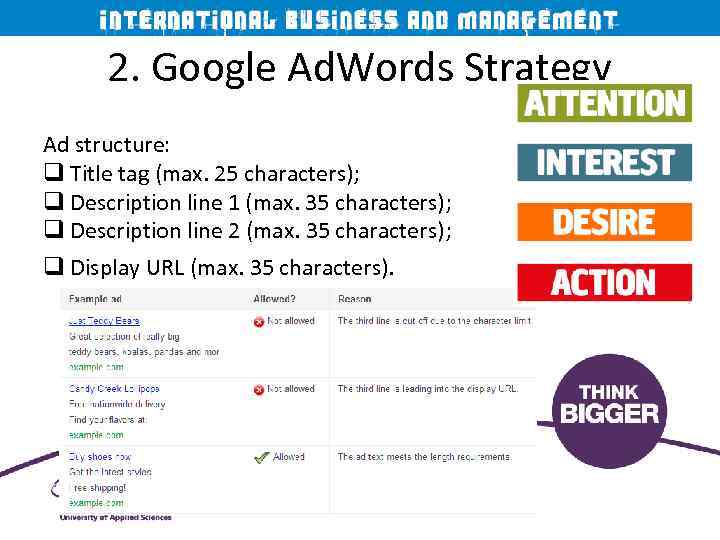 2. Google Ad. Words Strategy Ad structure: q Title tag (max. 25 characters); q Description line 1 (max. 35 characters); q Description line 2 (max. 35 characters); q Display URL (max. 35 characters).
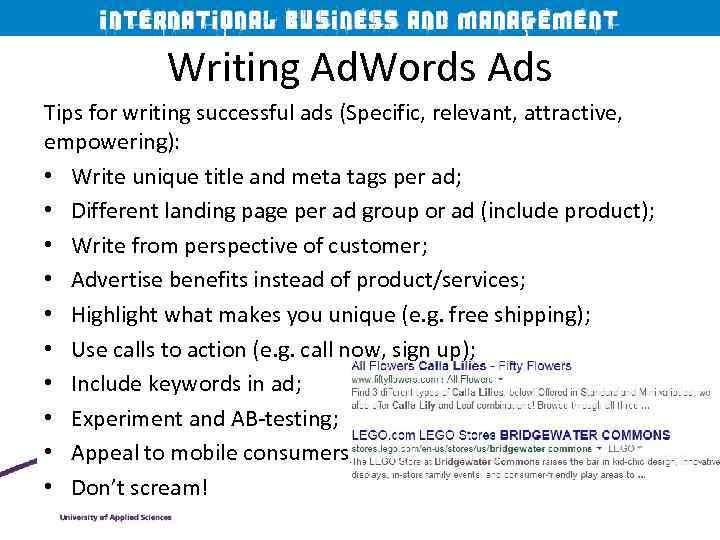 Writing Ad. Words Ads Tips for writing successful ads (Specific, relevant, attractive, empowering): • Write unique title and meta tags per ad; • Different landing page per ad group or ad (include product); • Write from perspective of customer; • Advertise benefits instead of product/services; • Highlight what makes you unique (e. g. free shipping); • Use calls to action (e. g. call now, sign up); • Include keywords in ad; • Experiment and AB-testing; • Appeal to mobile consumers; • Don’t scream!
 2. Google Ad. Words Strategy • Daily and weekly plans for spending their campaign budget; • Network(s) for your Ad. Words ads; • Target audience settings; • Ad serving options (standard or accelerated delivery).
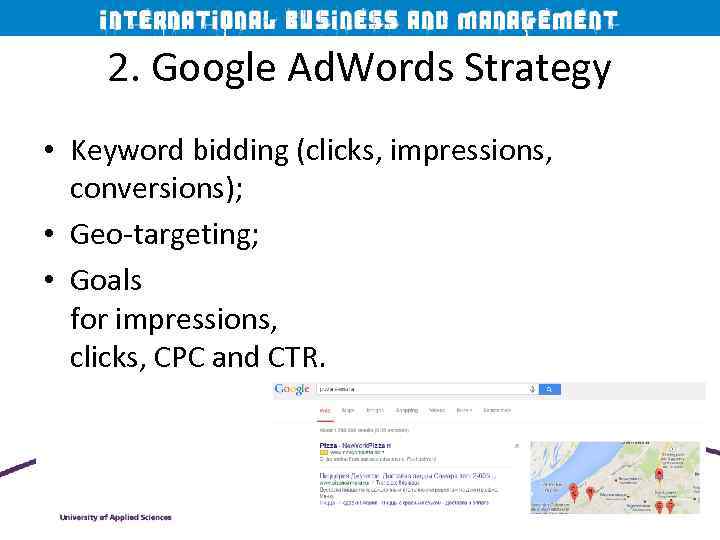 2. Google Ad. Words Strategy • Keyword bidding (clicks, impressions, conversions); • Geo-targeting; • Goals for impressions, clicks, CPC and CTR.
 Assignment • Create a list of the best 15 keywords the company should use; • Create a list of five negative keywords the company should use; • Create two sample Ad. Words ads.