


 Скачать презентацию Good Practices Related to Access to Safe Drinking
09e5c9d5078c5867eaab038da5dccc84.ppt
- Количество слайдов: 27
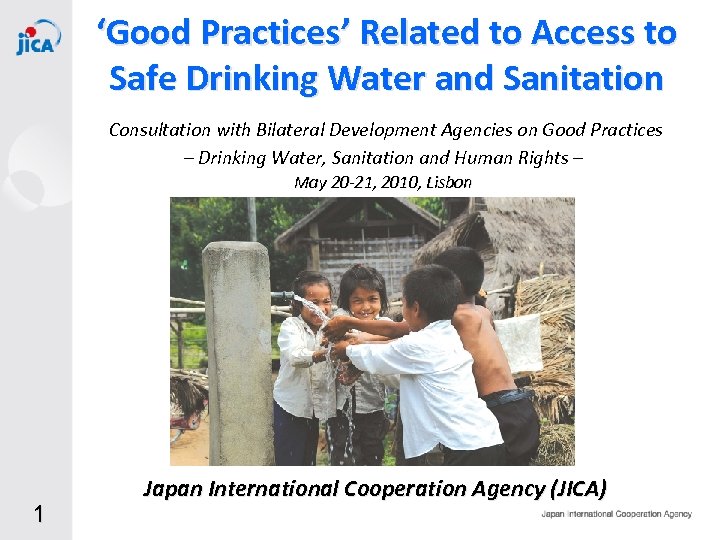 ‘Good Practices’ Related to Access to Safe Drinking Water and Sanitation Consultation with Bilateral Development Agencies on Good Practices – Drinking Water, Sanitation and Human Rights – May 20 -21, 2010, Lisbon 1 Japan International Cooperation Agency (JICA)
 Good Practices Case i : India - Urban water supply and sanitation in Bangalore Case ii : Senegal - Rural water supply and sanitation 2
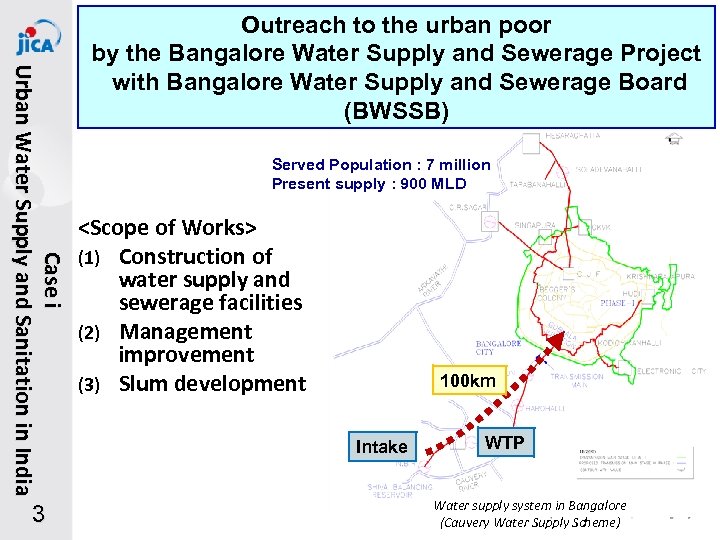 Ca s e i U r b a n Wa t e r S u p p l y a n d S a n i t a t i o n i n I n d i a 3 Outreach to the urban poor by the Bangalore Water Supply and Sewerage Project with Bangalore Water Supply and Sewerage Board (BWSSB) Served Population : 7 million Present supply : 900 MLD
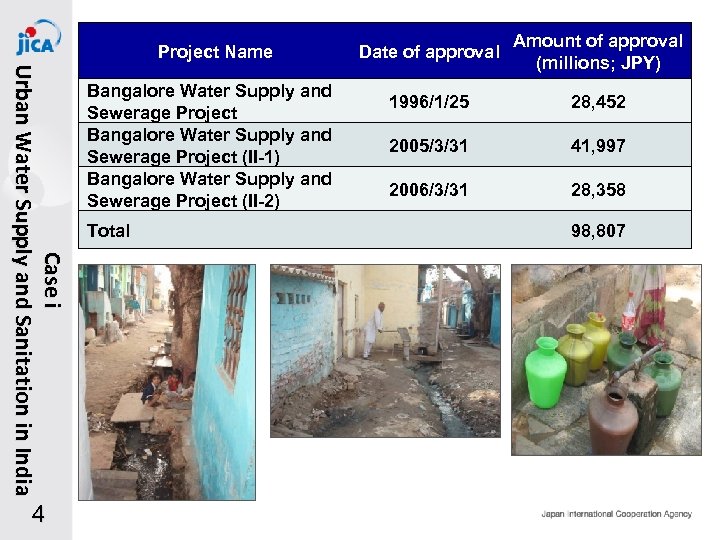 Project Name Ca s e i U r b a n Wa t e r S u p p l y a n d S a n i t a t i o n i n I n d i a 4 Bangalore Water Supply and Sewerage Project (II-1) Bangalore Water Supply and Sewerage Project (II-2) Total Date of approval Amount of approval (millions; JPY) 1996/1/25 28, 452 2005/3/31 41, 997 2006/3/31 28, 358 98, 807
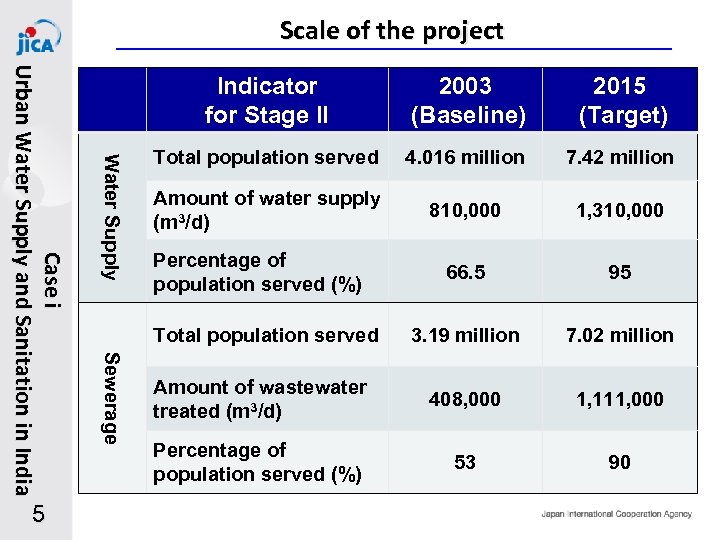 Scale of the project Sewerage 2003 (Baseline) 2015 (Target) Total population served 4. 016 million 7. 42 million Amount of water supply (m 3/d) 810, 000 1, 310, 000 66. 5 95 Total population served Water Supply Ca s e i U r b a n Wa t e r S u p p l y a n d S a n i t a t i o n i n I n d i a 5 Indicator for Stage II 3. 19 million 7. 02 million Amount of wastewater treated (m 3/d) 408, 000 1, 111, 000 Percentage of population served (%) 53 90 Percentage of population served (%)
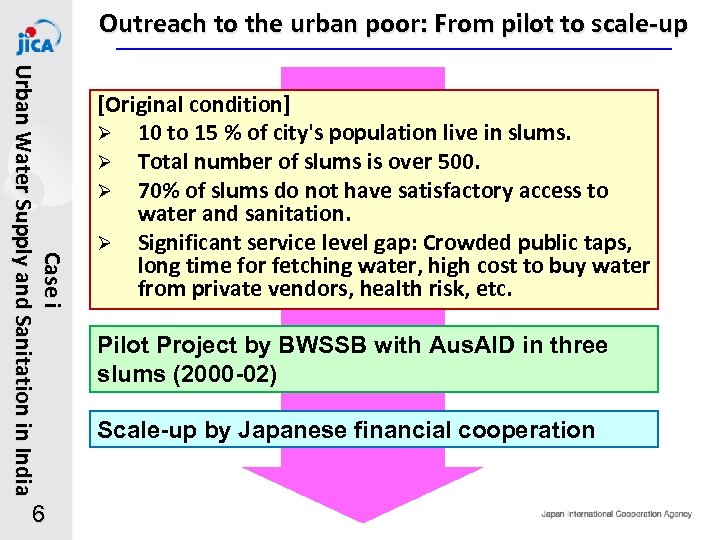 Outreach to the urban poor: From pilot to scale-up Ca s e i U r b a n Wa t e r S u p p l y a n d S a n i t a t i o n i n I n d i a 6 [Original condition] Ø 10 to 15 % of city's population live in slums. Ø Total number of slums is over 500. Ø 70% of slums do not have satisfactory access to water and sanitation. Ø Significant service level gap: Crowded public taps, long time for fetching water, high cost to buy water from private vendors, health risk, etc. Pilot Project by BWSSB with Aus. AID in three slums (2000 -02) Scale-up by Japanese financial cooperation
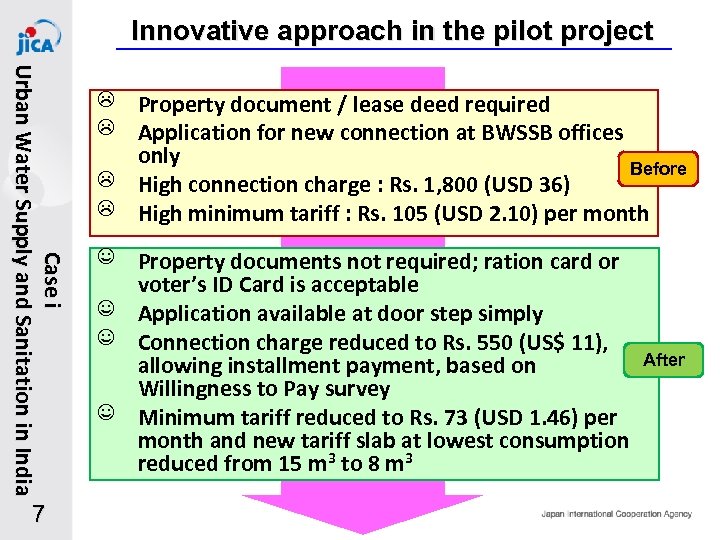 Innovative approach in the pilot project Ca s e i U r b a n Wa t e r S u p p l y a n d S a n i t a t i o n i n I n d i a 7 ☹ ☹ ☺ ☺ Property document / lease deed required Application for new connection at BWSSB offices only Before High connection charge : Rs. 1, 800 (USD 36) High minimum tariff : Rs. 105 (USD 2. 10) per month Property documents not required; ration card or voter’s ID Card is acceptable Application available at door step simply Connection charge reduced to Rs. 550 (US$ 11), allowing installment payment, based on Willingness to Pay survey Minimum tariff reduced to Rs. 73 (USD 1. 46) per month and new tariff slab at lowest consumption reduced from 15 m 3 to 8 m 3 After
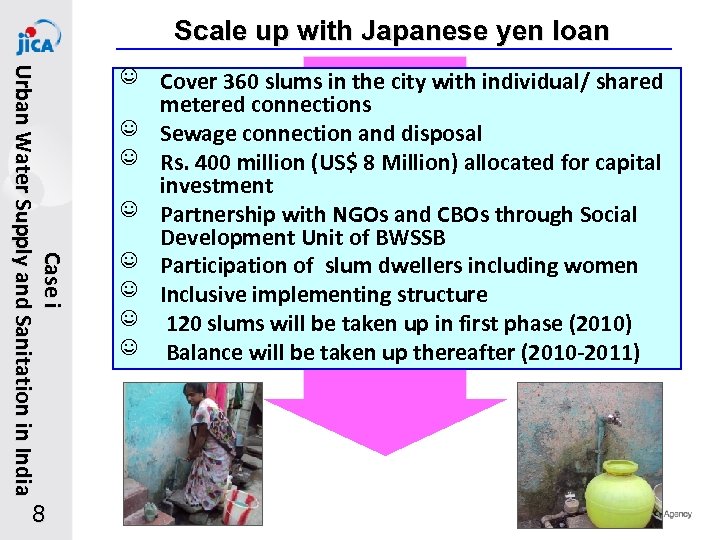 Scale up with Japanese yen loan Ca s e i U r b a n Wa t e r S u p p l y a n d S a n i t a t i o n i n I n d i a 8 ☺ ☺ ☺ ☺ Cover 360 slums in the city with individual/ shared metered connections Sewage connection and disposal Rs. 400 million (US$ 8 Million) allocated for capital investment Partnership with NGOs and CBOs through Social Development Unit of BWSSB Participation of slum dwellers including women Inclusive implementing structure 120 slums will be taken up in first phase (2010) Balance will be taken up thereafter (2010 -2011)
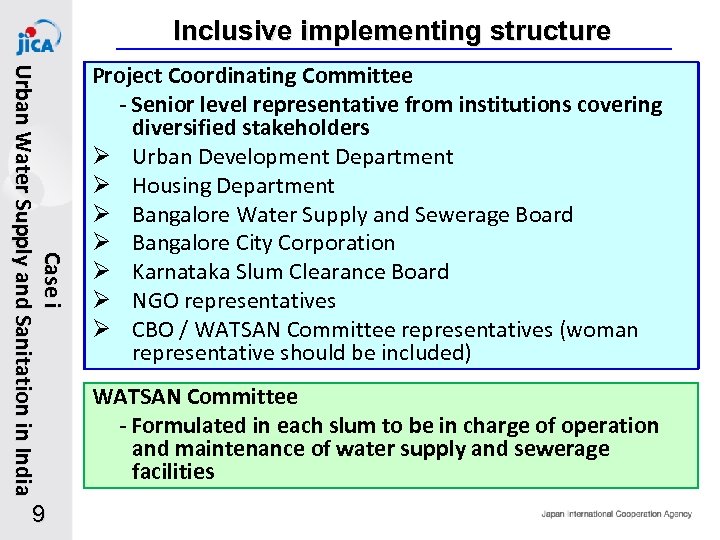 Inclusive implementing structure Ca s e i U r b a n Wa t e r S u p p l y a n d S a n i t a t i o n i n I n d i a 9 Project Coordinating Committee - Senior level representative from institutions covering diversified stakeholders Ø Urban Development Department Ø Housing Department Ø Bangalore Water Supply and Sewerage Board Ø Bangalore City Corporation Ø Karnataka Slum Clearance Board Ø NGO representatives Ø CBO / WATSAN Committee representatives (woman representative should be included) WATSAN Committee - Formulated in each slum to be in charge of operation and maintenance of water supply and sewerage facilities
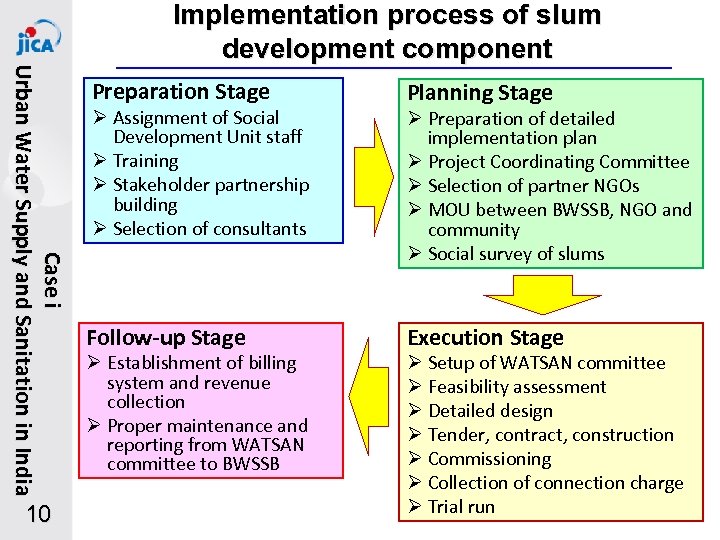 Ca s e i U r b a n Wa t e r S u p p l y a n d S a n i t a t i o n i n I n d i a 10 Implementation process of slum development component Preparation Stage Ø Assignment of Social Development Unit staff Ø Training Ø Stakeholder partnership building Ø Selection of consultants Follow-up Stage Ø Establishment of billing system and revenue collection Ø Proper maintenance and reporting from WATSAN committee to BWSSB Planning Stage Ø Preparation of detailed implementation plan Ø Project Coordinating Committee Ø Selection of partner NGOs Ø MOU between BWSSB, NGO and community Ø Social survey of slums Execution Stage Ø Setup of WATSAN committee Ø Feasibility assessment Ø Detailed design Ø Tender, contract, construction Ø Commissioning Ø Collection of connection charge Ø Trial run
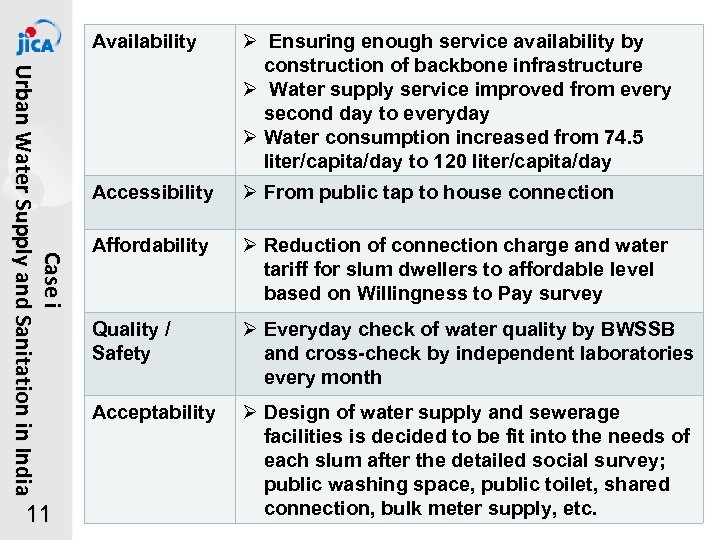 Ca s e i U r b a n Wa t e r S u p p l y a n d S a n i t a t i o n i n I n d i a Availability 11 Ø Ensuring enough service availability by construction of backbone infrastructure Ø Water supply service improved from every second day to everyday Ø Water consumption increased from 74. 5 liter/capita/day to 120 liter/capita/day Accessibility Ø From public tap to house connection Affordability Ø Reduction of connection charge and water tariff for slum dwellers to affordable level based on Willingness to Pay survey Quality / Safety Ø Everyday check of water quality by BWSSB and cross-check by independent laboratories every month Acceptability Ø Design of water supply and sewerage facilities is decided to be fit into the needs of each slum after the detailed social survey; public washing space, public toilet, shared connection, bulk meter supply, etc.
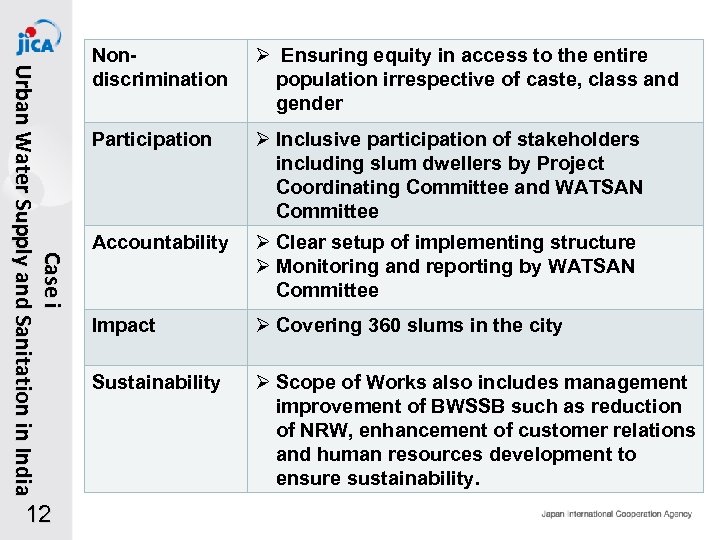 Ca s e i U r b a n Wa t e r S u p p l y a n d S a n i t a t i o n i n I n d i a 12 Nondiscrimination Ø Ensuring equity in access to the entire population irrespective of caste, class and gender Participation Ø Inclusive participation of stakeholders including slum dwellers by Project Coordinating Committee and WATSAN Committee Accountability Ø Clear setup of implementing structure Ø Monitoring and reporting by WATSAN Committee Impact Ø Covering 360 slums in the city Sustainability Ø Scope of Works also includes management improvement of BWSSB such as reduction of NRW, enhancement of customer relations and human resources development to ensure sustainability.
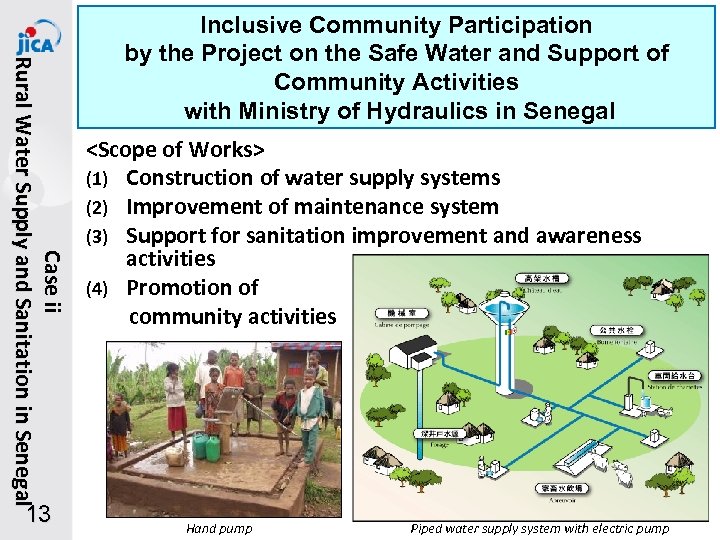 Case ii R u r a l W a t e r S u p p l y a n d S a n i t a t i o n i n S e n e ga l 13 Inclusive Community Participation by the Project on the Safe Water and Support of Community Activities with Ministry of Hydraulics in Senegal
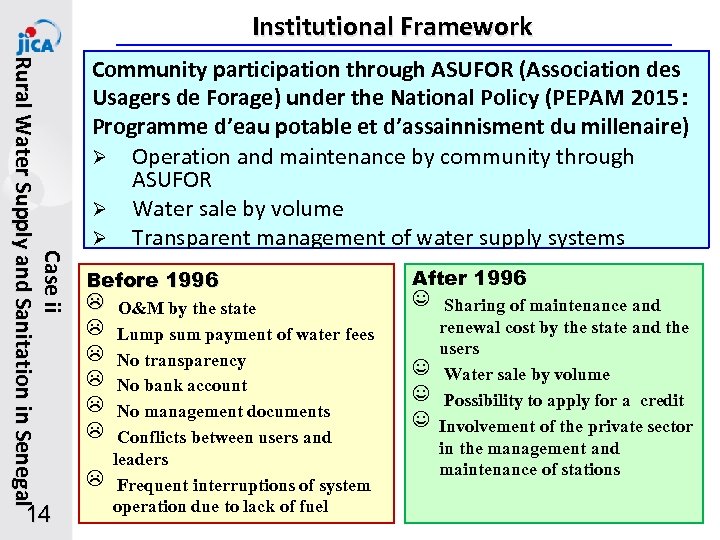 Institutional Framework Case ii R u r a l W a t e r S u p p l y a n d S a n i t a t i o n i n S e n e ga l 14 Community participation through ASUFOR (Association des Usagers de Forage) under the National Policy (PEPAM 2015: Programme d’eau potable et d’assainnisment du millenaire) Ø Operation and maintenance by community through ASUFOR Ø Water sale by volume Ø Transparent management of water supply systems Before 1996 ☹ O&M by the state ☹ Lump sum payment of water fees ☹ No transparency ☹ No bank account ☹ No management documents ☹ Conflicts between users and leaders ☹ Frequent interruptions of system operation due to lack of fuel After 1996 ☺ ☺ Sharing of maintenance and renewal cost by the state and the users Water sale by volume Possibility to apply for a credit Involvement of the private sector in the management and maintenance of stations
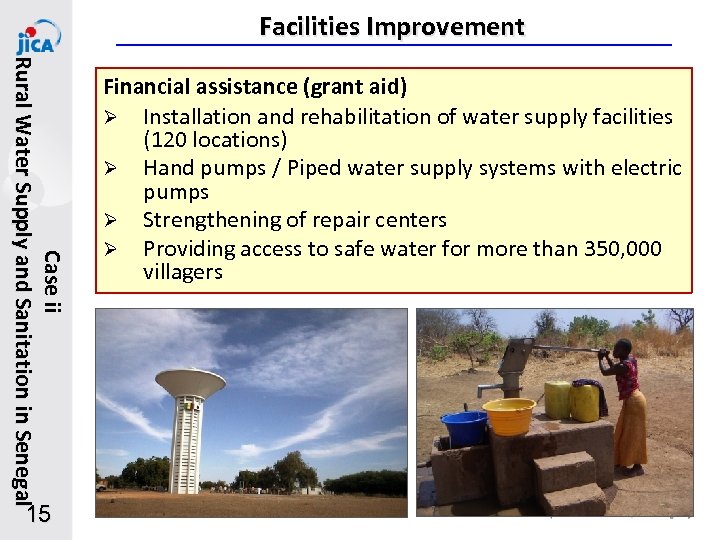 Facilities Improvement Case ii R u r a l W a t e r S u p p l y a n d S a n i t a t i o n i n S e n e ga l 15 Financial assistance (grant aid) Ø Installation and rehabilitation of water supply facilities (120 locations) Ø Hand pumps / Piped water supply systems with electric pumps Ø Strengthening of repair centers Ø Providing access to safe water for more than 350, 000 villagers
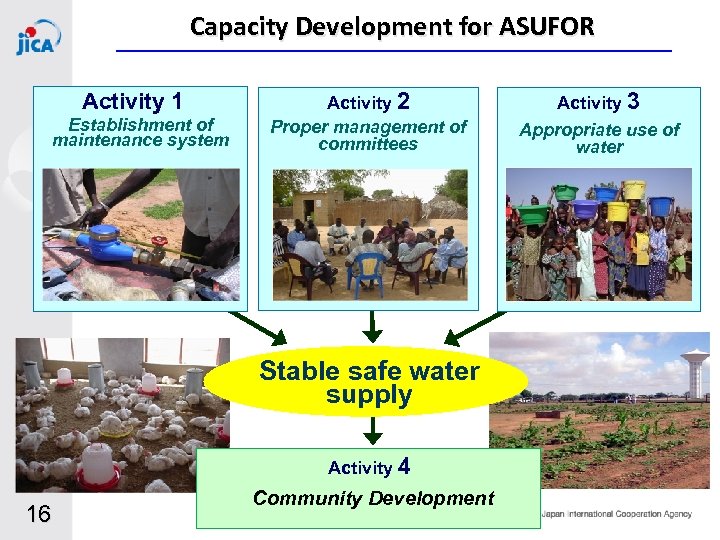 Capacity Development for ASUFOR Activity 1 Establishment of maintenance system Activity 2 Proper management of committees Stable safe water supply Activity 4 16 Community Development Activity 3 Appropriate use of water
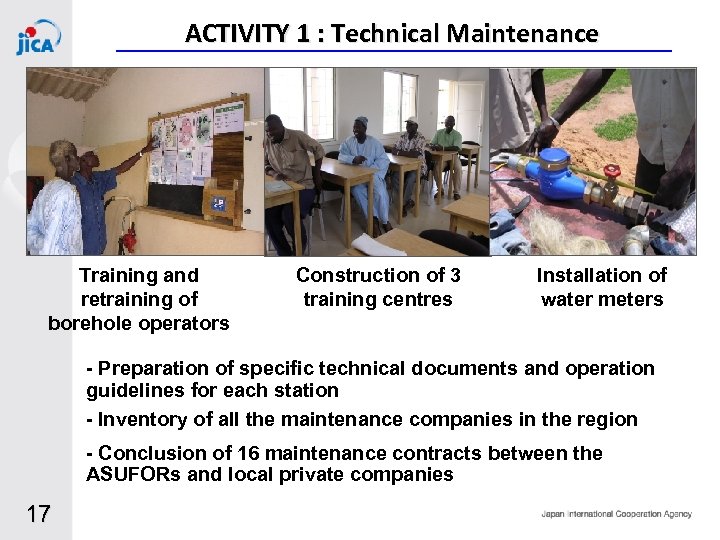 ACTIVITY 1 : Technical Maintenance Training and Construction of 3 Installation of retraining of training centres water meters borehole operators - Preparation of specific technical documents and operation guidelines for each station - Inventory of all the maintenance companies in the region - Conclusion of 16 maintenance contracts between the ASUFORs and local private companies 17
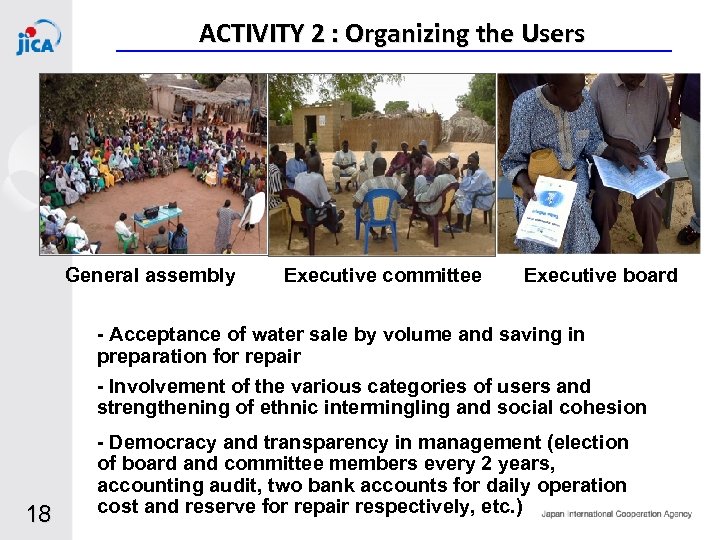 ACTIVITY 2 : Organizing the Users General assembly Executive committee Executive board - Acceptance of water sale by volume and saving in preparation for repair - Involvement of the various categories of users and strengthening of ethnic intermingling and social cohesion 18 - Democracy and transparency in management (election of board and committee members every 2 years, accounting audit, two bank accounts for daily operation cost and reserve for repair respectively, etc. )
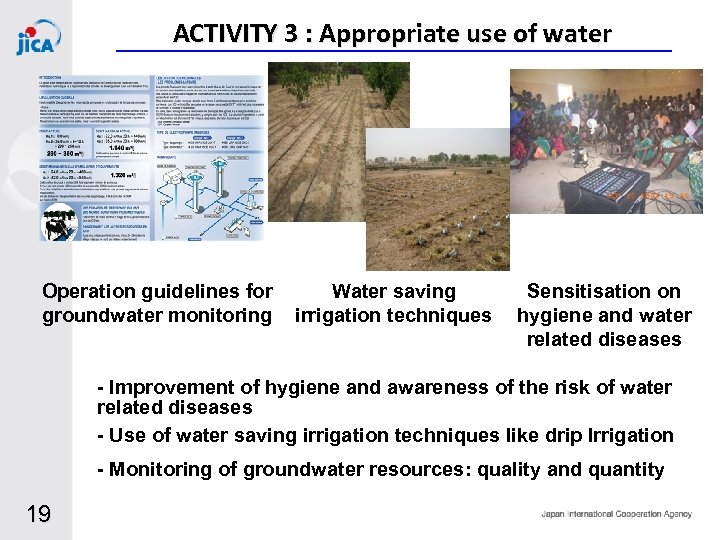 ACTIVITY 3 : Appropriate use of water Operation guidelines for Water saving Sensitisation on groundwater monitoring irrigation techniques hygiene and water related diseases - Improvement of hygiene and awareness of the risk of water related diseases - Use of water saving irrigation techniques like drip Irrigation - Monitoring of groundwater resources: quality and quantity 19
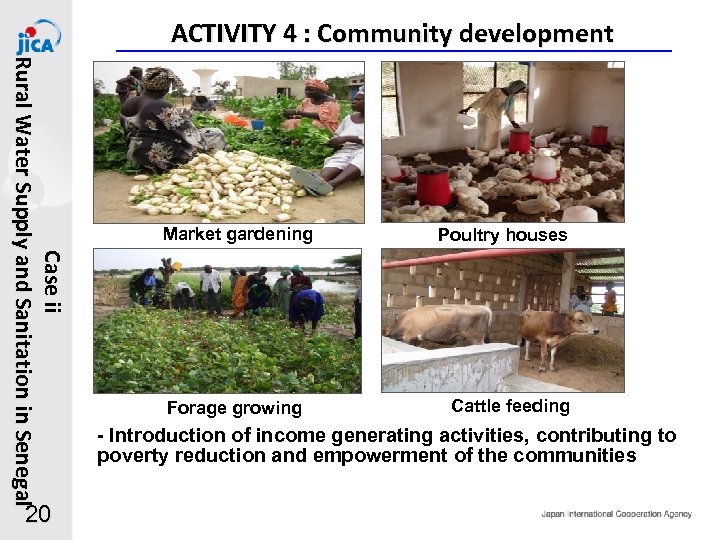 ACTIVITY 4 : Community development Case ii R u r a l W a t e r S u p p l y a n d S a n i t a t i o n i n S e n e ga l 20 Market gardening Forage growing Poultry houses Cattle feeding - Introduction of income generating activities, contributing to poverty reduction and empowerment of the communities
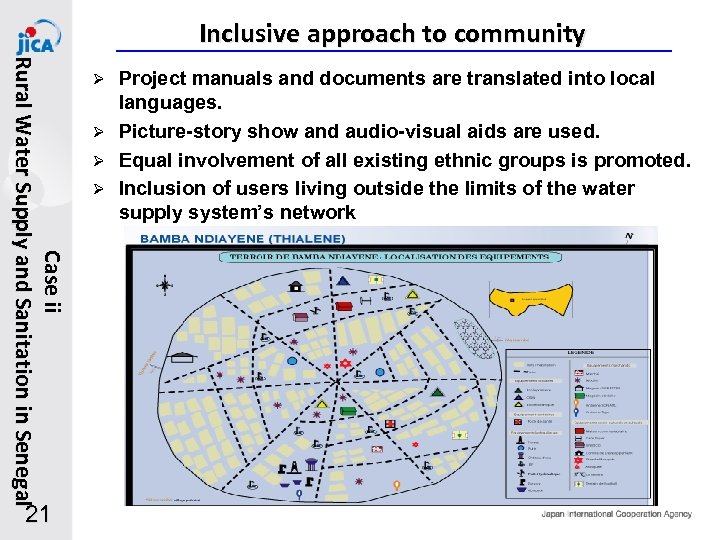 Inclusive approach to community Case ii R u r a l W a t e r S u p p l y a n d S a n i t a t i o n i n S e n e ga l 21 Project manuals and documents are translated into local languages. Ø Picture-story show and audio-visual aids are used. Ø Equal involvement of all existing ethnic groups is promoted. Ø Inclusion of users living outside the limits of the water supply system’s network Ø
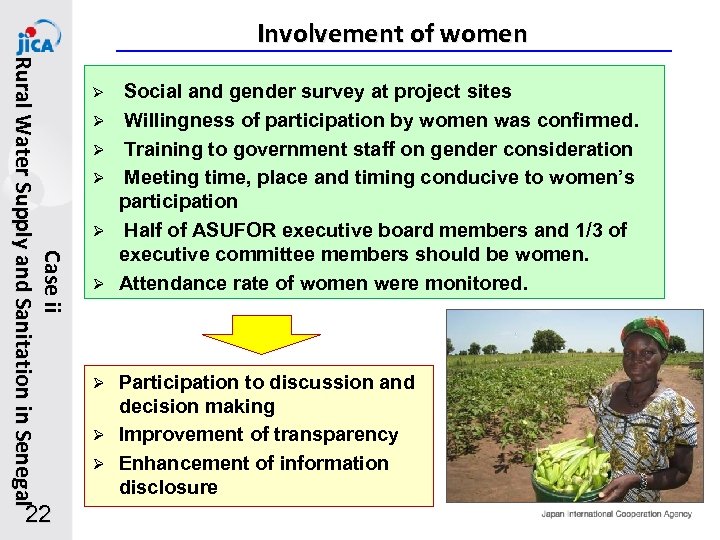 Involvement of women Case ii R u r a l W a t e r S u p p l y a n d S a n i t a t i o n i n S e n e ga l 22 Ø Social and gender survey at project sites Ø Willingness of participation by women was confirmed. Training to government staff on gender consideration Meeting time, place and timing conducive to women’s participation Half of ASUFOR executive board members and 1/3 of executive committee members should be women. Attendance rate of women were monitored. Ø Ø Participation to discussion and decision making Ø Improvement of transparency Ø Enhancement of information disclosure Ø
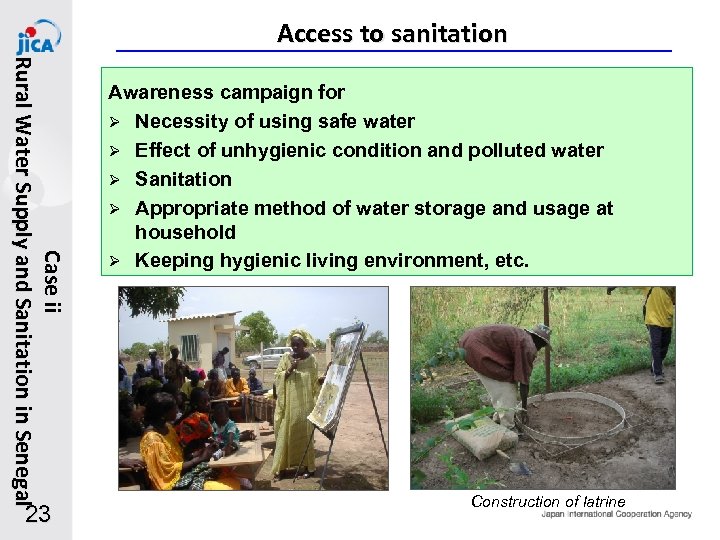 Access to sanitation Case ii R u r a l W a t e r S u p p l y a n d S a n i t a t i o n i n S e n e ga l 23 Awareness campaign for Ø Necessity of using safe water Ø Effect of unhygienic condition and polluted water Ø Sanitation Ø Appropriate method of water storage and usage at household Ø Keeping hygienic living environment, etc. Construction of latrine
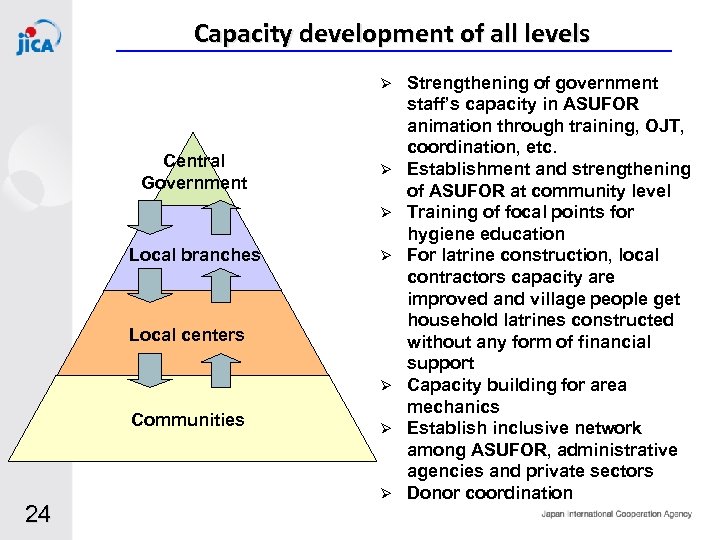 Capacity development of all levels Ø Central Government Ø Ø Local branches Ø Local centers Ø Communities 24 Ø Ø Strengthening of government staff’s capacity in ASUFOR animation through training, OJT, coordination, etc. Establishment and strengthening of ASUFOR at community level Training of focal points for hygiene education For latrine construction, local contractors capacity are improved and village people get household latrines constructed without any form of financial support Capacity building for area mechanics Establish inclusive network among ASUFOR, administrative agencies and private sectors Donor coordination
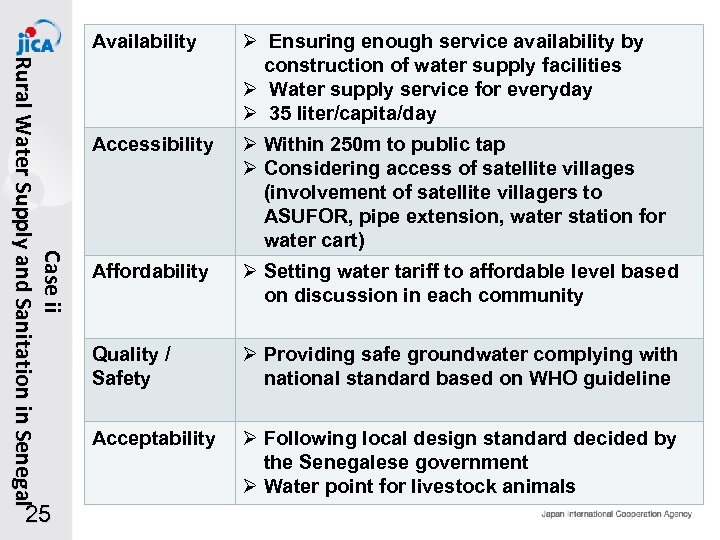 Case ii R u r a l W a t e r S u p p l y a n d S a n i t a t i o n i n S e n e ga l Availability 25 Ø Ensuring enough service availability by construction of water supply facilities Ø Water supply service for everyday Ø 35 liter/capita/day Accessibility Ø Within 250 m to public tap Ø Considering access of satellite villages (involvement of satellite villagers to ASUFOR, pipe extension, water station for water cart) Affordability Ø Setting water tariff to affordable level based on discussion in each community Quality / Safety Ø Providing safe groundwater complying with national standard based on WHO guideline Acceptability Ø Following local design standard decided by the Senegalese government Ø Water point for livestock animals
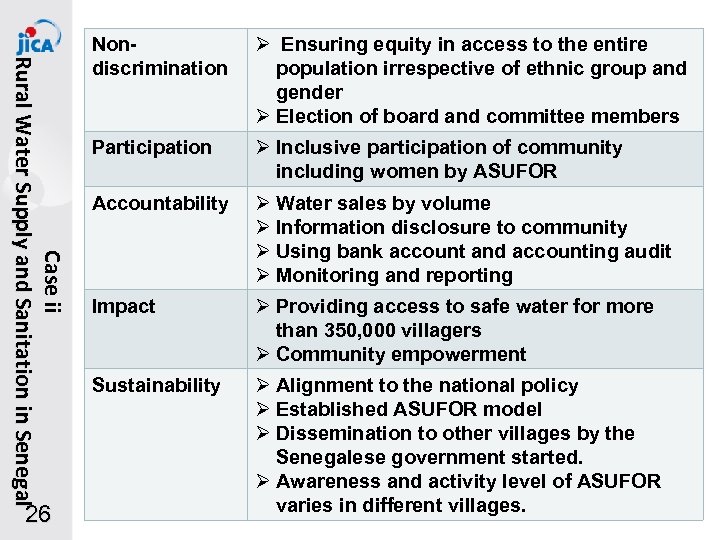 Case ii R u r a l W a t e r S u p p l y a n d S a n i t a t i o n i n S e n e ga l 26 Nondiscrimination Ø Ensuring equity in access to the entire population irrespective of ethnic group and gender Ø Election of board and committee members Participation Ø Inclusive participation of community including women by ASUFOR Accountability Ø Water sales by volume Ø Information disclosure to community Ø Using bank account and accounting audit Ø Monitoring and reporting Impact Ø Providing access to safe water for more than 350, 000 villagers Ø Community empowerment Sustainability Ø Alignment to the national policy Ø Established ASUFOR model Ø Dissemination to other villages by the Senegalese government started. Ø Awareness and activity level of ASUFOR varies in different villages.
 THANK YOU Contact: Shigeyuki MATSUMOTO Matsumoto. Shigeyuki@jica. go. jp 27