


 Скачать презентацию Good Practices Internationale Lösungen Archivierungssysteme und
bfb7e25e9af7955b404ead5d68bd09ed.ppt
- Количество слайдов: 46
 Good Practices – Internationale Lösungen § Archivierungssysteme und Vertrauenswürdigkeit Dr. Uwe Borghoff, Universität der Bundeswehr München, Institute for Software Technology § Preserving Born-Digital Public Records at The National Archives Adrian Brown, Head of Digital Preservation, The National Archives, UK § Das deutsche Projekt kopal - Kooperativer Aufbau eines Langzeitarchivs digitaler Informationen Tobias Steinke, Projektleiter kopal der Deutschen Nationalbibliothek Wien, 18. April 2007
 Archivierungssysteme und Vertrauenswürdigkeit Dr. Uwe Borghoff, Universität der Bundeswehr München, Institut für Softwaretechnologie Wien, 18. April 2007
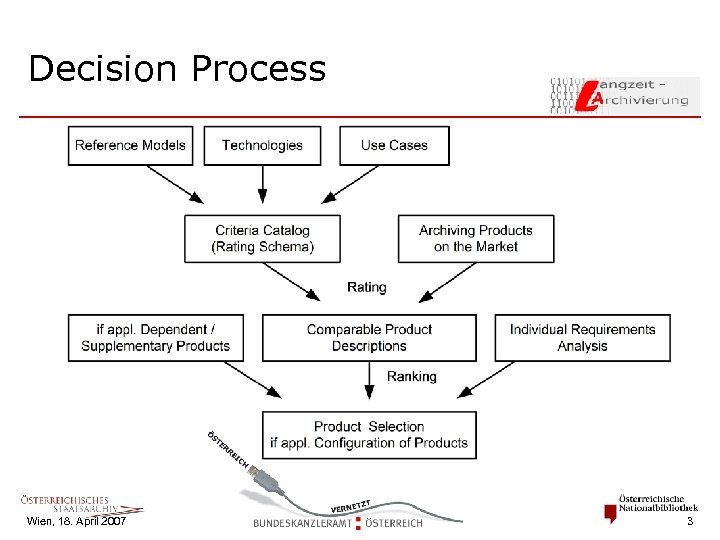 Decision Process Wien, 18. April 2007 3
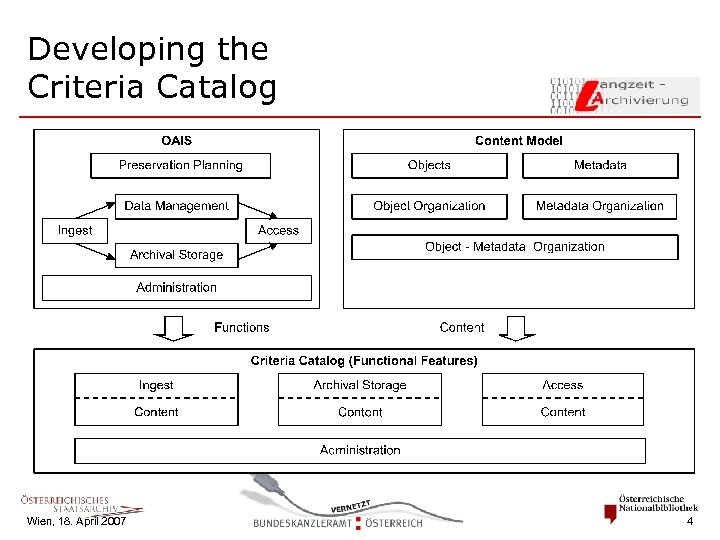 Developing the Criteria Catalog Wien, 18. April 2007 4
 Criteria Catalog General Attributes § Overall system architecture – Design principles, compliance with standards or recommendations (e. g, OAIS, OAI etc. ) § Explicit long-term features – E. g. , file format registry, preservation meta-data scheme § Object organization – E. g. , single object, collections, identification § Metadata organization + Rights / Role management – Consumer / producer / archive operator § Functions – Ingest / access / archival storage / administration Wien, 18. April 2007 5
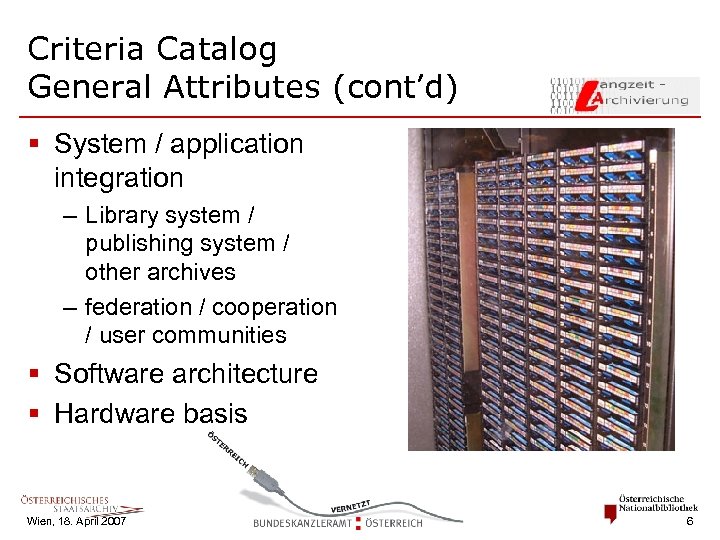 Criteria Catalog General Attributes (cont’d) § System / application integration – Library system / publishing system / other archives – federation / cooperation / user communities § Software architecture § Hardware basis Wien, 18. April 2007 6
 Criteria Catalog Functional Attributes (ingest) § Accepted submission formats § Object format / identification – E. g. , file format restrictions § Object organization – E. g. , hierarchies, links, versions, variants § Access procedures for producers – meta-data scheme incl. meta-data entry procedure • Batch ingest / conversion / (formal) quality checking / dedicated workflow • For meta-data: manually / automatic extraction / 3 rd party – Overall throughput Wien, 18. April 2007 7
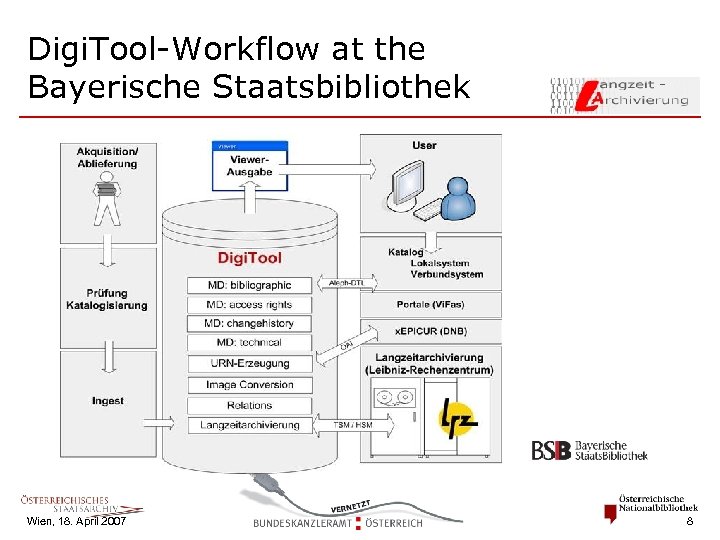 Digi. Tool-Workflow at the Bayerische Staatsbibliothek Wien, 18. April 2007 8
 Criteria Catalog Functional Attributes (access) § Access procedure for consumer – Remote vs. local / multilingual / help system / notification services / communication protocols § Search / retrieval – Metadata indexes / navigation / full text search / inspection of class methods § Dissemination form of objects / metadata – Conversion on the fly / on demand § Accounting, e. g. as part of a Digital Rights Management § Federation – access or replication transparency § Interoperation Wien, 18. April 2007 9
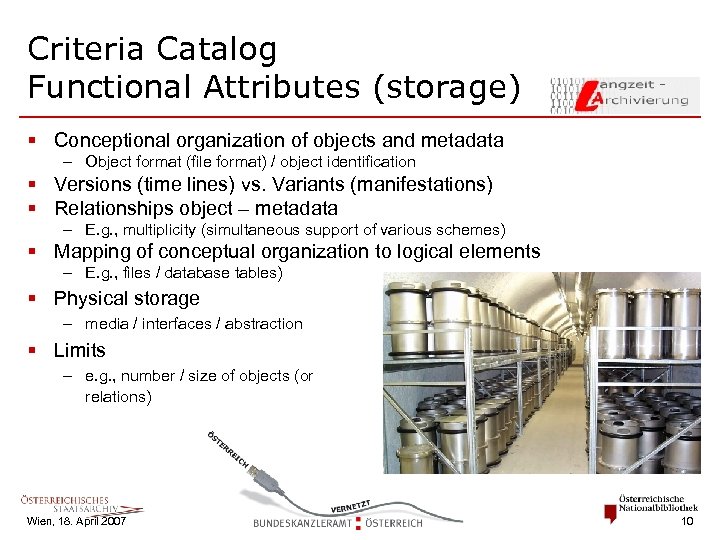 Criteria Catalog Functional Attributes (storage) § Conceptional organization of objects and metadata – Object format (file format) / object identification § Versions (time lines) vs. Variants (manifestations) § Relationships object – metadata – E. g. , multiplicity (simultaneous support of various schemes) § Mapping of conceptual organization to logical elements – E. g. , files / database tables) § Physical storage – media / interfaces / abstraction § Limits – e. g. , number / size of objects (or relations) Wien, 18. April 2007 10
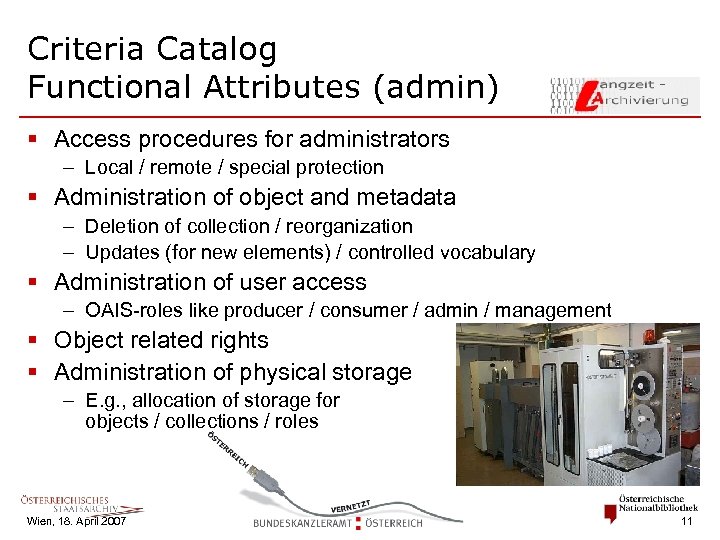 Criteria Catalog Functional Attributes (admin) § Access procedures for administrators – Local / remote / special protection § Administration of object and metadata – Deletion of collection / reorganization – Updates (for new elements) / controlled vocabulary § Administration of user access – OAIS-roles like producer / consumer / admin / management § Object related rights § Administration of physical storage – E. g. , allocation of storage for objects / collections / roles Wien, 18. April 2007 11
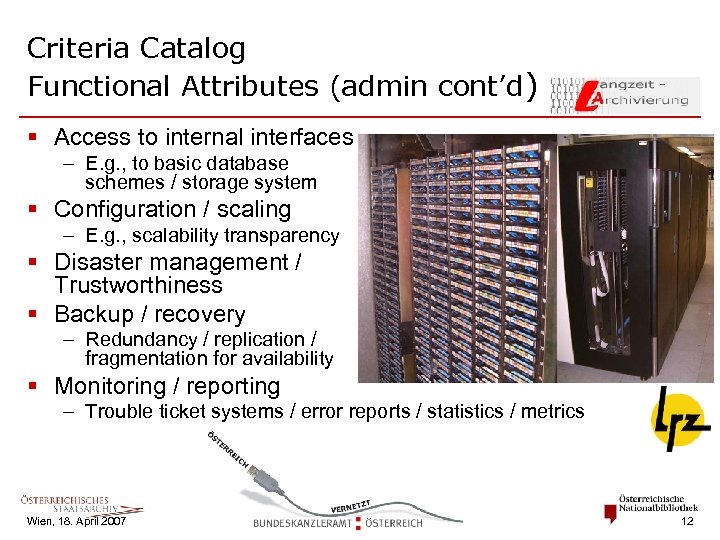 Criteria Catalog Functional Attributes (admin cont’d) § Access to internal interfaces – E. g. , to basic database schemes / storage system § Configuration / scaling – E. g. , scalability transparency § Disaster management / Trustworthiness § Backup / recovery – Redundancy / replication / fragmentation for availability § Monitoring / reporting – Trouble ticket systems / error reports / statistics / metrics Wien, 18. April 2007 12
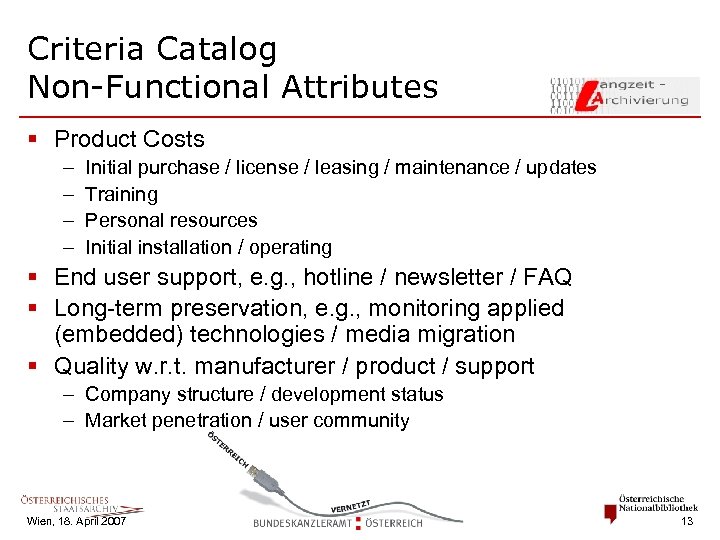 Criteria Catalog Non-Functional Attributes § Product Costs – – Initial purchase / license / leasing / maintenance / updates Training Personal resources Initial installation / operating § End user support, e. g. , hotline / newsletter / FAQ § Long-term preservation, e. g. , monitoring applied (embedded) technologies / media migration § Quality w. r. t. manufacturer / product / support – Company structure / development status – Market penetration / user community Wien, 18. April 2007 13
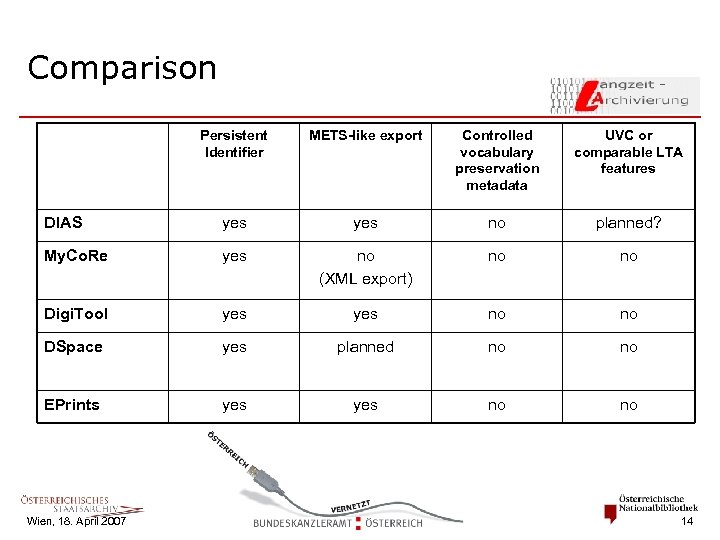 Comparison Persistent Identifier METS-like export Controlled vocabulary preservation metadata UVC or comparable LTA features DIAS yes no planned? My. Co. Re yes no (XML export) no no Digi. Tool yes no no DSpace yes planned no no EPrints yes no no Wien, 18. April 2007 14
 Preserving Born-Digital Public Records at The National Archives Adrian Brown, Head of Digital Preservation at The National Archives, UK Wien, 18. April 2007
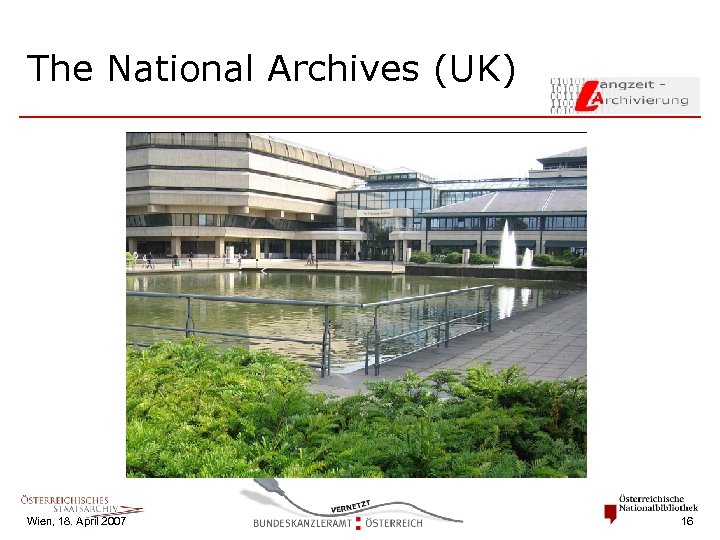 The National Archives (UK) Wien, 18. April 2007 16
 The National Archives (UK) § Both a government department and executive agency of the Secretary of State for Constitutional Affairs § Established 2003, brings together: – – Public Record Office (1838) Historical Manuscripts Commission (1869) Office of Public Sector Information (2005) Her Majesty’s Stationery Office (1786) § Based at Kew, London § Employs 580 staff Wien, 18. April 2007 17
 Collection § One of the largest archival collections in the world § Unbroken span of records from 11 th century to present day § 180 kilometres of paper records § 250 TB of digitised and born-digital records § 400 TB new transfers scheduled by 2009 Wien, 18. April 2007 18
 Drivers for change § § § e. Government 2004/5 Modernising Government targets Freedom of Information New audiences and improving access Increased efficiencies Wien, 18. April 2007 19
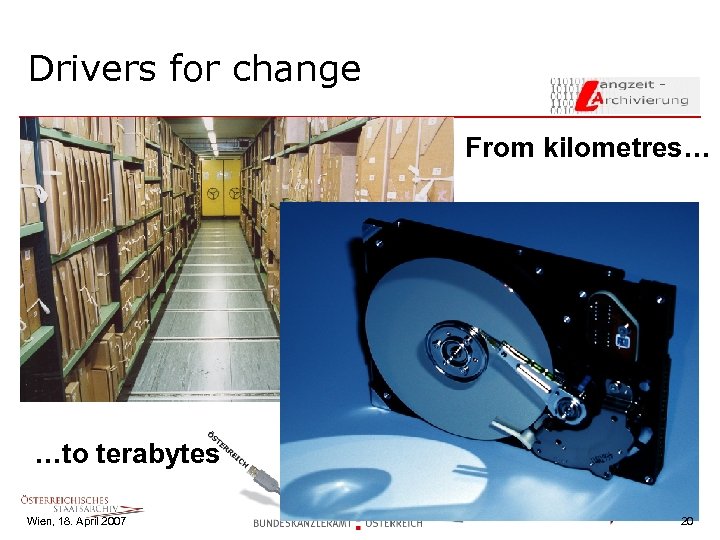 Drivers for change From kilometres… …to terabytes Wien, 18. April 2007 20
 Vision § Lead and transform information management § Guarantee the survival of today’s information for tomorrow § Bring history to life for everyone Wien, 18. April 2007 21
 Developments at TNA § § § § National Digital Archive of Datasets (1996) PRONOM (2002) Digital Archive (2003) Web Archiving Programme (2003) Electronic Records Online (2005) Seamless Flow (2005 - 2008) Shared Services (2007 -? ) Wien, 18. April 2007 22
 National Digital Archive of Datasets § Established in 1996 § Operated under contract by University of London § Holds over 150 datasets dating back to 1963 www. ndad. nationalarchives. gov. uk/ Wien, 18. April 2007 23
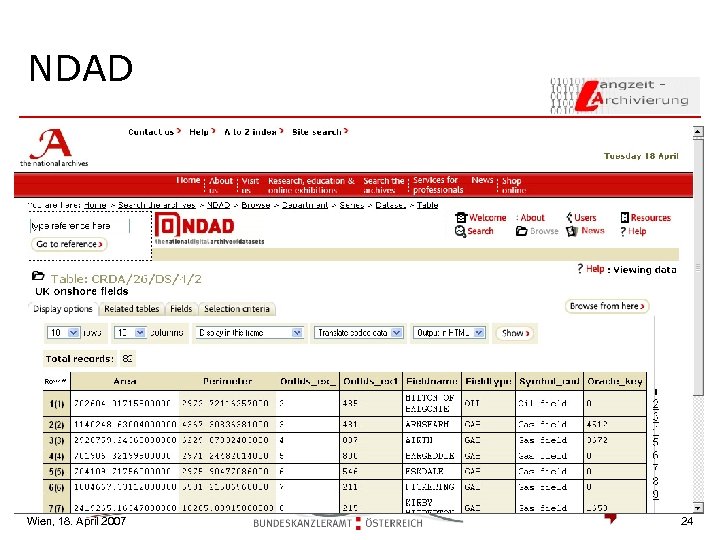 NDAD Wien, 18. April 2007 24
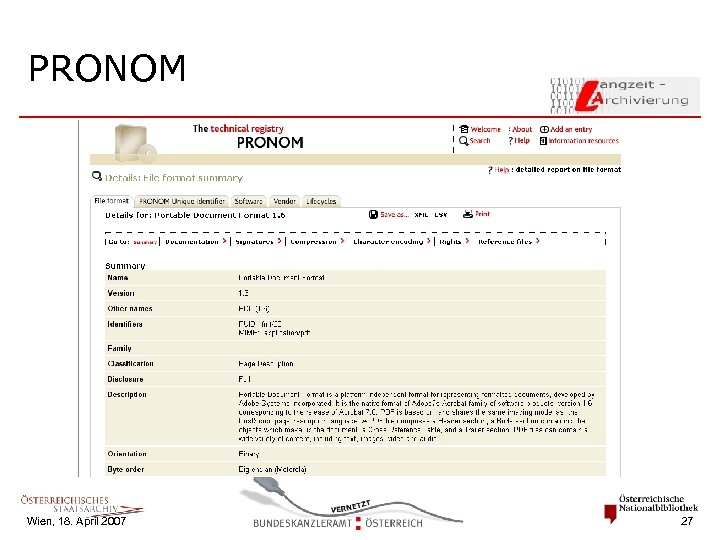
 PRONOM § An online technical registry § A resource for anyone requiring impartial and definitive information about the file formats, software products and other technical components required to support long-term access to electronic records and other digital objects of cultural, historical or business value § A knowledge base to support automated preservation services Wien, 18. April 2007 25
 PRONOM § § 2002: First version released (internal) 2003: Made available on the Web 2005: Major new version released 2006: PRONOM Unique Identifier scheme launched § 2007: New releases as part of Seamless Flow www. nationalarchives. gov. uk/pronom/ Wien, 18. April 2007 26
 PRONOM Wien, 18. April 2007 27
 Digital Archive § Operational in April 2003 § Secure (air-gapped) storage for born-digital public records § Scalable storage to >1 PB § Records stored in robotic tape libraries with secure off-site backup § Metadata stored in Oracle database Wien, 18. April 2007 28
 Web Archiving Programme § Selection • Based on 6 core functions of government • Frequency based on content analysis and topicality • 11 sites collected weekly • 53 sites collected biannually • Flexible collection of additional sites • Now expanding to whole of. gov. uk domain Wien, 18. April 2007 29
 Web Archiving Programme § Contract with Internet Archive 2003 -2005, and with European Archive from 2005 – Regular crawls § Member of UK Web Archiving Consortium – Special crawls § Supporting UK website rationalisation § Developing UK web archiving strategy Wien, 18. April 2007 30
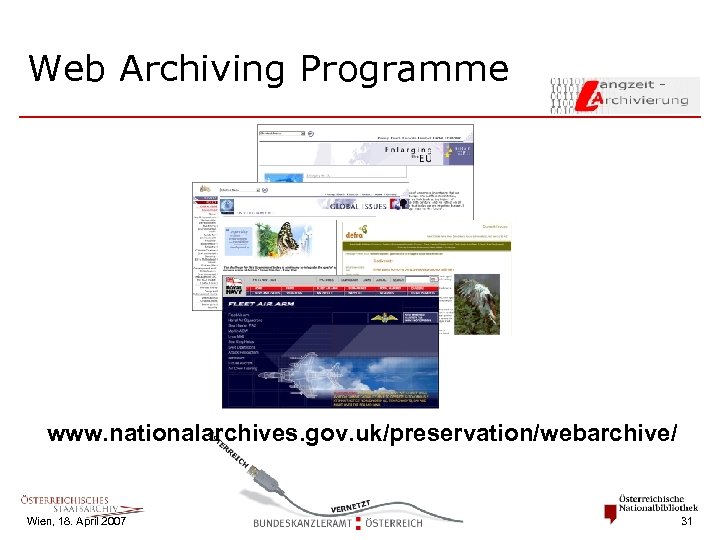 Web Archiving Programme www. nationalarchives. gov. uk/preservation/webarchive/ Wien, 18. April 2007 31
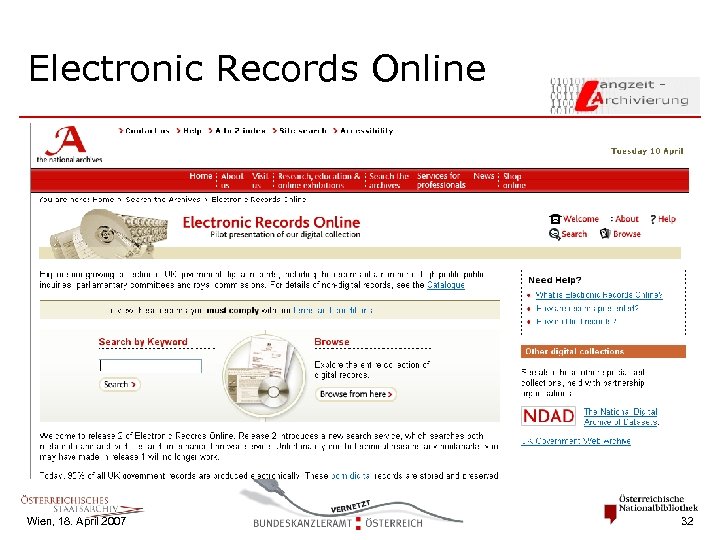 Electronic Records Online Wien, 18. April 2007 32
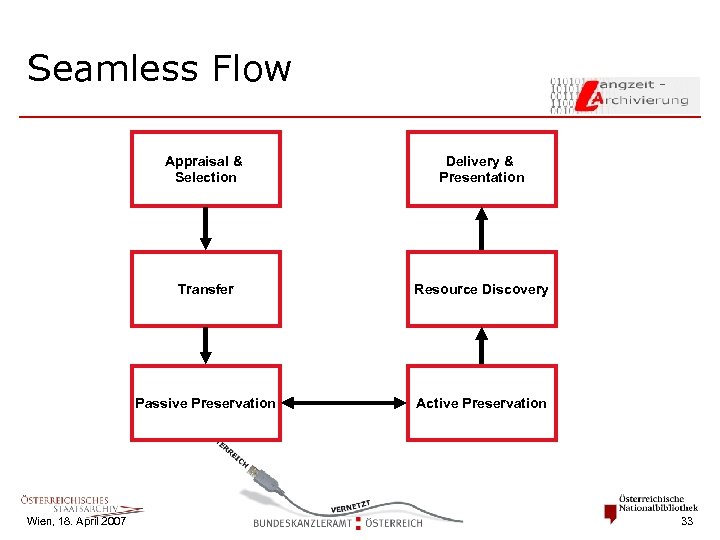 Seamless Flow Appraisal & Selection Transfer Resource Discovery Passive Preservation Wien, 18. April 2007 Delivery & Presentation Active Preservation 33
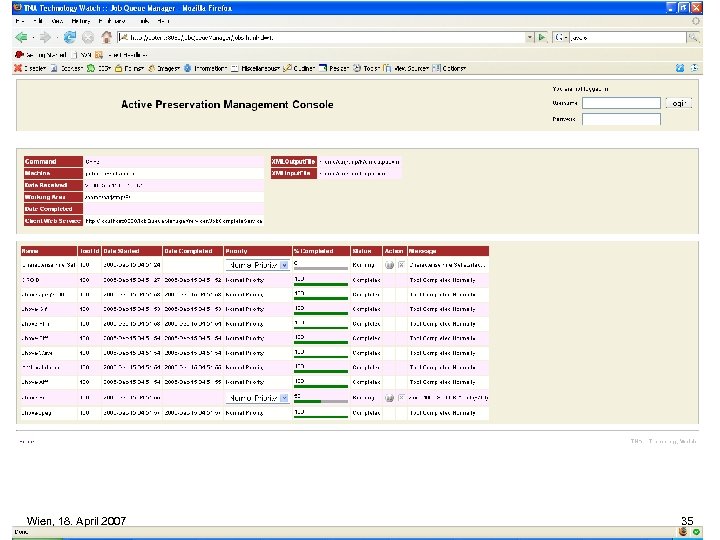
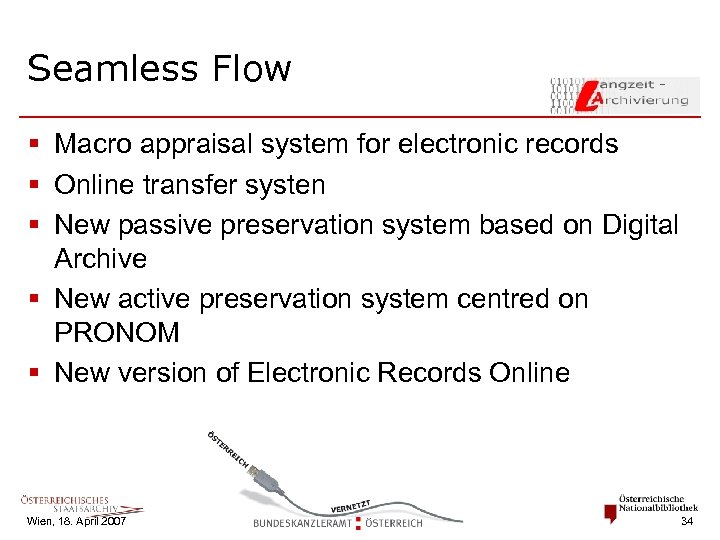 Seamless Flow § Macro appraisal system for electronic records § Online transfer systen § New passive preservation system based on Digital Archive § New active preservation system centred on PRONOM § New version of Electronic Records Online Wien, 18. April 2007 34
 Titel einfügen Wien, 18. April 2007 35
 Shared Preservation Services § Intermediate archive for central government § Preservation of semi-current records for 5 -100 years § Eliminates wasteful duplication of effort § Passive preservation storage may be contractedout § Active preservation services provided by TNA § Currently seeking initial funding for 5 years Wien, 18. April 2007 36
 Collaboration § § PLANETS In. SPECT Preserv Global Digital Format Registry Wien, 18. April 2007 37
 The National Archives (UK) Thank you! Wien, 18. April 2007 38
 Das deutsche Projekt kopal Kooperativer Aufbau eines Langzeitarchivs digitaler Informationen Tobias Steinke, Projektleiter kopal der Deutschen Nationalbibliothek Wien, 18. April 2007
 Übersicht § § Motivation Organisation Technische Lösung Stand und Ausblick Wien, 18. April 2007 40
 kopal: Motivation § Neues Gesetz über die Deutsche Nationalbibliothek – Pflichtabgabe und Sammelauftrag auch für Netzpublikationen – Bisher bereits digitale Publikationen auf Datenträgern (z. B. CDROM) – Deutsches Musikarchiv: Sammlung von digitaler Musik – Seit Mitte 2006 § Hoher Bedarf bei vielen deutschen Institutionen nach Langzeitspeicher für digitales Material § Bereits vorhandenen Materialen: Elektronische Dissertationen (Diss. Online), E-Journals, Digitalisate § Zukünftig: E-Books, Webseiten Wien, 18. April 2007 41
 kopal: Organisation § BMBF-gefördertes Projekt (2004 – 2007) § Partner und Rollen: – Deutsche Nationalbibliothek: Gesamtprojektleitung, Nutzung, Softwareentwicklung (ko. Lib. RI) – Niedersächsische Staats- und Universitätsbibliothek, Göttingen: Nutzung, Softwareentwicklung (ko. Lib. RI) – IBM Deutschland: Softwareentwicklung (DIAS) – Gesellschaft für wissenschaftliche Datenverarbeitung Göttingen (GWDG): Systemhosting Wien, 18. April 2007 42
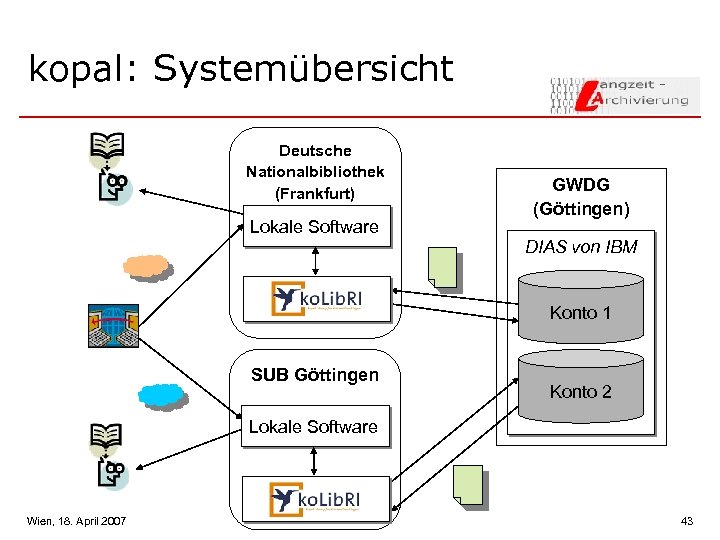 kopal: Systemübersicht Deutsche Nationalbibliothek (Frankfurt) Lokale Software GWDG (Göttingen) DIAS von IBM Konto 1 SUB Göttingen Konto 2 Lokale Software Wien, 18. April 2007 43
 kopal: Technische Lösung § Kern basiert auf DIAS von IBM für die Niederländische Nationalbibliothek und auf Standardsoftware § Folgt dem OAIS-Referenzmodell § Mandantenfähigkeit: Logisch getrennte Speicherbereiche § Open-Source-Software für lokale Anbindung: ko. Lib. RI (kopal Library for Retrieval and Ingest) § Offenes Archivobjektformat mit speziellen Metadaten zur Langzeitarchivierung (Universelles Objektformat) § Langzeitverfügbarkeit durch zukünftige Dateiformatmigration (Konvertierung und Versionsverwaltung) § Datensicherung durch Dienstleister (GWDG) Wien, 18. April 2007 44
 kopal: Stand und Ausblick § § DIAS in Göttingen installiert und produktiv nutzbar ko. Lib. RI als Vorversion bereits frei verfügbar Projektende: 30. 06. 2007 Entwicklung von Nachnutzungsszenarien – Teilnehmer: Archivieren bei DNB oder SUB Göttingen – Mandant: Eigens Konto im Göttinger DIAS – Eigenbetrieb: Weiteres DIAS-System § http: //kopal. langzeitarchivierung. de/ Wien, 18. April 2007 45
 Good Practices – Österreichische Aktivitäten § Die digitale Zukunft im Österreichischen Staatsarchiv GD Dr. Lorenz Mikoletzky, Österreichisches Staatsarchiv • Langzeitarchivierung elektronischer Dokumente – eine neue Herausforderung für Nationalbibliotheken GD Dr. Johanna Rachinger, Österreichische Nationalbibliothek Wien, 18. April 2007