


 Скачать презентацию Good morning Goals Phonemic Awareness
62ff439a58cbfda5e1b73dd5b6c89190.ppt
- Количество слайдов: 44
 Good morning….
 Goals • Phonemic Awareness • Shared Reading • Phonics
 Phonemes • • Rhythm and rhyme Sequence Separate Manipulate
 Initial Phonemes • Name Chant It begins with ____, (initial phoneme) And it ends with _____. Put them together, And they say ____
 • Patty Cake bug pin fun bed fox sit mouse round light name barn duck
 Final Phonemes • “What’s the last sound that you hear? ” (London Bridge is Falling Down) • “What’s the sound that ends these words? ” (Old Mac. Donald had a Farm)
 Phoneme Segmentation
 Segmenting and Blending • Tap and Sweep
 • Put It Together, Take It Apart
 Phoneme Manipulation: Deletion • Who Stole the Cookie from the Cookie Jar?
 Phoneme Manipulation: Substitution • Willoughby, Wallaby, Woo Willoughby wallaby wee, an elephant sat on me, Willoughby wallaby woo, an elephant sat on you. Willoughby wallaby Wustin, an elephant sat on Justin. Willoughby wallaby Wania, an elephant sat on Tania. • Riddles
 Star Names 1. Write your name on a card. 2. Analyze your name for the number of syllables and phonemes. Display this information on your card in some way. 3. Explain your name card to the rest of the people at your table: “This is what I can tell you about my name…” 3. Switch cards. Create a cheer for someone else’s name. segmenting by either syllables or phonemes: Give me a _____ ! (repeat as many times a needed) What does it say? _______ !
 Phonemic Awareness Skills and Strategies: How would you help students learn them in context?
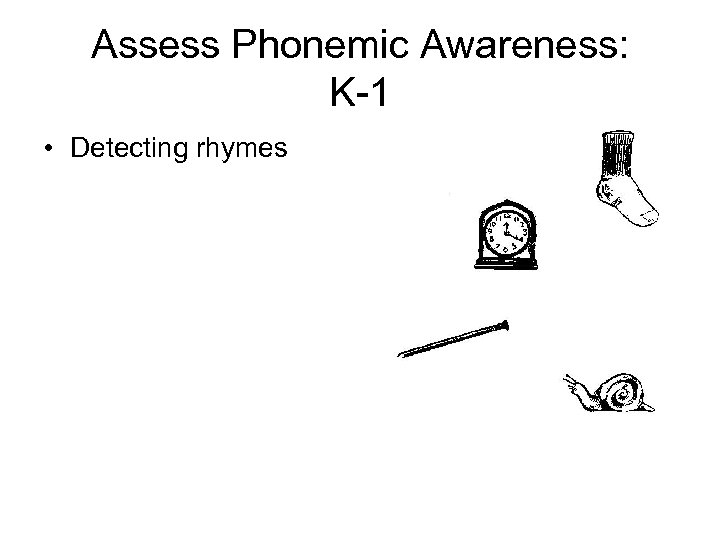 Assess Phonemic Awareness: K-1 • Detecting rhymes
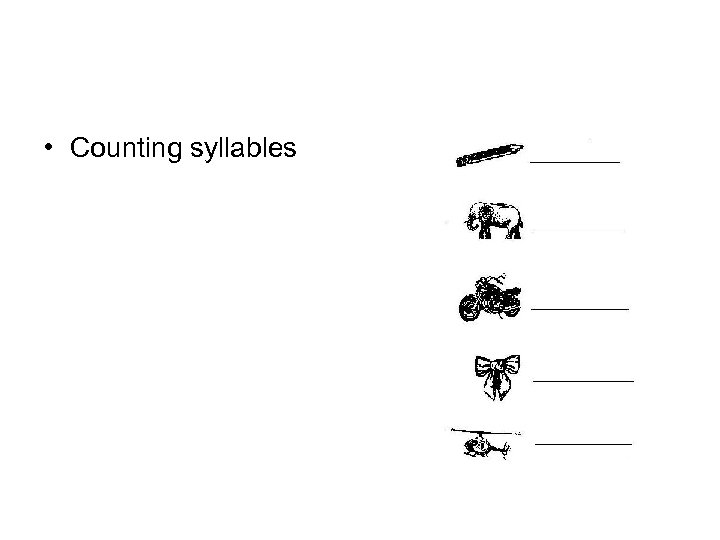 • Counting syllables
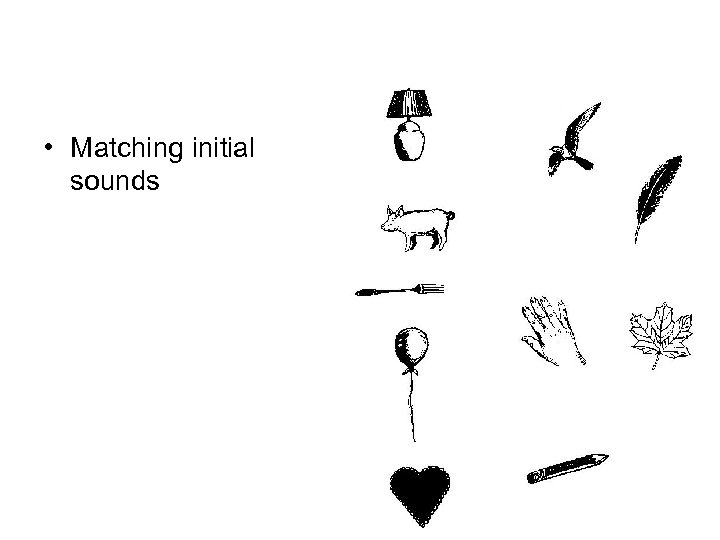 • Matching initial sounds
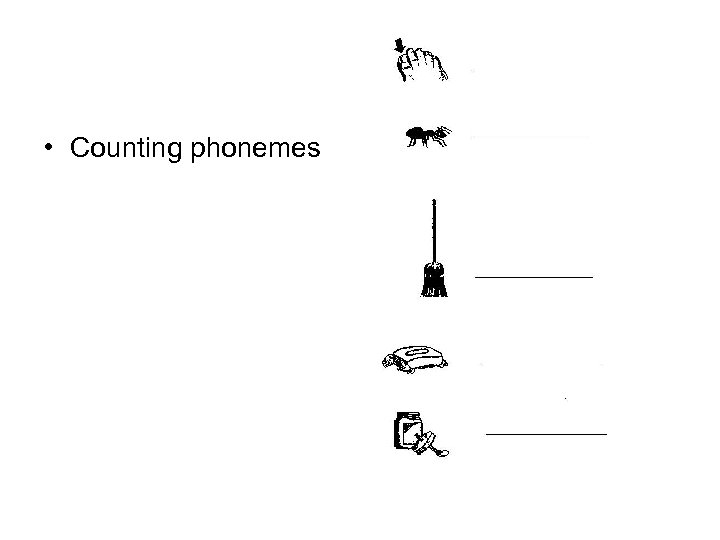 • Counting phonemes
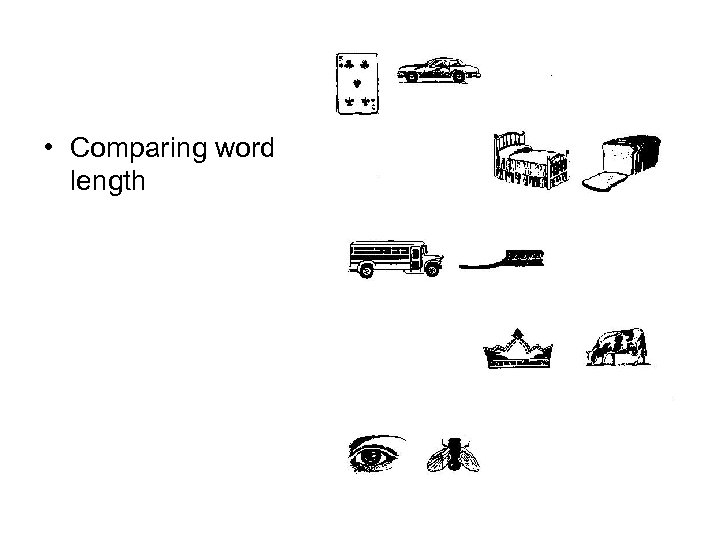 • Comparing word length
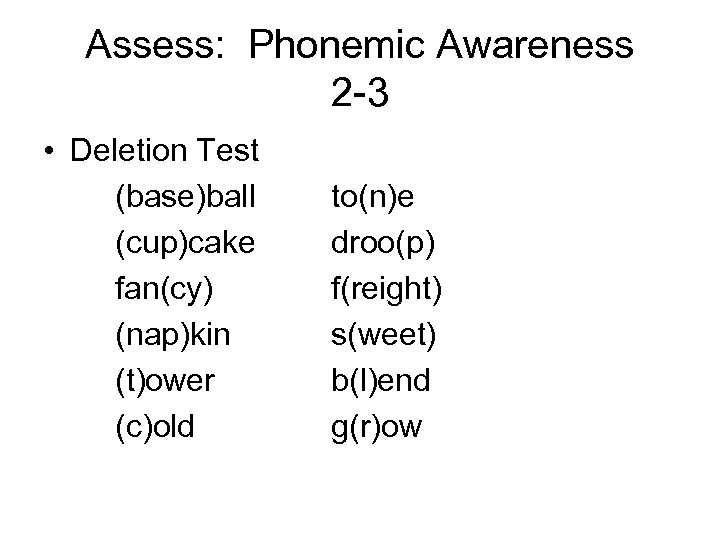 Assess: Phonemic Awareness 2 -3 • Deletion Test (base)ball (cup)cake fan(cy) (nap)kin (t)ower (c)old to(n)e droo(p) f(reight) s(weet) b(l)end g(r)ow
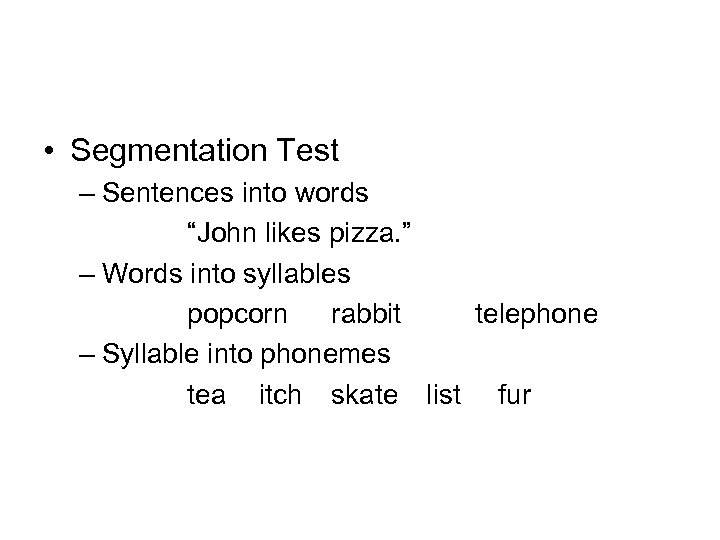 • Segmentation Test – Sentences into words “John likes pizza. ” – Words into syllables popcorn rabbit telephone – Syllable into phonemes tea itch skate list fur
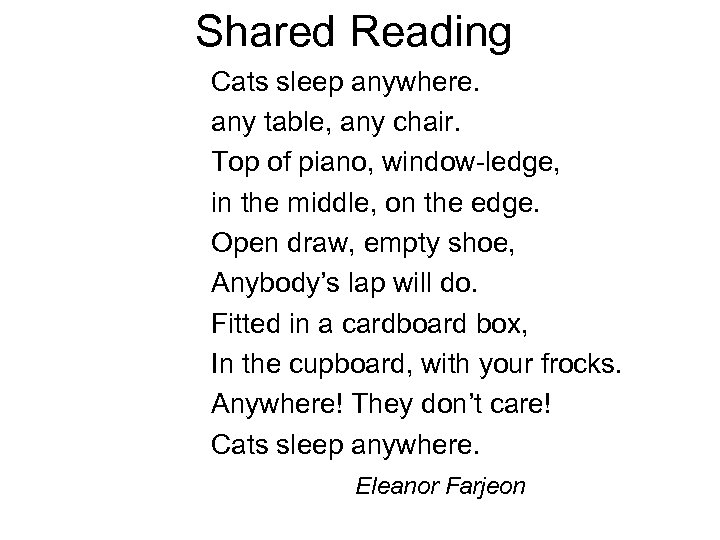 Shared Reading Cats sleep anywhere. any table, any chair. Top of piano, window-ledge, in the middle, on the edge. Open draw, empty shoe, Anybody’s lap will do. Fitted in a cardboard box, In the cupboard, with your frocks. Anywhere! They don’t care! Cats sleep anywhere. Eleanor Farjeon
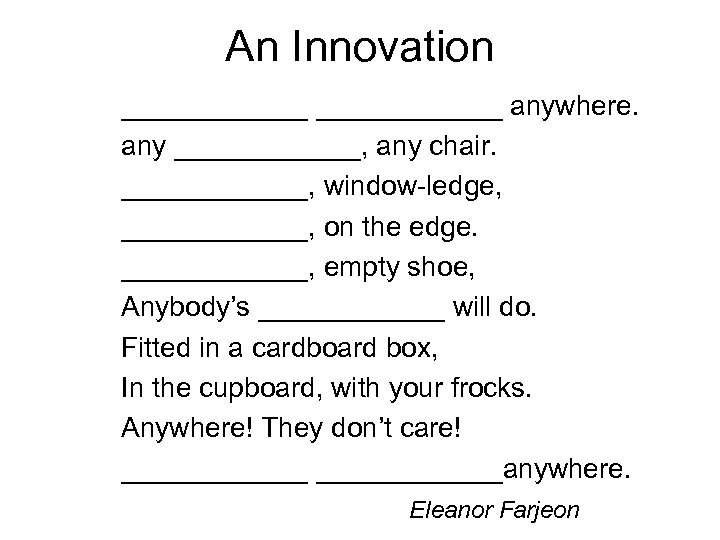 An Innovation ____________ anywhere. any ______, any chair. ______, window-ledge, ______, on the edge. ______, empty shoe, Anybody’s ______ will do. Fitted in a cardboard box, In the cupboard, with your frocks. Anywhere! They don’t care! ____________anywhere. Eleanor Farjeon
 A Balanced Reading Program • Read Aloud • Shared Reading • Guided Reading • Independent Reading
 Shared Reading • Text difficulty • Control of text • Model reading strategies • Variety of genres • Oral language development • Text structure
 Phonics • Phonics: the study and use of sound/spelling relationships • Phonics instruction teaches the relationship between letters (graphemes) and speech (phonemes) • Systematic, explicit vs. incidental, implicit Instruction
 Research Findings: Phonics • First –Grade Studies (Bond and Dykstra, 1967) • Houston Study (Foorman, Fletcher, Francis Schatschneider, et al. , 1998) • Stand alone, instructional component w/in a print rich classroom environment with a significant literature base • An essential but not sufficient piece of the reading puzzle • Without ongoing instruction in cognitive strategies, continual development of language skills, deepening knowledge through solid content-area instruction, voluminous reading in all types of text, daily opportunities to talk and write about what is read using conventions of spoken and written language, any gains realized in kindergarten and first grade will disappear by the upper grades.
 • Phonics vs. • Morphology/Structural analysis • Context clues • Sight words
 Phonics Teaching that is Systematic and Explicit • Whole-to-part • Part-to-whole
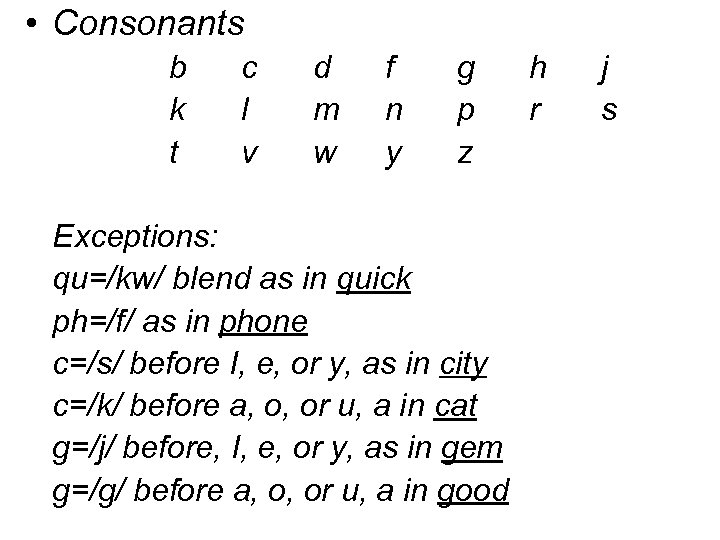 • Consonants b k t c l v d m w f n y g p z Exceptions: qu=/kw/ blend as in quick ph=/f/ as in phone c=/s/ before I, e, or y, as in city c=/k/ before a, o, or u, a in cat g=/j/ before, I, e, or y, as in gem g=/g/ before a, o, or u, a in good h r j s
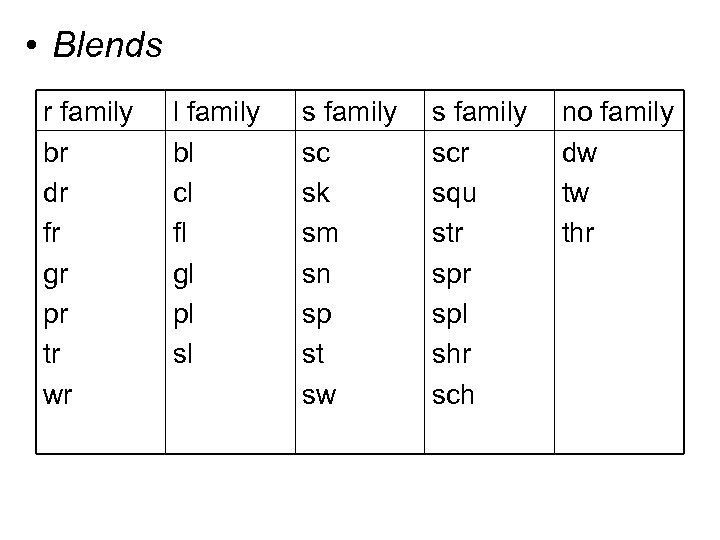 • Blends r family br dr fr gr pr tr wr l family bl cl fl gl pl sl s family sc sk sm sn sp st sw s family scr squ str spl shr sch no family dw tw thr
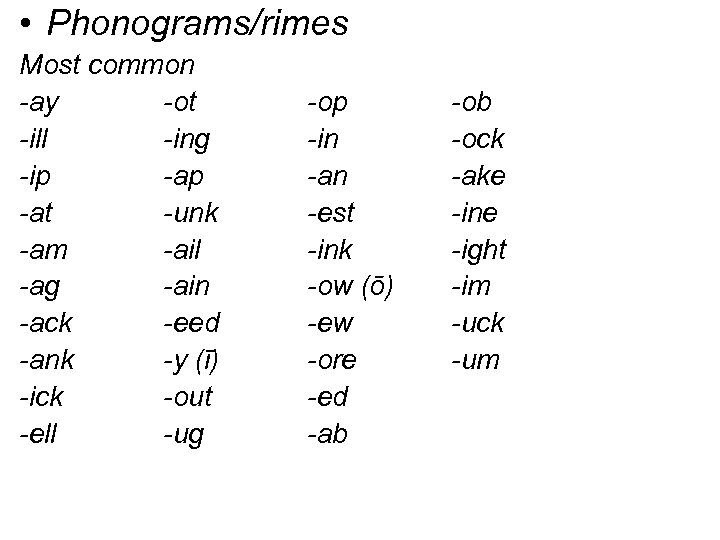 • Phonograms/rimes Most common -ay -ot -ill -ing -ip -at -unk -am -ail -ag -ain -ack -eed -ank -y (ī) -ick -out -ell -ug -op -in -an -est -ink -ow (ō) -ew -ore -ed -ab -ock -ake -ine -ight -im -uck -um
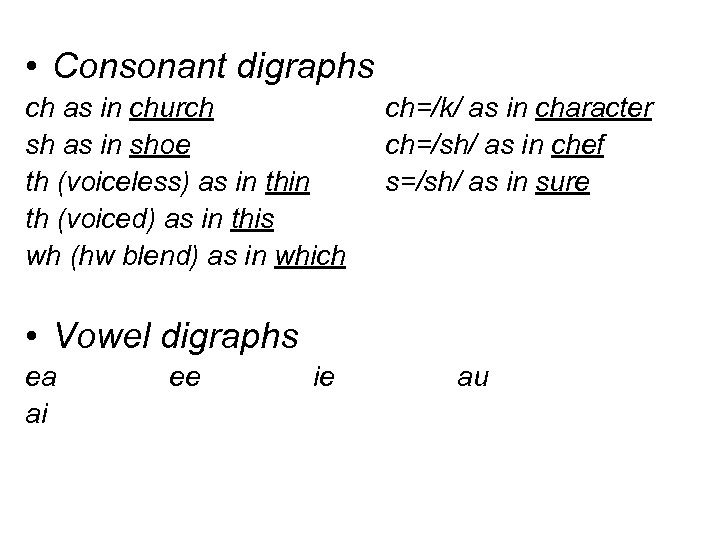 • Consonant digraphs ch as in church sh as in shoe th (voiceless) as in th (voiced) as in this wh (hw blend) as in which ch=/k/ as in character ch=/sh/ as in chef s=/sh/ as in sure • Vowel digraphs ea ai ee ie au
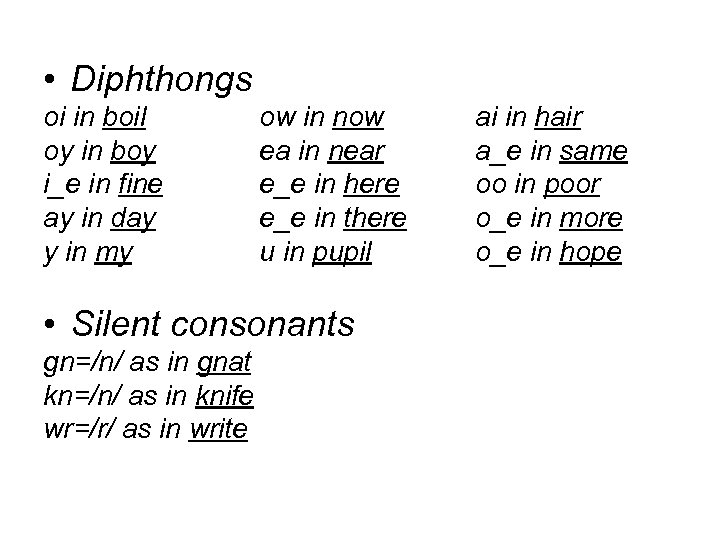 • Diphthongs oi in boil oy in boy i_e in fine ay in day y in my ow in now ea in near e_e in here e_e in there u in pupil • Silent consonants gn=/n/ as in gnat kn=/n/ as in knife wr=/r/ as in write ai in hair a_e in same oo in poor o_e in more o_e in hope
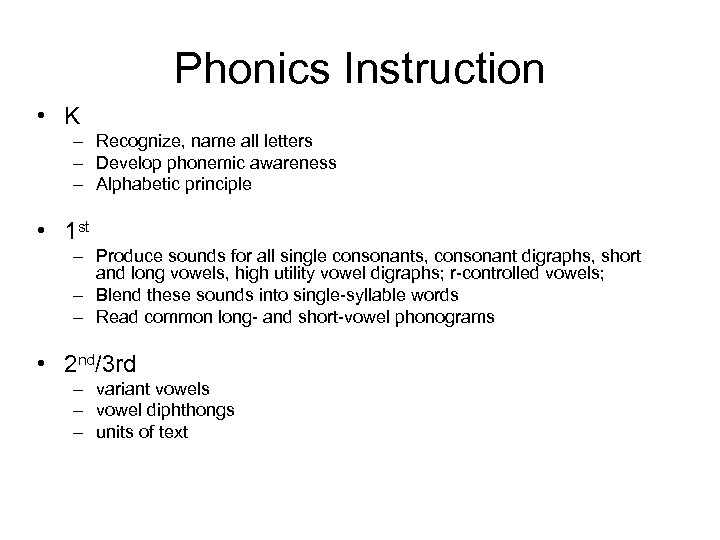 Phonics Instruction • K – Recognize, name all letters – Develop phonemic awareness – Alphabetic principle • 1 st – Produce sounds for all single consonants, consonant digraphs, short and long vowels, high utility vowel digraphs; r-controlled vowels; – Blend these sounds into single-syllable words – Read common long- and short-vowel phonograms • 2 nd/3 rd – variant vowels – vowel diphthongs – units of text
 Phonics Skills and Strategies: How would you help students learn them in context?
 Assessment: Phonics and Other Word Identification Strategies • Decode in isolation • Decode in context • Encode in isolation • Encode in context
 sh th ch wh
 i o u a e
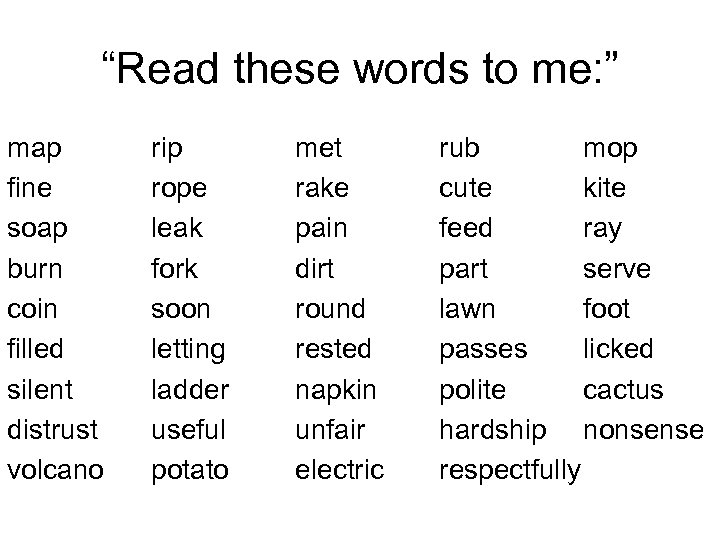 “Read these words to me: ” map fine soap burn coin filled silent distrust volcano rip rope leak fork soon letting ladder useful potato met rake pain dirt round rested napkin unfair electric rub mop cute kite feed ray part serve lawn foot passes licked polite cactus hardship nonsense respectfully
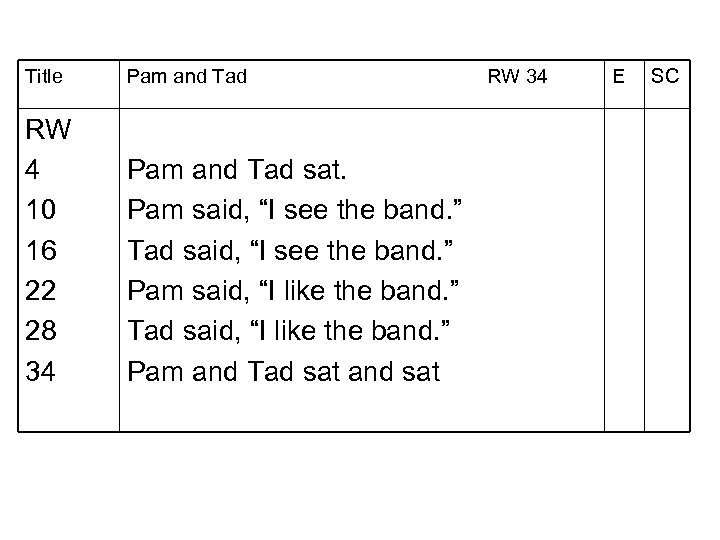 Title Pam and Tad RW 4 10 16 22 28 34 Pam and Tad sat. Pam said, “I see the band. ” Tad said, “I see the band. ” Pam said, “I like the band. ” Tad said, “I like the band. ” Pam and Tad sat and sat RW 34 E SC
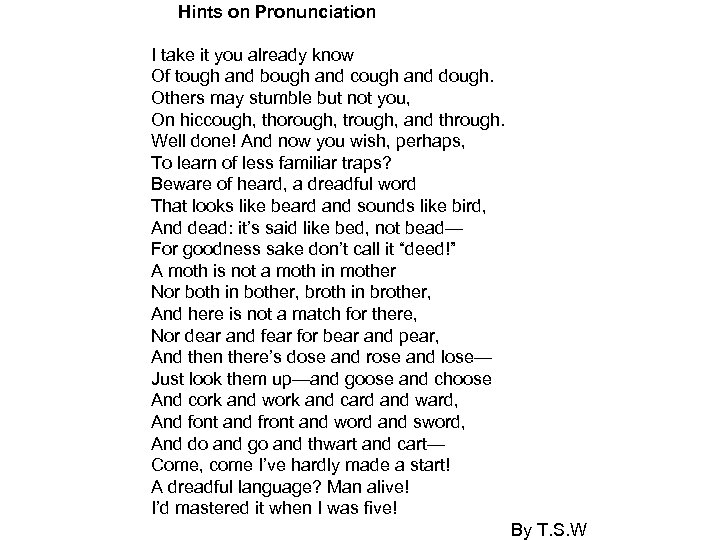 Hints on Pronunciation I take it you already know Of tough and bough and cough and dough. Others may stumble but not you, On hiccough, thorough, trough, and through. Well done! And now you wish, perhaps, To learn of less familiar traps? Beware of heard, a dreadful word That looks like beard and sounds like bird, And dead: it’s said like bed, not bead— For goodness sake don’t call it “deed!” A moth is not a moth in mother Nor both in bother, broth in brother, And here is not a match for there, Nor dear and fear for bear and pear, And then there’s dose and rose and lose— Just look them up—and goose and choose And cork and work and card and ward, And font and front and word and sword, And do and go and thwart and cart— Come, come I’ve hardly made a start! A dreadful language? Man alive! I’d mastered it when I was five! By T. S. W
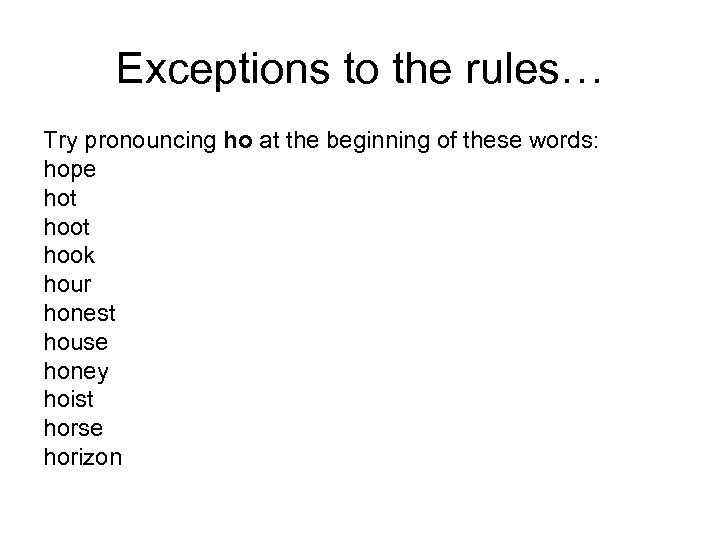 Exceptions to the rules… Try pronouncing ho at the beginning of these words: hope hot hook hour honest house honey hoist horse horizon
 For next time… Read: Honig et al. , chapters 9 -11; Online: Risinski, “Fluency is fundamental” (http: //teacher. scholastic. com/products/instructor/nov 03_ fluency. htm) Do: Language Arts Assignment 4: Interview your cooperating teacher about how high frequency words, multisyllabic words and fluency are addressed in your placement classroom. Provide a brief description of a lesson and learning objective that has been used. Reflect on the content of this interview as related to this week’s readings.
 Bibliography • • • The Hungry Thing by Jan Slepian and Ann Seidler Pigs in the Mud in the Middle of the Rud by Lynn Plourde and John Schoenherr Sheep Out to Eat by Nancy Shaw (also: Sheep in a Jeep, Sheep on a Ship, Sheep in a Shop) Six Sick Sheep (Tongue Twisters) Miss Mary Mack (Street Rhymes) by Joanna Cole and Stephanie Calmenson Phonemic Awareness in Young Children by Adams, Foorman, Lundberg and Beeler Phonemic Awareness: Playing with Sounds to Strengthen Beginning Reading Skills by Creative Teaching Press Phonemic Awareness Activities for Early Reading Success by Wiley Blevins Bringing the Rain to Kapiti Plain by Verna Aardema Making Words (Making Big Words, Making Bigger Words) by Pattricia M. Cunningham and Dorothy Hall Words Their Way: Word Study for Phonics, Vocabulary and Spelling Instruction by Bear et al.