Скачать презентацию good manners in crosscultural communication how to
dina mejkultura.pptx
- Количество слайдов: 13
 good manners in crosscultural communication : how to be polite
 Plan:
Plan:
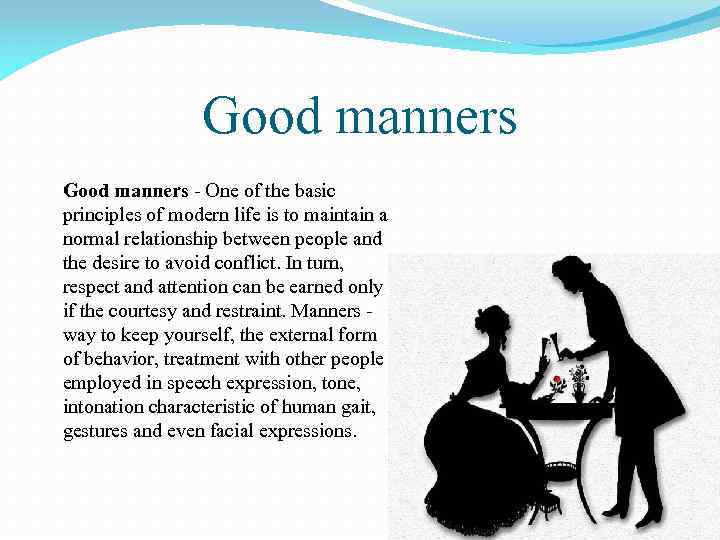 Good manners - One of the basic principles of modern life is to maintain a normal relationship between people and the desire to avoid conflict. In turn, respect and attention can be earned only if the courtesy and restraint. Manners - way to keep yourself, the external form of behavior, treatment with other people employed in speech expression, tone, intonation characteristic of human gait, gestures and even facial expressions.
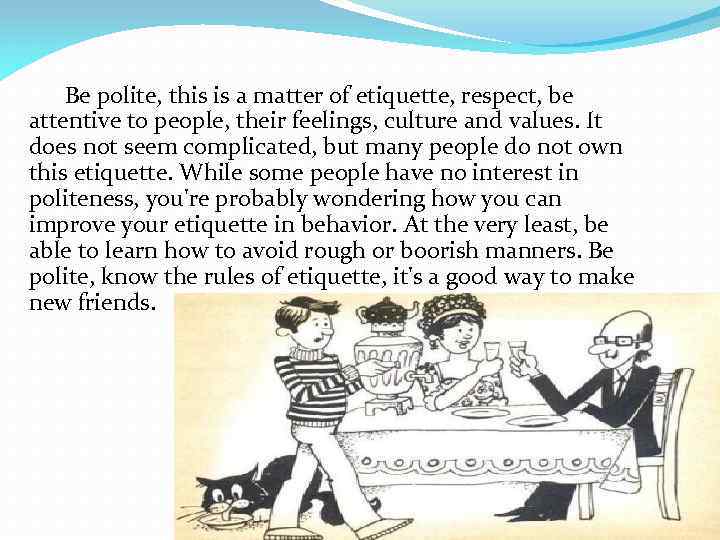 Be polite, this is a matter of etiquette, respect, be attentive to people, their feelings, culture and values. It does not seem complicated, but many people do not own this etiquette. While some people have no interest in politeness, you're probably wondering how you can improve your etiquette in behavior. At the very least, be able to learn how to avoid rough or boorish manners. Be polite, know the rules of etiquette, it's a good way to make new friends.
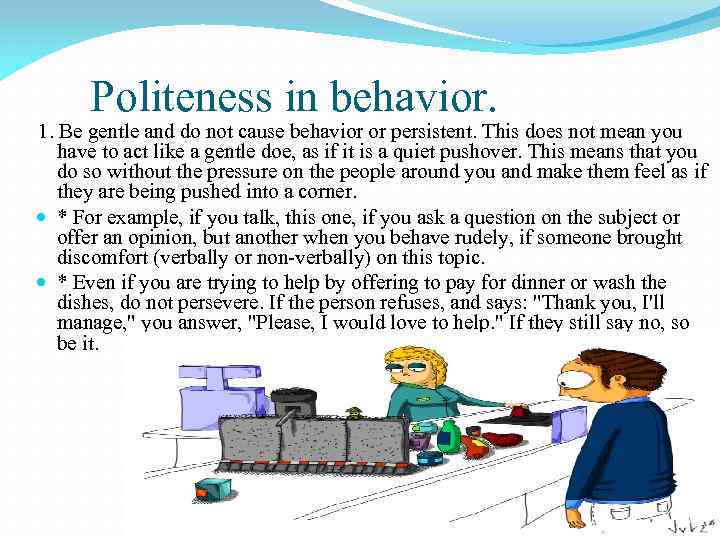 Politeness in behavior. 1. Be gentle and do not cause behavior or persistent. This does not mean you have to act like a gentle doe, as if it is a quiet pushover. This means that you do so without the pressure on the people around you and make them feel as if they are being pushed into a corner. * For example, if you talk, this one, if you ask a question on the subject or offer an opinion, but another when you behave rudely, if someone brought discomfort (verbally or non-verbally) on this topic. * Even if you are trying to help by offering to pay for dinner or wash the dishes, do not persevere. If the person refuses, and says: "Thank you, I'll manage, " you answer, "Please, I would love to help. " If they still say no, so be it.
 2. When in doubt, watch the other. They greet each other? What are they doing with my coat? What topics they discuss? Different relationships require different standards, and these standards often define what is polite and what is not. * Relations associated with the work, dinner, holiday, wedding or funeral, will require different approaches in the relationship, a different tone than the relationship with a group of friends. 3. Be polite. Always be polite as they could meet that person again in a different environment and do not want to cause negative memories that will give a bad location. If someone bothers you, or even insulting tone says, do not respond as well as an argument. Suggest "Let disagree" and change the subject, politely to continue the discussion, or simply give up the conversation.
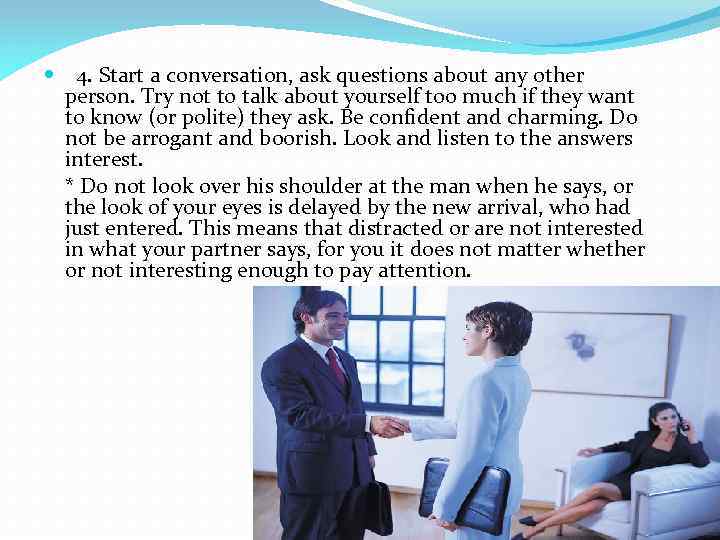 4. Start a conversation, ask questions about any other person. Try not to talk about yourself too much if they want to know (or polite) they ask. Be confident and charming. Do not be arrogant and boorish. Look and listen to the answers interest. * Do not look over his shoulder at the man when he says, or the look of your eyes is delayed by the new arrival, who had just entered. This means that distracted or are not interested in what your partner says, for you it does not matter whether or not interesting enough to pay attention.
 5. Firm handshake and eye contact when doing so. Can a little practice it, not to clap the hands of people or hurt them. This will make them feel uncomfortable. Especially watch out for a handshake women who have their hands on the ring. Excessive pressure can be very painful. * Remember, too, that many people are "old school" (especially if the location in Europe) is considered inappropriate to offer his hand for a handshake lady or elderly gentleman, of course, if you are a gentleman or a lady older, if you're a lady. Always greet the other person first, but wait for them to give them their own hands. But also, if you are an elderly person or a woman, keep in mind that if you do not file your hand, that person may feel rejected because he or she is willing to shake hands with you. Typically, this situation takes another person who moves to you for a handshake. Be careful. * Do not go to someone with already outstretched hand. That is, not to be persistent. If you want anyone to know what motivates them, make eye contact or smile, maybe a little open hand (bent at the elbow) to make a welcome gesture.
 6. Know the proper etiquette dinner. Place the napkin on his knees, and does not add anything to the table that was not there when got there (cell phone, sunglasses, jewelry). Put your purse between my legs, under your seat. Women do not have to apply makeup at the table. It looks like rudeness and demonstrates a lack of refinement. If you want to correct makeup, or check to see if there is something in your teeth, go to the toilet. 7. Smile and laugh that shows your fun, but not loud. Volume refers to arrogance or uncertainty. Your charming politeness makes you feel good the other person. Keep in mind this objective, to be attentive to the needs of people and their opinions. Do not make derogatory remarks in respect of any ethnic, political or religious group under any circumstances.
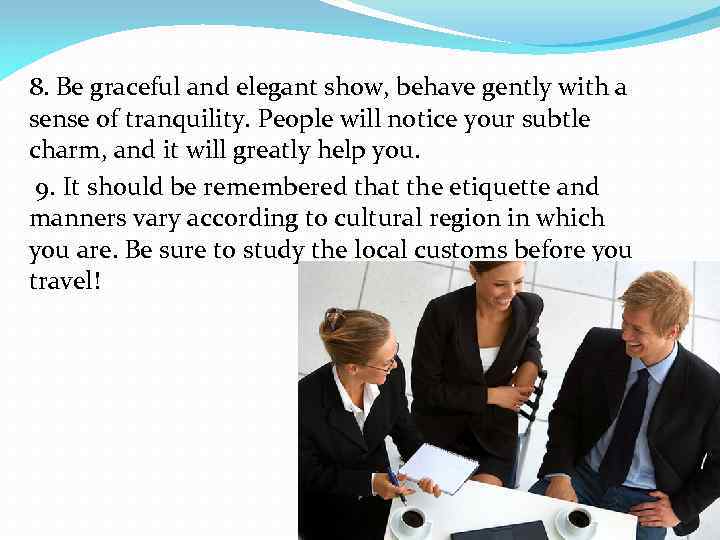 8. Be graceful and elegant show, behave gently with a sense of tranquility. People will notice your subtle charm, and it will greatly help you. 9. It should be remembered that the etiquette and manners vary according to cultural region in which you are. Be sure to study the local customs before you travel!
 Tips: Ø Be polite service personnel, do not neglect the rules of etiquette. Ø On the table do not put your elbows or do not remove people through salt and pepper. Always ask if they could please pass it on to you. Ø And of course, always remember to say please or thank you. Ø Be polite, some rules of etiquette. Ø Never say, "Help yourself, " if you can do it. . Ø Find out what kind of clothes needed for this event. How do you feel uncomfortable when you stand in the middle of a formal cocktail in leather pants and biker boots, if others in a tuxedo. Ø Do not interrupt people when they talk to other people, or in the middle of someone. Ø Always much worse to be caught in a lie than to tell the truth.
 Conclusion Good manners - One of the basic principles of modern life is to maintain a normal relationship between people and the desire to avoid conflict. I wanted to say at the end that it is necessary to behave in any. If you can not behave correctly it is necessary to learn. Never too late to learn to.