


 Скачать презентацию Good Hygiene Practices along the coffee chain Module
52ef75332bd42a0424394128479d6bee.ppt
- Количество слайдов: 14
 Good Hygiene Practices along the coffee chain Module 4. 9 Establish a Monitoring System for each CCP (Task 9 / Principle 4)
 Objectives and contents § Objectives § To equip trainees with the necessary skills to establish monitoring systems in a HACCP plan § Contents § The ‘What’s’, ‘Why’s’ and ‘How’s’ of monitoring § Designing a monitoring system § Documentation of monitoring systems in a HACCP plan 2 Module 4. 9 – Establish a Monitoring System for each CCP (Task 9 / Principle 4)
 Monitoring The act of conducting a planned sequence of observations or measurements of control parameters to assess whether a CCP is under control Effective monitoring ensures that critical limits for each CCP are not exceeded 3 Module 4. 9 – Establish a Monitoring System for each CCP (Task 9 / Principle 4)
 Purposes of monitoring § Measurement of system performance at CCPs – performance trends § To determine when there is loss of control at CCP § To establish records of the system’s level of performance at the CCP – demonstration of compliance with the HACCP plan 4 Module 4. 9 – Establish a Monitoring System for each CCP (Task 9 / Principle 4)
 Characteristics of monitoring systems § Can be done continuously § Can be done on a batch basis § Required to give rapid results because process control requires real-time adjustments § Should be done with accurate devices § Bear in mind that the monitored parameter is often an indirect measurement of the control parameter – e. g. fill volume is monitored to assure adequate heat killing 5 Module 4. 9 – Establish a Monitoring System for each CCP (Task 9 / Principle 4)
 Design of a monitoring system § What will be monitored? § How will critical limits and preventive measures be monitored? § What frequency of checking is required? § Who will monitor? 6 Module 4. 9 – Establish a Monitoring System for each CCP (Task 9 / Principle 4)
 What is monitored? § Monitoring may mean measuring a characteristic of a product such as p. H or Aw § Or of a process § Minimum (heat treatment) or maximum (storage) temperature § Time before drying, etc. § It may require measurement of more than one parameter such as time exposed to temperature, or time for drying § Measurement is not the only form of monitoring - some CCPs are controlled by visual inspection: § Split coconuts at harvest § Integrity of packaging § Verification of vendor's certificate 7 Module 4. 9 – Establish a Monitoring System for each CCP (Task 9 / Principle 4)
 How is monitoring carried out? § Monitoring procedures need to provide rapid results (real-time) § Instant (or almost instant) readings: clocks, thermometers, pressure gauges, p. H meters § Rapid readings: Aw meters, chlorine colorimetry, ATP-based microbial load, redox colorimetry § Microbial or chromatographic analysis is rarely used for monitoring 8 Module 4. 9 – Establish a Monitoring System for each CCP (Task 9 / Principle 4)
 How is monitoring carried out? § Monitoring procedures need to be reliable, accurate and relatively precise § Measuring devices should be calibrated regularly § Operators should be thoroughly trained in the principle and application of measurement 9 Module 4. 9 – Establish a Monitoring System for each CCP (Task 9 / Principle 4)
 Frequency of monitoring § Continuous monitoring is preferred whenever possible § Necessary to review monitoring results at appropriate intervals § To determine the sampling frequency of noncontinuous monitoring, consider § The normal variation in the process § Difference between critical and operating limits § Assessment of potential product loss during monitoring interval if there is loss of control 10 Module 4. 9 – Establish a Monitoring System for each CCP (Task 9 / Principle 4)
 Who monitors? § Any individual with a production or quality assurance function may be appropriate for assigning responsibility for monitoring § Individual responsible for monitoring must § Be adequately trained in the monitoring techniques and reporting responsibilities § Understand the importance of CCP monitoring § Have the authority to take appropriate action 11 Module 4. 9 – Establish a Monitoring System for each CCP (Task 9 / Principle 4)
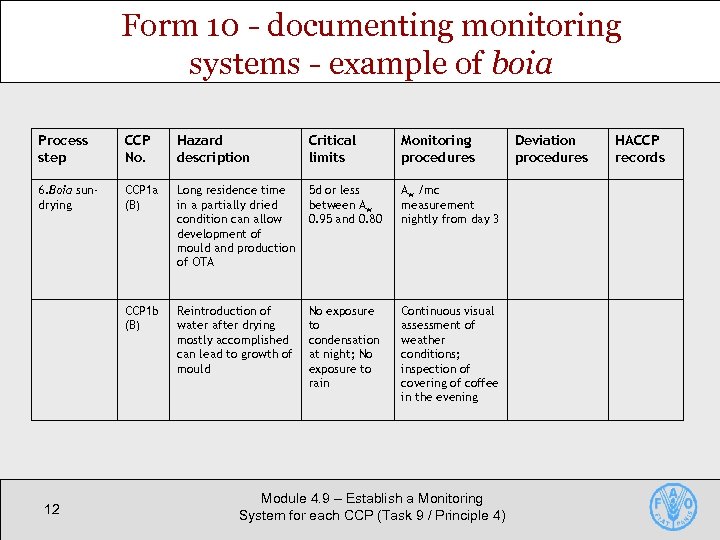 Form 10 - documenting monitoring systems - example of boia Process step CCP No. Hazard description Critical limits Monitoring procedures 6. Boia sundrying CCP 1 a (B) Long residence time in a partially dried condition can allow development of mould and production of OTA 5 d or less between Aw 0. 95 and 0. 80 Aw /mc measurement nightly from day 3 CCP 1 b (B) Reintroduction of water after drying mostly accomplished can lead to growth of mould No exposure to condensation at night; No exposure to rain Continuous visual assessment of weather conditions; inspection of covering of coffee in the evening 12 Module 4. 9 – Establish a Monitoring System for each CCP (Task 9 / Principle 4) Deviation procedures HACCP records
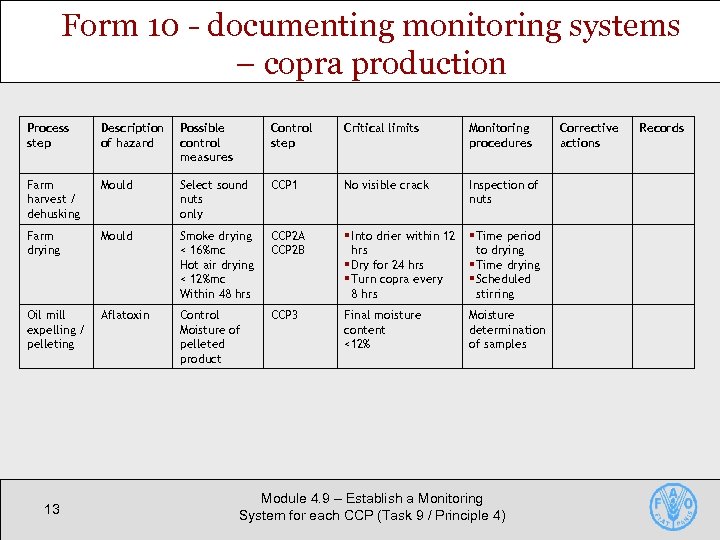 Form 10 - documenting monitoring systems – copra production Process step Description of hazard Possible control measures Control step Critical limits Monitoring procedures Farm harvest / dehusking Mould Select sound nuts only CCP 1 No visible crack Inspection of nuts Farm drying Mould Smoke drying < 16%mc Hot air drying < 12%mc Within 48 hrs CCP 2 A CCP 2 B § Into drier within 12 hrs § Dry for 24 hrs § Turn copra every 8 hrs § Time period to drying § Time drying § Scheduled stirring Oil mill expelling / pelleting Aflatoxin Control Moisture of pelleted product CCP 3 Final moisture content <12% Moisture determination of samples 13 Module 4. 9 – Establish a Monitoring System for each CCP (Task 9 / Principle 4) Corrective actions Records
 Summary § What is monitoring - and how and why is it carried out? § Considerations in designing a monitoring system § Documentation of monitoring systems in a HACCP plan 14 Module 4. 9 – Establish a Monitoring System for each CCP (Task 9 / Principle 4)