


 Скачать презентацию Good governance and decentralisation The case of Hungary
e64ae8e225cad25550e604928e5a5b3c.ppt
- Количество слайдов: 18
 Good governance and decentralisation. The case of Hungary Ilona Pálné Kovács University of Pécs, IRS, CERS. HAS palne@rkk. hu Circulation and adoption of local action standards and models International conference Agropolis, Montpellier, 20, 21, 22 and 23 March 2013
 The aim of the paper To connect the terms of good governance and decentralisation To introduce the shaping process of local governance in Hungary To outline of the conception of a research project financed by OTKA (K 104649)
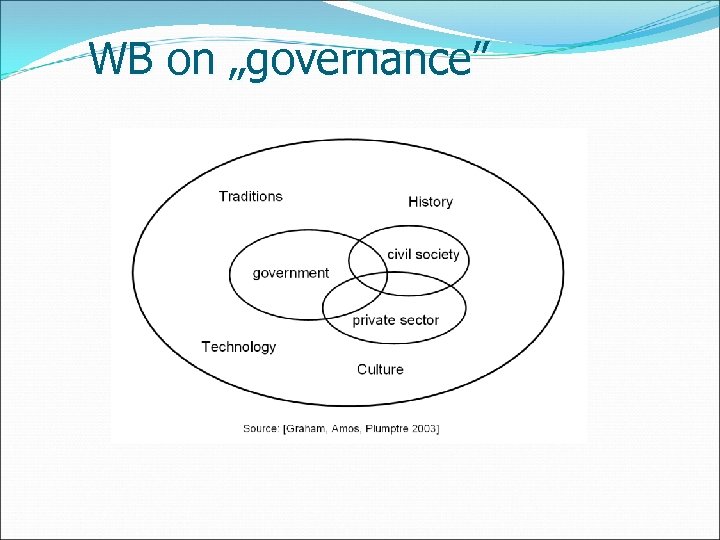
 Approaches to good governance From the interest of „sponsors” to general standard of democracy and quality of governance General criteria of democracy: human rigths, participation, transparency, „impartial”, non corrupt (Human Development Report, 2002, Freedom House, Amnesty Int. etc) Economy and quality of governance: sustainability, social equity, well-being (WB-WGI, OECD, UN, Bertelsman indicators): EU governance criteria: subsidiarity, MLG, partnership, NPM, networks, decentralisation (White book on good governance, MLG, new term of territorial governance etc. ) Paradigm of „governance” : mixing of levels, sectors, actors (Kooiman, 1993): correction failures of government (Jessop, 2011): Governance is better than government
 WB on „governance”
 Theory of decentralisation State theory: local governments as fourth branch of power or local staates? Public administration science: there is no consensus on how much and what kind of decentralisation is „ideal”, NPM Institutional economics: looking for economic consequences of decentralised public services (Oates, Tiebout, spill over, public /rational choice, fiscal and laboratory federalism, etc. ) Regional science and economic geography: (Krugman, Porter economy of agglomeration, regional competitiveness etc. ) How to measure? Few empirical evidences (Müller, 2009, Saito, 2011) Decentralisation is rather on democracy than performance (Gold Report, 2008, UN Habitat, 2007) Standards to be followed (European Charter of Local Governments (regional one, public services etc. )
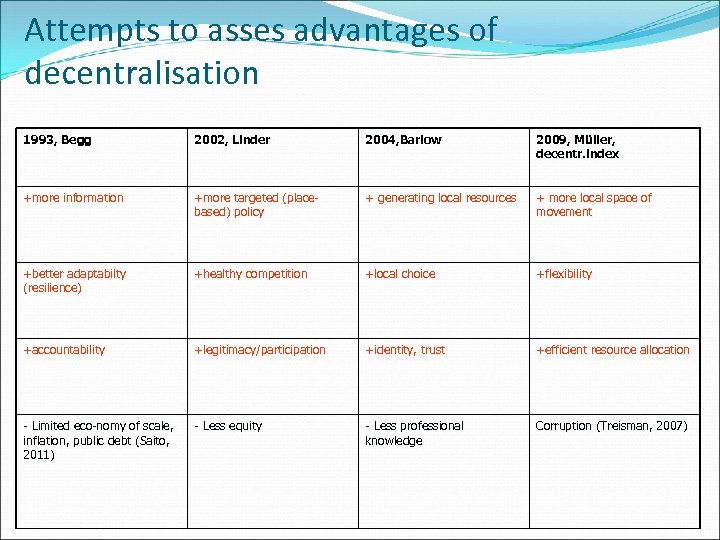 Attempts to asses advantages of decentralisation 1993, Begg 2002, Linder 2004, Barlow 2009, Müller, decentr. index +more information +more targeted (placebased) policy + generating local resources + more local space of movement +better adaptabilty (resilience) +healthy competition +local choice +flexibility +accountability +legitimacy/participation +identity, trust +efficient resource allocation - Limited eco-nomy of scale, inflation, public debt (Saito, 2011) - Less equity - Less professional knowledge Corruption (Treisman, 2007)
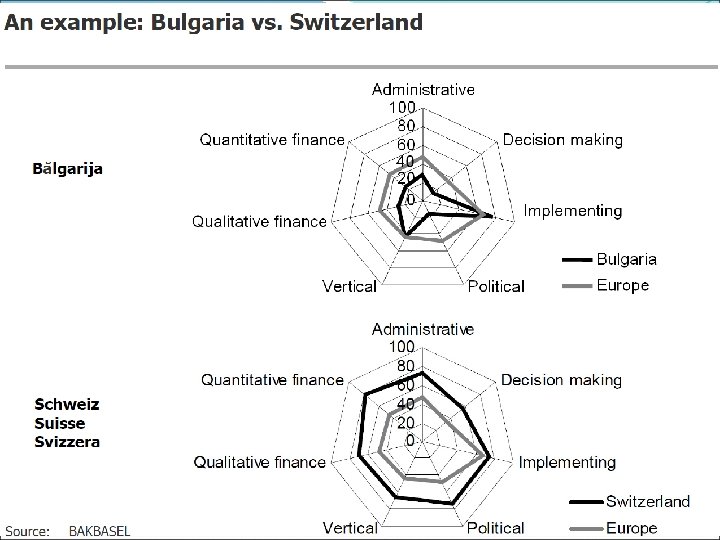
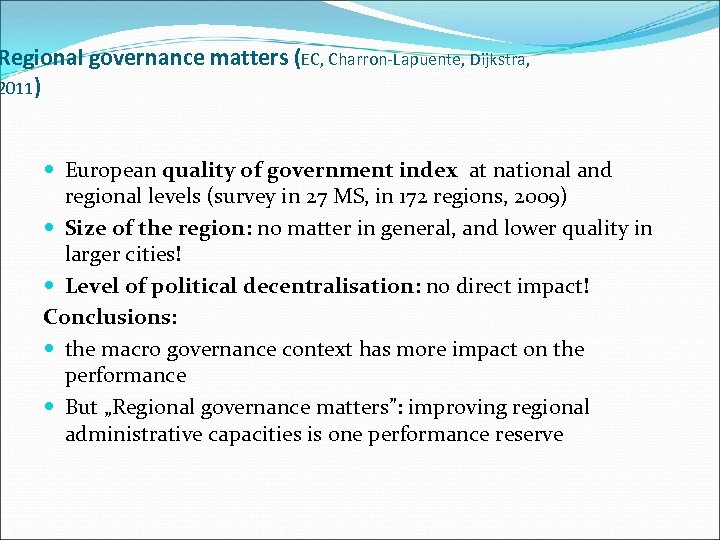 Regional governance matters (EC, Charron-Lapuente, Dijkstra, 2011) European quality of government index at national and regional levels (survey in 27 MS, in 172 regions, 2009) Size of the region: no matter in general, and lower quality in larger cities! Level of political decentralisation: no direct impact! Conclusions: the macro governance context has more impact on the performance But „Regional governance matters”: improving regional administrative capacities is one performance reserve
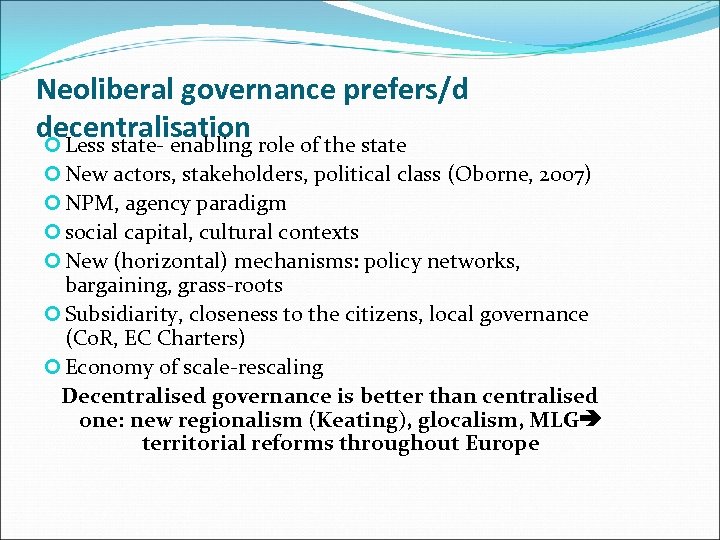 Neoliberal governance prefers/d decentralisation Less state- enabling role of the state New actors, stakeholders, political class (Oborne, 2007) NPM, agency paradigm social capital, cultural contexts New (horizontal) mechanisms: policy networks, bargaining, grass-roots Subsidiarity, closeness to the citizens, local governance (Co. R, EC Charters) Economy of scale-rescaling Decentralised governance is better than centralised one: new regionalism (Keating), glocalism, MLG territorial reforms throughout Europe
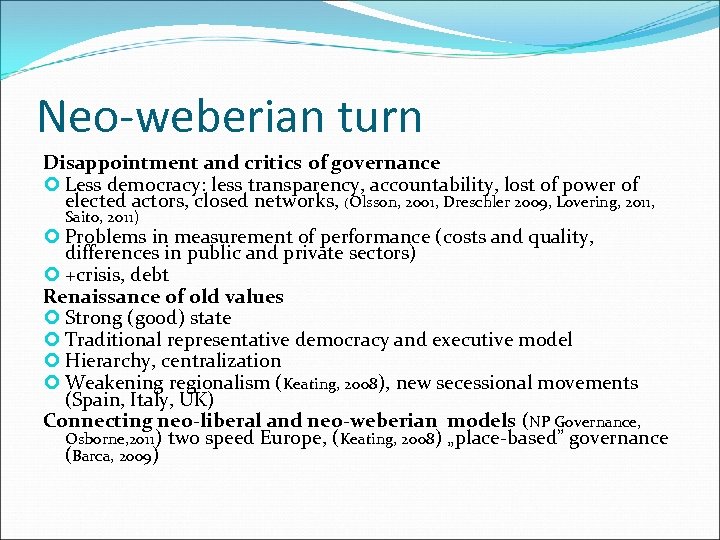 Neo-weberian turn Disappointment and critics of governance Less democracy: less transparency, accountability, lost of power of elected actors, closed networks, (Olsson, 2001, Dreschler 2009, Lovering, 2011, Saito, 2011) Problems in measurement of performance (costs and quality, differences in public and private sectors) +crisis, debt Renaissance of old values Strong (good) state Traditional representative democracy and executive model Hierarchy, centralization Weakening regionalism (Keating, 2008), new secessional movements (Spain, Italy, UK) Connecting neo-liberal and neo-weberian models (NP Governance, Osborne, 2011) two speed Europe, (Keating, 2008) „place-based” governance (Barca, 2009)
 Hungary. The ever question of how to govern the territory? History matters: never strong local governance in Hungary before 1990: systemic change, dominance of political values (autonomy, closesness to the citizens- fragmentation of the basic, elimination of the meso level) 1994 -: endless debate on the scale and boundaries/seats, streghtening impact of European cohesion policy Three options: micoregion- county-macroregion
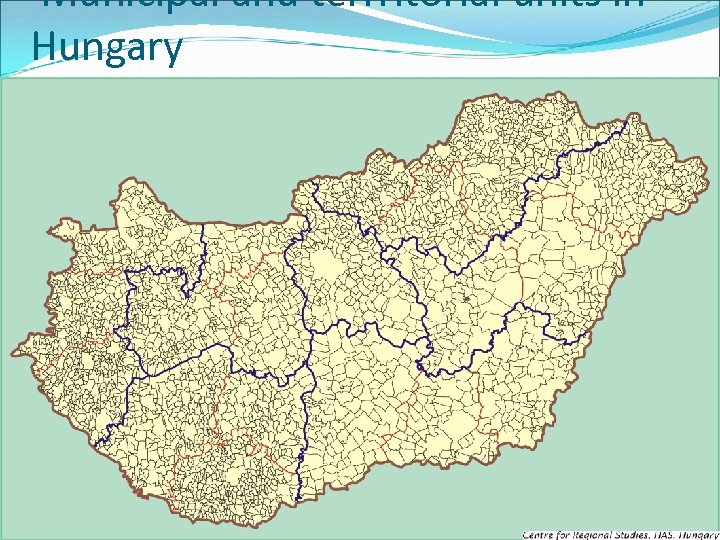 Municipal and terrritorial units in Hungary
 Problems emerged soon Insufficient capacities for local public services Low interest to co-operate Tensions/parallelism between counties and cities with county rank (23) The capital was always a hotpot ( districts↔capital↔county↔agglomeration↔r egion) Lack of integrative (meso) level and function (planning, co-ordination) within the system
 Corrections/rescaling Motivating of association Strengthening the county governments (1994) Law about regional development in 1996 Establishing the micro-regional associations (19932004 -) Building macro regions (statistics, development, selfgovernance, state governance), 1998, 2004 Shock of the joining to the EU in 2004 - centralised management of Structural Funds
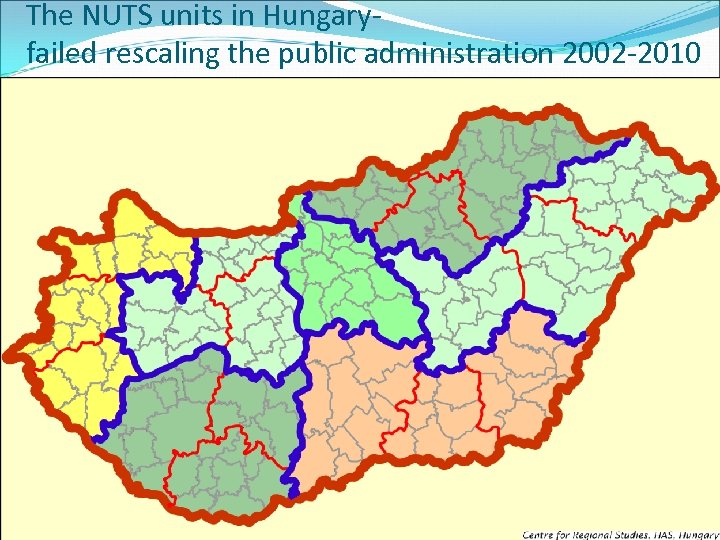 The NUTS units in Hungaryfailed rescaling the public administration 2002 -2010
 Results of insufficient reforms Is decentralised governance better? Jungle of geographical units Fragmented system Strong centralisation of SFs- weakening regionalism Decreasing trust (low turn out, cemented local politicians: 576 mayors for 20 years !)+cumulation of mandates in NP Bad performance and quality of public services Financial crisis, huge dept
 2010 turning point: „honest” centralisation and nationaliation Urgent need and real political chance to do something New constitution, new act on local government Crisis handling parallel with the legislation Strong and expanding state Regionalisation cancelled Local government system is almost empty bottle Where were the locals?
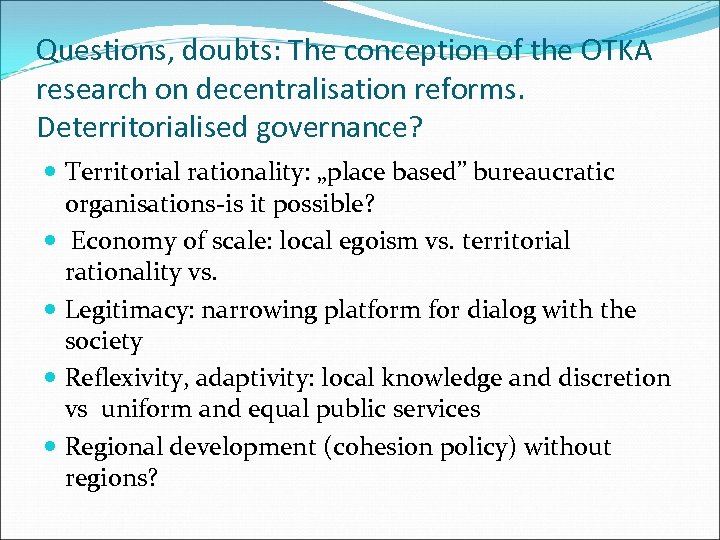 Questions, doubts: The conception of the OTKA research on decentralisation reforms. Deterritorialised governance? Territorial rationality: „place based” bureaucratic organisations-is it possible? Economy of scale: local egoism vs. territorial rationality vs. Legitimacy: narrowing platform for dialog with the society Reflexivity, adaptivity: local knowledge and discretion vs uniform and equal public services Regional development (cohesion policy) without regions?