 Скачать презентацию Going International Entrepreneurship beyond borders Tallinn 4 February
d7530fdb8f9b871f994875c5cba75fd3.ppt
- Количество слайдов: 24



Going International Entrepreneurship beyond borders Tallinn 4 February 2009
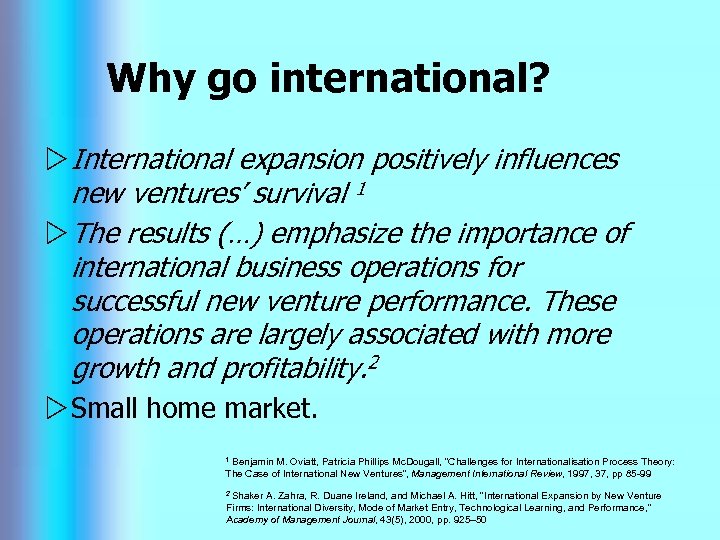
Why go international? w International expansion positively influences new ventures’ survival 1 w The results (…) emphasize the importance of international business operations for successful new venture performance. These operations are largely associated with more growth and profitability. 2 w Small home market. Benjamin M. Oviatt, Patricia Phillips Mc. Dougall, “Challenges for Internationalisation Process Theory: The Case of International New Ventures”, Management International Review, 1997, 37, pp 85 -99 1 2 Shaker A. Zahra, R. Duane Ireland, and Michael A. Hitt, “International Expansion by New Venture Firms: International Diversity, Mode of Market Entry, Technological Learning, and Performance, “ Academy of Management Journal, 43(5), 2000, pp. 925– 50
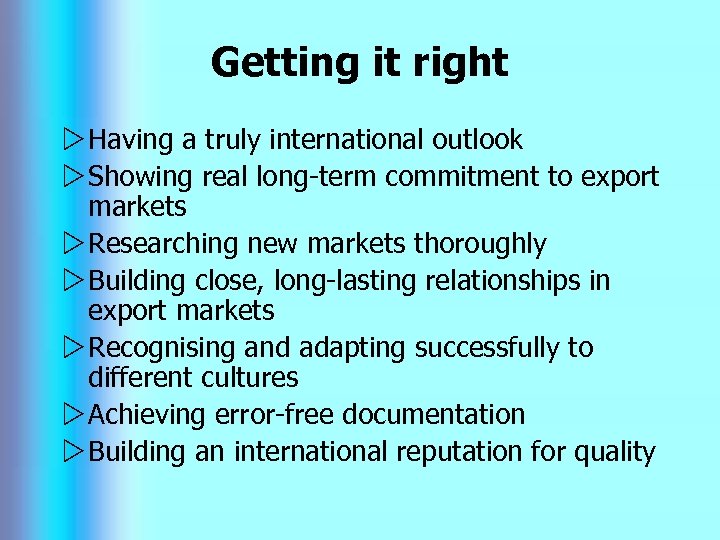
Getting it right w Having a truly international outlook w Showing real long-term commitment to export markets w Researching new markets thoroughly w Building close, long-lasting relationships in export markets w Recognising and adapting successfully to different cultures w Achieving error-free documentation w Building an international reputation for quality
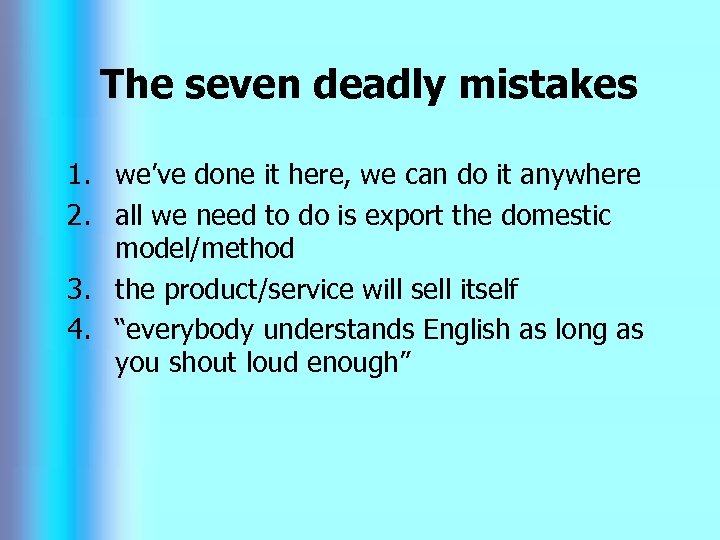
The seven deadly mistakes 1. we’ve done it here, we can do it anywhere 2. all we need to do is export the domestic model/method 3. the product/service will sell itself 4. “everybody understands English as long as you shout loud enough”
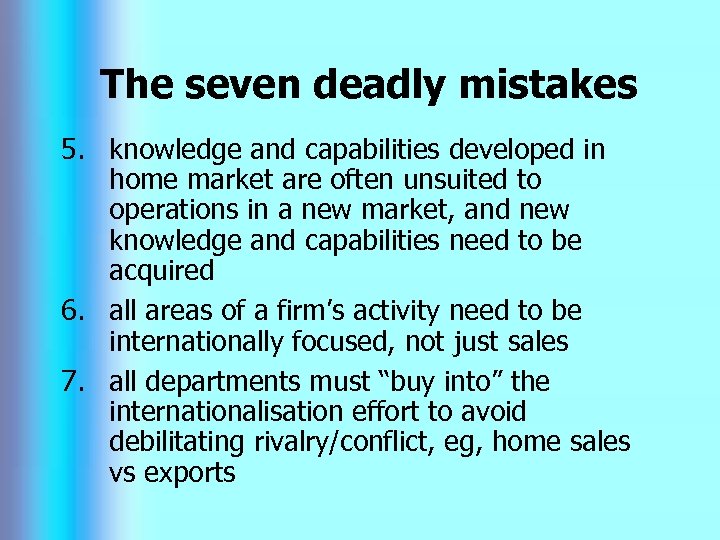
The seven deadly mistakes 5. knowledge and capabilities developed in home market are often unsuited to operations in a new market, and new knowledge and capabilities need to be acquired 6. all areas of a firm’s activity need to be internationally focused, not just sales 7. all departments must “buy into” the internationalisation effort to avoid debilitating rivalry/conflict, eg, home sales vs exports
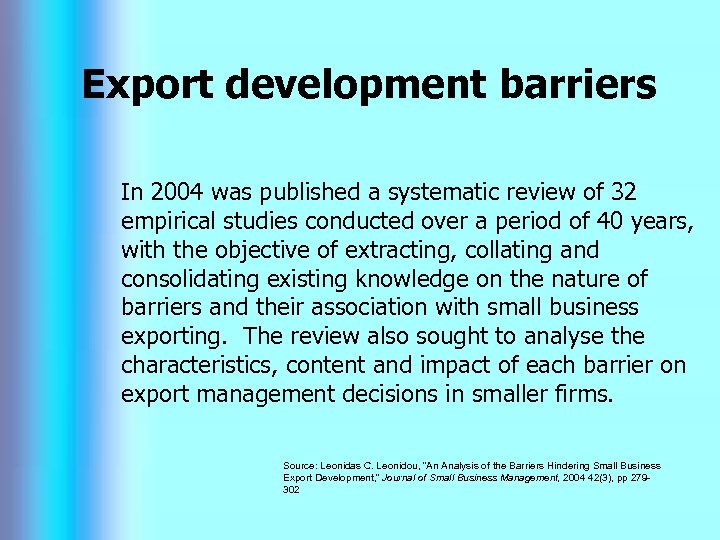
Export development barriers In 2004 was published a systematic review of 32 empirical studies conducted over a period of 40 years, with the objective of extracting, collating and consolidating existing knowledge on the nature of barriers and their association with small business exporting. The review also sought to analyse the characteristics, content and impact of each barrier on export management decisions in smaller firms. Source: Leonidas C. Leonidou, “An Analysis of the Barriers Hindering Small Business Export Development, ” Journal of Small Business Management, 2004 42(3), pp 279302
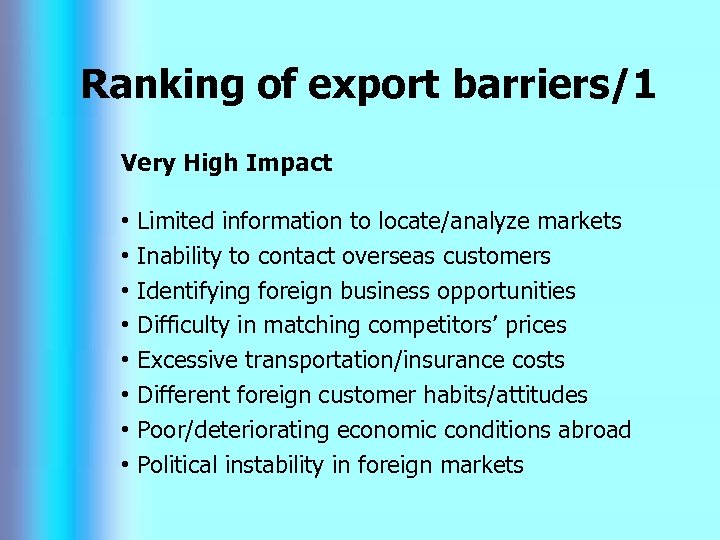
Ranking of export barriers/1 Very High Impact • • Limited information to locate/analyze markets Inability to contact overseas customers Identifying foreign business opportunities Difficulty in matching competitors’ prices Excessive transportation/insurance costs Different foreign customer habits/attitudes Poor/deteriorating economic conditions abroad Political instability in foreign markets
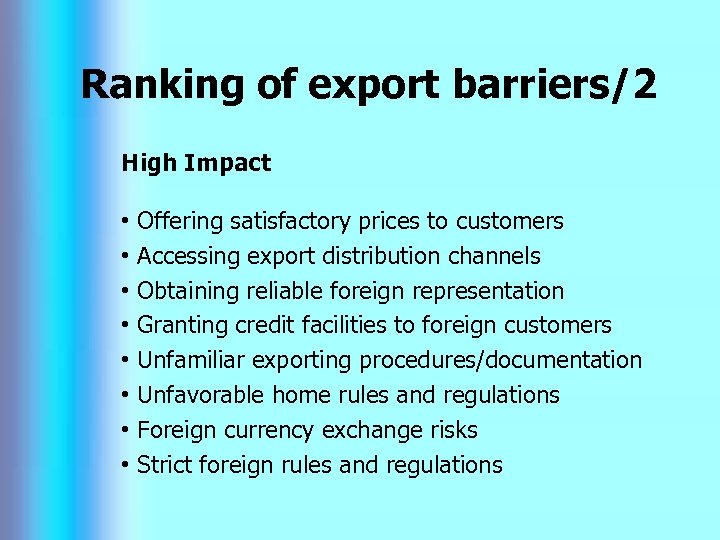
Ranking of export barriers/2 High Impact • • Offering satisfactory prices to customers Accessing export distribution channels Obtaining reliable foreign representation Granting credit facilities to foreign customers Unfamiliar exporting procedures/documentation Unfavorable home rules and regulations Foreign currency exchange risks Strict foreign rules and regulations
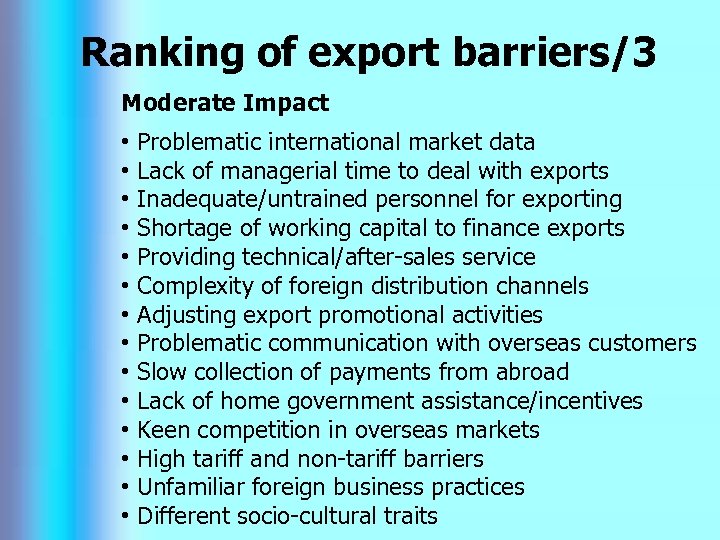
Ranking of export barriers/3 Moderate Impact • • • • Problematic international market data Lack of managerial time to deal with exports Inadequate/untrained personnel for exporting Shortage of working capital to finance exports Providing technical/after-sales service Complexity of foreign distribution channels Adjusting export promotional activities Problematic communication with overseas customers Slow collection of payments from abroad Lack of home government assistance/incentives Keen competition in overseas markets High tariff and non-tariff barriers Unfamiliar foreign business practices Different socio-cultural traits
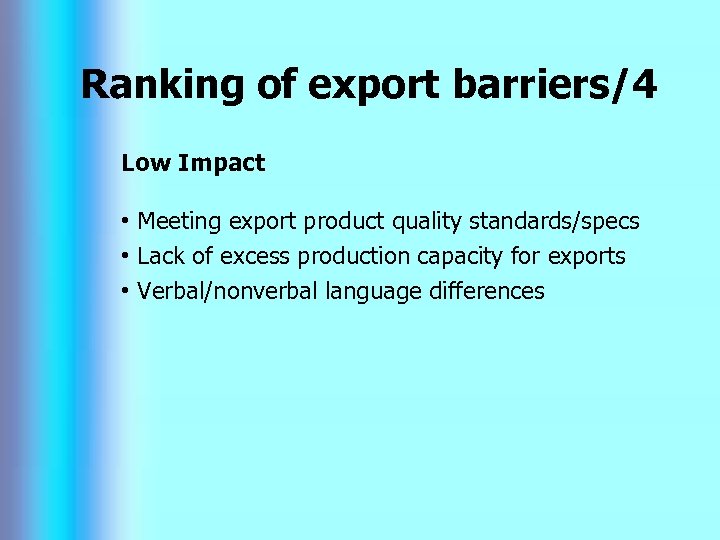
Ranking of export barriers/4 Low Impact • Meeting export product quality standards/specs • Lack of excess production capacity for exports • Verbal/nonverbal language differences
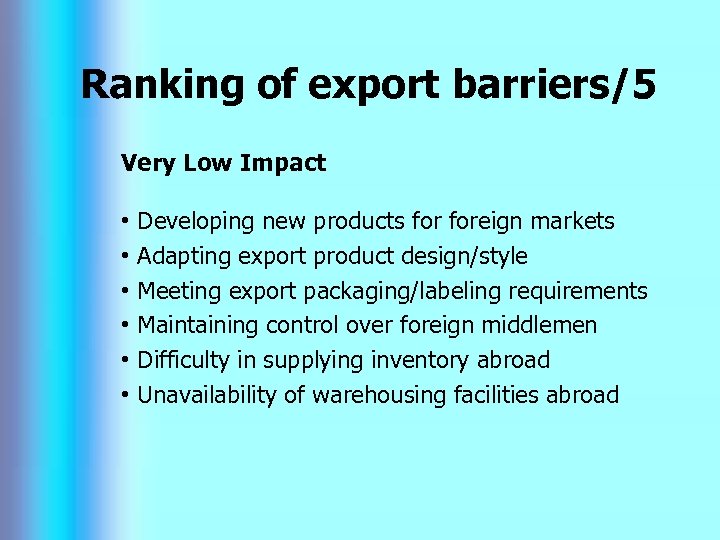
Ranking of export barriers/5 Very Low Impact • • • Developing new products foreign markets Adapting export product design/style Meeting export packaging/labeling requirements Maintaining control over foreign middlemen Difficulty in supplying inventory abroad Unavailability of warehousing facilities abroad
Key factors for successful internationalisation w It is a crucially important condition for success that the CEO and management team believe in and are committed to the internationalisation process (ie, you have to really want to) w But this, by itself, is still not enough. If not already present, international experience must be added to the management team (ie, you have to know how to)
Hire the best people you can w. Bear in mind the Class A, B and C idea • Class A people will attract and hire other Class A people • Class B people will do that for Class C people • Class C people won’t attract anybody at all
Hire people with the right experience w don’t just put an ad in the press and hope for the best w do as VCs do – go for clones w if you are not convinced someone is the right person, keep looking w become your own in-house headhunter make yourself a hit list of people you would love to have in your company w look into the future and start planning today the management team configuration that you think will be optimal down the road
How to attract such people w Network, but targetted networking w Be committed to what you are doing and make it exciting w Make your work environment an attractive one w Make your targets feel that their contribution will be really valued w Attach magnets to yourself (eg, strong funding, very strong team, credibility-giving advisors etc)
The Uppsala model w Classic four step sequence 1. direct exporting to a foreign country, often in response to an unsolicited order. 2. actively seeking export orders with the help of independent representatives or agents abroad. 3. establishment of a sales subsidiary or affiliate in a foreign country. 4. creation of a production/manufacturing facility abroad.
Outblaze, Hong Kong/1 Founded in August 1998 by current CEO, Yat Siu, Outblaze provides hosted Web applications, Internet messaging and communication services. Come 2000, we started getting a lot of customers coming to us from abroad. We weren’t really looking for them; they were coming to us, from the US, Europe, Africa, South America, just about everywhere.
Outblaze, Hong Kong/2 The next stage was that the firm decided to actively seek export orders with the help of independent resellers abroad. We looked at markets where we saw the lowest-hanging fruit: large portal operators with high-cost infrastructure. If they outsource services to a company like Outblaze, it makes a lot of sense.
Outblaze, Hong Kong/3 The following stage was the establishment of a sales subsidiary or affiliate in a foreign country. There were a number of areas where I sensed potential. It was based on my discussions with people, but certainly not research on a Gartner level. I went to the marketplace, I went to a conference, I talked to a few people, and I made a gut decision that this is a market we should be in.
Outblaze, Hong Kong/4 The fourth and last stage was the creation of development facilities abroad. We’ve ended up with multiple operations in different countries that focus on different areas. Hong Kong remains our R&D base. In India and China, we have specific, focused development, e. g. antispam.
Outblaze, Hong Kong/5 When we’re going to the US or Europe, do they necessarily care about a company from Hong Kong with 70– 80 employees? There’s always that kind of issue. So traction in the press and marketing efforts are very important while keeping costs “reasonable, ” which means “very low. ”
Outblaze, Hong Kong/6 Outblaze is now reported to provide services to over 75 million users around the planet. We used to just do business with anyone. Now we actually request deposits for service fees in advance, especially for markets that we consider a little bit more risky. Now there are really only two choices for outsourced email: Critical Path or Outblaze. Ten years ago we had 40+ competitors.
Outblaze, Hong Kong/latest ARMONK, NY and HONG KONG - 15 Jan 2009: IBM (NYSE: IBM) has announced its intent to acquire the strategic messaging service assets of Outblaze, Ltd. , a privately held provider of online messaging and collaboration services, based in Hong Kong. If we hadn't internationalized the business to sell to the US and Europe, we wouldn't be here today.
The last slide 1. Take the strategic decision to go international 2. Hire the best person you can who has successfully done this in your sector 3. Let him/her guide you re exactly where to go/what to do 4. Go for it!
Скачать презентацию Going International Entrepreneurship beyond borders Tallinn 4 February
d7530fdb8f9b871f994875c5cba75fd3.ppt