 Скачать презентацию GOFC GOLD — Fire Requirements for Fire Observations
aae20b0e1c0ce5750b6eaccc19db815a.ppt
- Количество слайдов: 21



GOFC/GOLD - Fire Requirements for Fire Observations
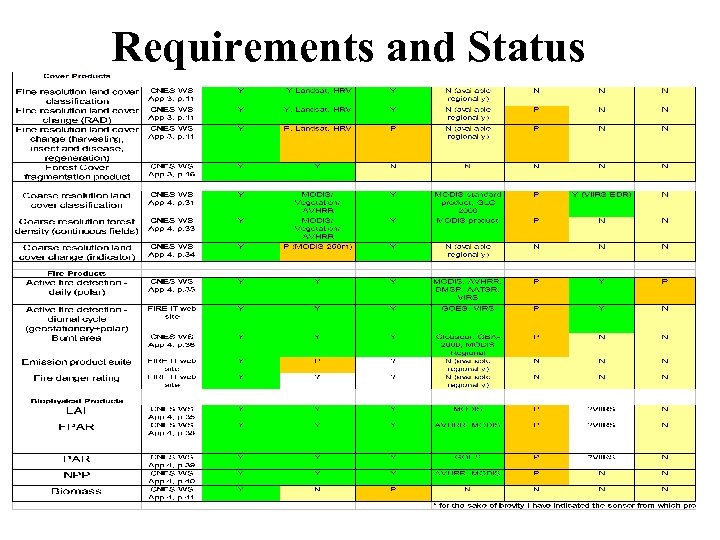
Requirements and Status
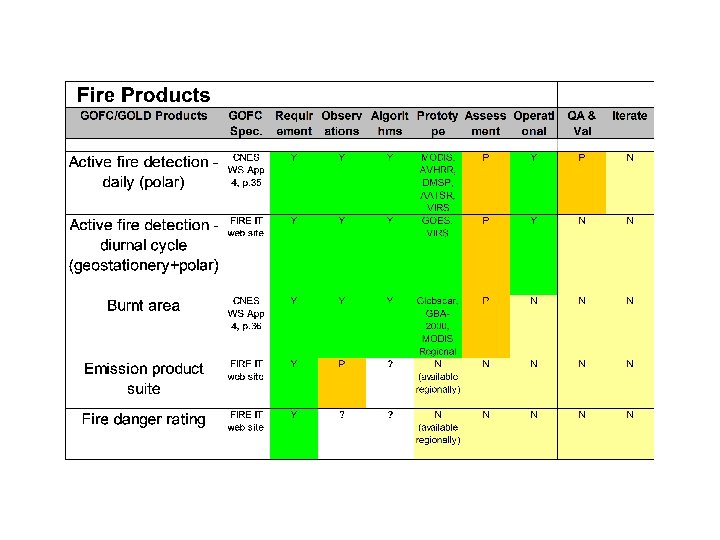
Fire Observations • Near Real Time (15 mins) for Regional Fire Control and Air Quality Management • Temporal Summaries for Fire and Ecosystem Management, National Reporting and Global Change Research • Requirements for – sensing systems with appropriate characteristics for deriving fire products – Intermediate and derived fire products of known accuracy – Web based open access to data – Consistent Long Term Data records – fire history and policy effectiveness • Requirements evolving - user needs / observation capabilities – Rapid operational prototyping
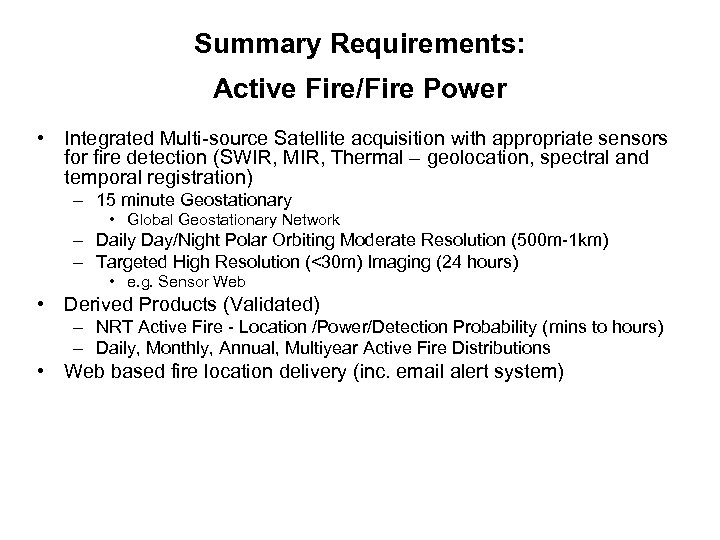
Summary Requirements: Active Fire/Fire Power • Integrated Multi-source Satellite acquisition with appropriate sensors for fire detection (SWIR, MIR, Thermal – geolocation, spectral and temporal registration) – 15 minute Geostationary • Global Geostationary Network – Daily Day/Night Polar Orbiting Moderate Resolution (500 m-1 km) – Targeted High Resolution (<30 m) Imaging (24 hours) • e. g. Sensor Web • Derived Products (Validated) – NRT Active Fire - Location /Power/Detection Probability (mins to hours) – Daily, Monthly, Annual, Multiyear Active Fire Distributions • Web based fire location delivery (inc. email alert system)
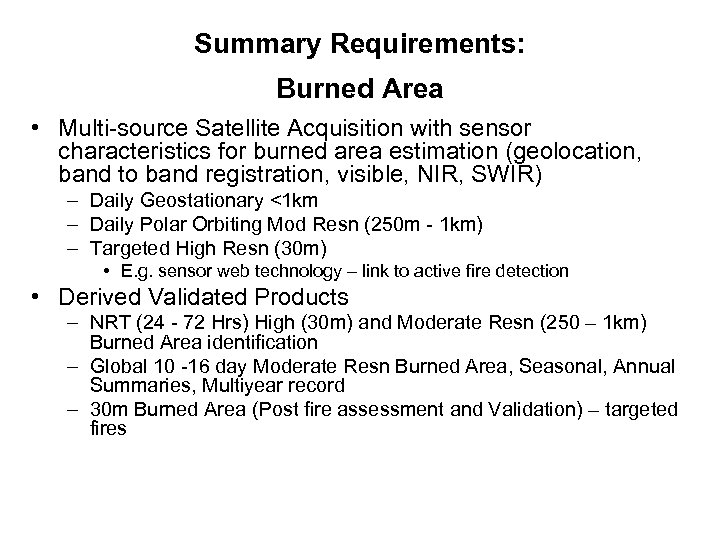
Summary Requirements: Burned Area • Multi-source Satellite Acquisition with sensor characteristics for burned area estimation (geolocation, band to band registration, visible, NIR, SWIR) – Daily Geostationary <1 km – Daily Polar Orbiting Mod Resn (250 m - 1 km) – Targeted High Resn (30 m) • E. g. sensor web technology – link to active fire detection • Derived Validated Products – NRT (24 - 72 Hrs) High (30 m) and Moderate Resn (250 – 1 km) Burned Area identification – Global 10 -16 day Moderate Resn Burned Area, Seasonal, Annual Summaries, Multiyear record – 30 m Burned Area (Post fire assessment and Validation) – targeted fires
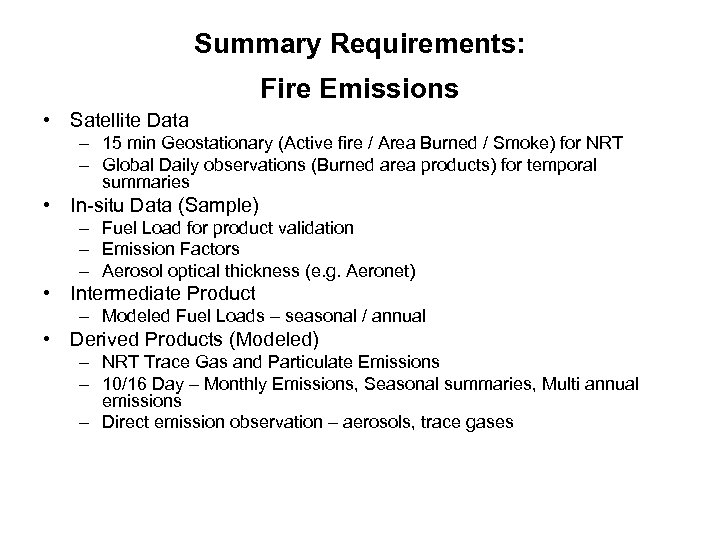
Summary Requirements: Fire Emissions • Satellite Data – 15 min Geostationary (Active fire / Area Burned / Smoke) for NRT – Global Daily observations (Burned area products) for temporal summaries • In-situ Data (Sample) – Fuel Load for product validation – Emission Factors – Aerosol optical thickness (e. g. Aeronet) • Intermediate Product – Modeled Fuel Loads – seasonal / annual • Derived Products (Modeled) – NRT Trace Gas and Particulate Emissions – 10/16 Day – Monthly Emissions, Seasonal summaries, Multi annual emissions – Direct emission observation – aerosols, trace gases
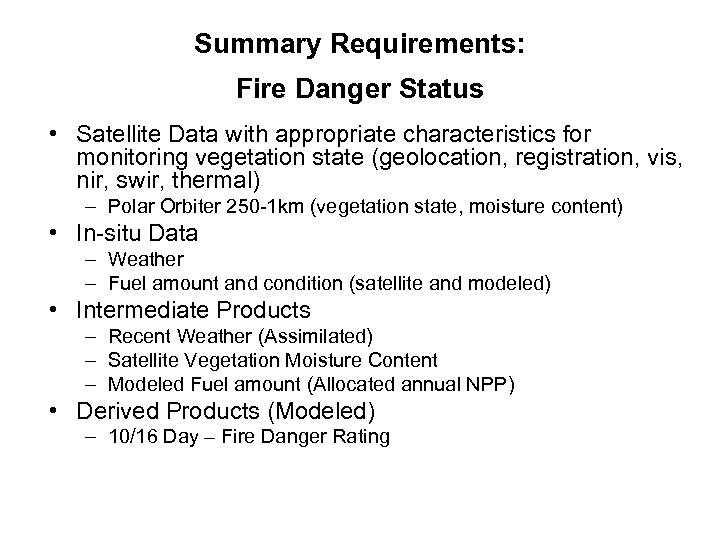
Summary Requirements: Fire Danger Status • Satellite Data with appropriate characteristics for monitoring vegetation state (geolocation, registration, vis, nir, swir, thermal) – Polar Orbiter 250 -1 km (vegetation state, moisture content) • In-situ Data – Weather – Fuel amount and condition (satellite and modeled) • Intermediate Products – Recent Weather (Assimilated) – Satellite Vegetation Moisture Content – Modeled Fuel amount (Allocated annual NPP) • Derived Products (Modeled) – 10/16 Day – Fire Danger Rating
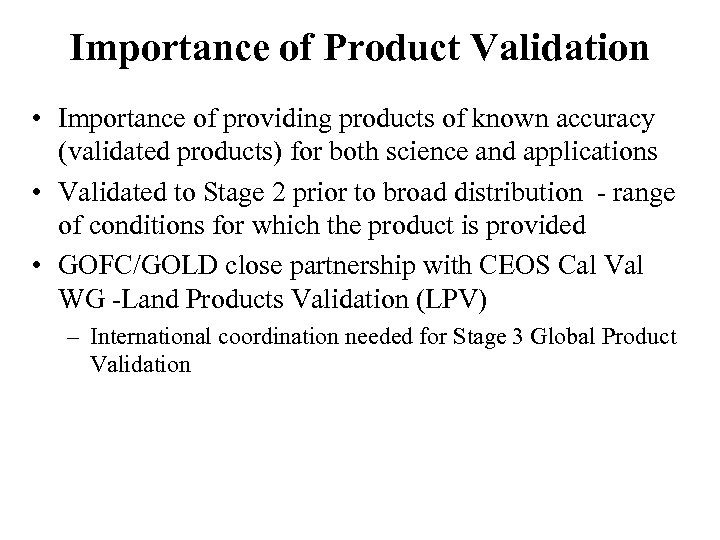
Importance of Product Validation • Importance of providing products of known accuracy (validated products) for both science and applications • Validated to Stage 2 prior to broad distribution - range of conditions for which the product is provided • GOFC/GOLD close partnership with CEOS Cal Val WG -Land Products Validation (LPV) – International coordination needed for Stage 3 Global Product Validation
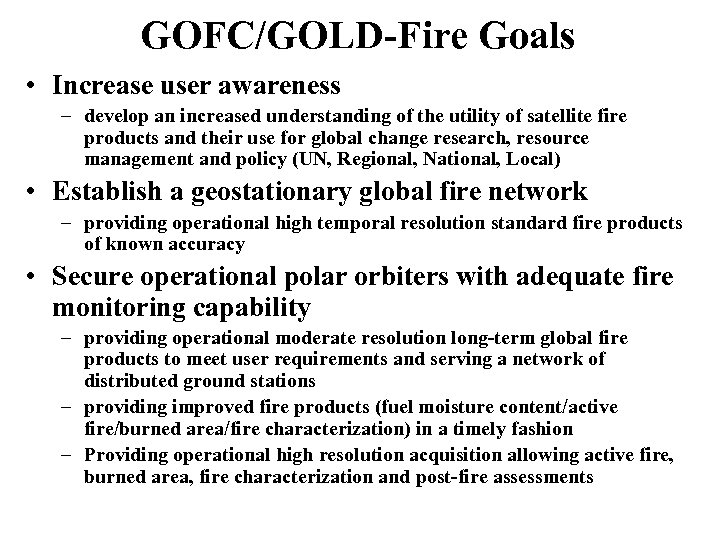
GOFC/GOLD-Fire Goals • Increase user awareness – develop an increased understanding of the utility of satellite fire products and their use for global change research, resource management and policy (UN, Regional, National, Local) • Establish a geostationary global fire network – providing operational high temporal resolution standard fire products of known accuracy • Secure operational polar orbiters with adequate fire monitoring capability – providing operational moderate resolution long-term global fire products to meet user requirements and serving a network of distributed ground stations – providing improved fire products (fuel moisture content/active fire/burned area/fire characterization) in a timely fashion – Providing operational high resolution acquisition allowing active fire, burned area, fire characterization and post-fire assessments
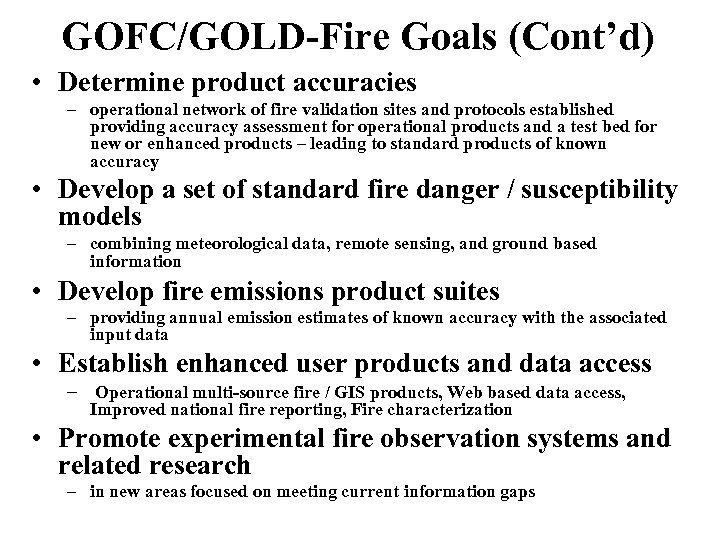
GOFC/GOLD-Fire Goals (Cont’d) • Determine product accuracies – operational network of fire validation sites and protocols established providing accuracy assessment for operational products and a test bed for new or enhanced products – leading to standard products of known accuracy • Develop a set of standard fire danger / susceptibility models – combining meteorological data, remote sensing, and ground based information • Develop fire emissions product suites – providing annual emission estimates of known accuracy with the associated input data • Establish enhanced user products and data access – Operational multi-source fire / GIS products, Web based data access, Improved national fire reporting, Fire characterization • Promote experimental fire observation systems and related research – in new areas focused on meeting current information gaps
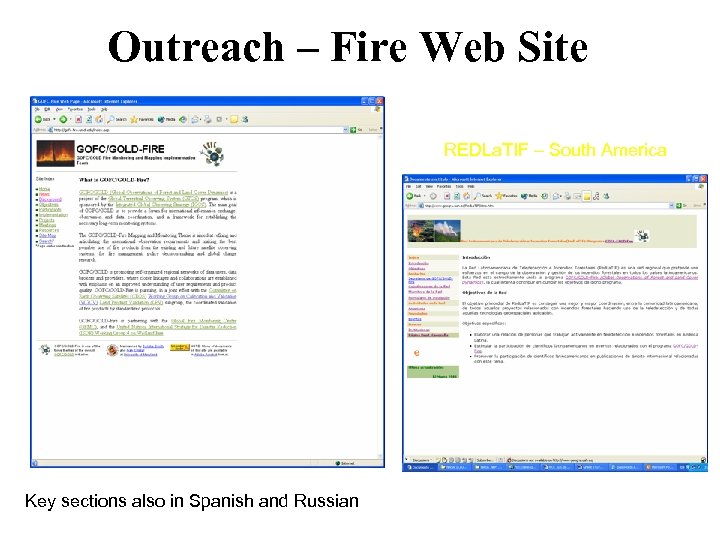
Outreach – Fire Web Site REDLa. TIF – South America Key sections also in Spanish and Russian
Rapid Operational Prototyping
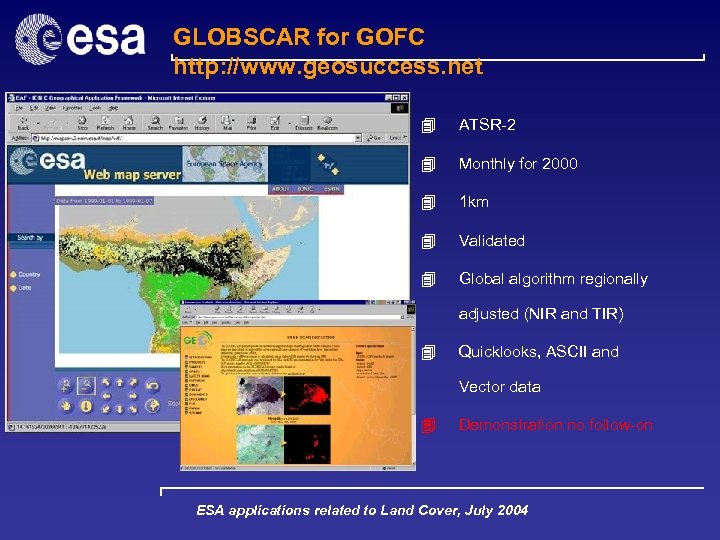
GLOBSCAR for GOFC http: //www. geosuccess. net 4 ATSR-2 4 Monthly for 2000 4 1 km 4 Validated 4 Global algorithm regionally adjusted (NIR and TIR) 4 Quicklooks, ASCII and Vector data 4 Demonstration no follow-on ESA applications related to Land Cover, July 2004
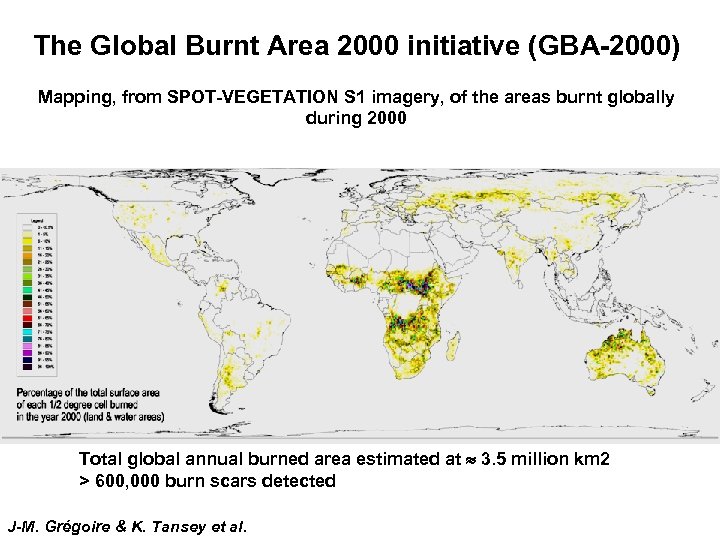
The Global Burnt Area 2000 initiative (GBA-2000) Mapping, from SPOT-VEGETATION S 1 imagery, of the areas burnt globally during 2000 Total global annual burned area estimated at 3. 5 million km 2 > 600, 000 burn scars detected J-M. Grégoire & K. Tansey et al.
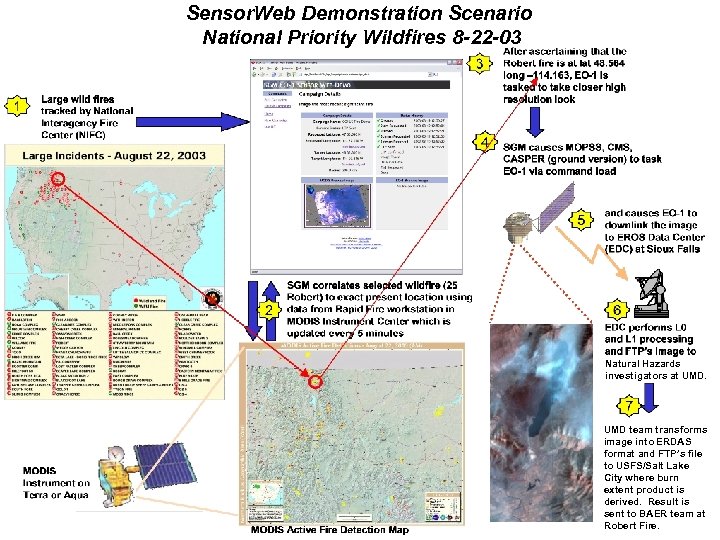
Sensor. Web Demonstration Scenario National Priority Wildfires 8 -22 -03 Natural Hazards investigators at UMD team transforms image into ERDAS format and FTP’s file to USFS/Salt Lake City where burn extent product is derived. Result is sent to BAER team at Robert Fire.
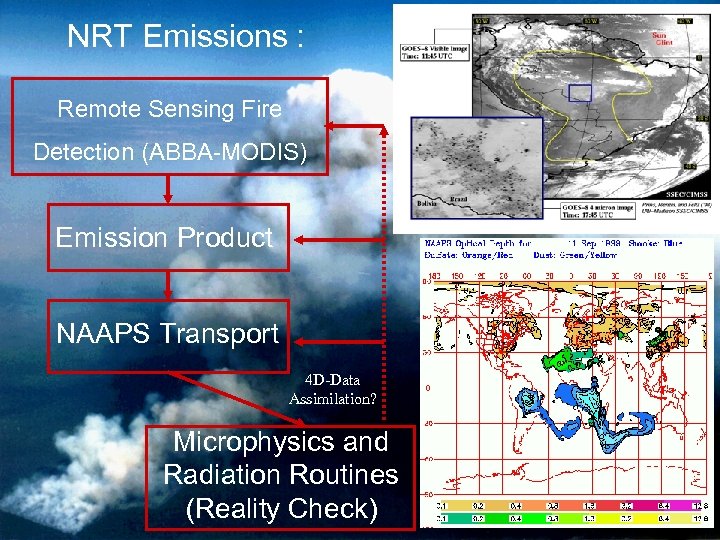
NRT Emissions : Remote Sensing Fire Detection (ABBA-MODIS) Emission Product NAAPS Transport 4 D-Data Assimilation? Microphysics and Radiation Routines (Reality Check)
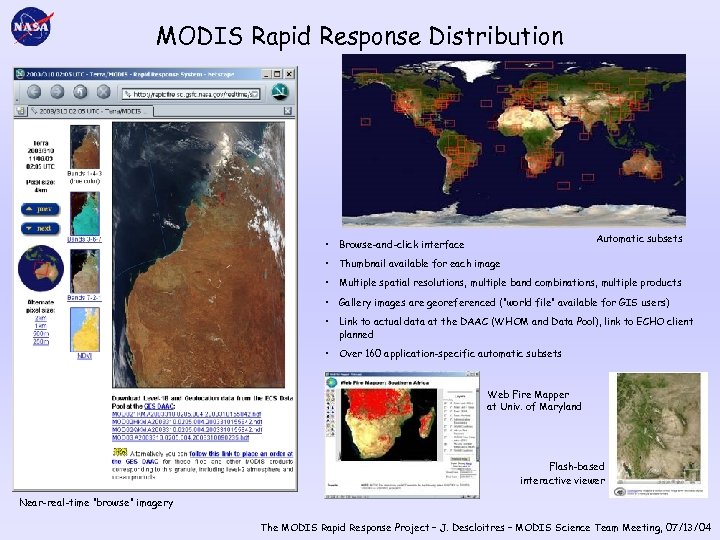
MODIS Rapid Response Distribution Automatic subsets • Browse-and-click interface • Thumbnail available for each image • Multiple spatial resolutions, multiple band combinations, multiple products • Gallery images are georeferenced (“world file” available for GIS users) • Link to actual data at the DAAC (WHOM and Data Pool), link to ECHO client planned • Over 160 application-specific automatic subsets Web Fire Mapper at Univ. of Maryland Flash-based interactive viewer Near-real-time “browse” imagery The MODIS Rapid Response Project – J. Descloitres – MODIS Science Team Meeting, 07/13/04
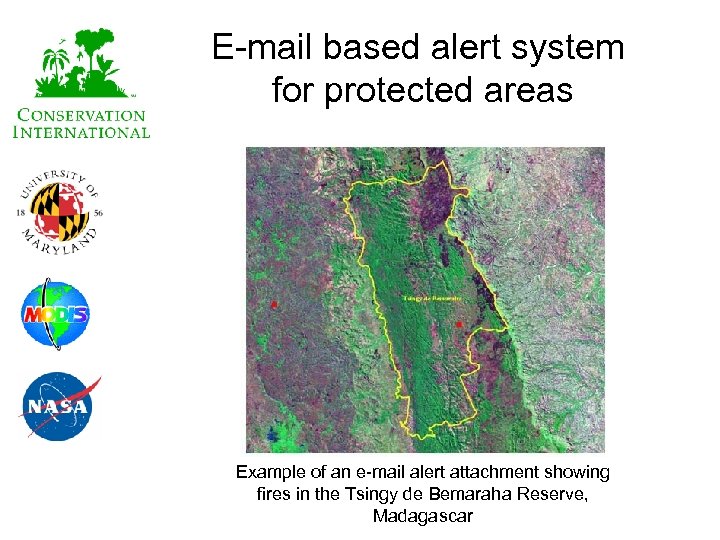
E-mail based alert system for protected areas Example of an e-mail alert attachment showing fires in the Tsingy de Bemaraha Reserve, Madagascar
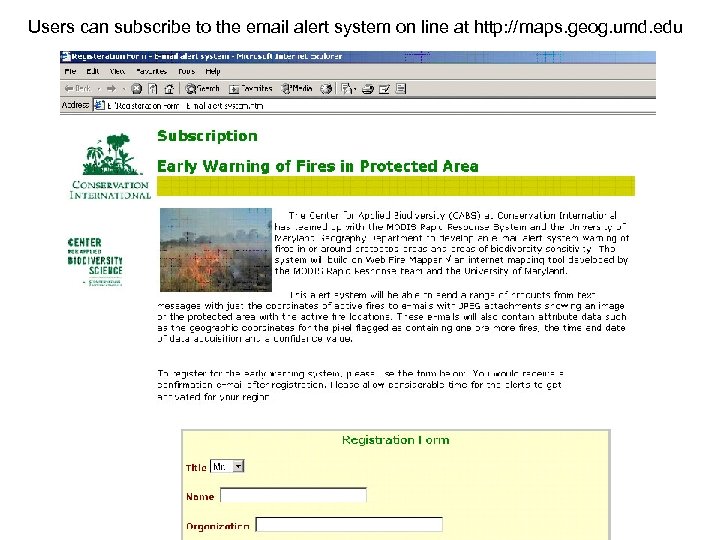
Users can subscribe to the email alert system on line at http: //maps. geog. umd. edu
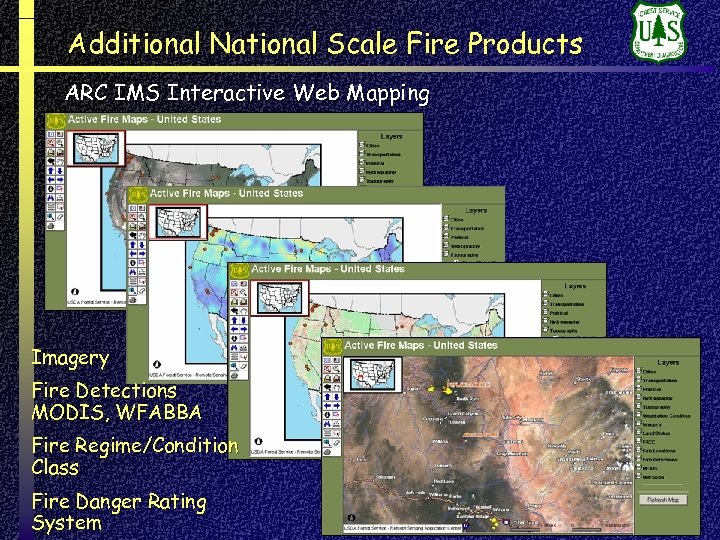
Additional National Scale Fire Products ARC IMS Interactive Web Mapping Imagery Fire Detections MODIS, WFABBA Fire Regime/Condition Class Fire Danger Rating System
Скачать презентацию GOFC GOLD — Fire Requirements for Fire Observations
aae20b0e1c0ce5750b6eaccc19db815a.ppt