


 Скачать презентацию GOES-R Program Overview and System Architecture Steven Kirkner
aeb90798fd06f2ac7f1120077fd50ce3.ppt
- Количество слайдов: 35
 GOES-R Program Overview and System Architecture Steven Kirkner GOES Program Manager May 10, 2004 GOES User’s Conference Broomfield, Colorado
 AGENDA • Program Mission • Program Challenges • Program Requirements • Program Improvements/Benefits • Program Baseline • Program Management • Summary
 GOES-R PROGRAM OFFICE Name Kirkner, Steve Title GOES Program Manager Phone Number. Ext 301 -713 -1055 161 Email Address steve. kirkner@noaa. gov Jenkins, Sarah Carson, Andrew Carson, Elizabeth Coakley, Monica Comeyne, Gus Dawkins, Stephen GOES Secretary HES & SIS Acquisitions Acquisition Program Manager Mission Requirements Space Segment Lead Budget Analyst 301 -713 -1055 301 -286 -0667 301 -713 -1055 781 -981 -0616 301 -713 -1055 171 166 sarah. jenkins@noaa. gov andrew. s. carson. 1@noaa. gov elizabeth. carson@noaa. gov mcoakley@ll. mit. edu gcomeyne@noaa. gov stephen. dawkins@noaa. gov Eckard, Maggie Flanagan, Dan Gray, Don Budget Manager ABI & SEISS Acquisitions Product Manager, Users Interface, Requirements Program Requirements Communications/Frequency Request Budget Analyst Ground Acquisitions System Engineer/Space System Engineer/Integration Frequency Request NOSA Liaison Contracting Officer Budget Analyst Document Manager Risk Manager Ground Acquisitions System Engineer/Ground. Segment Lead Calibration/Validation System Engineer/Integration 301 -713 -0088 164 301 -286 -3387 301 -713 -1055 160 margaret. eckard@noaa. gov daniel. g. flanagan. 1@noaa. gov donald. gray@noaa. gov 301 -713 -2789 301 -713 -0088 703 -610 -1733 301 -713 -1055 301 -713 -2789 301 -713 -4751 301 -713 -0088 301 -713 -1055 301 -902 -4660 703 -610 -1733 301 -713 -1055 james. gurka@noaa. gov roger. heymann@noaa. gov lisa. hurt@noaa. gov john. linn@noaa. gov michael. madden@noaa. gov daniel. may@noaa. gov dave. mcginnis@noaa. gov eric. miller@noaa. gov jay. moore@noaa. gov kesha. moses@noaa. gov john. prowell@noaa. gov adrian. rad@noaa. gov august. ryberg@mitretek. org kenneth. shere@noaa. gov les. shipley@noaa. gov michael. weinreb@noaa. gov david. zehr@noaa. gov Gurka, Jim Heymann, Roger Hurt Lisa Linn, John Madden, Michael May, Dan Mc. Ginnis, Dave Miller, Eric Moore, Jay Moses, Kesha Prowell, John Rad, Adrian Ryberg, Gus Shere, Ken Shipley, Les Weinreb, Michael Zehr, David 162 156 165 172 157 167 154 169 170 156 155
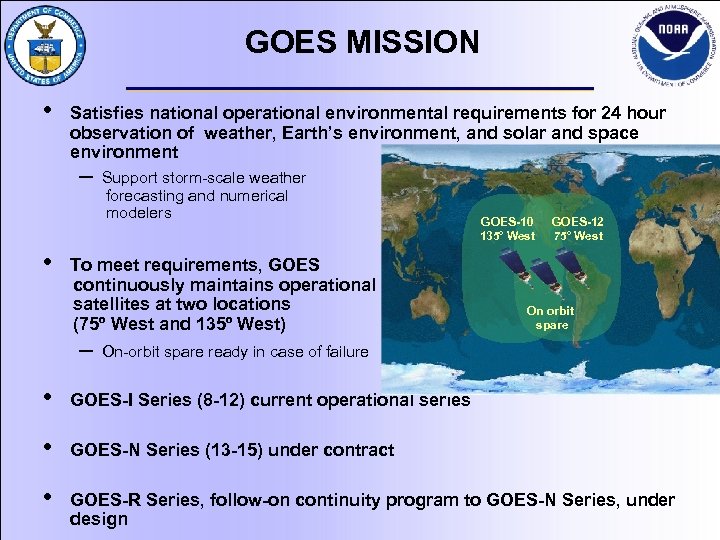 GOES MISSION • Satisfies national operational environmental requirements for 24 hour observation of weather, Earth’s environment, and solar and space environment – • Support storm-scale weather forecasting and numerical modelers To meet requirements, GOES continuously maintains operational satellites at two locations (75º West and 135º West) – GOES-10 135 o West GOES-12 75 o West On orbit spare On-orbit spare ready in case of failure • GOES-I Series (8 -12) current operational series • GOES-N Series (13 -15) under contract • GOES-R Series, follow-on continuity program to GOES-N Series, under design
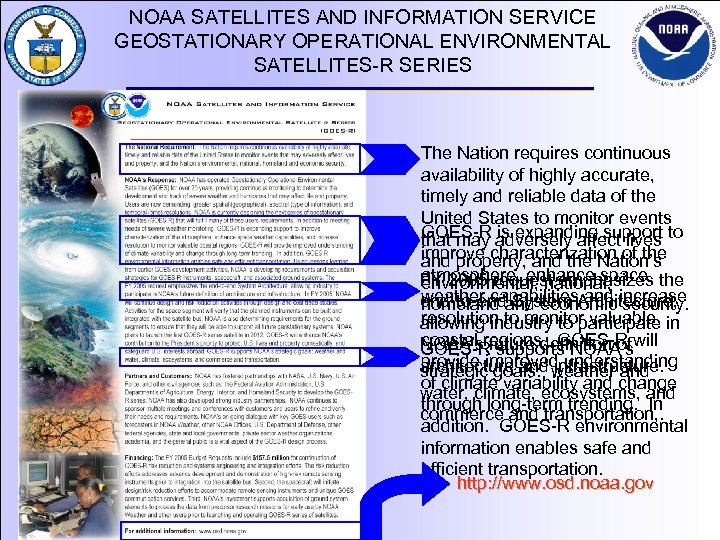 NOAA SATELLITES AND INFORMATION SERVICE GEOSTATIONARY OPERATIONAL ENVIRONMENTAL SATELLITES-R SERIES The Nation requires continuous availability of highly accurate, timely and reliable data of the United States to monitor events GOES-R adversely affect lives to that may is expanding support improve characterization of the and property, and the Nation’s atmosphere, enhance space FY 2005 request emphasizes the environmental, national, weather capabilities. Architecture, end-to-endand economic increase homeland System and security. resolution to monitor valuable allowing industry to participate in coastal NOAA’sregions. GOES-R will GOES-Rfuture definition of supports NOAA’s provide improved understanding architecture and weather and strategic goals: infrastructure. of climate variability and change water, climate, ecosystems, and through long-term trending. In commerce and transportation, . addition. GOES-R environmental information enables safe and efficient transportation. http: //www. osd. noaa. gov
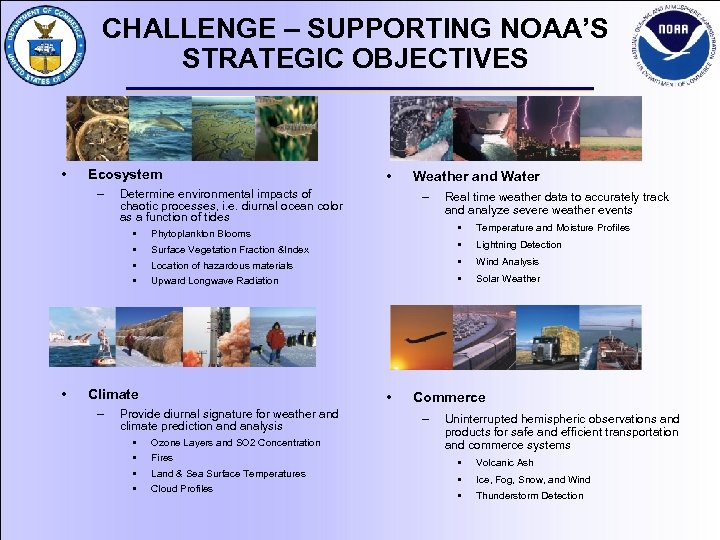 CHALLENGE – SUPPORTING NOAA’S STRATEGIC OBJECTIVES • Ecosystem – Determine environmental impacts of chaotic processes, i. e. diurnal ocean color as a function of tides • • • – Real time weather data to accurately track and analyze severe weather events • Temperature and Moisture Profiles Surface Vegetation Fraction &Index • Lightning Detection Location of hazardous materials • Wind Analysis Upward Longwave Radiation • Solar Weather • Provide diurnal signature for weather and climate prediction and analysis • • Weather and Water Phytoplankton Blooms Climate – • Ozone Layers and SO 2 Concentration Fires Land & Sea Surface Temperatures Cloud Profiles Commerce – Uninterrupted hemispheric observations and products for safe and efficient transportation and commerce systems • Volcanic Ash • Ice, Fog, Snow, and Wind • Thunderstorm Detection
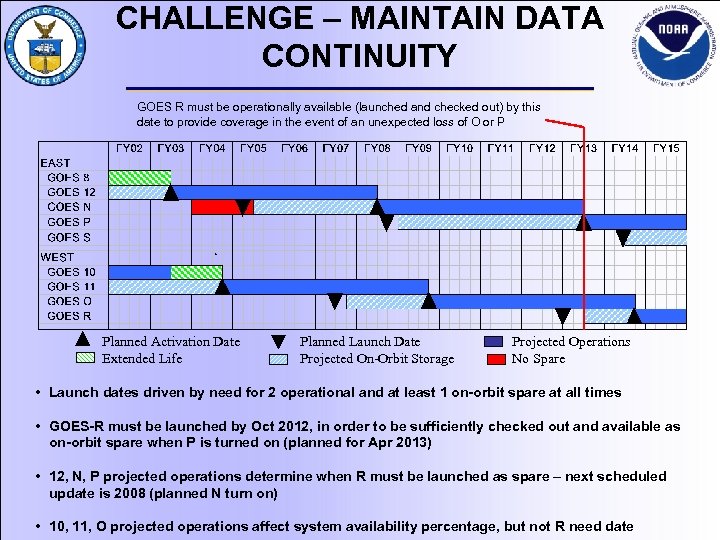 CHALLENGE – MAINTAIN DATA CONTINUITY GOES R must be operationally available (launched and checked out) by this date to provide coverage in the event of an unexpected loss of O or P Planned Activation Date Extended Life Planned Launch Date Projected On-Orbit Storage Projected Operations No Spare • Launch dates driven by need for 2 operational and at least 1 on-orbit spare at all times • GOES-R must be launched by Oct 2012, in order to be sufficiently checked out and available as on-orbit spare when P is turned on (planned for Apr 2013) • 12, N, P projected operations determine when R must be launched as spare – next scheduled update is 2008 (planned N turn on) • 10, 11, O projected operations affect system availability percentage, but not R need date
 CHALLENGE – BALANCED USER BENEFIT VS COST • Balance improvements to satisfy evolving user needs with affordable system cost • Include complete life cycle end-to-end costs in upfront planning to ensure decision makers have full understanding of system cost • Develop architectures that cost effectively handle large volumes of data required by users
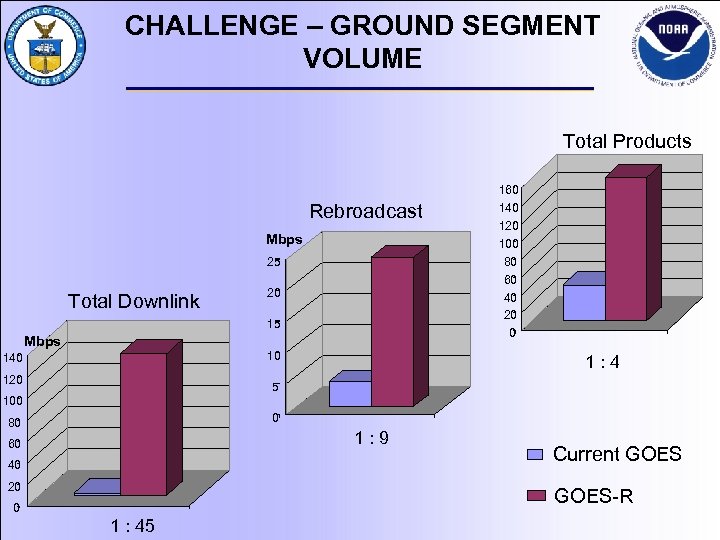 CHALLENGE – GROUND SEGMENT VOLUME Total Products Rebroadcast Mbps 25 Total Downlink 20 15 Mbps 0 10 140 120 160 140 120 100 80 60 40 20 1: 4 5 100 0 80 1: 9 60 40 20 Current GOES-R 0 1 : 45
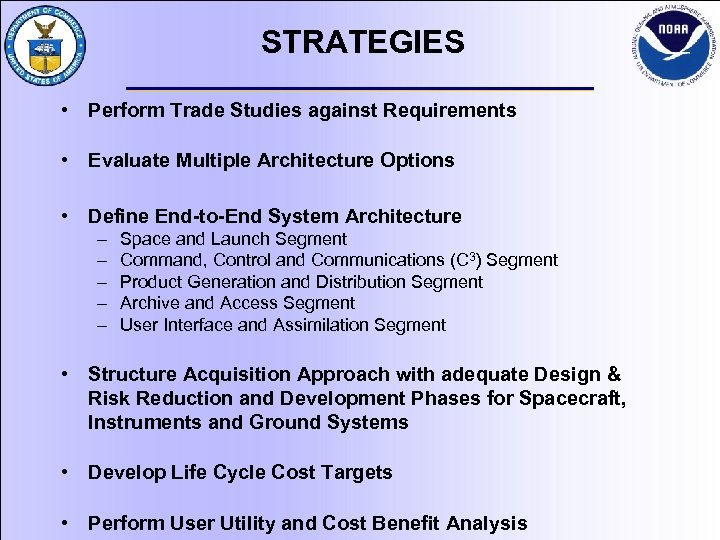 STRATEGIES • Perform Trade Studies against Requirements • Evaluate Multiple Architecture Options • Define End-to-End System Architecture – – – Space and Launch Segment Command, Control and Communications (C 3) Segment Product Generation and Distribution Segment Archive and Access Segment User Interface and Assimilation Segment • Structure Acquisition Approach with adequate Design & Risk Reduction and Development Phases for Spacecraft, Instruments and Ground Systems • Develop Life Cycle Cost Targets • Perform User Utility and Cost Benefit Analysis
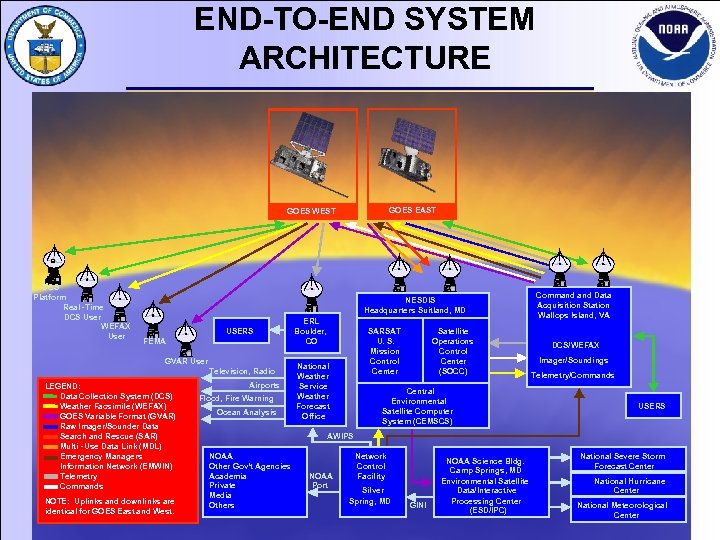 END-TO-END SYSTEM ARCHITECTURE GOES EAST GOES WEST DCS Platform Real - Time DCS User WEFAX User NESDIS Headquarters Suitland, MD USERS FEMA GVAR User Television, Radio LEGEND: Data Collection System (DCS) Weather Facsimile (WEFAX) GOES Variable Format (GVAR) Raw Imager/Sounder Data Search and Rescue (SAR) Multi - Use Data Link (MDL) Emergency Managers Information Network (EMWIN) Telemetry Commands NOTE: Uplinks and downlinks are identical for GOES East and West. Airports Flood, Fire Warning Ocean Analysis ERL Boulder, CO SARSAT U. S. Mission Control Center National Weather Service Weather Forecast Office Satellite Operations Control Center (SOCC) Central Environmental Satellite Computer System (CEMSCS) Command Data Acquisition Station Wallops Island, VA DCS/WEFAX Imager/Soundings Telemetry/Commands USERS AWIPS NOAA Other Gov’t Agencies Academia Private Media Others NOAA Port Network Control Facility Silver Spring, MD GINI NOAA Science Bldg. Camp Springs, MD Environmental Satellite Data/Interactive Processing Center (ESD/IPC) National Severe Storm Forecast Center National Hurricane Center National Meteorological Center
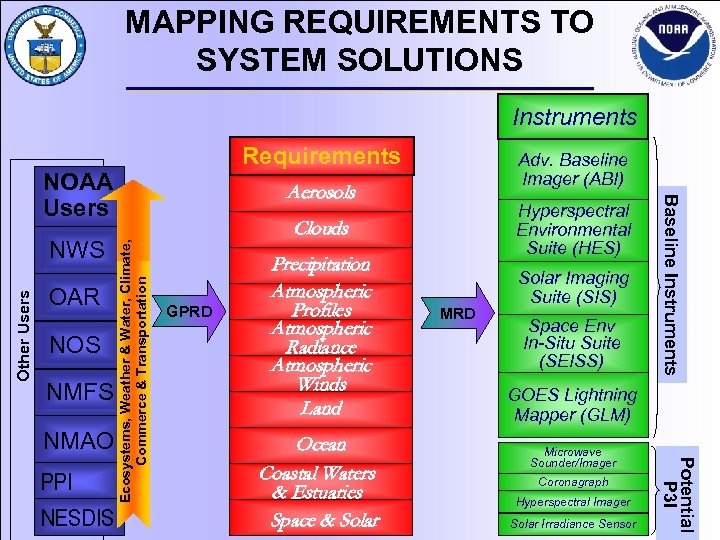 MAPPING REQUIREMENTS TO SYSTEM SOLUTIONS Instruments Requirements OAR NOS NMFS NMAO Hyperspectral Environmental Suite (HES) Clouds GPRD Precipitation Atmospheric Profiles Atmospheric Radiance Atmospheric Winds Land Ocean Coastal Waters & Estuaries Space & Solar MRD Solar Imaging Suite (SIS) Space Env In-Situ Suite (SEISS) GOES Lightning Mapper (GLM) Microwave Sounder/Imager Coronagraph Hyperspectral Imager Solar Irradiance Sensor Potential P 3 I PPI NESDIS Ecosystems, Weather & Water, Climate, Commerce & Transportation Other Users NWS Aerosols Baseline Instruments NOAA Users Adv. Baseline Imager (ABI)
 REQUIREMENTS • Extensive User Involvement – GOES User Conferences – 2001, 2002, and 2004 – Data User Conference – 2002, 2004 (upcoming) • GOES-R Program Requirements Document (GPRD) – Consolidate set of requirements to direct early system trades and ultimately system development – Incorporate all NOAA Line Office and Mission Goal Team Requirements • Validated by AAs and Goal Team leads – Coordinated with other federal and international agencies to help guide future potential collaborations • Mission Requirements Document (MRD) – Translates operational requirements into system acquisition requirements
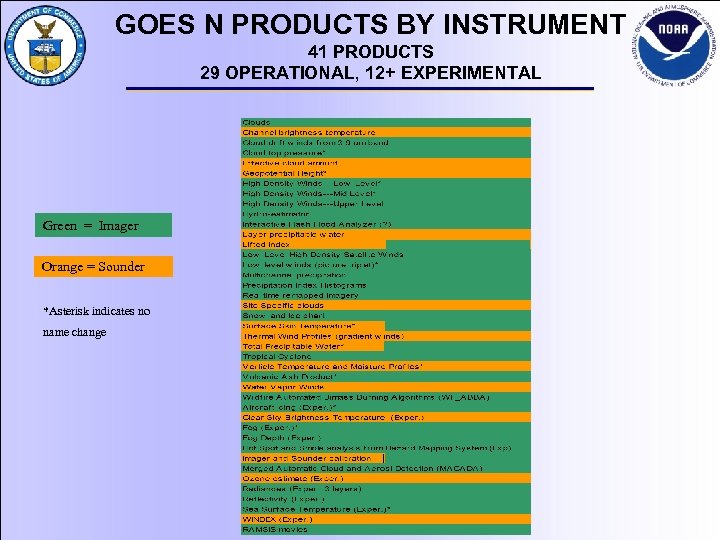 GOES N PRODUCTS BY INSTRUMENT 41 PRODUCTS 29 OPERATIONAL, 12+ EXPERIMENTAL Green = Imager Orange = Sounder *Asterisk indicates no name change
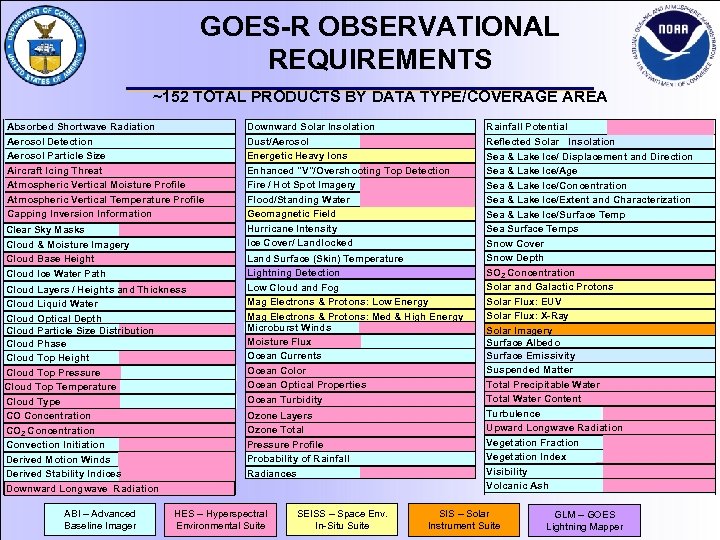 GOES-R OBSERVATIONAL REQUIREMENTS ~152 TOTAL PRODUCTS BY DATA TYPE/COVERAGE AREA Absorbed Shortwave Radiation Aerosol Detection Aerosol Particle Size Aircraft Icing Threat Atmospheric Vertical Moisture Profile Atmospheric Vertical Temperature Profile Capping Inversion Information Clear Sky Masks Cloud & Moisture Imagery Cloud Base Height Cloud Ice Water Path Cloud Layers / Heights and Thickness Cloud Liquid Water Cloud Optical Depth Cloud Particle Size Distribution Cloud Phase Cloud Top Height Cloud Top Pressure Cloud Top Temperature Cloud Type CO Concentration CO 2 Concentration Convection Initiation Derived Motion Winds Derived Stability Indices Downward Longwave Radiation ABI – Advanced Baseline Imager Downward Solar Insolation Dust/Aerosol Energetic Heavy Ions Enhanced "V"/Overshooting Top Detection Fire / Hot Spot Imagery Flood/Standing Water Geomagnetic Field Hurricane Intensity Ice Cover/ Landlocked Land Surface (Skin) Temperature Lightning Detection Low Cloud and Fog Mag Electrons & Protons: Low Energy Mag Electrons & Protons: Med & High Energy Microburst Winds Moisture Flux Ocean Currents Ocean Color Ocean Optical Properties Ocean Turbidity Ozone Layers Ozone Total Pressure Profile Probability of Rainfall Radiances HES – Hyperspectral Environmental Suite SEISS – Space Env. In-Situ Suite Rainfall Potential Reflected Solar Insolation Sea & Lake Ice/ Displacement and Direction Sea & Lake Ice/Age Sea & Lake Ice/Concentration Sea & Lake Ice/Extent and Characterization Sea & Lake Ice/Surface Temp Sea Surface Temps Snow Cover Snow Depth SO 2 Concentration Solar and Galactic Protons Solar Flux: EUV Solar Flux: X-Ray Solar Imagery Surface Albedo Surface Emissivity Suspended Matter Total Precipitable Water Total Water Content Turbulence Upward Longwave Radiation Vegetation Fraction Vegetation Index Visibility Volcanic Ash SIS – Solar Instrument Suite GLM – GOES Lightning Mapper
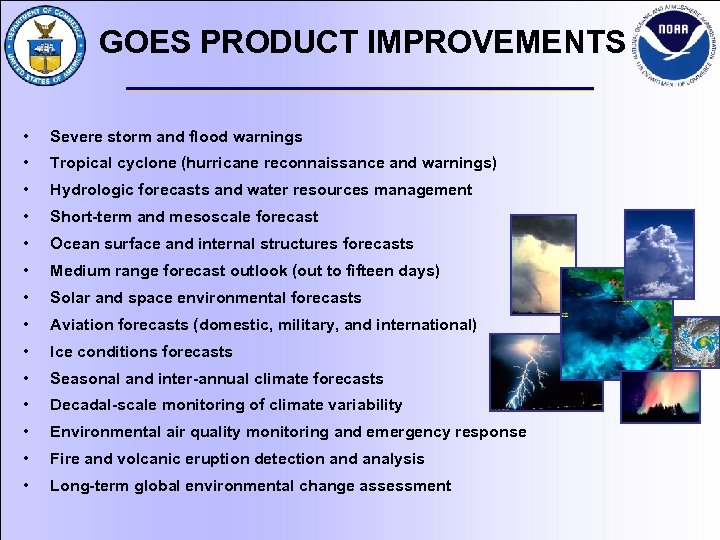 GOES PRODUCT IMPROVEMENTS • Severe storm and flood warnings • Tropical cyclone (hurricane reconnaissance and warnings) • Hydrologic forecasts and water resources management • Short-term and mesoscale forecast • Ocean surface and internal structures forecasts • Medium range forecast outlook (out to fifteen days) • Solar and space environmental forecasts • Aviation forecasts (domestic, military, and international) • Ice conditions forecasts • Seasonal and inter-annual climate forecasts • Decadal-scale monitoring of climate variability • Environmental air quality monitoring and emergency response • Fire and volcanic eruption detection and analysis • Long-term global environmental change assessment
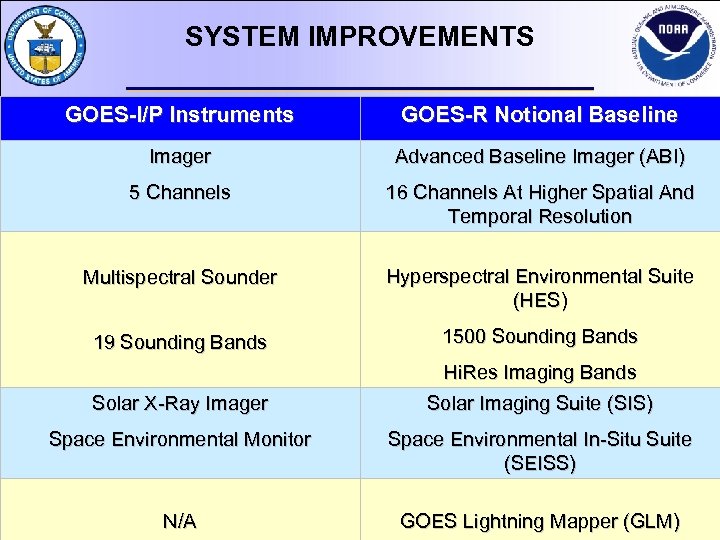 SYSTEM IMPROVEMENTS GOES-I/P Instruments GOES-R Notional Baseline Imager Advanced Baseline Imager (ABI) 5 Channels 16 Channels At Higher Spatial And Temporal Resolution Multispectral Sounder Hyperspectral Environmental Suite (HES) 19 Sounding Bands 1500 Sounding Bands Hi. Res Imaging Bands Solar X-Ray Imager Solar Imaging Suite (SIS) Space Environmental Monitor Space Environmental In-Situ Suite (SEISS) N/A GOES Lightning Mapper (GLM)
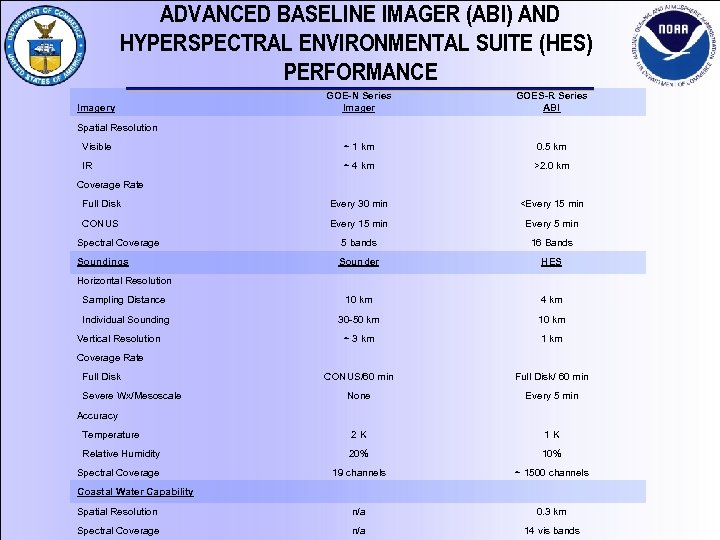 ADVANCED BASELINE IMAGER (ABI) AND HYPERSPECTRAL ENVIRONMENTAL SUITE (HES) PERFORMANCE GOE-N Series Imager GOES-R Series ABI Visible ~ 1 km 0. 5 km IR ~ 4 km >2. 0 km Full Disk Every 30 min
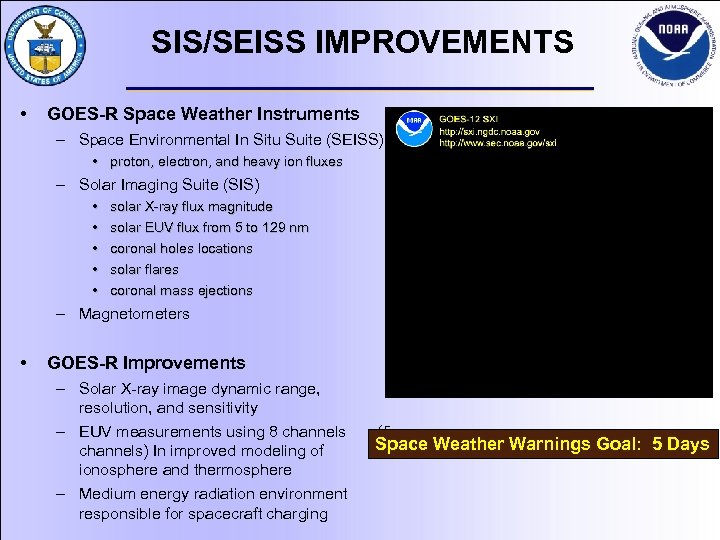 SIS/SEISS IMPROVEMENTS • GOES-R Space Weather Instruments – Space Environmental In Situ Suite (SEISS) • proton, electron, and heavy ion fluxes – Solar Imaging Suite (SIS) • • • solar X-ray flux magnitude solar EUV flux from 5 to 129 nm coronal holes locations solar flares coronal mass ejections – Magnetometers • GOES-R Improvements – Solar X-ray image dynamic range, resolution, and sensitivity – EUV measurements using 8 channels) In improved modeling of ionosphere and thermosphere – Medium energy radiation environment responsible for spacecraft charging (5 Space Weather Warnings Goal: 5 Days
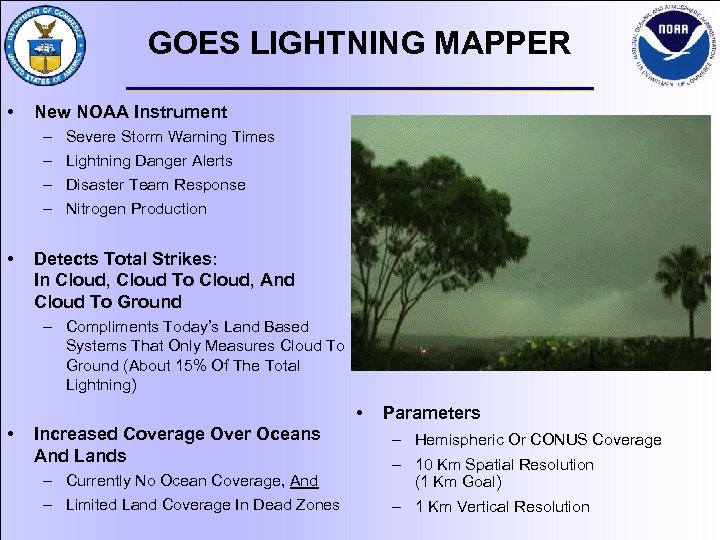 GOES LIGHTNING MAPPER • New NOAA Instrument – – • Severe Storm Warning Times Lightning Danger Alerts Disaster Team Response Nitrogen Production Detects Total Strikes: In Cloud, Cloud To Cloud, And Cloud To Ground – Compliments Today’s Land Based Systems That Only Measures Cloud To Ground (About 15% Of The Total Lightning) • • Increased Coverage Over Oceans And Lands – Currently No Ocean Coverage, And – Limited Land Coverage In Dead Zones Parameters – Hemispheric Or CONUS Coverage – 10 Km Spatial Resolution (1 Km Goal) – 1 Km Vertical Resolution
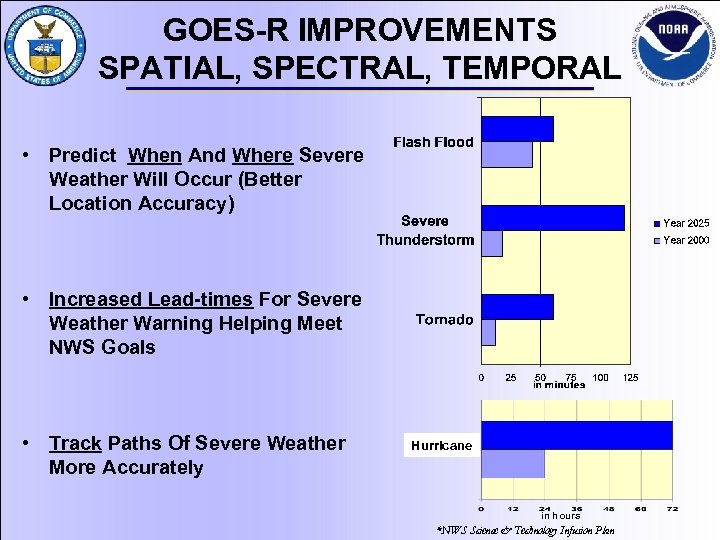 GOES-R IMPROVEMENTS SPATIAL, SPECTRAL, TEMPORAL • Predict When And Where Severe Weather Will Occur (Better Location Accuracy) • Increased Lead-times For Severe Weather Warning Helping Meet NWS Goals • Track Paths Of Severe Weather More Accurately Hurricane in hours *NWS Science & Technology Infusion Plan
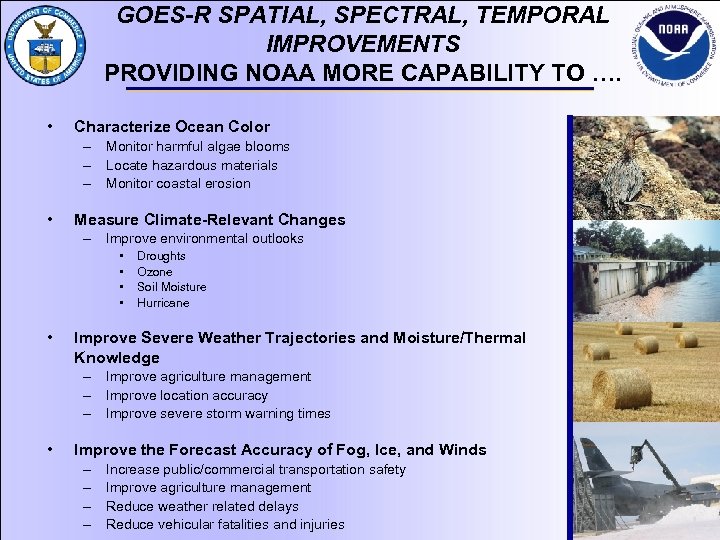 GOES-R SPATIAL, SPECTRAL, TEMPORAL IMPROVEMENTS PROVIDING NOAA MORE CAPABILITY TO …. • Characterize Ocean Color – Monitor harmful algae blooms – Locate hazardous materials – Monitor coastal erosion • Measure Climate-Relevant Changes – Improve environmental outlooks • • • Droughts Ozone Soil Moisture Hurricane Improve Severe Weather Trajectories and Moisture/Thermal Knowledge – Improve agriculture management – Improve location accuracy – Improve severe storm warning times • Improve the Forecast Accuracy of Fog, Ice, and Winds – – Increase public/commercial transportation safety Improve agriculture management Reduce weather related delays Reduce vehicular fatalities and injuries
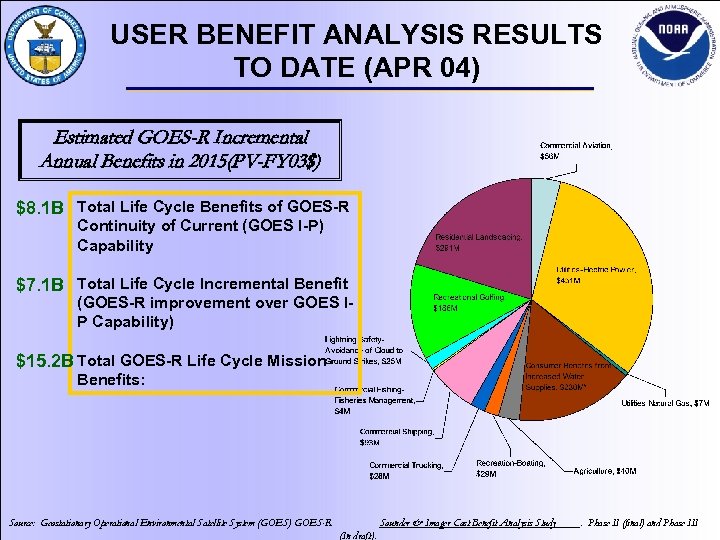 USER BENEFIT ANALYSIS RESULTS TO DATE (APR 04) Estimated GOES-R Incremental Annual Benefits in 2015(PV-FY 03$) $8. 1 B Total Life Cycle Benefits of GOES-R Continuity of Current (GOES I-P) Capability $7. 1 B Total Life Cycle Incremental Benefit (GOES-R improvement over GOES IP Capability) $15. 2 B Total GOES-R Life Cycle Mission Benefits: Source: Geostationary Operational Environmental Satellite System (GOES) GOES-R Sounder & Imager Cost Benefit Analysis Study (In draft). . Phase II (final) and Phase III
 ACQUISITION APPROACH • Architecture Studies – Twelve Contractors – Fixed Price Contracts (FY 04/05) • • • Initiate End-to-End Integration Studies Identify Risk Factors Develop Life Cycle Cost Estimate Assess Distributed, Consolidated, and Other Constellations in addition to System-level and Ground Segment Architectures Design and Risk Reduction Phase – Two to Three Contractors per effort – Fixed Price Contracts (FY 02 -06) • • Development Of Detailed Concept Designs And Higher Fidelity Cost Models Performs Accommodation and Trade Studies Identifies Risk Development and Production Phase – One Contractor per effort – Cost Plus Award Fee (FY 04 -22) • • Refines design development Begins approximately 1 year prior to Preliminary Design Review Delivers Engineering Model (Prototype) and Flight Models Supports through last planned launch date, Apr 22
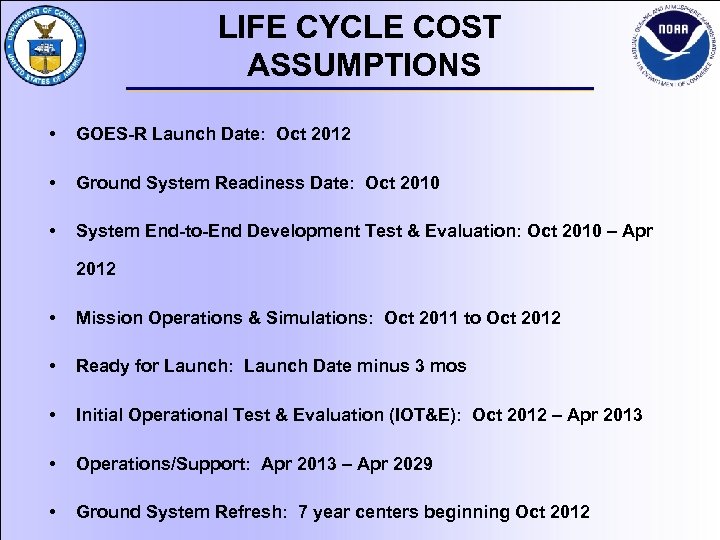 LIFE CYCLE COST ASSUMPTIONS • GOES-R Launch Date: Oct 2012 • Ground System Readiness Date: Oct 2010 • System End-to-End Development Test & Evaluation: Oct 2010 – Apr 2012 • Mission Operations & Simulations: Oct 2011 to Oct 2012 • Ready for Launch: Launch Date minus 3 mos • Initial Operational Test & Evaluation (IOT&E): Oct 2012 – Apr 2013 • Operations/Support: Apr 2013 – Apr 2029 • Ground System Refresh: 7 year centers beginning Oct 2012
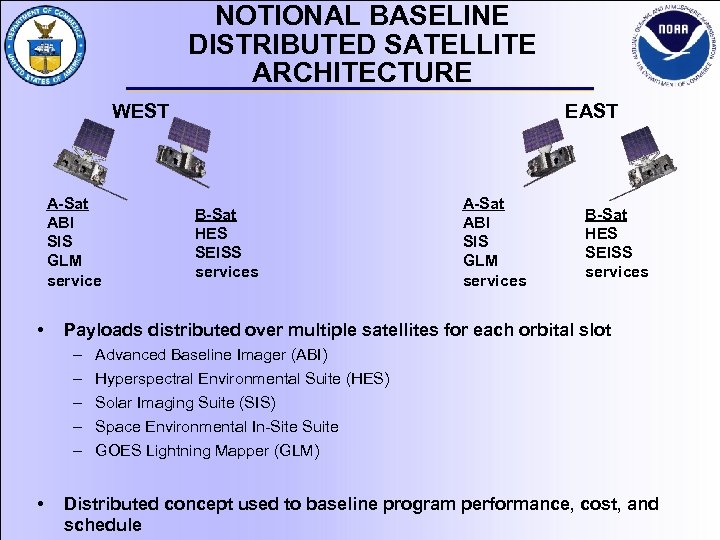 NOTIONAL BASELINE DISTRIBUTED SATELLITE ARCHITECTURE WEST A-Sat ABI SIS GLM service • B-Sat HES SEISS services A-Sat ABI SIS GLM services B-Sat HES SEISS services Payloads distributed over multiple satellites for each orbital slot – – – • EAST Advanced Baseline Imager (ABI) Hyperspectral Environmental Suite (HES) Solar Imaging Suite (SIS) Space Environmental In-Site Suite GOES Lightning Mapper (GLM) Distributed concept used to baseline program performance, cost, and schedule
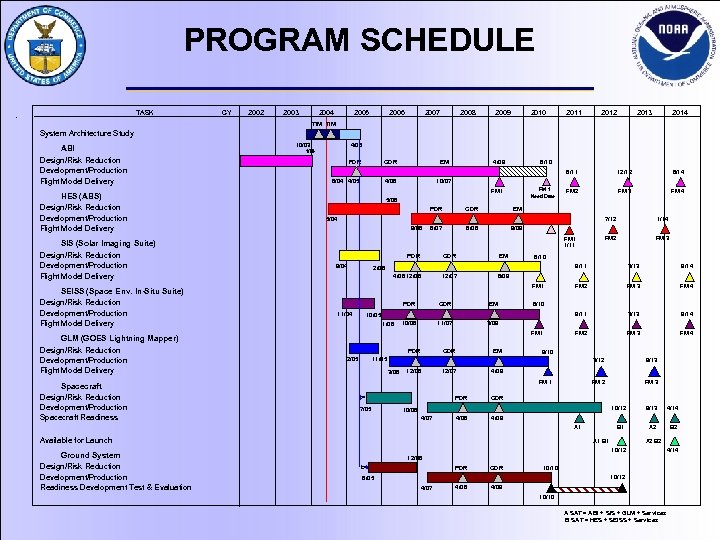 PROGRAM SCHEDULE TASK CY 2002 2003 2004 2005 2006 2007 2008 2009 2010 2011 2012 2013 2014 TIM System Architecture Study ABI Design/Risk Reduction Development/Production Flight Model Delivery HES (ABS) Design/Risk Reduction Development/Production Flight Model Delivery SIS (Solar Imaging Suite) Design/Risk Reduction Development/Production Flight Model Delivery SEISS (Space Env. In-Situ Suite) Design/Risk Reduction Development/Production Flight Model Delivery GLM (GOES Lightning Mapper) Design/Risk Reduction Development/Production Flight Model Delivery Spacecraft Design/Risk Reduction Development/Production Spacecraft Readiness 10/03 4/05 1/04 PDR CDR EM 8/04 4/05 4/06 10/07 4/09 8/10 6/11 FM 1 Need Date FM 1 5/06 PDR CDR 6/08 6/14 FM 2 FM 3 FM 4 EM 6/07 12/12 9/09 5/04 7/12 9/06 FM 2 FM 1 1/11 PDR CDR EM 4/06 12/06 9/04 12/07 6/09 9/11 CDR EM 1/06 10/06 11/07 3/13 9/14 FM 2 FM 3 FM 4 9/11 PDR 3/13 9/14 FM 2 FM 3 FM 4 3/09 6/10 10/05 FM 1 PDR 2/05 CDR EM 12/06 12/07 4/09 9/10 11/05 3/12 3/06 PDR FM 3 CDR 4/08 9/13 FM 2 FM 1 7/05 FM 3 6/10 2/06 FM 1 11/04 1/14 4/09 10/12 10/06 4/07 A 1 Available for Launch Ground System Design/Risk Reduction Development/Production Readiness Development Test & Evaluation B 1 A 1 B 1 9/13 4/14 A 2 B 2 10/12 4/14 12/06 PDR CDR 4/08 4/09 10/10 10/12 8/05 4/07 10/10 A SAT = ABI + SIS + GLM + Services B SAT = HES + SEISS + Services
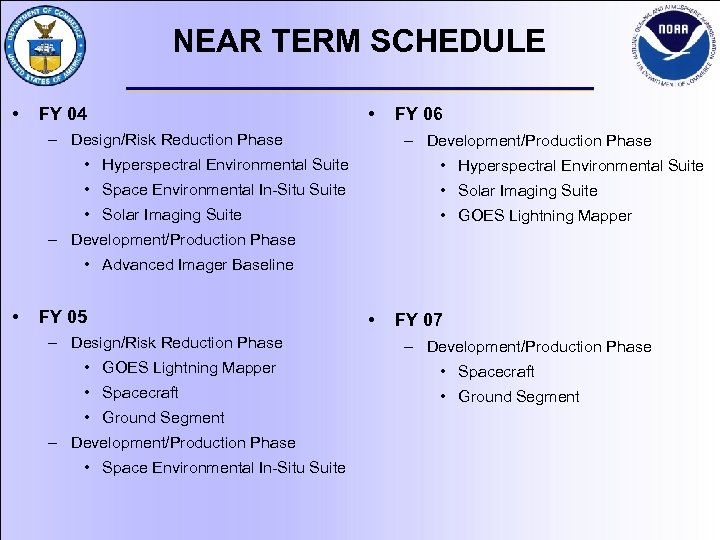 NEAR TERM SCHEDULE • FY 04 • – Design/Risk Reduction Phase FY 06 – Development/Production Phase • Hyperspectral Environmental Suite • Space Environmental In-Situ Suite • Solar Imaging Suite • GOES Lightning Mapper – Development/Production Phase • Advanced Imager Baseline • FY 05 – Design/Risk Reduction Phase • FY 07 – Development/Production Phase • GOES Lightning Mapper • Spacecraft • Ground Segment – Development/Production Phase • Space Environmental In-Situ Suite
 GOES-R INTEGRATED MANAGEMENT PLAN • Integrated Program Management and Acquisition Plan – Program Mission, Background, Objectives – System Description Overview – Configuration Management Status – Test and Evaluation Strategy – Logistics Engineering Concept – Risk Management Status – Acquisition Strategy – Project Management Plan – Financial Management Strategy • Appendix Plans – Requirements Plan – in process – System Engineering Plan – not started – Test and Evaluation Master Plan – in process – Risk Management Plan – completed Jan 04 – Configuration Management Plan – scheduled completion for May 04 – Program Office Communications Plan – not started – Quality Plan – not started – Exhibit 300 – updated annually
 GOES-R RISK REDUCTION PLAN • Investigation of the GOES-R derived meteorological, oceanic, and terrestrial products and their operational utility – Assure the viability of GOES-R products – Develop advanced products – Ensure timely efficient integration of the improvements into NWS, NESDIS, and other NOAA Line Office operations • Efforts over the next decade to develop, evaluate, and validate the GOES-R products and to prepare the user community • Addresses Algorithm Development, Data Assimilation & Model Impact Tests, User Familiarization, and other tasks • Covers FY 04 through FY 12 with budget allocations • Provides the interface between the Program Office and the Users’ Community
 CAL/VAL WORKING GROUP • Provide technical guidance/recommendations in the area of radiometric performance – Design of radiometric/calibration sub-systems of the sensors – Generation of a pre-launch test plan for sensor calibration and characterization, including methods for assuring traceability to international standards. – Evaluation of radiometric performance waivers – Analysis of data from pre-launch tests – Compilation of on-orbit calibration databases – Post-launch checkout of radiometric performance – Long-term monitoring and archiving of on-orbit radiometric performance • Assure that the GOES-R instruments produce data on orbit that satisfy NOAA’s scientific requirements for environmental monitoring
 GOES-R EDUCATIONAL TOOLS • Develop tools to educate people on the GOES-R End-to-End System - Booklet w/ standup capability - 2 page Glossy - Movie - Poster - GOES-R Road Show - National Geographic: Writing a “Remote Sensing Satellites” chapter for the NG “Exploring Space Encyclopedia” - The Weather Channel - Aerospace “Crosstalk” dedicated issue - Program Folder
 PROGRAM EMPHASIS • Continuity of a Oct 2012 Launch • Crosscuts NOAA 4 Mission Goals • End-to-End System • Risk Reduction Program • Cost Benefit (Cost/Sat Year) • Ties to the NOAA/National/International Observing System • Scheduled Incremental Upgrades (Ground/Space) to meet the User’s evolving needs (Pre-Planned Product Improvements) • GEO, Polar, and other NOAA Sensing Platforms complimentary contributions to NOAA requirements
 SUMMARY GOES-R series Architecture and Design Trades Proceeding – Initial requirements have been established – Architecture Studies have completed mid-term reviews – Continuing to release Design/Risk Reduction Phase RFPs to evaluate next level of trades – Releasing first Production/Development (Hardware phase) contract this summer • Defining GOES-R Risk Reduction Plans with Research and Algorithm development community • Program Plans are under development • Baseline Budget and Schedule are established
 GOES-R IMPROVEMENTS Provide NOAA More Capability … To Describe And Predict The Earth’s Environment To Conserve And Manage The Nation’s Natural Resources Leading To The …. Protection of LIVES, PROPERTY, and the ENVIRONMENT