


 Скачать презентацию GOES-R AWG Product Validation Tool Development Fire Detection
48d94f87b86eb2d1fe880cd6d5e0f99b.ppt
- Количество слайдов: 18
 GOES-R AWG Product Validation Tool Development Fire Detection and Characterization Application Team Christopher Schmidt (CIMSS) Ivan Csiszar (STAR) Wilfrid Schroeder (CICS/UMD) 1
 OUTLINE • Products • Validation Strategies • Routine Validation Tools • “Deep-Dive” Validation Tools • Ideas for the Further Enhancement and Utility of Validation Tools • Summary 2
 Products Fire detection and characterization algorithm properties: • Refresh rate: 5 minute CONUS, 15 minute full disk • Resolution: 2 km • Coverage: CONUS, full disk • ABI version of the current GOES Wildfire Automated Biomass Burning Algorithm (WF_ABBA) • Product outputs: – Fire location – Fire instantaneous size, temperature, and radiative power – Metadata mask including information about opaque clouds, solar reflection block-out zones, unusable ecosystem types. 3
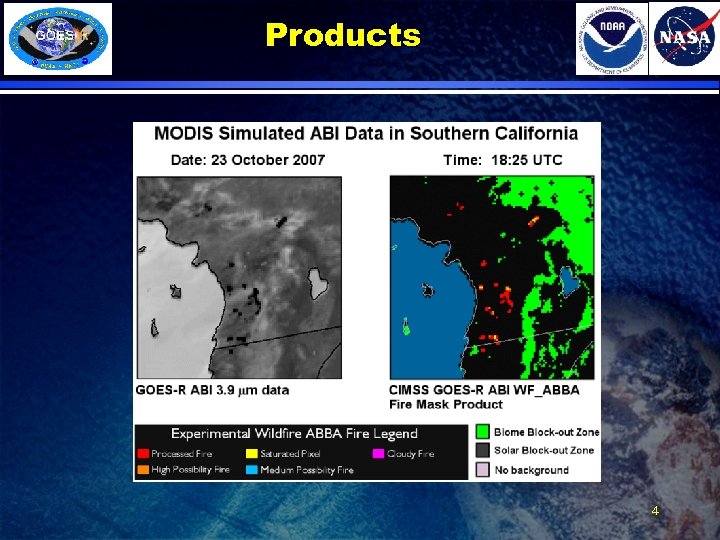 Products 4
 Validation Strategies FDCA Routine Validation Current practice for GOES WF_ABBA: No automated realtime method is available. Groundbased fire reports are incomplete and typically not available in realtime. At the Hazard Mapping System Human operators look at fire detections from various satellites and at satellite imagery to remove potential false alarms. This method is labor intensive and actual fire pixels are often removed. 5
 Validation Strategies FDCA Routine Validation ABI near realtime validation: • Co-locate ABI fire pixels with other satellite data • Ground-based datasets tend to be incomplete and not available in realtime • Fire detections from other satellites (polar orbiting) can be used in near realtime • Perfect agreement is not expected. Due to resolution, viewing angle, and sensor property differences a substantial number of valid fires will be seen by only one platform • Other fire properties (instantaneous fire size, temperature, and radiative power) have no available near realtime validation source (see Deep-Dive tools) • Important note: the product requirement does not align with user expectations. The requirement states: “ 2. 0 K brightness temperature within dynamic range (275 K to 400 K)” This applies to a pixel brightness temperature, and the algorithm achieves it for 100% of the fires where fire characteristics are calculated. When used to recalculate the input brightness temperature the fire characteristics match the input data to better than 0. 0001 K. 6
 Validation Strategies FDCA Validation Tools Routine validation tools: • Perform co-locations for individual fires and for clusters of fires • Provide statistics on matches • Table on following slide shows example of routine statistics from modelgenerated proxy data cases. 75 MW of fire radiative power is the estimated threshold for fire detectability. Deep-Dive validation tools: • Allow for validation of fire location and properties • Utilize high-resolution data from satellite or aircraft to provide fire locations and enable estimates of fire size, temperature, and radiative power • Can be partially automated, availability of high resolution data is limiting factor 7
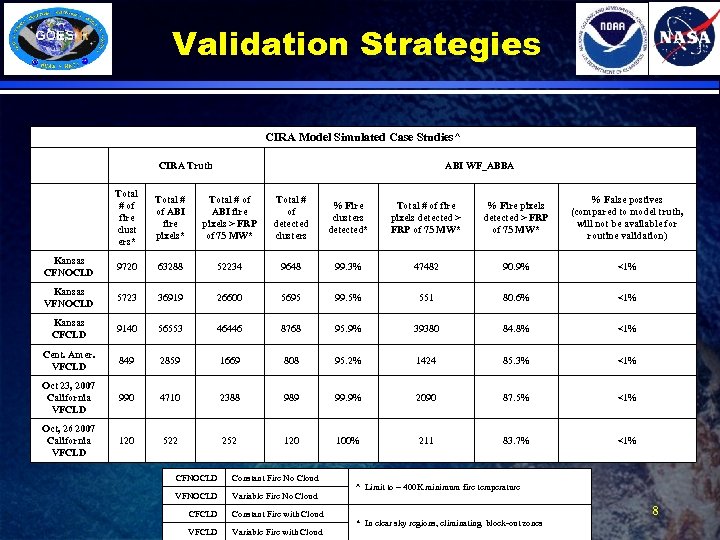 Validation Strategies CIRA Model Simulated Case Studies^ CIRA Truth ABI WF_ABBA Total # of fire clust ers* Total # of ABI fire pixels > FRP of 75 MW* Total # of detected clusters % Fire clusters detected* Total # of fire pixels detected > FRP of 75 MW* % False postives (compared to model truth, will not be available for routine validation) Kansas CFNOCLD 9720 63288 52234 9648 99. 3% 47482 90. 9% <1% Kansas VFNOCLD 5723 36919 26600 5695 99. 5% 551 80. 6% <1% Kansas CFCLD 9140 56553 46446 8768 95. 9% 39380 84. 8% <1% Cent. Amer. VFCLD 849 2859 1669 808 95. 2% 1424 85. 3% <1% Oct 23, 2007 California VFCLD 990 4710 2388 989 99. 9% 2090 87. 5% <1% Oct, 26 2007 California VFCLD 120 522 252 120 100% 211 83. 7% <1% CFNOCLD Constant Fire No Cloud VFNOCLD Variable Fire No Cloud CFCLD Constant Fire with Cloud VFCLD Variable Fire with Cloud ^ Limit to ~ 400 K minimum fire temperature 8 * In clear sky regions, eliminating block-out zones 8
 ”Deep-Dive” Validation Tools • Deep-dive fire detection and characterization validation tool builds on methods originally developed for MODIS and GOES Imager – Use of near-coincident (<15 min) Landsat-class and airborne data to generate sub -pixel summary statistics of fire activity • Landsat-class data are used to assess fire detection performance – History of successful applications using ASTER, Landsat TM and ETM+ to estimate MODIS and GOES fire detection probabilities and commission error rates (false alarms). Methods published in seven peer reviewed journal articles – Limited fire characterization assessment (approximate fire size only). Frequent pixel saturation and lack of middle infrared band prevent assessment of ABI’s fire characterization parameters • Airborne sensors are used to assess fire characterization accuracy – High quality middle-infrared bands provide fine resolution data (<10 m) with minimum saturation allowing full assessment of ABI’s fire characterization parameters (size, temperature, Fire Radiative Power) – Sampling is limited compared to Landsat-class data » » • Regional × hemispheric/global coverage Targeting case-study analyses Validation routines developed in IDL – Perform reference data co-location – Run pixel-based validation (relate ABI pixels with presence (amount) or absence of fire activity as indicated by near-coincident reference data) – Create outputs (graphic and tabular) • Proxy data generator developed in IDL and Mc. IDAS – Using input MODIS 1 km L 1 B radiance data – Testing alternative method using input 30 m ASTER data: goal is to improve sub 9 pixel representation of fires not resolved by 1 km MODIS L 1 B data
 ”Deep-Dive” Validation Tools • Several national and international assets will be used to support ABI fire validation – – – USGS Landsat Data Continuity Mission (2013) ESA Sentinel-2 (2013) DLR BIROS (2013) NASA Hys. PIRI (TBD ~2020) Airborne platforms (NASA/Ames Autonomous Modular Sensor-Wildfire; USFS Fire. Mapper) • Will perform continuous assimilation, processing and archival of reference fire data sets – Daily alerts targeting false alarms, omission of large fires • Main output: Quick looks (PNG) for visual inspection of problem areas showing ABI pixels overlaid on high resolution reference imagery – Probability of detection curves and commission error rates derived from several weeks/months of accumulated validation data • Main output: Tabular (ASCII) data containing pixel-based validation summary (graphic output optional) 10
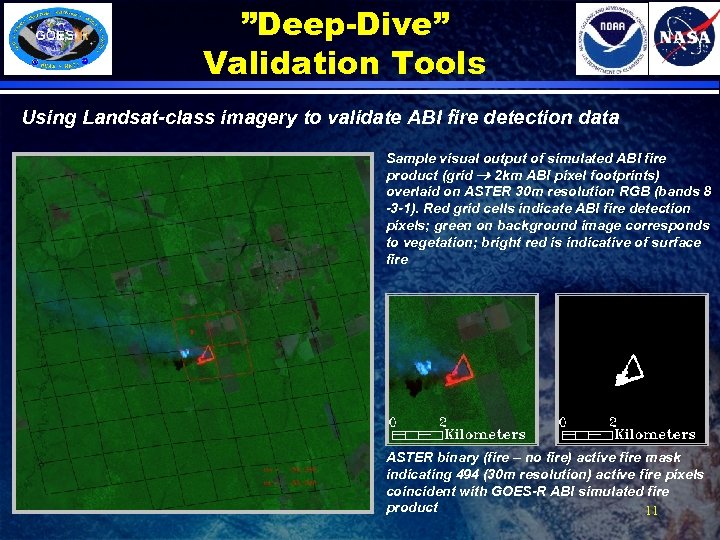 ”Deep-Dive” Validation Tools Using Landsat-class imagery to validate ABI fire detection data Sample visual output of simulated ABI fire product (grid 2 km ABI pixel footprints) overlaid on ASTER 30 m resolution RGB (bands 8 -3 -1). Red grid cells indicate ABI fire detection pixels; green on background image corresponds to vegetation; bright red is indicative of surface fire ASTER binary (fire – no fire) active fire mask indicating 494 (30 m resolution) active fire pixels coincident with GOES-R ABI simulated fire product 11
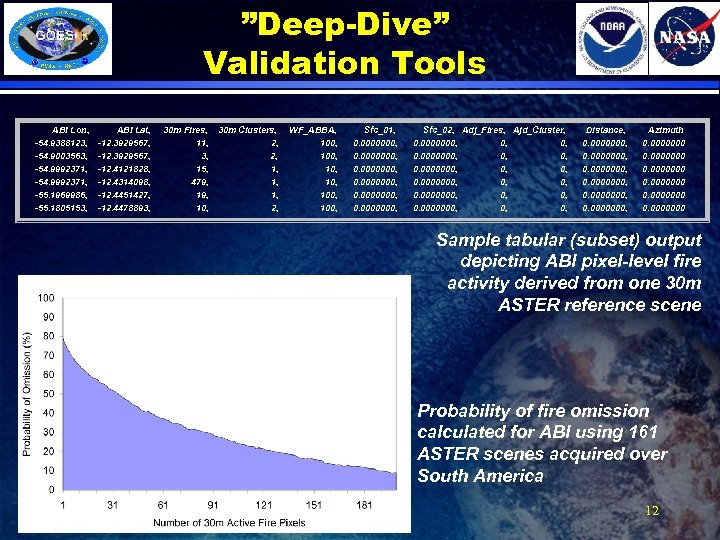 ”Deep-Dive” Validation Tools ABI Lon, -54. 9388123, -54. 9003563, -54. 9992371, -55. 1969986, -55. 1805153, ABI Lat, -12. 3929567, -12. 4121828, -12. 4314098, -12. 4451427, -12. 4478893, 30 m Fires, 11, 3, 15, 479, 10, 30 m Clusters, 2, 2, 1, 1, 1, 2, WF_ABBA, 100, 10, 100, Sfc_01, 0. 0000000, Sfc_02, Adj_Fires, Ajd_Cluster, 0. 0000000, 0, 0, Distance, 0. 0000000, Azimuth 0. 0000000 Sample tabular (subset) output depicting ABI pixel-level fire activity derived from one 30 m ASTER reference scene Probability of fire omission calculated for ABI using 161 ASTER scenes acquired over South America 12
 ”Deep-Dive” Validation Tools • Landsat-class data are NOT suited for the validation of ABI fire characterization parameters (Fire Radiative Power (FRP), size and temperature) – Frequent fire pixel saturation – Lack of middle-infrared band • Cross-validation of pixel-level fire characterization data using other similar satellite products proven impractical [Schroeder et al. , 2010] – No single product has been sufficiently validated to date therefore crossvalidation analyses provide little useful information – Differences in resolution and observation geometry are problematic 13
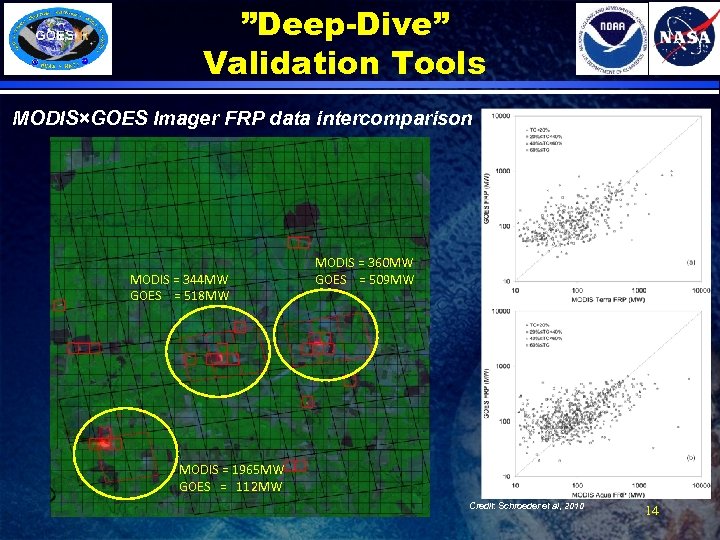 ”Deep-Dive” Validation Tools MODIS×GOES Imager FRP data intercomparison MODIS = 344 MW GOES = 518 MW MODIS = 360 MW GOES = 509 MW MODIS = 1965 MW GOES = 112 MW Credit: Schroeder et al, 2010 14
 ”Deep-Dive” Validation Tools • Data simulation is prone to misrepresent sub-pixel features in fireaffected pixels – Lack of quality reference data lead to overly simplistic (unrealistic) fire pixel representation • Airborne sensors provide fine resolution quality fire reference data – Support detailed analyses of fire characterization retrievals (testcase) – Airborne data can help us better constrain data simulation 15
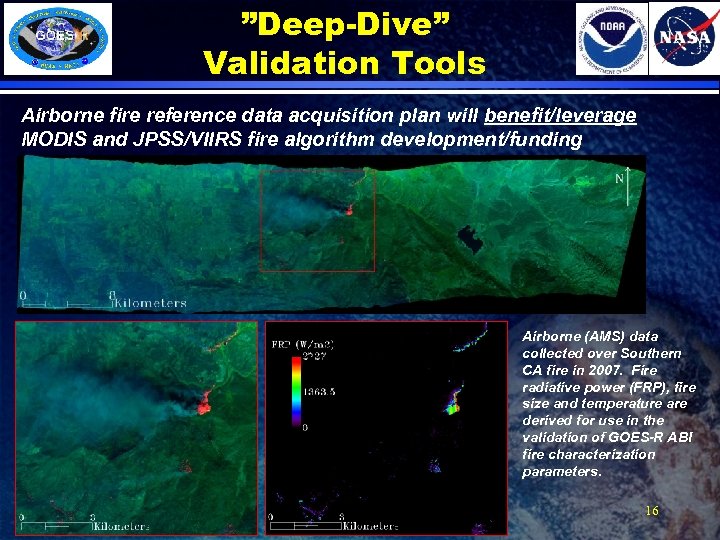 ”Deep-Dive” Validation Tools Airborne fire reference data acquisition plan will benefit/leverage MODIS and JPSS/VIIRS fire algorithm development/funding Airborne (AMS) data collected over Southern CA fire in 2007. Fire radiative power (FRP), fire size and temperature are derived for use in the validation of GOES-R ABI fire characterization parameters. 16
 Ideas for the Further Enhancement and Utility of Validation Tools • Off-line (IDL) interface would greatly improve management of reference data sets for use in the fire product validation – Data sources are dynamic: new data sets may be added, others may be modified, reference sensors can fail partially or completely (e. g. , ASTER, ETM+) requiring quick adaptation – Data formats can vary significantly depending on the provider – Off-line processor could add flexibility and agility to system • Built-in IDL functions could minimize implementation costs of new or modified modules using specific data formats • Would create standard reference data files for use as input by the core deep-dive fire validation tool – Eliminate need to modify on-line code – Operational risks are reduced – Reprocessing of revised input reference data could be more easily implemented • • • Must secure ways to maintain off-line system running and to perform updates Techniques are applicable to reprocessed ABI data Deep-dive tools could be automated presuming regularly available high resolution data sources are secured New development could include a web tool that allows interactive comparison of fire datasets from different satellites, including fire properties and metadata Further extension of that tool would allow comparisons with high resolution data used in the deep-dive tools, showing ABI pixels and fires overlaid on the high resolution data (similar to graphic on earlier slide) 17
 Summary • Fire detection and characterization is a baseline product derived from a current Operational fire algorithm, the WF_ABBA • Routine validation consists of co-locating ABI detected fires with those from polar orbiting platforms (JPSS, for example). Current tools developed in IDL. • Deep-dive tools utilize high resolution data from satellite instruments similar to ASTER and could conceivably be automated if a reliable source of high resolution data is secured 18