


 Скачать презентацию Goals and Status of MICE the international Muon
9686c3534f1b11fe3b8d23d47d14b72e.ppt
- Количество слайдов: 28
 Goals and Status of MICE the international Muon Ionization Cooling Experiment Henry Nebrensky (Brunel University) mis-representing the MICE Collaboration (http: //mice. iit. edu/) i. NEx. T – Henry Nebrensky – 24 September 2010 slide 1 1
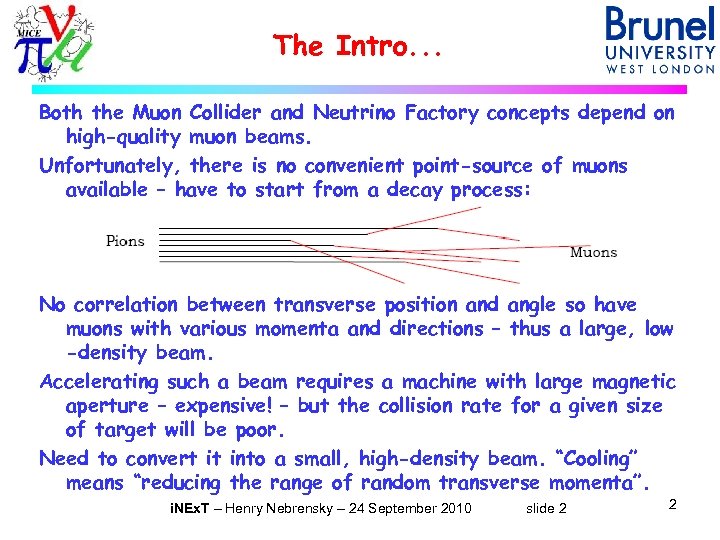 The Intro. . . Both the Muon Collider and Neutrino Factory concepts depend on high-quality muon beams. Unfortunately, there is no convenient point-source of muons available – have to start from a decay process: No correlation between transverse position and angle so have muons with various momenta and directions – thus a large, low -density beam. Accelerating such a beam requires a machine with large magnetic aperture – expensive! – but the collision rate for a given size of target will be poor. Need to convert it into a small, high-density beam. “Cooling” means “reducing the range of random transverse momenta”. i. NEx. T – Henry Nebrensky – 24 September 2010 slide 2 2
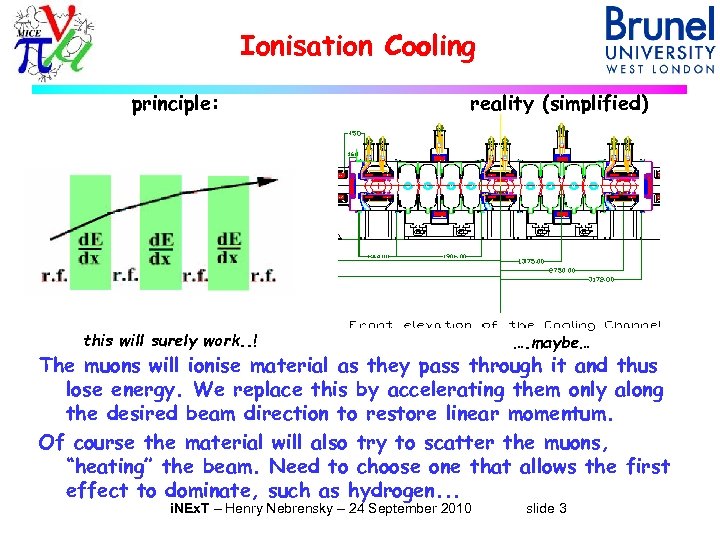 Ionisation Cooling principle: reality (simplified) this will surely work. . ! …. maybe… The muons will ionise material as they pass through it and thus lose energy. We replace this by accelerating them only along the desired beam direction to restore linear momentum. Of course the material will also try to scatter the muons, “heating” the beam. Need to choose one that allows the first effect to dominate, such as hydrogen. . . i. NEx. T – Henry Nebrensky – 24 September 2010 slide 3
 MICE Goals The aim of MICE is to demonstrate the principle of ionisation cooling in practice, i. e. · to build a realistic prototype of a cooling channel · to verify that it cools a beam (at all) · to evaluate performance Accelerator physicists would produce a set of suitable muon beams and see how they cool, but this is expensive and inconclusive, as an affordable prototype of cooling section only cools beam by 10% while standard emittance measurements barely achieve this precision. We are therefore doing a single-particle experiment: the momentum and position of each particle are measured before and then after it passes through the cooling channel. Thus state-of-the-art particle physics instrumentation will test state-of-the-art accelerator technology. i. NEx. T – Henry Nebrensky – 24 September 2010 slide 4
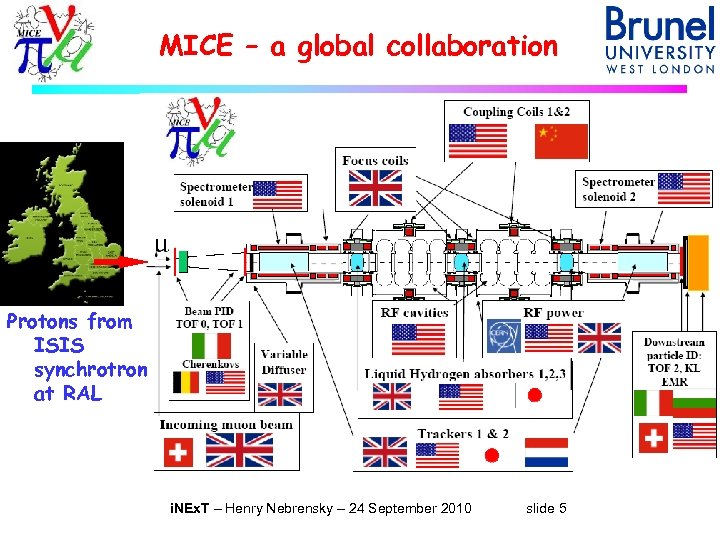 MICE – a global collaboration Protons from ISIS synchrotron at RAL i. NEx. T – Henry Nebrensky – 24 September 2010 slide 5
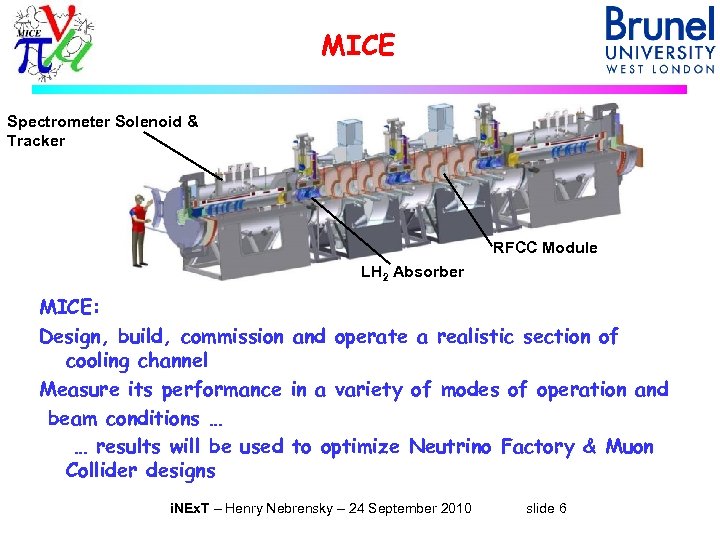 MICE Spectrometer Solenoid & Tracker RFCC Module LH 2 Absorber MICE: Design, build, commission and operate a realistic section of cooling channel Measure its performance in a variety of modes of operation and beam conditions … … results will be used to optimize Neutrino Factory & Muon Collider designs i. NEx. T – Henry Nebrensky – 24 September 2010 slide 6
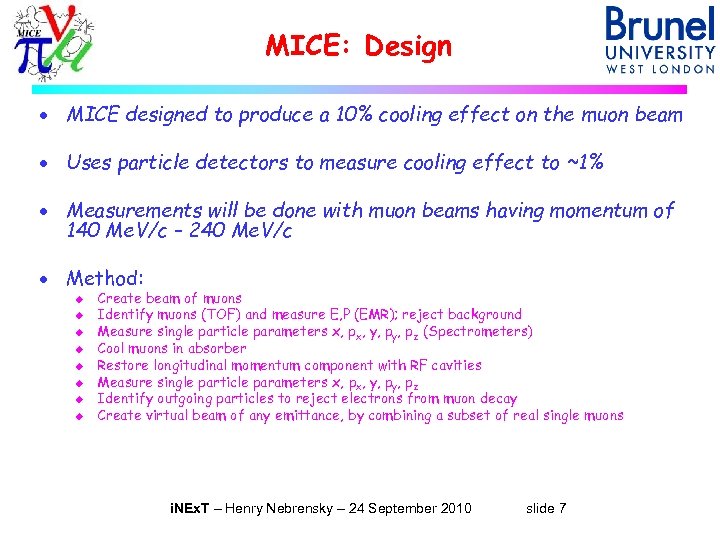 MICE: Design · MICE designed to produce a 10% cooling effect on the muon beam · Uses particle detectors to measure cooling effect to ~1% · Measurements will be done with muon beams having momentum of 140 Me. V/c – 240 Me. V/c · Method: u u u u Create beam of muons Identify muons (TOF) and measure E, P (EMR); reject background Measure single particle parameters x, px, y, pz (Spectrometers) Cool muons in absorber Restore longitudinal momentum component with RF cavities Measure single particle parameters x, px, y, pz Identify outgoing particles to reject electrons from muon decay Create virtual beam of any emittance, by combining a subset of real single muons i. NEx. T – Henry Nebrensky – 24 September 2010 slide 7
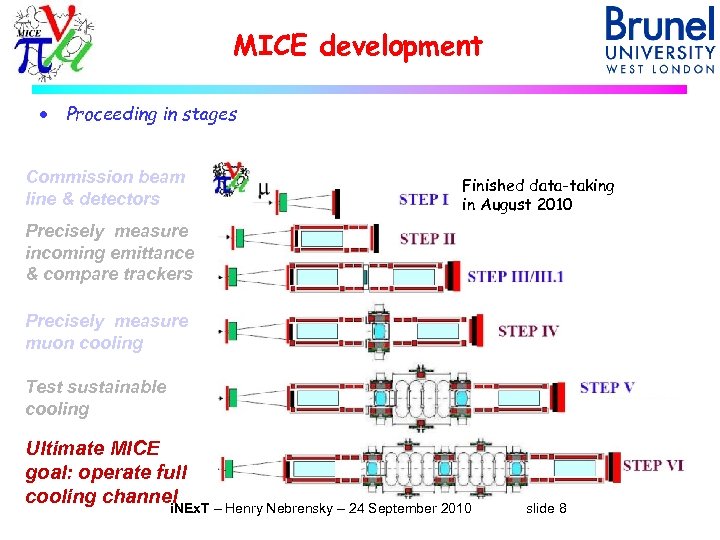 MICE development · Proceeding in stages Commission beam line & detectors Finished data-taking in August 2010 Precisely measure incoming emittance & compare trackers Precisely measure muon cooling Test sustainable cooling Ultimate MICE goal: operate full cooling channel i. NEx. T – Henry Nebrensky – 24 September 2010 slide 8
 Added features · at step III, a spool piece allows easy insertion of slabs of solid materials to measure precisely their effect on beam emittance · will test materials relevant to neutrino factory: Li. H, Carbon, Aluminum Titanium etc…(and simply plastic) · at step IV and above, optics in FC can be explored to allow smaller beta functions (down to 5 cm at 140 Me. V/c) to test flip vs non-flip mode · at step IV a wedge absorber can be tested in place of a flat piece to study effect · at step V and VI can test cavities with LN 2 cooling to allow higher gradient (X V 2) with same power i. NEx. T – Henry Nebrensky – 24 September 2010 slide 9
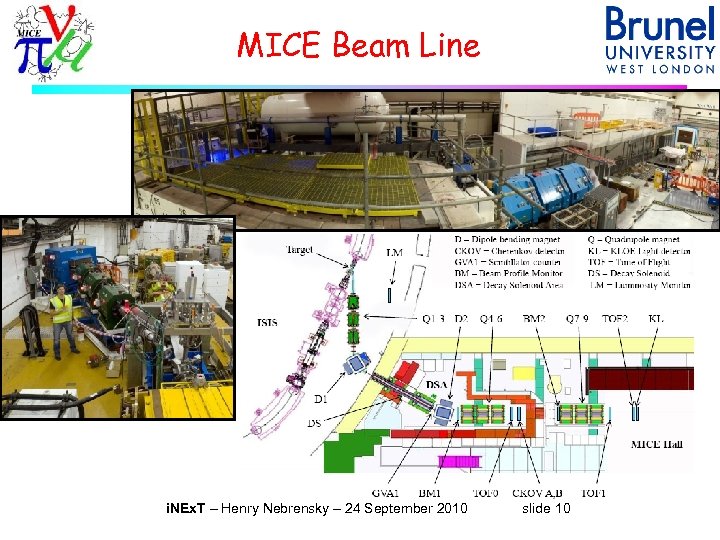 MICE Beam Line i. NEx. T – Henry Nebrensky – 24 September 2010 slide 10
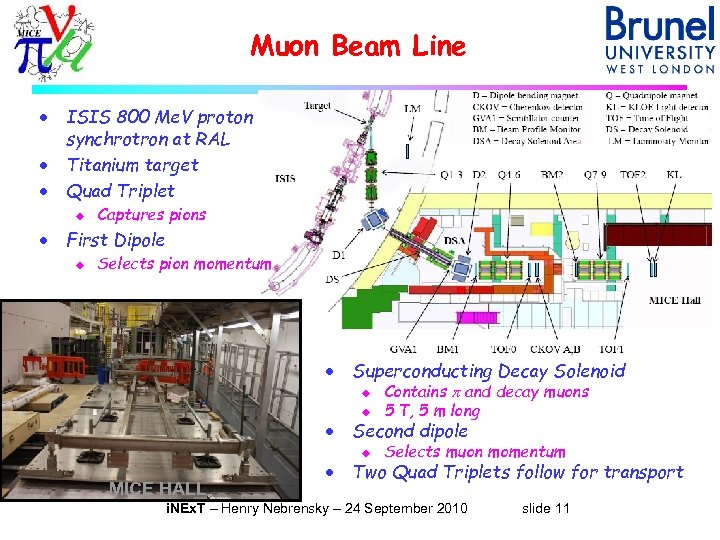 Muon Beam Line · · · ISIS 800 Me. V proton synchrotron at RAL Titanium target Quad Triplet u · Captures pions First Dipole u Selects pion momentum · Superconducting Decay Solenoid u Contains p and decay muons 5 T, 5 m long u Selects muon momentum u · MICE HALL · Second dipole Two Quad Triplets follow for transport i. NEx. T – Henry Nebrensky – 24 September 2010 slide 11
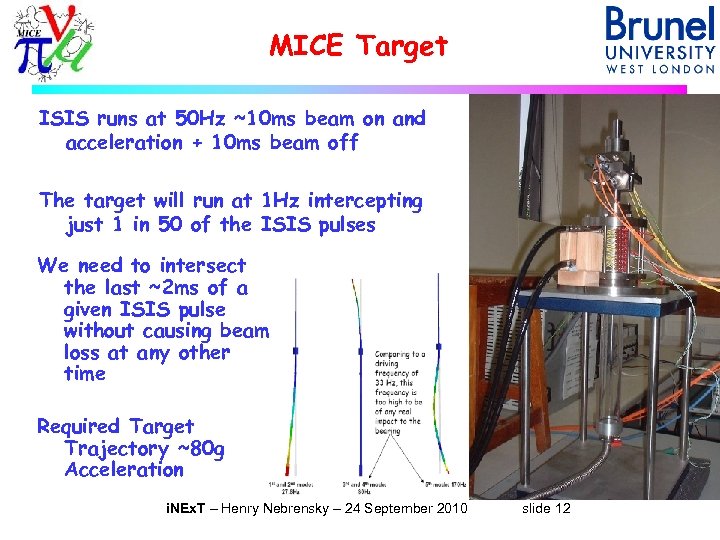 MICE Target ISIS runs at 50 Hz ~10 ms beam on and acceleration + 10 ms beam off The target will run at 1 Hz intercepting just 1 in 50 of the ISIS pulses We need to intersect the last ~2 ms of a given ISIS pulse without causing beam loss at any other time Required Target Trajectory ~80 g Acceleration i. NEx. T – Henry Nebrensky – 24 September 2010 slide 12
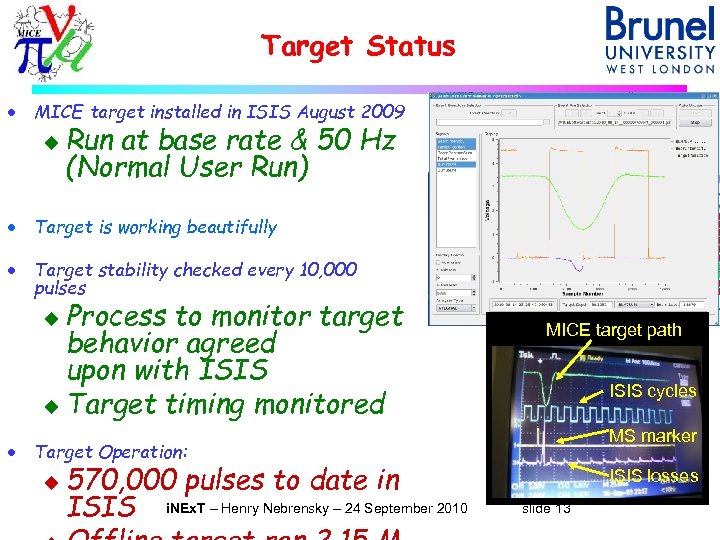 Target Status · MICE target installed in ISIS August 2009 u Run at base rate & 50 Hz (Normal User Run) · Target is working beautifully · Target stability checked every 10, 000 pulses Process to monitor target behavior agreed upon with ISIS u Target timing monitored u · MICE target path ISIS cycles MS marker Target Operation: u 570, 000 pulses to date in ISIS i. NEx. T – Henry Nebrensky – 24 September 2010 ISIS losses slide 13
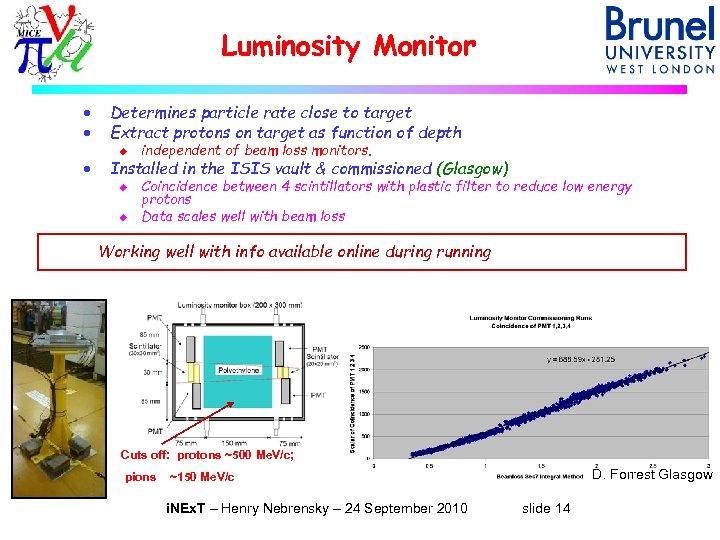 Luminosity Monitor · · Determines particle rate close to target Extract protons on target as function of depth u · independent of beam loss monitors. Installed in the ISIS vault & commissioned (Glasgow) u u Coincidence between 4 scintillators with plastic filter to reduce low energy protons Data scales well with beam loss Working well with info available online during running Cuts off: protons ~500 Me. V/c; pions D. Forrest Glasgow ~150 Me. V/c i. NEx. T – Henry Nebrensky – 24 September 2010 slide 14
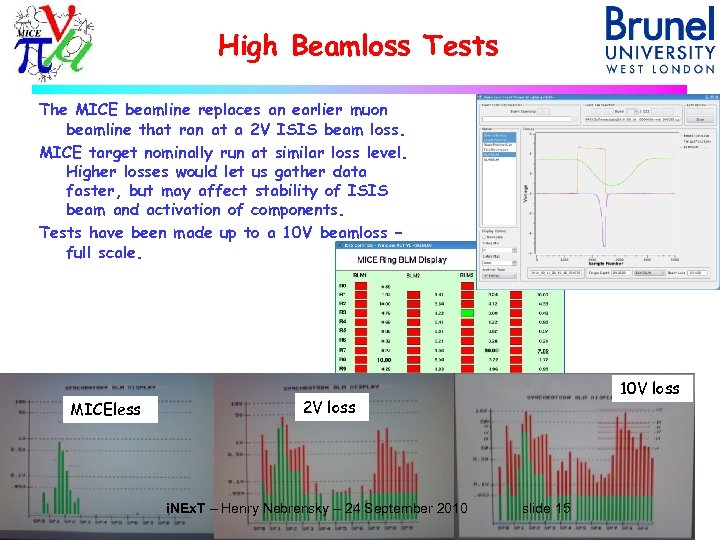 High Beamloss Tests The MICE beamline replaces an earlier muon beamline that ran at a 2 V ISIS beam loss. MICE target nominally run at similar loss level. Higher losses would let us gather data faster, but may affect stability of ISIS beam and activation of components. Tests have been made up to a 10 V beamloss – full scale. MICEless 10 V loss 2 V loss i. NEx. T – Henry Nebrensky – 24 September 2010 slide 15 15
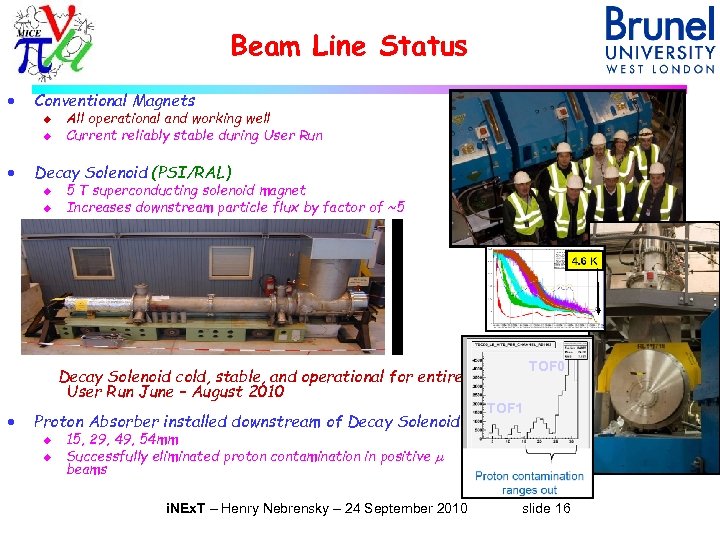 Beam Line Status · Conventional Magnets u u · All operational and working well Current reliably stable during User Run Decay Solenoid (PSI/RAL) u u 5 T superconducting solenoid magnet Increases downstream particle flux by factor of ~5 Decay Solenoid cold, stable, and operational for entire User Run June – August 2010 · Proton Absorber installed downstream of Decay Solenoid u u TOF 0 TOF 1 15, 29, 49, 54 mm Successfully eliminated proton contamination in positive m beams i. NEx. T – Henry Nebrensky – 24 September 2010 slide 16
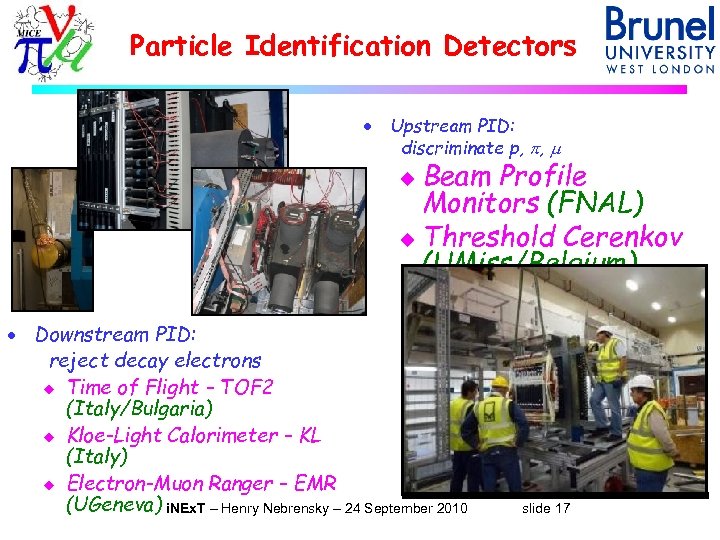 Particle Identification Detectors · Upstream PID: discriminate p, p, m Beam Profile Monitors (FNAL) u Threshold Cerenkov (UMiss/Belgium) u Time of Flight – TOF 0 & TOF 1 (Italy/Bulgaria) u · Downstream PID: reject decay electrons u Time of Flight – TOF 2 (Italy/Bulgaria) u Kloe-Light Calorimeter – KL (Italy) u Electron-Muon Ranger – EMR (UGeneva) i. NEx. T – Henry Nebrensky – 24 September 2010 slide 17
 Step I: Running · Goals u Commission and calibrate beam line detectors s Luminosity Monitor TOF 0, TOF 1, TOF 2, CKOVs, KL FNAL beam profile monitors Commission beam line magnets u Take data for each point in e-p matrix u s s MICE beam designed to be tunable Understand beam parameters for each configuration Compare data to simulation of beam line u Prepare for Steps with cooling u · Method u Dedicated data-taking run from June 22 – i. NEx. T – Henry Nebrensky – 24 September 2010 slide 18 August 12
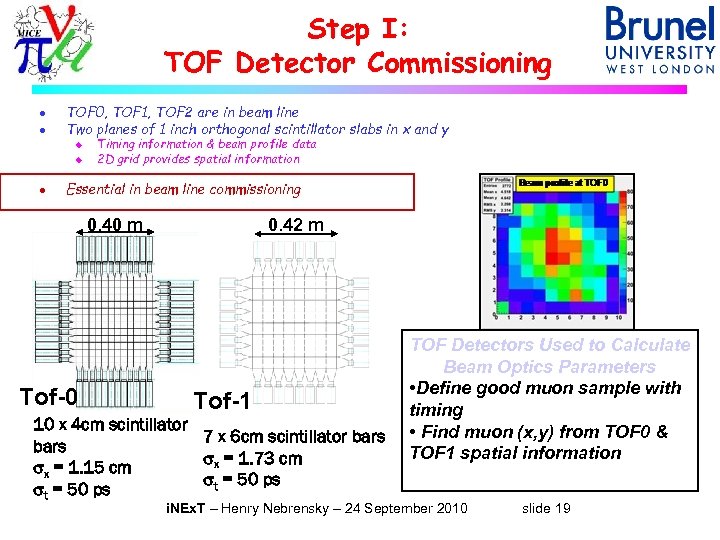 Step I: TOF Detector Commissioning · · TOF 0, TOF 1, TOF 2 are in beam line Two planes of 1 inch orthogonal scintillator slabs in x and y u u · Timing information & beam profile data 2 D grid provides spatial information Essential in beam line commissioning 0. 40 m Tof-0 0. 42 m Tof-1 10 x 4 cm scintillator 7 x 6 cm scintillator bars sx = 1. 73 cm sx = 1. 15 cm st = 50 ps TOF Detectors Used to Calculate Beam Optics Parameters • Define good muon sample with timing • Find muon (x, y) from TOF 0 & TOF 1 spatial information i. NEx. T – Henry Nebrensky – 24 September 2010 slide 19
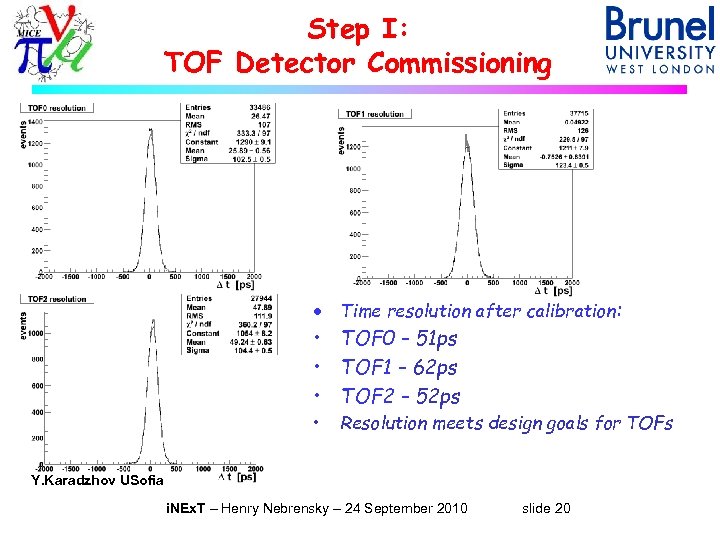 Step I: TOF Detector Commissioning · Time resolution after calibration: • TOF 0 – 51 ps • TOF 1 – 62 ps • TOF 2 – 52 ps • Resolution meets design goals for TOFs Y. Karadzhov USofia i. NEx. T – Henry Nebrensky – 24 September 2010 slide 20
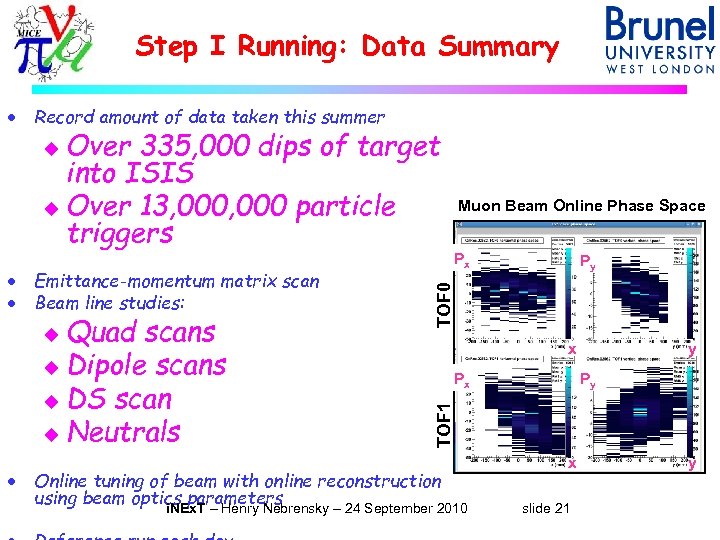 Step I Running: Data Summary · Record amount of data taken this summer Over 335, 000 dips of target into ISIS u Over 13, 000 particle triggers u Quad scans u Dipole scans u DS scan u Neutrals u · Py TOF 0 Emittance-momentum matrix scan Beam line studies: Px x Px y Py TOF 1 · · Muon Beam Online Phase Space Online tuning of beam with online reconstruction using beam optics parameters i. NEx. T – Henry Nebrensky – 24 September 2010 x slide 21 y
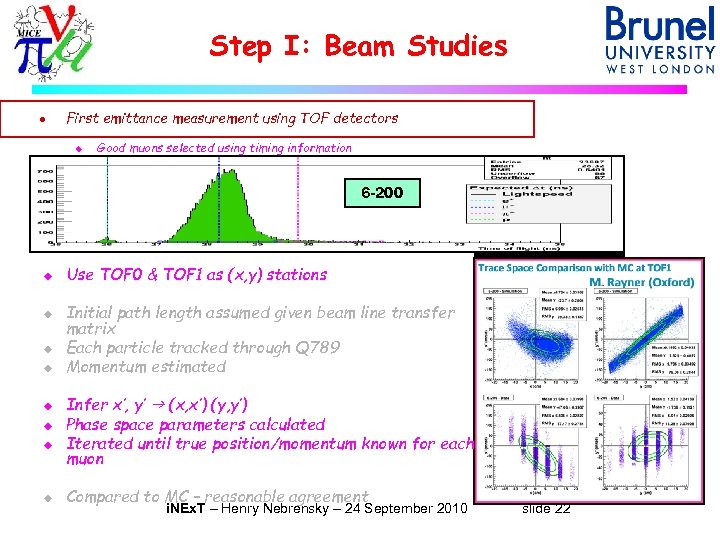 Step I: Beam Studies · First emittance measurement using TOF detectors u Good muons selected using timing information 6 -200 u u u u Use TOF 0 & TOF 1 as (x, y) stations Initial path length assumed given beam line transfer matrix Each particle tracked through Q 789 Momentum estimated Infer x’, y’ g (x, x’) (y, y’) Phase space parameters calculated Iterated until true position/momentum known for each muon Compared to MC – reasonable agreement i. NEx. T – Henry Nebrensky – 24 September 2010 slide 22
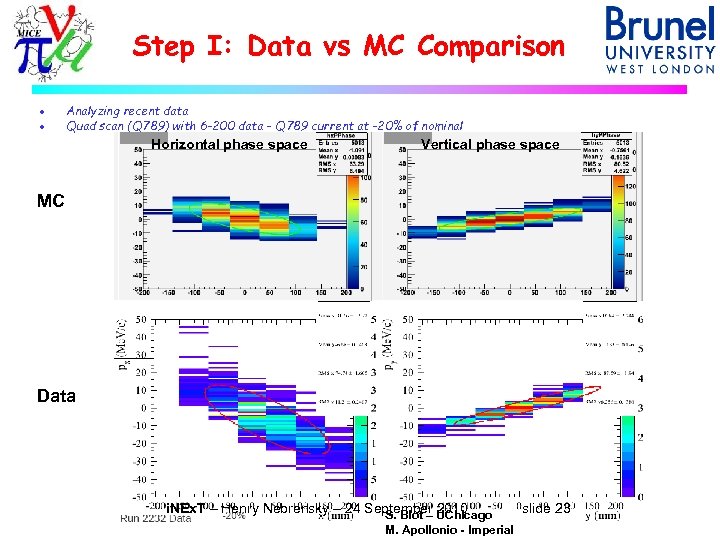 Step I: Data vs MC Comparison · · Analyzing recent data Quad scan (Q 789) with 6 -200 data – Q 789 current at -20% of nominal Horizontal phase space Vertical phase space MC Data i. NEx. T – Henry Nebrensky – 24 September UChicago S. Blot – 2010 M. Apollonio - Imperial slide 23
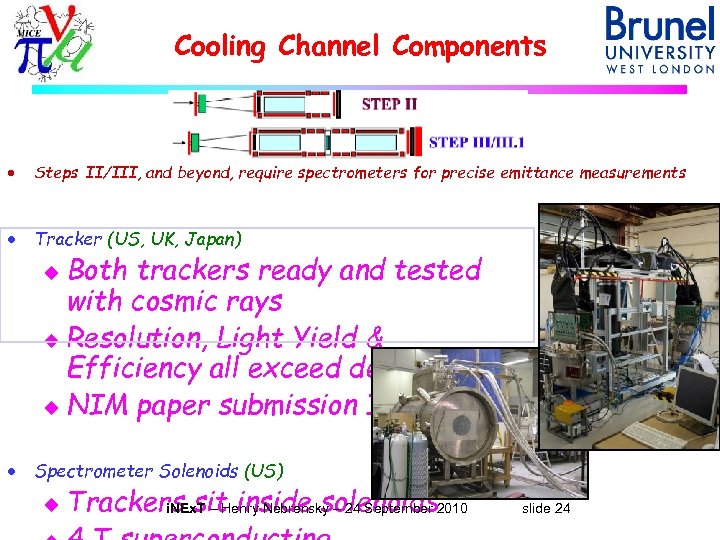 Cooling Channel Components · Steps II/III, and beyond, require spectrometers for precise emittance measurements · Tracker (US, UK, Japan) Both trackers ready and tested with cosmic rays u Resolution, Light Yield & Efficiency all exceed design goals u NIM paper submission In progress u · Spectrometer Solenoids (US) u Trackers sit inside solenoids 2010 i. NEx. T – Henry Nebrensky – 24 September slide 24
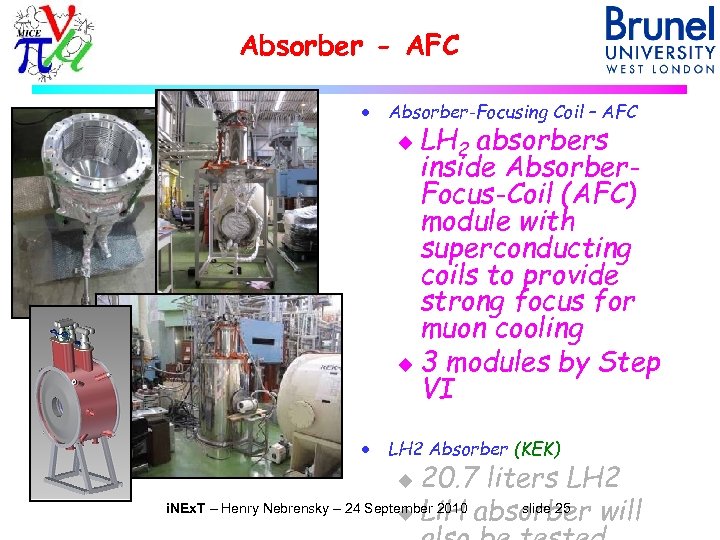 Absorber - AFC · Absorber-Focusing Coil – AFC LH 2 absorbers inside Absorber. Focus-Coil (AFC) module with superconducting coils to provide strong focus for muon cooling u 3 modules by Step VI u · LH 2 Absorber (KEK) 20. 7 liters LH 2 i. NEx. T – Henry Nebrensky – 24 September 2010 absorber will slide 25 u Li. H u
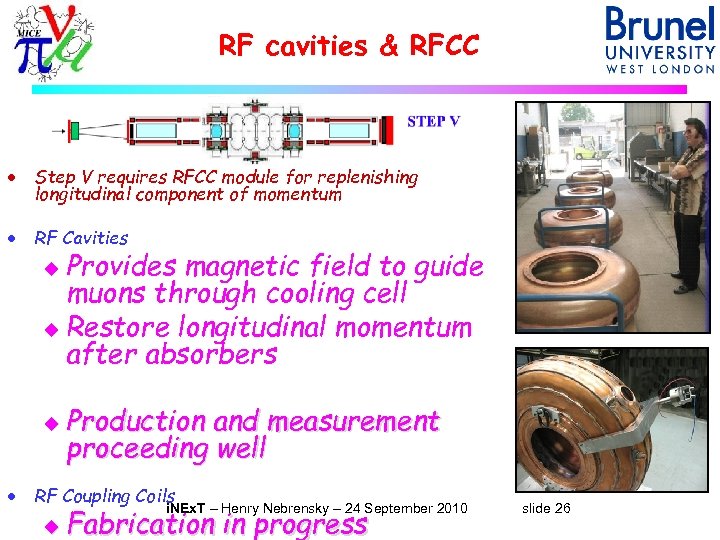 RF cavities & RFCC · Step V requires RFCC module for replenishing longitudinal component of momentum · RF Cavities Provides magnetic field to guide muons through cooling cell u Restore longitudinal momentum after absorbers u u · Production and measurement proceeding well RF Coupling Coils i. NEx. T – Henry Nebrensky – 24 September 2010 u Fabrication in progress slide 26
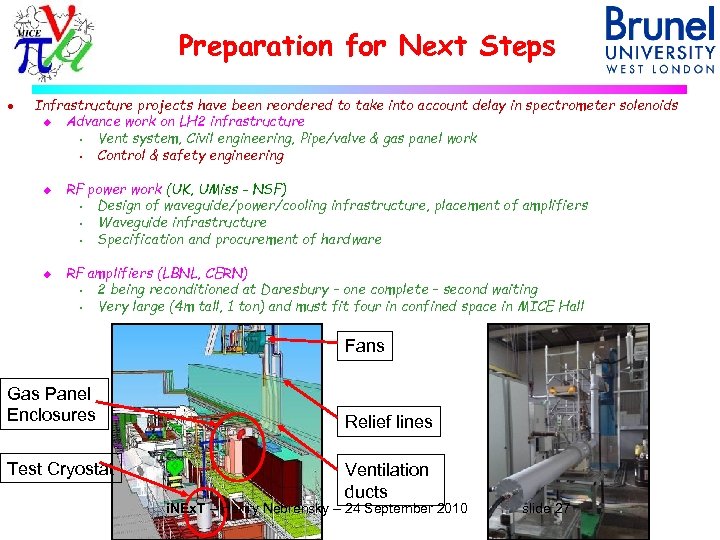 Preparation for Next Steps · Infrastructure projects have been reordered to take into account delay in spectrometer solenoids u Advance work on LH 2 infrastructure s Vent system, Civil engineering, Pipe/valve & gas panel work s Control & safety engineering u u RF power work (UK, UMiss - NSF) s Design of waveguide/power/cooling infrastructure, placement of amplifiers s Waveguide infrastructure s Specification and procurement of hardware RF amplifiers (LBNL, CERN) s 2 being reconditioned at Daresbury – one complete – second waiting s Very large (4 m tall, 1 ton) and must fit four in confined space in MICE Hall Fans Gas Panel Enclosures Test Cryostat Relief lines Ventilation ducts i. NEx. T – Henry Nebrensky – 24 September 2010 slide 27
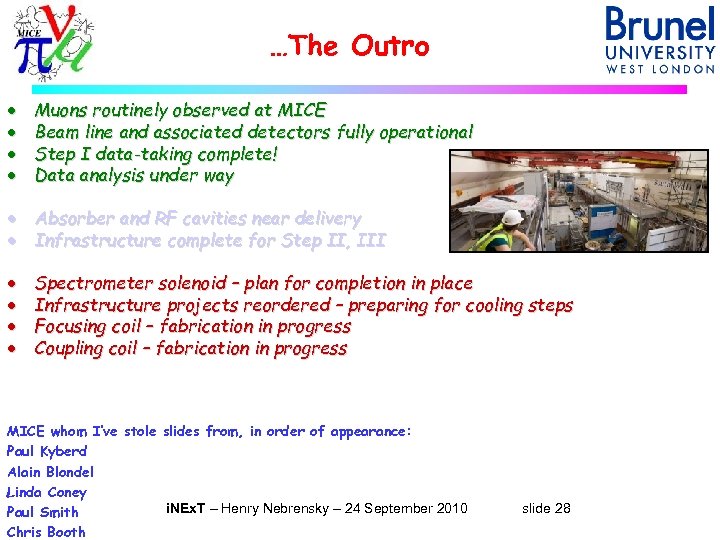 …The Outro · · Muons routinely observed at MICE Beam line and associated detectors fully operational Step I data-taking complete! Data analysis under way · Absorber and RF cavities near delivery · Infrastructure complete for Step II, III · · Spectrometer solenoid – plan for completion in place Infrastructure projects reordered – preparing for cooling steps Focusing coil – fabrication in progress Coupling coil – fabrication in progress MICE whom I’ve stole slides from, in order of appearance: Paul Kyberd Alain Blondel Linda Coney i. NEx. T – Henry Nebrensky – 24 September 2010 Paul Smith Chris Booth slide 28