 Скачать презентацию Goal To understand the mathematics that will be
136ad91a38f5c760fbef3c6d6ec8d060.ppt
- Количество слайдов: 27



Goal: To understand the mathematics that will be necessary for this course which you do not get in a math class Objectives: 1) Learning how to use Significant Figures 2) Learning how to work with Scientific Notation 3) Learning about how to use Units/Directions 4) Learning about the basics of Vectors
Significant Figures • Significant Figures are the digits that you know their values. • There is no guessing you know what it is. • If you DON’T know a digit you have to put in a zero by default (called a place holder). • The more significant digits you have the more accurate the number.
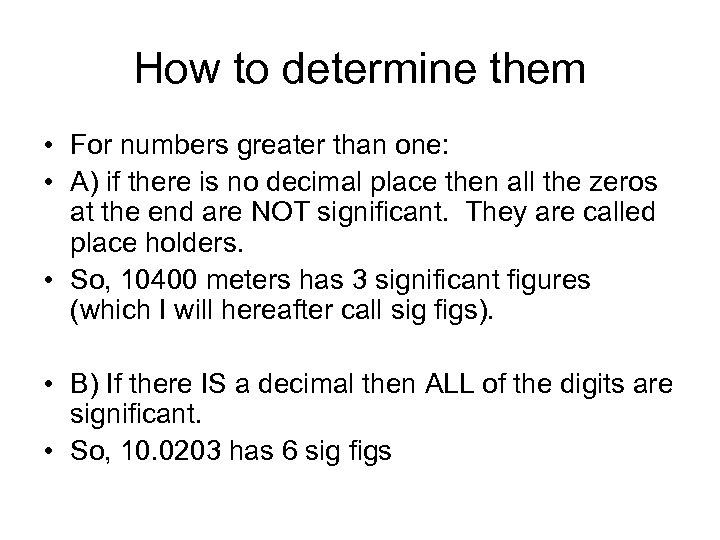
How to determine them • For numbers greater than one: • A) if there is no decimal place then all the zeros at the end are NOT significant. They are called place holders. • So, 10400 meters has 3 significant figures (which I will hereafter call sig figs). • B) If there IS a decimal then ALL of the digits are significant. • So, 10. 0203 has 6 sig figs
Less than 1 • For numbers less than one the 0’s on the left side are placeholders. • So, 0. 0102 only has 3 sig figs
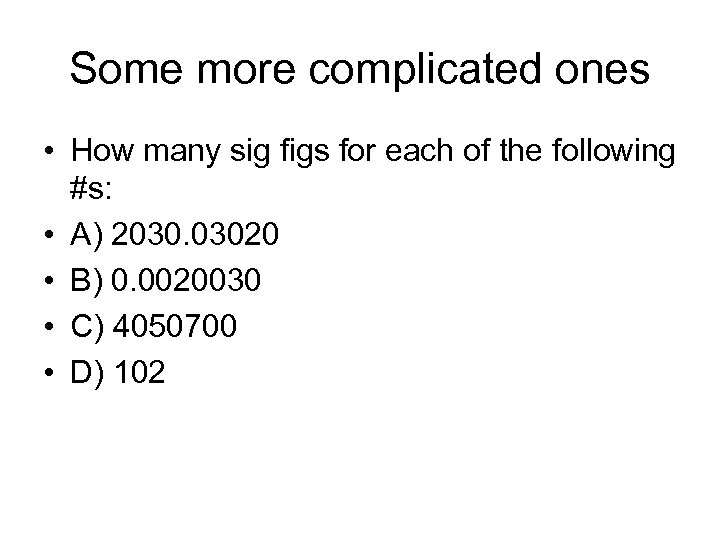
Some more complicated ones • How many sig figs for each of the following #s: • A) 2030. 03020 • B) 0. 0020030 • C) 4050700 • D) 102
How many to use? • Suppose I wanted to find the area of the white board, who would I do that? • Find the area of the whiteboard.
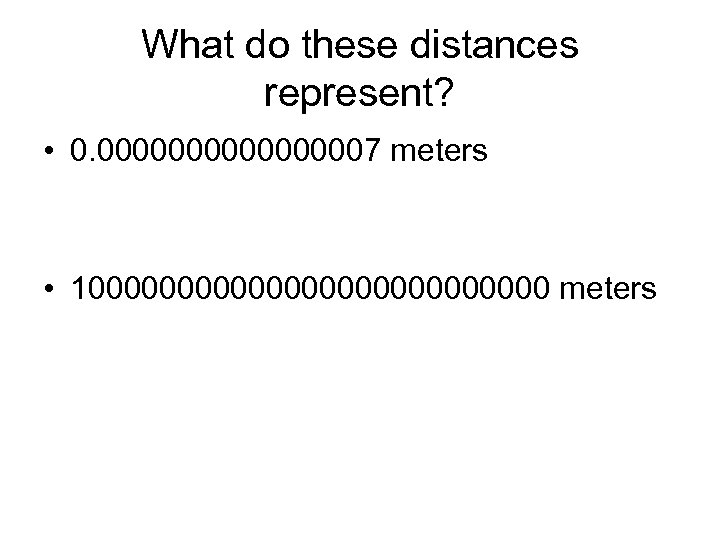
What do these distances represent? • 0. 000000007 meters • 10000000000000 meters
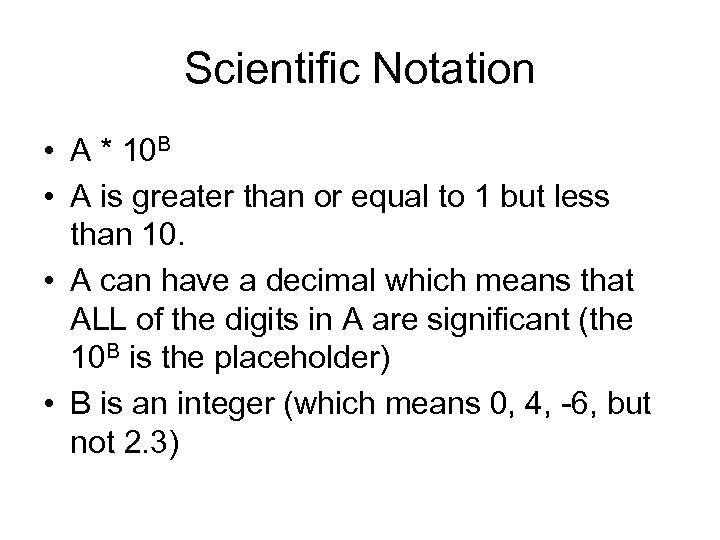
Scientific Notation • A * 10 B • A is greater than or equal to 1 but less than 10. • A can have a decimal which means that ALL of the digits in A are significant (the 10 B is the placeholder) • B is an integer (which means 0, 4, -6, but not 2. 3)
Math in scientific notation • For addition or subtraction you almost have to treat the powers of 10 as a “Unit”. • That is to say that to add or subtract – without using a calculator that is – you need to have everything have the same powers of 10. • Once you have that you can just add and subtract the #s in front and leave the powers of 10.
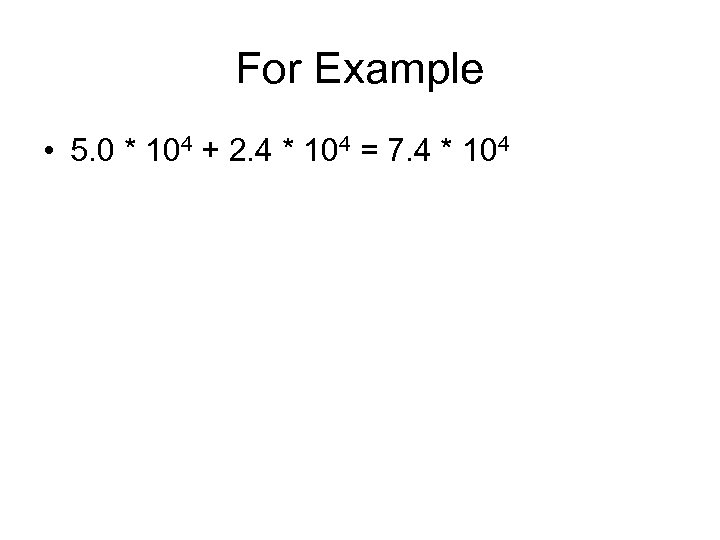
For Example • 5. 0 * 104 + 2. 4 * 104 = 7. 4 * 104
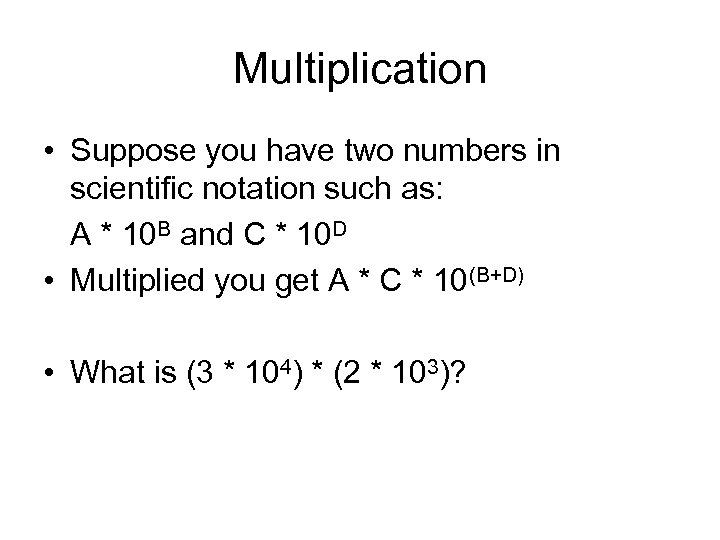
Multiplication • Suppose you have two numbers in scientific notation such as: A * 10 B and C * 10 D • Multiplied you get A * C * 10(B+D) • What is (3 * 104) * (2 * 103)?
Quick note about calculators: • If I give you a number of 1*102 when you enter it into your calculator be sure to enter 1 power 2 and not 10 power 2. • Go ahead and try this you should get 100. • If you do 10 power 2 you will get 1000 because your calculator thinks you are trying to enter 10*102
One more note • If you get the number in front to be more than 10 then you have to adjust it. • To do so take off factors of ten off of the front number (i. e. move the decimal) • Each time you withdraw a factor of 10 from the number in front you have to deposit that factor of 10 into the powers of ten (by adding 1 to the integer for each time you move the decimal)
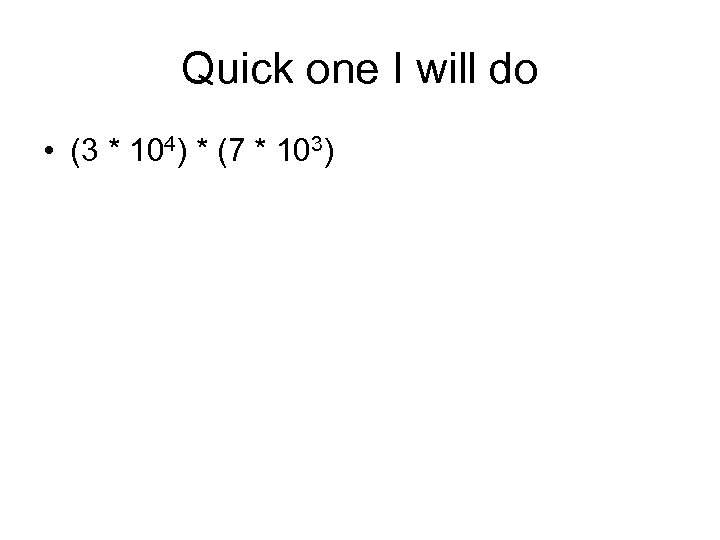
Quick one I will do • (3 * 104) * (7 * 103)
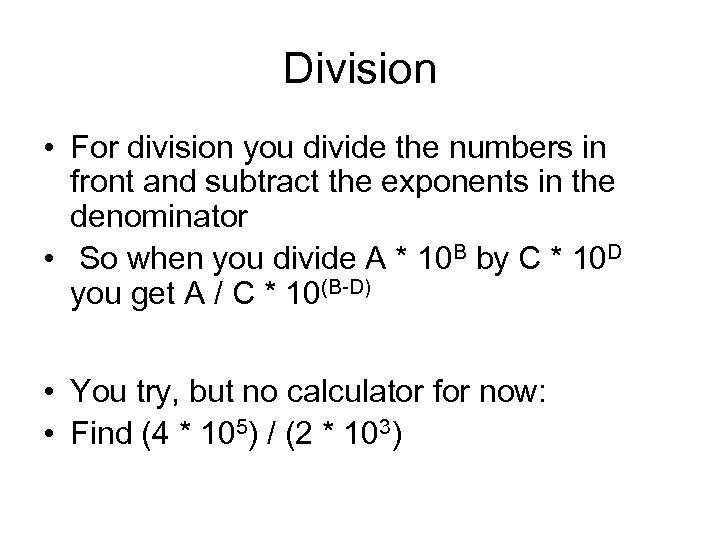
Division • For division you divide the numbers in front and subtract the exponents in the denominator • So when you divide A * 10 B by C * 10 D you get A / C * 10(B-D) • You try, but no calculator for now: • Find (4 * 105) / (2 * 103)
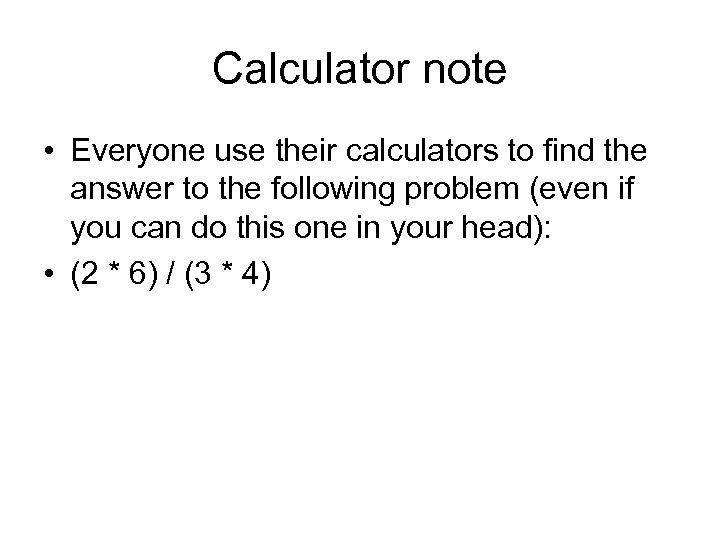
Calculator note • Everyone use their calculators to find the answer to the following problem (even if you can do this one in your head): • (2 * 6) / (3 * 4)
On the calculator • Always put the denominator in brackets, i. e. ()’s. Otherwise your calculator won’t calculate the problem correctly.
One more note: • If the number in front becomes less than 1 you have to adjust by adding factors of 10. • That is you move the decimal place. • Each time you add a factor of 10 you have to subtract a factor of 10 from the powers of 10 by decreasing the exponent by 1 for each power of 10 you add.
Using units/directions • In physics values do not come usually as just a number. • For example you don’t go to a store to buy 5. • You don’t go to the store to buy 5 pounds. • You may go to buy 5 pounds of apples. • In this case pounds is a unit as is apples.
Units include • Physics uses the mks system which stands for meters (m), kilograms (kg), and seconds (s) • Combinations of these units can make up other units as well. • For example velocity is m/s direction • Direction is also a unit (so up = -down)
Very Important • Units can be very important. • Unit errors in real life have had disastrous effects. • A units mistake was once claimed to cause the crash of a Mars probe. • Some claimed that a unit error (million and billion can sometimes be considered a “unit”) was rumored to wipe a TRILLION dollars of value from the stock market.
Adding values • When you add or subtract values you have to add values with the same unit. • It would not make sense to add 5 apples to 5 pears.
Multiplying/dividing • When multiplying or dividing you treat units like you would a variable in algebra. • So, a meter times a meter is a square meter. • A meter divided by a meter is 1 (i. e. they cancel)
Direction • One special type of “unit” is direction. • In this class it is VERY beneficial to think of direction as a unit and to include it for any value that requires it (which I will call vector values). • Examples include and are not limited to: up, down, forwards, backwards, towards an object, away from an object, North, South, East, West. • If you use graphing axis directions can be plus or minus x (called x hat) and plus or minus y (called y hat).
Adding Direction units • Just like with other units you can only add 2 values if they have the same unit. • So, you cannot add a North to a South much like you can’t add 5 cm to 2 m UNLESS you convert one of the two units first. • The conversion is straightforward often times because North = - South • However this also means you cannot add North to West as there is no conversion – i. e. these become two separate values as we will utilize in this course.
Vectors • Vectors take advantage of the fact that each dimension (dimensions are separated by 90 degrees) is independent for the most part. • Vectors in vector form have a component in each dimension (which for this class will be usually 2 dimensions). • When you add vectors you have to add the same components together while separating out the components that are not in the same direction. • If you want the hypotenuse of the vector, or the total value without sign or direction this is called a magnitude.
Conclusion • We have learned the basics of math that we will need to succeed in this course. • We have learned how to use significant figures and what they represent. • We have learned how to use scientific notation even without a calculator. • We have learned how to use units/directions and how they apply to vectors.
Скачать презентацию Goal To understand the mathematics that will be
136ad91a38f5c760fbef3c6d6ec8d060.ppt