


 Скачать презентацию GNSS Stations for Geodetic Applications Equipment and Site
94bebb78f5398606eda498cae6efd73d.ppt
- Количество слайдов: 11
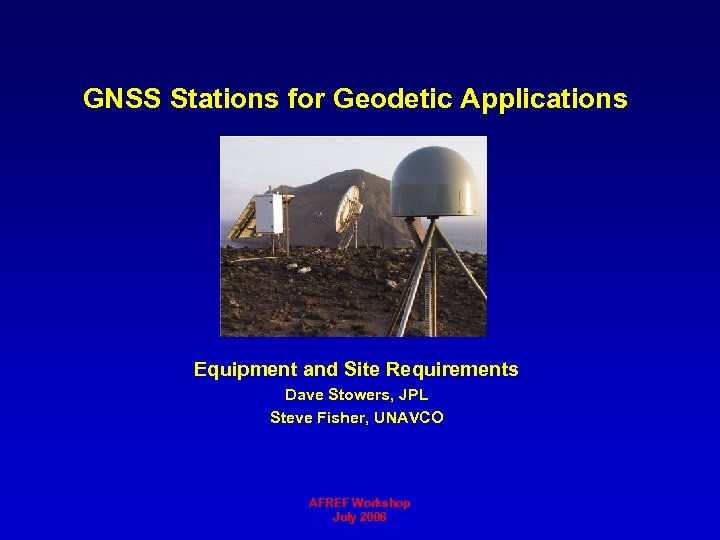 GNSS Stations for Geodetic Applications Equipment and Site Requirements Dave Stowers, JPL Steve Fisher, UNAVCO AFREF Workshop July 2006
 4. 3 GNSS Station Equipment GNSS Receivers • Tracking Performance – General: Dual frequency, many independent channels, up to 20 Hz sampling, ~ 1 mm phase precision – GNSS observables • Current: – GPS L 1 C/A, L 1 and L 2 P, L 1 and L 2 phase (also under AS) – GLONASS L 1 C/A Code, L 1 P and L 2 P, L 1 and L 2 phase • Coming soon: – GPS L 2 C, L 5 – first launches in 2005 -2007, IOC/FOC in 2012/2015 – Galileo – IOC/FOC 2010+ (anticipated) – Performance measures • • • 99%+ of expected data Cycle slips/observations <0. 1% MP 1 and MP 2 <0. 5 m at elev. >10° Zero baseline phase precision < 1 mm Short baseline precision 2 mm horizontal/4 mm vertical AFREF Workshop, July 2006
 4. 3 GNSS Station Equipment • GNSS Receiver Features and Specifications – Power consumption 3 -10 W – Memory up to many GB – Multiple I/O ports • Log and output multiple formats simultaneously • Raw, RINEX, BINEX, RTCM SC 104, etc. – Command control interface • Built in server technology supports http and ftp over TCP • Configuration over network by uploading configuration file • Serial commands and custom interface applications – Environmental specifications: -40 to +60 C, humidity sealed – Power management: ability to cycle power remotely and automatic restart in same configuration after power loss – Ability to log and stream data from external sensors (met, tilt) – Code and carrier multipath rejection and ability to disable – External timing frequency input – Reliability: Mean Time Between Failure (MTBF) ~60, 000 hours AFREF Workshop, July 2006
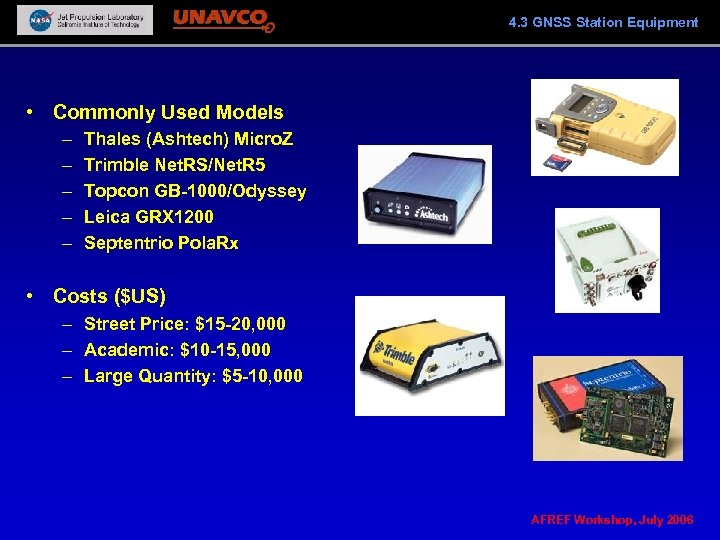 4. 3 GNSS Station Equipment • Commonly Used Models – – – Thales (Ashtech) Micro. Z Trimble Net. RS/Net. R 5 Topcon GB-1000/Odyssey Leica GRX 1200 Septentrio Pola. Rx • Costs ($US) – Street Price: $15 -20, 000 – Academic: $10 -15, 000 – Large Quantity: $5 -10, 000 AFREF Workshop, July 2006
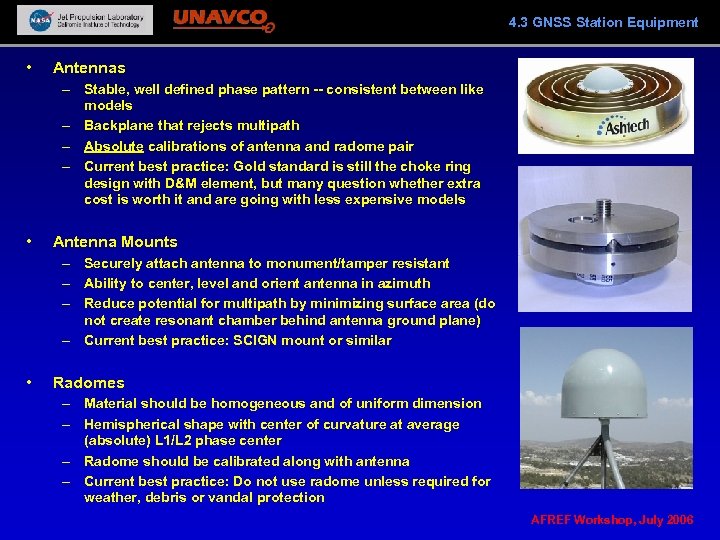 4. 3 GNSS Station Equipment • Antennas – Stable, well defined phase pattern -- consistent between like models – Backplane that rejects multipath – Absolute calibrations of antenna and radome pair – Current best practice: Gold standard is still the choke ring design with D&M element, but many question whether extra cost is worth it and are going with less expensive models • Antenna Mounts – Securely attach antenna to monument/tamper resistant – Ability to center, level and orient antenna in azimuth – Reduce potential for multipath by minimizing surface area (do not create resonant chamber behind antenna ground plane) – Current best practice: SCIGN mount or similar • Radomes – Material should be homogeneous and of uniform dimension – Hemispherical shape with center of curvature at average (absolute) L 1/L 2 phase center – Radome should be calibrated along with antenna – Current best practice: Do not use radome unless required for weather, debris or vandal protection AFREF Workshop, July 2006
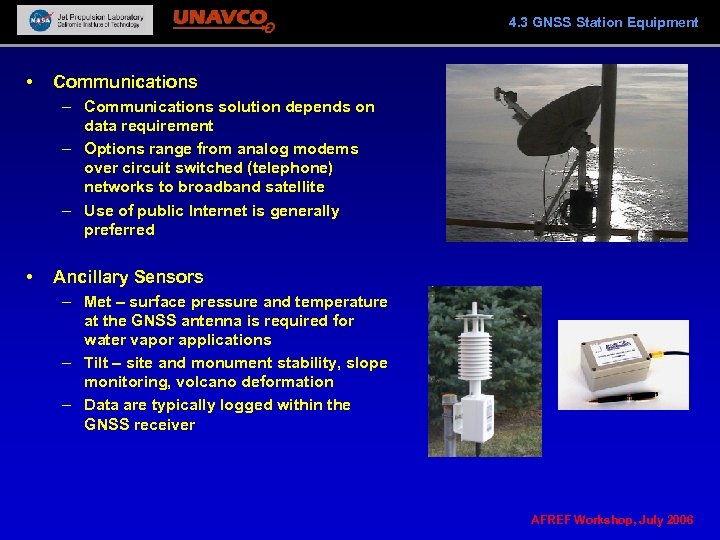 4. 3 GNSS Station Equipment • Communications – Communications solution depends on data requirement – Options range from analog modems over circuit switched (telephone) networks to broadband satellite – Use of public Internet is generally preferred • Ancillary Sensors – Met – surface pressure and temperature at the GNSS antenna is required for water vapor applications – Tilt – site and monument stability, slope monitoring, volcano deformation – Data are typically logged within the GNSS receiver AFREF Workshop, July 2006
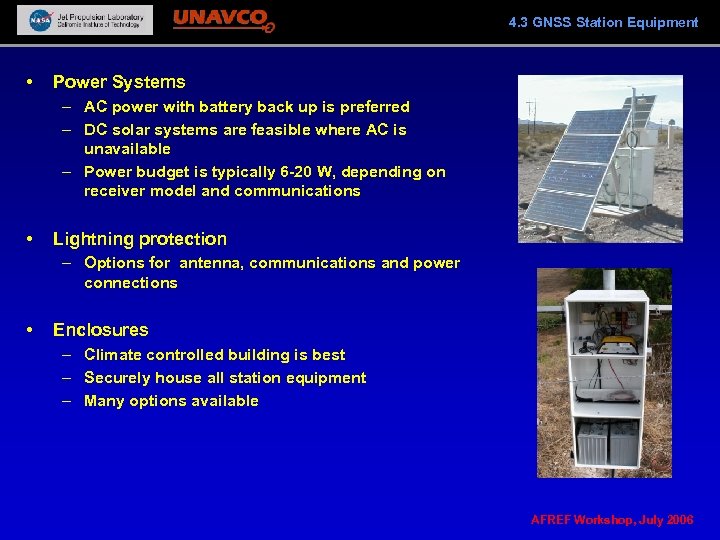 4. 3 GNSS Station Equipment • Power Systems – AC power with battery back up is preferred – DC solar systems are feasible where AC is unavailable – Power budget is typically 6 -20 W, depending on receiver model and communications • Lightning protection – Options for antenna, communications and power connections • Enclosures – Climate controlled building is best – Securely house all station equipment – Many options available AFREF Workshop, July 2006
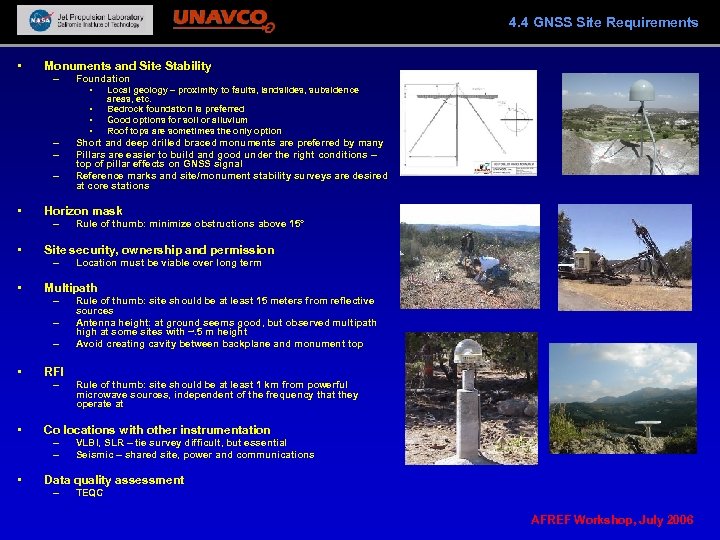 4. 4 GNSS Site Requirements • Monuments and Site Stability – Foundation • • – – – • – – Rule of thumb: site should be at least 1 km from powerful microwave sources, independent of the frequency that they operate at Co locations with other instrumentation – – • Rule of thumb: site should be at least 15 meters from reflective sources Antenna height: at ground seems good, but observed multipath high at some sites with ~. 5 m height Avoid creating cavity between backplane and monument top RFI – • Location must be viable over long term Multipath – • Rule of thumb: minimize obstructions above 15° Site security, ownership and permission – • Short and deep drilled braced monuments are preferred by many Pillars are easier to build and good under the right conditions – top of pillar effects on GNSS signal Reference marks and site/monument stability surveys are desired at core stations Horizon mask – • Local geology – proximity to faults, landslides, subsidence areas, etc. Bedrock foundation is preferred Good options for soil or alluvium Roof tops are sometimes the only option VLBI, SLR – tie survey difficult, but essential Seismic – shared site, power and communications Data quality assessment – TEQC AFREF Workshop, July 2006
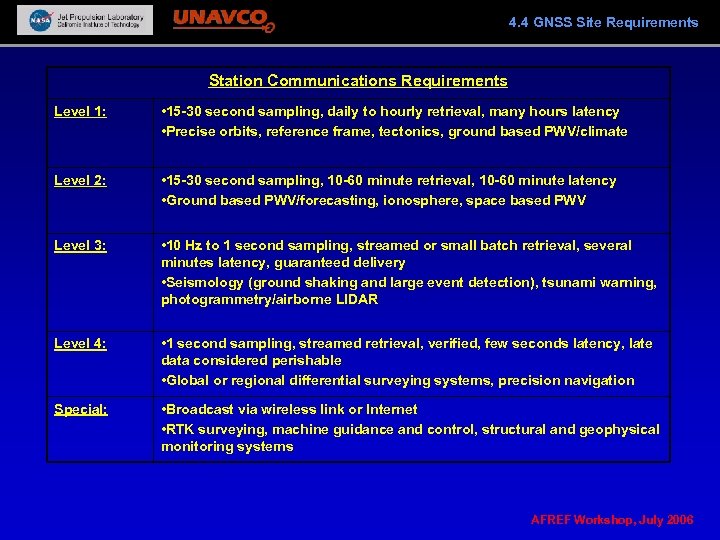 4. 4 GNSS Site Requirements Station Communications Requirements Level 1: • 15 -30 second sampling, daily to hourly retrieval, many hours latency • Precise orbits, reference frame, tectonics, ground based PWV/climate Level 2: • 15 -30 second sampling, 10 -60 minute retrieval, 10 -60 minute latency • Ground based PWV/forecasting, ionosphere, space based PWV Level 3: • 10 Hz to 1 second sampling, streamed or small batch retrieval, several minutes latency, guaranteed delivery • Seismology (ground shaking and large event detection), tsunami warning, photogrammetry/airborne LIDAR Level 4: • 1 second sampling, streamed retrieval, verified, few seconds latency, late data considered perishable • Global or regional differential surveying systems, precision navigation Special: • Broadcast via wireless link or Internet • RTK surveying, machine guidance and control, structural and geophysical monitoring systems AFREF Workshop, July 2006
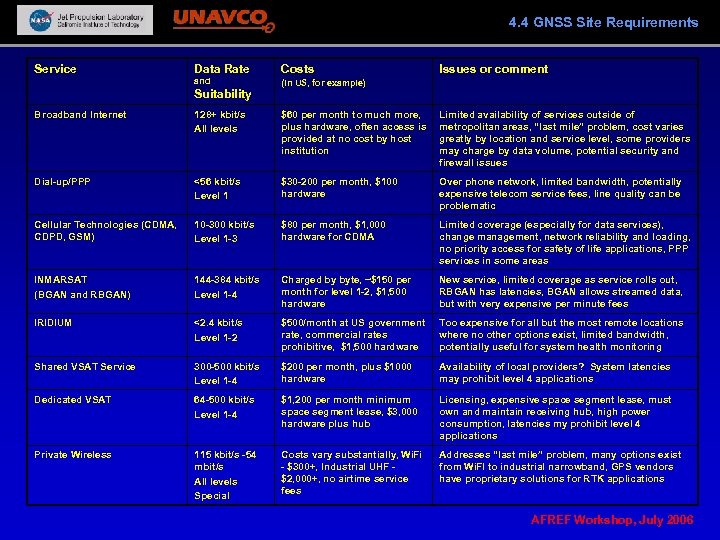 4. 4 GNSS Site Requirements Service Data Rate Costs and (in US, for example) Suitability Issues or comment Broadband Internet 128+ kbit/s All levels $60 per month to much more, plus hardware, often access is provided at no cost by host institution Limited availability of services outside of metropolitan areas, “last mile” problem, cost varies greatly by location and service level, some providers may charge by data volume, potential security and firewall issues Dial-up/PPP <56 kbit/s Level 1 $30 -200 per month, $100 hardware Over phone network, limited bandwidth, potentially expensive telecom service fees, line quality can be problematic Cellular Technologies (CDMA, CDPD, GSM) 10 -300 kbit/s Level 1 -3 $80 per month, $1, 000 hardware for CDMA Limited coverage (especially for data services), change management, network reliability and loading, no priority access for safety of life applications, PPP services in some areas INMARSAT (BGAN and RBGAN) 144 -384 kbit/s Level 1 -4 Charged by byte, ~$150 per month for level 1 -2, $1, 500 hardware New service, limited coverage as service rolls out, RBGAN has latencies, BGAN allows streamed data, but with very expensive per minute fees IRIDIUM <2. 4 kbit/s Level 1 -2 $500/month at US government rate, commercial rates prohibitive, $1, 500 hardware Too expensive for all but the most remote locations where no other options exist, limited bandwidth, potentially useful for system health monitoring Shared VSAT Service 300 -500 kbit/s Level 1 -4 $200 per month, plus $1000 hardware Availability of local providers? System latencies may prohibit level 4 applications Dedicated VSAT 64 -500 kbit/s Level 1 -4 $1, 200 per month minimum space segment lease, $3, 000 hardware plus hub Licensing, expensive space segment lease, must own and maintain receiving hub, high power consumption, latencies my prohibit level 4 applications Private Wireless 115 kbit/s -54 mbit/s All levels Special Costs vary substantially, Wi. Fi - $300+, Industrial UHF $2, 000+, no airtime service fees Addresses “last mile” problem, many options exist from Wi. FI to industrial narrowband, GPS vendors have proprietary solutions for RTK applications AFREF Workshop, July 2006
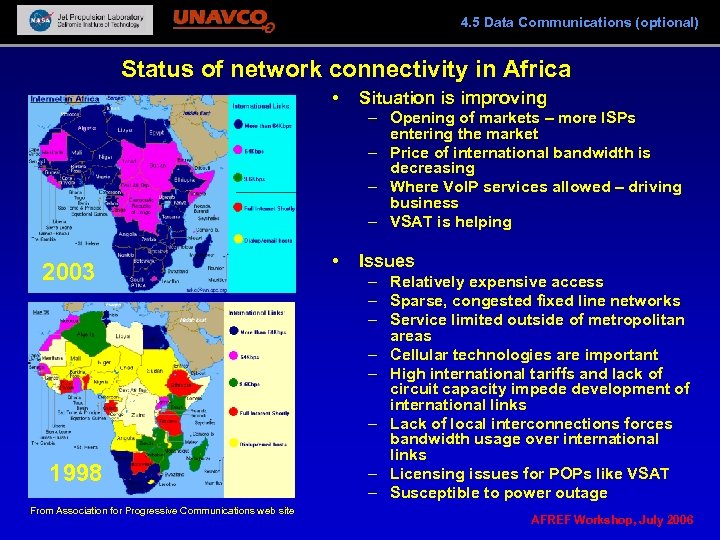 4. 5 Data Communications (optional) Status of network connectivity in Africa • Situation is improving – Opening of markets – more ISPs entering the market – Price of international bandwidth is decreasing – Where Vo. IP services allowed – driving business – VSAT is helping 2003 1998 From Association for Progressive Communications web site • Issues – Relatively expensive access – Sparse, congested fixed line networks – Service limited outside of metropolitan areas – Cellular technologies are important – High international tariffs and lack of circuit capacity impede development of international links – Lack of local interconnections forces bandwidth usage over international links – Licensing issues for POPs like VSAT – Susceptible to power outage AFREF Workshop, July 2006