


 Скачать презентацию GMES-GATO Atmospheric correction using atmospheric composition satellite data
044f5040146af891959477b0a3fbafe4.ppt
- Количество слайдов: 27
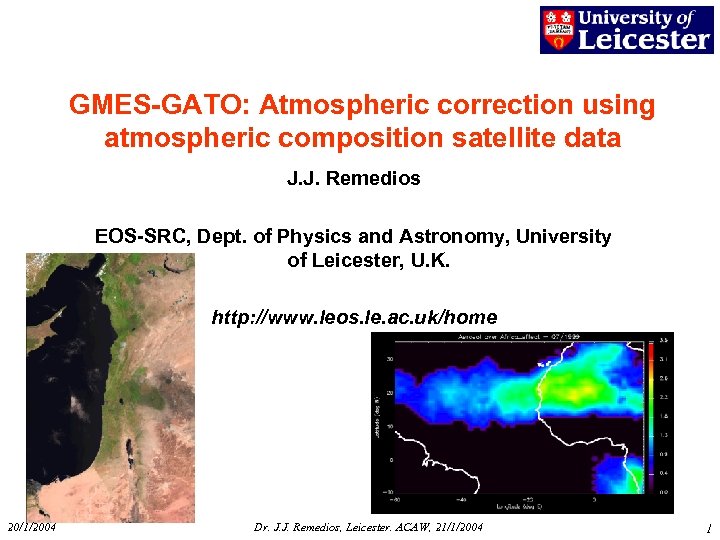 GMES-GATO: Atmospheric correction using atmospheric composition satellite data J. J. Remedios EOS-SRC, Dept. of Physics and Astronomy, University of Leicester, U. K. http: //www. leos. le. ac. uk/home 20/1/2004 Dr. J. J. Remedios, Leicester. ACAW, 21/1/2004 1
 Structure Influence of the atmosphere on surface observations – Atmospheric correction – Issues requiring surface and atmosphere information Requirements for atmospheric correction What are the technical issues? Current developments? Rational system needs (existing data/systems) What is missing (future systems)? GMES objectives 20/1/2004 Dr. J. J. Remedios, Leicester. ACAW, 21/1/2004 2
 Atmospheric influence on Systems Observing the Earth’ s Surface I 1. Satellite observations of the surface must intrinsically account for the atmosphere (atmospheric correction) Atmospheric effects are present at almost all wavelengths Example of 1. is correction of phytoplankton (ocean colour) data for ozone contribution. 2. Atmospheric composition may also affect surface properties and also the reverse – Direct e. g. , chemical action, deposition, emitted flux of gases. – Indirect, e. g. , control of surface temperature or photosynthetic radiation. User requirements include combined surface and atmosphere datasets, e. g. , forestation and carbon dioxide, vegetation and water vapour, U/V radiation. Example of 2. is dependence of phytoplankton concentrations on U/V radiation (and hence ozone) Concentrate on 1 here: atmospheric correction 20/1/2004 Dr. J. J. Remedios, Leicester. ACAW, 21/1/2004 3
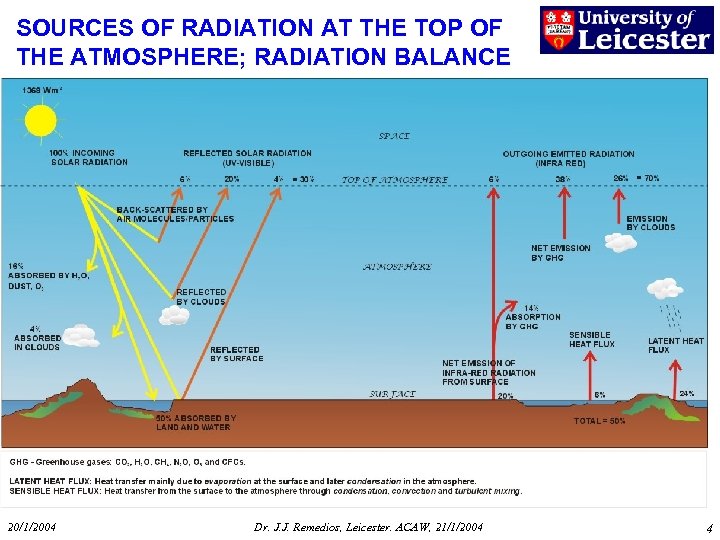 SOURCES OF RADIATION AT THE TOP OF THE ATMOSPHERE; RADIATION BALANCE 20/1/2004 Dr. J. J. Remedios, Leicester. ACAW, 21/1/2004 4
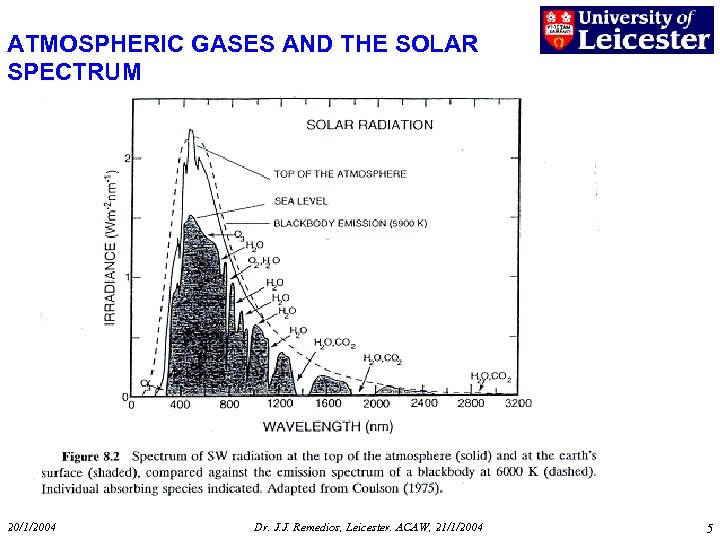 ATMOSPHERIC GASES AND THE SOLAR SPECTRUM 20/1/2004 Dr. J. J. Remedios, Leicester. ACAW, 21/1/2004 5
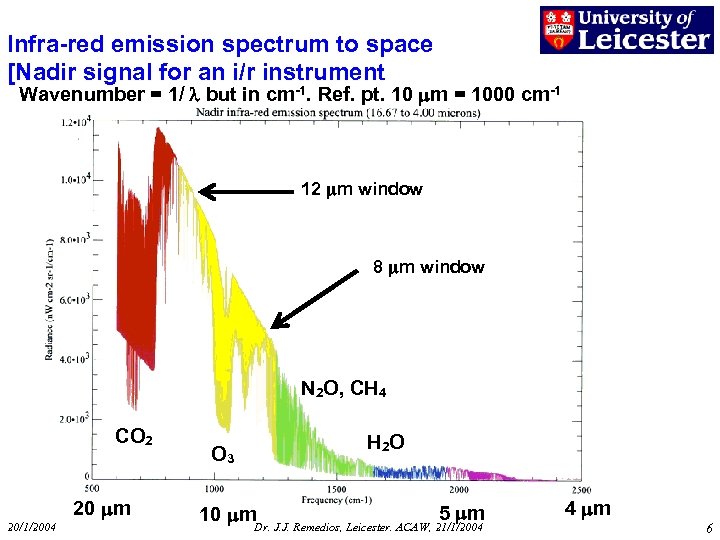 Infra-red emission spectrum to space [Nadir signal for an i/r instrument Wavenumber = 1/ l but in cm-1. Ref. pt. 10 mm = 1000 cm-1 12 mm window 8 mm window N 2 O, CH 4 CO 2 20 mm 20/1/2004 H 2 O O 3 10 mm 5 mm Dr. J. J. Remedios, Leicester. ACAW, 21/1/2004 4 mm 6
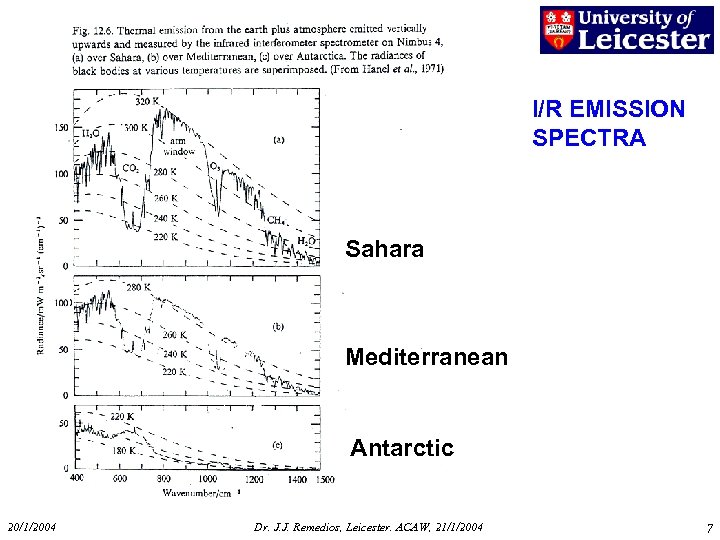 I/R EMISSION SPECTRA Sahara Mediterranean Antarctic 20/1/2004 Dr. J. J. Remedios, Leicester. ACAW, 21/1/2004 7
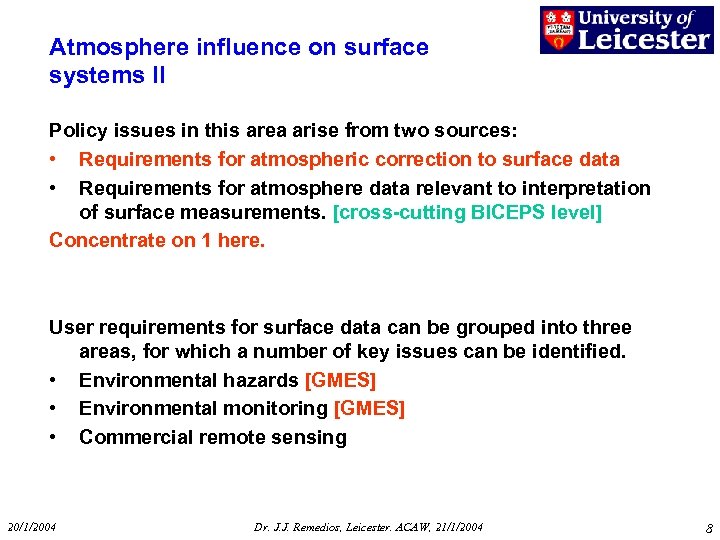 Atmosphere influence on surface systems II Policy issues in this area arise from two sources: • Requirements for atmospheric correction to surface data • Requirements for atmosphere data relevant to interpretation of surface measurements. [cross-cutting BICEPS level] Concentrate on 1 here. User requirements for surface data can be grouped into three areas, for which a number of key issues can be identified. • Environmental hazards [GMES] • Environmental monitoring [GMES] • Commercial remote sensing 20/1/2004 Dr. J. J. Remedios, Leicester. ACAW, 21/1/2004 8
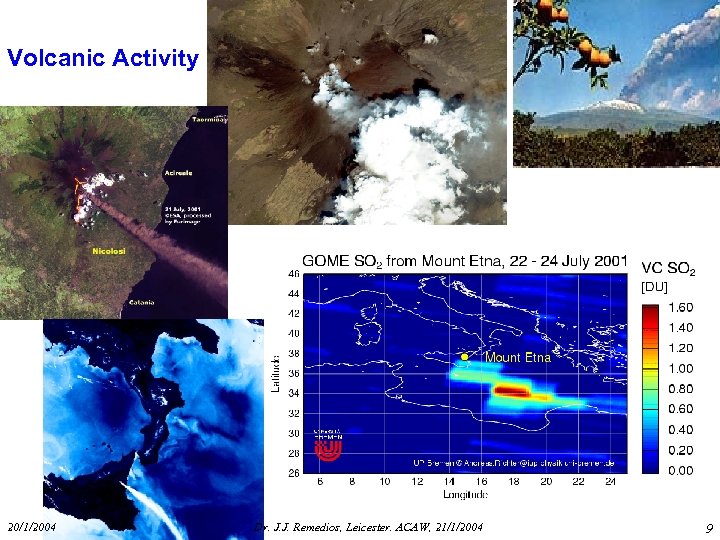 Volcanic Activity 20/1/2004 Dr. J. J. Remedios, Leicester. ACAW, 21/1/2004 9
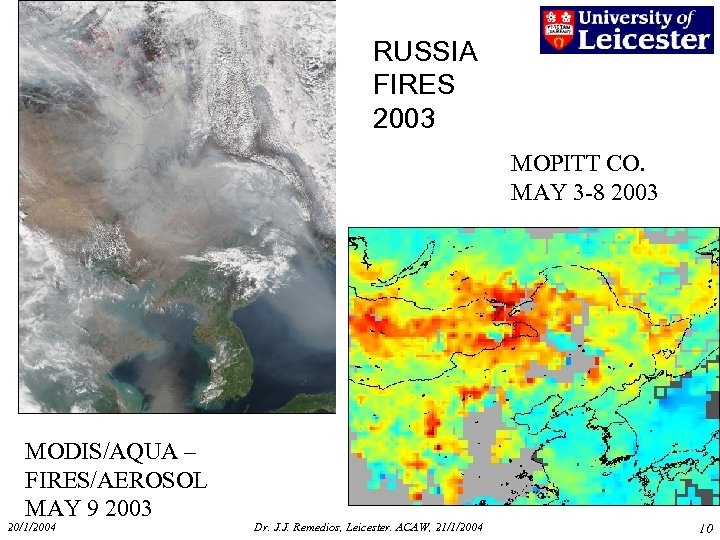 RUSSIA FIRES 2003 MOPITT CO. MAY 3 -8 2003 MODIS/AQUA – FIRES/AEROSOL MAY 9 2003 20/1/2004 Dr. J. J. Remedios, Leicester. ACAW, 21/1/2004 10
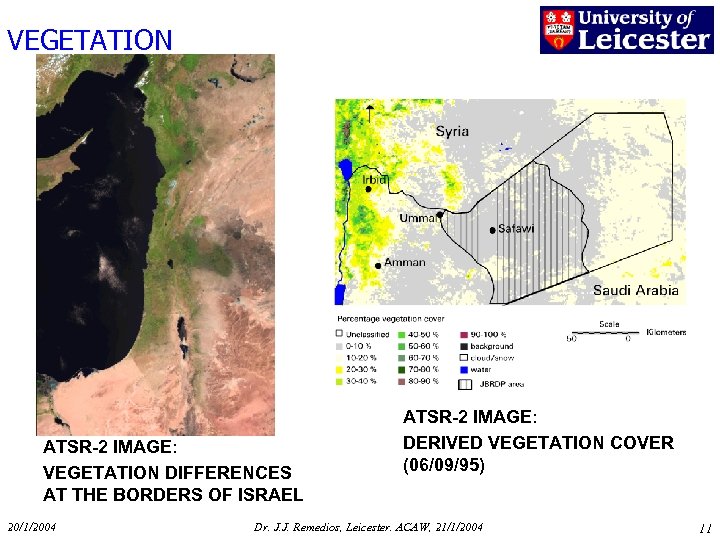 VEGETATION ATSR-2 IMAGE: VEGETATION DIFFERENCES AT THE BORDERS OF ISRAEL 20/1/2004 ATSR-2 IMAGE: DERIVED VEGETATION COVER (06/09/95) Dr. J. J. Remedios, Leicester. ACAW, 21/1/2004 11
 Atmospheric correction? 1. Most common atmospheric factors are a) Clouds (troposphere – optically thick, thin, broken) b) Tropospheric Aerosols (lower 2 -3 km) c) Tropospheric water vapour (lower 2 -3 km) d) Tropospheric CO 2, CH 4 (near-surface) e) Molecular density (ground to approximately tropopause) f) Stratospheric ozone (above 15/20 km) g) Stratospheric aerosols (volcanic eruption) h) O 4 complex 2. Would also include ionosphere for radio/microwave 20/1/2004 Dr. J. J. Remedios, Leicester. ACAW, 21/1/2004 12
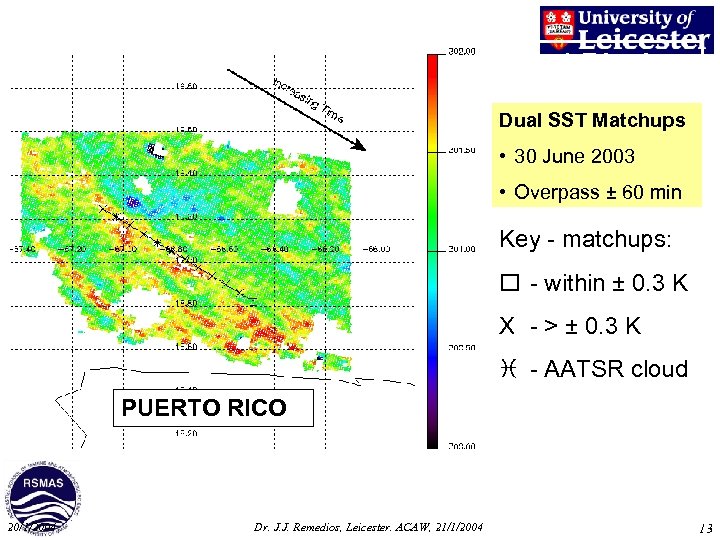 1 x 1 Block: Increasing time Dual SST Matchups • 30 June 2003 • Overpass ± 60 min Key - matchups: - within ± 0. 3 K X - > ± 0. 3 K i - AATSR cloud PUERTO RICO Colour indicates dual-view SST 20/1/2004 Dr. J. J. Remedios, Leicester. ACAW, 21/1/2004 13
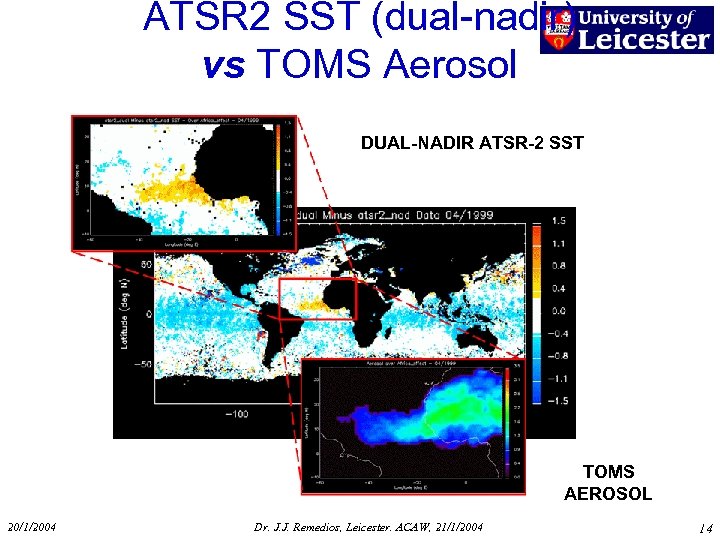 ATSR 2 SST (dual-nadir) vs TOMS Aerosol DUAL-NADIR ATSR-2 SST TOMS AEROSOL 20/1/2004 Dr. J. J. Remedios, Leicester. ACAW, 21/1/2004 14
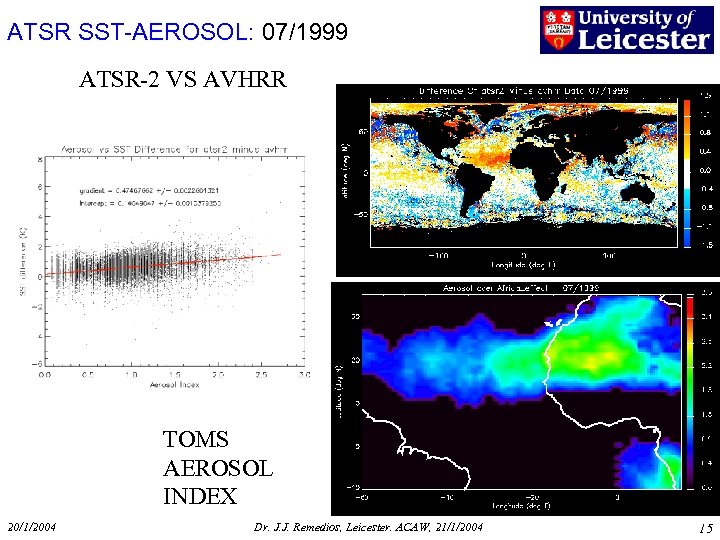 ATSR SST-AEROSOL: 07/1999 ATSR-2 VS AVHRR TOMS AEROSOL INDEX 20/1/2004 Dr. J. J. Remedios, Leicester. ACAW, 21/1/2004 15
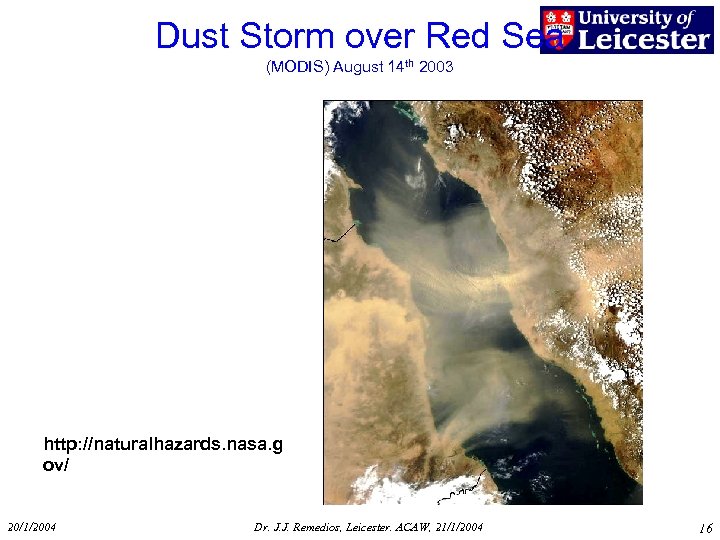 Dust Storm over Red Sea (MODIS) August 14 th 2003 http: //naturalhazards. nasa. g ov/ 20/1/2004 Dr. J. J. Remedios, Leicester. ACAW, 21/1/2004 16
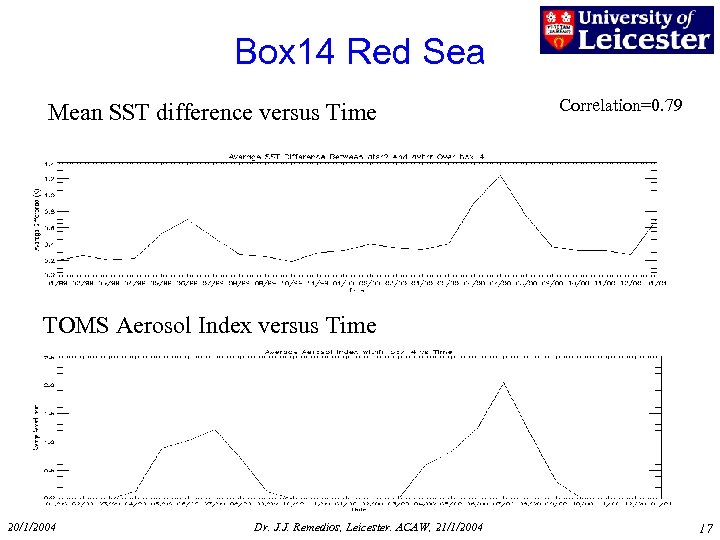 Box 14 Red Sea Mean SST difference versus Time Correlation=0. 79 TOMS Aerosol Index versus Time 20/1/2004 Dr. J. J. Remedios, Leicester. ACAW, 21/1/2004 17
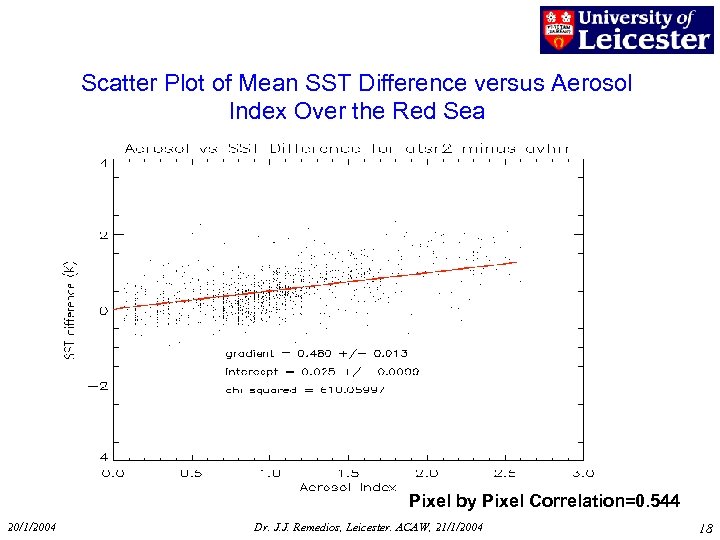 Scatter Plot of Mean SST Difference versus Aerosol Index Over the Red Sea Pixel by Pixel Correlation=0. 544 20/1/2004 Dr. J. J. Remedios, Leicester. ACAW, 21/1/2004 18
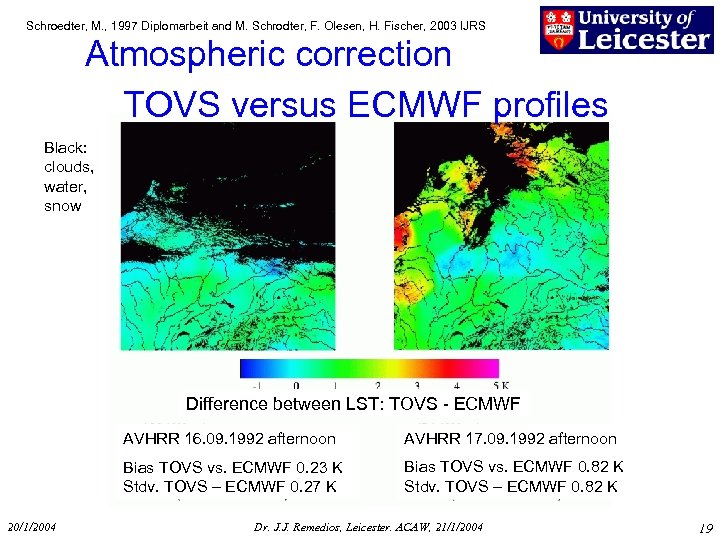 Schroedter, M. , 1997 Diplomarbeit and M. Schrodter, F. Olesen, H. Fischer, 2003 IJRS Atmospheric correction TOVS versus ECMWF profiles Black: clouds, water, snow Difference between LST: TOVS - ECMWF AVHRR 16. 09. 1992 afternoon Bias TOVS vs. ECMWF 0. 23 K Stdv. TOVS – ECMWF 0. 27 K 20/1/2004 AVHRR 17. 09. 1992 afternoon Bias TOVS vs. ECMWF 0. 82 K Stdv. TOVS – ECMWF 0. 82 K Dr. J. J. Remedios, Leicester. ACAW, 21/1/2004 19
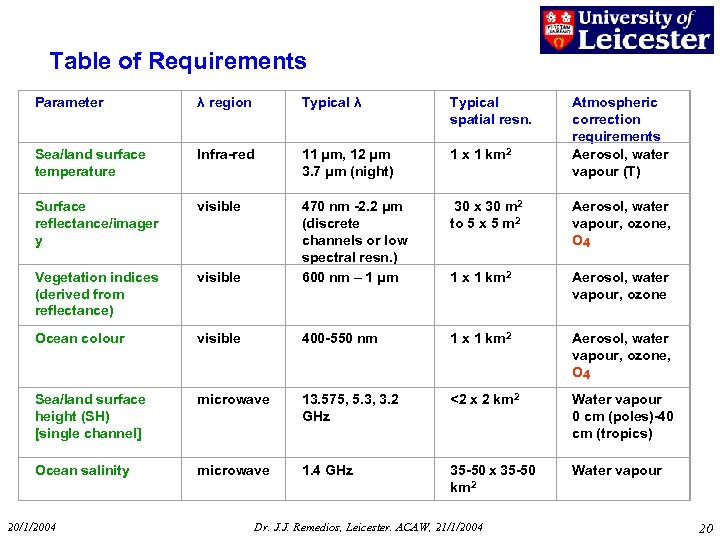 Table of Requirements Parameter λ region Typical λ Typical spatial resn. Sea/land surface temperature Infra-red 11 μm, 12 μm 3. 7 μm (night) 1 x 1 km 2 Surface reflectance/imager y visible 30 x 30 m 2 to 5 x 5 m 2 Aerosol, water vapour, ozone, O 4 Vegetation indices (derived from reflectance) visible 470 nm -2. 2 μm (discrete channels or low spectral resn. ) 600 nm – 1 μm 1 x 1 km 2 Aerosol, water vapour, ozone Ocean colour visible 400 -550 nm 1 x 1 km 2 Aerosol, water vapour, ozone, O 4 Sea/land surface height (SH) [single channel] microwave 13. 575, 5. 3, 3. 2 GHz <2 x 2 km 2 Water vapour 0 cm (poles)-40 cm (tropics) Ocean salinity microwave 1. 4 GHz 35 -50 x 35 -50 km 2 Water vapour 20/1/2004 Dr. J. J. Remedios, Leicester. ACAW, 21/1/2004 Atmospheric correction requirements Aerosol, water vapour (T) 20
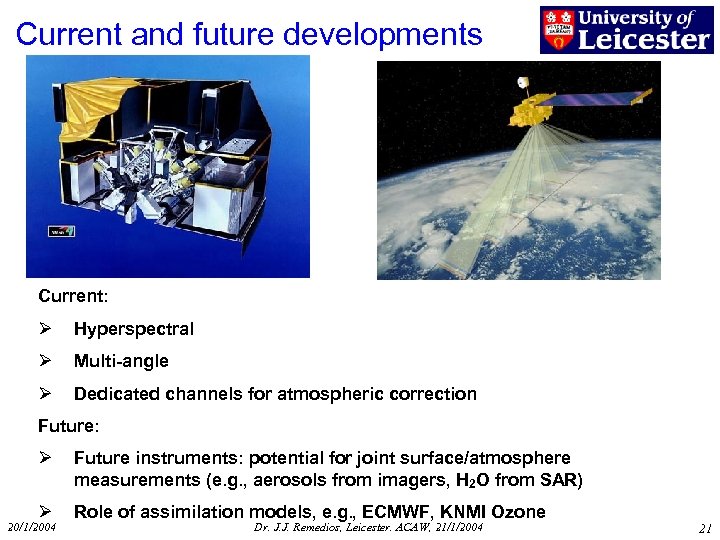 Current and future developments Current: Ø Hyperspectral Ø Multi-angle Ø Dedicated channels for atmospheric correction Future: Ø Future instruments: potential for joint surface/atmosphere measurements (e. g. , aerosols from imagers, H 2 O from SAR) Ø Role of assimilation models, e. g. , ECMWF, KNMI Ozone 20/1/2004 Dr. J. J. Remedios, Leicester. ACAW, 21/1/2004 21
 What are the technical issues? 1. The latest sensors often incorporate a spectral channel for determining atmospheric correction factors. a) Are all the relevant atmospheric factors measured b) Is vertical resolution required? c) Is the information measured at the correct wavelengths – particularly aerosols? 2. Surface products and imagers often require a high spatial resolution ( < 5 x 5 km 2 ) with specific temporal resolution. What is the ability of atmospheric GMES systems to deliver this information? Spectral vs Spatial resolution 3. Will atmospheric instruments measure the “correct” (relevant) types of aerosol? 4. What is the accuracy of assimilation and the potential for improved spatial scales? 20/1/2004 Dr. J. J. Remedios, Leicester. ACAW, 21/1/2004 22
 Rational System Needs (European) 1. Communication between surface sensing and atmospheric sensing communities (network) 2. Research into the exploitation of independent atmospheric sensing information within surface sensors. 3. Establish accuracies of ECMWF/ other assimilation systems for ozone/water vapour 4. Research into radiative transfer systems and models of the atmosphere 5. Inter-instrument research on aerosol across the e/m spectrum. 6. Operational data processing for multi-system data, e. g. ENVISAT/Metop 7. Continuity in the observation of key atmospheric variables and intercalibrated datasets relevant to surface products 20/1/2004 Dr. J. J. Remedios, Leicester. ACAW, 21/1/2004 23
 What is missing (in European systems)? 1. Research into the derivation of atmospheric correction information at high spatial scales. 2. Development of synergistic mission system concepts – formation flying 3. Development of assimilation systems providing atmospheric information to surface sensing communities 4. High spatial resolution aerosol mission to establish aerosol climatology/radiative properties [air quality] 5. [“Quick reaction” system for volcanic eruption into stratosphere] 20/1/2004 Dr. J. J. Remedios, Leicester. ACAW, 21/1/2004 24
 Overall surface-atmosphere system An integration of surface and atmosphere systems: • Observation systems Ø Use of atmospheric sensors in other GMES (sub-) system. Ø Exploitation of atmospheric information derived from other GMES systems (two-way) Ø High spatial resolution aerosol mission Ø Continuity of measurements for water vapour, ozone. • • 20/1/2004 Accessible and linked databases /processing centres [*] NRT capabilities including data assimilation [*] Dr. J. J. Remedios, Leicester. ACAW, 21/1/2004 25
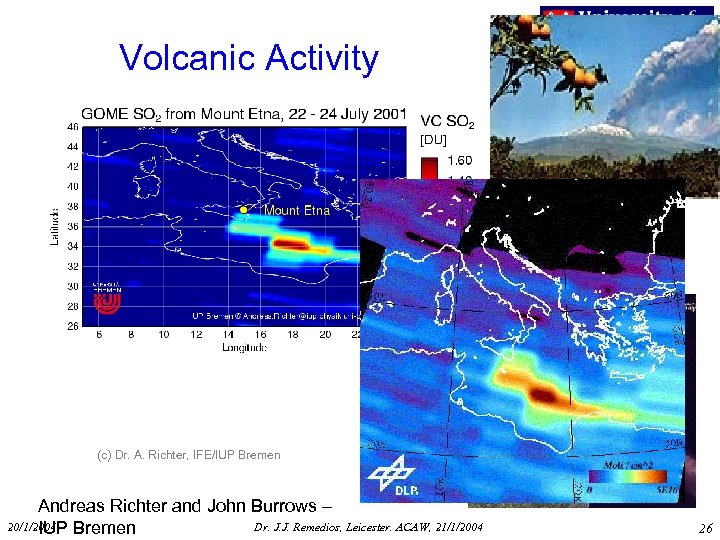 Volcanic Activity (c) Dr. A. Richter, IFE/IUP Bremen Andreas Richter and John Burrows – 20/1/2004 Bremen Dr. J. J. Remedios, Leicester. ACAW, 21/1/2004 IUP 26
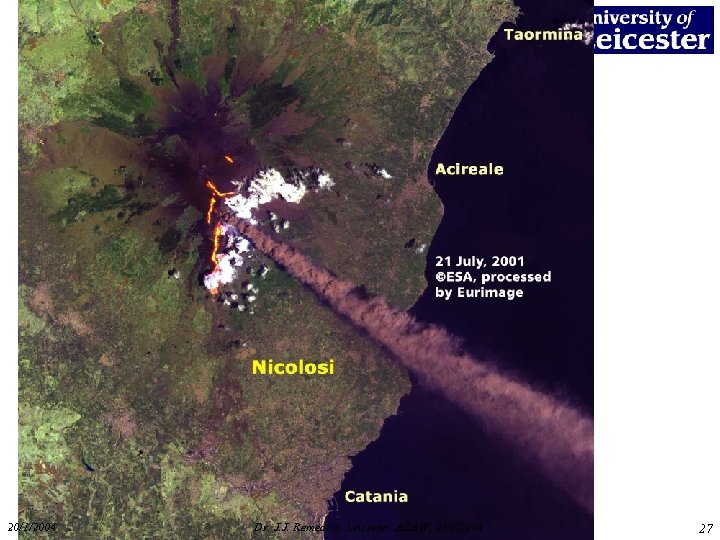 Mt Etna 20/1/2004 Dr. J. J. Remedios, Leicester. ACAW, 21/1/2004 27