 Скачать презентацию GM foods explained Presented by MADGE Mothers are
6298c76932b66a5c8f94b905dfbba565.ppt
- Количество слайдов: 32



GM foods explained Presented by MADGE Mothers are Demystifying Genetic Engineering
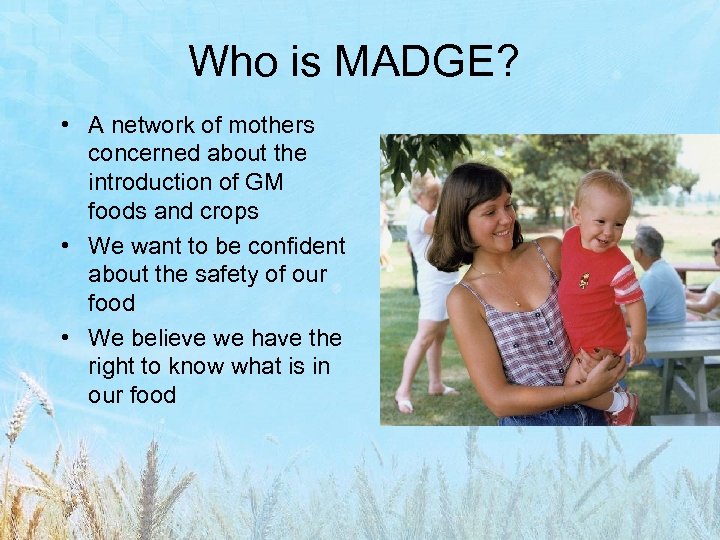
Who is MADGE? • A network of mothers concerned about the introduction of GM foods and crops • We want to be confident about the safety of our food • We believe we have the right to know what is in our food
Getting to know you Hands up if: • You are a mother • You are a farmer • You are a councillor • You feel like you already know a lot about GM • You feel like you don’t know much about GM at all
GM on our plates & in our fields • The Victorian government lifted the moratorium on growing GM crops in 2008 • Farmers can now grow GM canola • What’s the situation? – Where are GM foods on our plates? – Where are GM crops in our fields?
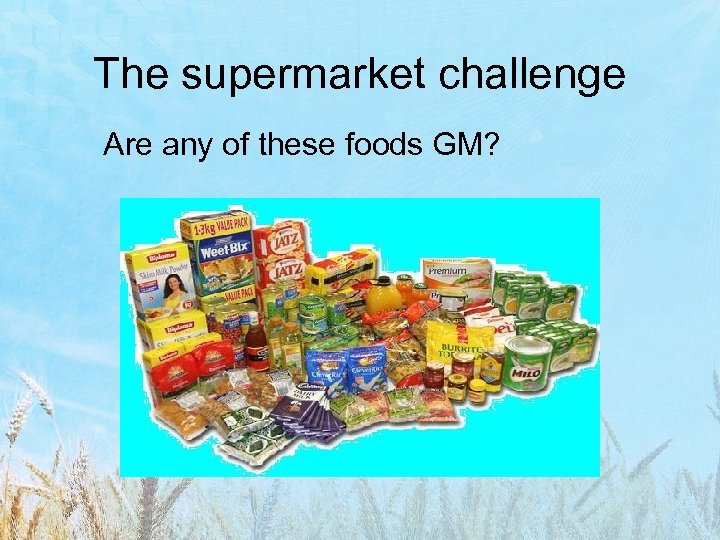
The supermarket challenge Are any of these foods GM?
Most GM foods aren’t labelled • You may have heard that GM foods are labelled, but… • Most GM foods don’t need to be labelled, because of exemptions to labelling laws: – – – Food from restaurants and food outlets Meat, dairy and eggs from animals fed GM Highly refined foods like sugars & oils Additives, processing aids & flavours “Accidental” GM contamination up to 1% of ingredients
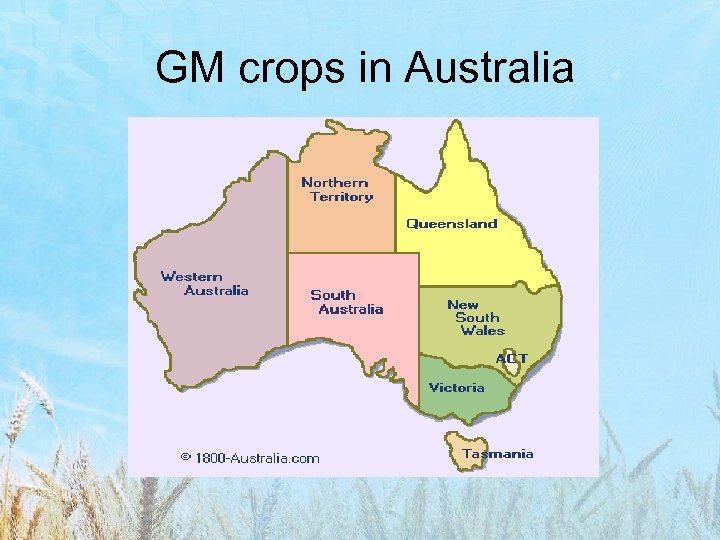
GM crops in Australia
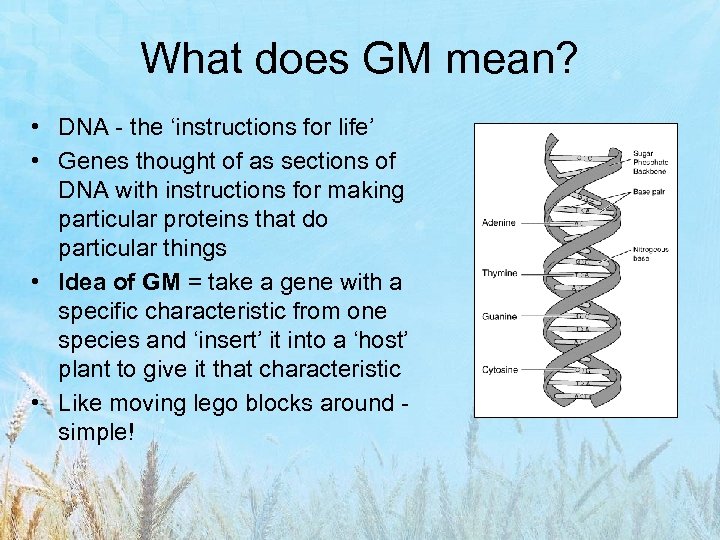
What does GM mean? • DNA - the ‘instructions for life’ • Genes thought of as sections of DNA with instructions for making particular proteins that do particular things • Idea of GM = take a gene with a specific characteristic from one species and ‘insert’ it into a ‘host’ plant to give it that characteristic • Like moving lego blocks around - simple!
Inserting the genes • Genetic modification is not the same as traditional selective breeding • There are two methods of ‘inserting’ DNA – The Agrobacterium Method – The Gene Gun Method • Let’s demonstrate…
Is it really that simple? • Last year, 300 scientists from 4 -year research project called ENCODE found that: – The idea of one gene - one protein is wrong – Genes can combine in different ways to make different proteins • “The ability to introduce alien genes into a genome is an impressive technological manipulation but we remain too ignorant of how the genome works to anticipate all the consequences, subtle or obvious, immediate or long-term, of those manipulations” Professor David Suzuki, 2007 (Geneticist, Author, Environmentalist)
Are GM foods safe to eat? • We don’t know because… • Our government regulatory authorities don’t independently test GM crops for health impacts before approval • They review test data submitted by biotechnology companies • Safety assessments are based on ‘substantial equivalence’ • There is no monitoring of the effects of GM food on public health
GM Crop Food Approvals - Australia Food Standards Australia New Zealand (FSANZ): Genetically Modified Foods & Their Approval Status, http: //www. foodstandards. gov. au/foodmatters/gmfoods/gmcurrentapplication 1030. cfm
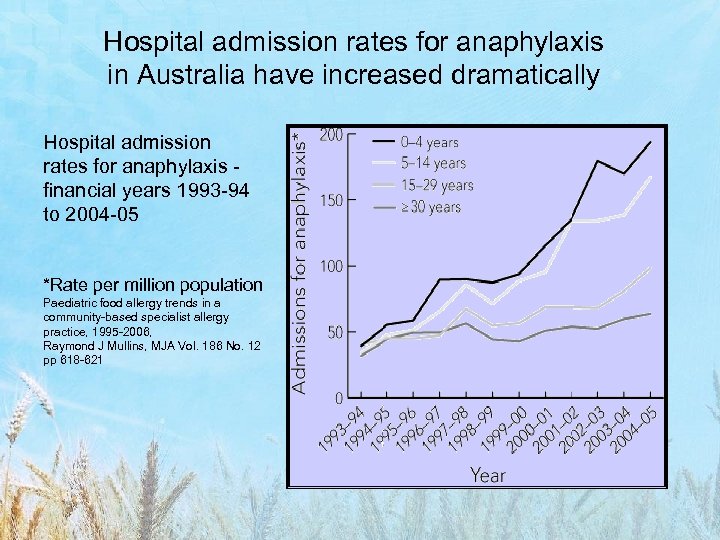
Hospital admission rates for anaphylaxis in Australia have increased dramatically Hospital admission rates for anaphylaxis - financial years 1993 -94 to 2004 -05 *Rate per million population Paediatric food allergy trends in a community-based specialist allergy practice, 1995 -2006, Raymond J Mullins, MJA Vol. 186 No. 12 pp 618 -621
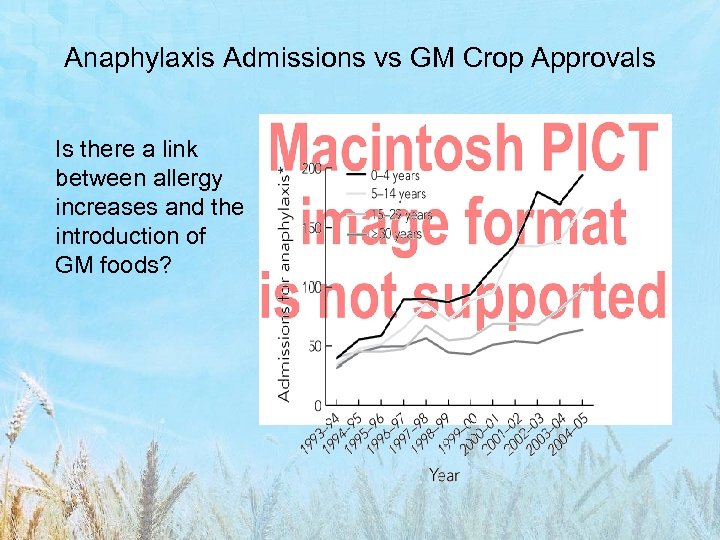
Anaphylaxis Admissions vs GM Crop Approvals Is there a link between allergy increases and the introduction of GM foods?
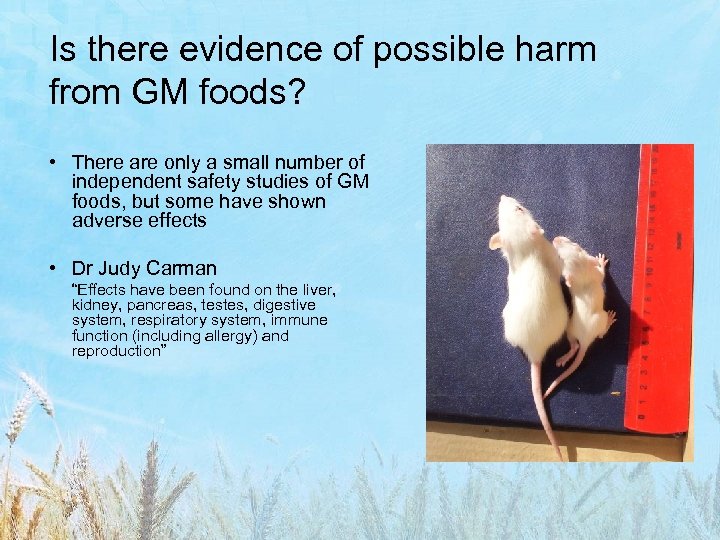
Is there evidence of possible harm from GM foods? • There are only a small number of independent safety studies of GM foods, but some have shown adverse effects • Dr Judy Carman “Effects have been found on the liver, kidney, pancreas, testes, digestive system, respiratory system, immune function (including allergy) and reproduction”
Many scientists are concerned… • “Governments should never have allowed these products into the food chain without insisting on rigorous testing for effects on health” Editorial, The Lancet, 29 May 1999 • “There have been no studies into whether any of the millions of people who have been hospitalized or died since GM crops were introduced got ill due to eating these crops” Judy Carmen, Canberra Times, 28 July 2008
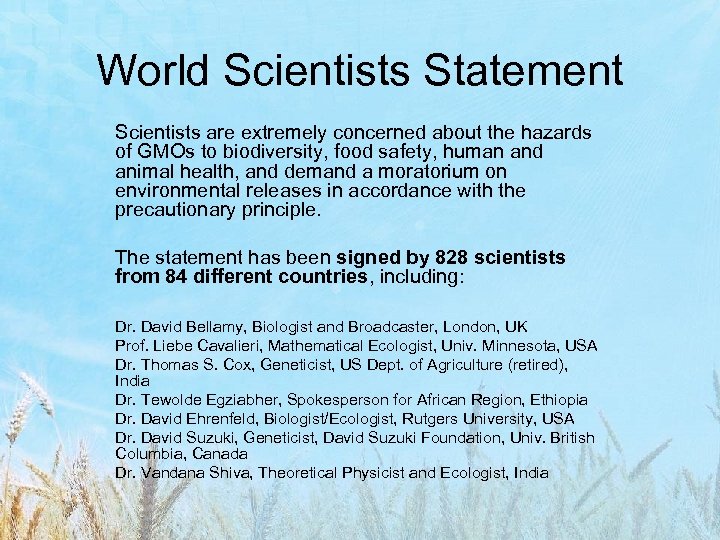
World Scientists Statement Scientists are extremely concerned about the hazards of GMOs to biodiversity, food safety, human and animal health, and demand a moratorium on environmental releases in accordance with the precautionary principle. The statement has been signed by 828 scientists from 84 different countries, including: Dr. David Bellamy, Biologist and Broadcaster, London, UK Prof. Liebe Cavalieri, Mathematical Ecologist, Univ. Minnesota, USA Dr. Thomas S. Cox, Geneticist, US Dept. of Agriculture (retired), India Dr. Tewolde Egziabher, Spokesperson for African Region, Ethiopia Dr. David Ehrenfeld, Biologist/Ecologist, Rutgers University, USA Dr. David Suzuki, Geneticist, David Suzuki Foundation, Univ. British Columbia, Canada Dr. Vandana Shiva, Theoretical Physicist and Ecologist, India
Questions we are entitled to ask • Why haven’t studies showing adverse health effects of GM foods in animals been repeated? • Why don’t our Government authorities carry out independent animal feeding studies before introducing GM crops into our food system? • Why aren’t all GM foods labelled to facilitate traceability in the food system and monitoring of public health effects?
GM contamination is common • The GM Contamination Register has recorded 216 cases of contamination in 57 countries worldwide • GM contamination occurs through: – Crop and seed production – Field contamination – Food trading & processing
Crop and seed contamination • Occurs through wind & insect pollination • Canola seeds are the size of 100’s and 1000’s - contamination can occur during harvesting, storage and transport • In Canada, 32 of 33 certified non-GM canola seed stocks were contaminated —Agronomy Journal 95, 2003
Chaos on the ground • Liability & insurance - who pays? • WA & SA have maintained bans on growing GM canola, and won’t allow transport of GM canola through their states • No systematic plan for segregating GM from non-GM crops through the supply chain • How can farmers certify their crops as non-GM if they don’t know where GM crops are growing? • Harvesters are considering a GM canola boycott, because it takes a week to ‘decontaminate’ the harvesting machine
Who owns our food? Seeds & patents • Farmers & gardeners have developed, saved & swapped seeds for 1000’s of years • Now domestic & international laws grant patents to corporations to ‘own’ seeds • Farmers can’t save patented seeds • In the 1970’s there were 1000’s of seed companies, now 10 companies own 57% of world trade in seed
I heard that…we need GM foods to ‘feed the world’ • "The poor and hungry need low-cost, readily available technologies and practices to increase food production" Professor Jules Pretty, University of Essex • "If anyone tells you that GM is going to feed the world, tell them that it is not…To feed the world takes political and financial will" Steve Smith, SCIMAC and Novartis (now SYNGENTA), • “Just two doses a year of vitamin A supplements is enough to prevent blindness in children. The cost of this is as little as $1 per child”, Fred Hollows Foundation
I heard that…we need GM foods because of climate change • There are no GM crops designed for climate change • Biotech giants are racing to patent genes • Non-GM breeding successes • Small farmers cool the climate
I heard that…GM is all about good science • GM food allowed despite scientists warning of toxins, allergens and new diseases (FDA) • Scientists showing GM might be harmful have been ‘attacked’ (Pusztai & Ermakova) • No scientific body of evidence to show that GM foods are safe – The ‘precautionary principle’ has not been applied
![[Section title slide] - Being a food detective • Greg - any ideas for](https://present5.com/presentation/6298c76932b66a5c8f94b905dfbba565/image-26.jpg "[Section title slide] - Being a food detective • Greg - any ideas for")
[Section title slide] - Being a food detective • Greg - any ideas for a good image here?
What foods aren’t GM? • • Organic foods Fruit & vegetables Pasture-fed meats Australian-grown cereal crops (except canola from November) • Any significant ingredients in foods labelled ‘Product of Australia’ – Except cottonseed & canola from November • Many producers have GM-free policies – look for the labels or call the information lines
What foods might be GM? • Australian cottonseed oil, ‘vegetable oil’ & (from November) canola oil – Find out what your chips are cooked in • All other GM will be imported, mostly from the Americas – The main international GM crops are soy, corn, canola and cotton • Look out for soy lecithin/protein, corn/maize syrup/starch – think laterally! – A handful of soy lecithin is thrown into almost everything processed • Food additives & processing enzymes
How can I avoid GM foods? • Buy organic • Buy from local farmers markets • Eat unprocessed foods – ‘make your own’ out of lovely Australian ingredients – Except for cottonseed oil and soon canola • Eat at restaurants that have signed up to the Greenpeace Chef’s Charter • Use the Greenpeace True Food Guide • Ring information numbers on food packaging • Be a food detective!
If you’re concerned, what else can you do? • Be informed - sign up to the MADGE newsletter • Go through your cupboards, and contact food manufacturers to find out whether your foods contain GM ingredients – Tell MADGE what you find out, so we can let others know • Tell food manufacturers and retailers how you feel about GM foods – Right now, Australian food companies are deciding whether to use GM canola in their products • Tell your State and Federal politicians your concerns • Sign the Greenpeace ‘GM Food - Our Right to Know’ petition
‘GM Food - Our Right to Know’ At the very least it is imperative that any GM produce be labelled Stephanie Alexander People have a right to know what they are eating Margaret Fulton If we are to get GM canola, it should be labelled, and if it is not labelled, we should all ask why Dr Rosemary Stanton, Nutritionist
Our food, our right, our responsibility Never doubt that a small group of thoughtful, committed citizens can change the world Margaret Mead, Anthropologist
Скачать презентацию GM foods explained Presented by MADGE Mothers are
6298c76932b66a5c8f94b905dfbba565.ppt