 Скачать презентацию Globalization Who Benefits 1 U S House of
828cb3380007c3d2155bf84527465ca7.ppt
- Количество слайдов: 61




Globalization: Who Benefits? 1 U. S. House of Representatives, August 2003
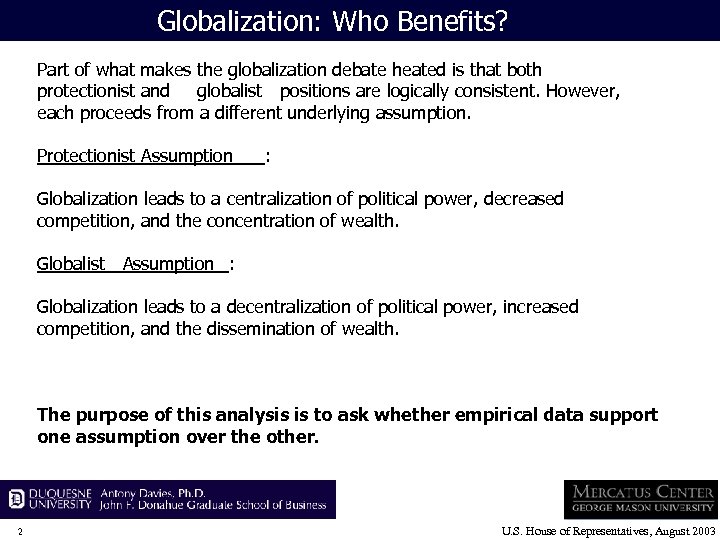
Globalization: Who Benefits? Part of what makes the globalization debate heated is that both protectionist and globalist positions are logically consistent. However, each proceeds from a different underlying assumption. Protectionist Assumption : Globalization leads to a centralization of political power, decreased competition, and the concentration of wealth. Globalist Assumption : Globalization leads to a decentralization of political power, increased competition, and the dissemination of wealth. The purpose of this analysis is to ask whether empirical data support one assumption over the other. 2 U. S. House of Representatives, August 2003

Globalization: Who Benefits? Goal : Examine conventional wisdom regarding the impact of globalization on various social and economic measures. 1. 2. Health : longevity, infant mortality, food intake 3. The environment 4. Gender equality 5. Individual rights : children’s rights, rights to education and health care, property rights 6. 3 Income : level, distribution, and growth Employment in the U. S. : CO 2 emissions, deforestation : equality in opportunity and outcome U. S. House of Representatives, August 2003

Per-Capita Income Conventional wisdom : Globalization leads to a shift in wealth from workers, consumers, and developing countries to multinationals. Theory : In developed countries, workers become unemployed as their jobs move abroad where labor is cheaper. In under-developed and developing countries, workers earn lower wages as the number of employers declines via consolidation and buy-outs driven by multinationals. Example : Mc. Donald’s is accused of preventing union formation and paying substandard wages in its restaurants abroad. 4 U. S. House of Representatives, August 2003
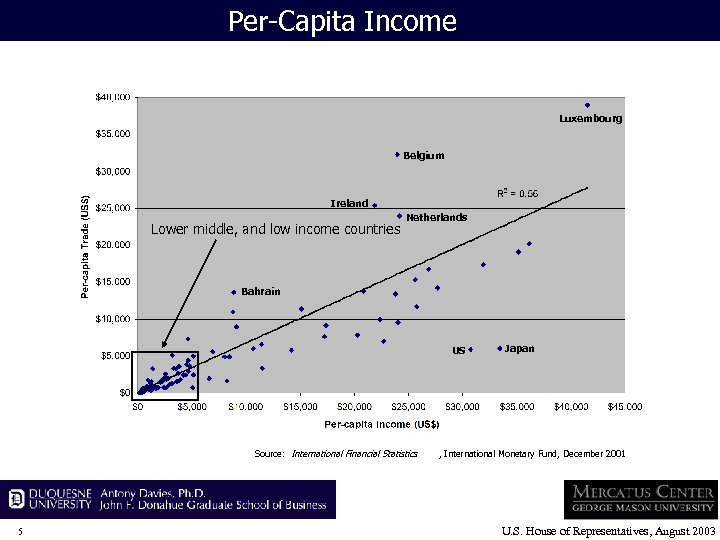
Per-Capita Income Luxembourg Belgium Ireland Lower middle, and low income countries Netherlands Bahrain US Source: International Financial Statistics 5 Japan , International Monetary Fund, December 2001 U. S. House of Representatives, August 2003
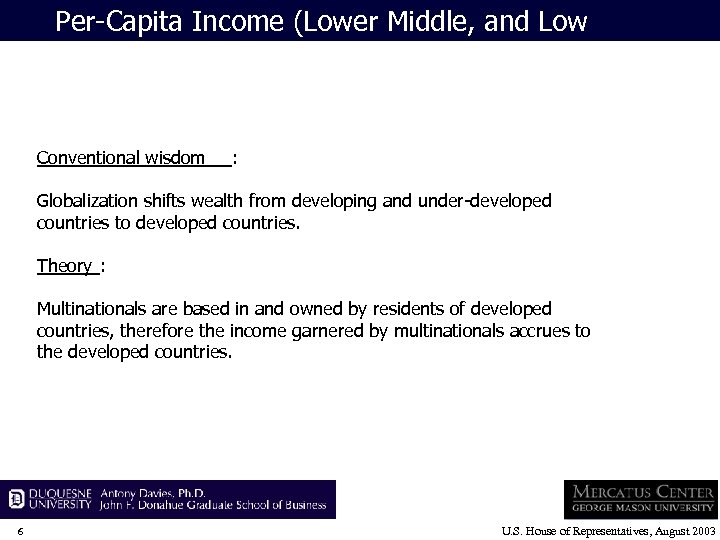
Per-Capita Income (Lower Middle, and Low Income) Conventional wisdom : Globalization shifts wealth from developing and under-developed countries to developed countries. Theory : Multinationals are based in and owned by residents of developed countries, therefore the income garnered by multinationals accrues to the developed countries. 6 U. S. House of Representatives, August 2003
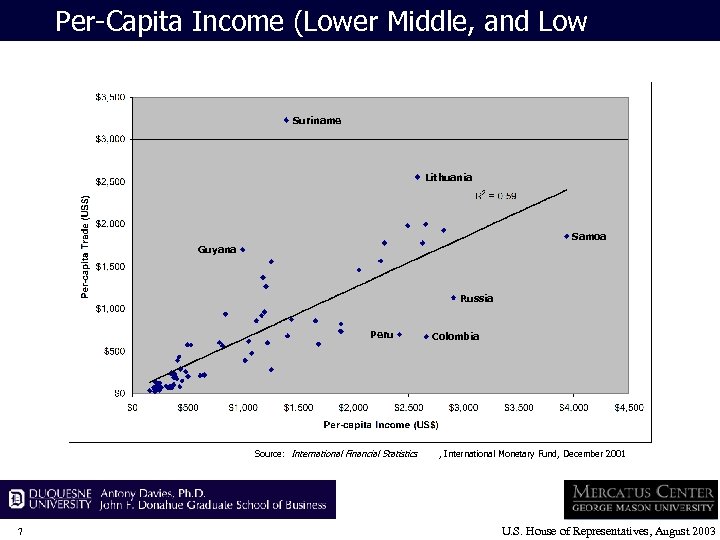
Per-Capita Income (Lower Middle, and Low Income) Suriname Lithuania Samoa Guyana Russia Peru Source: International Financial Statistics 7 Colombia , International Monetary Fund, December 2001 U. S. House of Representatives, August 2003
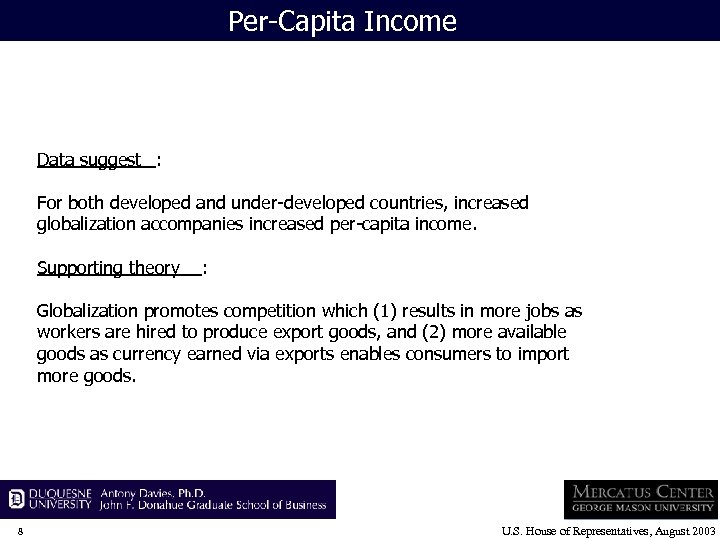
Per-Capita Income Data suggest : For both developed and under-developed countries, increased globalization accompanies increased per-capita income. Supporting theory : Globalization promotes competition which (1) results in more jobs as workers are hired to produce export goods, and (2) more available goods as currency earned via exports enables consumers to import more goods. 8 U. S. House of Representatives, August 2003
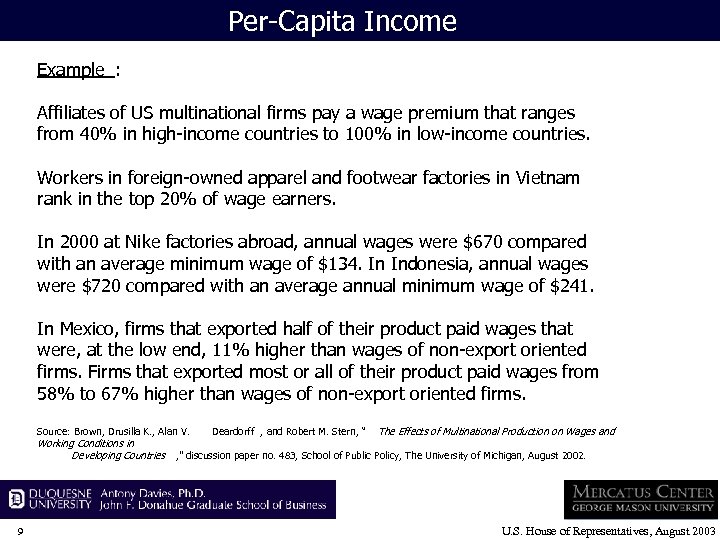
Per-Capita Income Example : Affiliates of US multinational firms pay a wage premium that ranges from 40% in high-income countries to 100% in low-income countries. Workers in foreign-owned apparel and footwear factories in Vietnam rank in the top 20% of wage earners. In 2000 at Nike factories abroad, annual wages were $670 compared with an average minimum wage of $134. In Indonesia, annual wages were $720 compared with an average annual minimum wage of $241. In Mexico, firms that exported half of their product paid wages that were, at the low end, 11% higher than wages of non-export oriented firms. Firms that exported most or all of their product paid wages from 58% to 67% higher than wages of non-export oriented firms. Source: Brown, Drusilla K. , Alan V. Working Conditions in Developing Countries 9 Deardorff , and Robert M. Stern, “ The Effects of Multinational Production on Wages and , ” discussion paper no. 483, School of Public Policy, The University of Michigan, August 2002. U. S. House of Representatives, August 2003
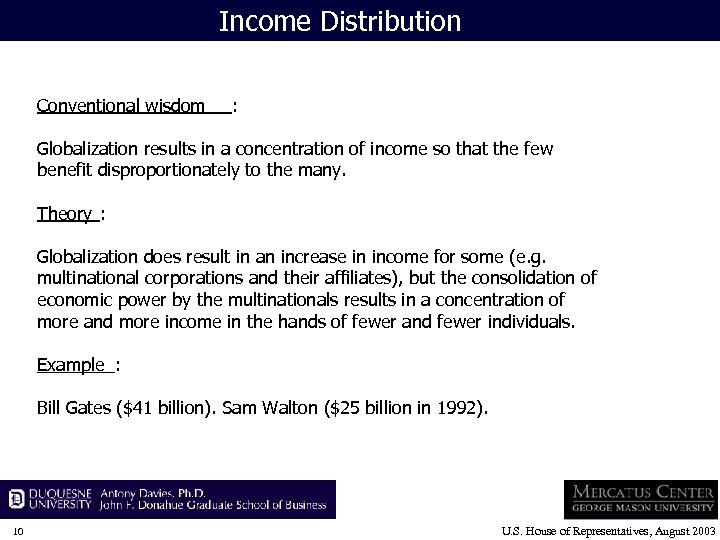
Income Distribution Conventional wisdom : Globalization results in a concentration of income so that the few benefit disproportionately to the many. Theory : Globalization does result in an increase in income for some (e. g. multinational corporations and their affiliates), but the consolidation of economic power by the multinationals results in a concentration of more and more income in the hands of fewer and fewer individuals. Example : Bill Gates ($41 billion). Sam Walton ($25 billion in 1992). 10 U. S. House of Representatives, August 2003
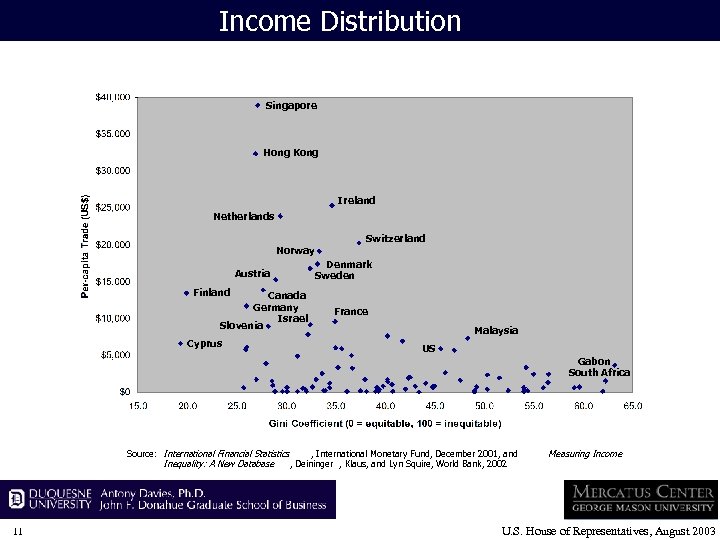
Income Distribution Singapore Hong Kong Ireland Netherlands Switzerland Norway Denmark Sweden Austria Finland Canada Germany Israel Slovenia Cyprus France Malaysia US Gabon South Africa Source: International Financial Statistics Inequality: A New Database 11 , International Monetary Fund, December 2001, and , Deininger , Klaus, and Lyn Squire, World Bank, 2002 Measuring Income U. S. House of Representatives, August 2003
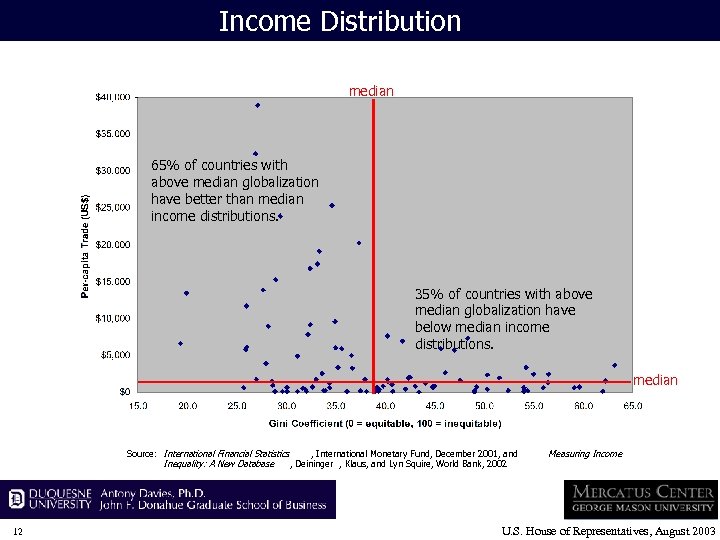
Income Distribution median 65% of countries with above median globalization have better than median income distributions. 35% of countries with above median globalization have below median income distributions. median Source: International Financial Statistics Inequality: A New Database 12 , International Monetary Fund, December 2001, and , Deininger , Klaus, and Lyn Squire, World Bank, 2002 Measuring Income U. S. House of Representatives, August 2003
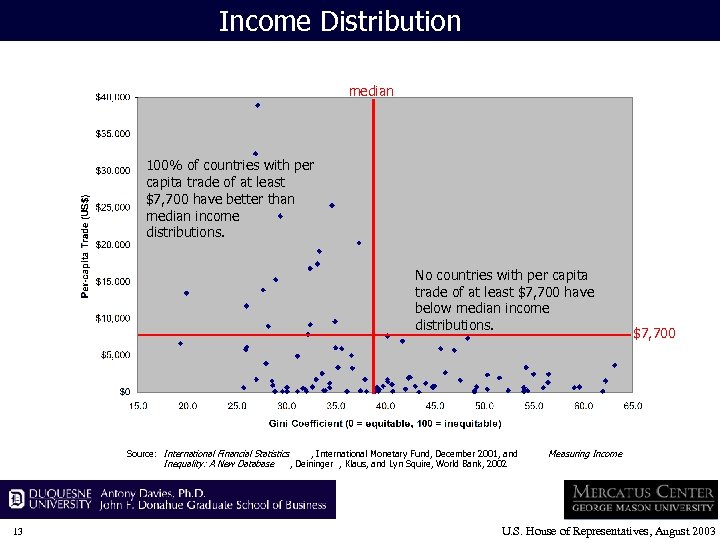
Income Distribution median 100% of countries with per capita trade of at least $7, 700 have better than median income distributions. No countries with per capita trade of at least $7, 700 have below median income distributions. Source: International Financial Statistics Inequality: A New Database 13 , International Monetary Fund, December 2001, and , Deininger , Klaus, and Lyn Squire, World Bank, 2002 $7, 700 Measuring Income U. S. House of Representatives, August 2003
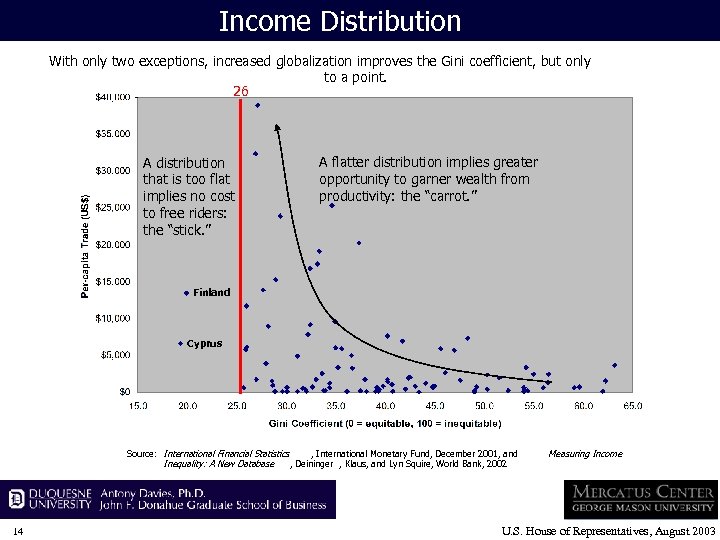
Income Distribution With only two exceptions, increased globalization improves the Gini coefficient, but only to a point. 26 A distribution that is too flat implies no cost to free riders: the “stick. ” A flatter distribution implies greater opportunity to garner wealth from productivity: the “carrot. ” Finland Cyprus Source: International Financial Statistics Inequality: A New Database 14 , International Monetary Fund, December 2001, and , Deininger , Klaus, and Lyn Squire, World Bank, 2002 Measuring Income U. S. House of Representatives, August 2003
Income Distribution Argument : If income is less concentrated in more globalized countries, what we’re seeing is simply a “big country” effect – big countries control most of the income and are more globalized. Counterargument : 1. The Gini coefficients we examine are “within” country – that is, we are not asking “how is income distributed across countries, ” but “how is income distributed within countries. ” Example : Cyprus has a Gini coefficient half that of the US. 2. Our measure of globalization is on a per-capita basis. 3. Nonetheless, if we focus only on lower middle and low income countries, we find similar results. 15 U. S. House of Representatives, August 2003
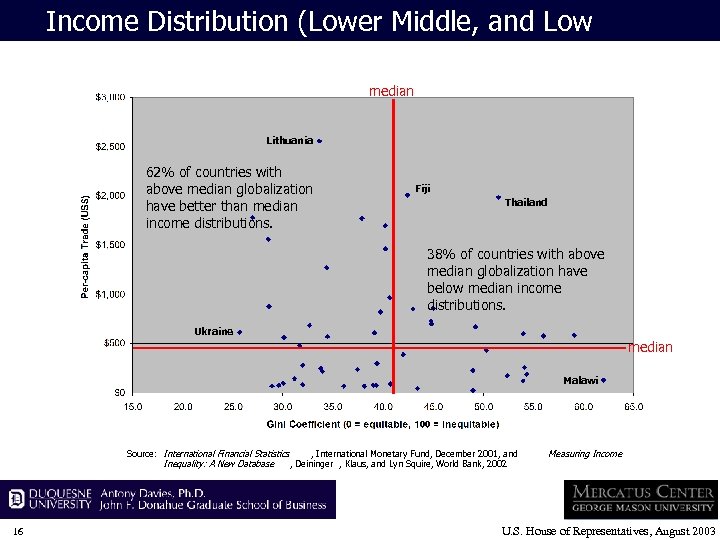
Income Distribution (Lower Middle, and Low Income) median Lithuania 62% of countries with above median globalization have better than median income distributions. Fiji Thailand 38% of countries with above median globalization have below median income distributions. Ukraine median Malawi Source: International Financial Statistics Inequality: A New Database 16 , International Monetary Fund, December 2001, and , Deininger , Klaus, and Lyn Squire, World Bank, 2002 Measuring Income U. S. House of Representatives, August 2003
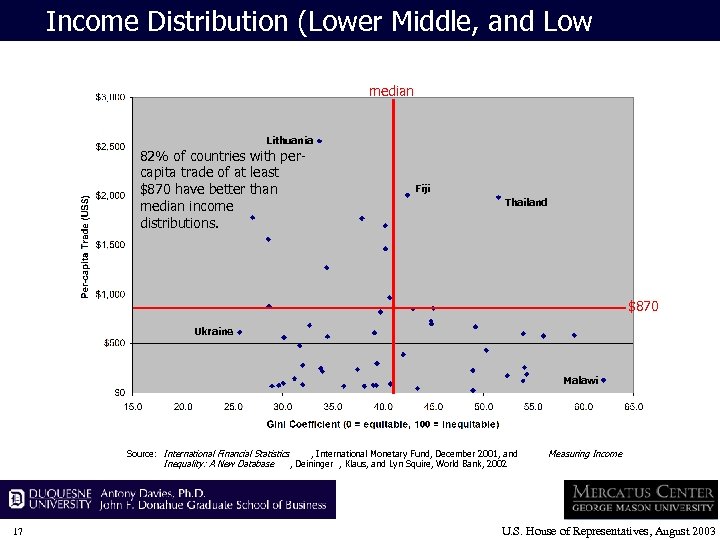
Income Distribution (Lower Middle, and Low Income) median Lithuania 82% of countries with percapita trade of at least $870 have better than median income distributions. Fiji Thailand $870 Ukraine Malawi Source: International Financial Statistics Inequality: A New Database 17 , International Monetary Fund, December 2001, and , Deininger , Klaus, and Lyn Squire, World Bank, 2002 Measuring Income U. S. House of Representatives, August 2003
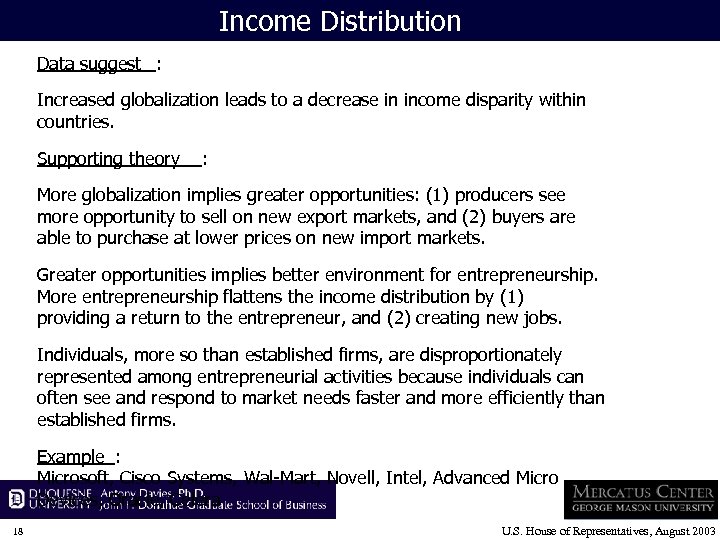
Income Distribution Data suggest : Increased globalization leads to a decrease in income disparity within countries. Supporting theory : More globalization implies greater opportunities: (1) producers see more opportunity to sell on new export markets, and (2) buyers are able to purchase at lower prices on new import markets. Greater opportunities implies better environment for entrepreneurship. More entrepreneurship flattens the income distribution by (1) providing a return to the entrepreneur, and (2) creating new jobs. Individuals, more so than established firms, are disproportionately represented among entrepreneurial activities because individuals can often see and respond to market needs faster and more efficiently than established firms. Example : Microsoft, Cisco Systems, Wal-Mart, Novell, Intel, Advanced Micro Devices, Oracle, Celera 18 U. S. House of Representatives, August 2003
Income Growth Conventional wisdom : Globalization increases disparity of growth across countries by slowing the income growth of lesser developed countries and augmenting the income growth of developed countries. 19 U. S. House of Representatives, August 2003
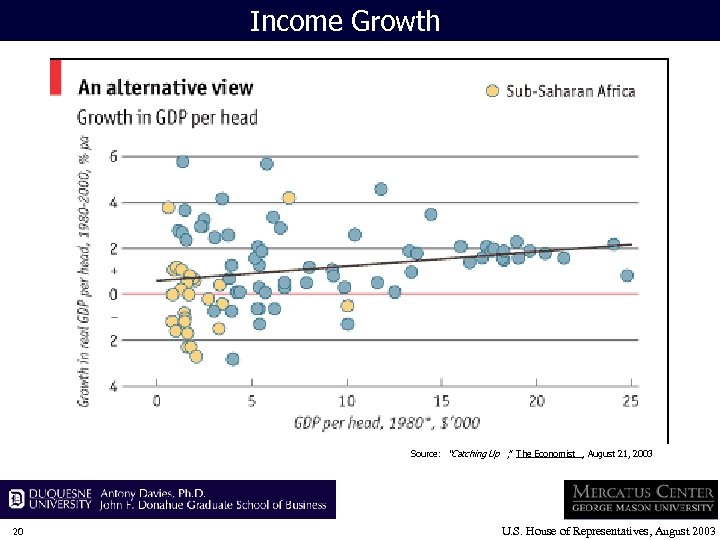
Income Growth Source: “Catching Up , ” The Economist , August 21, 2003 20 U. S. House of Representatives, August 2003
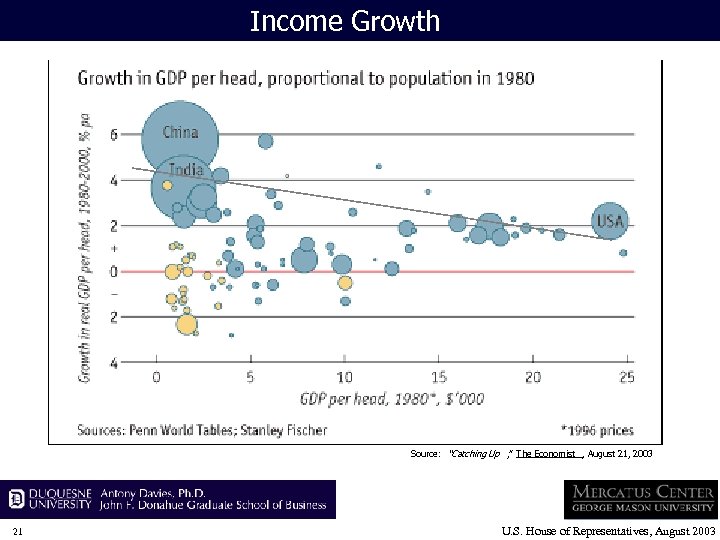
Income Growth Source: “Catching Up , ” The Economist , August 21, 2003 21 U. S. House of Representatives, August 2003
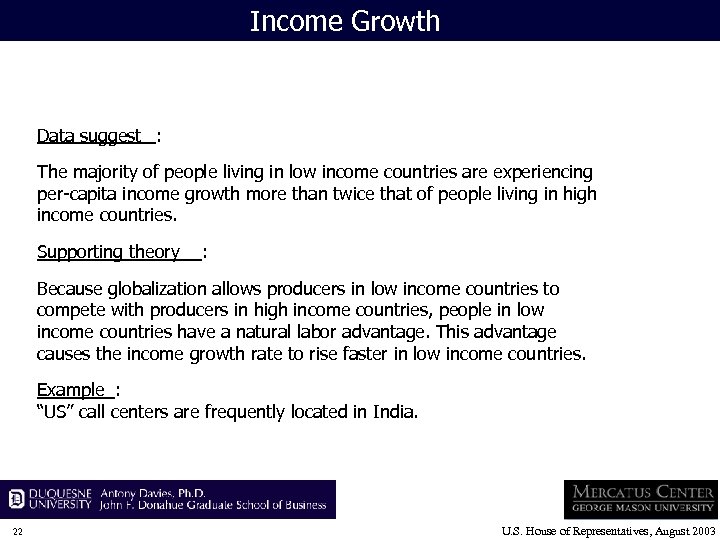
Income Growth Data suggest : The majority of people living in low income countries are experiencing per-capita income growth more than twice that of people living in high income countries. Supporting theory : Because globalization allows producers in low income countries to compete with producers in high income countries, people in low income countries have a natural labor advantage. This advantage causes the income growth rate to rise faster in low income countries. Example : “US” call centers are frequently located in India. 22 U. S. House of Representatives, August 2003

Health (life expectancy, infant mortality, food intake) Conventional wisdom : Increases in life expectancy, decreases in infant mortality, better nutrition accrue mostly to developed countries. Globalization causes a reduction in health measures for lesser developed countries. Theory : Globalization causes agricultural resources to be diverted to meet the needs of exporters rather than local needs. People driven off rural land are forced to work in overcrowded cities without proper water and sanitation. Foreign-owned firms, unfettered by environmental and health regulations, pollute the environment of lesser developed countries and maintain inadequate working conditions. 23 U. S. House of Representatives, August 2003
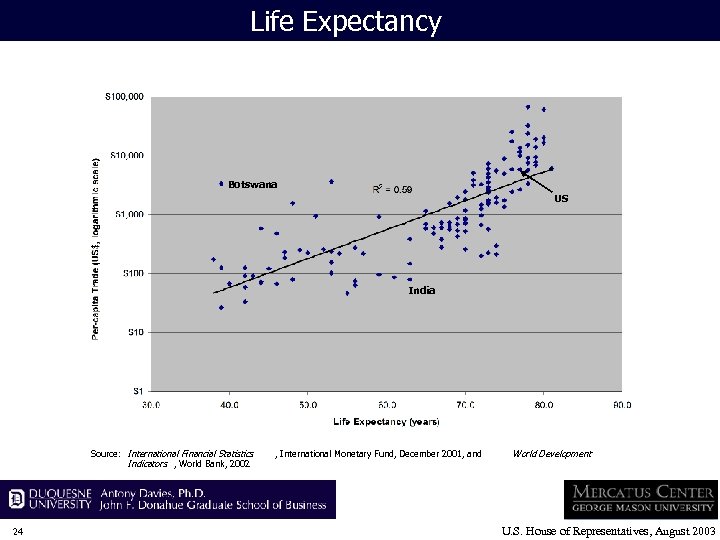
Life Expectancy Botswana US India Source: International Financial Statistics Indicators , World Bank, 2002 24 , International Monetary Fund, December 2001, and World Development U. S. House of Representatives, August 2003
Life Expectancy Argument : Again, we can argue that we are observing is a “developed country” effect. Developed countries are more globalized and have better health care, therefore it will appear that life expectancy and globalization are related. Counterargument : If we focus only on lower middle and low income countries, we find similar results. 25 U. S. House of Representatives, August 2003
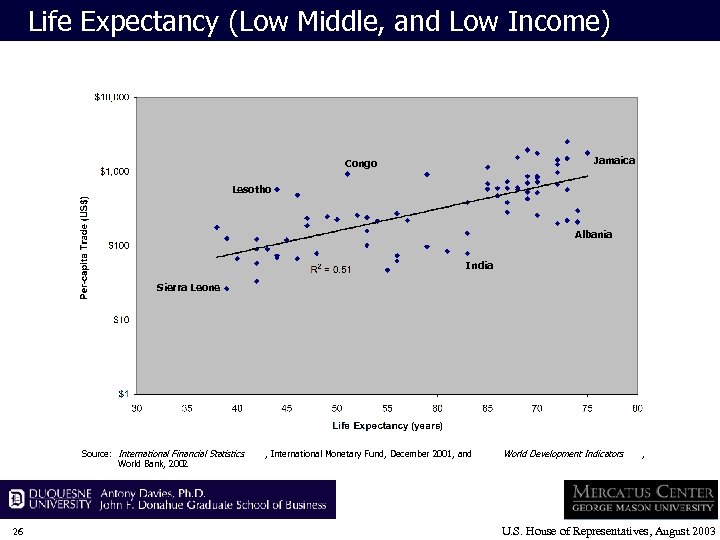
Life Expectancy (Low Middle, and Low Income) Jamaica Congo Lesotho Albania India Sierra Leone Source: International Financial Statistics World Bank, 2002 26 , International Monetary Fund, December 2001, and World Development Indicators , U. S. House of Representatives, August 2003
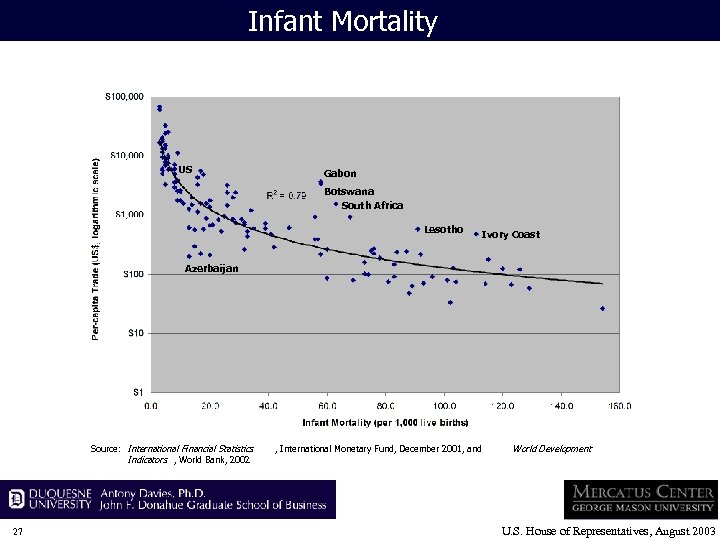
Infant Mortality US Gabon Botswana South Africa Lesotho Ivory Coast Azerbaijan Source: International Financial Statistics Indicators , World Bank, 2002 27 , International Monetary Fund, December 2001, and World Development U. S. House of Representatives, August 2003
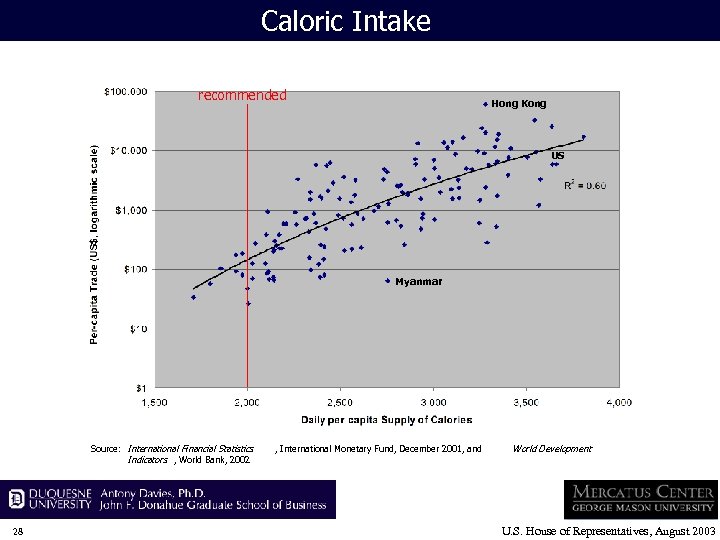
Caloric Intake recommended Hong Kong US Myanmar Source: International Financial Statistics Indicators , World Bank, 2002 28 , International Monetary Fund, December 2001, and World Development U. S. House of Representatives, August 2003
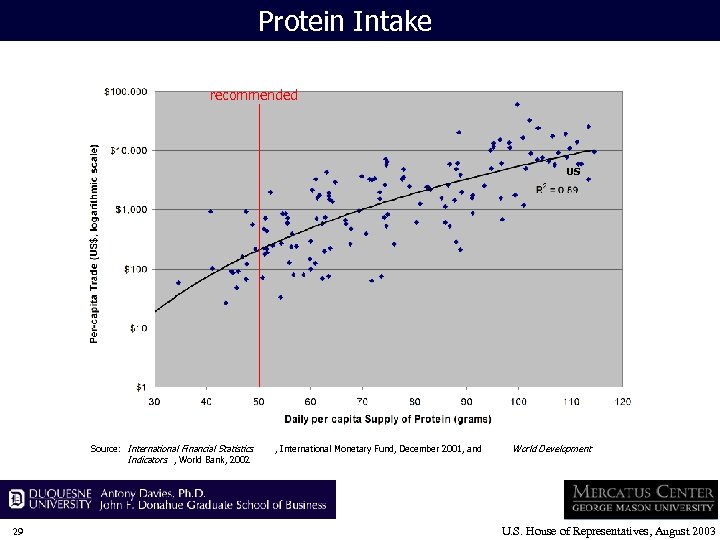
Protein Intake recommended US Source: International Financial Statistics Indicators , World Bank, 2002 29 , International Monetary Fund, December 2001, and World Development U. S. House of Representatives, August 2003

Health (life expectancy, infant mortality, food intake) Data suggest : Increased globalization leads to improved health and longevity. Supporting theory : Globalization makes goods and services available that would not otherwise be available. Goods which can be competitively produced domestically are traded for food and medicines that might not be competitively produced domestically. Capital flows make foreign investment in hospitals and health care infrastructure possible. 30 U. S. House of Representatives, August 2003

Environment Conventional wisdom : Globalization is bad for the environment. Theory : Firms in developed countries have incentive to exploit the environment in developing and under-developed countries. Greater industrialization and consumption put greater stress on the environment. Example : Rainforests. 31 U. S. House of Representatives, August 2003
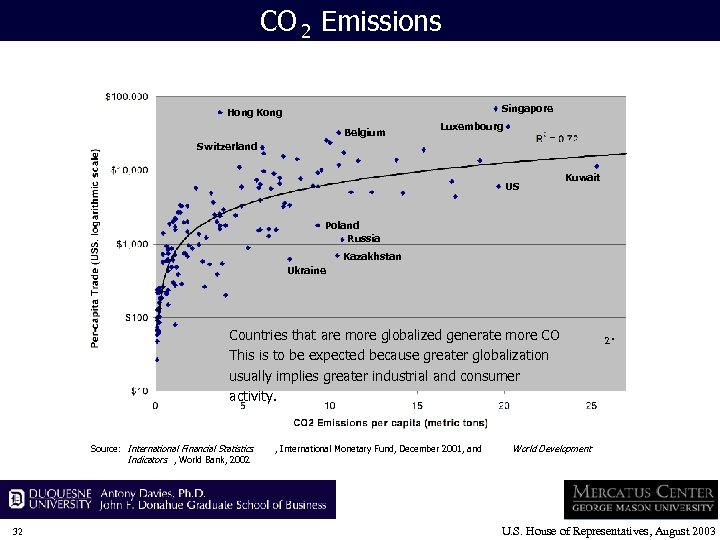
CO 2 Emissions Singapore Hong Kong Belgium Luxembourg Switzerland US Kuwait Poland Russia Kazakhstan Ukraine Countries that are more globalized generate more CO This is to be expected because greater globalization usually implies greater industrial and consumer activity. Source: International Financial Statistics Indicators , World Bank, 2002 32 , International Monetary Fund, December 2001, and 2. World Development U. S. House of Representatives, August 2003
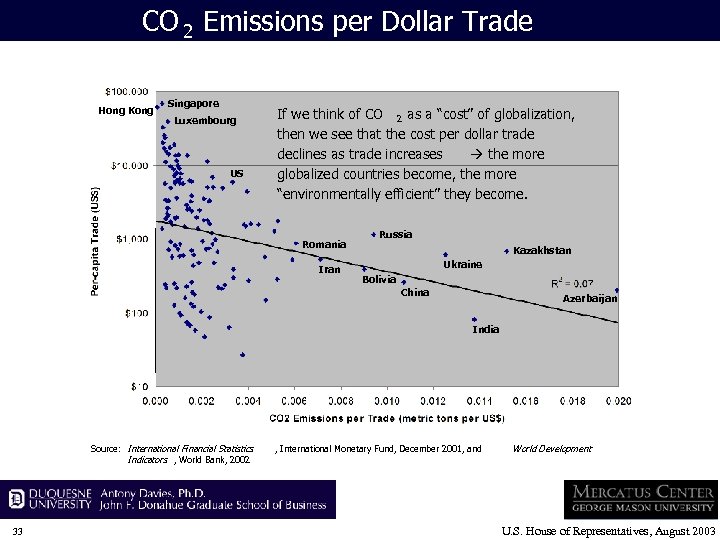
CO 2 Emissions per Dollar Trade Hong Kong Singapore Luxembourg US If we think of CO 2 as a “cost” of globalization, then we see that the cost per dollar trade declines as trade increases the more globalized countries become, the more “environmentally efficient” they become. Romania Iran Russia Kazakhstan Ukraine Bolivia China Azerbaijan India Source: International Financial Statistics Indicators , World Bank, 2002 33 , International Monetary Fund, December 2001, and World Development U. S. House of Representatives, August 2003
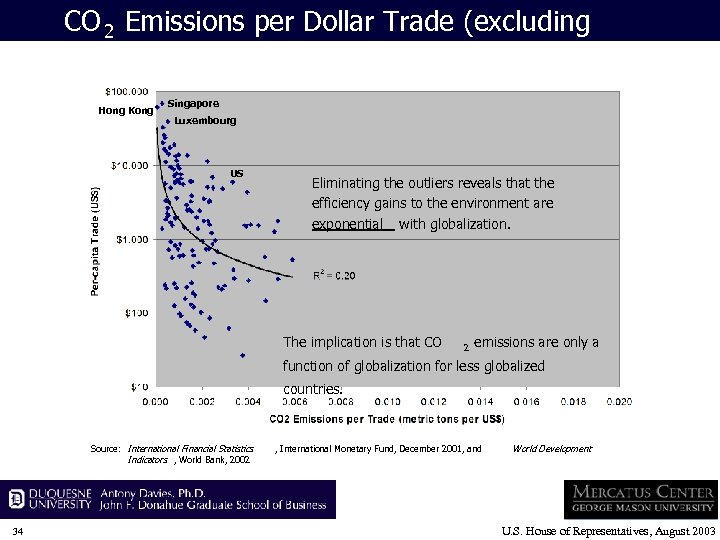
CO 2 Emissions per Dollar Trade (excluding outliers) Hong Kong Singapore Luxembourg US Eliminating the outliers reveals that the efficiency gains to the environment are exponential with globalization. The implication is that CO 2 emissions are only a function of globalization for less globalized countries. Source: International Financial Statistics Indicators , World Bank, 2002 34 , International Monetary Fund, December 2001, and World Development U. S. House of Representatives, August 2003
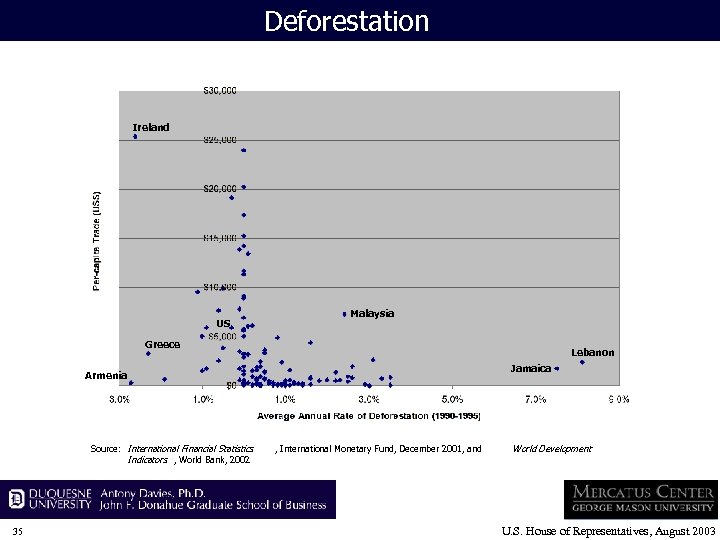
Deforestation Ireland US Malaysia Greece Lebanon Jamaica Armenia Source: International Financial Statistics Indicators , World Bank, 2002 35 , International Monetary Fund, December 2001, and World Development U. S. House of Representatives, August 2003
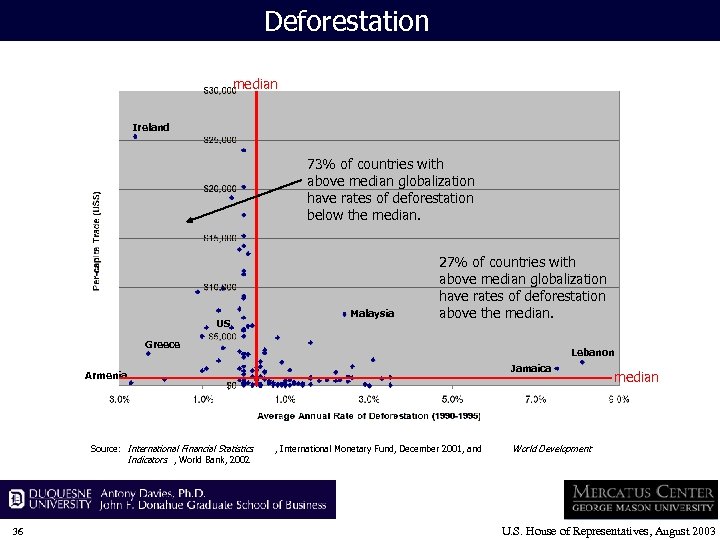
Deforestation median Ireland 73% of countries with above median globalization have rates of deforestation below the median. US Malaysia 27% of countries with above median globalization have rates of deforestation above the median. Greece Lebanon Jamaica Armenia Source: International Financial Statistics Indicators , World Bank, 2002 36 , International Monetary Fund, December 2001, and median World Development U. S. House of Representatives, August 2003
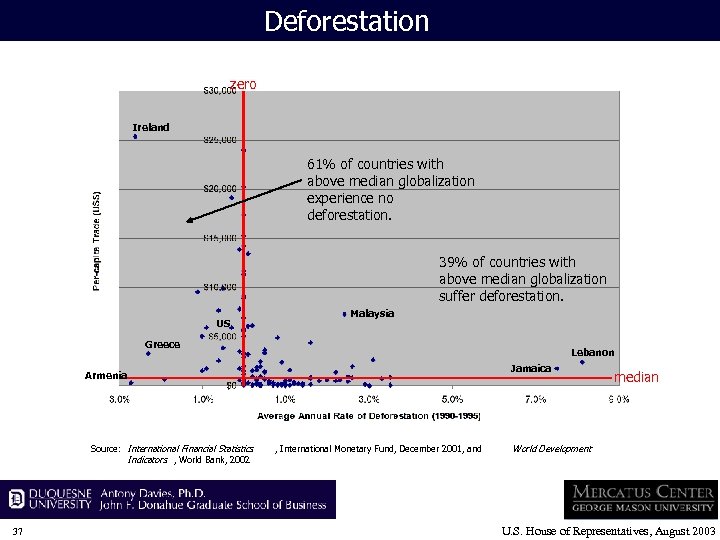
Deforestation zero Ireland 61% of countries with above median globalization experience no deforestation. 39% of countries with above median globalization suffer deforestation. US Malaysia Greece Lebanon Jamaica Armenia Source: International Financial Statistics Indicators , World Bank, 2002 37 , International Monetary Fund, December 2001, and median World Development U. S. House of Representatives, August 2003
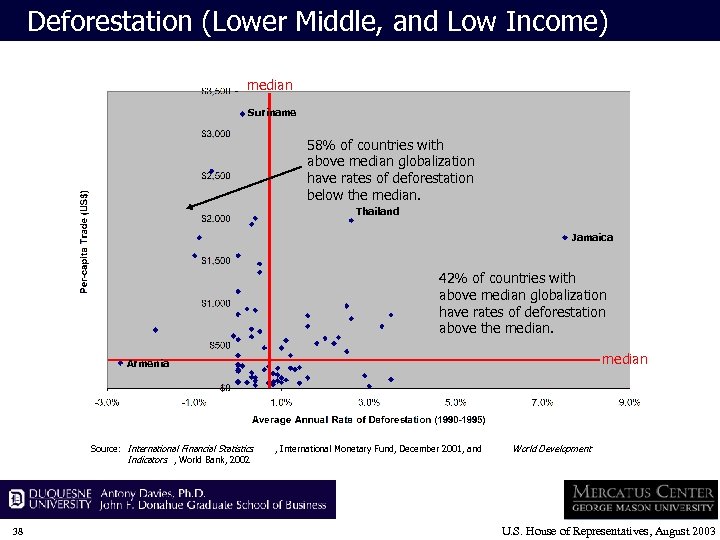
Deforestation (Lower Middle, and Low Income) median Suriname 58% of countries with above median globalization have rates of deforestation below the median. Thailand Jamaica 42% of countries with above median globalization have rates of deforestation above the median Armenia Source: International Financial Statistics Indicators , World Bank, 2002 38 , International Monetary Fund, December 2001, and World Development U. S. House of Representatives, August 2003
Environment Data suggest : Increased globalization leads to better environmental conditions. Supporting theory : There is some optimal level of environmental “use. ” Under utilization of the environment can be as bad (i. e. living without power, transportation, etc. ) as over utilization (i. e. dead oceans, barren land, etc. ). Example : Cows and elephants. Christmas tree farms. 39 U. S. House of Representatives, August 2003
Gender Equality Conventional wisdom : Because the globalization is founded on the premise of exploitation, gender inequality (like child labor rates) will worsen in the presence of globalization. Theory : Politically and economically weak demographic groups are least able to resist the consolidation of power that accompanies globalization. 40 U. S. House of Representatives, August 2003
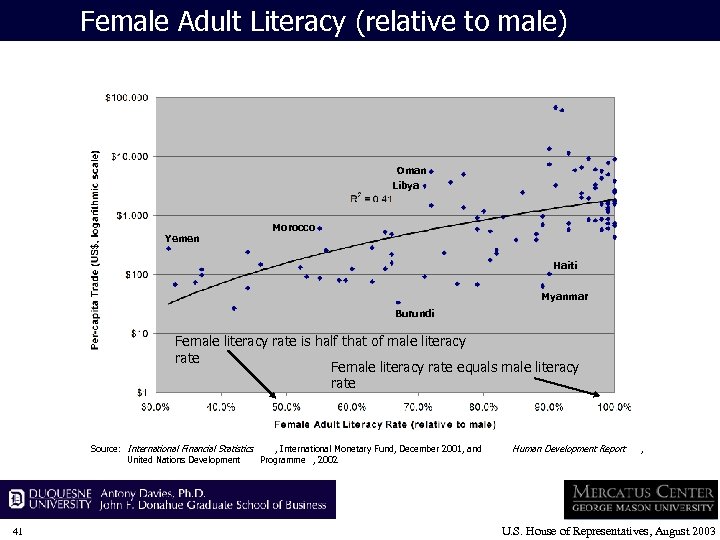
Female Adult Literacy (relative to male) Oman Libya Yemen Morocco Haiti Myanmar Burundi Female literacy rate is half that of male literacy rate Female literacy rate equals male literacy rate Source: International Financial Statistics , International Monetary Fund, December 2001, and United Nations Development Programme , 2002 41 Human Development Report , U. S. House of Representatives, August 2003
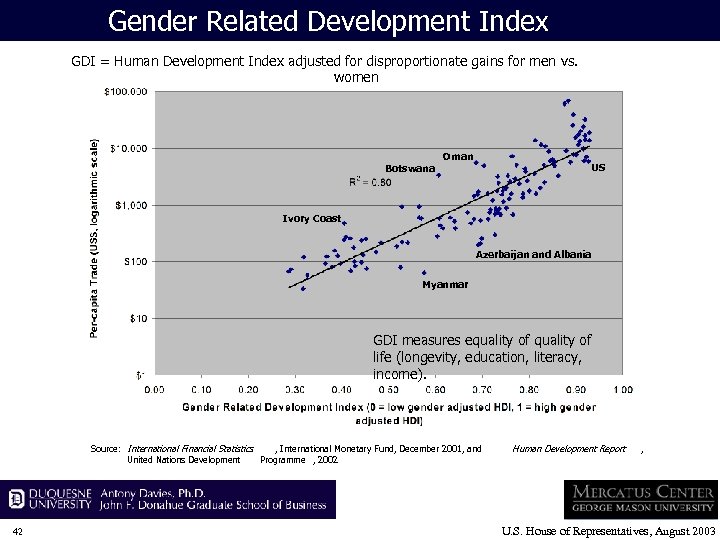
Gender Related Development Index GDI = Human Development Index adjusted for disproportionate gains for men vs. women Botswana Oman US Ivory Coast Azerbaijan and Albania Myanmar GDI measures equality of life (longevity, education, literacy, income). Source: International Financial Statistics , International Monetary Fund, December 2001, and United Nations Development Programme , 2002 42 Human Development Report , U. S. House of Representatives, August 2003
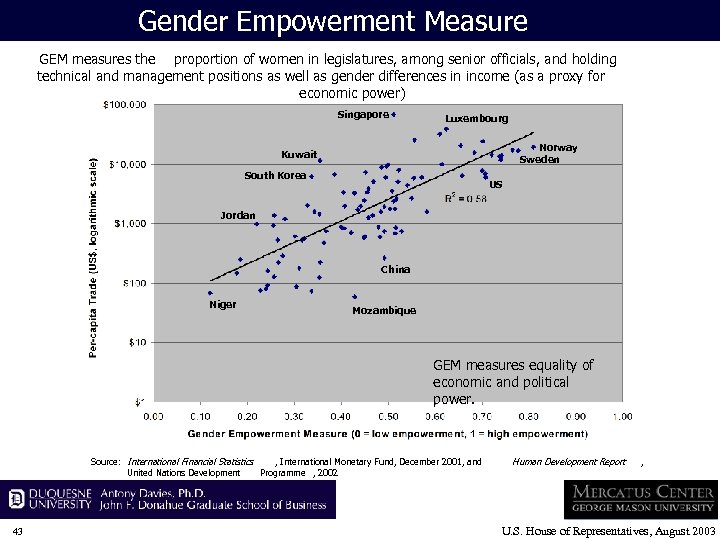
Gender Empowerment Measure GEM measures the proportion of women in legislatures, among senior officials, and holding technical and management positions as well as gender differences in income (as a proxy for economic power) Singapore Luxembourg Norway Sweden Kuwait South Korea US Jordan China Niger Mozambique GEM measures equality of economic and political power. Source: International Financial Statistics , International Monetary Fund, December 2001, and United Nations Development Programme , 2002 43 Human Development Report , U. S. House of Representatives, August 2003
Gender Equality Data suggest : Increased globalization leads to greater gender equality. Supporting theory : Because globalization decentralizes power and augments competition, demographic groups that would seek to dominate others are disempowered. Economic and political power accrue to those who provide the innovation, goods, and services that others desire. Example : Historically, oppressed demographic groups have gained greater freedoms coincident with general economic gains: slavery in the US ends as industrial revolution waxes; women in the US attain suffrage as technological advances from industrial revolution reach into the home; the most repressive Islamic countries today are also among the poorest. 44 U. S. House of Representatives, August 2003

Child Labor Conventional wisdom : Increased globalization leads to exploitation of children. Theory : Developed countries import manufactured goods from underdeveloped countries that can supply the goods at lower cost by employing child labor. The increased trade encourages underdeveloped countries to increase child labor. Example : Nike employs child labor in Pakistan. 45 U. S. House of Representatives, August 2003
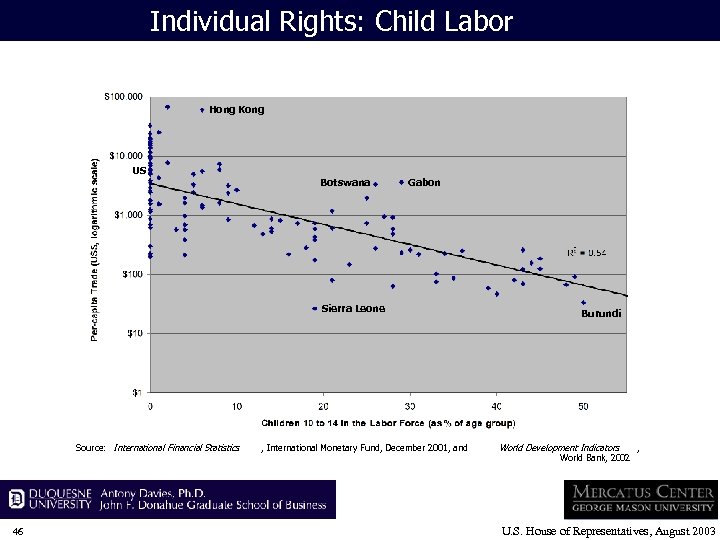
Individual Rights: Child Labor Hong Kong US Botswana Gabon Sierra Leone Source: International Financial Statistics 46 , International Monetary Fund, December 2001, and Burundi World Development Indicators World Bank, 2002 , U. S. House of Representatives, August 2003
Individual Rights: Child Labor Data suggest : Increased globalization leads to a reduction in the exploitation of children. Supporting theory : Increased trade results in increased income – increased foreign demand for the output of an underdeveloped country means (1) more people are hired to supply the foreign demand, and (2) those people earn better wages due to increased foreign demand. As income increases, basic needs (food, clothing, shelter) are met and surplus income becomes available for education. Increased education rates reduce child labor in the current and subsequent generations because (1) children are in school instead of in factories, and (2) the children grow into educated adults who, with greater earning power, can afford to educate their children. 47 U. S. House of Representatives, August 2003

Individual Rights: Economic Freedom Conventional wisdom : Increased globalization leads to the subjugation of less powerful countries by more powerful countries. Theory : Multinationals move into underdeveloped countries, absorb existing industries, strip the countries of resources and effectively enslave their people by exercising monopoly power in labor and goods markets within the countries. Example : “The Mc. Donald’s juggernaut. ” 48 U. S. House of Representatives, August 2003
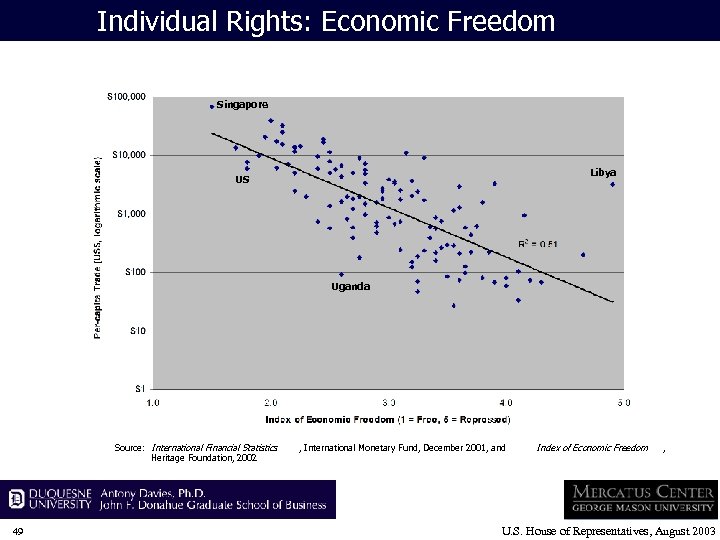
Individual Rights: Economic Freedom Singapore Libya US Uganda Source: International Financial Statistics Heritage Foundation, 2002 49 , International Monetary Fund, December 2001, and Index of Economic Freedom , U. S. House of Representatives, August 2003

Individual Rights: Economic Freedom Data suggest : Increased globalization leads to an increase in people’s economic freedom. Over the past twenty-five years, the number of multinational corporations has increased almost six-fold (7% annually) while world RGDP has increased less than three-fold (4% annually). The implication is that economic power is becoming progressively less concentrated halved every 25 years. Supporting theory : Globalization results in a decline, not increase, because opening world markets results in (1) greater competition among existing firms, and (2) greater opportunity for new firms, which results in (3) even more competition for existing firms. 50 Competition is usually thought of in terms of “price reduction. ” A more important result of competition is “innovation. ” Increases in standards of living are more a function of new goods and services rather than lower priced goods and services. U. S. House of Representatives, August 2003

Individual Rights: Human Development Conventional wisdom : What is important is not simply the “economic” ramifications of globalization, but also the social consequences. Theory : If globalization produces more wealth in the aggregate, it does so at the expense of non-economic “goods” such as health, education, and well-being. Example : Robber barons of the industrial revolution. 51 U. S. House of Representatives, August 2003
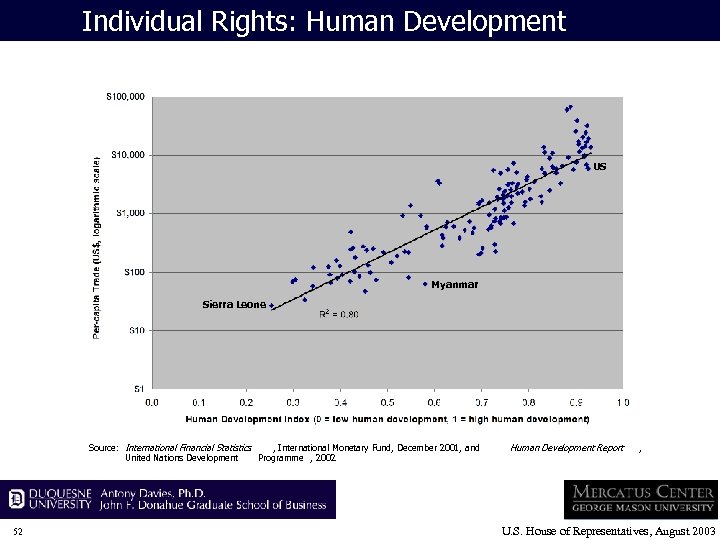
Individual Rights: Human Development US Myanmar Sierra Leone Source: International Financial Statistics , International Monetary Fund, December 2001, and United Nations Development Programme , 2002 52 Human Development Report , U. S. House of Representatives, August 2003
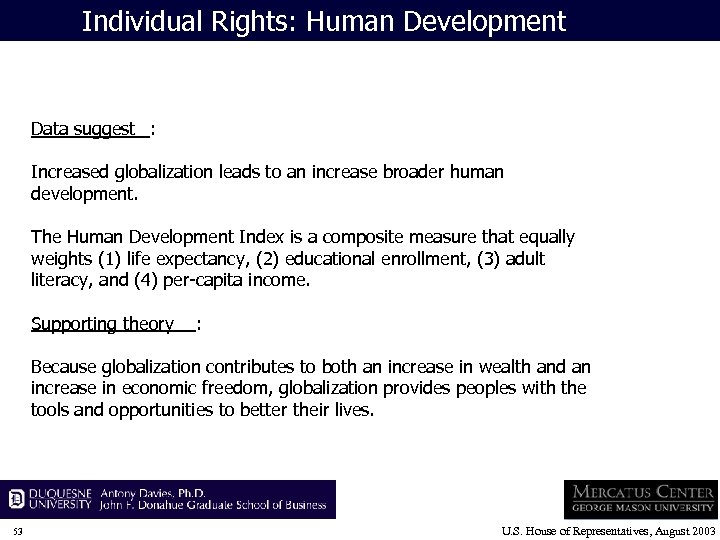
Individual Rights: Human Development Data suggest : Increased globalization leads to an increase broader human development. The Human Development Index is a composite measure that equally weights (1) life expectancy, (2) educational enrollment, (3) adult literacy, and (4) per-capita income. Supporting theory : Because globalization contributes to both an increase in wealth and an increase in economic freedom, globalization provides peoples with the tools and opportunities to better their lives. 53 U. S. House of Representatives, August 2003

Employment in the U. S. Conventional wisdom : Increased globalization leads to unemployment of U. S. workers as foreign competition destroys American jobs. Theory : Lesser developed countries can supply labor at a lower wage and without the added costs associated with labor protection laws that apply to U. S. workers. Firms in these countries export product to the U. S. at prices with which American firms cannot compete. American firms then layoff U. S. workers. Example : Steel. 54 U. S. House of Representatives, August 2003
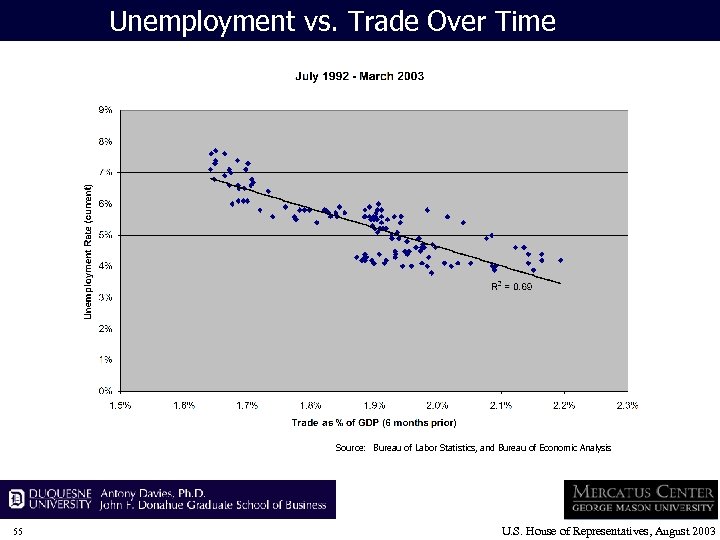
Unemployment vs. Trade Over Time Source: Bureau of Labor Statistics, and Bureau of Economic Analysis 55 U. S. House of Representatives, August 2003
Summary This analysis looks only at the correlation between globalization and socio-economic measures. While the argument can be made that globalization directly impacts income, the argument that globalization directly impacts health, longevity, and the environment is more tenuous. What is more likely is that globalization is not the cause of improved socio-economic measures, but is one result of underlying conditions responsible for improving a broad variety of social and economic measures. The underlying condition, and the common thread throughout this discussion, is freedom: economic and political. Political freedom ensures that individuals can think, speak, and act as they please. Economic freedom ensures that individuals can generate income and comfortably own property that is dependent on and/or arises from their thoughts, words, and actions. 56 U. S. House of Representatives, August 2003

Summary This is not, however, the end of the story… While globalization is clearly better for society as a whole, there are losers. Globalization puts some hard-working, American taxpayers out of work. Many of these people have families to support. Many of these people are at a stage in life in which they cannot be retrained. For these people, globalization’s harm is morally wrong. Is compromise possible? Yes. Use the power of globalization to protect those who would be disenfranchised by globalization. 57 U. S. House of Representatives, August 2003

Summary Example : Remove protective tariffs on steel while simultaneously enacting a “Steel Workers Income Security Act (SWISA). ” SWISA 1. 2. 58 The act will guarantee that any steel workers who are laid off as a result of the removal of protective barriers would continue to receive the income and benefits they would have received had they not been laid off. This compensation will be paid by the government and will be paid until age 65. The cost of SWISA will be paid by a general sales tax levied on all Americans. U. S. House of Representatives, August 2003

Summary Short-run win : Under SWISA, (1) steel workers will be as well off as they would have been under a protective tariff, and (2) Americans in general will be better off than they would have been under a protective tariff. Long-run win : Because SWISA will apply only to those steel workers who are employed in steel manufacturing at the time protective tariffs are removed, SWISA will allow for a gradual downsizing in capacity in the steel industry. This downsizing will free up valuable capital for use in other industries via natural attrition rather than layoffs. 59 U. S. House of Representatives, August 2003
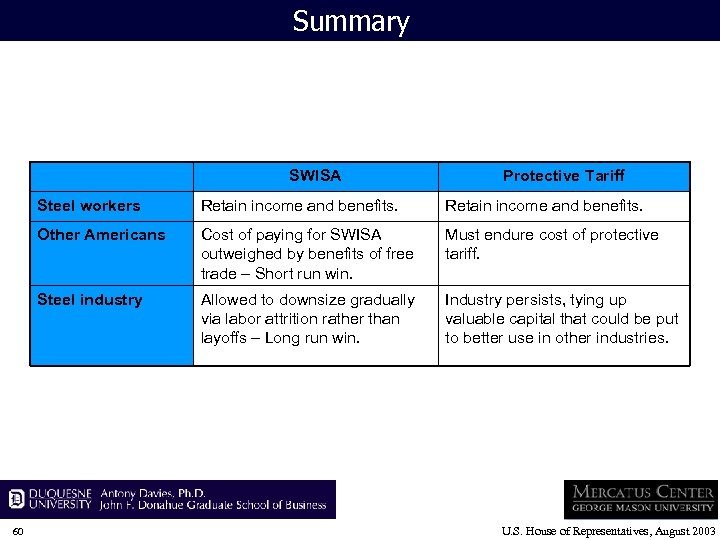
Summary SWISA Protective Tariff Steel workers Retain income and benefits. Other Americans Cost of paying for SWISA outweighed by benefits of free trade – Short run win. Must endure cost of protective tariff. Steel industry 60 Retain income and benefits. Allowed to downsize gradually via labor attrition rather than layoffs – Long run win. Industry persists, tying up valuable capital that could be put to better use in other industries. U. S. House of Representatives, August 2003

Summary Hypothesis : Without political freedom, economic freedom is unattainable. Without economic freedom, political freedom is meaningless. 61 U. S. House of Representatives, August 2003
Скачать презентацию Globalization Who Benefits 1 U S House of
828cb3380007c3d2155bf84527465ca7.ppt