 Скачать презентацию Globalization of Container Security Its Origins Its Transition
81fa94c85dd689381fd8511db7b31443.ppt
- Количество слайдов: 32



Globalization of Container Security Its Origins, Its Transition, and Its Current Status Dr. Jim Giermanski Powers International
Three Phase Development n Phase 1 - Harmonizing divergent Customs Practices n Phase 2 - 9/11 and Port Security n Phase 3 - Chain of Custody
Phase 1: Pre 9/11 1999 -2001 Recognition of the Need for Cooperation and Modernization
Modernizing Customs Revised Kyoto Convention of 1999 a) simplifying Customs procedures b) information technology c) automated targeting systems d) maximum use of information technology f) e-commerce
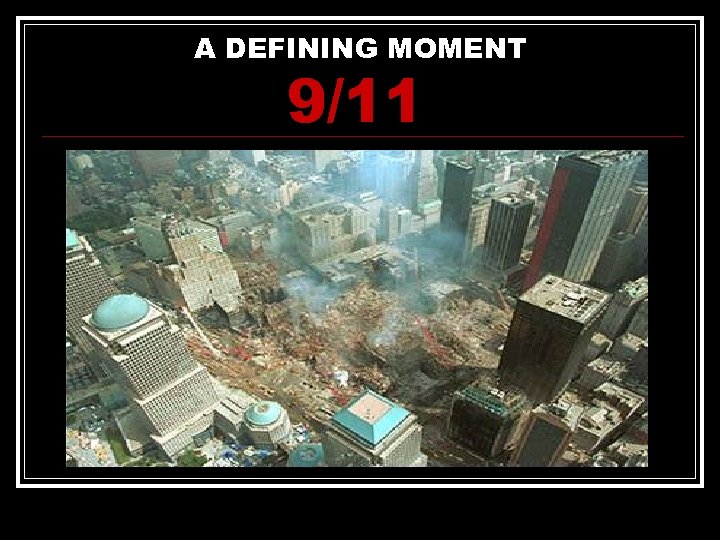
A DEFINING MOMENT 9/11
Phase-2: 2001 -2004 Post 9/11 and the Maritime Model
Emergence of Security Programs 1. Customs Trade Partnership Against Terrorism (C-TPAT), 2001 a) Originally 7 companies b) Now 8, 322 firms c) 7 security areas mandated d) focus on importer, vessel carrier, and port/terminals 2. U. S. Container Security Initiative (CSI), 2002 a) Generated the 24 hr. Rule b) 32 Countries participating, 58 Ports
First U. S. Laws and Port Security Ø Trade Act of 2002 as amended by The Maritime Transportation Security Act in November 2002 1. Advance Cargo Data (electronically) 2. Security-Related Vessel identification system Vessel security plans Port security assessments; and in the 3. Operational and efficiency Matters Maritime intelligence system Grants program
International Organizations/Standards 1. Transported Asset Protection Association (TAPA) issues Freight Security Requirements, 2001 2. International Maritime Organization (IMO) a) Creation of International Ship and Port Facility Security Code (ISPS) b) ISPS went into effect 2004, “Special Measures to enhance Maritime Security”
UN Economic Commission for Europe Recommendation 33, (Approved September, 2004) The Single Window through which “…trade-related information and/or documents need only be submitted once at a single entry point to fulfill all import, export, and transit-related regulatory requirements. ”
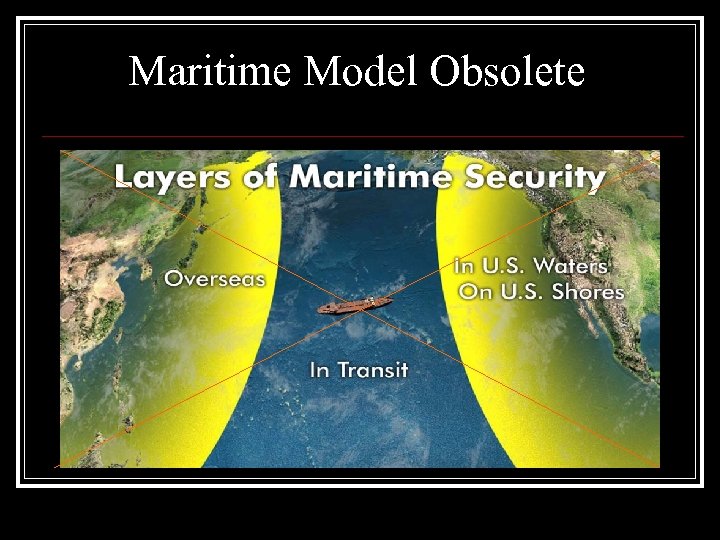
Phase-2 Culminates In The Maritime Model: Port-to-Port Security
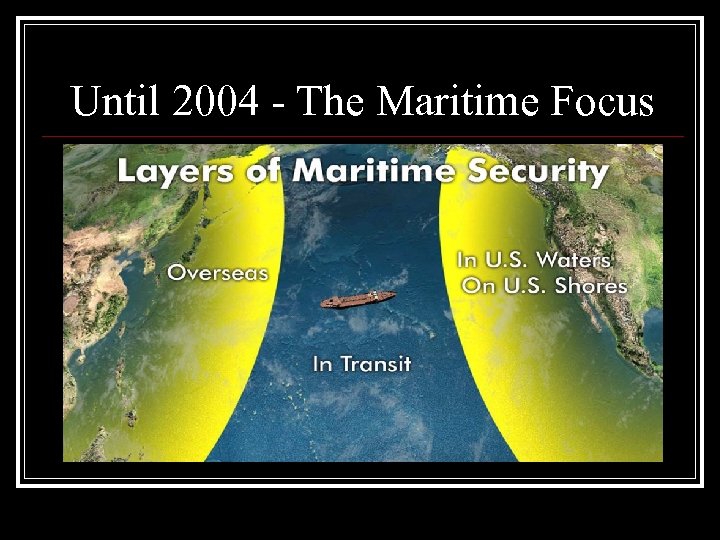
Until 2004 - The Maritime Focus
Phase-3: 2004 - 2008 A New View: Origin to Destination
Modernizing Customs Kyoto Convention ICT Guidelines (Information and Communication Technology) 2004 a) electronic exchange of information at export and import b) chain of “electronic” data c) single global schema linked electronically
The EU Factor Ø EC Regulation No. 1935/2004 a) origin to destination and traceability b) safety of foodstuffs Ø EU report # 40008032 -6 -2 - 2005 a) security essential to supply chain b) supply chain secure origin to destination
NGOs and Government Actions 1. World Customs Organization (WCO), 2005 Framework of Standards to Secure and Facilitate Global Trade a) b) c) Section 1 -2 -4 of WCO Standards: stuffing to destination Appendix 1, Annex 1 control at stuffing, intermediate handling, loading, off loading, terminal, destination Edifact and XML as EDI standards
NGO’s and Governments, Cont. n U. S. Adopts WCO Standards, 2005 n Kyoto ICT Guidelines go into effect, 2006
Governments Programs and Laws Ø C-TPAT Changes: New Standards for Importers 2005/2006 a) Security begins at Stuffing b) Tracking and monitoring c) 9 areas of security Ø SAFE Port Act, October 2006 a) Advance Electronic Information b) Origin to Destination Security c) Many WCO components incorporated d) Codification of C-TPAT and CSI e) Green Lanes (Tier-3) established
The EU’s AEO Ø AEO (Authorized Economic Operator) 2006 a) Use of advance electronic data b) Electronic records c) Security Compliance to SAFE Framework d) Adopting of Single Window Concept e) Authorized access to cargo and control of seals f) Control of cargo from loading to unloading g) Generally Consistent to C-TPAT
New U. S. Law and Supreme Court Decision Implementing the 9/11 Commission Recommendations Act of 2007 a) Detect breach and access “prior” to entering U. S. b) Electronic notification of breach in supply chain c) Applicability of end-to-end security for all truck, rail, and vessel New Federal Rules Of Civil Procedure 2007 a) Electronic data discoverable for litigation in civil matters b) Impact on role and value of chain of custody c) Role of 3 rd party control of data
What Does it All Mean? The New Model: Electronic Global Chain of Custody (EGCC)
Maritime Model Obsolete
The New EGCC Ø Global Supply Chain Defined a) No longer port-to-port b) Now Origin to Destination Ø Technology Needed a ) No longer RFID-only “RFID is only an interim solution and that ultimately CBP will use container security devices…” Greg Olsavsky, CBP’s Director of Cargo Control (May, ) b) Satellite c) GSM/Zigbee d) 3 rd party platforms, servers, and call centers 2008 Ø A SINGLE WINDOW Implementation In U. S.
U. S. Single Window International Trade Data System (ITDS) establishes a single portal system: ACE (Automated Commercial Environment) Eventually Combines: a) Automated Manifest System (AMS) b) Automated Broker Interface (ABI) c) Automated Export System (AES) d) Automated Commercial System (ACS)
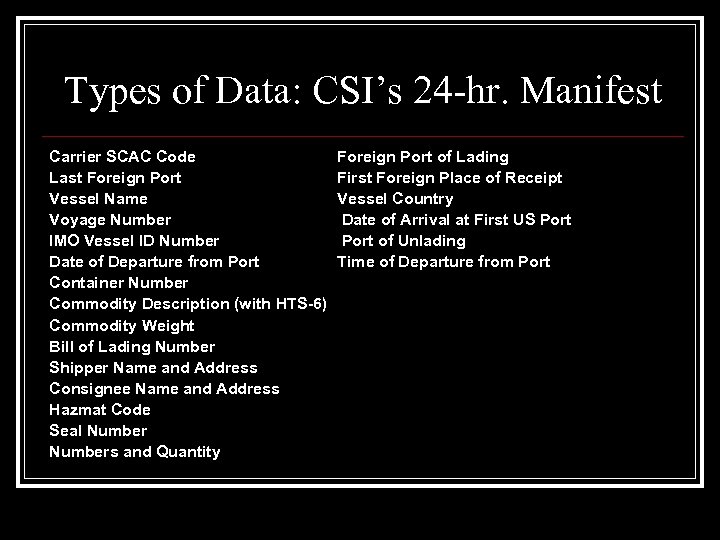
Types of Data: CSI’s 24 -hr. Manifest Carrier SCAC Code Last Foreign Port Vessel Name Voyage Number IMO Vessel ID Number Date of Departure from Port Container Number Commodity Description (with HTS-6) Commodity Weight Bill of Lading Number Shipper Name and Address Consignee Name and Address Hazmat Code Seal Numbers and Quantity Foreign Port of Lading First Foreign Place of Receipt Vessel Country Date of Arrival at First US Port of Unlading Time of Departure from Port
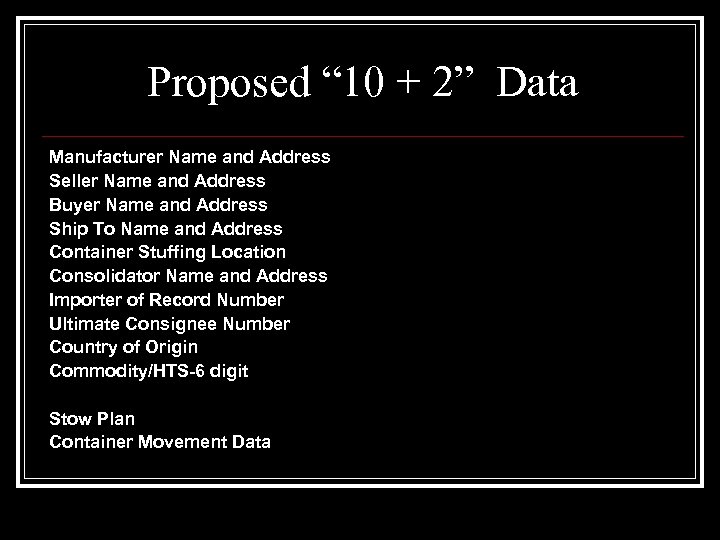
Proposed “ 10 + 2” Data Manufacturer Name and Address Seller Name and Address Buyer Name and Address Ship To Name and Address Container Stuffing Location Consolidator Name and Address Importer of Record Number Ultimate Consignee Number Country of Origin Commodity/HTS-6 digit Stow Plan Container Movement Data
EGCC Today Origin to Destination
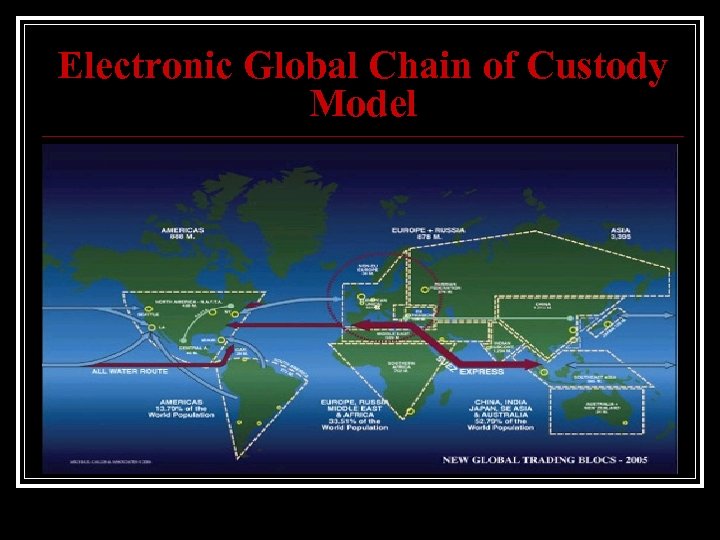
Electronic Global Chain of Custody Model
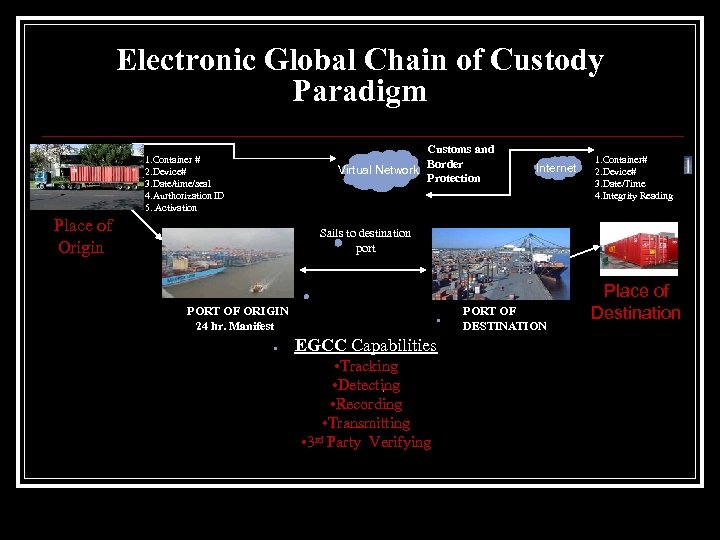
Electronic Global Chain of Custody Paradigm 1. Container # 2. Device# 3. Date/time/seal 4. Aurthorization ID 5. . Activation Place of Origin Customs and Border Virtual Network Protection Internet 1. Container# 2. Device# 3. Date/Time 4. Integrity Reading Sails to destination port PORT OF ORIGIN 24 hr. Manifest PORT OF DESTINATION EGCC Capabilities • Tracking • Detecting • Recording • Transmitting rd Party Verifying • 3 Place of Destination
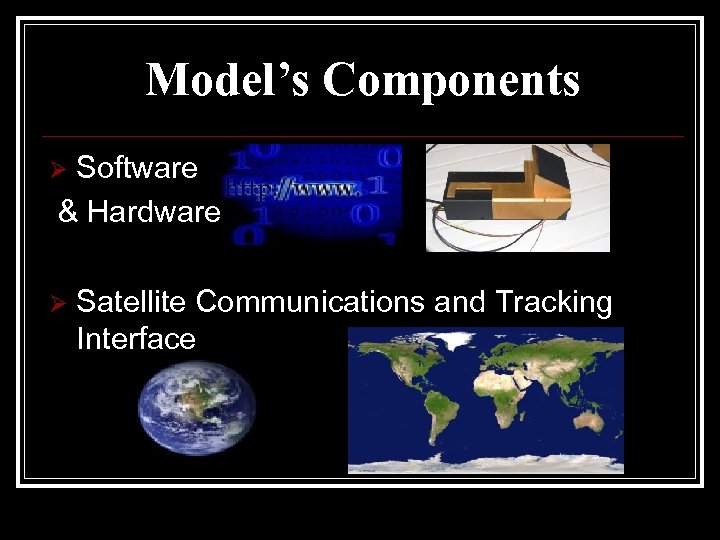
Model’s Components Software & Hardware Ø Ø Satellite Communications and Tracking Interface
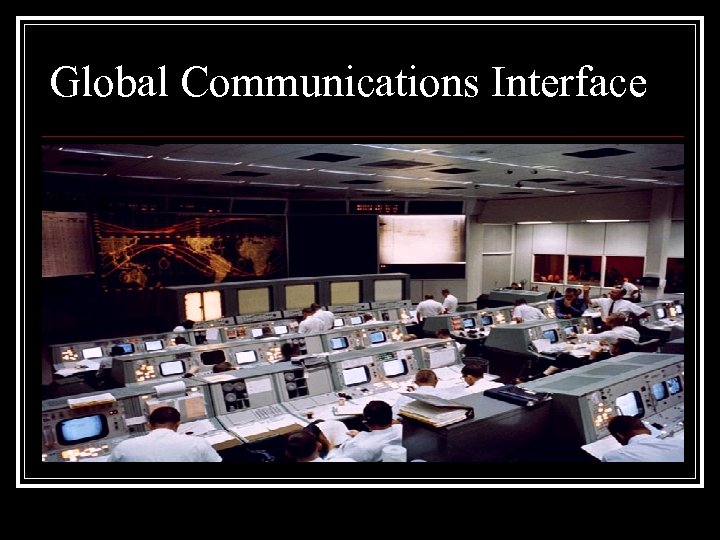
Global Communications Interface
Dr. Jim Giermanski Powers International jgiermanski@powersintlinc. com
Скачать презентацию Globalization of Container Security Its Origins Its Transition
81fa94c85dd689381fd8511db7b31443.ppt