 Скачать презентацию Globalization Introduction Faster international
bb05ba0272f02439f683de0288f321c5.ppt
- Количество слайдов: 27




Globalization
Introduction • • • Faster international communication speeds Unprecedented ability to conduct business globally Larger customer bases International laws Cultural differences
Regulating the Internet on a National Level • Poses challenges to a world composed of different cultures, attitudes, languages, codes of conduct and government authorities • Users can be exposed to products, services or information that are considered offensive or that are illegal in their countries of residence • Application of national laws to cyberspace

Accounting for Legal and Cultural Differences • Government regulation – Affects the growth of the Internet – Has the potential to cause major problems as the volume of international e-business transactions increases • International organizations must decide when national governments can apply or create laws that will affect parties and transactions that fall partially or completely outside their jurisdiction • “ILOVEYOU” virus – not prosecuted because of a lock of Philippine laws
International Internet Regulations • Businesses and legal experts are calling for the creation of worldwide e-commerce laws and standards • Address cybercrimes such as copyright infringement, cybersquatting, cyber terrorism, fraud, hacking and computer viruses • World Intellectual Property Organization (WIPO) – A United Nations’ organization that created an international forum for regulating Internet issues • The Organization for Economic Cooperation and Development – A forum for 29 member countries to communicate ideas, share experiences and develop policy
International Internet Regulations • European Union Directive on Data Protection – An agreement among its members on the regulations that apply to information exchange – Mandates that personal information be kept current and used in a lawful manner for its designated purpose • Extensive international regulation may conflict with national laws and impede the growth of ebusiness
International Internet Regulations • Internet Content Summit (2000) – “Self-regulation of Internet Content” – Report favors self-rating and filtering over third-party regulation – Suggests that Web content providers rate their sites, that filters for possibly offensive content be made available and that a network of national hotlines be established so that Internet users can register complaints about site content
Creating an e-Business with Global Capabilities • Opportunity for expansion • An ambitious and expensive investment that does not guarantee increased revenue • Potential global businesses must review expected revenues vs. expected cost • Linguistic and cultural barriers
Choosing an International Market • Focus time and money in one or two key markets initially • Research competitors and visitors in foreign markets – Investigate companies that offer goods or services comparable – Visit web sites to evaluate the status of their efforts • When choosing an international market consider: – – The number of people online Internet usage growth rates Per capita income The consumers’ expectations of your business
Choosing an International Market • Use resources for ultra informatiopn – Internet and technology statistics – Resource library – U. S. Department of Commerce, United Nations and other research firms. • Smaller, less obvious markets are sometimes better choices for marketing-specific products.
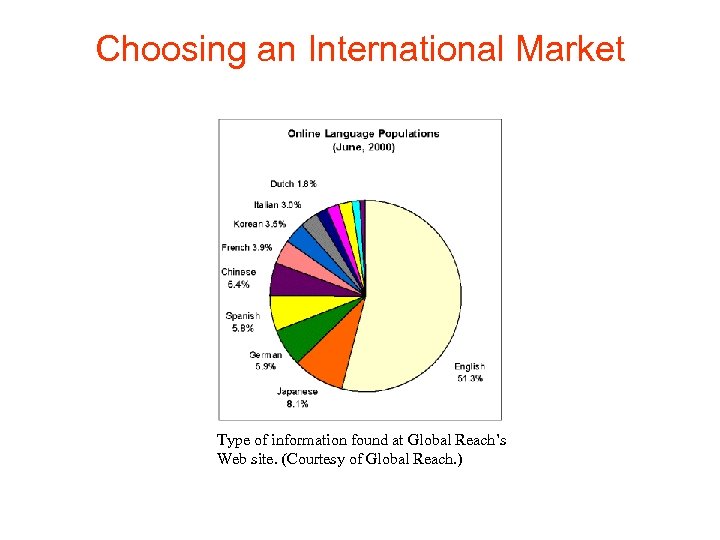
Choosing an International Market Type of information found at Global Reach’s Web site. (Courtesy of Global Reach. )
Obtaining a Local Internet Address • . com domain name is the most universally recognized address on the Web • Domain-name registration in foreign countries is often complex • May require owning a trademark or incorporating your business in the foreign country • Organizations offering domain name registration services: – Internet Assigned Numbers Authority (IANA) – Net. Names
Internationalization and Localization • Two steps – Internationalization and Localization – Internationalization • Restructuring the software used by your e-business so that it can process foreign languages, currencies, date formats and other variations involved in conducting business globally • OS, database, etc. – Localization • Includes the translation and cultural adaptation of your site’s content and presentation • Online translation services – – Enterprise Translation Server Alis Technologies Logos Alta. Vista’s Babelfish
Internationalization and Localization • Online translators are not 100 percent reliable – A bilingual translator and an editor should be employed • Consider the context of the message in a foreign culture • Translate META tags and text within graphic images • Adaptation of site layout to accommodate translations – E. g. traditional Chinese reads right to left. • Color scheme and logo translation • Conversion rates
Internationalization and Localization • Consider downloading capabilities (network speed) in foreign markets • Categorize information on global web site to help balancing cultural adaptation with consistency throughout all markets – Global content • Refers to information and design that requires translation, but is essentially the same for all cultures – Regional content • Product and marketing information that is usually written once in English and then adapted for various markets – Local content • Material on specific regional pages that appears only on that Web site, such as regional promotions, pricing, delivery and store or office locations
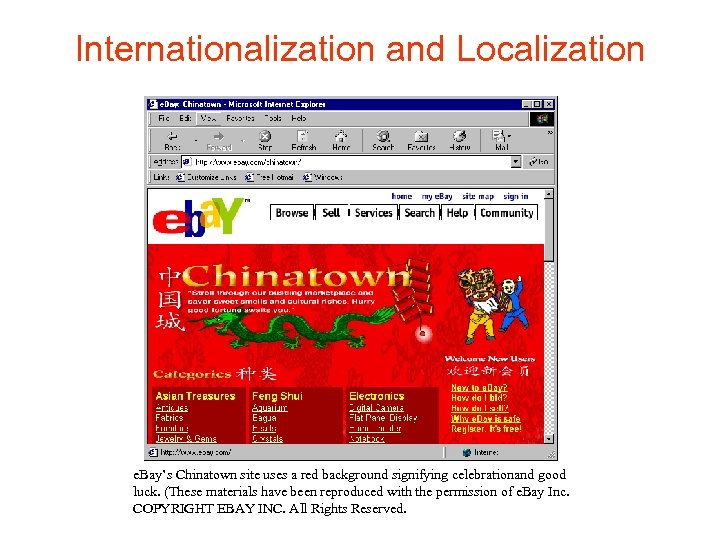
Internationalization and Localization e. Bay’s Chinatown site uses a red background signifying celebrationand good luck. (These materials have been reproduced with the permission of e. Bay Inc. COPYRIGHT EBAY INC. All Rights Reserved.
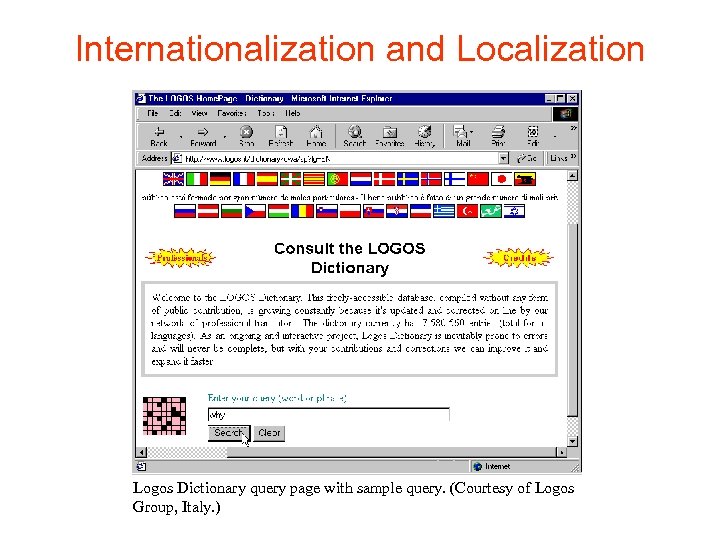
Internationalization and Localization Logos Dictionary query page with sample query. (Courtesy of Logos Group, Italy. )
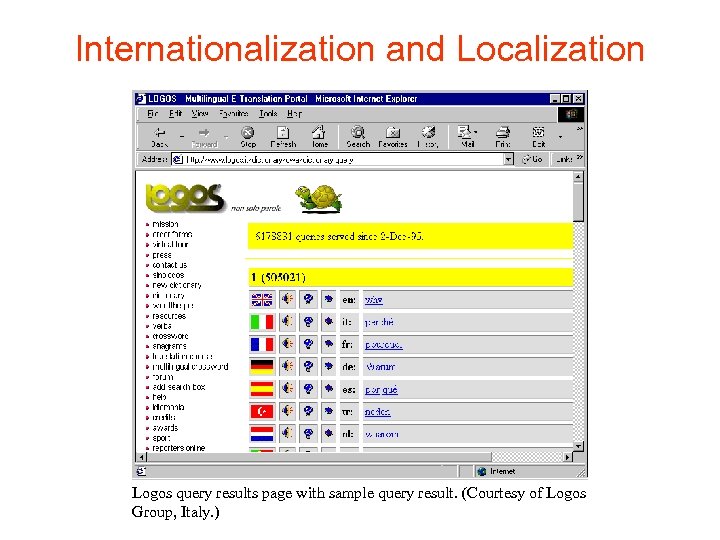
Internationalization and Localization Logos query results page with sample query result. (Courtesy of Logos Group, Italy. )
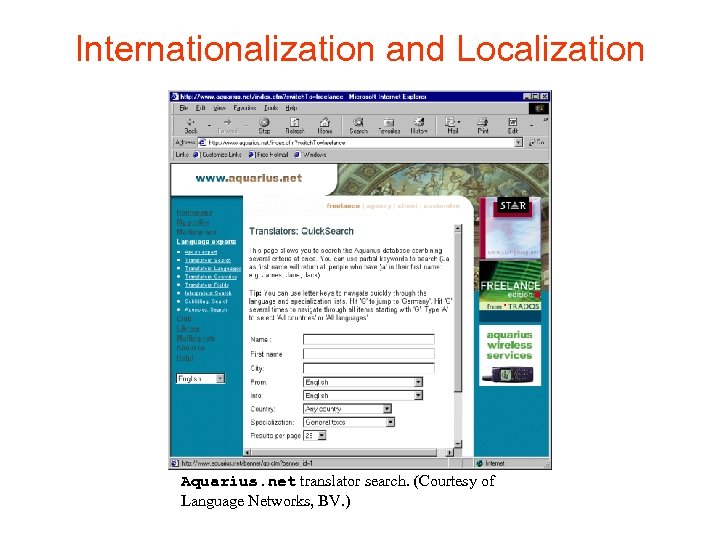
Internationalization and Localization Aquarius. net translator search. (Courtesy of Language Networks, BV. )
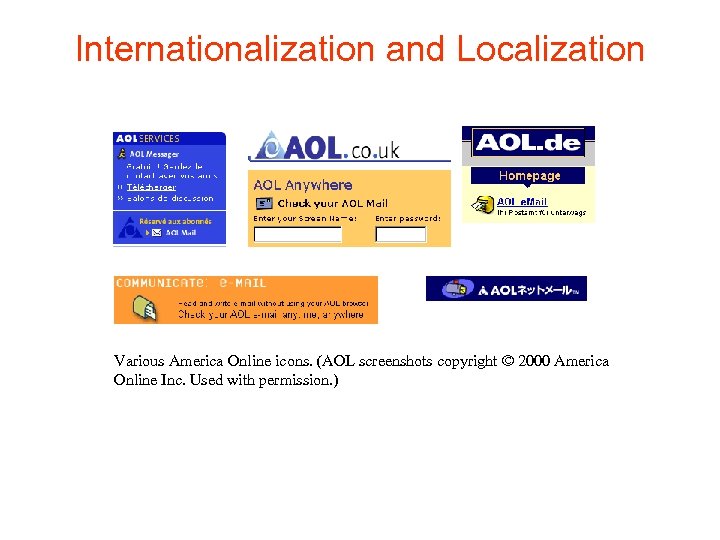
Internationalization and Localization Various America Online icons. (AOL screenshots copyright © 2000 America Online Inc. Used with permission. )
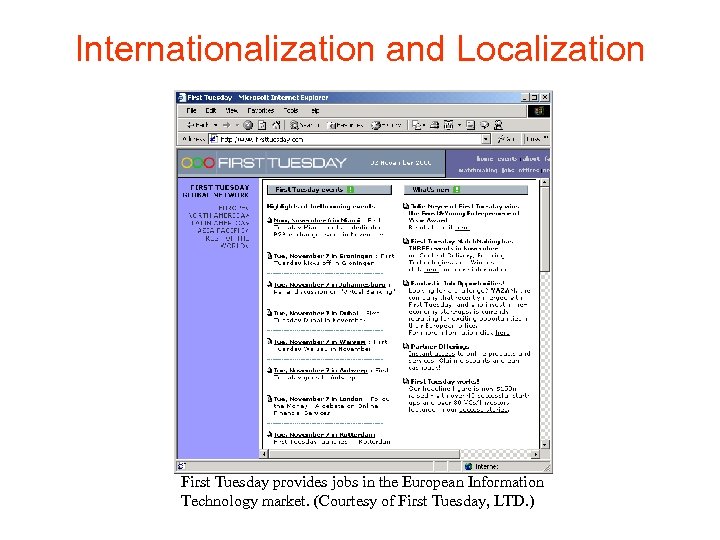
Internationalization and Localization First Tuesday provides jobs in the European Information Technology market. (Courtesy of First Tuesday, LTD. )
Partnering and Hiring • Choosing a local partner in a foreign market offers several benefits – – Physical presence in the target country A recognized brand Extensive knowledge of the target market Localized content and customer service
Payment Systems • Localize your payment system in order to accommodate foreign customers • Offer alternatives to credit-card payment – In many countries, credit cards are far less common than in the United States
Distribution • Shipping from a local distribution center • National postal services – British Post Office – Deutsche Post • International shipping and handling companies – UPS – Federal Express – The United States Postal Service • Businesses must consider the additional time needed for packages to pass through customs
Legal and Taxation Systems • Laws may vary by country, state or region • Companies that wish to buy or sell products in the global market must obey both the export laws of their own country and the import laws of the country in which they wish to do business • Government restrictions on international trade • International tax law resources – – – Taxware International, Inc. my. Customs World Tariff Vastera Clear. Cross
Promotions • Investigate the interpretation of your company and product names in the language or languages in which you are advertising • Research acceptable marketing tactics • Choose an appropriate medium for reaching target audience • Evaluate the success of your campaign – MMXI – Net. Value – ACNielsen
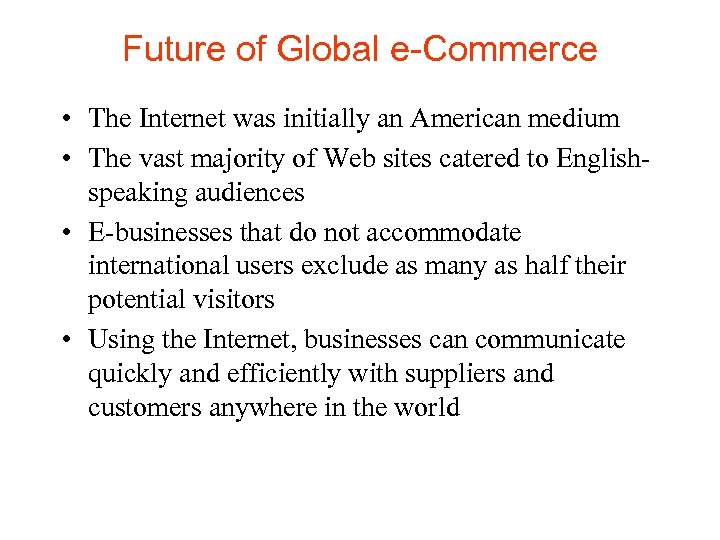
Future of Global e-Commerce • The Internet was initially an American medium • The vast majority of Web sites catered to Englishspeaking audiences • E-businesses that do not accommodate international users exclude as many as half their potential visitors • Using the Internet, businesses can communicate quickly and efficiently with suppliers and customers anywhere in the world
Скачать презентацию Globalization Introduction Faster international
bb05ba0272f02439f683de0288f321c5.ppt