 Скачать презентацию Globalisation The growing integration of the world s economy
ce5396fd611efb11f497e5ee055e3b75.ppt
- Количество слайдов: 20



Globalisation The growing integration of the world’s economy
International Dimension of Business The type of competition (perfect, monopoly, monopolistic or oligopoly) that the business faces in its domestic and overseas market. • Trade barriers • Costs of production • Trading agreement - World Trade Organisation - Mercosur - G 8 countries
Factors Affecting Globalisation • • • Liberalisation Technological change Growing market and competition Deregulation of business Cost of transportation Consumer tastes
Impact on Local Businesses by International Events • Consider consumer needs • Choice of location • More competition • Economies of scale
Factors to Consider to Trade Internationally • Impact of host countries in ‘inviting’ this business to set up and trade • Incentives provided by the parent country to set up and trade in the host countries • Impact of the business’ activities on customers, competitors, suppliers and on the business itself in the various countries • The effectiveness of the business’ presence internationally eg wider than simply profit, consumers’ views in home and host countries.
Factors Influencing International Location • Legislation and bureaucracy • Corruption • The introduction of a single currency • Corporate image • Protectionism • • • Financial incentives Mark opportunities The labour force Globalisation Environmental factors drought/war etc
Reasons for International Marketing • • • Increase sales revenue and hence profitability Achieve unit sales or revenue growth targets Increase share of market Achieve enhanced oligopolistic position Preserve oligopolistic position Reduce dependence upon mature or stagnant markets • Increase demand to allow spreading overhead in existing plants • Increasing demand to exploit economies of scale
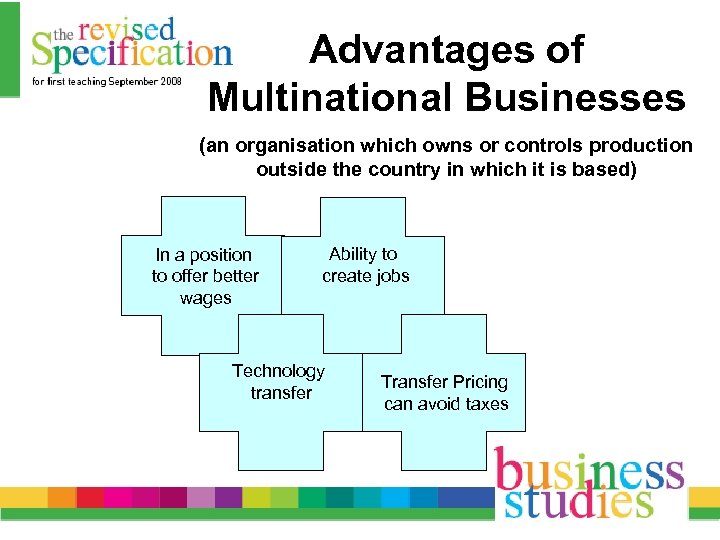
Advantages of Multinational Businesses (an organisation which owns or controls production outside the country in which it is based) In a position to offer better wages Ability to create jobs Technology transfer Transfer Pricing can avoid taxes
Methods of entering the overseas market • Exporting • Licensing • Franchising • Direct investment • Mergers • Joint ventures
International Marketing Strategies Consideration examples • Company resources and capabilities • International competitors • International Culture • Creating competitive advantage • Coping with political risk and uncertainty • Profiling international product markets • Exporting • Business Alliances • Foreign direct investment • Channels of international distribution • Pricing in international markets • International marketing negotiations • Assessing international marketing performance
Disadvantages of Multinational Businesses • EU and its rules and regulations, eg trade, subsidies for farmers, taxes • World Trade Organisation (WTO) and its rules and regulations on the sector (s) of your business • The cost implications of not meeting international agreements (free trade rules be they in retaliation form or fines or loss of value in not ‘standing shoulder to shoulder’ with trade partners) • The dangers that exist alongside the opportunities for business and consumers of increasing international trade eg child labour, pollution, protectionism, double standards.
Effects from Eastern Europe on Western Countries e. g. Communist regimes overthrown and democracies put in place • Lowering inflation • Lowering unemployment • Transfer of ownership • Skills to making a profit • Establishing the system - finances, transport - buying - selling markets
India as a Market Place • Stable democratic environment • Large market size with middle class population with increasing purchasing power • Access to regional international markets through membership of regional integration frameworks such as SAARC • Foreign investment welcome in almost all sectors • Large and diversified infrastructure spread across the whole country • Thrust on technology, innovation and knowledge base • Large manufacturing capability, spanning almost all areas of manufacturing activities • Vibrant capital market of stock exchanges and listed companies
India as a Market Place (continued) • Legal protection for intellectual property rights • Import regime in conformity with WTO commitments – removal of remaining quantitative restrictions on imports of goods into India barring certain items on grounds of national security, defence and health • Rupee is fully convertible on current account and is being progressively liberalized on capital account • Availability of skilled manpower and professional managers • Well developed capital market, banking infrastructure, insurance and financial services sector • Well developed accountancy, legal, actuarial and consultancy profession • Well-established legal system with an independent judiciary
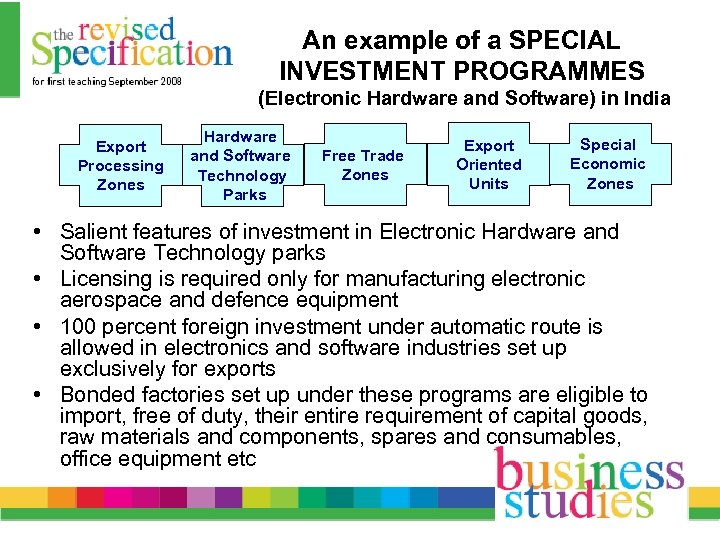
An example of a SPECIAL INVESTMENT PROGRAMMES (Electronic Hardware and Software) in India Export Processing Zones Hardware and Software Technology Parks Free Trade Zones Export Oriented Units Special Economic Zones • Salient features of investment in Electronic Hardware and Software Technology parks • Licensing is required only for manufacturing electronic aerospace and defence equipment • 100 percent foreign investment under automatic route is allowed in electronics and software industries set up exclusively for exports • Bonded factories set up under these programs are eligible to import, free of duty, their entire requirement of capital goods, raw materials and components, spares and consumables, office equipment etc
SPECIAL INVESTMENT PROGRAMMES continued • Deemed export benefits are available to suppliers of these goods from the Domestic Tariff Area (DTA) • Relaxation is there to sell a part of the production from such units in the Domestic Tariff Area depending upon the level of the value addition achieved • After 2 years of import of or indigenously procured items like computers and computer peripherals can be donated to recognised non-commercial educational institutions, registered charitable hospitals, public libraries, public funded research and development establishments, governmental organisation or to government of states or union territory without payment of any duties; • Capital goods are allowed to be re-exported
China: facts • Domestic policies encourage exports • Chinese financial system does not encourage the country’s citizens to consume more • A lot of air and water pollution problems • Chinese banking system does not lend itself to new investment • Natural resource scarcity e. g. water and energy. It imports a lot of oil • Very densely populated • A lot of minorities that are not well integrated into the majority culture - inequality still quite prominent • Local governments have few sources of revenue to finance physical infrastructure • Chinese degree of urbanisation is low • Lacks energy-efficient standards for building, cars and fuel • Still a major aid recipient especially from the USA • It is a major economic powerhouse as it is accumulating hundreds of billions of dollars in foreign currency reserves
For Business in Singapore Examples • Anyone including foreigners can set up and operate a business • Setting up a business is easy; all you have to do is register your firm with The Registry of Companies and Business in Singapore city • It does not take very long to set up a business • It has a complex infrastructure and a well regulated economy • Singapore is a zero-tax haven for a number of non-resident controlled companies • Singapore only taxes companies sourced within the country or foreign sourced income that is remitted into Singapore • In Singapore resident companies take advantage of the fact that Singapore has an extensive double tax network treaty
Against Business in Singapore Examples • The most expensive country in the world to live in • When choosing a company name for your business, proper approval is required. All company names must end with ‘Private limited’ or ‘Pte Limited’. • Annual accounts and annual returns are required to be filed by all businesses • Annual returns have to be filed with both the Companies Registry as well as with the Income Tax authorities • To set up an LLC two directors are required, one of whom must be a Singapore resident, a native Singaporean, or someone who has a Singapore Employment Pass
Against Business in Singapore Examples continued • The directors of an LLC must be individuals • There must be at least two individuals, or one corporate shareholder for a business to be set up • Every foreign company registered in Singapore must have two agents acting on its behalf in the country. These agents must be native Singaporeans, permanent residents of the country or must have a Singapore Employment Pass • A resident, qualified Singapore auditor must do the business' accounts • A general meeting must be held on an annual basis • People who have declared bankruptcy cannot be nominated as directors
Скачать презентацию Globalisation The growing integration of the world s economy
ce5396fd611efb11f497e5ee055e3b75.ppt